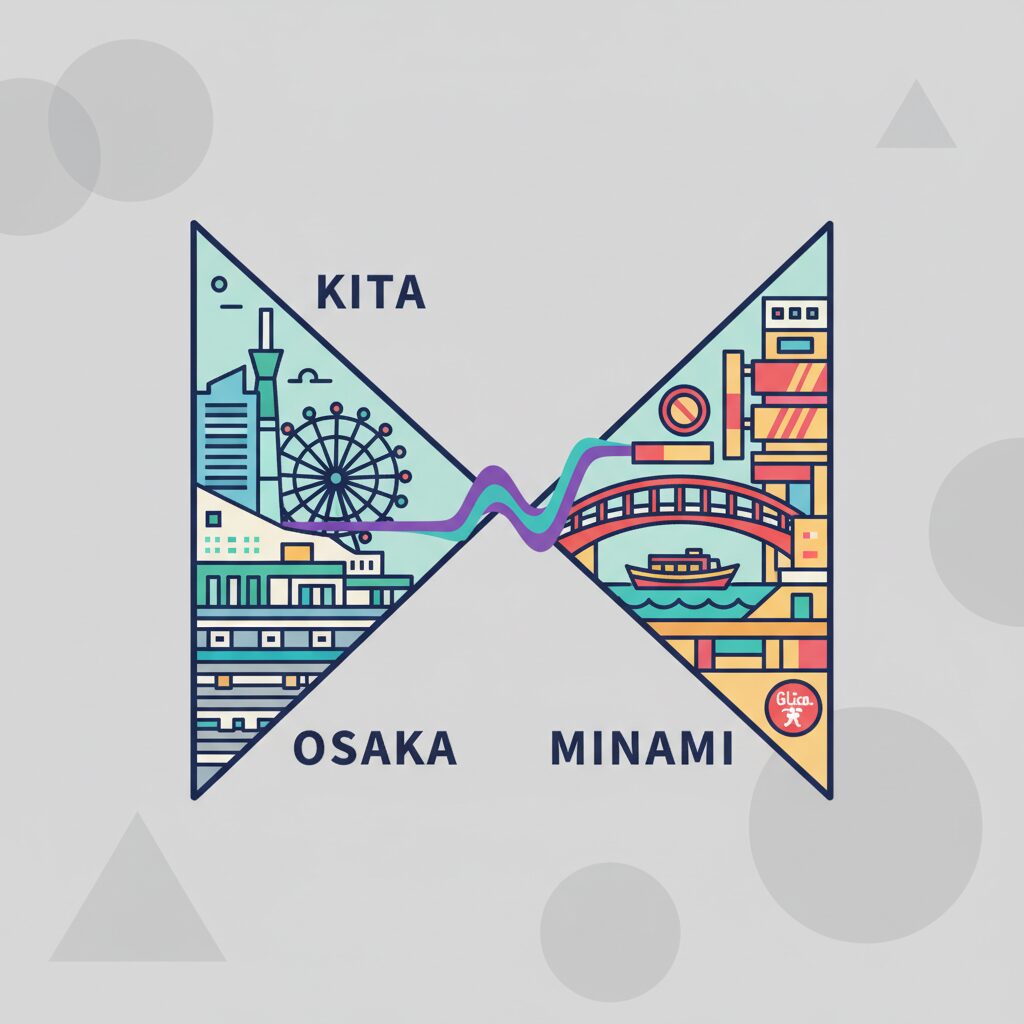
So you’ve heard the talk. Osaka is Japan’s kitchen, the nation’s comedy club, the city that marches to the beat of its own, slightly off-key drum. You’ve been told it’s friendlier, louder, and more direct than Tokyo. All of this is true, to a degree. But after living here, you start to notice a fracture line running straight through the heart of the city, a cultural San Andreas Fault that divides Osaka against itself. This isn’t a north-south divide in the way Americans think of, say, California. This is a tale of two distinct city centers, two urban poles with gravitational fields so powerful they bend the very personality of the people within them. I’m talking about Kita, the North, centered around the sprawling Umeda station complex, and Minami, the South, anchored by the neon-drenched districts of Namba and Shinsaibashi. To an outsider, it’s all just “downtown Osaka.” To a resident, moving between them feels like changing countries. The air pressure is different. The rhythm of footsteps is different. The unspoken rules of engagement are entirely different. Many foreigners who live or work here find themselves bewildered by this duality. They work in the polished corporate towers of Kita and wonder where the famously boisterous, food-obsessed Osakans are hiding. Or they party in the chaotic streets of Minami and can’t fathom how any serious business gets done in this city. The truth is, you can’t understand Osaka by visiting just one. The city’s soul isn’t in Kita or Minami; it’s in the dynamic, often contradictory, space between them. Understanding this split is the key to unlocking the complex, pragmatic, and deeply human character of the Osaka people. This isn’t a travel guide for a two-day trip. It’s a field guide to a weekend-long cultural immersion, a structured experiment in observing and understanding the two faces of this magnificent, maddening city.
To truly grasp this dynamic, consider how this Kita vs. Minami divide might influence your daily life, from where you work to where you choose to live.
The Polished Facade: Understanding Kita’s Corporate Heartbeat
Kita, which literally means “north,” serves as the city’s official face. It’s the well-dressed, confident sibling who landed a prestigious job at a respected company. Centered around the complex nexus of Osaka-Umeda Station, Kita is a district filled with gleaming office towers, expansive luxury department stores, and five-star hotels. This is where the money flows, home to national and international corporate headquarters, and where Osaka showcases its most polished, globally competitive identity. The energy here is kinetic but controlled and deliberate. It’s the steady hum of commerce, not the wild roar of culture.
The Umeda Labyrinth and the Osaka Mindset
To grasp the Kita mindset, one must first navigate the Umeda station complex. It’s not just a single station but a subterranean Borgesian maze connecting numerous train lines, subways, department stores, and underground malls. Unlike Tokyo Station, which, grand and architecturally notable, seems designed with a certain logic and user-friendliness, Umeda feels as if created by a committee that never consulted one another—each member adding new wings independently. Yet, Osakans traverse it with alarming, instinctual speed. They don’t slow down or hesitate at intersections. They have memorized the best route from the Hankyu line to the Yotsubashi line, sometimes involving three different floors and a diagonal shortcut through a basement food hall. This is not merely commuting; it reflects a core Osaka value: efficiency bordering on brutalism. The aim is to reach Point A to Point B as quickly as possible, with no regard for the aesthetics of the journey. There’s pride in mastering this chaos, a shared competence that unites Kita’s residents. If you see someone standing still, staring at a phone map, chances are they’re not from here. This relentless focus on the destination rather than the journey pulses through Kita. It’s a place defined by meetings, schedules, and objectives.
Dress Code and Demeanor: The Unspoken Language of Kita
Observe the plaza outside Grand Front Osaka on a weekday. The fashion here contrasts starkly with the expressive, often eccentric styles seen in Minami. Instead, it signals status and professionalism. The suits are sharp, fabrics high-quality, and brands recognizable but rarely ostentatious. For women, the style is polished, elegant, and restrained, prioritizing professional conformity over self-expression. This is the influence of the three major department store matriarchs dominating Umeda: Hankyu, Hanshin, and Daimaru, each with distinct personalities and clientele. Hankyu is the luxury queen, favored by affluent Kansai suburban ladies who shop for designer labels and attend cultural events. Hanshin feels more approachable, famous for its vast basement food hall and passionate support for the local baseball team, the Hanshin Tigers. Daimaru, part of the Pokémon Center building, caters to a younger yet still professional crowd. Interactions within these spaces are polite, formal, and transactional. Osaka’s famed directness is softened, replaced by the meticulous, almost ritualistic customer service synonymous with high-end Japanese retail. Conversations happen in low tones. The boisterous laughter typical of Osaka is notably absent. This is Osaka donning its business suit, and it plays the role with utmost seriousness.
After-Five in Kitashinchi: Where Business Meets Pleasure, Quietly
Just a brief walk south of the main station area lies Kitashinchi, Kita’s exclusive nightlife district. A foreigner might wander in expecting Minami’s neon-soaked revelry and feel perplexed. The streets are quiet, lined with discreet building entrances marked only by small, elegant signs and meticulously raked gravel patches. This is not a place for casual bar-hopping. Kitashinchi is a realm of upscale hostess clubs, exclusive sushi counters, and private bars requiring membership or introductions. This is where Kita’s real business dealings unfold. After boardroom meetings, executives escort their most important clients here to wine and dine them amid refined luxury. A single evening can cost more than a month’s rent. Kitashinchi’s economy revolves around relationships, trust, and the subtle art of Japanese hospitality. It’s a world nearly impenetrable to outsiders—not out of malice, but because its purpose is to provide a private, controlled space for reinforcing business ties. This side of Osaka starkly contradicts the city’s cheerful merchant stereotype: it reveals a deep respect for hierarchy, tradition, and the paramount importance of preserving face (mentsu). This discreet engine hums quietly behind unmarked doors, driving Kita’s corporate world.
The Grand Front Illusion: Modernity as Osaka’s Aspiration
New landmarks like Grand Front Osaka and the soaring Umeda Sky Building embody the city’s ambitions. These spaces are crafted to feel international, competing with developments like Tokyo Midtown or Roppongi Hills. Filled with global brands, stylish cafes, and cutting-edge technology showrooms, they represent Osaka’s claim that “We are not just a regional hub; we are a global city.” Yet, watching locals interact with these places reveals an interesting detail: they often treat them as destinations for special occasions rather than everyday life. People come for a particular purpose—an elegant dinner, a date, or a specific exhibition. The spontaneous, casual energy found elsewhere in Osaka feels somewhat muted within these hyper-modern walls. There’s a sense of maintaining one’s best behavior. This reveals a central tension in modern Osaka’s identity: the desire for global recognition and sophistication clashes with its inherent, unpretentious, down-to-earth character. Kita shines as the clearest expression of this aspiration—a sparkling vision of the future that can sometimes feel disconnected from the city’s lively, chaotic present.
The Neon Jungle: Minami as Osaka’s True Face
If Kita represents the city’s polished corporate leadership, Minami embodies its wild, pulsating heart. Just a ten-minute subway ride to the south, yet worlds apart in spirit, Minami is an expansive, chaotic, and unapologetically vibrant assortment of neighborhoods including Namba, Shinsaibashi, Dotonbori, and Amerikamura. This is the Osaka immortalized on postcards—the Glico Running Man, the massive mechanical crab, the endless arcades filled with the aroma of takoyaki and the clamor of pachinko machines. While Kita centers on making money, Minami focuses on spending, enjoying, and celebrating it with full enthusiasm. The energy here is effervescent and raw. It’s the roar of culture, commerce, and humanity colliding.
“儲かりまっか?” (Mokarimakka?) – The Commercial Spirit in Action
A classic Osaka greeting, often used among older business owners, is “Mokarimakka?” which roughly means “Are you making a good profit?” The usual response is “Bochi bochi denna” – “So-so.” This exchange captures the essence of Minami’s identity. Commerce here isn’t a sterile exchange behind closed doors; it’s a lively, public show. Stroll through the Shinsaibashi-suji shopping arcade, a covered street that seems to stretch endlessly. Here, you’re not just a shopper; you’re an audience. Shopkeepers call out from their stalls, vendors promote their goods with well-practiced humor, and the sheer density of shops, signs, and people is an overwhelming sensory experience. This is the spirit of the akinai, the traditional Osaka merchant culture. It’s about being straightforward, building relationships with customers, and always stressing value. The concept of kosupa (cost performance) rules in Minami. People aren’t merely searching for bargains; they seek the best quality and experience for the price they pay. This explains the long lines for a 500-yen bowl of ramen—not because it’s cheap, but because it’s seen as worth 1000 yen in satisfaction. This mindset, rooted in centuries as Japan’s commercial hub, permeates every interaction in Minami.
Fashion as Expression: The Shinsaibashi-Amerikamura Continuum
Forget Kita’s understated elegance. Fashion in Minami is an assertion of identity. Shinsaibashi’s main street offers a mix of international luxury labels and Japanese fast-fashion giants, but the way people wear these clothes is distinct. There is a love for bold patterns, vibrant colors, and a style Osakans call kote-kote—a term meaning gaudy, extravagant, or richly decorated depending on the context. It’s about standing out, not blending in. Just west of the main street lies Amerikamura, or “Amemura,” the heart of Osaka’s youth culture for decades. It’s a chaotic network of narrow streets filled with vintage clothing stores, small record shops, and street art. Fashion here is even more experimental and individualistic—home to Japanese subcultural tribes in their natural environment. What links these diverse styles is viewing fashion as performance. Clothing becomes an opening line, a way to express your tribe, mood, and humor. There is a playful boldness and lack of self-consciousness here rarely found in Tokyo’s trend-focused Harajuku. In Minami, personal style is less about following trends and more about creating a spectacle of your own.
The Art of “Kuidaore”: Eating Until You Drop as a Cultural Pact
You can’t discuss Minami without mentioning kuidaore, a term that famously means “to eat oneself into ruin.” However, this isn’t about gluttony; it’s a philosophy. In Minami, food is the primary mode of social interaction and cultural expression. Dotonbori is its grand stage— a canal-side street where gigantic animatronic sea creatures promote restaurants specializing in everything from crab and pufferfish to gyoza and ramen. The emphasis is always on bold flavors, good value, and a fun, unpretentious vibe. Unlike the often tranquil and aesthetically refined dining culture of Kyoto or upscale Tokyo, eating in Minami is communal and often loud. You’ll stand shoulder to shoulder with strangers at a takoyaki stall, watching the vendor flip octopus balls with practiced, theatrical skill. You’ll squeeze into a tiny, smoke-filled izakaya tucked in Hozenji Yokocho’s back alleys, sharing plates and shouting orders to the chef. Food quality is a matter of fierce civic pride. Osakans debate passionately about which venue has the best okonomiyaki or most flavorful kushikatsu. This ongoing public discourse keeps standards exceptionally high. Eating in Minami means taking part in a city-wide conversation about what defines good food, a dialogue that has continued for centuries.
The Night Unfiltered: Dotonbori, Izakayas, and the Dissolution of Hierarchy
When night falls, the divide between Kita and Minami becomes unmistakable. While Kitashinchi operates on exclusivity and formality, Minami’s nightlife is radically inclusive. Around Namba and Dotonbori, the streets become great equalizers. In a crowded tachinomi (standing bar), a salaryman in a crumpled suit might be drinking a highball next to a group of university students with brightly dyed hair, who stand beside tourists clutching guidebooks. The strict social hierarchies that permeate much of Japanese life seem to vanish under the warm glow of izakaya lanterns. This is where the famous Osaka “friendliness” genuinely shines. It’s not that people are inherently kinder here; rather, the social context fosters interaction. Strangers are met with genuine curiosity. They’ll ask where you’re from, what you’re eating, and if you’re enjoying yourself. Striking up a conversation with a stranger at a bar is common and expected during a night out in Minami. This openness is situational—a temporary bond forged in shared chaos and enjoyment. It’s the city letting loose and inviting everyone to the celebration.
A Tale of Two Saturdays: Putting the Theory into Practice
To truly understand the city’s dual nature, you need to experience it consecutively. Set aside a weekend for this experiment. Don’t approach it as a typical sightseeing trip. Treat it instead as a study in urban anthropology. Your aim is not to sightsee, but to observe people and sense the city’s changing energy.
Saturday Morning and Afternoon: The Kita Persona
Begin your day in Kita. But don’t just hurry through the station. Find a seat at a café overlooking the vast atrium of Osaka Station City. Order a coffee and simply watch. Notice the pace of the people below—not a leisurely stroll, but a brisk, purposeful march. Everyone has a destination. After your coffee, delve into the department stores—choose Hankyu Umeda. Ascend the escalators through the floors, paying close attention to the merchandising—it’s impeccable, almost museum-like. Observe the shoppers: their quiet, respectful exchanges with staff, their refined attire, and the hushed tone of their conversations. For lunch, skip the basement food halls for now. Instead, opt for a restaurant on an upper floor of a building like Grand Front Osaka. The food will be artfully presented, the service flawless, and the ambiance calm. The experience is crafted to be seamless and sophisticated. In the afternoon, stroll through Nakanoshima Park, the green island between Kita and the business district of Yodoyabashi. You’ll see families and couples, but the atmosphere remains calm and orderly—a carefully curated form of leisure. You are now immersed in the world of Kita: structured, professional, and aspirational.
Saturday Evening and Night: The Minami Transformation
As evening falls, take the Midosuji subway line four stops south to Namba. The moment you exit the station, you’ll feel the shift. It’s almost a physical sensation. The city’s volume rises; the air thickens with the aromas of countless street food stalls. Your task now is to dive headfirst into the chaos. Navigate through the densely packed Shinsaibashi-suji arcade. Don’t focus on a destination—let the flow of people carry you. For dinner, embrace kuidaore. Instead of one big meal, graze. Grab takoyaki from a street vendor and eat it on the spot. Join a line for ramen. Find a kushikatsu spot, respect the “no double-dipping” rule, and order a beer. Your aim is to experience food as a direct, unfiltered pleasure. After eating, head over to Dotonbori. Stand on Ebisu Bridge and take in the dazzling spectacle of neon signs reflecting on the water. Finally, find a small, crowded izakaya in a back alley. Squeeze onto a counter seat, order a drink, and don’t be surprised if your neighbor strikes up a conversation. Join in. This is the world of Minami: spontaneous, sensory, and deeply communal.
Bridging the Divide: The Midosuji Boulevard and the Osaka Identity
It can be tempting to view Kita and Minami as two distinct, warring cities: the refined, international business hub versus the loud, flashy entertainment district. However, this perspective is too simplistic. The true charm of Osaka lies in the fact that they are two halves of a single, intricate whole, with the same people moving between these two worlds every day.
The Symbolism of the Walk
Midosuji Boulevard, the grand avenue linking Kita and Minami, is more than just a road—it’s the city’s backbone. Walking its length reveals the gradual transformation of Osaka’s character. Beginning in Umeda to the north, you are surrounded by the towering headquarters of major banks and corporations. Moving south, you pass through the dignified business districts of Yodoyabashi and Honmachi. Then, the atmosphere begins to transform. Corporate logos give way to flagship stores of international luxury brands like Chanel and Louis Vuitton in Shinsaibashi. The buildings age slightly, and the pace slows. Finally, crossing the Dotonbori canal, the vibrant, electric energy of Minami bursts forth to meet you. This physical journey perfectly mirrors the city’s psychological landscape—it’s a spectrum, not a simple binary.
Why Both Halves Make a Whole
Osaka would not be Osaka without its northern and southern poles. Kita serves as the economic engine, connecting the city to the rest of Japan and the world. It provides financial stability and professional employment, enabling the city to flourish. It’s where Osaka demonstrates it can compete globally, proving it’s more than just a land of comedians and takoyaki. Minami, by contrast, is the city’s cultural heart, the guardian of its identity and a living museum of its merchant spirit. It’s where values like pragmatism, humor, and a love for life’s pleasures are continuously celebrated and reinforced. The person bowing politely and exchanging business cards in a Yodoyabashi office at 5 PM is often the same individual laughing uproariously, drink in hand, among strangers in a Namba izakaya by 9 PM. This ability to seamlessly switch codes and adapt behavior to the context is arguably Osaka’s most essential skill.
What Foreigners Misunderstand: It’s Not Contradiction, but Duality
A common misconception about Osaka is mistaking one side of the city for the whole. Foreigners who experience only the boisterous fun of Minami may be taken aback by the formality and social strictness found in professional settings, seeing it as hypocrisy. Conversely, those working in Kita’s corporate sphere might perceive the city as less welcoming than its reputation claims, dismissing tales of Osaka warmth as exaggerated clichés. The truth is that Osaka’s people excel at what the Japanese call TPO—Time, Place, and Occasion. They understand inherently that there is a time for formality (Kita) and a time to let loose (Minami). This is not a contradiction but a sophisticated social intelligence, born from a merchant culture where success depended on reading your customer and adjusting your approach accordingly. One had to be serious and respectful with the samurai lord, while cheerful and approachable with the common townsfolk. This duality is woven into the city’s very fabric. To truly live in and understand Osaka is to embrace this duality—navigating the Umeda maze with focus in the morning, and happily losing oneself in Namba’s back alleys by night. It means recognizing that the city’s personality lies not in one or the other, but in the continual, dynamic flow between these two powerful poles.