Step off the train at Namba Station, and you feel it instantly. It’s not just the neon glare of Dotonbori or the scent of sizzling takoyaki that hits you; it’s a rhythm, an energy that pulses through the very veins of Osaka. It’s a city that talks. A lot. But it’s more than just noise; it’s a performance. Conversations here are a sport, a dance of wit and timing, a rapid-fire exchange that can leave newcomers delightfully bewildered. At the heart of this linguistic ballet lies a cultural institution, a comedic art form that is as essential to Osaka as deep-fried skewers and the Hanshin Tigers: Manzai. This is not just stand-up comedy; it’s a dialogue, a structured chaos built on two fundamental, opposing, and inseparable roles—the ‘Boke’ and the ‘Tsukkomi’. To understand Manzai is to unlock the code to Osaka’s soul, to grasp the playful, pragmatic, and profoundly human spirit of its people. It’s an invitation to listen closer to the chatter in the shotengai shopping arcades, to see the humor in a missed train, and to appreciate that in Osaka, the punchline is always just around the corner. Our journey into this world of laughter begins where it is most revered, at the epicenter of Japanese comedy.
To truly immerse yourself in the city’s vibrant, everyday energy after a comedy show, consider exploring the colorful aisles of a local Super Tamade Sozai.
The Anatomy of Laughter: Deconstructing the Boke and Tsukkomi Dynamic
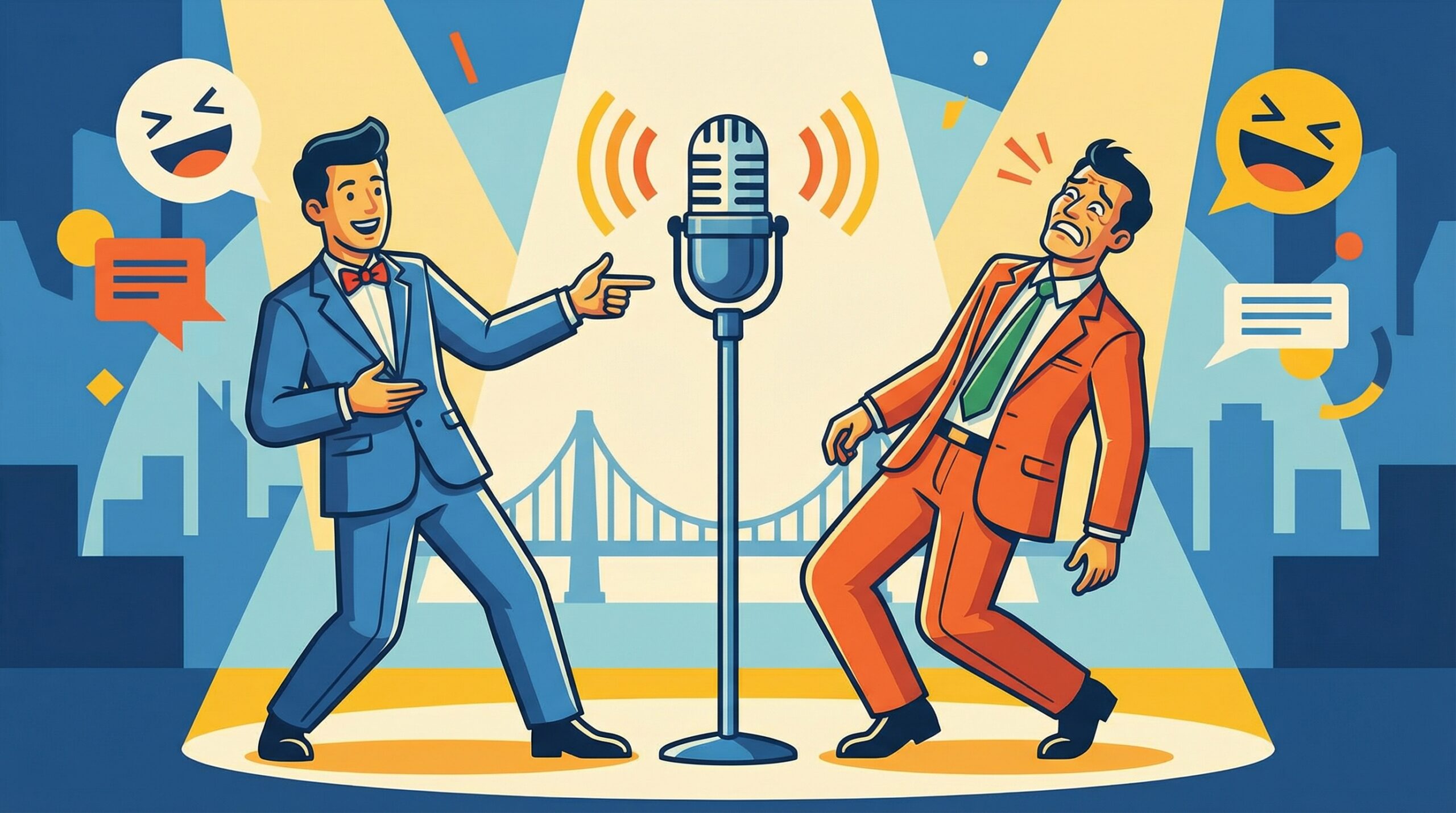
At its essence, Manzai appears deceptively simple. Two performers, a ‘Boke’ and a ‘Tsukkomi’, stand before a microphone and engage in conversation. Yet beneath this straightforward setup lies a vast realm of comedic intricacy—a rapid-fire clash of absurdity and logic that produces laughter through sheer speed. This pairing is more than just a duo; it resembles a comedic atom, with the Boke as the wild, unpredictable electron and the Tsukkomi as the stable, grounding nucleus. The energy and laughter emerge when they interact. To truly grasp the brilliance of Manzai, one must see these two roles not merely as character types but as fundamental comedic forces.
The Boke: Architect of Absurdity
The ‘Boke’ (ボケ) powers the comedic engine. Derived from the verb ‘bokeru’ (惚ける or 呆ける), meaning to be senile, air-headed, or feign ignorance, the Boke is the fool who steers the dialogue off course into the hilarious wilderness of illogic. Their role is to introduce a flaw in reality—a misunderstanding, an outrageous exaggeration, a nonsensical statement, or a wildly incorrect interpretation of a common phrase. They aren’t simply foolish; in fact, the best Boke often operate with a peculiar internal logic, making their absurd worldview momentarily believable before it collapses. They generate comedic tension.
Consider a simple example: ordering coffee. While a typical person would simply order coffee, the Boke might request “boiled brown bean water, cradled by a ceramic halo, topped with a cloud of cow’s tears.” This statement, in one sense, is technically accurate but so poetically strange that it disrupts mundane reality. This is the Boke’s domain: transforming the familiar into the strange, compelling both audience and partner to view the world through a distorted lens.
Various flavors of Boke employ different tactics to derail reality.
The Pure Misunderstanding Boke
This archetype is classic. The Boke takes a word or phrase literally or bizarrely incorrectly, leading to escalating misunderstandings. For example, when the Tsukkomi says, “We need to catch our flight! Let’s get a taxi!” the Boke might brandish a butterfly net, exclaiming, “Right! I’ll catch one! They’re fast this time of year!” The humor stems from the gap between expectation (catching a cab) and the absurd action (catching an insect). The Tsukkomi’s exasperated response locks in the comic effect.
The Wordplay and Pun Master (Dajare Boke)
Japanese’s abundance of homophones makes it fertile ground for the pun-loving Boke. They seize opportunities to twist words into ‘dajare’ (ダジャレ), silly puns. Though often seen as lowbrow, a skilled Boke elevates it to art. For example, when the Tsukkomi laments, “Ah, my futon is so cold,” the Boke grins and replies, “That’s because all the futons flew away!” playing on ‘futon’ (布団, bedding) and ‘futtonda’ (吹っ飛んだ, blown away). The pun’s groan-worthy nature adds charm, and the Tsukkomi’s predictable irritation delivers the payoff.
The Know-It-All Boke (Tensai Boke)
The most refined type is the ‘Tensai Boke,’ or genius fool. This Boke acts out of misplaced confidence rather than ignorance. They lecture the Tsukkomi and audience with elaborate, nonsensical theories on topics they know nothing about—explaining quantum physics through udon noodles or recounting Italian history via Super Mario characters. The comedy arises from the Boke’s unwavering self-assurance despite staggering ignorance. They construct a magnificent nonsense palace, and the Tsukkomi’s role is to dismantle it, brick by hilarious brick.
The Boke’s ultimate task is to jam the gears of social convention—posing questions no one else dares and making statements no one else would utter, thus freeing the audience from the constraints of everyday logic. They create the comedic problem, the essential ‘wrongness’ the act revolves around.
The Tsukkomi: The Voice of Reason and Rhythm
If the Boke represents chaos, the ‘Tsukkomi’ (ツッコミ) embodies order. Derived from ‘tsukkomu’ (突っ込む), meaning to thrust or poke, the Tsukkomi is the straight man—the anchor to reality—whose job is to highlight the Boke’s absurdity. But calling them a mere ‘straight man’ vastly understates their role. The Tsukkomi is an energetic, crucial participant who controls the rhythm, pace, and impact of each joke. Their craft demands lightning-fast reflexes, sharp wit, and impeccable comedic timing.
The Tsukkomi’s main function is correction. When the Boke builds their nonsense house, the Tsukkomi serves as the inspector who comes to condemn it. Their interjection clarifies the joke for the audience, ensuring everyone understands why the Boke’s statement is absurd. It also validates the audience’s disbelief—when they think “That’s ridiculous,” the Tsukkomi vocalizes it, creating a shared comic moment. Most importantly, the Tsukkomi’s reaction is the punchline: the Boke sets up the joke; the Tsukkomi delivers the knockout blow.
The art of Tsukkomi includes several facets.
The Verbal Retort
This is the Tsukkomi’s primary tool. Simply saying “You’re wrong” isn’t enough; it must be done with style, speed, and wit. The iconic Osakan Tsukkomi phrase is “Nande ya nen!” (なんでやねん!), roughly “Why?!” or “What the heck?!”—a versatile expression that conveys disbelief, frustration, and affection all at once. A skilled Tsukkomi wields a variety of such retorts tailored to the Boke’s particular nonsense, whether sarcasm (“Oh sure, the Egyptians built pyramids to store takoyaki pans. Makes sense.”), analogy (“You explaining economics is like a goldfish discussing space travel.”), or firm declarations (“That’s a pigeon! Not a government drone spying on your hair loss! It’s a pigeon!”).
The Physical Tsukkomi
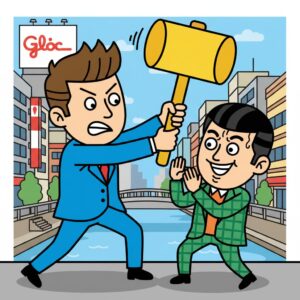
Manzai often features the Tsukkomi delivering a sharp tap on the Boke’s head or shoulder. Traditionally done with a ‘harisen’ (ハリセン), a folded paper fan that strikes loudly without real harm, this physical gesture remains a comedic punctuation mark. It’s not violence but a non-verbal exclamation point signaling the end of a comedic beat, resetting the flow for the next joke. Timing is crucial, usually landing at the climax of the verbal retort to maximize comedic effect. This percussive element propels the performance’s rhythm.
The Conductor of Comedy
Ultimately, the Tsukkomi acts as the comedic conductor, controlling tempo. When the Boke improvises a particularly funny tangent, a good Tsukkomi knows when to let it run and when to rein it in. If a joke falters, the Tsukkomi can salvage it with a witty comment about the joke itself. They guide the audience’s focus, build and release tension, and maintain the performance’s high-energy, machine-gun pace. Without a strong Tsukkomi, the Boke’s absurdity would be mere confusing rambling. The Tsukkomi provides structure, context, and the cathartic release that transforms nonsense into comedic gold.
This duo forms the foundation of Manzai. The Boke creates a deviation from the norm, and the Tsukkomi’s forceful correction snaps reality back into place, generating a comedic vibration that echoes as laughter. It’s a continual cycle of tension and release, madness and sanity, question and answer—unfolding dozens of times per minute in a whirlwind of perfectly timed dialogue.
The Sound of Funny: Osaka-ben and the Language of Manzai
Manzai cannot be separated from its linguistic birthplace: Osaka-ben (大阪弁), the Osaka region’s dialect. Trying to perform Manzai in Tokyo’s standard Japanese (Hyojungo) is like attempting jazz with a metronome; you might hit all the right notes, but the soul, swing, and essence of the music would be lost. Osaka-ben is more than just a set of different words; it has a unique musicality and rhythm perfectly suited to the fast-paced exchange between Boke and Tsukkomi.
The intonation of Osaka-ben is more melodic and varied than standard Japanese, enabling richer emotional expression. A simple phrase can convey layers of sarcasm, warmth, or frustration depending on its musical tone. This is a boon for comedians. The dialect is also more direct and punchier, with shorter sentences and vocabulary full of expressive, onomatopoeic, and blunt words.
Take the iconic Tsukkomi phrase, “Nande ya nen!” In standard Japanese, this might be rendered as “Doushite desu ka?” or “Naze nan desu ka?” While grammatically correct, those versions are clinical and lack the sharp impact. “Nande ya nen!” is brief, striking, and flows naturally with force. It acts as a verbal slap that perfectly matches the physical one.
Another example is the word for ‘stupid.’ In Tokyo, the word is ‘baka’ (馬鹿), while in Osaka, it is ‘aho’ (アホ). Though they mean the same on the surface, their comedic use differs greatly. ‘Baka’ carries a harsher, biting tone, but ‘aho,’ in the friendly Tsukkomi-to-Boke context, is imbued with a quirky affection. It’s a fond exasperation. When a Tsukkomi yells “Aho ka!” (“Are you an idiot?!”) at their partner, it’s not a cruel insult but a term of endearment, acknowledging the Boke’s crucial role. It’s a way of saying, “You’re wonderfully foolish, and I wouldn’t want it any other way.”
Other key Osaka-ben expressions add color to Manzai. Words like ‘meccha’ (めっちゃ) for ‘very’ or ‘really,’ ‘honma’ (ほんま) for ‘truly,’ and sentence endings like ‘~nen’ and ‘~yan’ instead of the standard ‘~desu’ or ‘~da yo’ give dialogue its unmistakable local flavor. This linguistic toolkit allows Manzai performers to craft routines with speed and rhythm that are hard to replicate in other dialects. The language itself serves as a comedic instrument.
For foreigners living in Osaka, tuning into Osaka-ben is the first step in appreciating the city’s humor. You’ll start to hear the Boke/Tsukkomi banter unfolding on the streets. The cashier making a silly joke (Boke) and the customer firing back a witty, mock-annoyed retort (Tsukkomi). Two friends arguing over directions, one giving absurd guidance (Boke) and the other snapping back with “Honma aho ya na, omae!” (“You’re a real idiot!”) (Tsukkomi). In Osaka, the stage is everywhere, and the native dialect is the script.
From Shrine Rituals to Neon Stages: A Brief History of Manzai
Though Manzai seems like a thoroughly modern art form, its origins reach far back into Japanese history. The name itself, 漫才, merges the characters for ‘comic’ and ‘talent’. Its distant predecessors can be traced to celebratory rituals from the Heian period (794-1185). Duos would go from door to door at New Year, offering festive chants and performing a brief, stylized dance to ward off evil spirits. One performer would lead the chant (an early form of the Tsukkomi), while the other played a small drum and added auspicious, often humorous, interruptions (the proto-Boke).
This tradition developed over the centuries, but the form recognizable today truly took shape in Osaka during the vibrant, modernizing Taisho (1912-1926) and early Showa (1926-1989) eras. As Japan embraced Western culture, demand for new entertainment grew. In this context, Yoshimoto Kogyo, a company founded in Osaka in 1912, began transforming the industry. They adapted the traditional Manzai format by removing its ritualistic elements, dressing performers in Western-style suits, and placing them on stage with a single standing microphone. This marked the birth of modern, しゃべくり漫才 (shabekuri manzai), or ‘talking Manzai’.
Pioneers of this new style included duos like Entatsu and Achako, who became stars in the 1930s through radio broadcasts. They discussed everyday subjects—movies, baseball, the economy—using the fast-paced Boke/Tsukkomi structure and familiar Osaka-ben. For the first time, comedy shifted from ancient folktales or stylized acts to the present day, reflecting ordinary people’s lives. This resonated deeply with audiences, cementing Osaka’s status as Japan’s comedy capital.
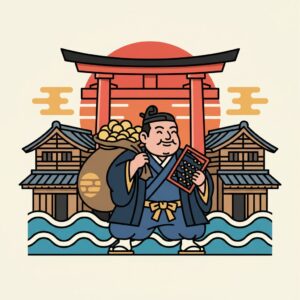
Why Osaka? The city’s history as a merchant center is crucial. For centuries, Osaka was Japan’s kitchen and commercial hub. The merchant class, the ‘chonin’, prized quick thinking, sharp negotiation, and the ability to build rapport. A good sense of humor was a business asset. This fostered a culture where wit was appreciated and clever language was as valuable as a balanced ledger. This pragmatism and fondness for lively conversation permeated the city’s character. Osakans are famously friendly, direct, and unpretentious. They enjoy talking, laughing, and gently teasing one another. Manzai is the artistic expression of this inherent cultural DNA.
The post-war era brought television, which propelled Manzai and Yoshimoto Kogyo’s comedians to national prominence. Duos from Osaka dominated the airwaves, and the Boke/Tsukkomi format became a core template for Japanese TV, influencing everything from variety to game shows. The annual M-1 Grand Prix, a nationwide Manzai competition, is now one of the most-watched TV events of the year—a cultural phenomenon that can turn unknown comedians into household names overnight. The journey from a New Year’s blessing to a primetime spectacle showcases Manzai’s remarkable adaptability and its enduring bond with the heart of Japanese popular culture.
The Holy Land of Laughter: Experiencing Manzai Live in Osaka
To truly grasp Manzai, you need to experience it live. You must be in the room, surrounded by hundreds of people laughing uproariously, feeling the energy spark between the performers and the audience. While Manzai can be seen on TV, the live show is an entirely different experience. It’s raw, immediate, and immersive. In Osaka, there’s no more revered spot for this pilgrimage than the Namba Grand Kagetsu theater.
Namba Grand Kagetsu (NGK): The Carnegie Hall of Comedy
Situated in the lively heart of the Namba district, the Namba Grand Kagetsu, or NGK as it’s commonly called, is the flagship theater of Yoshimoto Kogyo. This is the major league. Entering the building is an event in itself. The lobby bursts with color and noise, filled with souvenir shops selling famous comedians’ merchandise, food stalls offering everything from popcorn to Yoshimoto-branded manju cakes, and life-sized cardboard cutouts of comedy legends that fans eagerly pose beside. The atmosphere hums with anticipation. You’ll find families, young couples, groups of friends, and elderly patrons—a diverse mix united by their love of laughter.
The theater itself is large but surprisingly cozy. The seats are comfortable, sightlines are excellent, and the acoustics are crafted to carry every nuance of the performers’ fast-paced dialogue. A typical show at NGK is not just Manzai; it’s a variety package, a sumptuous buffet of Japanese comedy. The show usually begins with several sets from younger, up-and-coming Manzai duos. This is followed by performances from established, mid-career acts and finally the legends—the veteran comedians who have perfected their craft over decades. Watching these masters is a privilege. Their timing is flawless, their chemistry so seamless that their act feels less like a scripted performance and more like an effortlessly hilarious conversation.
The grand finale of most NGK shows is a performance of ‘Shinkigeki’ (新喜劇), or ‘New Comedy.’ This slapstick-heavy play features a recurring cast and a loose, formulaic plot, often set in places like an udon shop or a hot spring inn. While Manzai is a dialogue rich in wit, Shinkigeki is a feast of physical gags, running jokes, and character-based humor. It’s highly accessible, even if you don’t catch every word, and provides a delightful contrast to the verbal finesse of Manzai.
Practical Tips for the Foreign Visitor
Let’s address the obvious challenge: the language barrier. Manzai relies heavily on wordplay, cultural references, and linguistic subtleties that can be hard for non-native speakers to fully appreciate. Does this mean you shouldn’t attend? Absolutely not. Here’s how to get the most out of the experience:
- Embrace the Universal: Much of the humor transcends language. The physical comedy of the Tsukkomi’s taps, the exaggerated facial expressions, the sheer absurdity of the Boke’s antics—these elements speak volumes. You can enjoy the show on a purely physical and emotional level.
- Focus on the Rhythm: Pay attention to the musicality of the performance. Feel the dialogue’s ebb and flow, the acceleration and pauses. Notice how the Tsukkomi’s interjections act like drumbeats. Even without understanding the words, you can admire the technical skill and artistry.
- Watch the Audience: The crowd is part of the performance. Their reactions will guide you. When they burst into laughter, you’ll feel the energy in the room. This shared experience is a big part of the fun. You are taking part in a cherished cultural ritual, which is powerful in itself.
- Do Some Homework: Before attending, look up a few famous duos likely to perform. Viewing some of their clips online (some with subtitles) can give you a sense of their style and characters. Knowing who the ‘cool’ Tsukkomi or the ‘goofy’ Boke is adds important context.
Tickets for NGK can be bought online through the Yoshimoto Kogyo website (which may have English options), at the theater box office, or at convenience store ticket machines like FamiPort or Loppi. Shows run multiple times a day, nearly every day of the year. Don’t hesitate; the staff are accustomed to foreign visitors. Simply point, smile, and prepare to laugh.
For a slightly different atmosphere, try the Yoshimoto Manzai Theater, located right next to NGK. This smaller, more intimate venue mainly showcases younger talent. The vibe is fresher and more energetic, and tickets are cheaper. It’s an excellent place to see the future stars of Manzai before they hit the big time.
Beyond the Stage: The Boke/Tsukkomi Lifestyle of Osaka
What sets Manzai apart is that it extends beyond the stage. In Osaka, the Boke/Tsukkomi dynamic permeates daily life. It serves as the essential framework for social interaction. After spending some time here, you begin to notice it everywhere—in the most ordinary moments. It acts as a shared cultural language that lubricates the workings of daily life with humor and warmth.
At a butcher shop, a customer might say, “Give me the best pork you have! Something that will make me as handsome as the pig!” This is the Boke. The butcher, without hesitation, might respond, “Sorry, we don’t have anything that miraculous. This will just have to do,” while slapping the meat package on the counter. That’s the Tsukkomi. This brief exchange is an impromptu Manzai routine, creating a fleeting connection, a shared laugh, and humanizing a simple transaction.
If a friend arrives late to a meeting, you could say, “Where have you been? Did you decide to walk here from Mount Fuji?” You’re playing the Boke, presenting an absurd scenario. Your friend might reply, “Don’t be ridiculous, the traffic was terrible on the Fuji route. I took the Mount Everest express instead.” They’ve accepted your Boke and offered one of their own. Alternatively, they might play the Tsukkomi and say, “Aho ka! The train was delayed! Stop being so dramatic!” This playful exchange signals closeness and friendship.
Even the act of complimenting follows this pattern. If you praise an Osakan’s new shirt, they’re unlikely to respond simply with “Thank you.” Instead, they might perform a Boke by saying something self-deprecating like, “This old thing? I think the moths have been using it as a restaurant.” This invites you, the compliment-giver, to act as Tsukkomi by replying, “Don’t be silly, it looks great on you!” This ritual of playful denial and reassurance manages social exchanges with humility and humor, preventing any awkwardness.
For foreigners, this can be tricky at first. The directness and teasing might sometimes be mistaken for rudeness. But it almost always comes from a place of warmth. The Tsukkomi, in everyday life, signals engagement. It means, “I am listening to you, I feel comfortable with you, and I’m playing along.” Learning to recognize this rhythm is key to truly feeling at home in Osaka. You don’t need to be a comedian, but appreciating this everyday performance opens a new level of connection with the city and its wonderfully funny people.
The Ever-Evolving Art of a Funny Conversation
Manzai is not a fixed art form, preserved unchanged over time. It is continually evolving, with each new generation of comedians expanding the possibilities of what a Boke and a Tsukkomi can embody. The traditional, suit-clad, rapid-fire style still endures and is highly respected, but new variations have appeared alongside it.
Comedy duos like Downtown, who gained fame in the late 1980s and 90s, transformed the genre. Hitoshi Matsumoto’s Boke was surreal, unpredictable, and often infused with dark philosophical undertones, while Masatoshi Hamada’s Tsukkomi was notably sharp, aggressive, and impressively quick-witted. They brought a level of coolness and edge to Manzai that attracted a huge youth audience and influenced nearly every comedian afterward.
In recent years, new archetypes have emerged. There are ‘ronri-ha’ (論理派), or ‘logical’ Manzai duos, who structure their routines around dissecting flawed logical premises. Some groups blur the distinction between Boke and Tsukkomi, with roles shifting fluidly throughout the performance. Others have moved away from traditional themes to focus on highly specialized, niche topics, finding humor in the details of history, science, or video games.
The M-1 Grand Prix acts as an annual platform showcasing this ongoing evolution. Winning the contest requires not only humor but also innovation. Champions are often those who discover new ways to approach the Boke/Tsukkomi dynamic, introducing fresh rhythms or novel joke structures. This continuous innovation keeps Manzai vibrant, relevant, and firmly at the heart of Japanese entertainment.
The Final Punchline
Watching Manzai is experiencing more than just a comedy show. It is witnessing a cultural artifact in motion—a living tradition that links New Year’s rituals of the past with today’s fast-paced, media-filled world. It celebrates language, showcases perfect timing, and embodies the simple, profound joy of shared laughter.
The interplay between the Boke and the Tsukkomi is Osaka’s great contribution to comedy—a flawless formula for humor born from the tension between chaos and order. This rhythm can be found not only on the stage of the Namba Grand Kagetsu but also in the lively pulse of the city itself. So, when you visit Osaka, I encourage you to book a ticket. Relax, let the waves of Osaka-ben envelop you, and listen for that perfect, satisfying rhythm: the setup and the punch, the Boke and the Tsukkomi—the beautiful, hilarious heartbeat of a city made to make you smile.