I still remember my first week living in Osaka, fresh from the manicured politeness of Tokyo. I was in a small, family-run electronics shop in Nipponbashi, looking for a specific type of obscure cable. The shop owner, a man who looked to be in his late sixties with a face like a crumpled map of the city, squinted at my request. He rummaged under the counter for a solid minute, pulled out a tangled mess of wires, and presented it to me with a grand flourish. “Here you go,” he said with a completely straight face. “This one will let you talk to aliens.” I stood there, a Tokyo-bred curator, utterly baffled. Was he mocking me? Was this a scam? I managed a weak, confused smile. He stared at me for a beat, then his stern expression cracked into a huge grin. An older woman shopping nearby let out a hearty cackle. “He got you!” she said, patting my arm. “You have to tell him, ‘I don’t need to talk to aliens, I’m trying to talk to you!'”
In Tokyo, that interaction would have been unthinkable. It was inefficient, illogical, and bordered on rude. But here, in the heart of Osaka, it was something else entirely: a greeting, an IQ test, and a performance all rolled into one. It was my first, clumsy lesson in the city’s native tongue, which isn’t Japanese so much as it is Owarai—comedy. Specifically, it was an impromptu manzai routine, and I had just failed my part. To truly understand Osaka, to decode its chaotic energy, its aggressive friendliness, and its stark contrast to the rest of Japan, you don’t start with a history book or a travel guide. You start with a ticket to a comedy show. Because in Osaka, comedy isn’t just entertainment you watch on a stage; it’s the operating system for daily life. It’s the rhythm of conversations, the currency of social interaction, and the key to unlocking the city’s very soul.
To fully appreciate how this comedic rhythm permeates the city, consider exploring the unspoken rhythm of Osaka’s Nakazakicho, another district where the city’s unique soul is expressed.
What is Manzai, Really? More Than Just Jokes
Before you can unravel the shopkeeper’s alien joke, you first need to grasp the essential framework of Japanese comedy, as perfected and championed by Osaka: Manzai. At its core, Manzai is a two-person stand-up routine. But reducing it to that is like calling a symphony merely a series of notes. Manzai is a rapid, rhythmic exchange built on a distinctive, almost sacred, dynamic. It’s a conversational dance woven into every aspect of Osakan life, from corporate boardrooms to bus stops. It hinges on two opposing yet inseparable roles: the boke and the tsukkomi.
The Anatomy of a Punchline: Tsukkomi and Boke
The boke, roughly translated as ‘dunce’ or ‘airhead’, drives the comedy forward. Their role is to misunderstand, forget, say something completely absurd, essentially tearing a hole in reality. The shopkeeper offering me a space-age cable was playing the boke, intentionally injecting nonsense into an otherwise ordinary transaction. The boke isn’t necessarily foolish; in fact, playing a good boke takes sharp wit to discover the most illogical and surprising tangent in any topic. They are the catalysts of chaos, the purveyors of absurdity. They see a perfectly normal scene and think, “How can I make this stranger?”
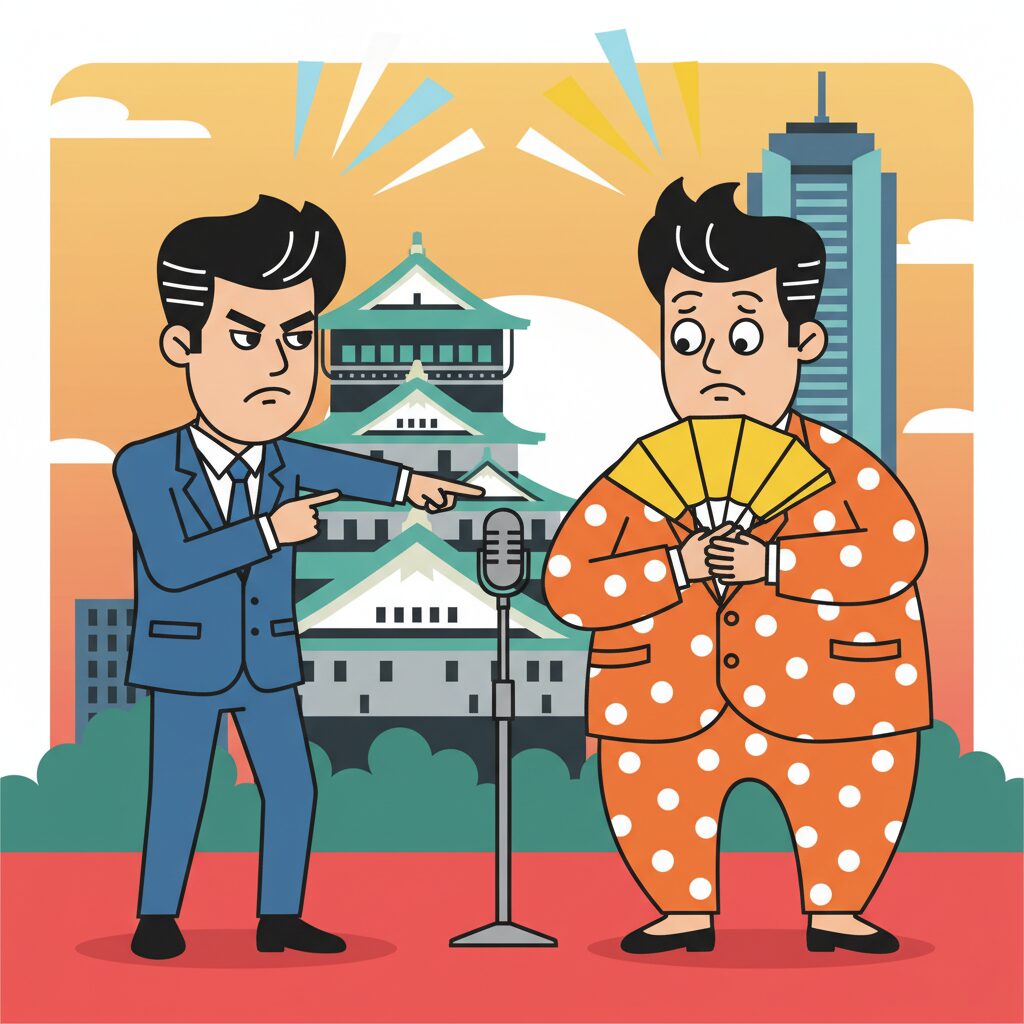
Then there’s the tsukkomi. The tsukkomi acts as the ‘straight man’, the ‘retorter’, the grounding force of reality. Their job is to spot the absurdity created by the boke and correct it, often with a biting, exasperated reply and, traditionally on stage, a quick smack with a paper fan (harisen). The woman who explained the joke to me was delivering the tsukkomi line I was meant to respond with. The most iconic tsukkomi phrase, the city’s unofficial mantra, is Nandeyanen!—a versatile exclamation that translates roughly to “What the hell?!”, “What are you talking about?!”, or “That makes no sense!” The tsukkomi doesn’t just highlight the joke; they complete it. The tension sparked by the boke‘s absurdity is released through the tsukkomi‘s sharp correction. The laughter unfolds in that release. Without the tsukkomi, the boke is simply a weirdo spouting nonsense. Without the boke, the tsukkomi is just an angry critic. Together, they form a seamless comedic cycle.
This interplay is crucial to understanding everyday conversation in Osaka. People constantly, sometimes subtly, sometimes openly, cast themselves and others into these roles. When you tell a friend about your awful day and they reply, “Well, at least you weren’t abducted by aliens,” they’re playing the boke. Your expected reaction isn’t to logically rebut but to adopt the tsukkomi role: “Why is your head always in the clouds? Come back down to Earth!” This back-and-forth isn’t mere entertainment; it’s a way of showing empathy and building rapport. It says, “I hear your problem, and I’m engaging with it by turning it into a shared performance, making it lighter and easier to handle.” In Tokyo, the response might be a sympathetic, “That sounds rough.” Both express empathy, but Osaka’s method is interactive, performative, and loud.
The Rhythm and the Rant: The Music of Osaka Dialect
Manzai’s engine is the boke and tsukkomi, but its fuel is the local dialect, Osaka-ben. This language almost seems engineered for comedic timing. Compared to the flatter, more monotone standard Japanese spoken in Tokyo (Hyojungo), Osaka-ben is a rollercoaster of pitch, rhythm, and raw feeling. Sentences often end with sharp, definitive sounds like nen, yan, and de, giving conversations a percussive, driving beat. Words are shortened, consonants emphasized, and delivery faster and more forceful. The dialect conveys not just information but attitude.
Certain words become comedic tools. Meccha (‘super’ or ‘very’) is expressed with more punch and feeling than Tokyo’s totemo. Honma (‘really’ or ‘true’) carries a hint of skepticism, perfect for questioning a boke’s ridiculous claim. But the prized distinction is between aho and baka. Across most of Japan, baka means ‘idiot’ or ‘fool’, and is a harsh insult. In Osaka, however, baka is seldom used and feels severe, almost alien. The preferred insult is aho. Yet aho is wonderfully nuanced. Yes, it can be an insult, but its meaning hinges almost entirely on tone. When a comedian shouts Aho ka! (“Are you an idiot?!”) at their partner, it’s just a rhythmic part of the act. When a grandmother teasingly calls her grandchild aho for spilling, it’s a term of affection. It’s a playful nudge acknowledging shared human folly. It fosters inclusion. Being called aho in Osaka often means you’re part of the group, in on the joke. In Tokyo, calling a stranger baka might start a fight; in Osaka, calling a new acquaintance aho with a smile could start a friendship. This linguistic subtlety reveals a deep cultural divide. Tokyo’s insult judges intelligence and creates distance; Osaka’s judges absurdity and builds connection.
The Comedy Theater: Not a Tourist Trap, But a Town Hall
To experience this culture in its most concentrated form, you need to visit a comedy theater. In Osaka, all paths lead to Namba, the city’s bustling, neon-filled entertainment district. This is the headquarters of Yoshimoto Kogyo, the undisputed giant of Japanese comedy, and home to its flagship venue: Namba Grand Kagetsu, or NGK. Going to NGK isn’t like attending a Western-style theater—a quiet, reverent affair. It more closely resembles a packed sports stadium on the night of the home team’s biggest game. It’s loud, boisterous, and profoundly communal.
Namba Grand Kagetsu (NGK): The Mecca of Mirth
From the moment you arrive near NGK, you sense its vibrant energy. The surrounding streets resemble a comedy theme park. Souvenir shops sell memorabilia of famous comedians, food stalls offer Yoshimoto-branded takoyaki, and life-sized cardboard cutouts of comedy stars attract fans eager to take photos. The crowd outside is a microcosm of the city: clusters of high school students, couples on dates, families with children and grandparents, and salarymen relaxing after work. This isn’t a niche interest; it’s a mainstream family outing, as ordinary as going to the movies.
Inside, the atmosphere is electric. Shows are lengthy, often running for several hours, with a variety of acts. You’ll witness veteran Manzai duos who have performed together for decades, their timing so flawless it’s like watching a single person with two mouths. Their jokes focus on married life, aging, and the absurdities of modern society—subjects that deeply resonate with the older audience members. Then you’ll see younger, faster, more frenetic acts featuring comedians who could be the future TV stars. Their material is more contemporary, and their delivery more physical and intense. The audience plays an active role. They don’t just laugh; they roar, gasp, and shout catchphrases alongside the performers. There’s a strong sense of shared history and understanding. Certain jokes are so well known that just the setup sends the crowd into fits of laughter.
The highlight of many NGK shows is Yoshimoto Shinkigeki (Yoshimoto New Comedy). This unique theatrical form is a slapstick play with a recurring cast of characters and a familiar yet beloved plot, usually set in places like an udon shop or hot spring inn. It’s a live-action sitcom where the audience anticipates every character’s signature gag with eager excitement. When the clumsy, pot-bellied security guard appears and trips over a chair, the theater erupts. It’s a comforting, hilarious ritual that many have grown up with. It’s Osaka’s theatrical equivalent of comfort food.
Beyond the Main Stage: The Ecosystem of Laughter
While NGK is the heart, Osakan comedy’s ecosystem stretches throughout the city. Yoshimoto Kogyo, the entertainment conglomerate running NGK, is both a cultural and economic powerhouse in Osaka. Founded more than a century ago in the city, it holds a near-monopoly over the comedy industry. Operating like a Hollywood studio system, it discovers, trains, and manages talent from a young age. This has created a clear career path for anyone in the Kansai region recognized as omoroi (funny). Being funny is a respected and celebrated talent, and Yoshimoto offers the structure to turn it into a livelihood.
This system is supported by a network of smaller, more intimate theaters, such as the Yoshimoto Manzai Theater right beside NGK. Here, emerging comedians, the wakate, refine their skills. Shows are cheaper, the atmosphere rawer and more experimental. You can see the hunger in these young performers. They’re desperate for laughs, trying new material, sometimes bombing spectacularly. The audience tends to be younger and more discerning, consisting of die-hard comedy fans proud to spot the next big thing. Attending one of these shows feels like witnessing the city’s creative engine in action. It’s the ongoing process of renewal that keeps Osaka’s comedy scene so lively. It stands as a testament to how deeply comedy is woven into the city’s identity. It’s not just a product to consume; it’s an industry, an art form, and a significant source of civic pride.
Owarai Logic in Everyday Osaka: Reading the Room
Attending a Manzai show feels like enrolling in an intensive language course. Once you’ve absorbed the rhythm and logic of the boke and tsukkomi, you start noticing it everywhere. You realize that the stage’s unwritten rules mirror those of everyday life. Osaka’s social interactions follow a kind of ‘Owarai Logic,’ where the aim of conversation is often less about exchanging information and more about jointly crafting a small, entertaining performance. This logic can be puzzling to outsiders, but once you grasp it, the city’s character becomes clear.
The “Ochi”: Why Every Story Needs a Punchline
In a typical Tokyo conversation, a story is told to relay facts. “I was late for my meeting today because the Yamanote Line was delayed by 15 minutes due to a signal problem.” The story is straightforward, factual, and serves a clear purpose. In Osaka, a story without a punchline, or ochi, is seen as a failure—a conversational dead end. The whole point of sharing an anecdote is to entertain. Facts come second to the performance.
The same story in Osaka might go like this: “You won’t believe it—the train stopped forever. I was stuck next to this old guy peeling a mikan, and the peel got longer and longer, like a snake. I swear he was trying to break a world record. By the time the train moved, he had this giant orange snake, and I was ten minutes late. My boss is probably going to make me peel mikans for him all afternoon as punishment.” The story is exaggerated, loaded with absurd details, and ends with a self-deprecating punchline. It’s not really about the train delay; it’s about a shared absurd experience. This style explains why people from Osaka are often stereotyped as extremely talkative. They’re not just chatting—they’re crafting material, searching for an angle, a detail, or an ochi that will land. Conversation is a creative collaboration to find humor. Simply stating facts isn’t enough.
Service with a Side of Sass: The Shopkeeper as Boke
This performative tendency significantly changes customer service. Foreigners and even other Japanese often find Osaka shop interactions surprising for their direct, teasing, and informal nature, especially in traditional shotengai (shopping arcades). The polite, deferential service standard in Tokyo often gives way to playful banter that mimics boke-tsukkomi.
Stroll through Kuromon Ichiba Market and the fishmonger might yell, “Hey, you! Don’t just stare, buy something! This fish won’t jump into your bag by itself!” He’s playing the gruff, impatient boke. The expected local response isn’t offense but a tsukkomi comeback: “If I buy this one, will you give me a discount? It looks like it’s already had a tough day.” The fruit vendor, noticing you hesitate between two melons, may say, “Just pick one, they’re both better than your haircut!” A joke, an invitation. You’re meant to laugh and reply, “Well, this melon has to last me a week. My haircut only has to last until I get home!” This isn’t rudeness; it’s intimacy. The shopkeeper treats you not as a faceless customer but as a potential sparring partner. Engaging in the banter shows you understand local culture. You become part of the community, not just a shopper. Taking these remarks literally misses their true purpose. The exchange isn’t merely about money for goods; it’s about sharing witty remarks and laughter.
The Art of Self-Deprecation: “I’m the Idiot Here.”
One of Osaka’s strongest social tools is self-deprecation. While humility is valued throughout Japan, Osaka elevates it to comedic art. Making yourself the butt of the joke, playing the boke at your own expense, quickly breaks down barriers, builds trust, and shows you don’t take yourself too seriously. This is especially notable in business, which can shock those used to Tokyo’s rigid formality.
A business meeting in Osaka might start with the team leader saying, “I was so busy preparing that I forgot breakfast and now my stomach’s about to make a noise louder than our sales projections.” This immediately eases tension. It signals the discussion will be practical and personal, not stiff and hierarchical. By admitting a foolish flaw, the speaker becomes relatable and trustworthy. In Osaka, an overly polished presentation might be met with skepticism. One that includes a small, funny, self-deprecating story is seen as genuine and honest. This isn’t unprofessional; it’s effective. Laughter builds relationships, and strong relationships are the foundation of good business in Osaka’s merchant culture.
The Tokyo-Osaka Comedy Divide: A Tale of Two Humors
The significance of comedy in Osaka becomes most evident when compared to Tokyo. These two cities represent the twin poles of Japanese culture, and their respective comedy scenes highlight their profound differences. The well-known rivalry between Kanto (Tokyo region) and Kansai (Osaka region) plays out nightly on television across the country, reflected in the distinct styles and attitudes of their comedians.
Kanto vs. Kansai: The Unspoken Rivalry
Kansai comedy, centered on Osaka’s Manzai tradition, is often described as direct, fast-paced, and driven by the characters themselves. The humor arises from the comedians’ personalities—their arguments, quirks, and genuine chemistry. It is grounded in the rhythm of everyday conversation, often seeming spontaneous and unscripted, even if carefully rehearsed. Iconic duos like Downtown, with Kansai natives Hitoshi Matsumoto and Masatoshi Hamada, perfected a style of aggressive, ad-libbed tsukkomi and surreal boke that has shaped generations.
In contrast, Kanto comedy is typically viewed as more intellectual, subtle, and script-oriented. It tends to favor conte (a French term for ‘short story’), which are elaborate, self-contained sketches featuring characters and scenarios that are often surreal or theatrical. Here, comedians resemble actors portraying roles within a fictional setting. Groups like Tokyo 03 are known for their intricately crafted skits centered on awkward social situations. The stereotype suggests that Kanto comedy is clever and witty, while Kansai comedy is loud and visceral. While a generalization, it underscores a fundamental philosophical difference. Osaka comedy springs from the unpredictability of human interaction, whereas Tokyo comedy constructs a controlled world and finds humor within it. This mirrors the cities themselves: Osaka, the lively, pragmatic merchant city; Tokyo, the stylish, image-conscious, and more orderly capital.
“You’re Not Funny”: The Ultimate Osaka Insult
This deeply ingrained comedic identity creates a unique social pressure in Osaka. In many cultures, being boring is a minor social fault. In Osaka, being omoro nai (not funny/uninteresting) is a grave offense. It is a harsher judgment than being told you are wrong, unattractive, or even unkind. There is a constant, underlying expectation to be entertaining. This doesn’t mean you must be a professional comic, but you are expected to help make life a little more amusing.
For newcomers, this can be quite intimidating. If you are naturally quiet or reserved, Osakans might actively try to “fix” you. They’ll prod and tease, attempting to provoke a reaction and uncover your comedic side. Their intentions are generally positive—they want to include you in their unique way of connecting—but it can feel like relentless interrogation. It’s no surprise that many from other parts of Japan find Osakans overbearing or aggressive. They are not accustomed to a communication style where every conversation doubles as a wit audition. Living in Osaka requires cultivating a thicker skin and a readiness to engage in this performance. The social contract demands you at least attempt to be omoroi. This is perhaps the biggest misconception about the city. Its renowned friendliness is not passive or gentle; it is active, demanding, and performative, calling for your participation.
How to “Get” Osaka Humor: A Survival Guide for Newcomers
So, how does a non-native navigate this intricate comedic landscape? You don’t need to become a stand-up comedian overnight, but adopting a few key principles can turn your experience of the city from confusing to captivating. It’s about learning to be a good audience member and, eventually, an eager participant.
Rule #1: Don’t Take Yourself Too Seriously
This is the fundamental rule. Osaka’s entire comedic culture is built on the willingness to laugh at oneself and the absurdities of life. If someone jokes about your accent, your clothes, or your confusion, it’s almost never meant to be hurtful. It’s an olive branch—an invitation to join in the fun. The worst reaction is to become defensive or offended. The best response is to laugh along with them. Even better, get ahead of them by making the joke yourself. If you make a mistake, point it out with a laugh. “I just tried to pay for my train ticket with my apartment key. Looks like I need more coffee.” By playing the boke on yourself, you show you’re on the same wavelength. In Osaka, vulnerability is strength because it opens the door for shared laughter.
Rule #2: Learn the Basic Responses
You don’t need a full routine, but having a few simple tsukkomi phrases ready can be a game-changer. Mastering the timing and intonation of Nandeyanen! is a great start—use it when a shopkeeper quotes a ridiculous price or a friend suggests a crazy plan. Another essential is Honma ka? (“Really?”) said with genuine disbelief. A soft, smiling Aho ya na (“You’re a lovable idiot”) is the perfect comeback to a friend’s silly joke. And then there’s the ultimate Osaka conversational escape hatch: shiran kedo (“…but I don’t really know”). This funny phrase can end any bold or questionable statement, instantly freeing you from responsibility. Using these expressions shows you’re not just passively listening—you’re actively joining the conversational rhythm. It signals you understand the game.
Rule #3: Watch, Listen, and Immerse
The best way to learn is by observing. Turn on the TV any evening, and you’ll be flooded with comedy panel shows hosted by Kansai comedians. Watch their interactions, the speed of their banter, their physical reactions. Even if you don’t catch every word, you’ll absorb the rhythm. More importantly, attend a live show—go to NGK or a smaller theater. Don’t stress about understanding every punchline. The point is to feel the energy in the room, hear the wave of laughter, and observe the performers’ masterful timing, body language, and Osaka dialect. It’s a cultural experience unlike any other. Pay attention out on the streets, in the markets, and on the subway. Listen to how people speak to each other—you’ll spot an old couple bickering like a seasoned manzai duo, or a group of students riffing off one another, each trying to top the last with a better punchline. The whole city is a stage, and every day is a performance. You just need to tune your ears to the right frequency.
Ultimately, manzai is more than just an art form in Osaka; it’s a philosophy. It’s a worldview that sees the best way to handle life’s challenges and absurdities as turning them into a story with a great punchline. It explains the city’s resilience, pragmatism, and irrepressible spirit. Living in Osaka means realizing that communication isn’t just about clarity—it’s about connection. It’s about the shared joy of pointing out life’s absurdities and laughing together. It’s about knowing that sometimes, the most fitting response to a crazy situation is a perfectly timed Nandeyanen!. Once you grasp that, you don’t just understand Osaka humor—you understand Osaka itself.