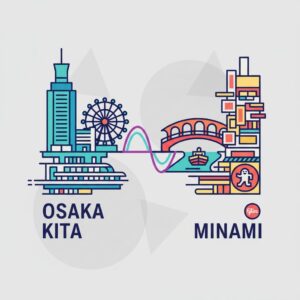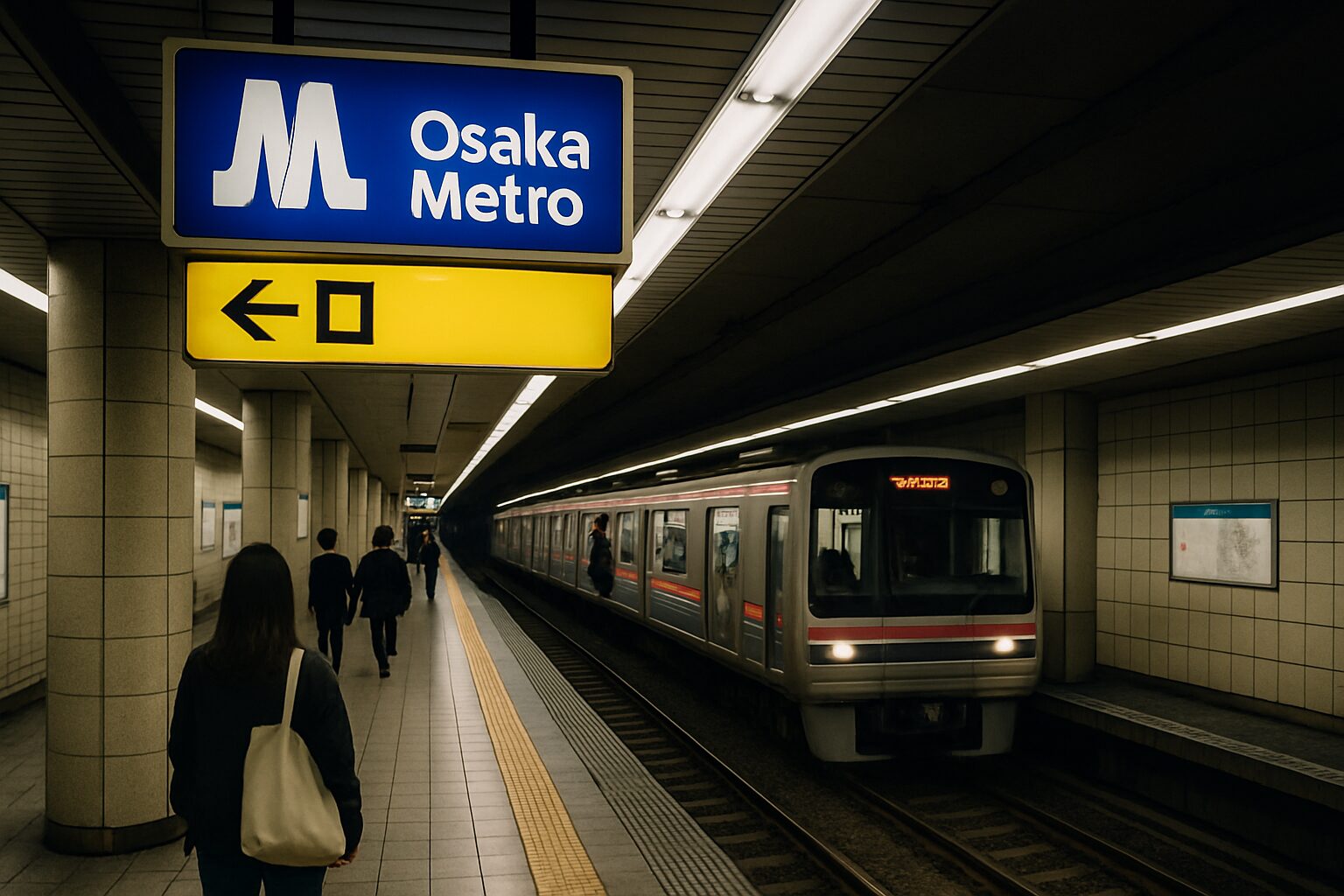
There’s a moment that every first-time traveler to Japan experiences. It’s that initial confrontation with the public transportation map. Spread out like a psychedelic circuit board, a riot of colored lines crisscrosses, dives, and loops in a beautiful but utterly bewildering display of organized chaos. Standing before this mural of metropolitan movement, you feel a cocktail of awe and quiet panic. This is the gateway to the city, but which gate do you choose? In Tokyo, this feeling can linger, a persistent challenge in a city that operates on a scale that defies imagination. But then there’s Osaka. A city with a pulse just as vibrant, a spirit just as electric, but with a circulatory system that feels designed with the human in mind. While both cities boast world-class transit, for the traveler seeking confidence and clarity, Osaka’s public transport, spearheaded by its magnificent Metro system, offers a far gentler, more intuitive, and ultimately more liberating introduction to urban Japan.
At the heart of this experience is a simple truth: a city you can navigate is a city you can truly explore. It’s the difference between sticking to a rigid plan, fearful of a wrong turn, and allowing for spontaneous discovery, confident that you can always find your way back. Osaka’s system doesn’t just move you from point A to B; it empowers you. It hands you the keys to the city from the moment you tap your ticket and descend into its clean, welcoming depths. Before we dive into the rhythmic heart of Osaka’s transit, let’s get our bearings on the map. The entire city’s energy converges on hubs like Umeda, the northern gateway, from which countless urban adventures begin.
Once you’ve mastered the city’s rhythm, you can truly immerse yourself in its culture, perhaps by experiencing the local tradition of a relaxing visit to a neighborhood sentō.
The Tale of Two Cities: A Transit Showdown
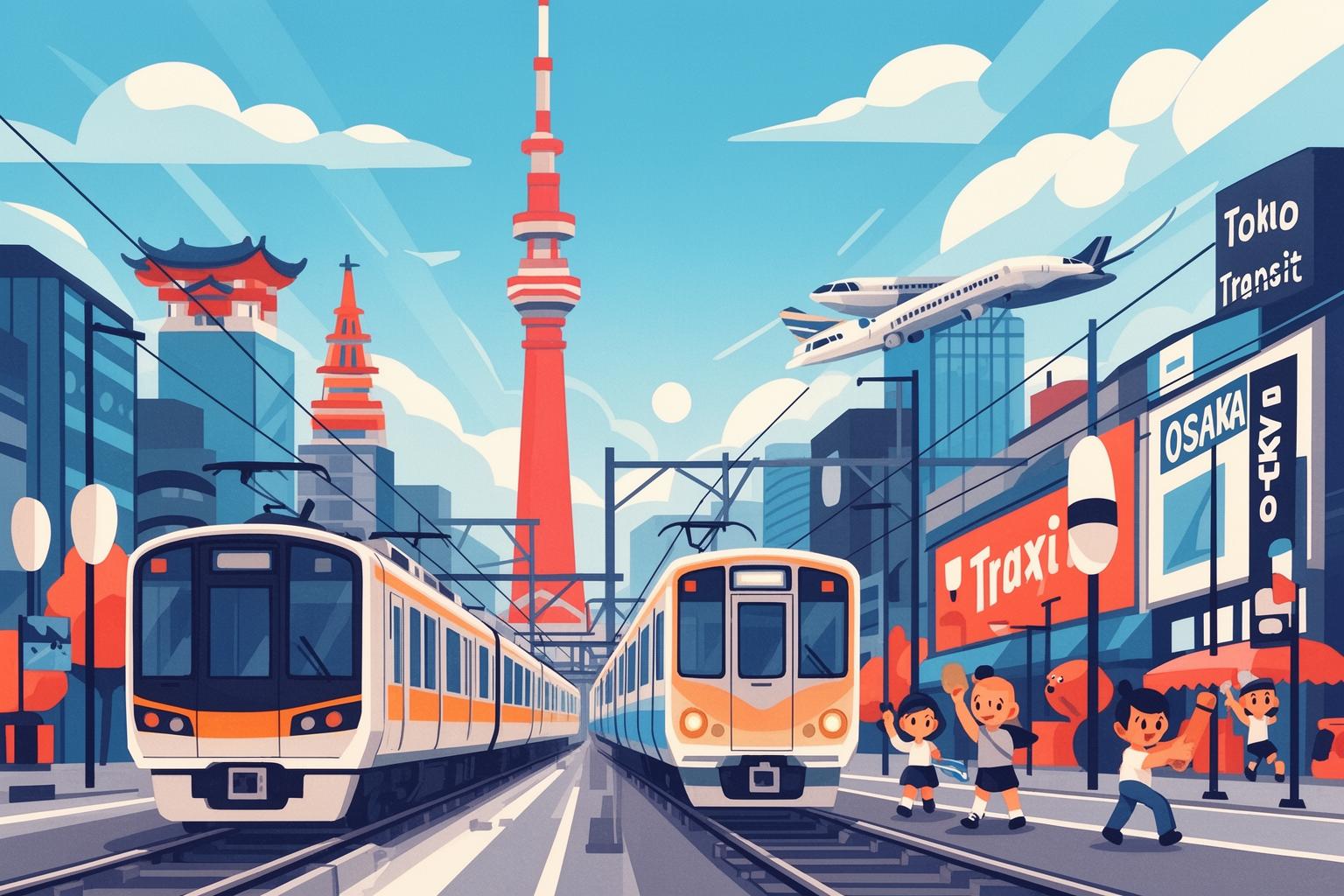
To truly appreciate the elegant simplicity of Osaka’s system, one must first grasp the intricate marvel that is Tokyo’s. Tokyo’s public transport isn’t merely a system; it’s an ecosystem—a vast, multi-layered organism of steel and electricity operated by a dozen distinct companies. There’s the giant JR East with its iconic Yamanote Line, the sprawling Tokyo Metro, the deep-reaching Toei Subway, and numerous private railway lines such as Keio, Odakyu, and Tobu, stretching like tentacles into the suburbs. They all intersect and overlap within enormous stations that resemble subterranean cities more than transport hubs. For example, Shinjuku Station serves over three million people daily. Moving from a Keio platform to a Marunouchi Line platform can feel like a fantasy quest: a ten-to-fifteen-minute journey through a maze of numbered exits, winding corridors, and relentless crowds.
The challenge for visitors in Tokyo lies in this complexity. Which pass should you buy? Does it cover all these different companies? Transferring from a Tokyo Metro line to a Toei line often requires exiting one set of gates and entering another, sometimes paying a separate fare. Although IC cards like Suica and Pasmo have significantly eased this process, the system’s foundation remains a patchwork quilt. You find yourself constantly checking your app—not just to find the right line, a typical task in any city, but to identify the correct company, station entrance, and most cost-effective route. It’s an engineering marvel but demands full attention and can be mentally draining.
Now, turning to Osaka, the initial impression is one of immediate clarity. The system seems designed on a clean slate rather than having evolved organically over a century into a complex tangle. Your Osaka experience mainly revolves around two key players: the Osaka Metro and the JR Osaka Loop Line. While Osaka also hosts several private railways—Hankyu, Hanshin, Keihan, Kintetsu, and Nankai—their roles are more straightforward for visitors. Generally, these lines serve as gateways to other cities. Heading to Kobe? Take the Hanshin or Hankyu lines. Traveling to Kyoto? Use the Keihan or Hankyu. Going to Nara? Ride the Kintetsu line. This clear division of purpose is central to Osaka’s user-friendliness. Intra-city travel is mostly covered by the Metro, a single, cohesive system, while inter-city travel is handled by the private lines or the primary JR network. This mental division makes planning your journey much simpler. You’re not juggling multiple subway operators to get across town; you’re simply riding the Metro.
The Heart of Simplicity: The Osaka Metro’s Midosuji Line
If the Osaka Metro represents the heart of the city’s transit system, then the Midosuji Line serves as its aorta. This single crimson line is the most powerful asset in any tourist’s toolkit. Running north to south, it cuts through the city, linking nearly every major district that visitors hope to explore. Mastering this one line is like unlocking 80% of Osaka’s key attractions. It offers a direct route of pure convenience, a steady pulse that transports you through the very essence of the city.
Let’s take a ride. Your journey may start at Shin-Osaka Station in the north, the arrival point for the Shinkansen bullet train. From here, you board the Midosuji Line, marked boldly with an ‘M.’ Just two stops south is M16, Umeda Station. You emerge into the gleaming high-rise maze of Kita, Osaka’s northern downtown. This area features sprawling department stores like Hankyu and Daimaru, the architectural marvel of the Umeda Sky Building, and an extensive underground mall that connects it all. Umeda is the city’s refined face—a center for commerce, fashion, and fine dining.
Continuing south, the train passes through Yodoyabashi and Honmachi, the city’s business and administrative core. While less frequented by tourists, this district houses the tranquil Nakanoshima Park, an elegant island oasis nestled between two rivers, featuring museums and a beautiful rose garden. It’s an ideal spot to observe the city’s working rhythm and enjoy a peaceful walk away from the crowds.
Next, you reach M19, Shinsaibashi Station. As the doors open, you step into the epicenter of Osaka’s shopping culture. The Shinsaibashi-suji Shopping Arcade stretches for hundreds of meters—a covered corridor bustling with people, music, and the aroma of street food. To the west lies Amerikamura, or ‘Amemura,’ Osaka’s answer to Harajuku—a lively hub of youth fashion, quirky boutiques, and creative energy. The atmosphere here is electric, offering a stark and exciting contrast to Umeda’s polished vibe.
Just one more stop south brings you to M20, Namba Station. Here lies the southern powerhouse of Osaka, the city’s playground. Namba is not just one place but a sprawling galaxy of entertainment. From the station, you’re moments away from the iconic Glico Running Man sign, the giant mechanical crab of Kani Doraku, and the neon-lit canal of Dotonbori. This is the Osaka you’ve seen in photos—a sensory explosion of sizzling takoyaki, flashing billboards, and vibrant energy. Namba is also home to the Den Den Town electronics district and Kuromon Ichiba Market, a paradise for food lovers. All of this is accessible from a single station on one line.
Heading further south, the Midosuji Line takes you to Tennoji Station, where the city’s modern and ancient spirits converge. You can visit the historic Shitennoji Temple, one of Japan’s oldest Buddhist temples, or ascend the retro-futuristic Tsutenkaku Tower in the Shinsekai district for panoramic city views. Tennoji also features a large park, a zoo, and the impressive Abeno Harukas, Japan’s tallest skyscraper. This single crimson thread ties together the city’s bullet train gateway, its northern business center, its central shopping street, its southern entertainment district, and its historic temple quarter. Such is the unmatched power and simplicity of the Midosuji Line.
Deciphering the Map: Color-Coding and Station Logic
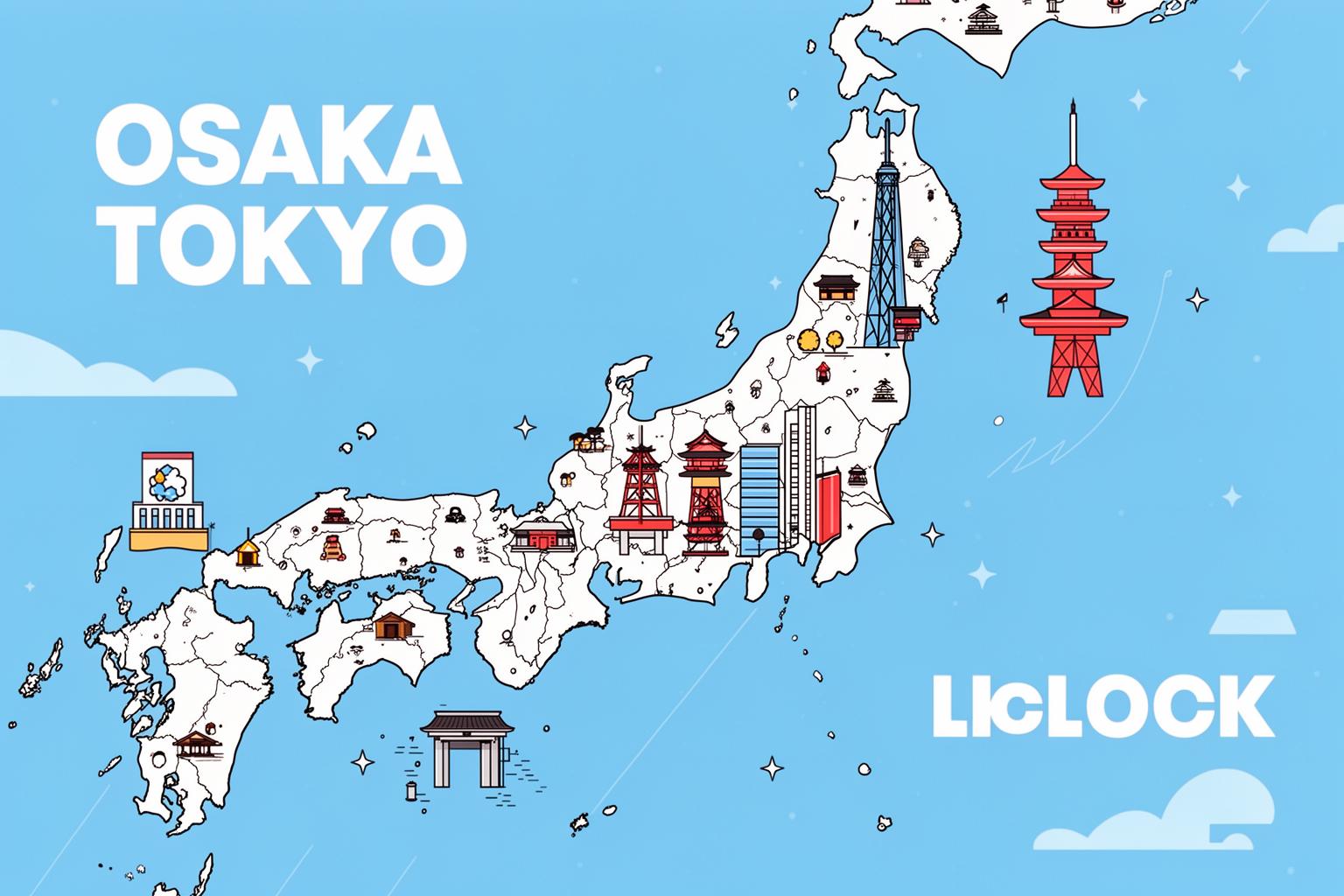
Beyond the brilliance of its layout, the Osaka Metro stands out for its user interface. The system is crafted with a profound, intuitive grasp of how a newcomer’s mind operates. It serves as a model in visual communication, making navigation feel less like a challenge and more like a game.
First, consider the color-coding. Each line is assigned a distinct, vibrant color and an accompanying letter. The Midosuji Line is a bold red ‘M,’ the Tanimachi Line a royal purple ‘T,’ and the Chuo Line a bright green ‘C.’ While this approach is not unique to Osaka—most metro systems utilize color—the relatively small number of lines here prevents the map from becoming cluttered, allowing the colors to stand out with striking clarity. Users quickly associate each color with their journey: “I need to get to the castle, so I’ll take the green line.” This simple visual cue is incredibly effective, enabling navigation through quick glances rather than intense scrutiny.
What truly distinguishes Osaka, however, is its station numbering system. Every station on the Metro has a unique alphanumeric code. For instance, as noted earlier, Umeda is M16, and Namba is M20. This innovation is brilliant for several reasons. It completely bypasses language barriers—you don’t need to read or pronounce ‘Shinsaibashi’; you only need to look for M19. It instantly indicates your direction of travel as well: if you’re at M16 headed toward M20, you know to find the platform where station numbers increase. This serves as an immediate, foolproof orientation tool and even helps estimate your journey length—the distance between M16 and M20 is four stops. This straightforward system eliminates much potential confusion and anxiety, making every trip predictable and stress-free.
This clarity is reflected in the stations’ physical environment. Signage is consistently excellent, offering clear directions in both Japanese and English at every decision point. Osaka’s stations are generally smaller and less complex than Tokyo’s massive ones, so the signage is more effective. Fewer choices at any moment prevent the information overload that could lead to paralysis in a larger station. Even the auditory cues assist passengers: many lines feature unique jingles that play upon a train’s arrival, providing an additional sensory confirmation that you’re in the right place. Platforms are clean, staff are helpful, and the overall atmosphere is one of calm efficiency. All these elements combine to create an experience that is manageable and welcoming, even during busy times.
The JR Osaka Loop Line: The Perfect Complement
While the Metro forms the backbone of your north-south and east-west travel, the JR Osaka Loop Line serves as its ideal partner, a reliable companion in your urban adventures. Imagine it as a circle encircling the city’s core, linking important spots along the outskirts and smoothly connecting with the Metro at several key interchange stations. If the Metro lets you explore individual neighborhoods in depth, the Loop Line lets you sweep around the city to major landmarks.
One of the city’s most popular tourist attractions is the stunning Osaka Castle. Although accessible via the Metro’s Chuo (Green) or Tanimachi (Purple) lines, the most scenic and direct route often involves taking the Loop Line to Osakajokoen Station, meaning ‘Osaka Castle Park Station.’ The moment you step off, you’re right at the edge of the expansive park, with the castle’s main keep impressively towering in the distance. This line delivers you straight to the doorstep of this iconic site.
As you travel around the loop, you’ll discover other intriguing districts. Tsuruhashi Station places you in the heart of Osaka’s lively Koreatown, a bustling maze of streets filled with enticing aromas of yakiniku barbecue and kimchi. It offers a rich cultural experience far removed from the sleek skyscrapers of Umeda. Continuing on to Tennoji, a major transfer point where the Loop Line intersects with the Metro’s Midosuji and Tanimachi lines, underscores its role as a southern gateway. A bit further along is Shin-Imamiya Station, your entrance to the charmingly nostalgic and quirky neighborhood of Shinsekai, overseen by the Tsutenkaku Tower. This glimpse of Showa-era Osaka is an unmissable delight.
Perhaps most important for many visitors, the Loop Line provides access to Universal Studios Japan. By traveling to Nishikujo Station on the Loop Line, you can easily make a cross-platform transfer to the JR Yumesaki Line, which ends at Universal City. This entire trip is covered by the JR Pass if you have one, making it both convenient and economical.
The advantage of this two-system setup lies in its simple mental model for tourists. Need to travel north or south through the city center? Take the red Midosuji Line. Want to visit the castle or circle the city’s perimeter? Use the JR Loop Line. This elegant combination of the two main lines covers most sightseeing needs and is much easier to grasp than Tokyo’s complex network of overlapping operators and sprawling routes. It provides a clear structure for understanding the city’s geography and how to navigate it.
The Human Element: Flow and Feel
Beyond the technical details of maps and routes, navigation also involves an intangible aspect: the feel of the city. Osaka’s geography and culture greatly enhance its navigability. The city’s main tourist spots are clustered relatively close together, mostly aligned along the Umeda-Namba axis served by the Midosuji Line. In contrast, Tokyo’s key attractions are scattered widely across its expansive metropolitan area. A day of sightseeing in Tokyo might entail traveling from Asakusa in the east to Shibuya in the west, then on to Shinjuku Gyoen National Garden, involving multiple transfers between different lines and operators. In Osaka, you can check off several major sights simply by hopping on and off one train line. This concentration naturally results in a simpler, less tiring travel experience.
Transferring between lines is generally less challenging in Osaka as well. Although the Umeda-Osaka station complex is undeniably large and can be confusing, it stands as an exception rather than the norm. A typical transfer, such as from the Midosuji Line to the Sennichimae Line at Namba, usually involves a short, straightforward walk through clearly marked underground passages. This contrasts with the ordeal of transferring at Tokyo’s Otemachi Station—a hub for five subway lines—where you might spend ten minutes walking underground through a sterile maze of signs, or the similarly complex journey through Shinjuku. Most Osaka stations are on a more human scale, making transit less intimidating.
The city’s character also plays a role. Osakans are known for being friendly, outgoing, and straightforward. There’s a genuine warmth and lack of affectation in the atmosphere that goes beyond cultural stereotype and has practical benefits for lost travelers. People tend to be more approachable; if you’re standing in a station looking confused at a map, it is common for a local to offer assistance unprompted. While station staff across Japan are famous for their professionalism and helpfulness, Osaka’s general public often feels like an extension of the information desk. This welcoming, unpretentious vibe creates a comforting network of human connection that can be invaluable when navigating an unfamiliar place.
Practical Tips for Riding the Osaka Metro
Navigating Osaka’s public transport is straightforward, and with a few handy tips, you’ll be moving through the city like a local from day one. Your first and most important tool is an IC card. In the Kansai region, this card is called ICOCA, but any major card from other areas, such as Tokyo’s Suica or Pasmo, will work perfectly. Just load it with cash at any station’s ticket machine, then tap it on the reader at the gates when you enter and exit. This completely removes the need to calculate fares or buy separate paper tickets for each trip. It’s the secret to smooth, hassle-free travel.
For a full day of sightseeing, consider the Osaka Enjoy Eco Card. This one-day pass provides unlimited access to the entire Osaka Metro system and city buses. On weekdays, it’s reasonably priced, but on weekends and holidays, it’s an outstanding deal at a significantly lower cost. The value is tremendous—a few Metro rides alone will cover its price, and every ride beyond that is essentially free. Additionally, the pass grants small discounts on admission to many tourist spots around the city, including Osaka Castle and the Umeda Sky Building—just show your pass at the ticket counter. It’s one of the best-value tourist passes anywhere in Japan.
At the station, observe the simple etiquette that keeps things running smoothly. Passengers line up neatly on the platform where the train doors will open. Always let people exit the train before you board. Inside the train, it’s polite to set your phone to silent and avoid loud conversations. While trains can be crowded, especially during rush hour, there’s a shared respect that makes the experience pleasant.
Finally, while navigation apps like Google Maps and Japan Transit Planner are extremely helpful, you may find yourself relying on them less quickly in Osaka. Once you’ve memorized the Midosuji Line and the Loop Line, you’ll confidently navigate the city center using your own mental map. This speaks volumes about the system’s design: it’s so intuitive that it soon becomes second nature.
Tokyo is undeniably one of the world’s greatest cities, with a transportation network that stands as a monumental achievement of human creativity. It’s a city that excites and challenges in equal measure. Yet, for travelers taking their first steps into the dynamic world of Japanese urban life, Osaka offers a warmer, more inviting welcome. Its transport system isn’t a puzzle to be cracked but a tool to be used—a key that unlocks the city with elegant simplicity. The logical grid of the Metro, the dependable workhorse that is the Midosuji Line, and the clear, user-friendly design of its stations all combine to dissolve the anxiety of navigation. This leaves you free to focus on what truly matters: savoring incredible food, experiencing vibrant culture, and embracing the unabashedly joyful spirit of a city that moves to its own infectious beat.