Yo, step off the beaten path, away from the neon glow of Dotonbori and the towering heights of Umeda Sky Building. Let’s walk together down a quiet residential street, just as the sun begins to dip low, painting the sky in hues of orange and purple. You’ll hear it before you see it: the distant clatter of wooden geta on pavement, the cheerful chatter spilling from an open doorway, the faint, comforting scent of soap and steam carried on the evening breeze. Look for the distinctive curved gable roof, the tall, slender chimney reaching for the sky like a neighborhood lighthouse, and the soft light of a paper lantern illuminating a simple sign. Hanging in the doorway is a cloth curtain, a noren, gently swaying and inviting you in. This, my friend, is the entrance to a world that holds the true, unvarnished soul of Osaka. This is a sento, a public bathhouse. It’s more than just a place to wash away the grime of the day; it’s a living, breathing community center, a sanctuary of steam and stories, and the most authentic cultural immersion you can find in this vibrant city. Forget your travel guides for a moment. To understand Osaka, you must understand the ritual of the shared bath, the beautiful concept of hadaka no tsukiai, or “naked communion,” where the city’s heart beats strongest, unadorned and true. This is where status and pretense are left in a wicker basket with your clothes, and all that matters is the shared warmth of the water and the easy camaraderie of your neighbors. This is the Osakan way.
After soaking in the communal warmth of the sento, you might find yourself craving another quintessential Osakan experience, like enjoying a bowl of noodles at one of the city’s famous standing noodle stalls.
The Rhythm of Arrival: Stepping Through the Noren
The journey begins the moment you part that fabric curtain. The world outside, with its traffic and concerns, immediately feels far removed. The first thing you’ll encounter is the genkan, the entrance area, filled with rows of small wooden lockers for your shoes, called getabako. Spotting an empty locker, you slide your shoes inside and take the wooden key, often a thick, beautifully worn piece with a number carved into it. This simple gesture marks the first step of the ritual, a symbolic shedding of the outside world. The air inside carries the scent of damp wood, tatami mats, and something clean, almost medicinal. You approach the bandai, a high wooden counter, often elevated to give the proprietor a commanding view of both the men’s and women’s entrances. Here, you’ll be greeted by an obachan (grandmother) or ojisan (grandfather), whose family may have run this very sento for generations. Their smile is warm, their movements practiced and efficient. The entrance fee is modest, usually around 500 yen—an incredible value for the experience ahead. You might notice a sign for a tebura setto, an “empty-handed set,” which for a couple hundred yen extra provides a small rental towel, a large rental towel, soap, and shampoo. It’s the perfect choice for the spontaneous visitor. After paying, you head to the changing rooms, one for men (男) and one for women (女). Watch for the color of the noren—traditionally blue or purple for men, and red or pink for women. Passing through this second curtain feels like a final transition, leaving the outside world behind and entering a sacred, communal space. The sounds from the bath hall grow clearer now: the steady rush of water, voices echoing against tiled walls, the rhythmic splash of buckets. Your heart may beat a little faster with anticipation, but a sense of calm begins to wash over you. You’ve arrived.
The Sanctuary Within: Navigating the Changing Room
The datsuijo, or changing room, is a space suspended in time. Typically, it’s a large, open area with high ceilings designed to let steam escape. A slow-turning ceiling fan might be lazily stirring the warm, humid air overhead. In one corner, an old, boxy television could be showing a Hanshin Tigers baseball game, the announcer’s excited voice serving as a familiar backdrop to the evening ritual. The floor might be cool tile or warm, worn wood. Along the walls, you’ll find lockers for your clothes. In older, more traditional sento, metal lockers with keys may be absent, replaced instead by rows of simple, open-faced shelves holding large wicker baskets, or kago. Watching regulars—old men, fathers, young students—placing their wallets, phones, and clothes into these open baskets without hesitation offers your first true lesson in the culture of trust that defines the sento. This isn’t a gym locker room filled with strangers; it’s a shared living room for the neighborhood. As you begin to undress, you might feel a trace of self-consciousness, which is natural for any first-timer. But take a look around. No one is watching. No one is judging. The elderly man with wrinkled, story-filled skin carefully folds his clothes. The burly middle-aged man stretches his back after a long day of physical labor. A young father helps his small son out of his shirt. In this space, everyone is equal. Social status, job titles, and wealth don’t matter. You are all here for the same simple, profound reason: to get clean, to relax, and to be part of a community. It is deeply liberating. Once you’re undressed, you’ll grab your small wash towel and any toiletries you’ve brought and head toward the bathing area. The large bath towel remains behind in your basket or locker. This small towel, the tenugui, is your most essential tool for the next hour. It is used for scrubbing, maintaining modesty as you walk around, and dabbing your face, but its most important rule will come into play later. For now, hold it in front of you as you slide open the glass-paned door leading to the main event: the bath hall itself.
The Ritual of Cleansing: Before the Bliss of the Bath
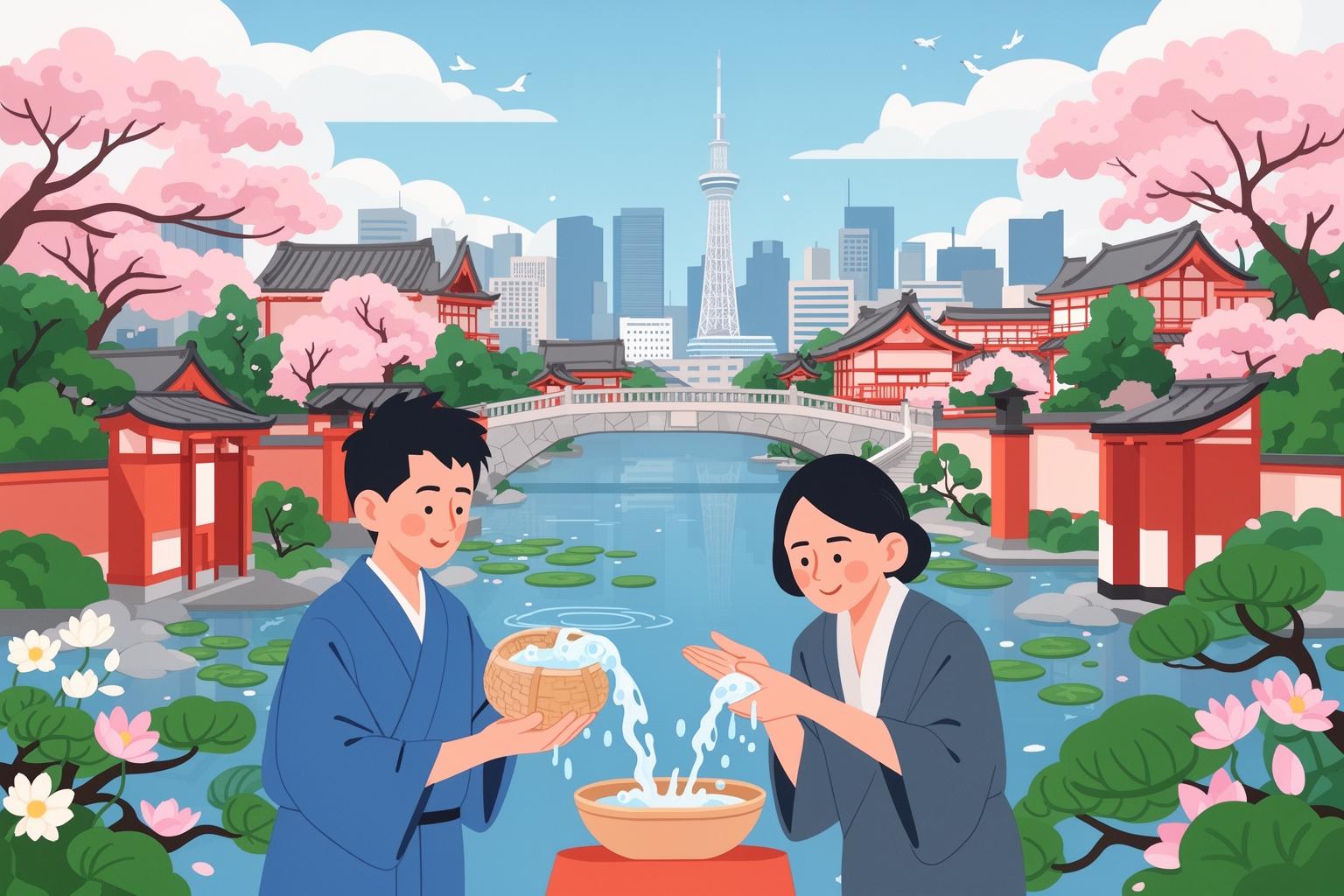
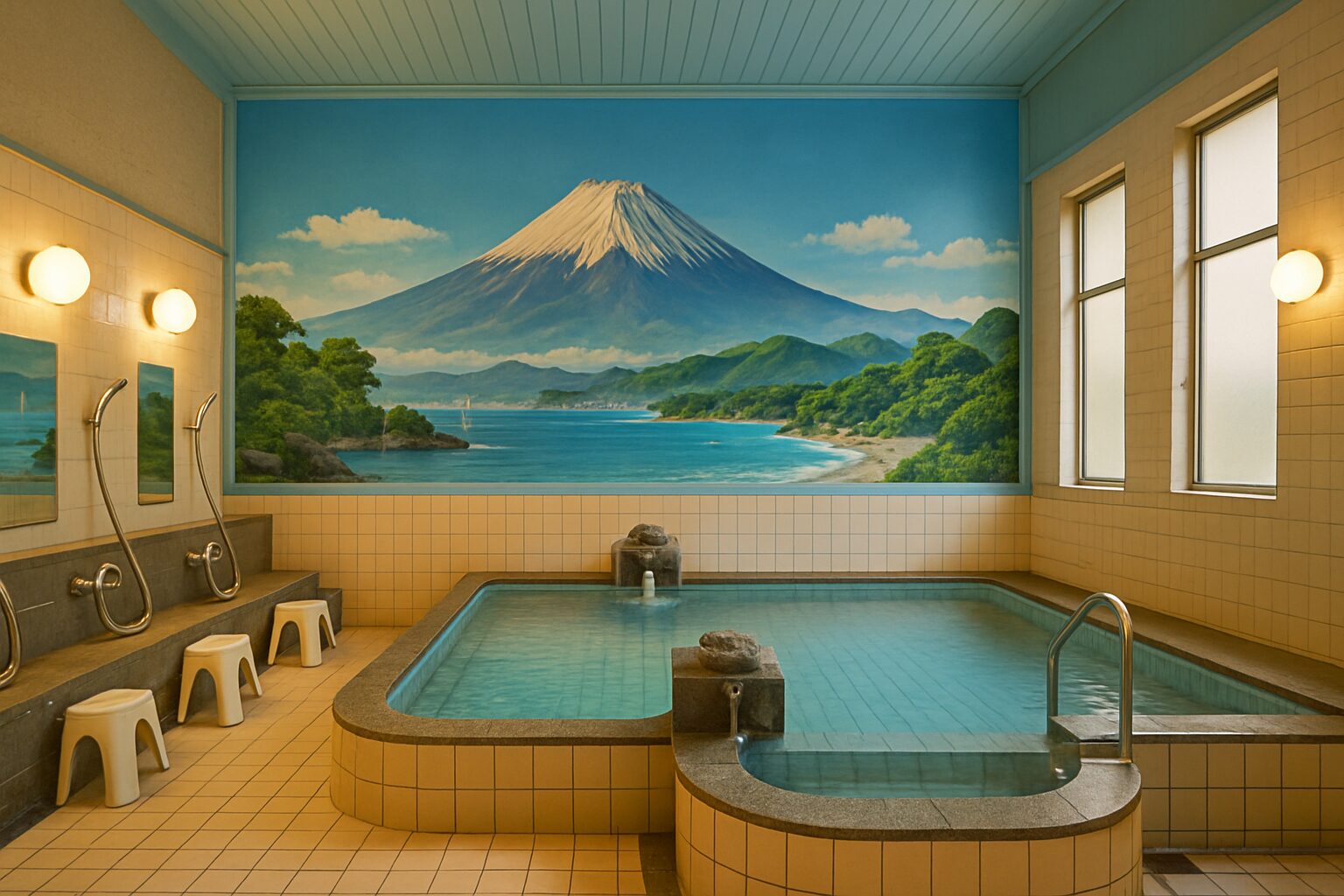
A warm, thick billow of steam welcomes you as you step into the bath hall, or yokujo. The sound of running water surrounds you, a constant, soothing white noise. The room is vast and cavernous, with ceilings so high they seem to vanish into the steam. The walls are tiled, and at the far end, rising above the main baths, is often a magnificent mural. Traditionally, it depicts Mount Fuji, its snow-capped peak symbolizing purity and grandeur, offering a majestic sight to those who may never see the real mountain. In Osaka, you might also find murals showcasing local landmarks like Osaka Castle or other famous landscapes. Before you even think about dipping a toe into the inviting pools of hot water, the most important ritual must be observed. This is the cardinal rule of the sento, the one unbreakable law: you must wash your body thoroughly before entering the baths. The tubs are meant for soaking and relaxing, not for cleaning. To do this, proceed to the arai-ba, the washing area. Here, rows of low-sitting plastic or wooden stools face individual washing stations, each equipped with a faucet, a shower head, and a small bucket or basin called an oke. Take a stool and an oke, find an open spot, and sit down. The stool’s low height is intentional; it prevents splashing onto your neighbors. Turn on the faucet—one tap for hot, one for cold—which you mix in your oke to the temperature you prefer, and begin scrubbing. Use your small towel and soap to wash every part of your body, being mindful of those nearby. When using the shower head, keep it low and aimed toward yourself. The etiquette centers on consideration. This pre-soak wash is more than hygiene; it’s a meditative act. It serves as a moment to transition, scrubbing away the physical and mental residue of the day, preparing you to enter the bath’s pure waters. As you rinse the last of the soap from your body, you are ready. You have followed the rules, shown respect for the space and its patrons, and can now, finally, approach the tubs.
A Symphony of Waters: Exploring the Different Tubs
Now the true pleasure begins. The main bath, known as the shuyoku, is typically the largest and most central tub. The water is hot, usually between 41 and 43 degrees Celsius (106-109°F), which may feel intense at first. The trick is to enter gradually. Sit on the edge, dip your feet in, and use your oke to splash some hot water onto your legs, chest, and shoulders to help your body adjust. Then, slowly, immerse yourself up to your shoulders. The sensation is one of complete relaxation. Every muscle in your body, from neck to toes, seems to loosen simultaneously. The weight of the world, the tension in your shoulders, simply dissolves into the steam. This is the foundational sento experience, but the journey has only just begun. Look around, and you’ll notice various smaller, specialized baths, each providing a unique sensation. You’ll almost certainly find a jetto-buro, or jet bath. These are usually separated for individual use and feature powerful underwater jets targeted at specific body areas. There might be a standing jet that pounds your back, or a reclined seat that massages your lower back and legs. Regulars love these, often grimacing in a blend of pain and pleasure as strong streams unravel deep tension knots. Be patient and wait your turn; it’s well worth it. Then there’s the infamous denki-buro, the electric bath. Yes, that’s right. This bath carries a low-level electric current between two plates on opposite sides of the tub. It is a uniquely Japanese invention, cherished for its ability to soothe deep muscle aches. For newcomers, the sensation is strange—a tingling, vibrating, slightly numbing feeling that can be quite startling at first. Approach cautiously. Enter slowly and absolutely avoid sudden movements. The regulars will quietly chuckle watching a first-timer’s surprised reaction. It’s a rite of passage. Many sento also offer a mizuburo, a small, deep tub filled with cold water. This is not for the faint-hearted, but the health benefits of alternating between hot and cold baths (a practice called onrei-yoku) are legendary. After time spent in the main bath or especially the sauna, plunging into the mizuburo is a shocking jolt to the system that tightens your skin, stimulates circulation, and leaves you feeling incredibly refreshed and energized. If the sento has a sauna, you can sweat out impurities before hitting the cold plunge. Finally, watch for the yakuyu, or medicinal bath. The water here is cloudy or colored, infused with various herbs and minerals that shift with the seasons. In winter, on the solstice, it might be a yuzu-yu, filled with floating, fragrant yuzu citrus fruits. On Children’s Day in May, you’ll find shobu-yu, a bath filled with iris leaves. These seasonal baths connect the sento to natural rhythms and ancient traditions, offering therapeutic benefits and delightful scents. If you’re truly lucky, you may discover a sento with a rotenburo, an outdoor bath. Soaking in hot water under the open sky, perhaps in a small, enclosed garden with a stone lantern and a single maple tree, is the ultimate bathing experience. It is pure bliss.
The Heartbeat of the Neighborhood: More Than Just a Bath
As you move from tub to tub, you begin to realize that the sento is much more than just a collection of pools. It serves as the social hub of the neighborhood. The conversations you catch are a vivid glimpse into Osakan life. Two elderly men, submerged up to their chins in the hot water, might be fervently debating the performance of the Hanshin Tigers. A group of women might be exchanging recipes or chatting about a new shop opening nearby. A father might patiently instruct his young son on the proper way to rinse his stool and bucket after washing. This embodies hadaka no tsukiai, or “naked communion.” Without the shield of clothes and the distinctions of profession or social class, people become more open, relaxed, and true to themselves. Barriers dissolve in the steam. Here, friendships are formed, information is shared, and the community’s social fabric is woven and strengthened day after day. You are not just an anonymous customer; you become a temporary member of the neighborhood family. The regulars are the heart and soul of the sento. There’s the silent old man who claims the same corner of the main bath every day, eyes closed in deep meditation. There’s the cheerful shop owner who visits after closing his store, greeting everyone with a hearty voice. There are groups of obachan who treat the sento as their personal salon, their laughter bouncing off the tiles. Observing these interactions offers a cultural lesson. You witness unspoken rules in practice: people making room for others, offering a slight bow upon entering or leaving a tub, quietly rinsing their spot at the washing station before they depart. It’s a choreographed dance of mutual respect and shared understanding passed down through generations. The sento is a place of learning, where children pick up the values of community and consideration simply by being present. Above it all, the painted Mount Fuji watches silently, a majestic witness to the simple, beautiful everyday drama of life in Osaka.
The Afterglow: Post-Bath Traditions
After you’ve soaked to your heart’s content, your skin tingling and your body feeling as light as a feather, it’s time for the final stage of the ritual. You step out of the steamy bath hall into the relatively cool changing room. Wrapping a large, dry towel around your waist brings immense comfort. Take your time drying off—there’s no need to rush. Many sento have a weigh scale, often a large, old-fashioned mechanical one, where regulars dutifully check their post-bath weight. Once dressed, the experience isn’t quite finished. One of the most cherished post-sento traditions awaits: the celebratory drink. Look for the vintage glass-doored refrigerators humming in a corner of the changing room or lobby. Inside, you’ll find a variety of beverages in classic glass bottles. The undisputed favorite post-bath drink is kohi gyunyu (coffee-flavored milk), closely followed by furutsu gyunyu (fruit-flavored milk). There’s something indescribably perfect about the taste of that sweet, ice-cold milk after a long, hot soak. Popping the paper cap and chugging the bottle, often with one hand on your hip, is a quintessential Japanese experience. For adults, a cold bottle of beer is also a popular and deeply satisfying choice. Many sento feature a small rest area, or kyukeishitsu, attached to the lobby, furnished with a few worn leather sofas or even a raised tatami-mat section. Here, patrons continue conversations, read newspapers or manga, or simply sit in quiet contemplation, savoring the feeling of being completely clean and relaxed. This is the final phase of winding down, a gentle transition back into the world. The TV might still be on, the proprietor chatting with a regular, and the peaceful atmosphere of the bath hall extends into this communal space. It’s the perfect conclusion to a perfect ritual.
Practical Etiquette for a Perfect Sento Experience
To ensure your visit goes smoothly and respectfully, keep a few key etiquette points in mind. Consider them not as rigid rules, but as ways to show your understanding and appreciation for the culture of this shared space. The most important guideline, as mentioned earlier, is to wash your body thoroughly before entering any of the tubs. The next crucial rule involves your small wash towel. While it’s acceptable to use it for modesty when moving between the washing area and the baths, it must never be dipped into the bathtub water. The tub water is for everyone, and the towel is considered unclean. Regular visitors often place their folded towel on their head—a classic sento style—or set it on the tiled edge of the tub. When at the washing station, be mindful of those around you; avoid splashing water on others. After washing, it’s courteous to rinse your small stool and bucket with hot water for the next person. In the tubs, feel free to relax, but refrain from swimming or roughhousing, as it is a place for quiet soaking. If a bath is small and crowded, be considerate of how long you stay. On a sensitive note: tattoos. Traditionally in Japan, tattoos have been linked with the yakuza, or organized crime, leading many bathing facilities (especially large, modern hot spring resorts) to prohibit entry to those with tattoos. However, local neighborhood sento in cities like Osaka tend to be more relaxed. Owners usually care more about your behavior than your skin. Small tattoos are rarely a problem. If you have extensive tattoos and are worried, try visiting during quieter times, be discreet, or use a “tattoo cover seal” available at pharmacies. The best approach is to be polite and respectful, and you will almost certainly be welcomed. Remember, the sento’s spirit is one of inclusion and community.
Finding Your Neighborhood Gem
While there are large, modern “super sento” complexes featuring restaurants and massage chairs, the true charm lies in the small, often family-run sento hidden within residential neighborhoods. Each has its own distinct character, its own community of regulars, and its own unique history. Part of the experience is discovering them. As you walk or cycle through Osaka’s quieter districts, watch for the telltale sign: a tall, slender chimney. This landmark indicates a sento is nearby. Many of these places lack flashy websites or advertising; their presence is maintained through word-of-mouth and the loyalty of local patrons. Neighborhoods like Nishinari, Shinsekai, and the backstreets around Tennoji are known for their high concentration of classic, old-school sento, each with its own story to tell. Don’t hesitate to explore. Push aside the noren of a place that catches your interest. Even if your Japanese is limited, a smile, a polite nod, and a respectful attitude go a long way. The owners are usually happy to welcome a new face, especially one showing genuine curiosity about their culture. Every sento is a bit different. One may be famous for a unique herbal bath, another for stunning, intricate Showa-era tile artwork, and a third for a particularly friendly owner who enjoys chatting with guests. Finding “your” sento—a place that feels like a home away from home—is one of the great pleasures of living in or exploring Osaka more deeply. Each visit unveils a new detail you hadn’t noticed before and brings you closer to the heart of the city.
A Warm Farewell: Carrying the Sento Spirit With You
As you finally retrieve your shoes from the getabako, offer a polite “arigato gozaimashita” to the owner and step back into the cool night air, a deep sense of well-being will envelop you. Your body feels warm and alive with renewed energy, your skin is impeccably clean, and your mind is calm and clear. The sounds of the city seem softer, the streetlights glow a little warmer. This sensation, this post-sento glow, is something you’ll carry with you. The experience goes far beyond hygiene. It is a form of meditation. It represents a direct link to a tradition that has been a cornerstone of Japanese daily life for centuries. It serves as a reminder of the simple yet profound pleasure of warmth, water, and human connection. By taking the plunge, you haven’t just visited a place; you’ve engaged in a ritual that shapes the rhythm of life for countless Osakans. You’ve shared a space where the city lets down its guard and reveals its true, friendly, and unpretentious nature. So, next time you find yourself wandering the streets of Osaka, look for that tall chimney. Listen for the sound of splashing water. Follow the scent of steam. Step through the noren and discover the soul of the city, waiting to welcome you in a warm, inviting pool of water.