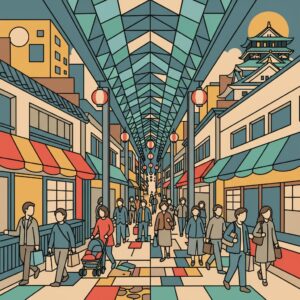
Step off the neon-drenched thoroughfare of any major Osaka district, and wander. Veer into a narrow, smoke-filled alleyway, a ‘yokocho’ where the glow of red paper lanterns, or ‘akachochin’, spills onto the worn pavement. Let your ears guide you toward the clatter of plates, the sizzle of a hot griddle, and the rising crescendo of laughter and spirited conversation. Here, in these unassuming nooks, you’ll find the beating heart of Osaka’s social life: the tachinomi, or standing bar. This isn’t just a place to grab a quick drink; it’s a cultural institution, a communal living room where status is left at the door and human connection is the main item on the menu. For any traveler or resident wanting to move beyond the surface of this vibrant city, understanding the tachinomi is your key to unlocking its true, unfiltered soul. It’s a world that might seem intimidating at first—a whirlwind of unspoken rules and rapid-fire Kansai dialect—but with a little guidance, you’ll not only navigate it but find yourself welcomed into the fold, sharing a drink and a laugh with a stranger who might just become a friend for the night. This guide is your invitation to step inside, find your footing at the counter, and experience Osaka at its most authentic.
If you’re looking for another authentic way to connect with locals beyond the standing bars, consider experiencing the communal atmosphere of an Osaka neighborhood bathhouse.
The Soul of the City: What Exactly is a Tachinomi?
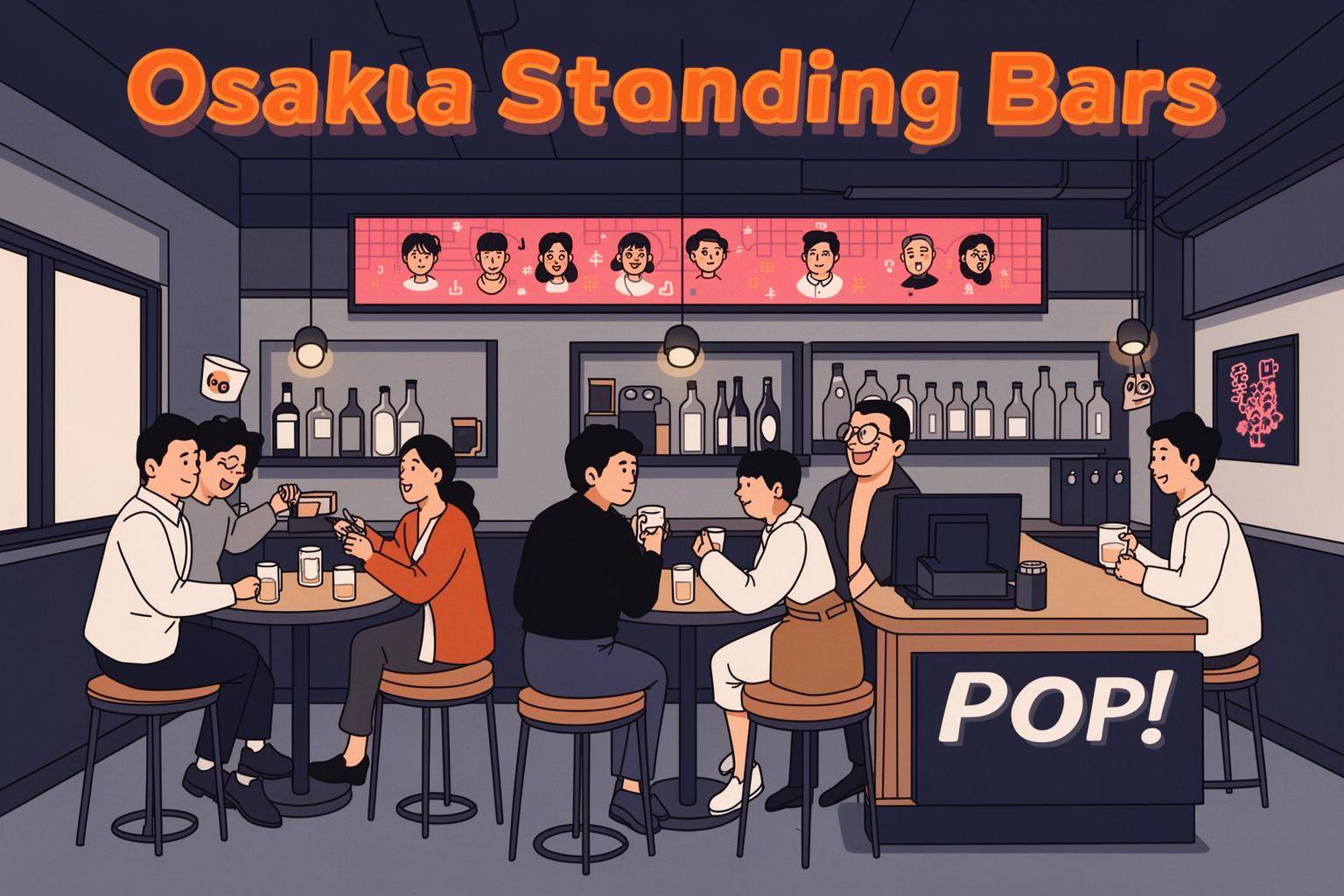
At its most literal, ‘tachinomi’ simply translates to ‘standing-drinking.’ However, this straightforward translation barely captures its deeper cultural meaning. The concept represents a uniquely Japanese response to the urban demands for speed, affordability, and social connection. Think of it as the opposite of a formal, seated dining experience—there are no chairs, no reservations, and often no complications. You come to drink, enjoy a few small bites, and then move on. This tradition has deep historical roots, dating back to the Edo period when sake shops sold drinks by the measure to merchants and laborers who drank on the premises before heading home. It was a pragmatic idea born from a fast-paced society.
The contemporary tachinomi, however, is a lively evolution of this heritage. It flourished in the post-war period as an affordable and cheerful refuge for the working class, and today it spans a wide variety of styles. From gritty, decades-old establishments serving regulars for fifty years to sleek, modern standing bars focusing on craft beer, natural wine, or artisanal sake, they all share one core principle: standing is not a drawback but a benefit. It keeps the atmosphere dynamic and fluid, lowering the social barriers that formal seating arrangements can create, encouraging spontaneous conversation. It acts as an equalizer; a company president might stand elbow-to-elbow with a construction worker, both simply looking to relax.
This setting is also home to the cherished Japanese concept of ‘senbero,’ a blend of ‘sen-en’ (1,000 yen) and ‘berobero’ (drunk or tipsy). The aim—and the fun—of senbero is to see if you can get pleasantly intoxicated for just one crisp 1,000 yen bill. With drinks often starting around 300 yen and small plates, or ‘tsumami,’ similarly priced, tachinomi provides the perfect backdrop for this noble challenge. It’s not about heavy drinking but about a savvy, economical way to enjoy oneself, a point of pride for many Osakans who appreciate practicality and a good bargain.
Reading the Room: The Unspoken Atmosphere of an Osaka Standing Bar
Stepping into a classic tachinomi is a full sensory experience. Even before you see the counter, you’ll be surrounded by a cloud of aromas: the sweet, savory fragrance of ‘doteyaki’ (beef sinew stew) simmering in a deep pot of miso, the sharp tang of soy sauce, the smoky scent of grilled fish, and in many older establishments, the lingering haze of cigarette smoke. This olfactory harmony is the first indication that you’ve arrived somewhere genuine.
Your ears will catch the city’s soundtrack at rest—a steady, low murmur of conversation interrupted by sudden bursts of laughter. Often, the language is the rich, musical Kansai dialect, which can sound louder and more expressive to the unaccustomed ear. Over it all, you’ll hear the rhythmic clinking of glasses, the sizzle of food hitting a hot grill, and the bartender’s gruff yet friendly exchanges. It’s a soundscape of pure, unfiltered community.
Visually, it’s a scene I can only call organized chaos. These spaces are usually very small, sometimes fitting only ten or fifteen people packed along a single wooden counter. Yet there is a flow, an unspoken choreography. Patrons instinctively make themselves smaller, shift and pivot to let others pass, and reach for condiments without invading their neighbor’s space. Though it may appear cramped, it feels communal. You’re not an isolated customer at a table; you are part of a single, transient organism, sharing this tiny pocket of warmth and camaraderie against the vastness of the city outside.
The cast of characters is as diverse as Osaka itself. On a weekday evening, you’ll find groups of salarymen with loosened ties, unwinding after a long day at work. Older gentlemen, the ‘joren-san’ or regulars, occupy their favorite spots at the counter and share a well-worn rapport with the owner. You might spot a young couple on a casual date, or a solo diner quietly enjoying a book and a beer. The bartender, or ‘taisho’ (master), quietly conducts this symphony. Often stoic and efficient, the taisho possesses an almost supernatural talent for managing a dozen orders and conversations simultaneously. Earning a nod of recognition from the taisho is a subtle triumph for any newcomer.
Cracking the Code: The Practical Mechanics of a Tachinomi
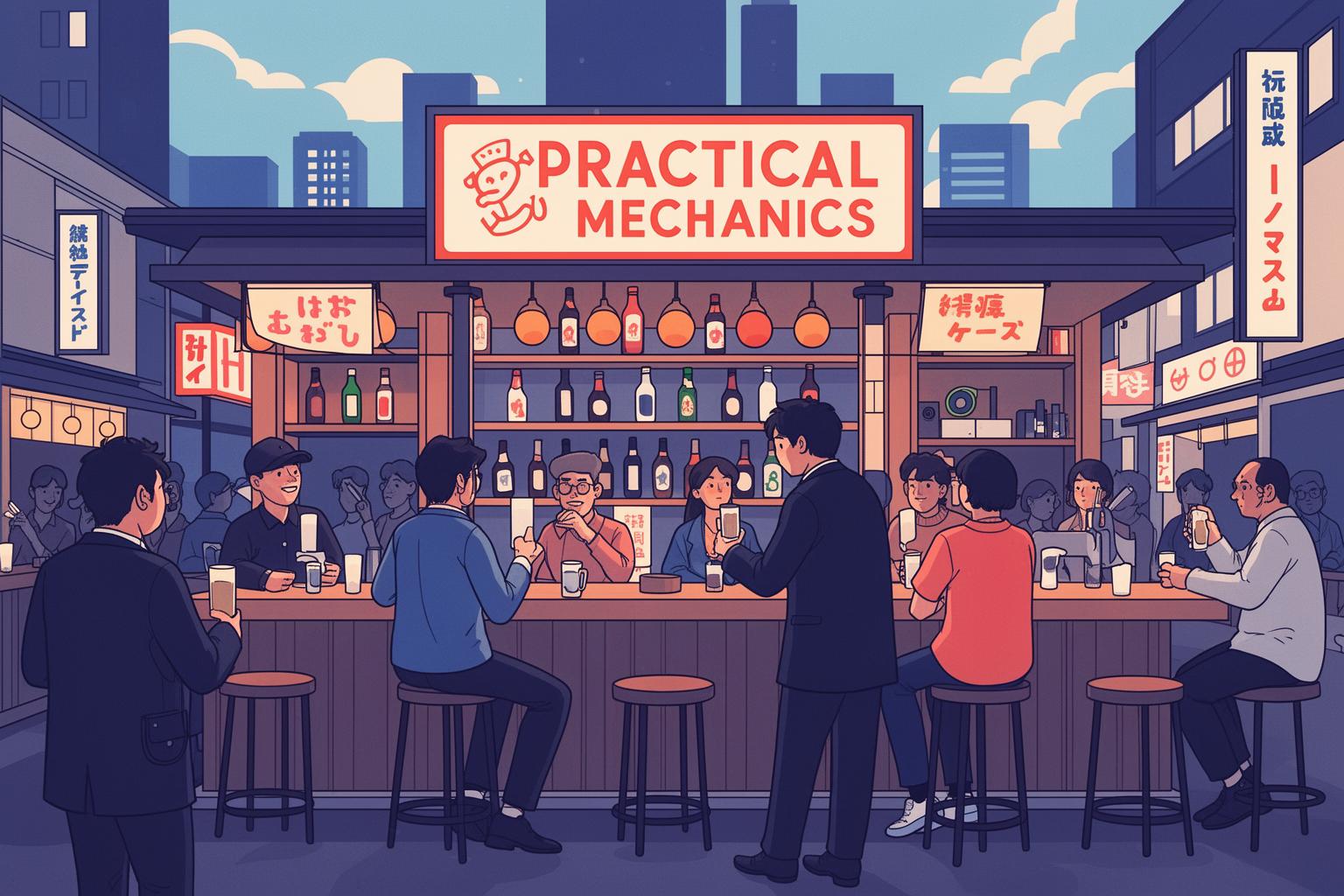
Navigating the functional aspects of a standing bar can feel overwhelming for a first-timer, but the system is based on straightforward, low-key efficiency. The most important step is the first one: entering with confidence. Don’t hesitate awkwardly by the door. Look along the counter for an open spot. If you find a space large enough for one person, step in. It’s perfectly fine to ask your potential new neighbor, “Koko, ii desu ka?” (“Is this spot okay?”). A simple nod and smile are all it takes to claim your place.
Ordering can be a fun challenge. At many traditional tachinomi bars, printed menus don’t exist. Instead, the items are listed on strips of paper called ‘tanzaku’ pasted on the walls. They’ll likely be written entirely in Japanese, sometimes in elegant calligraphy. This is your moment to be bold. You can try to decipher the characters, point to what the person next to you is having, and say “are, kudasai” (“that one, please”), or simply ask the staff for their recommendation by saying, “Osusume wa nan desu ka?” To get their attention, avoid waving or shouting. Instead, catch their eye and say a clear, polite “Sumimasen” (“Excuse me”). They are attentive and will come to you.
One of the most distinctive features is the payment system. In many old-fashioned spots, the common method is ‘cash on delivery,’ sometimes called in Japanized English ‘kyasshu on.’ When you arrive, you place a 1,000 yen bill or some coins into a small tray or bowl on the counter before you. When you order drinks or dishes, the staff will bring them and take the exact amount from your tray, returning any change. This clever system keeps things transparent and allows for a quick exit when you’re done—you simply gather your remaining change and leave. Some bars run a tab instead, where the ‘taisho’ keeps a mental tally of your orders and you pay at the end. The easiest way to know is to observe what the person next to you does. A third, more modern option is a ticket machine, or ‘kenbaiki,’ usually near the entrance. You insert money, press the buttons for what you want, and hand the printed tickets to the staff. It’s less personal but very efficient.
The Unwritten Rules: Mastering Tachinomi Social Etiquette
Beyond the mere act of ordering and paying lies a complex web of unspoken social rules. Mastering these distinctions is what separates a tourist from someone who genuinely understands the culture. The first and most important rule involves personal space. In a crowded bar, you will be close to strangers physically, but there remains an expectation of a personal ‘bubble.’ Keep your elbows tucked in, place your bag on a hook beneath the counter or by your feet, and avoid spreading your belongings around. The counter is a shared space, and everyone deserves their small portion of it. When reaching for communal soy sauce or chili powder, do so swiftly and considerately, returning it to its original spot.
A tachinomi is not meant to be a place to linger for the entire evening. The business model depends on a steady flow of customers. The charm of the experience lies in its brevity. Staying an hour, maybe an hour and a half, is perfectly respectable. This allows you to enjoy a few drinks and snacks before moving on, possibly to another tachinomi for a ‘hashigo-zake’ (bar-hopping) adventure. Overstaying, especially when others are waiting for a spot during busy times, is regarded as bad manners.
The ritual of ‘Kanpai!’ (Cheers!) is a cornerstone of Japanese drinking culture and remains very much alive in standing bars. If your neighbor happens to get their drink at the same time, they might nod and raise their glass. The proper response is to raise your own glass, make eye contact, say “Kanpai!” and gently clink your glass against theirs. It’s a simple yet meaningful gesture of shared experience.
Your relationship with the staff is important. They are not just servers but hosts and experts of their space. Acknowledge them with a nod or a quiet “Konnichiwa” upon arrival. When you are ready to leave, it is customary to say “Gochisousama deshita,” expressing thanks for the meal or experience. This shows respect for their hard work and skill. While being friendly is appreciated, avoid monopolizing their attention with long conversations, especially when the bar is busy. They are managing numerous tasks at once, and their efficiency is part of the experience’s charm.
One common question from Westerners concerns buying rounds. Unlike many pub cultures, buying a drink for a stranger you’ve just met is uncommon. The individualistic and transient nature of the payment system doesn’t encourage it. A much more common and appreciated gesture is to offer a piece of a dish you’ve ordered. For example, if you have a plate of yakitori, you might offer a skewer to your neighbor and ask if they’d like one. Sharing food in this way is a more natural way to break the ice.
From Stranger to Friend: How to Spark a Connection

For many who step into a tachinomi, the ultimate aim is to turn a solo drinking session into a social experience. Fortunately, in Osaka, people are known for being open, friendly, and curious. Starting a conversation is often easier than you might expect. Forget about clever pick-up lines; the simplest, situational openers work best. A sincere compliment about the food your neighbor is enjoying—”Sore, oishii desu ka?” (“Is that delicious?”)—is an excellent way to begin. It’s polite and invites a straightforward, positive reply. Asking for a recommendation is another effective approach: “Nani ka osusume arimasu ka?” (“Do you have any recommendations?”). Locals love sharing their insider knowledge.
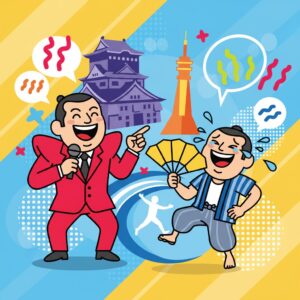
To genuinely connect, you need to understand the distinct character of Osakans. They are famous across Japan for their directness, their fondness for witty jokes (the ‘boke’ and ‘tsukkomi’ comedy style is a local specialty), and their warmth. Don’t be shocked if someone starts with a direct question about where you’re from or cracks a lighthearted joke at your expense. This isn’t impoliteness; it’s a form of friendly interaction. The best reaction is to laugh and join in. A little self-deprecating humor will win their affection instantly.
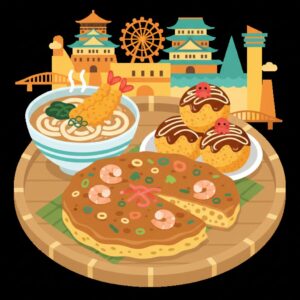
Once the conversation gets going, certain topics are safe bets. People will want to know about your home country and your impressions of Japan, especially Osaka. Showing enthusiasm for local dishes like takoyaki or okonomiyaki is always a hit. But if you want to guarantee an engaged, hour-long chat, learn just two words: Hanshin Tigers. The local baseball team is less of a sports club and more of a religion in Osaka. Asking about the Tigers, even if you’re clueless about baseball, will unlock a flood of local pride and strong opinions.
Even with a language barrier, much can be conveyed non-verbally. Keep an open, friendly posture. Smile. Use gestures. Shared laughter is a universal language. The alcohol naturally acts as a social lubricant, helping to lower inhibitions on both sides. When it’s time to leave, the exit is just as important as the entrance. There’s no need for a long, dramatic farewell. Simply turn to your new friend, offer a slight bow or nod, and say, “Osaki ni shitsurei shimasu” (“Pardon me for leaving before you”). It’s a wonderfully polite and truly Japanese way to say goodbye. The charm of the tachinomi experience often lies in its fleeting nature. You share a moment together, then part ways, leaving nothing but a pleasant memory.
A Culinary Crash Course: What to Order
The variety of food and drinks can be overwhelming, but there are some timeless options that will never let you down. The quintessential first order for any drinking session in Japan is “Toriaezu, nama,” which literally means “For now, a draft beer.” It’s a social custom, a way to start things off without much thought. From there, you can try other staples. The Highball—a simple mix of Japanese whisky and highly carbonated soda served over ice—is extremely popular and refreshing. Another favorite is ‘Chuhai,’ a blend of shochu (a distilled spirit) and flavored soda, with lemon, grapefruit, and oolong tea among the common flavors. Naturally, there is always sake and shochu, which you can order by name or simply request the house recommendation.
The food, known as ‘atemi’ or ‘tsumami,’ is made specifically to accompany alcohol. These are not full meals, but small, flavorful bites. Every tachinomi has its specialty, but some classics to watch for include:
- Doteyaki: A rich, deeply comforting stew of beef sinew slow-cooked in a sweet and savory miso broth. It’s an iconic Osaka dish and a must-try.
- Kushikatsu: Skewers of meat, seafood, and vegetables, breaded in panko and deep-fried to a golden crisp. Remember the golden rule: no double-dipping in the communal sauce container!
- Yakitori/Yakiton: Grilled skewers of chicken (yakitori) or pork (yakiton). From thigh meat to heart to cartilage, there’s a skewer for every taste.
- Oden: A classic winter dish, though available year-round in some places. Various ingredients such as daikon radish, boiled eggs, and fish cakes are simmered for hours in a light, delicate dashi broth.
- Sashimi: Many tachinomi, especially those near markets, pride themselves on the freshness of their raw fish, offering small, affordable plates of the day’s catch.
Your Tachinomi Pilgrimage: Neighborhoods to Explore
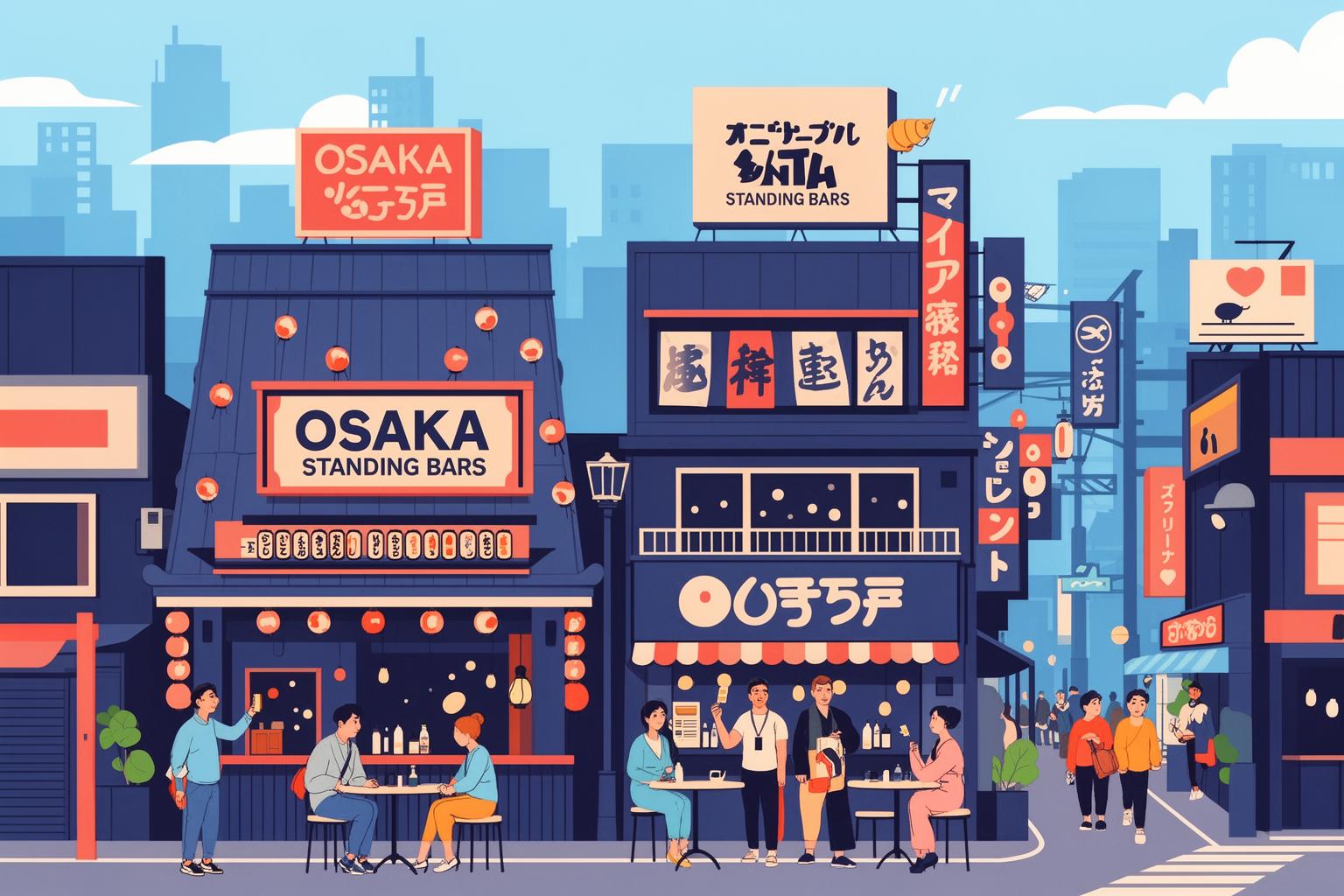
Almost every street in Osaka features a standing bar, but some neighborhoods are renowned for their density and quality. Exploring these districts offers a glimpse into the varied characters of the city’s drinking culture.
- Tenma: Undoubtedly the champion and the sacred ground of tachinomi, the area around JR Tenma Station is a vast network of covered shopping arcades (‘shotengai’) and narrow back alleys, each seemingly packed with more bars than the last. The lively energy here buzzes constantly, making it an ideal spot for bar-hopping where you can visit three or four venues in a single night.
- Namba (specifically Ura Namba): Hidden behind Namba’s main tourist areas is ‘Ura Namba’ or ‘Back Namba’. This neighborhood’s narrower alleys and smaller bars create an atmosphere that feels like stepping back a decade or two. It’s grittier, more intimate, and home to some of the city’s most cherished and long-established bars.
- Kyobashi: A key train hub for commuters, Kyobashi boasts a large and fiercely local tachinomi scene. Many bars here sit directly beneath the elevated train tracks, lending an industrial, no-frills vibe. This is the place to experience the ‘salaryman’ culture in its natural environment—unpretentious, loud, and remarkably affordable.
- Shinsekai: Dominated by the iconic Tsutenkaku Tower, Shinsekai offers a nostalgic and slightly gritty setting that feels like a step back into the Showa Era. Known as the spiritual home of kushikatsu, this area features countless tachinomi establishments serving crispy skewers alongside cheap beer. It’s a sensory feast and a journey back in time.
Final Call: Embrace the Stand-Up Spirit
The tachinomi is much more than just a place to drink. It’s a microcosm of Osaka itself—quick, efficient, welcoming, and deeply human. It serves as a third space, distinct from the stresses of work and the solitude of home, where bonds are formed over inexpensive drinks and simple, delicious food. To newcomers, the crowded environment and unwritten rules might feel like obstacles. But once you grasp the rhythm and etiquette, you’ll discover one of the most inviting and accessible social scenes imaginable.
So, take a chance. Set aside the guidebook, wander down that intriguing alley, and seek out the warm glow of a red lantern. Slide into a narrow spot at the counter. Order a beer, try a dish you can’t pronounce, and raise a ‘Kanpai!’ to the person beside you. You might not have a life-changing conversation. You may only exchange a few polite words. But you will have taken part in a ritual central to the heart of this city. You will have traded the familiar distance of a tourist for the lively, shoulder-to-shoulder closeness of a local. And in Osaka, a city founded on good food, good humor, and good company, there is no greater compliment. The counter is open, and a seat is waiting for you.