The air was crisp, the sky a brilliant, cloudless blue that promised a perfect Kansai morning. I stood at the designated collection point, a small, netted cage at the corner of my street in a quiet residential ward of Osaka. In my hand, I held the city-approved, semi-transparent garbage bag, filled with carefully sorted burnable waste. I had read the pamphlet. I had checked the color-coded calendar. I had tied the bag with the approved, ear-like knots. With a feeling of civic pride, I placed my offering among the others, secured the net against the ever-present threat of crows, and went about my day, confident I had passed a fundamental test of life in Japan. When I returned that afternoon, it was still there. A solitary, rejected monument to my foreign ignorance. Affixed to its side was a small, polite, yet devastatingly stern red sticker. It read, in no uncertain terms, that a violation had occurred. My meticulously sorted trash was now a public declaration of my failure to integrate. This, I would soon learn, is a rite of passage for many newcomers to Osaka. Garbage disposal here is not merely a municipal service; it is a complex social ritual, a neighborhood drama played out at the curb every morning. It is a system governed by a thicket of unwritten rules, enforced not by city officials, but by the ever-watchful eyes of your neighbors. To understand this system is to understand the deep-seated cultural currents that shape daily life in Osaka, a world away from the tourist trails of Dotonbori. It’s about order, responsibility, and the relentless, quiet pressure of the collective.
This experience hints at a broader cultural tapestry where even daily routines are intertwined with local customs, as seen in the subtle art of Ame-chan exchanges that fosters community connection.
More Than Just Rules: The Unspoken Code of the Curb

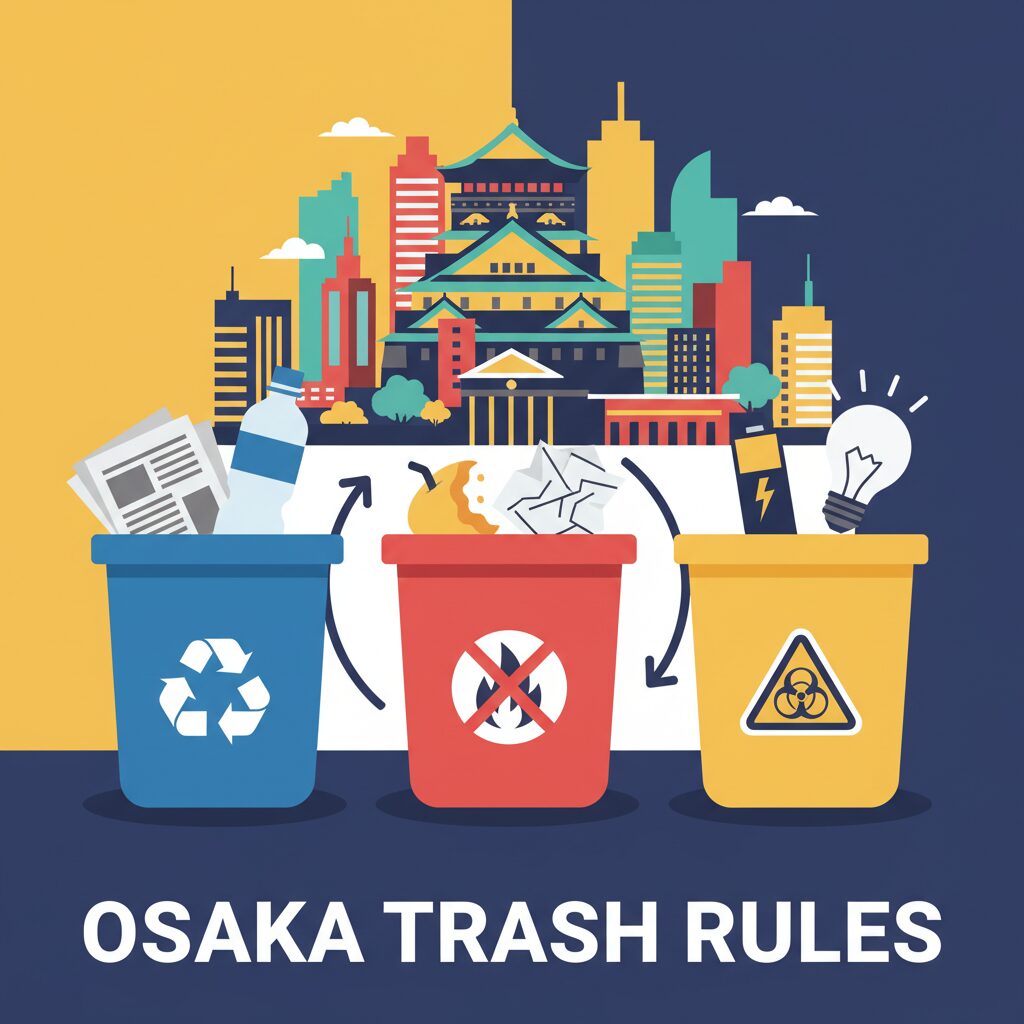
Every ward in Osaka provides its residents with a detailed, often bafflingly complex, color-coded calendar that outlines the comprehensive waste management schedule: burnables on Monday and Thursday, plastics on Wednesday, and cans, bottles, and PETs on Friday. It appears straightforward, just a simple logistical arrangement. Yet this is the first and most widespread misconception. The official guidelines are only the base on which a far more intricate web of social expectations is constructed. These unwritten rules hold the real weight, as they decide whether your bag is collected or left behind as a mark of public shame.
The Tyranny of the Clock
While the calendar specifies the day, the unwritten rule governs the time. Collection trucks usually arrive between 8:30 and 9:00 AM. However, this does not imply you can place your trash out at 8:15. The firm, universally understood deadline is 8:00 AM. Putting out garbage the night before is a grave offense. It is perceived as unsightly, attracting nocturnal animals and the city’s clever crows. It clutters the sidewalk and, in the humid summer months, causes unpleasant odors. It signifies negligence and disrespect for the shared street appearance. On the other hand, rushing to the collection point at 8:05, just as your neighbor returns from their morning walk, is just as forbidden. The window has closed. Adding your bag to the pile after the silent cutoff disrupts the community’s established rhythm. The proper routine is to wake, prepare your refuse, and make the short trip to the collection spot between sunrise and 8:00 AM—a quiet morning ritual shared with your neighbors.
The Sacred Net
In many areas, particularly those with detached homes and small apartments, the collection point is shielded by a large, weighted green or blue net. This isn’t optional. It is an essential piece of civic infrastructure in the ongoing battle against crows, which are intelligent, relentless, and astute in targeting weakly secured bags. The unspoken rule involves technique: you don’t just toss your bag into the enclosure and fling the net over it. Instead, you lift the net, place your bag neatly beside the others, then carefully lower the net, ensuring its weighted edges lie flat on the ground with no gaps. The entire pile’s protection is a collective responsibility. If one bag is left exposed, a crow will tear it open and scatter its contents across the street. When that happens, it’s clear who last used the net. The ensuing silent judgment is unmistakable. The failure is collective, but the blame falls on the one careless with the community’s main defense.
The Ritual of Rinsing
The city instructs residents to rinse plastic containers, PET bottles, and cans before disposal. To many foreigners, this seems like a courteous request for the especially conscientious. In Osaka, it is a firm rule. This isn’t just about ensuring recyclables arrive pristine at the processing plant, although that matters. It is an act of respect for your neighbors and sanitation workers. Unrinsed yogurt containers, soy sauce bottles, and beer cans attract pests and cause foul odors, especially in the hot, humid summer. Putting an unwashed item in the recycling bin forces others to endure the smell of your leftovers—it’s the olfactory equivalent of blasting loud music late at night. The standard is exacting: remove the PET bottle label, wash and dry the inside, and crush it to save space. For plastic bento boxes, wash off oil and sauce residue. This small, private labor signals your dedication to the public good. Your recycling should never smell or be sticky; it should be a clean, orderly collection of materials that testifies to your conscientiousness.
The Neighborhood Watch: Who Are the Garbage Guardians?
The enforcement of this complex system does not rely on uniformed city inspectors issuing fines. Instead, it comes from within the community itself—a decentralized network of surveillance that turns every resident into both a guardian and a potential violator. This is the panopticon of the trash station, where the simple act of taking out the garbage becomes a demonstration of social conformity.
The Gomi Tōban
Central to this system is the gomi tōban, or garbage duty person. This is not a formal occupation but a rotating responsibility assigned to households by the local neighborhood association, the chōnaikai. The tōban‘s tasks are straightforward yet significant. They are the first to arrive at the collection point in the morning, unlocking the cage or setting out the net. They are the last to leave after the truck has come, sweeping up any stray litter and ensuring the area is spotless. Importantly, they act as the primary inspectors. They hold an unspoken authority to check the garbage bags. If a bag seems too heavy for burnables, hinting at a hidden can or bottle, they may give it a squeeze. If they notice the shape of a prohibited item through the semi-transparent bag, they have the right to investigate. They are the ones who apply the red sticker of shame. This is not done out of spite but seen as their duty to educate and uphold the community’s standards. A violation reflects not only on the individual but on the entire neighborhood block.
The All-Seeing Obachan
Even on days when they are not officially on duty, the neighborhood elders—especially the retired women, or obachan—serve as the informal enforcers of the rules. From their balconies, their front windows, or during their morning walks, they observe everything. They know the neighborhood’s rhythms and recognize who places their trash out too early, whose plastic containers are inadequately washed, and who regularly overfills their bags. Their enforcement is typically more subtle than the red sticker. It may come in the form of a casual remark: “Ah, Tanaka-san, the truck comes on Friday for bottles, you know.” It is a gentle yet firm reminder conveyed with a smile that emphasizes the seriousness of the matter. For a foreigner, gaining the approval of these guardians is essential. A polite morning greeting, a sincere effort to follow the rules, and a humble, teachable attitude can turn them from strict judges into helpful guides who might even offer friendly advice on how to properly bundle your cardboard.
Why So Strict? The Cultural Roots of Collective Cleanliness
This intense focus on something as ordinary as garbage may appear baffling or even oppressive to an outsider. However, it is not arbitrary; it represents the modern expression of deeply rooted historical and cultural values of collective responsibility and the supreme importance of public harmony. As a historian, I observe clear parallels with pre-modern social structures that still resonate in the alleys of Osaka today.
Echoes of the Gonin-gumi
During the Edo period, Japanese society was organized into gonin-gumi, or groups of five households. These units were collectively accountable for the behavior, taxes, and security of their members. If one household broke the law or neglected its duties, the other four were held responsible as well. This system cultivated a strong sense of mutual obligation and vigilance. Although the gonin-gumi no longer officially exist, their underlying mentality endures in the modern chōnaikai and the unwritten rules governing neighborhood life. Your garbage is not simply your garbage; it reflects on the entire block. A disorderly collection point is a collective failure. Thus, it is everyone’s concern to ensure that each individual meets the standards. This is not about being intrusive; it is about preserving the integrity of the group.
Osaka’s Pragmatic Harmony
While the notion of group harmony, or wa, is foundational throughout Japan, it takes on a particularly practical character in Osaka. As a long-standing city of merchants, where reputation, reliability, and smooth cooperation were vital for business and survival, maintaining a clean and orderly environment was a practical necessity. It helped prevent disease, kept pests away, and projected a respectable image to the outside world. This pragmatic approach continues today. The strict rules exist because they are effective, resulting in a city that is remarkably clean. The Osaka style can feel more direct and less formal than in Tokyo. In a large Tokyo apartment complex, a sterile notice from the building management might be the only corrective measure. In an Osaka neighborhood, however, your neighbor is more likely to tell you directly—but politely—that you have made a mistake. This is a more personal, and arguably more effective, form of social control.
A Foreigner’s Survival Guide to Osaka Trash
Navigating this system may feel intimidating, but it is certainly achievable. It requires careful observation, humility, and a willingness to view the process not as a burden, but as a form of cultural communication. Mastering the art of trash disposal is the key to gaining a deeper understanding of your new home.
Become a Student of the Curb
Your greatest asset is observation. During the first few weeks, become a garbage detective. Watch your neighbors closely. When do they take out their bags? How do they carry them? Notice how they fold cardboard boxes and tightly bundle newspapers with string. Look inside their transparent recycling bags. Observe how clean the plastic trays are and how bottles are crushed. Imitate their actions precisely. The goal is to blend in, making your bag indistinguishable from the rest. This is not about losing your identity, but about showing respect for local customs.
Decode the Sacred Texts
The garbage calendar from the ward office is your bible. Do not lose it or disregard it. Pin it to your refrigerator and take a photo of it on your phone. Study its symbols and colors until you understand them instinctively. Pay close attention to special cases: rules for oversized garbage (sodai gomi), specific instructions for disposing of cooking oil or batteries, and schedule changes on national holidays. If your Japanese is limited, ask a friend or use a translation app to decode every detail. Ignorance of the law, whether written or unwritten, is no excuse.
Embrace Humility and Ask for Help
When you inevitably feel confused, holding a strange piece of packaging and unsure if it is plastic or burnable, the worst choice is to guess. The risk of public mistakes is too high. Instead, embrace humility. Approach a neighbor, perhaps one of the obachan you greet each morning. A simple, “Sumimasen, kore wa dochira desu ka?” (“Excuse me, which category is this?”) while showing the item will almost always be met with a helpful, often surprisingly detailed explanation. Asking does two things: it resolves your immediate confusion and signals to the community that you are making an effort. This effort is noticed and valued far more than silent, error-prone compliance.
The Payoff: The Beauty of a Spotless Street

The initial frustration and anxiety eventually give way to a deep appreciation for the system. The reward for such diligence is the environment it maintains. Walk down any residential street in Osaka at 10:00 AM on collection day. There is no sign of the morning’s activity. The nets are gone, the cages locked, and the pavement spotless. There are no overflowing public bins, no lingering odors, no scattered litter. The contrast with many other major cities worldwide is striking.
This shared daily ritual, despite its strictness, nurtures a profound and lasting respect for public space. It reinforces the notion that the street outside your home is an extension of your living room, a space cared for collectively. Participating in this system correctly is a quiet yet powerful statement: “I am part of this community. I respect our shared space. I am doing my part.” Mastering Osaka’s garbage rules is more than sorting plastic from paper; it is an education in the complex, often unseen social mechanics that enable a city of millions to operate with such impressive grace and order. It is a frustrating, humbling, and ultimately rewarding journey into the very essence of living in Osaka.