It was a Tuesday afternoon in the belly of the Tenjinbashisuji Shotengai, a seemingly endless covered arcade that serves as Osaka’s commercial aorta. I was standing in front of a vegetable stand, contemplating a row of daikon radishes with the kind of intense focus only a foreigner trying to master Japanese home cooking can muster. They all looked vaguely the same: large, white, vaguely intimidating. As I reached for one, a hand, weathered and swift, shot out from my right and clamped down on my wrist. I turned to see a woman, perhaps in her late seventies, with a tightly permed hairdo and an expression of profound disapproval. “Anata, sore ja nai,” she declared, her voice a gravelly mix of certainty and concern. Not that one. She released my wrist, picked up a different daikon—one that looked identical to my untrained eye—and thrust it into my hands. “Kocchi no ho ga oishii.” This one is tastier. She then tapped the green leaves sprouting from the top. “Kono ha wa, misoshiru ni irenasai.” Put these leaves in your miso soup. And just like that, she was gone, swallowed back into the river of shoppers. I was left standing there, holding my superior radish, feeling a strange cocktail of confusion, slight embarrassment, and an unexpected warmth. I had just been the recipient of classic Osaka ‘osekkai’.
‘Osekkai’ is a word that defies simple translation. Dictionaries will offer you “nosy,” “meddlesome,” or “officious,” all of which carry a distinctly negative charge. And to be sure, at first glance, it feels exactly like that: an unsolicited intrusion into your personal affairs. A stranger on the train platform tells you your bag is unzipped. The cashier at the supermarket questions your choice of instant curry, pointing to a different brand that’s on sale. A neighbor you’ve never spoken to before stops you to ask why you’re putting the trash out on the wrong day. For anyone raised in a culture that prizes personal space and polite distance—be it London, New York, or even Tokyo—these encounters can feel abrasive, condescending, or just plain weird. You find yourself wondering, “Why do you care?” But in Osaka, that’s precisely the point. They do care. ‘Osekkai’ is not born from a desire to criticize, but from a deeply ingrained sense of communal responsibility and a pragmatic belief that there’s no point in watching someone make a mistake, however small, when you can easily step in. It is the social glue of the city, a direct, unfiltered, and often surprisingly tender form of communication. It’s the city’s operating system, running in the background of every market, train station, and neighborhood street. To live in Osaka is to learn to navigate this system, to understand that what feels like an invasion of privacy is often an invitation to connect. This is not a city that stands on ceremony; it’s a city that reaches out and grabs you by the wrist, all to make sure you go home with the very best daikon.
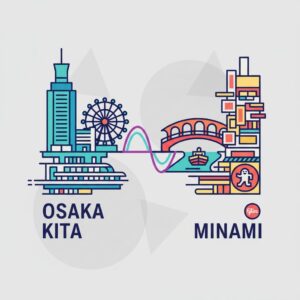
This unique social fabric is also reflected in the distinct personalities of Osaka’s Kita and Minami districts, which shape the city’s daily rhythms and residential character.
The Anatomy of an ‘Osekkai’ Encounter
To truly understand ‘osekkai,’ you need to break it down and grasp its component parts as they unfold in real time. These encounters, though diverse, usually follow a familiar, rhythmic pattern. They are micro-dramas enacted on the stage of everyday life—brief but powerful exchanges that reveal the character of the city. For newcomers, they can be surprising. However, once you recognize the structure, you can begin to appreciate the performance and even learn to take part. An ‘osekkai’ exchange is seldom a single, isolated remark; it is a multi-act play, a social dance with clear steps that swiftly moves from public observation to personal connection.
The Opening Salvo: Unsolicited Advice
Every ‘osekkai’ interaction starts with an intervention. It’s the moment when the invisible barrier between strangers is broken by a direct, practical, and completely unsolicited piece of advice or correction. This is the part that outsiders often label as “nosy.” You are at a subway ticket machine, staring blankly at the map, and a salaryman on his way home physically guides your hand to the right button. You struggle to open a notoriously complicated plastic package in a convenience store, and the clerk comes from behind the counter to show you the proper technique. You wear a new coat on a chilly day, and an elderly woman at the bus stop gravely warns you that you aren’t dressed warmly enough and risk catching a cold. This advice almost always stems from pragmatism and efficiency. Osaka, a city shaped by merchants, values practicality, effectiveness, and avoiding waste—of time, money, and effort. When someone tells you you’re buying the wrong fish, it’s not a judgment of taste but a public service announcement about a fresher, cheaper, or more seasonal option. They see a fellow citizen headed toward a less-than-ideal outcome, and the collective instinct is to correct the course. It reflects a common reality and a belief that we all face similar daily challenges—and so knowledge gained by one should be shared freely with all. It’s not about asserting superiority but about passing along a shortcut or life hack born from experience.
The Follow-Up: Personal Questions
Right after the initial intervention, the interaction often shifts—from practical matters to personal ones. The advice has done its job; it has opened a channel of communication. Now comes the information-gathering stage. Having briefly connected, the Osakan will often ask a series of questions that may seem startlingly direct by other cultural standards. “Where are you from?” is typical. But this can quickly escalate to “What do you do for work?” “Are you married?” “Do you have children?” and the question that often unnerves foreigners, “How much do you pay for rent?” From a Western standpoint, this can feel like an interrogation, an invasion of privacy. Topics such as salary, rent, and marital status are usually off-limits. But within Osaka’s ‘osekkai’ culture, this isn’t idle curiosity. It’s a rapid, almost systematic social mapping process. The questioner seeks to understand who you are and where you fit into the local landscape. Knowing your job, neighborhood, and family situation helps them build a mental profile. It allows them to find common ground, to relate your experience to their own or someone they know. It’s a quest for context. If you say you’re a teacher, they might share a story about their grandson’s teacher. If you mention you live in Tenma, they’ll immediately offer an opinion on the best takoyaki stand nearby. This isn’t gossip gathering; it’s a way of weaving you, the stranger, into the city’s social fabric. It’s their way of saying, “You are not just a face in the crowd. I’m trying to see you.”
The Closer: The Unexpected Gift
Many ‘osekkai’ encounters end with a small, symbolic gesture of goodwill. This act transforms the entire exchange, casting the initial intrusion in a warm light of sincerity. It is part of the well-known ‘amechan’ culture, where older women, or ‘obachan,’ always seem to have an endless supply of hard candies in their purses, ready to offer to crying children, helpful strangers, or anyone in need of a little boost. But it goes far beyond candy. The greengrocer who just advised you on the best tomatoes might toss an extra one into your bag for free, a practice called ‘omake.’ The owner of a tiny eatery where you stopped for lunch may hand you a bottle of tea for the road. The neighbor who scolded you about garbage day might show up later with a plate of homemade pickles. This closing gesture is vital. It physically manifests the connection that has just been formed. It smooths over any tension caused by direct advice or personal questions. It silently confirms that the interaction was grounded in kindness, not criticism. It says, “We’ve shared a moment. We’re now part of the same community. Here’s a token of our new relationship.” It’s a small, sweet, deeply human gesture that leaves you feeling not meddled with but welcomed.
‘Osekkai’ in the Wild: The Natural Habitats of Meddlesome Kindness
While ‘osekkai’ can occur anywhere at any time, there are specific environments in Osaka where it thrives—ecosystems where the soil is especially fertile for unsolicited advice and communal interaction. These are the places where the city’s spirit pulses most strongly, where the boundaries between public and private dissolve, and where everyday life plays out in its most vivid form. To truly understand Osaka, you must immerse yourself in these spaces, not as a mere observer, but as an active participant in the ongoing drama of ‘osekkai’. They serve as testing grounds for any non-Japanese resident, venues where you can see the culture in its purest state and eventually learn how to engage with it.
The Shotengai: The City’s Living Room
The shotengai, or covered shopping arcade, is the quintessential stage for Osaka’s ‘osekkai’ culture. Arcades like Tenjinbashisuji, the longest in Japan, or the bustling Kuromon Market are not just commercial corridors; they function as the city’s collective living rooms. They are loud, crowded, and deeply human. Here, commerce is inseparable from conversation. Shopkeepers don’t merely sell goods; they engage you, question you, and offer advice. You can’t just buy a piece of mackerel at a fishmonger’s stall—the transaction often involves a detailed inquiry into your dinner plans. “How will you cook this?” the owner asks, wiping his hands on his apron. If your answer is unsatisfactory, you’ll receive a firm yet friendly lecture on the proper method, which might involve simmering it with miso or grilling it with salt. This lesson might be supplemented by remarks from other customers waiting in line. “He’s right,” an older woman might say. “But don’t forget the ginger. You must have ginger!” In the shotengai, your personal business becomes public conversation, a subject for open discussion and collaborative problem-solving. Vendors and regular customers form a close-knit community, and when you enter their space, you are temporarily embraced within it. The divide between vendor and customer, as well as between customers themselves, is remarkably thin. It’s a place where you are seen not as an anonymous buyer, but as a neighbor in need of guidance in choosing the right vegetables for a stew. This steady, low-level public intimacy is what makes the shotengai the vibrant heart of ‘osekkai’.
The Sento: The Public Bathhouse
If the shotengai is the city’s living room, the sento, or public bathhouse, is its communal bathroom. Few places in the world foster such a radical form of equality. Stripped of clothes, status, and pretense, everyone is reduced to their shared humanity. This collective vulnerability fosters an atmosphere of remarkable openness, making the sento a hotbed of ‘osekkai’. As a foreigner, you often attract particular interest. You might have your bathing etiquette corrected with surprising bluntness. An elderly man may silently reposition your washbowl, demonstrating the proper way to rinse off before entering the main bath. A grandmother might gently chide you for bringing your small modesty towel into the tub. These acts are not hostile but serve as lessons in communal living, ensuring the shared space stays clean and pleasant for all. Once these basic rules are understood, the sento becomes a place for deep, wandering conversations. The hot water loosens tongues as well as muscles. People share intimate details—their children’s stories, health complaints, memories of old Osaka—with a candor rarely found elsewhere. Here, ‘osekkai’ transcends advisory roles and becomes a form of shared therapy, a means for people to connect and unburden themselves in a warm, steamy, profoundly human space.
The Standing Bar: Tachinomi Culture
Osaka’s tachinomi, or standing bars, provide yet another distinctive setting for ‘osekkai’ to flourish. These small, no-frills establishments—often hidden in labyrinthine passages beneath train tracks—host patrons standing shoulder-to-shoulder, eating and drinking after work. With no chairs, private tables, or personal space, this close proximity combined with the loosening effect of alcohol creates an intense, albeit temporary, camaraderie. The social rule is simple: standing at the same bar means you’re part of the same conversation. A salaryman might lean over to ask what you’re drinking, then insist you try his favorite sake. If a Hanshin Tigers baseball game is on the small TV in the corner, your opinion on the team’s performance will be eagerly sought, regardless of your sports knowledge. Conversations are brief but intense. You might learn a man’s whole life story in the fifteen minutes it takes to finish a beer, then never see him again. Here, ‘osekkai’ is less about practical advice and more about social inclusion. It’s a way of drawing you into the bar’s fleeting community. By asking questions, offering you morsels from their plate, or including you in a round of cheers, other patrons actively resist big city anonymity. For the price of a drink, you gain a brief but genuine sense of belonging.
The Historical and Economic Roots of ‘Osekkai’
To truly grasp the deep-rooted nature of ‘osekkai’ in Osaka, one must look beyond present-day exchanges and explore the city’s distinctive history. This is not merely a modern eccentricity; it is a cultural DNA, shaped over centuries of commerce, community, and comedy. As a historian, I find the origins of this behavior captivating, as they unveil a social logic perfectly suited to Osaka’s role as Japan’s hub of trade and national kitchen. The city’s pragmatic, straightforward, and community-centered mindset did not arise by chance; it was a survival strategy forged amid a thriving merchant environment.
The Merchant City: A Culture of Negotiation and Trust
For much of its history, Osaka served as Japan’s commercial core. While Edo (modern Tokyo) was home to the samurai government, with its strict hierarchies and formalities, Osaka was the ‘tenka no daidokoro’—the nation’s kitchen. It was a city of merchants, artisans, and financiers where success hinged not on noble birth or protocol, but on shrewdness, practicality, and above all, trust. Business in Osaka thrived on personal relationships. Deals were often sealed not by detailed contracts, but with a handshake and mutual understanding. Building this kind of trust required quickly and accurately gauging one’s counterparts. There was no room for the nuanced, indirect communication favored by samurai; instead, one had to assess a person’s character, honesty, and reliability head-on. This nurtured a culture of frankness. ‘Osekkai’ can be seen as a direct outcome of this merchant ethos; the personal questions and candid advice are ways to cut through social pretenses and get to the core of the matter and the individual. A merchant witnessing a peer making a poor deal wouldn’t stand by politely—intervention was essential, as losses for one could ripple through the entire community. This spirit of shared interest and blunt honesty became embedded in the city’s social fabric, extending well beyond the marketplace. It reflects a belief that plain speaking, even if intrusive, is ultimately more sincere and helpful than polite silence.
Community Over Formality: Surviving Together
In historical Osaka, daily life was lived in close quarters. Many residents inhabited ‘nagaya’, long wooden row houses where families occupied small, connected units often sharing resources like wells and toilets. Privacy was a scarce luxury. In this context, neighbors’ affairs were quite literally shared matters. You could overhear their arguments, smell their cooking, and know when they were ill or struggling. Such close proximity fostered a vital, and necessary, sense of communal interdependence. Survival depended on mutual care. ‘Osekkai’ functioned as the mechanism for this mutual support. Asking a neighbor if they were eating well was not prying; it was a sincere check on their health, since illness could affect the entire row. Reprimanding a neighbor’s child playing dangerously in the street wasn’t meddling; it was collective responsibility for the safety of all children. This culture of shared care, born from the dense urban fabric of the past, endures. Although most Osakans no longer live in ‘nagaya’, the core principle remains: we are in this together, and your well-being is linked to mine. Today’s ‘obachan’ correcting your daikon choice channels generations of ancestors who knew that a strong community depends on people stepping in to help one another, even without being asked.
The Comedy Gene: Humor as a Social Lubricant
Osaka’s culture cannot be discussed without highlighting its central role in Japanese comedy, especially ‘manzai’. Manzai—a rapid-fire stand-up performed by a duo—features the ‘boke’ (the foolish or funny one) and the ‘tsukkomi’ (the sharp-witted straight man). A key part of the ‘tsukkomi’s’ role is to highlight the ‘boke’s’ absurdities and mistakes with quick, often physical, and always witty retorts. This comedic rhythm is deeply ingrained in Osakan communication. ‘Osekkai’ interactions often take on the spirit of ‘tsukkomi’. The intervention is direct and critical but frequently softened with humor or playful exaggeration. The person offering correction isn’t just dispensing advice; they are performing a social role, playing the ‘tsukkomi’ to your temporary ‘boke’. This transforms potentially uncomfortable or offensive moments into lighthearted exchanges. Laughter acts as a social lubricant, enabling remarkable directness without causing offense. When you learn to appreciate the humor in these moments and laugh at yourself alongside the adviser, you begin to understand the true essence of ‘osekkai’. It is serious advice delivered with a smile, a correction inviting you to share the joke. This unique blend of pragmatism and playfulness is what makes Osaka’s style of intervention so distinctive.
The Osaka vs. Tokyo Divide: A Tale of Two Social Contracts
For many foreigners living in Japan, the cultural differences between Osaka and Tokyo represent the country’s most striking internal contrast. Though only a short bullet train ride separates the two cities, their social dynamics are fundamentally different. Understanding Osaka’s ‘osekkai’ culture is impossible without comparing it to Tokyo’s prevailing social ethos. This comparison reveals not only regional quirks but two distinct philosophies on how to navigate public space and engage with strangers. It’s a classic contrast of direct interaction versus subtle observation, and where you feel more at ease often reflects your own cultural background.
Tokyo’s ‘Kuki wo Yomu’: Reading the Air
In Tokyo, the key social skill is ‘kuki wo yomu’, literally meaning “reading the air.” It involves intuitively grasping the situation, understanding unspoken norms, and sensing others’ feelings and intentions without explicit communication. Social harmony, or ‘wa’, is paramount, achieved by minimizing conflict and avoiding imposition. In this setting, unsolicited advice is a significant breach of etiquette. Offering it suggests the other person is incapable, that you believe you know better, and that you’re willing to disrupt harmony for your own ego. The ideal is to be self-reliant and grant others the same respect. If someone struggles, the Tokyo approach is to wait for them to request help or offer assistance in a subtle, indirect way that allows them to refuse without losing face. One’s personal bubble is sacrosanct. Communication is layered and nuanced; often, what goes unspoken matters more than what is said. This creates an atmosphere of polite, orderly, and often comfortable anonymity. For many, this feels reassuring; for others, it can seem cold and isolating.
Osaka’s ‘Kuki wo Tsukuru’: Creating the Air
Where Tokyo is about reading the air, Osaka focuses on ‘kuki wo tsukuru’—creating the air. Osakans are less concerned with passively interpreting social cues and more inclined to actively shape them. They achieve this through humor, direct questions, and naturally, ‘osekkai’. The assumption is not that everyone should be left alone, but that everyone potentially belongs to the same conversation. Harmony is maintained not through silent deference but through active, good-natured engagement. Silence isn’t regarded as polite; rather, it can be seen as aloof or unfriendly. The Osakan social contract relies on participation. By stepping in when someone struggles with a ticket machine, they’re not pointing out incompetence; they’re fostering a shared moment, however brief. They create the air, transforming silent individual struggle into lively communal problem-solving. This approach values the collective’s well-being and efficient goal achievement over preserving each individual’s pristine personal bubble. It’s a louder, messier, and more chaotic social model, but one that actively combats urban isolation.
A Foreigner’s Misinterpretation
This difference is where misunderstandings often arise. A foreigner arriving in Osaka, especially after time in Tokyo or from a Western culture valuing individualism, may be predisposed to view ‘osekkai’ as intrusive or critical. When a stranger publicly corrects your Japanese pronunciation, your first reaction might be shame or embarrassment. You hear, “You are wrong.” Yet the Osakan speaker is often expressing something quite different: “I want to help you communicate better. I’m investing a moment of my time because I see you’re trying to join our world.” When a shopkeeper questions your purchase, you might feel patronized, hearing, “You’re making a foolish choice.” The intended message is often, “I have local knowledge you don’t, and I want to share it so you can have a better experience and save money.” The key is to reframe the intention. ‘Osekkai’ is rarely about exclusion or highlighting your otherness. It is, in its own unique and sometimes awkward way, an act of inclusion. It attempts to pull you out of your foreign bubble and into Osaka’s lively, interconnected society.
How to Navigate ‘Osekkai’ and Turn It into Friendship
Grasping the theory behind ‘osekkai’ is one thing; learning to handle it gracefully in the moment is quite another. For many newcomers, the initial response tends to be defensive. We bristle at what feels like criticism, pull away from personal questions, and feel uneasy about unexpected gifts. Yet, resisting ‘osekkai’ is like swimming against a current; it’s tiring and ultimately pointless. The real skill lies not in resistance but in learning the dance steps. By responding in a way that honors the spirit of the exchange, you can turn these potentially awkward moments into foundations for genuine relationships and deeper integration into local life.
Rule One: Don’t Take It Personally
The most crucial advice for navigating ‘osekkai’ is to separate yourself from the interaction. The comment is rarely about you personally; it’s not an assessment of your intelligence, character, or worth. The focus is almost always external—on the task at hand, the item you’re buying, or the situation you’re in. When someone points out you’re holding your chopsticks wrong, they’re addressing your grip, not your essence. When they say your route is inefficient, they’re critiquing the path, not your life choices. Take the advice as what it is: practical information freely given, based on local knowledge. The Osakan mindset tends to be pragmatic. There’s a right and wrong way to do many small things, usually the most efficient or economical way. By sharing this info, they’re simply helping you navigate their shared environment better. Recognizing this keeps the information separate from your ego, letting you accept, decline, or simply thank them without feeling hurt.
Rule Two: Respond with Gratitude and Humor
A defensive or dismissive reaction to ‘osekkai’ will shut down the interaction and make you seem cold or unapproachable. The socially expected—and much more rewarding—response is engagement. A simple, smiling “Arigato gozaimasu!” (Thank you very much!) is the minimum and often enough. Yet, to truly master it, add a touch of engagement and, if possible, humor. Phrases like “Honto desu ka?” (Really?) or “Benkyo ni narimasu” (That’s a good lesson for me / I’m learning) show you’re open and appreciate the advice. This acknowledges the other person’s effort and fosters a positive connection. Even better, embrace the comedic ‘tsukkomi’ style. If an ‘obachan’ hands you candy, accept it with a playful remark. If someone points out you’ve been in the wrong line for ten minutes, laugh at yourself and thank them warmly. Showing you don’t take yourself too seriously and appreciate the humor demonstrates cultural fluency. It signals you “get it,” which quickly earns respect and affection in Osaka.
Rule Three: The Art of Reciprocity
‘Osekkai’ isn’t intended as a one-way interaction. It’s a system of give and take that creates and sustains community ties. Once you’ve been on the receiving end of this meddlesome kindness, a social door opens. The final step in mastering ‘osekkai’ is learning how to give back. This doesn’t mean correcting strangers right away—that takes years of nuance. Rather, it means actively engaging with your new community. The next time you visit the shopkeeper who gave advice, bring a small ‘omiyage’ (souvenir) from a trip. Ask your neighbor, the one who knows all the trash rules, for their recommendation on a local clinic. Share useful information when you can. If you find a great bakery, mention it to your local café owner. This reciprocity solidifies the shift from stranger to acquaintance, and acquaintance to friend. It shows you’re not just a passive receiver of advice but an active, contributing neighbor. Through these small acts of giving back, the initial ‘osekkai’ encounter grows into a true, lasting human connection.
The Future of ‘Osekkai’ in a Modernizing Osaka
In an increasingly digital, individualistic, and anonymous world, one might question the future of a hands-on and intrusive culture like ‘osekkai’. As in any major global city, Osaka’s social fabric is evolving. Younger generations, raised with smartphones and globalized culture, are sometimes less inclined to interact with strangers. The quiet convenience store, with its minimal human contact, is replacing the chatty neighborhood market in many places. Does this indicate the gradual disappearance of ‘osekkai’? Is this charming, maddening, and profoundly human element of Osaka life destined to become a relic?
Perhaps. In some of the city’s trendier districts like Horie or Shinsaibashi, where stylish cafes and international brand stores predominate, you are certainly less likely to have a stranger question your latte choice. The global culture of polite, transactional service has made inroads. Younger Osakans may communicate more like their Tokyo counterparts, valuing personal space and non-interference. Yet, to declare ‘osekkai’ dead would be a serious mistake. The culture is not so much vanishing as it is concentrating. It remains fiercely and defiantly alive in the city’s shotengai, working-class neighborhoods, public baths, and in the hearts of its older generations. It persists because it still fulfills a vital role. ‘Osekkai’ is, at its core, an antidote to loneliness. It is a system designed to ensure no one is truly invisible. In a world where meaningful human interaction can be scarce, a culture that compels such interactions, however awkwardly, holds profound value. It is a safety net woven not from government programs, but from the everyday meddling of ordinary people. It guarantees that if you collapse on the street, someone will not only call an ambulance but will likely scold you for not wearing a hat in the sun. It is a culture that refuses to let you be anonymous. It insists, for better or worse, that you are part of something larger than yourself. And in that insistence lies the messy, frustrating, and ultimately beautiful soul of Osaka.