So you’ve decided to move to Osaka. You’ve heard the stories. The food is legendary, a glorious assault on the senses. The people are louder, funnier, and more direct than their famously reserved counterparts in Tokyo. The city hums with a mercantile energy, a get-it-done spirit that’s both infectious and a little intimidating. You’ve probably scouted apartments online, picturing yourself in a cozy one-room mansion in Namba or a quiet residential nook in Tennoji. It all seems straightforward enough. You sign the lease, you get the key, you start your new life. Simple, right? Wrong. The real onboarding to life in Osaka doesn’t happen in a real estate office or at the ward office. It happens at 8 AM on a Tuesday, standing in front of a green net full of garbage bags, feeling the silent, collective gaze of the entire neighborhood on your back. This is the moment of truth. This is where you learn that living in Osaka isn’t just about renting a space; it’s about joining a complex, intricate, and deeply pragmatic social ecosystem. The unwritten rules of daily life, particularly those surrounding the mundane acts of tossing your trash and greeting your neighbors, are the true language of the city. They are the invisible architecture that holds the whole chaotic, beautiful place together. This isn’t a guide to the tourist spots. This is a deep dive into the code of conduct that governs every quiet residential street and bustling apartment complex, a reality check that will determine whether you simply exist in Osaka or truly belong. Welcome to the neighborhood. Let’s hope you know what to do with that empty bag of potato chips.
If you’re picturing yourself in a cozy one-room mansion in Namba or a quiet residential nook in Tennoji, you might also want to consider the unique charm of finding a retro Osaka apartment to unlock a different side of the city.
The Gospel of Gomi: Why Garbage Isn’t Just Trash in Osaka
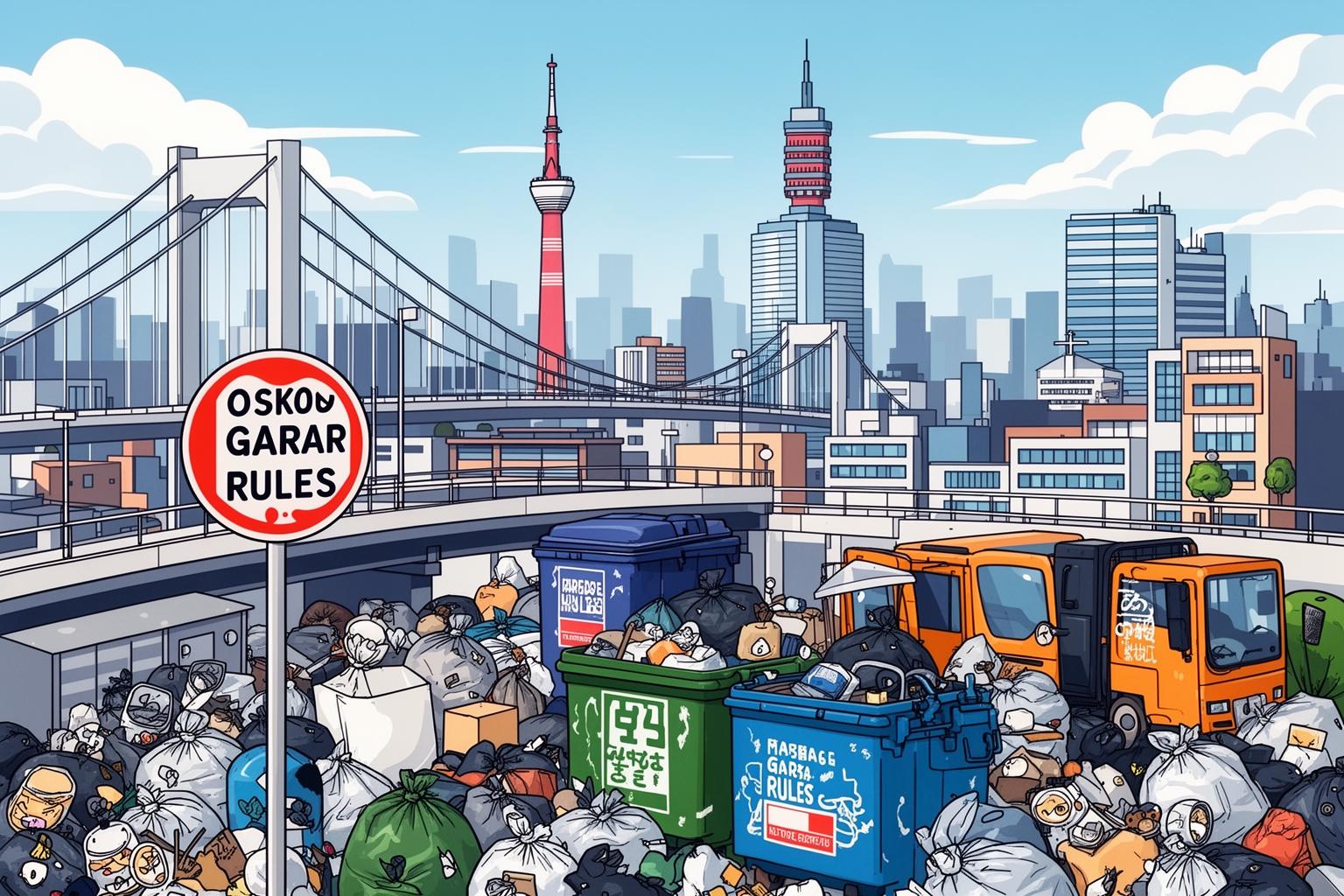
In most places, garbage disposal is an afterthought. You fill a bag, toss it into a bin, and it seemingly disappears. It’s a private act resolved by a public service. But in Osaka, this assumption will be your first—and possibly most significant—social misstep. Here, garbage—or gomi—is not a private affair. It is a public performance, a weekly test of your social skills, your respect for the community, and your ability to follow rules precisely. Failure is not an option because your audience is your entire neighborhood, and they are watching. This system forms the foundation of residential life, a complex ritual that highlights the city’s deep-rooted pragmatism and its surprisingly strong communitarian spirit, standing in stark contrast to its reputation for individualism.
Deconstructing the Calendar: The Sacred Schedule
Your first essential reading in Osaka will not be a novel or travel guide, but a multi-colored, densely printed, and utterly perplexing garbage collection calendar issued by your local ward office. This document is your bible. It is your key to social harmony. Do not lose it. Do not ignore it. Laminate it and display it in your kitchen. This calendar commands, with the unwavering authority of a divine edict, what type of garbage can be disposed of, on which day, and in what specific type of bag.
There are burnable days (Monday and Thursday, perhaps) when you can discard food scraps, paper waste, and other combustibles in city-approved transparent or semi-transparent bags. Then there are plastics days (Wednesday, for example) for PET bottles, shampoo containers, and food trays—all of which must be rinsed clean. Let me emphasize: rinsed clean. Leaving yogurt residue inside a container is a cardinal sin. It attracts crows, smells foul, and signals to your neighbors that you lack regard for the collective well-being. Cans, glass bottles, and other recyclables have their own day, as do newspapers and cardboard, which must be neatly bundled with string.
Miss the burnable garbage day? Too bad. That bag of kitchen scraps will be your roommate for the next three or four days, a pungent reminder of your failure, especially during Osaka’s notoriously humid summers. The schedule is not a suggestion; it’s a strict, non-negotiable social contract. Following it is the first and most fundamental sign that you grasp the basic principle of living in a dense urban environment: your actions directly affect everyone around you.
The Unspoken Judgment of the Neighborhood Watch
The actual site of this weekly ritual is the gomi-basho, the designated garbage collection spot for your building or block. This is not a chaotic dumping ground. It is a carefully managed, almost sacred space. Usually situated at a street corner or small caged area, it is covered by a large, weighted green or blue net—the karasu-yoke netto—designed to repel the highly intelligent and relentless Osaka crows. Your responsibility extends beyond simply dropping off your bag; you must place it neatly under the net and secure it properly afterward. Leaving the net open is a breach of communal trust.
This is where real social pressure arises. There’s almost always a self-appointed guardian of the gomi-basho, often an elderly woman (obachan) who has lived in the neighborhood for decades. She knows the rules better than the city officials who wrote them. She sees everything: you sneaking out a plastic bottle on burnable day, improperly bundled cardboard. She might not confront you directly at first, but you may find your offending bag left behind by collectors with a bold red sticker of shame explaining your mistake. Or, in classic Osaka fashion, an anonymous, passive-aggressive note might appear on your apartment building’s notice board, reminding residents of the correct way to dispose of styrofoam trays.
This isn’t about cruelty; it’s about efficiency and fairness. In Osaka, the prevailing logic is practical to its core: “If we all follow the rules, the system works smoothly for everyone. If you mess up, you create a problem that others—your neighbors—must solve.” The Tokyo approach might feel more anonymous, a conflict between you and faceless bureaucracy. In Osaka, it’s personal. Your garbage reflects your character, and your neighbors are the judges.
Oversized Trash (Sodai Gomi): A Bureaucratic Quest
Disposing of a simple bag of trash is a weekly challenge. Getting rid of an old microwave, broken chair, or worn mattress is an entire quest, a multi-step bureaucratic adventure that acts as a rite of passage for any long-term resident. You cannot simply leave a large item on the curb—that’s a grave offense, akin to abandoning a child. The process, called sodai gomi disposal, is a masterclass in following procedure.
First, you must call your local ward’s oversized trash center or use their website. You describe the item in detail. They tell you the exact disposal fee, which can range from a few hundred to several thousand yen. Next, you must go to a designated convenience store or post office and purchase a special sodai gomi sticker for that exact amount. You write your name or a confirmation number on the sticker, affix it to the item, and on the designated collection day—and only that day, often weeks later—you bring it to the specified collection point by 8:00 AM.
There is no margin for error. The wrong sticker amount, the wrong day, the wrong place—all will leave your old microwave perched forlornly on the curb, a monument to your failure to navigate the system. Completing this task successfully feels like a major life accomplishment. It signals your transition from temporary visitor to someone who understands how the city’s intricate machinery really functions. The process is frustrating and tedious, yet ultimately clarifying, reinforcing Osaka life’s central theme: there is a right way to do things, and personal convenience comes second to the smooth running of the collective system.
Beyond a Simple “Konnichiwa”: Navigating the Social Fabric
The same principles of shared space and collective responsibility that apply to the gomi-basho also extend into the more intangible, yet equally significant, sphere of neighborly relations. Your interactions—or lack thereof—in the hallways of your apartment building, on the street, and within the local community association are constantly observed. In the West, especially in large cities, it’s common to live for years without knowing your neighbors’ names. In residential Osaka, however, such anonymity is not just rare; it can be seen as suspicious or even rude. The social fabric is woven from countless small, repeated interactions, and your willingness to engage in this daily dance reveals a lot about you.
The Art of the Aisatsu: Greeting as a Social Barometer
The simple act of greeting, or aisatsu, is a powerful social tool in Japan, and perhaps even more so in the close-knit neighborhoods of Osaka. It is the first and most basic way to establish yourself as a non-threatening member of the community. A cheerful “Ohayo gozaimasu!” (Good morning!) to a neighbor in the elevator, a slight bow with a “Konnichiwa” (Hello) to someone you pass on the stairs, or a simple “Otsukaresama desu” (a versatile phrase acknowledging someone’s hard work) to the building manager are more than mere pleasantries. They serve as social signals that say, “I see you. I acknowledge you as part of my daily environment. I am a considerate and trustworthy person.”
Neglecting to greet people, especially those you encounter daily, can create an invisible barrier around you. It may be interpreted as arrogance, aloofness, or a lack of respect for the community. In Osaka, where directness and a shared sense of humanity are valued, this can have particularly negative effects. Your neighbors are not necessarily seeking to become your closest friends, but they are evaluating you. Are you the person who plays loud music late at night? The one who leaves their bicycle blocking the hallway? A consistent, friendly greeting establishes a baseline of trust, helping to preempt potential conflicts and showing you understand the unspoken rule of communal living: we’re all in this together, so at least let’s be pleasant.
Sound, Silence, and the Paper-Thin Walls
One of the first physical realities you’ll notice in a typical Japanese apartment is the thinness of the walls. Sound travels easily. You will hear your neighbor’s television, their arguments, their children practicing piano, and their late-night laundry. And they will undoubtedly hear you as well. This acoustic transparency demands a heightened awareness of the noise you create. This often proves challenging for foreigners used to sturdier construction and different cultural notions of personal space.
There are strict unwritten rules about noise. Running a vacuum early in the morning or late at night is considered a major faux pas. Loud parties are generally out of the question unless you live in a building designed for musicians. Even something as simple as heavy footsteps—what the Japanese call “dondon”—can cause friction.
Disputes are rarely addressed with direct confrontation, at least not initially. Typically, you’ll first receive an anonymous and polite note in your mailbox from building management reminding residents to be mindful of noise after 10 PM. This serves as a warning. If the problem continues, complaints may become more specific and less anonymous. Understanding this process is key. In Osaka, maintaining peace isn’t just about avoiding conflict; it’s about actively nurturing quiet as a form of respect for neighbors’ right to a peaceful environment in a space where privacy is limited and easily compromised.
The “Kairanban” and the “Chonaikai”: Opt-in or Obligation?
As you settle in, you may come across two staples of traditional community life: the kairanban and the chonaikai. The kairanban is a community clipboard or circular passed from door to door, carrying local news, event announcements, and public safety notices. It’s your responsibility to read it, indicate that you have seen it, and promptly pass it to your next-door neighbor. This simple analog system physically connects every household on the block.
The chonaikai is the neighborhood association itself. You will likely be invited—or gently pressured—to join. Membership usually requires a small monthly or annual fee. This contributes to maintaining amenities like the gomi-basho, organizing seasonal festivals (matsuri), conducting fire safety drills, and funding children’s activities. For many Japanese residents, participation is a given. For a foreigner, it can pose a dilemma: is this a delightful chance to integrate, or a burdensome and costly obligation?
In Tokyo, especially in large modern apartment buildings, opting out often carries few social consequences. The city is more anonymous and populations tend to be more transient. In many Osaka neighborhoods, however, abstaining can mark you as an outsider—someone who benefits from the community’s efforts without contributing. Being part of the chonaikai means more than paying a fee; you may be expected to participate in neighborhood clean-up days or help run a food stall at summer festivals. Though it may feel like a chore, it’s often where genuine connections form. It’s how you move from being simply “the foreign resident at number 203” to “Ogawa-san, the person who lives at 203.” It’s a trade-off: a bit of your time and money in exchange for a much deeper level of social acceptance.
The Pragmatic Community: Why These Rules Exist
It’s easy to view these detailed rules about garbage, noise, and community involvement as restrictive, intrusive, or even harsh. From a Western individualistic viewpoint, the idea that your neighbors are monitoring your trash sorting might feel like an invasion of privacy. But to truly understand Osaka, you need to change your perspective. These rules aren’t rooted in malice or a desire for control. Instead, they arise from a deep, hard-earned pragmatism developed over centuries of people living in very close proximity.
It’s Not About Being Mean, It’s About Being Fair
At the heart of Osaka’s neighborhood culture is the principle of fairness, or kōhei. The social agreement is straightforward: if everyone accepts the same minor inconveniences and abides by the same rules, life improves for the entire community. The system aims to reduce friction. When you fail to rinse a plastic bottle, you’re not merely breaking a rule—you’re causing a real problem. The bottle could attract pests, emit odors, and lead to the entire bag’s rejection by collectors, forcing a neighbor—perhaps the elderly woman who kindly manages the garbage spot—to re-sort it. Your small act of negligence creates extra work and discomfort for others.
This is the core of the Osaka mindset. It’s less about abstract ideals and more about practical consequences. The question isn’t “Is this rule philosophically fair?” but “Does this rule make living together smoother and more predictable?” When someone breaks a rule, the response isn’t moral outrage but practical frustration: “Come on, we all agreed to this. Don’t make it harder for everyone.” This straightforward, outcome-focused thinking defines Osaka culture, shaped by its history as a city of merchants and artisans where reputation and reliability were paramount.
Osaka vs. Tokyo: Two Different Community Experiences
Here the difference from Tokyo becomes clear. While Tokyo is equally, if not more, rule-oriented, the enforcement and the feeling behind it differ. In Tokyo, rules often feel top-down and impersonal, enforced by building management companies, signs, or automated announcements. You’re a small part of a vast, efficient, and largely anonymous system. You follow the rules because they exist, and breaking them leads to administrative consequences.
In Osaka, the rules feel bottom-up and deeply personal. They’re enforced by the community itself—neighbors, the local shopkeeper, or the obachan watching from her balcony. The community is the system, and you are a visible, accountable member of it. This can feel more intrusive but also more human. When you slip up, you’re not just breaking a regulation; you’re disappointing the people living around you. But when you get it right, the reward isn’t just avoiding a fine—it’s a nod of approval, a warmer greeting the next day, a sense of truly belonging. The social feedback is immediate and tangible. Osaka’s community is less about quiet, anonymous coexistence and more about active, sometimes boisterous, participation.
Common Misunderstandings Among Foreigners
The biggest mistake foreigners make is underestimating how seriously these unspoken rules are taken. They might view the garbage schedule as a mere “guideline” or think a friendly smile excuses a noisy party. They might see the chonaikai as an optional club rather than a quasi-governmental cornerstone of local life. This is a fundamental misunderstanding. Osaka’s famed “friendliness” is not unconditional. It’s built on a mutual understanding of respect and responsibility. People here are direct, open, and ready to laugh with you, but they also expect you to do your part and honor the shared environment.
The best advice to newcomers is simple: watch, listen, and ask when unsure. Don’t assume your cultural habits apply. Find a friendly neighbor or the building manager (kanrinin) and ask, “Is this the right way to do this?” Demonstrating a genuine willingness to learn and follow local customs often matters more than being perfect from the start. The effort itself shows respect, and in Osaka, respect is the currency that transforms a stranger into a neighbor.
Living in Osaka means constantly balancing personal freedom with community responsibility. It can be frustrating and confusing, but it’s also deeply fulfilling. Mastering the art of sorting plastics, perfecting your morning greeting, and navigating the subtle rhythms of neighborhood life are what unlock the city’s true essence. It’s how you stop being a tourist in your own home and start building a real life here. The challenges are real, but the sense of belonging—the feeling of being an accepted member of a pragmatic, straightforward, and surprisingly warm community—is something no travel guide can fully prepare you for.