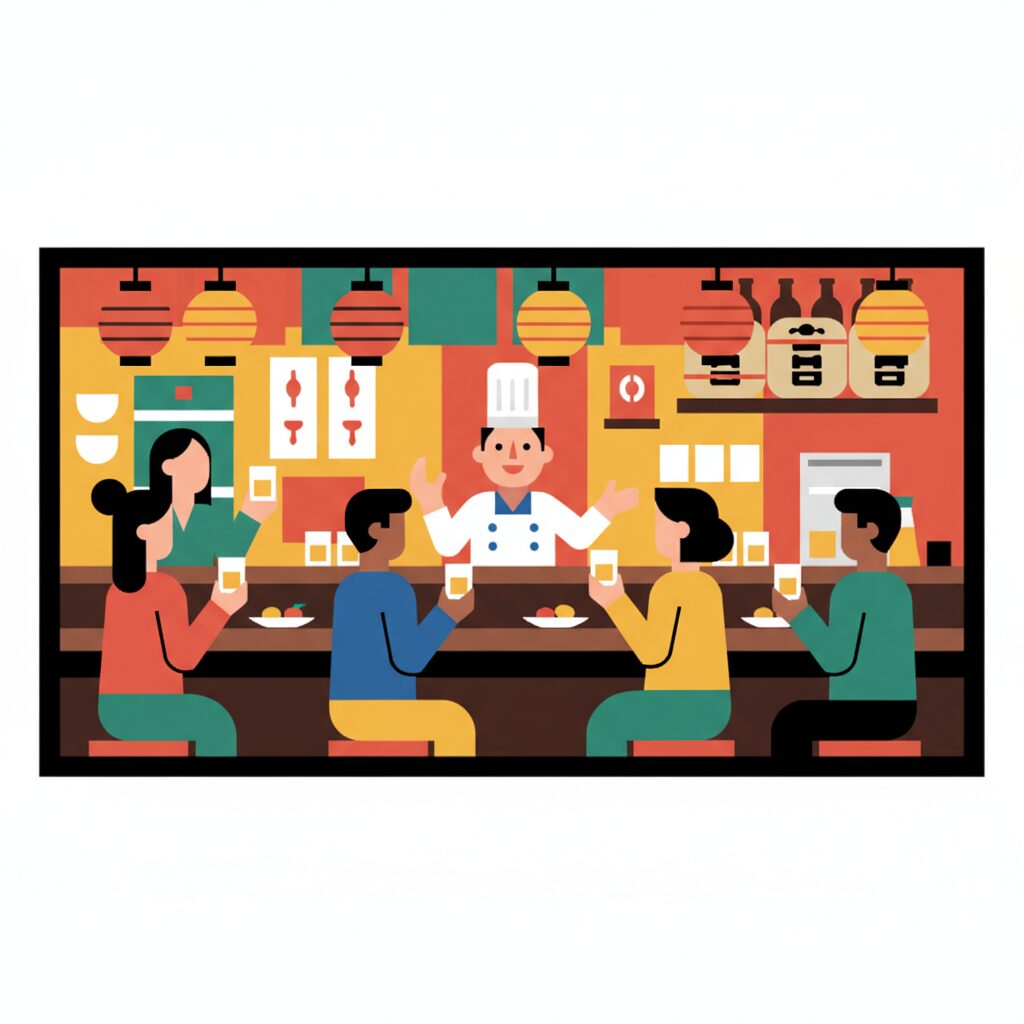
It’s five-fifteen on a Tuesday evening in Kyobashi. The air, thick with the humid promise of summer, suddenly changes. It’s not the weather. It’s a shift in energy, a collective exhalation. The doors of office buildings slide open, and a torrent of men in crisp shirts and women in neat blouses floods the streets. But they don’t march uniformly toward the train station. Instead, they splinter off, pulled by an invisible but powerful gravity toward the warm, glowing lanterns hanging under the railway tracks. They disappear behind steamed-up glass doors and plastic curtains into spaces no bigger than a generous walk-in closet. Inside, there are no chairs. There are no tables. There is only a counter, a crowd, and the rising symphony of clinking glasses and easy laughter. This is the world of tachinomi, the standing bar, and for Osaka’s working population, this is not a special occasion. This is just Tuesday. It’s the default setting, the automatic response to the clock striking five.
For anyone moving here from Tokyo, or from anywhere else for that matter, the scene is a puzzle. Where are the reserved tables, the elaborate multi-course nomikai, the polite, structured after-work gatherings that feel like a second shift? In Osaka, the social contract feels different. It’s faster, louder, more direct, and it happens on its feet. To understand why tens of thousands of Osakans choose to end their day packed shoulder-to-shoulder in a standing-room-only bar, you have to understand the city’s core philosophy. Tachinomi culture isn’t just about drinking. It’s a living, breathing expression of Osaka’s obsession with efficiency, its unique brand of social interaction, and its deeply pragmatic approach to life. It’s a physical manifestation of the city’s soul, a place where its merchant DNA and comedic heart beat in perfect, frantic rhythm. Forget the guidebooks for a moment. If you truly want to understand how Osaka works, you need to pull back a noren curtain, find a small space at the counter, and just listen.
This pragmatic, efficient approach to socializing mirrors the city’s no-nonsense attitude, which is equally evident when navigating practical matters like negotiating initial renting fees in Osaka.
The Economics of Efficiency: More Than Just a Cheap Beer
At first glance, the appeal appears straightforward: tachinomi are inexpensive. However, reducing them to merely a budget option misses the essence entirely. It’s not about being cheap; it’s about being clever. The driving principle here is rooted deeply in the Osaka mindset: kosupa, short for ‘cost performance.’ This is more than just a business term; it’s a personal philosophy. An Osakan doesn’t simply ask, “How much does it cost?” but rather, “What am I getting for my time and money?” A tachinomi is the perfect answer to that question, exemplifying the art of maximizing value.
‘Kosupa’ as a Way of Life
Step into a typical tachinomi in a business area like Umeda or Yodoyabashi. A draft beer might run you 300 yen. A small plate of doteyaki, slow-cooked beef sinew in miso that embodies Osaka’s soul food, might cost 250 yen. A skewered kushikatsu, deep-fried and crispy, could be 100 yen each. For just over 1,000 yen, you can enjoy two drinks, a couple of filling snacks, and a solid 45 minutes of social relaxation. Payment is made as you go, by placing coins in a small tray on the counter—transparent, instant, and hassle-free.
Contrast this with the typical Tokyo-style izakaya. There, an otoshi, a mandatory appetizer you didn’t order, comes with the bill. Drinks are priced at 500 or 600 yen. Portions of food are larger and pricier. You might linger for two hours, sharing dishes, and at night’s end, you’re splitting a bill often exceeding 4,000 yen per person. For an Osakan, the kosupa calculation is obvious. The izakaya provides a seated experience but at four times the cost and triple the time investment. The tachinomi delivers the essentials—a quality drink, good food, and social interaction—with ruthless efficiency. This attitude traces back to Osaka’s history as Japan’s merchant capital, a city built by pragmatic businesspeople who valued every yen and prized quick, decisive transactions. That same logic extends to socializing, aiming to reach the desired result—stress relief, camaraderie—with minimal resource waste.
The Currency of Time
The second vital resource is time. A Tokyo nomikai can feel like being held hostage. It’s often scheduled weeks ahead, has a fixed start and finish time, and can last three hours, followed by a nijikai, a secondary party. It’s a significant time commitment that encroaches on personal life. Osaka’s tachinomi culture embodies the opposite: complete freedom over time.
The charm of a tachinomi lies in its transient nature. No reservations are needed. You can stop by alone for a quick ten-minute beer while waiting for a train. You can catch up with a colleague for a thirty-minute debrief after a tough meeting. It works perfectly as a zero-jikai, or ‘zeroeth party,’ a brief primer before a larger dinner. Or it can be the full event for the evening. The absence of chairs is an essential part of this system. Standing serves as a subtle, physical cue that this is temporary, discouraging guests from settling in too long. High turnover is the business model, allowing small shops to serve many customers. For guests, this is a benefit, not a drawback. It offers a guilt-free way to leave—you don’t have to invent excuses; the setting itself implies a brief stay. This respects the reality of commuters’ lives. People have families to get home to and long train rides ahead. The tachinomi doesn’t demand your entire evening; it merely borrows a small, refreshing moment of it.
The Architecture of Socializing: Designing for Interaction
The physical layout of a tachinomi is no accident. It is a carefully, if somewhat unintentionally, crafted environment meant to encourage a distinctive type of social interaction that is uniquely Osaka. The tight space, the shared counter, the very act of standing—all combine to break down social barriers and create a temporary, fluid community every night.
Forced Proximity, Natural Conversation
Most tachinomi are narrow and deep, with a simple counter separating staff from customers. There are no booths, no private rooms, no cozy corners to escape to. You are, out of necessity, shoulder-to-shoulder with strangers. Your personal space shrinks to the size of your own body. While this enforced closeness might cause anxiety in many cultures, in Osaka it sparks connection. You inevitably see what the person next to you is ordering and overhear the conversation two people away. In this setting, joining in is not rude; it is often expected.
This sharply contrasts with many modern bars and izakayas, which emphasize privacy and cater to pre-existing groups. Typical izakayas are collections of social islands—tables and booths that separate groups. A tachinomi is a social river, a continuous flow of conversation. It favors the individual or pair, enabling easy integration into a larger, temporary whole. A salaryman recently scolded by his boss might stand next to a construction worker celebrating the end of a long shift, with a young marketing professional on the other side. Their daily lives are very different, but for thirty minutes, they are simply three people sharing a counter, complaining about the Hanshin Tigers’ latest game or commenting on the sashimi’s quality. It’s a great social equalizer.
The Counter as the Stage
At the heart of this world is the taisho or ‘master.’ More than a bartender or cook, they are the director, host, and social hub. In the cramped confines of the tachinomi, the taisho is always within earshot. They see everything, hear everything, and skillfully manage the flow of both drinks and conversation. A good taisho remembers regulars’ favorite drinks, knows their stories, and serves as a social bridge.
They might say to a newcomer, “You should try the simmered daikon. Tanaka-san next to you has it every day, right?” Just like that, a conversation begins between you and Tanaka-san. This triangular dynamic—customer, taisho, and another customer—is the magic of the tachinomi. The counter acts as the stage where these small daily dramas unfold. The taisho often becomes a confidant, a neighborhood fixture providing continuity and stability. In the anonymity of a sprawling city, visiting a tachinomi where the owner greets you by name is a powerful anchor. It acknowledges your existence and place in the community. This personal connection is something a large chain izakaya, with rotating staff and standardized procedures, can never replicate.
The Osaka Mindset on Display: ‘Honesty’ Over ‘Harmony’
To grasp the fundamental difference between the social operating systems of Osaka and Tokyo, spend an hour in a tachinomi. Japanese culture is often described through the concepts of tatemae (the public facade) and honne (one’s true feelings). While this duality exists throughout Japan, Osaka’s version is strikingly distinct. In a tachinomi, the heavy cloak of tatemae worn all day at the office is left at the door, allowing the raw, unfiltered honne to emerge powerfully.
‘Honne’ Before ‘Tatemae’: Speaking Your Mind
In Tokyo’s business environment, communication tends to be indirect, layered with politeness and a strong emphasis on group harmony (wa). Criticism is softened, and genuine opinions are often concealed. The after-work nomikai might feel like an extension of this—an occasion for carefully managed socializing. An Osaka tachinomi, however, serves as the opposite. It is a sanctuary for honne. Here, the famously direct and expressive Osaka dialect, Osaka-ben, dominates. People openly and loudly complain about their bosses, clients, and workloads. They celebrate successes with uninhibited enthusiasm and passionately debate sports. Conversations are blunt, honest, and refreshingly genuine.
This isn’t about rudeness; it reflects different social values. For many Osakans, true respect arises from directness, not polite evasion. Suppressing stress is viewed as unhealthy and unproductive. The tachinomi acts as a crucial release valve, a space for collective catharsis. By openly sharing their daily frustrations, patrons find solidarity, realizing they’re not alone. This shared vulnerability, expressed openly and without shame, forges a strong, albeit temporary, bond. It’s a practical, straightforward approach to mental wellness, far less costly than therapy and often accompanied by fried chicken.
The Comedy of Connection: Laughter as a Social Lubricant
It’s no accident that Osaka is Japan’s undisputed comedy capital, home to the huge Yoshimoto Kogyo entertainment empire. Humor here is more than entertainment; it’s a core communication tool, with the tachinomi serving as its nightly open-mic stage. The conversational style is a rapid-fire flow of jokes, puns, and the classic boke-tsukkomi dynamic—the Japanese version of a straight man/funny man routine. A boke says something silly or absurd, and the tsukkomi promptly fires back with a sharp-witted correction or insult.
At a tachinomi, everyone is a potential comedy partner. A stranger might make a boke comment about your tie, and you’re socially expected to respond with a tsukkomi retort. This isn’t confrontational; it’s a social handshake, a way to gauge and build rapport. Self-deprecation is highly valued. Bragging or taking oneself too seriously is frowned upon. Instead, people bond by humorously exposing their own flaws and absurdities. This culture of laughter is perhaps the most effective icebreaker imaginable. It instantly dissolves tension and hierarchy. In a space overflowing with genuine laughter, the rigid social divisions found outside lose their hold. This is often what foreigners mean when they say “Osaka people are friendly.” It’s not just a vague warmth; it’s an active, participatory friendliness founded on shared humor.
A Social Safety Net: More Than Just a Bar
In the vast urban expanse of a modern city, loneliness can become a quiet epidemic. People reside in enormous apartment complexes, work in sprawling office buildings, and may go days without meaningful human interaction beyond their immediate family or colleagues. The tachinomi, in its modest way, acts as an essential remedy to this isolation. It serves as a classic ‘third place’—a crucial social gathering spot that is neither home nor workplace—and provides an informal, grassroots support system for the city’s labor force.
The ‘Third Place’ for Urban Workers
The idea of the third place, popularized by sociologist Ray Oldenburg, refers to public venues that host regular, voluntary, informal gatherings of people. These places are the foundation of community life. For many Osaka office workers, their nearby tachinomi fits this role perfectly. It is a space where they are not defined by their job or family role but can simply be themselves. They are a regular, a familiar presence. Its low cost and minimal time requirement make it accessible enough to become a daily or weekly ritual.
This regularity is crucial. It nurtures a sense of belonging and recognition. The shop owner knows your name. Other regulars acknowledge you with a nod. There is a comforting rhythm to the experience. Additionally, the standing setting democratizes the environment. A senior manager and a junior staff member, who might never socialize together outside of work, can find themselves standing side-by-side, their corporate ranks rendered irrelevant. Blue-collar and white-collar workers, young and old, men and women—all are equalized by the simple wooden counter. This casual mingling weaves a social fabric far richer and more diverse than the carefully curated social bubbles we often inhabit.
An Unspoken Support Network
Beyond everyday greetings, the tachinomi often serves as a genuine support network. Thanks to the honest, honne-driven atmosphere, people feel at ease sharing real problems. Someone might mention they’re seeking a new job, and the person beside them just happens to know of an opening. Another could complain about issues with their landlord, and a regular who works in real estate might offer free advice. It becomes a hub of information exchange and mutual aid.
From my perspective as someone from China, this resonates deeply. It brings to mind the vibrant, communal spirit found in neighborhood street food stalls or local teahouses. In both cultures, there’s an understanding that community is not forged in formal settings but in these everyday, informal spaces where people consistently gather. It is where news is shared, counsel is given, and a sense of collective identity is strengthened. The tachinomi is Osaka’s version of this timeless social tradition, perfectly adapted to the fast-paced, densely populated reality of modern city life. It stands as a testament to the enduring human need for connection—one that can sometimes be most effectively fulfilled in a small, crowded room without chairs.
Common Misunderstandings and Practical Advice for Foreigners
For someone new to Osaka, the world of tachinomi can initially feel intimidating. It’s loud, crowded, and governed by a set of unspoken rules. However, navigating this scene is much easier than it seems, and grasping a few key points can unlock one of the most authentic Osaka experiences available. The first step is to let go of some common misconceptions.
Misconception: ‘It’s a Dirty, Old Man’s World.’
Historically, tachinomi had a reputation as gritty, smoke-filled spots frequented mainly by older, working-class men—the classic oyaji. While these traditional, atmospheric venues still exist and are an essential part of the culture, the scene has since diversified dramatically. Today, Osaka is brimming with new-wave tachinomi that defy these old stereotypes.
In areas like Fukushima, Tenma, and Ura Namba, you’ll find trendy standing bars specializing in craft beer, natural wine, or artisanal sake. Some tachinomi offer exquisite sushi or tempura, delivering Michelin-level quality at a fraction of the cost of seated restaurants. Others are inspired by Italian, Spanish, and even French cuisines. These establishments are bright, modern, and hugely popular among younger crowds, including many groups of women. The tachinomi format has proven incredibly versatile, providing young chefs and entrepreneurs a low-cost platform to showcase their talents. So, no matter your taste or style, there’s a tachinomi for you.
Misconception: ‘You Have to Be a Fluent Japanese Speaker.’
Although knowing some Japanese will enhance your experience, being fluent is definitely not required. The charm of the tachinomi environment lies in how much communication is non-verbal. Menus are often right in front of you, making pointing a perfectly acceptable way to order. A simple ‘Kore, kudasai’ (‘This, please’) will take you a long way. The lively, expressive nature of Osaka-ben means people are accustomed to communicating beyond just words.
More important than language skills is your attitude. Osakans generally appreciate anyone who shows genuine interest in their culture. Be open, curious, and don’t hesitate to smile at those around you. If someone orders something that looks delicious, a simple ‘Oishisou desu ne’ (‘That looks tasty’) can be a great way to start a conversation. Your willingness to engage matters far more than perfect grammar. In a city that values directness and good humor, a friendly attitude is all the passport you need.
A Foreigner’s Guide to Tachinomi Etiquette
To ensure a smooth experience, keep these unspoken rules in mind:
Don’t Linger Unnecessarily: The business model depends on high customer turnover. Tachinomi are not libraries or coffee shops. Have your one or two drinks, enjoy your snacks and conversation, then exit gracefully. Staying for around an hour is generally considered long. If you want to continue the conversation, suggest moving to a second location.
Know the Payment System: Many tachinomi operate on a kyasshu on (cash on delivery) basis. You pay for each item as it arrives. Often, you’ll be given a small bowl or tray to place your money, and staff will make change from there. This system is very efficient, preventing any hassle when splitting the bill.
Be Mindful of Your Space: These places are cozy. Keep your bag at your feet or on a provided hook, not on the counter. Watch your elbows. The aim is to occupy as little physical space as possible, allowing more patrons to enjoy the experience. It’s a form of collective consideration.
Engage, but Read the Room: Tachinomi are inherently social, but not everyone is there to make new friends. Some just want a quiet, solitary drink to unwind. If someone is turned away, absorbed in their phone, or signaling ‘do not disturb,’ respect their space. However, if they make eye contact, smile, or comment on your order, feel free to engage. A simple ‘Kanpai!’ (Cheers!) is a universal invitation.
The Future of Tachinomi: Evolving with the City
The tachinomi is far from being a static relic of the past. It is a vibrant and resilient institution that continues to adapt, perfectly reflecting the flexible and entrepreneurial spirit of Osaka itself. Its survival and recent revival stand as proof of the strength of its fundamental values: value, efficiency, and community. As the city transforms, so does its most cherished social space, demonstrating its relevance to a new generation.
One of the most exciting developments is the emergence of specialty tachinomi. This trend underscores Osaka’s lasting identity as Tenka no Daidokoro (The Nation’s Kitchen). Young, ambitious chefs—who might not have the funds to open a full-scale restaurant—are leveraging the low-cost tachinomi concept as a stepping stone. They focus on sourcing exceptional ingredients and showcasing their craft in a cozy environment. This has sparked a culinary democratization, where high-quality dishes—from dry-aged sashimi to creative Italian small plates—are available to everyday diners on a weekday evening. It’s a win-win situation: chefs gain a platform, and the city’s food enthusiasts enjoy an ever-expanding culinary playground.
The recent global pandemic posed a substantial challenge to a culture centered on close social contact. For a while, the idea of standing shoulder-to-shoulder with strangers seemed unimaginable. Yet, as the world reopened, the allure of the tachinomi proved too strong to resist. The experience underscored just how vital these ‘third places’ are for urban well-being. People didn’t just miss the drinks; they missed the casual, spontaneous human interactions that are difficult to replicate online or in formal settings. The tachinomi surged back to life, reaffirming its essential role in the city’s social fabric.
In the end, the tachinomi persists because it perfectly embodies the city that gave birth to it. Osaka is a city that eschews ceremony. It values a good bargain, honest communication, and hearty laughter. It thrives on the energy of countless individuals working, striving, and living in close quarters. The tachinomi is where all these qualities intersect. It is a space that is both economical and rich, efficient yet soulful, individualistic and profoundly communal. It is the unspoken heartbeat of Osaka’s working life—a rhythm best understood standing with a cold drink in one hand and an open mind, ready for the conversation about to unfold.