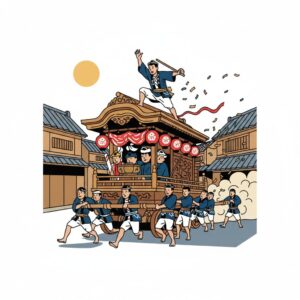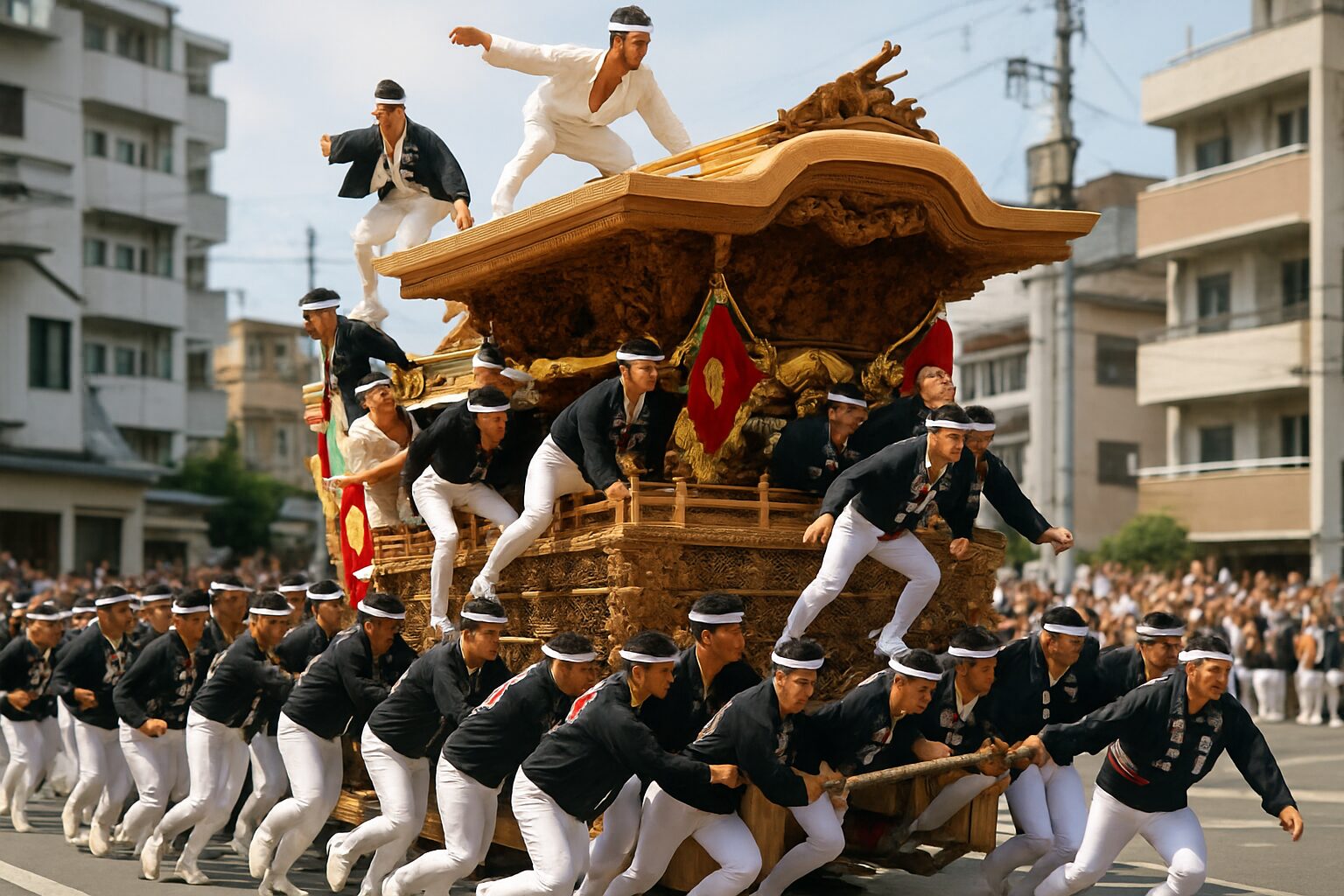
There’s a sound that defines Kishiwada. It’s not a single note, but a symphony of chaos and control. It’s the thunder of a thousand wooden-soled footsteps pounding on asphalt, the rhythmic, guttural chants of hundreds of men heaving on thick ropes, and the high-pitched shriek of solid pine wheels grinding against pavement as they drift around a corner at impossible speeds. This is the sound of the Kishiwada Danjiri Matsuri, one of Japan’s most thrilling and dangerous festivals. At the heart of this storm, weighing over four tons and crafted entirely from wood, is the Danjiri itself—a majestic, intricately carved festival float that is less a vehicle and more a living, breathing deity of timber and tradition. Watching it careen through the narrow streets, a lone figure dancing gracefully on its rooftop, you can’t help but ask: who on earth builds these things? The answer lies in a world far from the festival’s frenetic energy, in quiet workshops filled with the scent of cypress and the patient sound of a chisel meeting wood. This is the world of the Daikugata, the master carpenters of Kishiwada. Theirs is not a job, but a lifelong vow, a sacred inheritance of skill, spirit, and secrets passed down through generations, dedicated to crafting the very soul of their city.
To fully appreciate the dedication of Kishiwada’s Daikugata, one must understand the broader cultural soul of Osaka, which you can explore by finding your unconventional home in the city’s most authentic neighborhood.
The Soul of the Wood: More Than Just Carpentry
To truly understand the Daikugata, one must first grasp their connection with their medium. This is not a world of mass-produced lumber and nail guns; rather, it is a realm where wood is revered as a sacred, living entity, imbued with its own spirit. The primary wood used for a Danjiri is Keyaki, or Japanese Zelkova. It is selected for its remarkable hardness, resistance to the elements, and most notably, its exquisitely intricate and beautiful grain that seems to ripple with a life force of its own. Choosing a Keyaki tree for a new Danjiri is not a mere commercial transaction but a quest that can take years, sometimes even a decade. A master Daikugata ventures deep into the mountains in search of the perfect tree. He is not simply seeking size or quality, but character. He studies how the tree grew, how it twisted toward the sunlight, and how it endured typhoons and heavy snowfalls. He believes the tree’s life story—its struggles and resilience—is etched into its very fibers, and that this spirit—this kodama—will become the essence of the Danjiri itself.
Once chosen, the wood is felled with reverence and left to season over several years, a slow and natural process that allows moisture to escape without cracking or warping the wood. During this time, the carpenter forms a deep bond with the material, learning to ‘read’ the wood—understanding its internal stresses, hidden knots, and distinct personality. In the workshop, apprentices are taught to listen to the sound of their plane gliding over a plank, as subtle changes in pitch can reveal shifts in the grain’s direction long before they become visible. This philosophy is deeply connected to Japan’s native Shinto beliefs, in which gods and spirits, or kami, are thought to inhabit every element of nature—from mountains and rivers to ancient trees. In the hands of the Daikugata, Keyaki is far more than raw material; it is a sacred collaborator in creation. They do not seek to dominate the wood but to coax out its inherent beauty and strength, giving the spirit of the forest a second life as the heart of the community’s most treasured celebration. This profound respect underpins every Danjiri, a silent prayer of gratitude whispered with every mallet strike and every curl of wood shaving.
The Anatomy of a Masterpiece: Deconstructing the Danjiri
A Danjiri float is a marvel of both structural engineering and artistry—a four-ton puzzle box in which every piece has its own name, purpose, and history. Seeing one up close is overwhelming due to its complexity. The entire structure is assembled without a single nail or screw, relying instead on the ancient craft of Japanese joinery, or kigumi. This technique grants the frame essential flexibility, allowing it to absorb the immense stresses experienced during the festival, especially during the signature high-speed cornering maneuver called the yarimawashi.
The Foundation and Frame
The base of the Danjiri consists of a massive, lattice-like frame constructed from enormous beams of Keyaki wood. These beams are interlocked through a series of incredibly complex joints, each cut with microscopic precision. This forms the skeleton of the structure, designed to endure twisting forces that would break a rigid frame. Rising above is the main body, which includes platforms for musicians playing bells, flutes, and drums, their rhythms serving as the accelerating heartbeat of the procession. The entire structure is topped by a grand, curving roof known as the Ooyane, resembling that of a temple or shrine. It is here, on this precarious, swaying perch, that the festival’s most prominent figure, the Daigunomi or “master carpenter,” stands. His role is to act as a human rudder, directing the pullers below with his fan and gestures, his movements a perfect complement to the float’s violent motion. His presence on the roof is a testament to the Daikugata’s confidence in their craftsmanship; they literally stand by their work as it faces its greatest challenge.
The Narrative Carvings: Horimono
What truly elevates the Danjiri beyond a mere vehicle is the profusion of intricate carvings, or horimono, decorating every available surface. These are not simple embellishments. Rather, they are dense, dynamic, and dramatic narrative panels that depict stories of heroism, mythology, and history. The carvings turn the float into a three-dimensional history book—a rolling tribute to Japanese culture. Common themes include epic samurai battles like the Tale of the Heike or the Battle of Kawanakajima, folklore scenes featuring mythical creatures such as dragons and phoenixes, and tales of filial piety and loyalty from Chinese classics. The level of detail is astounding—you can perceive the terror in a single soldier’s face, the intricate pattern on a kimono, and the individual scales on a coiling dragon. These carvings are executed by specialist artisans called horimonoshi, who work closely with the Daikugata. They dedicate months, sometimes years, to a single float, employing hundreds of different chisels and knives to breathe life into the wood. The figures seem to leap from the panels, creating a sense of dynamic motion that echoes the festival’s energy. To study a Danjiri’s horimono is to plunge deeply into Japan’s collective imagination.
The Wheels and Ropes
Even the functional components of the Danjiri are the result of vast traditional knowledge. The two enormous main wheels, or koma, are made not from durable Keyaki but solid pine. This choice is intentional. The softer pine provides the ideal amount of friction on the road, enabling controlled drifting during the yarimawashi. The drawback is that the wheels wear down rapidly under the intense heat and pressure; it is not uncommon for a wheel to be smoking by the end of a run. Teams have pit crews on standby, ready to jack up the four-ton float and swap wheels within minutes. The Danjiri is pulled by two long, thick ropes attached to the front of the float. These ropes serve as reins, gripped by hundreds of pullers who supply the raw power. The manner in which these ropes connect to the Danjiri’s frame is another crucial aspect of the Daikugata’s design, engineered to convert the chaotic energy of the pullers into forward motion.
A Lifetime Apprenticeship: The Path of the Daikugata

Becoming a Daikugata is not a decision made lightly. It is a calling—a path beginning in youth that demands lifelong, unwavering dedication. The apprenticeship system is worlds apart from modern vocational training. It is an immersive, comprehensive education where the student learns not just with their hands, but with their entire being.
An apprentice, often a boy in his mid-teens, enters the workshop at the very bottom of the hierarchy. For the first year or even longer, he may not be permitted to touch the precious Keyaki wood. His days are filled with sweeping the floor, cleaning the workshop, and, most importantly, learning to sharpen the tools. This is not a simple task; it is a fundamental discipline. The master’s collection of chisels, planes, and saws is his lifeblood, and the apprentice must learn to hone each tool to a razor’s edge—a skill that takes years to master. He learns to feel the steel against the whetstone, to recognize the microscopic burr on the edge, and to understand how a perfectly sharpened tool becomes an extension of the carpenter’s own hand. This phase tests patience, humility, and commitment. It teaches the apprentice to respect the tools, the workspace, and the craft before he ever begins practicing it.
Gradually, more responsibility is given to him. He starts by working on simpler pieces of wood, learning to make straight cuts and perfect right angles with a handsaw. He spends countless hours mastering the hand plane, striving to create a surface that is not only flat but feels alive and silky to the touch. He absorbs the unspoken language of the workshop. A master Daikugata rarely issues long verbal instructions; instead, the apprentice learns by watching, anticipating the master’s next move, and handing him the right tool before it is even requested. He internalizes the rhythm of the work, the sound of a flawlessly seated joint, and the subtle gestures conveying more than words ever could.
Years go by. The apprentice begins to master the secrets of kigumi joinery. He starts with the simplest joints and gradually advances to the complex, interlocking puzzles that form the Danjiri’s frame. Each joint must be cut with absolute precision, often to within a fraction of a millimeter. A gap too wide weakens the structure; a fit too tight risks splitting the wood under pressure. This craft requires both a mathematical mind and an artist’s touch. Only after demonstrating mastery of the basics is the apprentice permitted to work on a real Danjiri, perhaps beginning with a small, hidden structural component. To finally leave one’s mark on the town’s sacred float is a moment of immense pride and fear—the culmination of years of tireless preparation. The journey from apprentice to master may take twenty or thirty years. It unfolds slowly and organically, much like the seasoning of the Keyaki wood itself. One does not simply graduate; one earns the trust of the master and the community, becoming not just a builder but a guardian of a priceless cultural legacy.
The Workshop’s Rhythm: A Symphony of Wood and Steel
Entering a Daikugata’s workshop feels like stepping back in time. The very air is distinct, heavy with the alluring, sweet-and-spicy aroma of Keyaki and Hinoki cypress shavings. This scent clings to your clothes, serving as a fragrant reminder of the timeless craft unfolding inside. The noisy, hurried modern world seems far away. Here, the prevailing sounds are the elemental rhythms of the trade.
There is the steady, percussive thwack-thwack-thwack of a wooden mallet striking a chisel handle—a sound filled with focused, creative energy. It is interrupted by the long, whispery shhhhh of a hand plane shaving a delicate curl of wood, evoking pure precision and finesse. You hear the scratch of a marking gauge scoring a line, the gentle rasp of a file smoothing an edge, and the soft, murmured conversations between the master and his apprentices. What is notably absent is the high-pitched scream of modern power tools. Though some may be used for rough, initial cuts, the heart of the work—the joinery and finishing—is almost entirely done by hand. This deliberate pace is not inefficient; it is crucial. It enables the carpenter to sense the wood, respond to its character, and work in harmony with the material rather than against it.
Visually, the workshop presents a scene of organized chaos. The floor is blanketed by a soft, fragrant carpet of wood shavings. Along the walls, hundreds of hand tools are arranged with meticulous care—rows of chisels with blades of varying widths and shapes, saws with teeth designed for different tasks, and planes of all sizes, their wooden bodies worn smooth by generations of use. These are not merely tools; they are cherished heirlooms, each with its own story. At the center of the space, a Danjiri in progress commands attention. It might be a new frame being assembled, its massive beams resting like the bones of a whale, or a completed float undergoing its annual maintenance, its intricate carvings shining under the workshop lights. The space is a sanctuary of focus. The carpenters move with quiet, efficient grace, each man well aware of his role. There is an atmosphere of intense concentration, but it is calm and meditative, not frantic. Here, time is measured not by hours and minutes, but by the slow, patient transformation of a tree into a masterpiece.
Beyond the Festival: The Daikugata’s Year-Round Role

The explosive energy of the Danjiri Matsuri lasts only a few days in September and October, but for the Daikugata, the festival truly never ends. Their work is an ongoing, year-round cycle of creation, maintenance, and preservation. As soon as the festival concludes, their labor begins anew.
Each Danjiri is returned to its danjiri-goya, or float garage, and shortly after, transported to the Daikugata’s workshop for a thorough post-mortem. The immense forces of the yarimawashi strain even the sturdiest floats. The Daikugata and his team meticulously inspect every joint, beam, and carving, checking for stress fractures, loose connections, and any damage sustained during the float’s vigorous dance through the streets. This process resembles a detailed health check-up for a high-performance athlete. Necessary repairs are carried out with the same care and precision as the original construction. This careful maintenance ensures that the Danjiri—often the community’s largest financial and emotional investment—can be safely passed down to future generations.
Every few decades, a town’s association decides it is time to commission a new Danjiri. This is a monumental undertaking, taking two to three years and costing hundreds of millions of yen, all raised by the local community. Choosing the Daikugata for such a project is a decision of great importance and careful consideration. Once selected, the master carpenter collaborates closely with the town’s festival committee to design the new float, including determining its overall dimensions and, crucially, selecting themes for the horimono carvings. These choices hold deep significance as they will define the town’s identity for generations to come. The building process is a public event, with community members often visiting the workshop to watch their new Danjiri take shape, growing more excited with each piece added.
Perhaps the most vital year-round role of a master Daikugata is that of a teacher. The survival of this intricate craft depends entirely on successfully passing knowledge from one generation to the next. The master bears a profound responsibility to train apprentices, imparting not only technical skills but also the philosophy, discipline, and spirit of the craft. His workshop serves as a living classroom, and his legacy is measured not just by the floats he has built, but by the skilled hands and dedicated hearts of the carpenters he has mentored. The Daikugata’s workshop, therefore, is more than a workplace; it is the year-round heart of the festival’s spirit, where the community’s identity is forged in wood and sweat long before the drums and bells sound in the autumn air.
Experiencing the Craft: How to Connect with the Daikugata Legacy
While the roaring spectacle of the Kishiwada Danjiri Matsuri is an unforgettable event, connecting with the deeper story of the Daikugata calls for a more tranquil approach. For any visitor to Osaka, a trip to Kishiwada during the off-season provides a unique chance to appreciate the artistry behind the adrenaline.
The Essential First Stop: Kishiwada Danjiri Kaikan
Your exploration of this world should begin at the Kishiwada Danjiri Kaikan, the city’s official festival museum. Situated next to the stunning Kishiwada Castle, this modern facility offers the perfect introduction to the craft. The main hall is dominated by a full-sized, historic Danjiri, allowing you to get up close and truly appreciate the scale and detail that are impossible to catch during the chaotic festival. You can walk around it, peer into its corners, and admire the breathtaking horimono carvings. The museum presents excellent exhibits that detail the construction process, display the various tools used by the Daikugata, and explain the historical significance of the carving themes. One highlight is a large theater that showcases dynamic, multi-screen videos of the festival, including stunning slow-motion footage of the yarimawashi, helping you understand the physics and danger involved. It’s the best way to experience the energy of the festival in a safe, controlled setting and develop a profound appreciation for the craftsmanship behind it all. Be sure to check the opening hours and modest admission fee before your visit.
A Walk Through Living History
After touring the museum, take a stroll through the old streets of Kishiwada, especially in the Kanno and Hamacho districts near the castle. Even without the festival crowds, the town’s spirit is tangible. Look out for the danjiri-goya, the garages where each neighborhood proudly stores its floats. These are usually modest buildings with large wooden or steel doors, but they serve as the sacred homes of the town’s pride and joy. Although you cannot enter, simply seeing them conveys how deeply the Danjiri culture is woven into daily life. The workshops of the Daikugata themselves are scattered throughout these neighborhoods. As private working spaces rather than tourist sites, it’s essential to be respectful and not intrude. However, if you pay attention, you might spot a sign or hear the distinctive sound of a hammer on a chisel. To pause on the street and listen is to connect with the living heartbeat of this tradition.
Timing Your Visit for a Deeper Look
While the festival days in September (for the coastal districts) and October (for the inland districts) represent the height of excitement, they are also extremely crowded. For a more insightful experience, consider visiting in late August. During this time, the towns hold practice runs called shiken-biki — full-speed rehearsals for the main event. The atmosphere is charged with anticipation, but smaller crowds make for better viewing. Visiting in the quiet winter or spring months provides the opposite benefit: the town is peaceful, allowing for a relaxed exploration of the Danjiri Kaikan and historic streets, giving you the mental space to fully absorb the richness of the culture without distractions.
The Future of a Timeless Craft

In a world marked by rapid technological advances and automation, the continued existence of a craft as demanding and time-intensive as that of the Daikugata is truly remarkable. However, the tradition inevitably faces significant challenges. Will the younger generation, presented with a variety of career paths, be willing to dedicate themselves to a multi-decade apprenticeship requiring tremendous physical and mental discipline for relatively modest financial returns? Additionally, the rising cost and scarcity of high-quality, old-growth Keyaki wood are increasing concerns, driving the already steep price of a new Danjiri even higher.
Despite these challenges, the future of the Daikugata appears secure, grounded in the unwavering passion of the Kishiwada people. The Danjiri is more than just a float; it symbolizes community identity, serves as a source of civic pride, and acts as a bond connecting generations. As long as the people of Kishiwada feel the festival’s spirit deeply, there will be a demand for master carpenters capable of giving that spirit physical form. The role of the Daikugata commands great honor and respect within the community, providing a powerful motivation that goes beyond financial rewards. The craft itself is not static. While its core techniques and philosophy remain constant, each generation of masters subtly refines the art, discovering new ways to convey the dynamic energy of the carvings or enhance the durability of the frame. This quiet innovation, embedded within a strong tradition, ensures the craft remains vibrant and relevant. Today’s Daikugata are not merely reproducing their ancestors’ work; they are active contributors to a living, evolving art form.
The Heartbeat of Kishiwada
The roar of the Danjiri Matsuri gradually fades away, the ropes are neatly coiled, and the magnificent wooden floats are returned to their rest. Yet, in the quiet backstreets of Kishiwada, within a workshop filled with the aroma of history and possibility, a different sound endures. It is the steady, rhythmic tapping of a chisel, the patient whisper of a plane, the gentle hum of a living tradition. The Daikugata is far more than just a carpenter; he is a historian, an engineer, an artist, and a guardian of his community’s spirit. The Danjiri he crafts is not merely an object, but a vessel for the collective energy, pride, and soul of his town. To appreciate the work of the Daikugata is to realize that the true spectacle of Kishiwada lies not only in the two days of intense celebration, but in the 363 days of patient, dedicated craftsmanship that make it all possible. This is the constant, steady heartbeat of the city, a promise in wood and steel of the thunder yet to come.