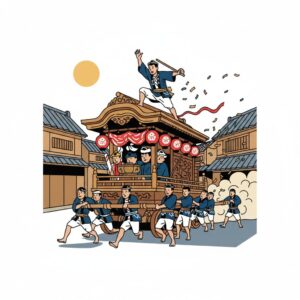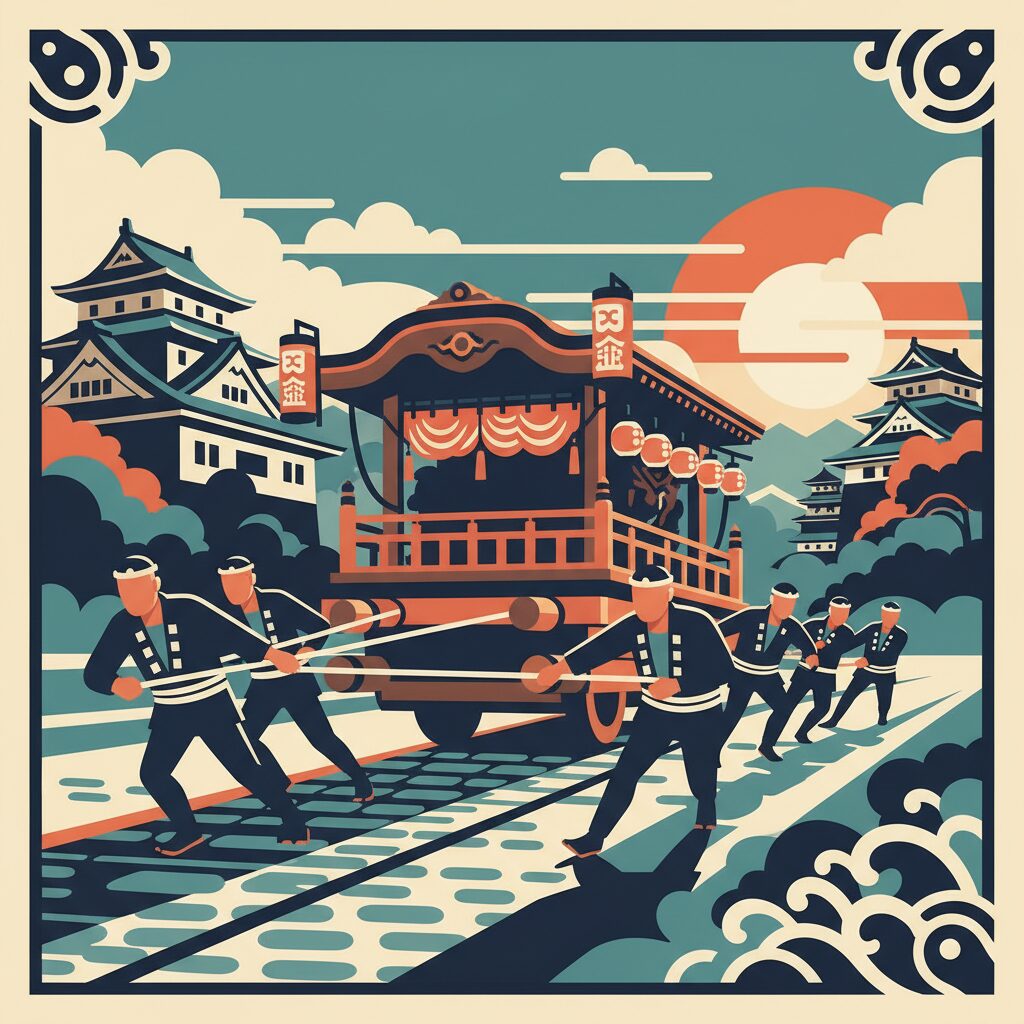
You hear it before you see it. It’s a sound that’s not just noise, but a physical force—a percussive earthquake of wooden wheels on asphalt, the rhythmic, guttural chants of hundreds of men, and the high-pitched melody of flute and bell that somehow cuts through the chaos. Then, it appears. A four-ton, intricately carved wooden shrine, a danjiri, careens around a corner at a full sprint, pulled by a human engine of 500 men. On its roof, a single figure, the daiku-gata, dances, leaping from one edge to the other as the massive float threatens to tip, to crash, to disintegrate under the sheer force of its own momentum. This is the Kishiwada Danjiri Matsuri, the most famous and ferocious of Osaka’s many Danjiri festivals. To the uninitiated, it looks like pure, unadulterated madness. A thrilling, dangerous spectacle. A weekend of wild celebration before the autumn chill sets in.
But if you live here, if you scratch just below the surface of the spectacle, you realize this isn’t a party. It’s a ritual. It’s a demonstration of power, a declaration of identity, and the most visible manifestation of a social structure as rigid and intricate as the carvings on the floats themselves. This isn’t the friendly, food-obsessed, joke-cracking Osaka of popular imagination. This is southern Osaka, the Senshu region, where identity is forged not in the neon glow of Dotonbori but in the tight-knit, fiercely proud neighborhood teams that dedicate their lives to this festival. To understand the Danjiri is to understand the unspoken rules, the deep-seated loyalties, and the almost feudal hierarchies that still govern life in many parts of this city. It’s a world away from the polite, individualistic anonymity of Tokyo, and it reveals a side of Osaka that most outsiders never see. This is where you learn that in Osaka, community isn’t something you join; it’s something you’re born into, a lifelong contract sealed with sweat, sake, and unwavering loyalty to your town’s wooden chariot.
To see another side of Osaka that defies its popular image, explore the realities of life in the city’s most notorious neighborhood.
The Unspoken Code: Hierarchy in the Streets
The first common misconception outsiders have about the Danjiri concerns the nature of participation. This is not a casual, volunteer-run local festival that one can join on a whim. Being part of a Danjiri team, or chō, is a lifelong commitment that often begins at birth and lasts until death. It forms the core organizing principle of social life in these towns—a complex network of duties and loyalties that shapes relationships, careers, and an individual’s standing within the community. The power structure is a detailed pyramid, as solid and steadfast as the zelkova wood from which the floats are carved. Everyone has a defined place, role, and rank, a hierarchy that is evident in every interaction—from how a beer is poured at a meeting to the precise position a man holds on the two massive ropes.
Born into the Team: A Lifelong Bond
In Tokyo, a person’s identity is often linked to their company or university—you are a Mitsubishi man or a Waseda graduate. Social circles are fluid, centered around shared interests or career goals. In the Danjiri towns of southern Osaka, your primary identity is your chō. You are from Miyamoto-chō; you root for Kaminumachō. This affiliation is not optional; it is inherited. Families have belonged to the same team for generations. Before a boy can even walk, he wears a miniature version of the team’s happi coat and twisted headband. He learns the festival chants just as other children learn nursery rhymes.
As a toddler, he may pull a toy-sized Danjiri with his friends—a perfect replica of the real float. This is not mere play; it is early indoctrination. It’s the first step in a lifelong education in teamwork, discipline, and a profound love for one’s neighborhood—a concept known as jimoto-ai. He absorbs stories of his team’s past glories, legendary crashes, and heroic figures who once stood on the roof. He internalizes the rivalries with neighboring towns, a fiery competition that drives the entire festival. By the time he reaches adolescence, the Danjiri is far from a hobby; it becomes the center around which his social life revolves. His closest friends are teammates; his father and uncles hold senior positions. His future is already intertwined with the fate of this wooden float. To reject the Danjiri would be like turning your back on your family—a betrayal of a sacred, unspoken agreement.
The Pyramid of Power: Roles and Responsibilities
The controlled chaos of festival day is the product of a strictly enforced, military-style hierarchy. Each of the twenty-two major teams in Kishiwada, along with numerous others in the region, operates within a rigid, age-based structure. These titles reflect a man’s life journey, his accumulated experience, and his responsibilities to the group. Climbing this pyramid is the lifelong goal of many, requiring decades of physical effort, steadfast loyalty, and skillful political navigation within the organization.
At the Base: Wakashu (The Young Blood)
From their teens through their early thirties, men serve as wakashu, the youth faction. They provide the raw strength and energy that drive the Danjiri. Their lives are filled with hard work and strict subordination. For months before the festival, their evenings and weekends are dedicated to intense practice sessions—pulling a temporary cart or the ropes themselves—learning to run in precise coordination, lean smoothly into turns, and respond immediately to commands from their seniors. They perform the grunt work: cleaning the storage warehouse, coiling heavy ropes, setting up meetings, and most importantly, showing utmost respect to elders. At meetings, they arrive first and leave last, pour drinks, listen quietly, and speak only when spoken to. Their reward is the thrilling rush of the yarimawashi—the high-speed, 90-degree turns that define the festival. Although this is their physical prime, their social status remains lowest. They learn humility, endurance, and the fundamental Danjiri lesson: the group matters most; the individual comes last.
In the Middle: Sewa-nin (The Caretakers)
Once men graduate from wakashu status, they become sewa-nin—世話人, literally “caretakers.” This group forms the organizational backbone and middle management of the Danjiri world. Typically men in their thirties and forties, they have earned their physical dues and now shift focus from muscle to management. They are the planners, strategists, treasurers, and diplomats, managing the complex logistics of the festival: obtaining permits, coordinating with police, and mapping out the route. They also lead fundraising efforts, a delicate but vital duty, visiting every home and business in their area to seek donations (gofushugi), demanding a nuanced understanding of local relationships and social status. An essential part of their role is training and disciplining the wakashu, passing down the skills and traditions they learned. The sewa-nin hold the group together; they command the respect of the young and the ear of the old, expertly navigating the group’s political intricacies.
At the Top: Daiku-gata and the Elders
At the summit are the show’s stars and the quiet powers behind the scenes. The daiku-gata, or master carpenter, is the man who dances on the roof—a striking embodiment of the team’s spirit. His role is a breathtaking blend of balance, courage, and athleticism. Yet he is more than a performer; he is the conductor and navigator of the four-ton float. Using his fan, he signals pullers, guiding their speed and direction, anticipating the centrifugal forces around turns. Being chosen as daiku-gata is the highest honor for an active member, the pinnacle of lifelong training and devotion. Even above him are the elders, or toshiyori/oyabun. These retired men wield tremendous, often absolute authority. They are the guardians of tradition and living repositories of the team’s history. Their approval is needed for every major decision; they settle disputes, select key personnel for the upcoming year, and their quiet nod carries more weight than the loudest calls from younger members. They embody the unbroken legacy of the Danjiri, ensuring that its spirit and rules pass down unchanged to succeeding generations.
Language as a Tool: The Sharp Dialect of Command
The dialect shouted during the festival is far removed from the standard Japanese taught in schools; it is even rougher and more guttural than the well-known Osaka-ben. It is a language of command, stripped of politeness and softened tones. Filled with clipped imperatives and specialized vocabulary known only by those immersed in the Danjiri culture, phrases like “Ikeyo!” (Go!) and “Sorayo!” (That’s it!) are barked with an intensity that can startle outsiders. This speech enforces the strict hierarchy—junior members would never dream of addressing their seniors so directly, while seniors expect immediate, unquestioning obedience. This linguistic code-switching is a hallmark of Osaka life: a man might use this rough Danjiri-speak with his teammates but switch to the most polite, honorific keigo in business meetings the next day. Understanding this flexibility is key to grasping Osaka’s practical mindset—using the right language for the situation. On festival day, the priority is moving a four-ton beast through packed streets, and there is no time for “please” or “thank you.”
Beyond the Ropes: The Danjiri’s Grip on Daily Life
To mistake the Danjiri as merely a two-day festival in September is to completely miss its significance. While the festival itself is the spectacular highlight, the Danjiri is in fact a year-round institution—a parallel authority that shapes the social, economic, and even political fabric of the town. Its rhythms govern the local calendar, and its network offers a safety net often more dependable and robust than any official system. This deep-rooted integration into everyday life is what truly sets it apart from other festivals in Japan and provides a profound glimpse into the power of community in Osaka.
A Year-Round Commitment, Not Just a Two-Day Celebration
As soon as one year’s festival concludes, the preparations for the next begin. The autumn and winter months are dedicated to reflection, formal thank-you visits, and the critical selection of leaders for the coming year. In spring, weekly meetings commence. Held in the local community hall or a designated member’s home, these gatherings are part social, part business. It’s where strategies are debated, routes planned, and budgets finalized. Attendance is mandatory and serves as a measure of one’s dedication. Summer brings both heat and intense physical labor. The Danjiri is removed from its special storage for detailed inspection and maintenance. The massive zelkova-wood frame is examined for stress fractures, elaborate carvings are polished, and the wheels carefully checked. Simultaneously, the wakashu ramp up their physical training, running miles through town at night to build the stamina necessary to pull the float for hours. The sound of their chants becomes a familiar soundtrack of summer evenings. This continuous, year-round engagement fosters a strong sense of shared purpose. The Danjiri is ever-present, a constant hum woven into daily life that swells to a thunderous crescendo as September nears.
The Danjiri Network: A Social and Professional Safety Net
Perhaps the most critical aspect for understanding life in these Osaka communities is that the Danjiri team is much more than a festival group; it is an all-encompassing social and professional network, resembling a brotherhood or a traditional guild. For members, the team is the first port of call for any issue. Need a job? Senior members who own construction companies or restaurants will find one for you. Searching for a new apartment? A sewa-nin will connect you with a local real estate agent offering a good deal. Struggling business? Team members deliberately become your customers. This system of mutual support creates strong incentives for loyalty. Your reputation within the Danjiri team reflects your standing in the entire town. A man known as a reliable, hardworking member will find opportunities opening throughout his life. This blending of personal and professional life starkly contrasts with Tokyo’s more segmented world, where work colleagues and friends often remain within separate circles. In a Danjiri town, these worlds overlap. Bonds forged through the sweat and risk of pulling the float are lifelong, extending into every aspect of life. This is the hidden strength of the Danjiri—a cradle-to-grave system of social welfare, employment, and identity.
The Cost of Belonging: Conformity and Pressure
Naturally, this close-knit world also has a darker side. The immense advantages of belonging come with equally intense pressure to conform. The nail that sticks out is hammered down—and in the Danjiri world, hammered down hard. Individuality is not prized; the group’s smooth operation matters most. Openly challenging elders’ decisions brands you a troublemaker. Missing meetings or training without a strong excuse is considered disrespectful. The gravest offense is quitting the team. This is far more than leaving a sports club; it is regarded as a deep betrayal of your roots and community. Those who leave may face social ostracism, even family shunning. The community’s protective walls can quickly become a prison. Financially, the burden is significant. Elaborate uniforms, mandatory donations, and endless rounds of post-meeting drinks all add up. Generous contributions are expected, with social pressure to keep pace. Moreover, intense localism fosters a powerful “insider versus outsider” dynamic. Foreigners or even Japanese from other cities are respected and welcomed as spectators. They can admire the craftsmanship, enjoy the energy, and receive hospitality. Yet they remain outsiders—they cannot join, cannot truly belong. This fundamental truth explains a common experience in Osaka: people can be warmly friendly and open on the surface, yet maintain an impenetrable distance beneath. The Danjiri is the ultimate insiders’ club.
A Woman’s Place: Navigating a Masculine World
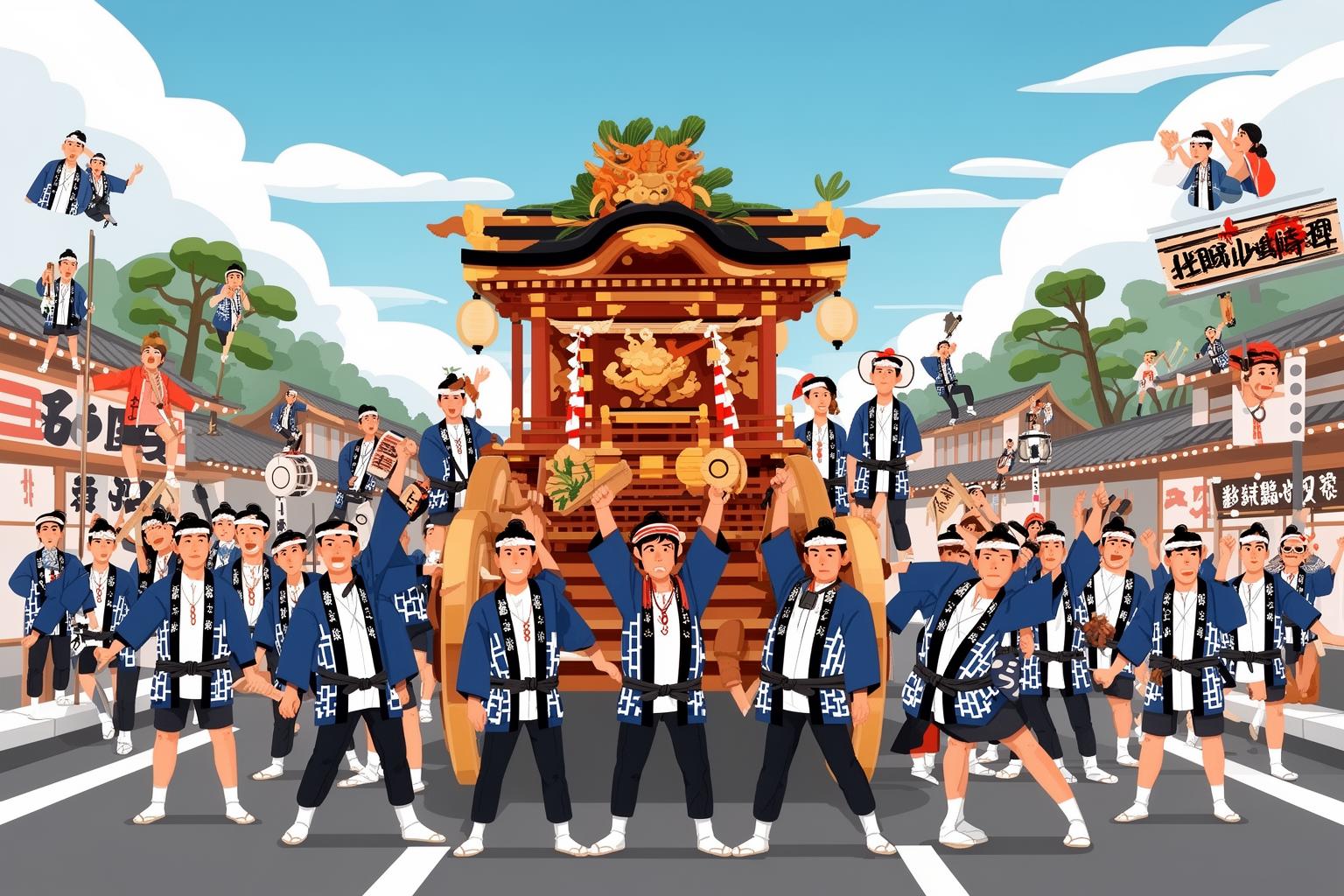
From my viewpoint as a woman observing this world, the Danjiri presents a captivating and often startling display of traditional gender roles. It exists as an unapologetically, overwhelmingly masculine domain. The image of hundreds of men, shirtless or clad in their traditional attire, collaborating in a ritual of strength and risk evokes something from a bygone era. While the men are the public face of the festival, those pulling the ropes and atop the float, women hold a vital, though separate and less visible, role. Grasping their position is essential to understanding the conservative social values supporting this tradition.
Behind the Scenes, Not on the Cart
The most absolute rule of the Danjiri is that women are forbidden from being on the float. This sacred space is reserved solely for men. This prohibition stems from ancient Shinto beliefs and superstitions, yet it has become an unyielding principle of the Danjiri tradition. Instead of pulling the ropes, women provide the logistical and emotional support that enables the festival. In the weeks before the event, they dedicate themselves to braiding colorful good-luck charms to decorate the float. During the festival, their efforts are tireless. They rise early to prepare large quantities of onigiri rice balls and other foods to sustain the men. They manage stations along the route to distribute drinks and cold towels. They primarily care for the children, ensuring their safety amidst the surging crowds and the dangerous path of the Danjiri. They form their own social groups, with bonds as strong as those of the men, built through shared labor and collective pride in their team. Their contribution is indispensable and deeply respected, yet remains firmly behind the scenes. For a female spectator, the festival can be an intense ordeal. The streets are packed, and the crowd moves in unpredictable surges as the Danjiri draws near. My advice is to find a safe spot on a side street or a slightly elevated vantage point. Be mindful that the pullers are in intense concentration and will not stop for onlookers. The raw, masculine energy is tangible; while not hostile, it can be intimidating. This is a space where you are a guest, witnessing a ritual not meant for your participation.
Shifting Roles? A Glimpse of Change
Is this strict segregation of roles evolving in the 21st century? The answer is: gradually, and only on the fringes. You will not see a woman atop a Danjiri in Kishiwada anytime soon. The core, physical traditions remain zealously preserved. However, subtle changes are emerging. In some smaller, lesser-known Danjiri festivals in other towns, girls and women are occasionally permitted to pull the ropes, especially along the safer, straighter sections of the route. Even in Kishiwada, younger generations of women are embracing more contemporary support roles. They may manage the team’s social media, design promotional materials, or take leadership in organizing community fundraising events beyond the traditional door-to-door collections. These shifts are incremental. The fundamental structure endures. The Danjiri serves as a powerful reminder that in Japan, modernity and entrenched tradition can coexist side by side. A young woman might be a programmer or designer in her professional life, operating in a globalized, gender-equal environment from Monday to Friday. Yet on festival weekend, she willingly embraces a traditional role defined by generations of custom, supporting the men of her family and community. This duality is not necessarily viewed as a contradiction but as an alternative way of being—a means to honor a heritage that shapes her identity as much as her career does.
The Spirit of Kishiwada: Why This Matters for Understanding Osaka
So why does this intense, hyper-local festival in a small corner of Osaka hold significance for a foreigner trying to grasp the city as a whole? Because the Danjiri is not an exception. It is the most extreme manifestation of a mindset that permeates many facets of Osaka life. The values shaped amid the festival’s fervor—a tolerance for risk, a fierce pride in one’s local roots, and an unshakeable faith in the power of the collective—help explain why Osaka feels so distinct from Tokyo and other Japanese cities. It is the key to understanding the city’s soul, which is far more intricate than the stereotypes of comedians and takoyaki imply.
Risk, Pride, and Collective Responsibility
The hallmark of the festival, the yarimawashi, is an act of calculated, high-stakes risk. Success brings immense honor to one’s town, while failure—crashing the priceless, hand-carved float—results in shame remembered for years. This readiness to go all-in, risking spectacular failure for the chance of spectacular success, reflects the historic Osaka merchant spirit. For centuries, the city’s merchants built their fortunes on bold risks in the rice and futures markets. This contrasts with the more cautious, process-driven culture of Tokyo’s samurai bureaucracy. Moreover, the Danjiri fosters a powerful sense of collective responsibility. When a yarimawashi is executed flawlessly, credit goes not only to the daiku-gata but to the entire chō. Conversely, if the Danjiri crashes, blame is not placed on one person; it is a collective failure borne by the whole team. This ingrained belief that “we are all in this together” supports the social fabric of old Osaka neighborhoods. People feel a genuine responsibility toward their neighbors and community’s reputation, a connection often diluted by the transient anonymity of a megacity like Tokyo.
Not the Osaka You Know: Beyond Dotonbori and Comedy
If your only impression of Osaka is the flashing Glico sign and the boisterous TV comedians, the world of the Danjiri will be a revelation. It uncovers a hidden Osaka, one that is more conservative, more insular, and much more traditional than most people realize. The famous Osaka friendliness is genuine, but the Danjiri reveals it often operates within clear social boundaries. There is warmth and openness toward guests, but also an impenetrable barrier around the inner circle. The Danjiri culture helps explain the city’s renowned hyperlocalism. Someone from Kishiwada may feel a stronger kinship with their neighbor, even a rival, than with someone from Umeda in northern Osaka. Their identity is tied to the streets they grew up on and the team they support. This is why Osaka can sometimes feel less like a single, unified city and more like a federation of fiercely independent city-states, each with its own customs, dialect, and sacred wooden shrine. Living in Osaka means navigating this duality. It means enjoying the easy-going, pragmatic, and humorous surface while honoring the deep, powerful currents of tradition and loyalty flowing just beneath. The Danjiri is the moment those currents surge to the surface, a raw and beautiful reminder that beneath the modern metropolis lies an ancient, clan-based soul.