Hola, my stylish adventurers! Sofia here, ready to whisk you away from the serene temples and neon-drenched streets you think you know and plunge you headfirst into the raw, pulsating heart of Osaka’s cultural soul. We’re heading south to the coastal city of Kishiwada, a place that, for most of the year, is a quiet, unassuming suburb. But come September, it transforms. The air crackles with an electric tension, a primal energy that culminates in one of Japan’s most formidable and frankly, dangerous, cultural displays: the Kishiwada Danjiri Festival. This isn’t just a parade; it’s a full-contact, high-speed prayer, a testament to community spirit forged in sweat, splinters, and the thunderous, unifying roar of a single, powerful word: ‘Sorya!’ Forget everything you’ve learned about the quiet reverence of Japanese tradition; this is a festival that screams its identity from the rooftops, and today, we’re going to learn its language. It’s an experience that’s viscerally real, photogenically chaotic, and an absolute must for any traveler seeking the undiluted spirit of Japan. Before we dive into the beautiful madness, let’s pinpoint where this incredible story unfolds.
To truly understand the diverse character of Osaka beyond its famous festivals, consider exploring the complex reality of its most misunderstood neighborhood.
The Heartbeat of Kishiwada: The Unifying Roar of ‘Sorya!’
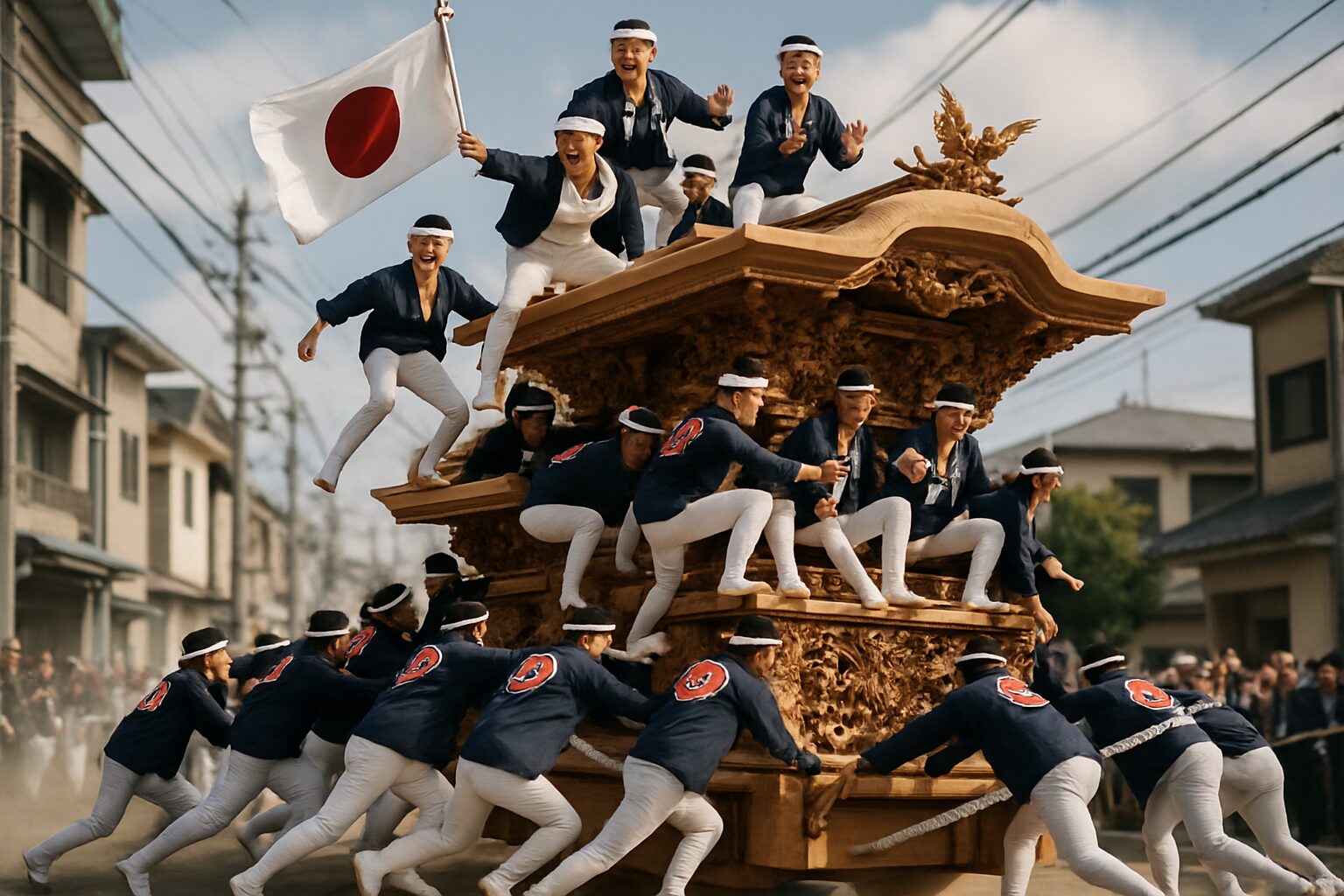
Before you catch sight of anything at the Danjiri festival, you hear it first. The sound grows from a distant murmur into a ground-shaking, unified chant: “Sorya! Sorya! Sorya!” This is the festival’s sonic heartbeat, a seemingly simple word packed with complex, context-dependent meaning. For the hundreds of men hauling the massive wooden floats, it’s their language. A guttural, powerful exclamation, it functions as a versatile communication tool in the heat of the moment. When the enormous, four-ton Danjiri float begins to move, “Sorya!” signals the time to heave—a coordinated grunt of enormous effort that unites hundreds of muscles into a single, flowing motion. As the float gains speed, careening down the narrow streets, the chant quickens and sharpens, becoming a percussive rhythm that propels the runners forward, their faces a blend of intense focus and sheer exhilaration. It is the sound of encouragement, a vocal adrenaline surge pushing them beyond their physical limits.
But listen carefully, and you’ll detect shifts in its tone and rhythm. As the Danjiri nears one of the terrifyingly sharp ninety-degree turns, the “Sorya!” sharpens, growing more urgent. It warns the crowds to step back and signals the men on the levers that the critical moment is upon them. Then, after a successful “yarimawashi”—the festival’s signature high-speed cornering maneuver—the “Sorya!” bursts into a triumphant, joyful roar. It is a cry of relief, pride, and brotherhood. Echoing off the buildings, it celebrates having defied physics and danger for another year. This single word captures the festival’s entire emotional spectrum: struggle, risk, teamwork, and ultimate exhilaration. It’s not merely a word; it’s the audible expression of Kishiwada’s fighting spirit, a linguistic key unlocking the very heart of this powerful event. To truly understand the Danjiri festival, you must first learn to feel the meaning behind every “Sorya!” It is the city’s pulse, the collective voice of generations of tradition carried on the wind.
More Than a Float: The Sacred Soul of the Danjiri
At the heart of this whirlwind of motion and sound lies the Danjiri itself. Calling it a mere ‘float’ is a significant understatement. Each Danjiri is a moving masterpiece of sculpture—a four-ton shrine carved from zelkova wood, shimmering with intricate detail and rich in history. These are far from mere festival props; they embody the pride and spirit of each neighborhood (‘cho’) that takes part. Owning and preserving a Danjiri is a monumental effort, often costing hundreds of millions of yen, funded by the community across generations. They are sacred artifacts, tangible connections to the town’s heritage and symbols of its identity. Strolling through the streets before the festival officially commences, you can find them stored in special buildings, resembling slumbering beasts radiating quiet power. On festival morning, they emerge, and the city bursts to life.
A Masterpiece in Motion: The Exquisite Art of the Danjiri
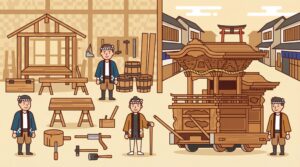
If you get close to a stationary Danjiri—if you can catch a calm moment—you’ll be captivated by the craftsmanship. Every surface is adorned with elaborate, three-dimensional wood carvings that are truly breathtaking. These decorations are not random; they are detailed historical tales, vividly depicting famous battles, epic legends, and scenes from Japanese folklore. One float may portray the ‘Battle of Kawanakajima,’ with samurai on horseback frozen in a dramatic clash. Another might illustrate stories from the ‘Taiheiki,’ a classic war epic. The level of detail is astounding; you can see the expressions on the warriors’ faces, the intricate patterns on their armor, and the dynamic energy of their stances. These carvings are created by specialized master artisans called ‘horimono-shi,’ who devote their lives to this craft. The Danjiri’s roof is itself a piece of art—a complex, sweeping structure reminiscent of a castle or temple. Even the hidden structural elements are joined with extraordinary precision, using traditional Japanese joinery techniques that require no nails or screws. This is what makes the Danjiri so exceptional; it is both a vehicle of raw power and a delicate vessel of immense artistic and cultural significance. It’s a moving museum, a history book brought to life, telling the story of Japan—and more importantly, the story of Kishiwada—through every splinter and groove.
The Anatomy of a Spectacle: Key Roles on the Danjiri
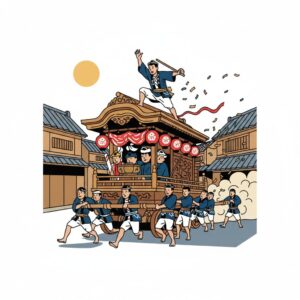
The Danjiri is not driven by an anonymous crowd; it is navigated by a team of specialists, each holding a unique and crucial role. These positions are earned through years of commitment and are held with great honor. At the very top, literally, is the ‘Daiku-gata’—the carpenter or foreman—who is the star of the show, dancing on the roof. With a fan in each hand, he conducts this chaotic orchestra, leaping, stomping, and signaling to the team below. His movements are more than theatrical; they communicate speed, direction, and upcoming turns. His balance is uncanny, and his courage unwavering as he performs this precarious ballet on a moving stage. At the front are the ‘Mae-teko,’ the front lever men, who wield two large wooden levers essential for steering the float’s front, especially during the ‘yarimawashi.’ This role demands immense strength and responsibility. Running alongside the main body are the ‘Sako,’ young leaders who manage the pullers and relay commands—acting as the operation’s nervous system. At the rear, the ‘Ushiro-teko’ serves as the helmsman, controlling the massive rudder-like lever that steers the Danjiri. The timing and coordination among the Daiku-gata, Mae-teko, and Ushiro-teko require split-second precision—a dialogue of trust and experience that ensures the enormous float maneuvers the streets safely. Of course, there are also the hundreds of pullers, the ‘Hikite,’ the operation’s driving force. They are arranged by age, with the youngest at the front and the most seasoned veterans further back, regulating the pace. Each role is a crucial cog in a complex machine—a human ecosystem founded on trust, tradition, and a shared passion for their town and their Danjiri.
The Silent Symphony: The Language of Non-Verbal Communication
While the ‘Sorya!’ chant dominates the soundscape of the festival, a rich, silent language is being spoken concurrently. This non-verbal communication enables the astounding coordination you observe. It is a symphony of gestures, rhythms, and subtle signals instinctively understood by the participants. To an outsider, it may appear chaotic, but to those involved, it follows a well-rehearsed, albeit unwritten, script. This silent language is the crucial element that transforms a wild crowd into a cohesive organism, capable of maneuvering a four-ton wooden behemoth through impossibly tight spaces at breathtaking speeds.
The Daiku-gata’s Dance: Conducting Chaos with a Fan
The most apparent form of this silent language is the Daiku-gata’s performance on the roof. His fans, or ‘uchiwa,’ are not mere props but his conducting batons. An open fan raised high may signal ‘full speed ahead.’ A sharp snap could indicate an upcoming turn. A circular motion might call for building momentum. He stomps his feet on the roof, sending vibrations that convey messages through the wooden frame to those below. His body language is a constant broadcast of intent. He leans into a turn before it happens, physically guiding the pullers on the direction of impending force. This is more than bravado; it is a vital command center. The Daiku-gata serves as the eyes of the Danjiri, peering over the crowd and runners, anticipating obstacles and planning the route seconds ahead. The pullers, heads down in exertion, rely on him for guidance, catching his signals peripherally. His dance is a compelling, high-stakes semaphore, a visual poetry directing the raw power charging beneath his feet.
The Rhythms of the Narimono: The Festival’s Percussive Soundtrack
Beneath the Daiku-gata, inside the Danjiri, is another essential group of communicators: the ‘Narimono,’ or musicians. This hidden ensemble includes a large ‘taiko’ drum, smaller ‘shime-daiko’ drums, a ‘kane’ bell or gong, and a ‘fue’ flute. They provide the festival’s driving soundtrack, but their music is far from random. The rhythm represents another communication layer. A steady, driving beat propels the float along straight paths. As a corner nears, the rhythm may grow more complex and frantic, heightening tension and signaling the imminent ‘yarimawashi.’ The kane bell’s piercing tone cuts through the crowd’s roar, acting as a metronome for the pullers. The soulful melody of the fue flute, often played during slower moments or the day’s start, adds spiritual and emotional depth. Each neighborhood’s Danjiri features distinct rhythms and melodies, a sonic signature instantly recognized by its members. This musical language harmonizes with the Daiku-gata’s signals and the ‘Sorya!’ chants, weaving a rich tapestry of communication that keeps everyone perfectly synchronized.
The Language of the Ropes: A Collective Consciousness
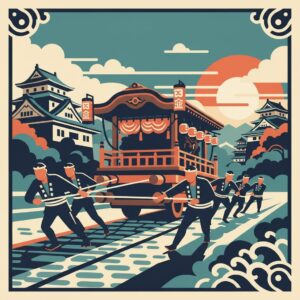
The final, most subtle and profound layer of this silent communication is the language of the ropes themselves. Two massive ropes, often exceeding 100 meters long, extend from the front of the Danjiri. The hundreds of pullers are no mere drones; they form a finely tuned sensory network. They detect the slightest changes in rope tension, subtle pulls left or right signaling direction shifts. They sense the Danjiri’s momentum and struggles through vibrations transmitted by the rope. Experienced pullers in the middle and back interpret these physical cues instantly, adjusting their force and position without exchanging words. When the float begins to turn, this collective consciousness becomes visible. The men on the inside of the turn ease their pace, while those on the outside quicken theirs, bodies leaning outward—a human centrifuge generating the force needed to swing the massive float around. It is an instinctive, fluid choreography honed over years, a physical empathy binding them together. This tactile communication, conveyed through the taut fibers of the rope, enables a large group to move with the grace and unity of a single organism.
Yarimawashi: The Art of the Adrenaline-Fueled Corner Turn
All this communication, energy, and training converge in a single, heart-stopping moment: the ‘yarimawashi.’ This move is the hallmark of the Kishiwada Danjiri Festival and arguably one of the most thrilling spectacles in all of Japan. The goal is to take a ninety-degree corner at full speed without slowing down or stopping. It’s a maneuver that appears to defy the laws of physics—a breathtaking display of controlled chaos that is both terrifying and exhilarating to witness. The success of a ‘yarimawashi’ is the ultimate testament to a team’s skill, courage, and unity. It is the moment when all the elements of the festival—the chanting, the music, the unspoken signals, and the raw physical power—combine into a perfect, explosive crescendo.
The Physics of Passion: Deconstructing the Turn
Pulling off a successful ‘yarimawashi’ is a complex interplay of forces. The Danjiri has no brakes and only basic steering, so the turn is achieved through a mix of brute force, leverage, and centrifugal motion. As the float speeds toward the corner, the Daiku-gata on the roof signals the critical moment. On his command, the Mae-teko, the men at the front, thrust their large wooden levers into the ground on the inside of the turn, attempting to pivot the front wheels. At the same time, the Ushiro-teko, the helmsman at the rear, twists his massive lever in the opposite direction, causing the rear wheels to skid outward. The hundreds of pullers on the ropes adjust their speed and angle, with the outside line running wide and fast to pull the float’s front around. For a few terrifying seconds, the Danjiri teeters on a knife’s edge. It leans perilously, the wooden wheels creaking and smoking from friction, threatening to topple or crash into the corner building. The sound is overwhelming: the roar of the crowd, the screech of wood on pavement, the thunder of hundreds of running feet, and the explosive ‘Sorya!’ chant reaching its peak. Then, in a moment of sublime grace, it rights itself, finds its line, and races down the next street—the team having successfully threaded the needle. A perfect ‘yarimawashi’ is a marvel, a fleeting moment where raw power and elegant precision merge as one.
The Viewer’s Perspective: Where to Watch and What to Watch For
Watching the ‘yarimawashi’ as a spectator is an adrenaline rush in itself. To secure the best vantage point, arrive early and stake out a spot at one of the famous intersections. The corner by Kishiwada Station and the infamous ‘Konakara-zaka’ slope are legendary but also extremely crowded. My suggestion is to choose a less famous corner; the experience will be every bit as intense. The key is to listen. You’ll hear the Danjiri long before you see it—the rumble of the wheels, the rising chant. As it draws near, the crowd presses close against the walls, and local volunteer security, wearing festival ‘happi’ coats, shout instructions to keep everyone safe. Follow their guidance! When the Danjiri makes its turn, you feel the rush of wind, see the fierce determination on the pullers’ faces, and witness the Daiku-gata’s fearless dance against the sky. Notice the small details: how the Ushiro-teko plants his feet and uses his entire body weight to turn the lever, sparks flying from the wheels, and the look of triumphant relief on the team’s faces once they’ve cleared the corner. Prepare yourself for sensory overload. It’s loud, it’s fast, and so close you can feel the ground tremble. It’s a moment you won’t forget.
A Tale of Two Festivals: September and October
One great thing for visitors to know is that the Danjiri madness isn’t limited to just one weekend. Kishiwada actually hosts two major Danjiri festivals, each with its own unique character and geographical setting. This provides more flexibility in planning and lets you choose the experience that best fits your preferences. While both festivals showcase the thrilling ‘yarimawashi’ and exquisitely crafted floats, the atmosphere and scale can vary significantly. Knowing this difference is essential for creating your ideal Danjiri itinerary.
The Seaside Spectacle: The September Festival
The more renowned of the two is the September festival, held in Kishiwada’s old castle town and port area, commonly called the ‘Hama-suji’ (beach route). This is the original and biggest event. It involves 22 towns from the Kishiwada and Haruki districts, and the atmosphere is incredibly intense. The streets are narrower, the history deeper, and the rivalries between towns more fierce. This is the festival that frequently appears on television, known for its speed, aggression, and the sheer density of crowds. On the second day, the festival climaxes with a grand procession into Kishiwada Castle, a truly picturesque moment. If you’re an adrenaline seeker looking for the most powerful, unfiltered Danjiri experience, the September festival is the one for you. However, be warned: it’s not for the faint-hearted. The crowds can be overwhelming, and securing a good viewing spot requires planning and patience. It’s a fully immersive experience demanding your complete attention.
The Mountain Echoes: The October Festival
Just a few weeks later, in October, the ‘Yama-suji’ (mountain route) festival takes place in the eastern, more inland districts of Kishiwada. This event actually features more Danjiri, with over 40 floats from towns like Higashi-Kishiwada, Minami-Kishiwada, and Yagi. While the action remains skillful and exciting, the overall vibe is often described as a bit more relaxed and family-friendly. The roads are wider, making the viewing less claustrophobic. For first-time visitors, the October festival offers a fantastic introduction. It includes all the core elements of the Danjiri spectacle—the speed, the sharp turns, the chanting—but with more breathing space. You’ll see more local families enjoying the day, making it feel more welcoming to outsiders. It’s a wonderful chance to witness another side of Kishiwada and appreciate how this amazing tradition unites the entire city, from seaside to mountains.
Living the Festival: A Guide for the First-Timer
Attending the Kishiwada Danjiri Festival is an unforgettable experience, though it can be intimidating for first-timers. This event is not a staged tourist show; it’s a genuine, vibrant, and occasionally dangerous community celebration. Coming prepared with some knowledge and respect for local customs will not only ensure your safety but also greatly enrich your experience. Think of it as gearing up for one of the most thrillingly chaotic cultural immersions you’ll ever encounter.
Dress Code and Etiquette: Blending In and Staying Safe
First things first: your attire, especially your shoes. You’ll be on your feet for hours—walking, standing, and sometimes needing to move quickly. Comfortable, closed-toe shoes are an absolute must; leave heels and flimsy sandals at home. For clothing, choose something practical and light since the weather in September and October can still be warm and humid. The most important rule for both etiquette and safety is to stay out of the way. The Danjiri festival floats move at incredible speeds and do not stop for anything or anyone. Stick to the sidewalks, and if a security volunteer or police officer asks you to move, comply immediately. Never try to cross the street when you hear a float approaching. The pullers are focused and moving fast, unable to halt for pedestrians. Show respect by not disrupting the procession, as this is a sacred event for the participants. Be a respectful observer—feel the energy, take your photos, but always give the Danjiri and their team plenty of space.
Fueling the Excitement: Festival Food and Drink
One of the highlights of any Japanese festival is the food, and the Danjiri Festival is no exception. The streets alongside the main procession routes are lined with ‘yatai,’ or food stalls, offering a tempting variety of festival snacks. This is a great way to recharge between exciting ‘yarimawashi’ performances. You’ll find all the classic treats: ‘yakitori’ (grilled chicken skewers), ‘takoyaki’ (Osaka’s famous octopus balls), ‘yakisoba’ (fried noodles), and ‘karaage’ (Japanese fried chicken). For a sweet finish, look for ‘choco-banana’ or ‘ringo-ame’ (candied apples). Naturally, there will be plenty of ice-cold beer and soft drinks to help you cool off. Grabbing a snack and a drink from a yatai is an essential part of the festival experience—a chance to pause, soak in the festive atmosphere from a safe distance, and savor some delicious, simple Japanese street food. Don’t hesitate—just point and enjoy!
Getting There and Around: Navigating the Crowds
The easiest way to reach Kishiwada is via the Nankai Main Line from Namba Station in central Osaka, with a trip lasting about 30 minutes. On festival days, trains will be crowded, so allow yourself extra time. Once you arrive at Kishiwada Station (for the September festival) or nearby stations for the October festival, the best way to get around is on foot. The streets will be closed to traffic, turning the area into a pedestrian zone—albeit a very crowded one. Pick up a festival map, usually available at the station, to familiarize yourself with the route. My advice is not to stress about seeing every famous spot. Instead, find a place you like, get comfortable, and let the festival come to you. Trying to push through crowds to move from one popular corner to another can be exhausting and often futile. The magic of the Danjiri festival happens everywhere, not just at the well-known intersections. Go with the flow, be patient, and you’ll discover your own perfect vantage point.
The Soul of a City: Beyond the Festival Frenzy
To truly appreciate the Kishiwada Danjiri Festival, it is essential to recognize that this event is far more than just a two-day celebration. It represents the culmination of a year’s hard work and is a tradition that shapes the very identity of the city and its residents. The festival stands as the most vivid expression of a profound, powerful community bond that defines life in Kishiwada. It is a passion ingrained in the people, passed down through generations, and serves as the adhesive that holds the city’s social fabric together.
A Year-Long Passion: Preparation and Community Spirit
Once one year’s festival concludes, preparations for the next begin immediately. Various neighborhood associations (‘cho’) convene throughout the year to plan logistics, raise funds, and organize practice sessions. Youth groups (‘seinen-dan’) train for months, running and chanting to build the stamina and teamwork necessary to manage the Danjiri. Musicians rehearse their complex rhythms until they become instinctive, while craftsmen carefully inspect and restore the intricate carvings on the floats. This year-round dedication is what makes the festival possible, fostering an incredible sense of solidarity and shared purpose within each community. Children grow up dreaming of the day they can pull the ropes and eventually earn an esteemed role on the Danjiri. It is a rite of passage, a profound source of local pride that connects generations. This strong sense of belonging is the true spirit of the festival, palpable on festival day as an intangible force even more striking than the spectacle itself.
The Danjiri Kaikan: A Year-Round Experience of the Festival
What if your visit to Osaka doesn’t coincide with the festival dates? Don’t worry—you can still experience the Danjiri spirit by visiting the Kishiwada Danjiri Kaikan, the official festival museum located adjacent to Kishiwada Castle. This thoughtfully curated museum brings the festival to life any day of the year. Inside, you can examine a full-sized, historic Danjiri float up close, enabling you to fully appreciate the artistry of its carvings in a way impossible during the hectic festival. Exhibits detail the festival’s history, participants’ roles, and the craftsmanship behind the Danjiri’s construction. The highlight is the large 3D theater, which showcases dynamic footage of past ‘yarimawashi’ performances. The powerful sound and visuals make you feel as though you are right in the heart of the action. It’s an excellent way to grasp the event’s scale and intensity and is a must-see for anyone interested in this unique facet of Osaka’s culture, whether visiting in September or May.
There is a raw, untamed beauty to the Kishiwada Danjiri Festival that captivates completely. It is a celebration of community, a test of courage, and a living link to a warrior heritage. It challenges common perceptions of Japan by revealing a side that is loud, passionate, and fiercely proud. To stand on a street corner in Kishiwada, feel the ground tremble as the Danjiri approaches, and be swept up in the collective roar of ‘Sorya!’ is to connect with something ancient and deeply human. It is a spectacle that is both an art form and a force of nature. So, when planning your Osaka adventure, dare to step off the beaten path and answer the call of the Danjiri. It’s a story you won’t just see; you’ll feel it in your bones.