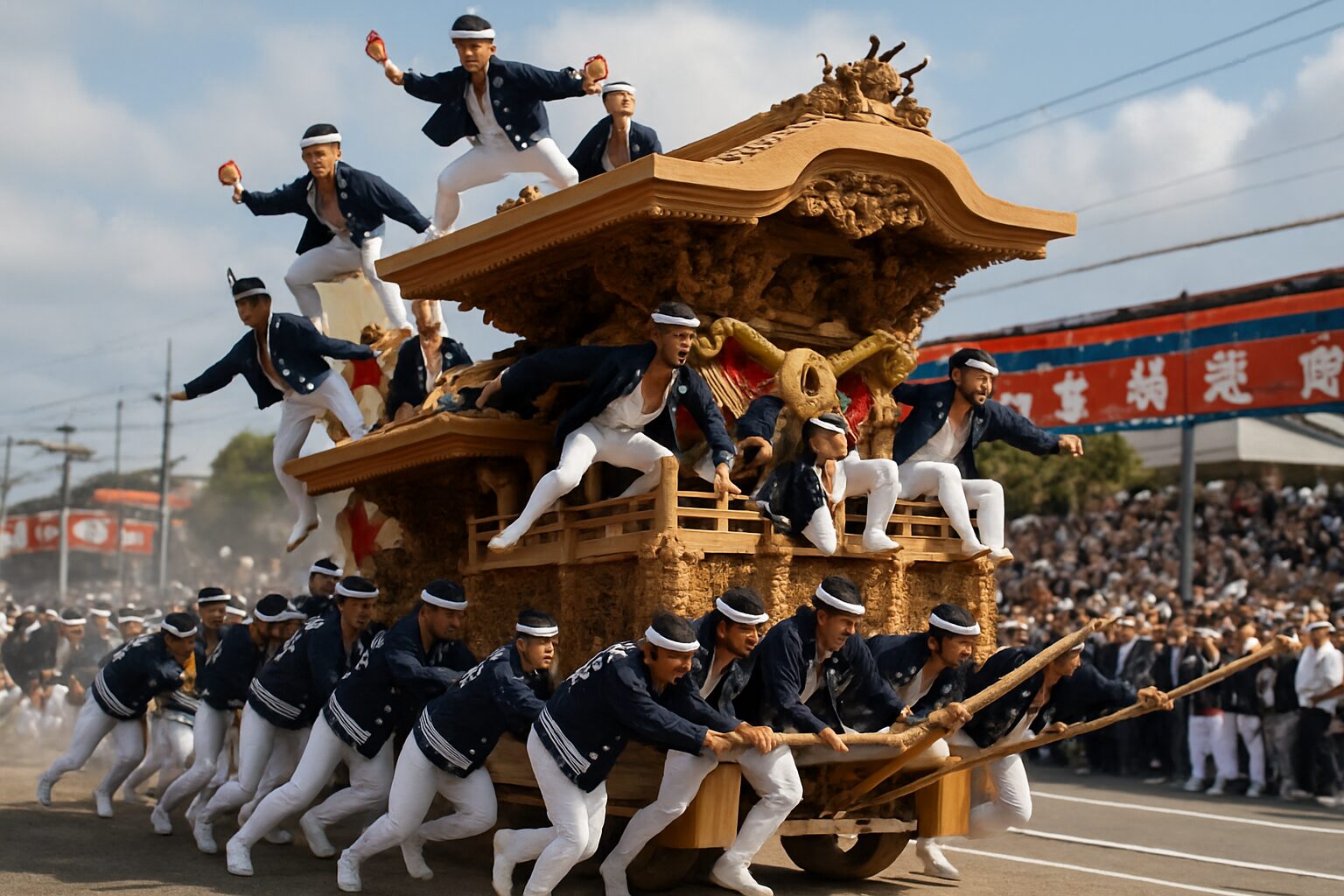
There’s a rhythm to Osaka that you feel deep in your bones, a pulse that beats just a little faster than the rest of Japan. You find it in the sizzle of takoyaki on a Dotonbori grill, in the boisterous laughter echoing through a Shinsekai tavern, and in the relentless, forward-moving energy of its people. But to experience this city’s heartbeat in its most primal, thunderous, and unfiltered form, you have to leave the neon glow of Namba behind and head south to the castle town of Kishiwada. Here, every September, the streets erupt in a controlled explosion of wood, sweat, and soul-shaking sound. This is the Kishiwada Danjiri Matsuri, and it’s not just a festival; it’s a force of nature. Forget everything you think you know about serene Japanese parades with their delicate mikoshi shrines swaying gently on the shoulders of participants. The Danjiri Matsuri is a full-throttle, high-speed spectacle of bravery, tradition, and pure, unadulterated adrenaline. It’s a breathtaking display where massive, intricately carved wooden floats, weighing upwards of four tons, are hauled through narrow, winding streets at breakneck speeds by hundreds of men and women, their synchronized chants a roaring testament to the power of community. It is, without exaggeration, one of the most intense and thrilling cultural experiences you can find in all of Japan, a raw and powerful tradition that has been passed down through generations, pulsing with the very essence of Osaka’s wild heart.
The festival’s awe-inspiring massive wooden floats are themselves masterpieces, each one painstakingly crafted by dedicated artisans known as the daikugata.
The Heartbeat of the Festival: The Danjiri Floats

To truly grasp the festival, you must first appreciate the danjiri themselves. These are far more than simple parade floats; they are mobile masterpieces, sacred heirlooms, and the tangible expression of each neighborhood’s pride and history. Constructed entirely from magnificent keyaki wood—a type of Japanese zelkova valued for its strength and stunning grain—each danjiri represents a triumph of carpentry and sculpture. The wood remains unpainted, allowing its natural, deep amber tone to shine, polished to a high gleam by generations of hands. Towering and formidable, they often exceed four meters in height and weigh an astonishing four to five tons. Encountering one up close, even when still, evokes awe at its massive scale and the immense human effort involved in both its creation and movement. The entire framework is a complex assembly of beams and platforms, crafted without nails using traditional joinery methods perfected over centuries. This design grants the float a necessary flexibility, crucial for enduring the significant stresses experienced during the festival.
Yet, the true spirit of the danjiri resides in its carvings. Every surface is adorned with stunningly intricate, three-dimensional sculptures teeming with life. These are far from arbitrary decorations. Each panel narrates a story, illustrating epic scenes from Japanese history and mythology. You might find the famous Battle of Kawanakajima, with samurai warriors locked in combat on horseback, their armor and weapons rendered with incredible detail. Another panel could depict a dramatic episode from the Tale of the Heike, or portray a legendary fierce dragon or a clever kitsune fox. These carvings are the work of master artisans—a lineage of craftsmen devoted to this unique art form. The level of detail is breathtaking; you can discern a warrior’s expression, the intricate pattern on a kimono, or the individual scales of a mythical creature. Each neighborhood’s danjiri features its own distinctive carvings, presenting a visual narrative of its identity and heritage. Standing before one, you could spend hours tracing the stories with your eyes, feeling the deep weight of history embedded in the very grain of the wood.
The Symphony of Motion: Roles and Teamwork
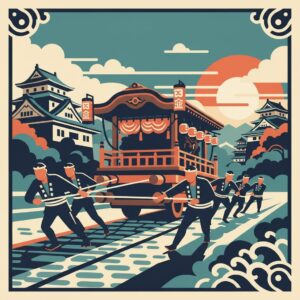
A danjiri is nothing without its people. It takes a team of hundreds, sometimes nearly a thousand, to bring this wooden giant to life. This is not a chaotic crowd but a highly organized, well-coordinated machine where every individual has a specific and essential role. The most visible are the pullers, the raw force behind the operation. Two thick, heavy ropes, each about 100 meters long, extend from the front of the float. Hundreds of men, women, and even children from the neighborhood grip these ropes, their combined strength generating forward momentum. Their energy is contagious, their expressions a blend of intense focus and joyful exertion.
Steering this multi-ton beast, however, is far more complex. The danjiri has no steering wheel. Its direction is managed by a small group of specialists. At the front, hidden in the undercarriage, are the maeteko, or front lever men. They use sturdy wooden levers to pry at the front wheels, subtly steering the float. At the rear, a larger team called the ushiroteko operates the main steering mechanism. This massive wooden lever, resembling a ship’s tiller, extends from the rear axle. It demands immense strength and precise teamwork to push and pull this lever, causing the entire back section of the float to shift and pivot. This is how the danjiri navigates the narrow streets of Kishiwada. Alongside the wheels run the men with wedges, ready at a moment’s notice to jam a wooden block beneath a wheel to help initiate a turn or halt the float’s momentum. Every role is connected, forming a symphony of human effort built on trust, communication, and months of rigorous practice. The chants rising from the team are not merely for spirit; they serve as commands, signals coordinating the pulling, levering, and turning into a single, powerful motion.
The Apex of Adrenaline: The Yarimawashi
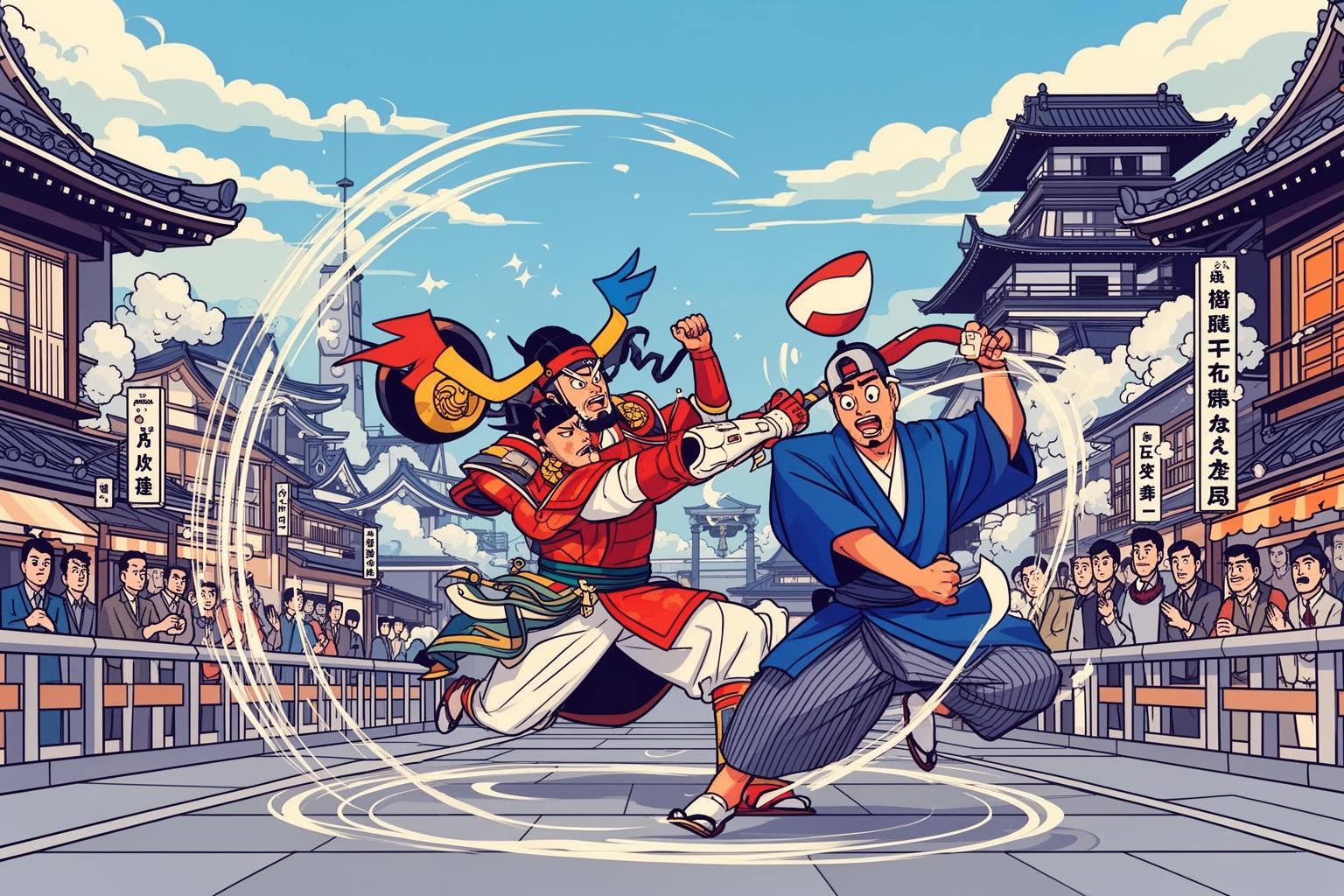
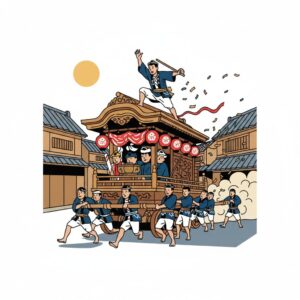
Every element of the Danjiri Matsuri builds up to one defining, heart-stopping moment: the yarimawashi. This signature maneuver of the festival is a remarkable display of skill, speed, and bravery that must be seen to be believed. Simply put, a yarimawashi is a full-speed, 90-degree turn at a street corner. However, that description barely conveys its true nature. Picture a four-ton wooden giant, essentially a battering ram on wheels, racing toward an intersection at full throttle. The ground shakes. The shouts of the pullers and the thunder of solid wooden wheels on pavement are deafening. The crowd holds its breath. Just as it seems the float will crash into the corner building, a flurry of commands erupts. The ushiroteko throw their entire weight against the massive rear lever, the men with wedges jam their blocks under the outer wheel, and the inside pullers slacken their ropes while the outside pullers dig in and pull with all their might. The danjiri pivots with tremendous force, the outer rear wheel lifting completely off the ground. For a fleeting moment, the entire colossal structure balances precariously on a knife’s edge, skidding around the corner in a controlled slide that defies physics. Wood scrapes asphalt, sending a high-pitched screech into the air, sometimes sparking. Then, just as swiftly, it straightens out and charges down the next street without losing momentum. It is a moment of pure, visceral excitement—a flawless blend of brute force and delicate precision. A successful yarimawashi is greeted by a thunderous roar of approval from the crowd, a shared exhalation of relief and admiration. A failed attempt might cause the float to tip or worse, crash into a building—a rare yet ever-present risk that sharpens the tension of the celebration.
Perched precariously atop this controlled chaos is the festival’s most iconic figure: the daikugata, or carpenter. This man is the star of the spectacle, standing on the very roof of the charging danjiri. Clad in the neighborhood’s traditional attire, wearing a distinctive headband and wielding a large fan in each hand, the daikugata serves as both conductor and performer. He is responsible for spotting obstacles ahead and signaling to the team below, but his primary role is to embody the float’s spirit. As the danjiri barrels down the street, he dances. He leaps from one side of the gabled roof to the other, striking dramatic poses, his fans slicing through the air. During a yarimawashi, as the float tilts and skids violently beneath him, he maintains an almost supernatural balance, his body swaying perfectly against the G-forces trying to hurl him into the crowd. It is a feat of incredible athleticism and extraordinary courage. Being chosen as the daikugata is one of the highest honors a man in Kishiwada can achieve, a role demanding years of training and nerves of absolute steel. Watching him, silhouetted against the sky, is to witness a living symbol of the festival’s daring, defiant spirit.
Two Festivals in One: The Contrasting Moods of Day and Night
The Kishiwada Danjiri Matsuri is an experience divided into two distinct parts, each with its own unique atmosphere. The daytime festival, known as Hiru-曳行, focuses on power, speed, and competition. This is when the yarimawashi takes place, and the air buzzes with intense competitive spirit. The sun blazes down on the streets, reflecting off the polished wood of the danjiri and the sweat-drenched brows of the pullers. The sounds are sharp and loud: the relentless pounding of drums, the piercing call of flutes, the guttural shouts of the teams, and the constant, deafening rumble of wooden wheels. Each of the twenty-two neighborhoods, or chō, participating in the main September festival takes immense pride in its danjiri and its team. Though the rivalry is friendly, the drive to perform the most perfect, fastest, and most daring yarimawashi is unmistakable. Crowded streets are filled with spectators, a lively sea of people vying for the best vantage point, their cheers and gasps amplifying the high-stakes drama unfolding before them. The daytime event is a display of raw athleticism, a powerful testament to the strength and discipline of the Kishiwada community.
As dusk descends on the city, a stunning transformation occurs. The frenetic, aggressive energy of the day softens into a gentler, more magical ambiance for the Yoru-曳行, or night parade. The danjiri, once symbols of sheer power just hours earlier, are now decorated with over two hundred red paper lanterns, or chōchin. Each lantern glows warmly from within, casting an ethereal light that highlights the intricate carvings and turns the imposing floats into shimmering palaces of light. The pace slows significantly. Rather than sprinting, teams pull the danjiri at a dignified walking speed, inviting everyone to admire their beauty. The forceful chants of the day give way to melodic festival songs, and children who were kept safely distant during daylight hours are now allowed to help pull the ropes or even ride on the float itself. The atmosphere becomes festive and familial. The air fills with the scent of festival food from countless stalls, or yatai—the savory aroma of grilled squid, the sweet smell of caramelizing sugar for candy apples, and the comforting fragrance of dashi from takoyaki vendors. Families stroll through the streets, friends gather to chat, and the entire town feels like one enormous, joyous block party. The night parade leans less toward thrilling spectacle and more toward heartfelt community celebration. It is a time for the people of Kishiwada to honor tradition, showcase the beauty of their floats, and share a moment of collective pride beneath the soft, glowing light of the lanterns. Experiencing both the fierce energy of the day and the enchanting charm of the night is essential to fully appreciate the Danjiri Matsuri’s rich spectrum.
A Tradition Forged in History and Community
To view the Danjiri Matsuri merely as an exhilarating parade is to overlook its profound significance. This festival is the heart and soul of Kishiwada, a tradition intricately woven into the community’s fabric for more than three centuries. Its roots date back to 1703, when the daimyo, or feudal lord, of Kishiwada Castle, Okabe Nagayasu, prayed for a plentiful harvest at the Fushimi Inari Shrine in Kyoto. When his prayers were granted with a rich crop, he launched a festival of gratitude, which laid the foundation for the contemporary Danjiri Matsuri. What started as a solemn religious ceremony has transformed over time into the magnificent display of strength and local pride it is today. Yet, at its essence, it remains an offering, embodying the unity and spirit of the community.
For the people of Kishiwada, life is governed by the festival calendar. Preparations begin months or even a full year ahead. The teams diligently practice their pulling and turning techniques. The musicians, known as the narimono, rehearse their complex rhythms on drums (taiko), flutes (fue), and bells (kane), producing the distinctive soundtrack that gives each neighborhood its unique auditory identity. The danjiri itself is carefully maintained, its wood nurtured, its carvings cleaned, and its running gear checked repeatedly. Participation spans generations. A boy might start by pulling ropes alongside his father and grandfather, dreaming of the day he will be strong enough to be an ushiroteko or courageous enough to be the daikugata. This tradition is transmitted not through written texts but through shared experience, forging an unbreakable bond that unites the community. Those who have moved away from Kishiwada faithfully return every September to take part, taking vacation time from their jobs in Tokyo or elsewhere to rejoin their neighborhood teams. The festival stands as a powerful expression of identity. When you see participants wearing their neighborhood happi coats, each bearing its own color and crest, you witness more than just a uniform; you see a symbol of belonging, a deep-rooted connection to a place and its people that surpasses all else during these few days in September.
A Practical Guide for the First-Time Visitor
Experiencing the Kishiwada Danjiri Matsuri is an unforgettable adventure, but its intensity means a bit of planning is necessary, especially for first-timers. The main festival, showcasing neighborhoods around Kishiwada Castle, occurs over a weekend in mid-September. A second, slightly smaller yet equally exciting Danjiri festival involving other city districts takes place in early October. Always check the official Kishiwada city website for exact dates, as they can shift slightly each year.
Getting there is simple. From Namba Station in central Osaka, take the Nankai Main Line Express train. It’s a direct trip, taking about 30 minutes. The key stations to disembark at are Kishiwada or Takojizo. From either stop, follow the large crowds and the sound of drums to locate the festivities. Streets will be closed to traffic, so prepare for a lot of walking. This leads to the most important advice: wear comfortable, sturdy, closed-toe shoes. You’ll be on your feet for hours, navigating crowded streets, and want to protect your feet from occasional jostling.
Now, the million-dollar question: where to watch? The famous yarimawashi corners, especially those near Kishiwada Station, are iconic but extremely crowded. People reserve spots hours, sometimes even a day, in advance. For a first visit, trying for a front-row spot here can be overwhelming and frankly, less enjoyable. Instead, I suggest a more flexible viewing approach. Choose a spot along one of the long, straight sections of the course. While you won’t see the dramatic turns, you will feel the incredible speed and power of the danjiri as it thunders by, which is thrilling in itself. The area around Kishiwada Castle also offers a less congested, beautifully scenic backdrop. Another good tactic is to focus on the earlier parts of the day or the night parade, which are generally less crowded than peak afternoon hours. Don’t fixate on one spot; wander around, soak in the atmosphere from different viewpoints, and let the festival unfold naturally.
Safety is paramount at such a chaotic event. Local police and festival organizers manage crowd control impressively, but you must remain alert. Always stay behind designated safety lines. When a danjiri approaches, the crowd often surges and compresses, so be mindful of your surroundings, especially if you have children—hold their hands tightly. The floats move with tremendous momentum and cannot stop suddenly. They always have the right of way. Be sensible, maintain a safe distance, and never try to cross the street when a float is approaching. Pack light but bring essentials: sunscreen, a hat, and plenty of water for the daytime, as September can still be quite hot. A portable phone battery is advisable since you’ll be taking many photos and videos. Also, bring cash—streets are lined with yatai food stalls, and you won’t want to miss the delicious festival treats. Sampling yakisoba, karaage, and candied strawberries is as much a part of the experience as watching the floats.
Beyond the Parade Route
While the festival is the main attraction, Kishiwada has much more to offer if you have the time to explore. For a deeper appreciation of the danjiri without the chaotic crowds, visiting the Kishiwada Danjiri Kaikan (Danjiri Museum) is essential. Situated right next to the castle, the museum allows you to see a full-sized danjiri up close, admire the intricate carvings, and watch high-definition videos of past festivals on a large screen, giving you a front-row view of the most spectacular yarimawashi moments in a safe environment. It’s a fantastic way to prepare yourself before heading to the streets or a great alternative for those who can’t attend on festival days.
Naturally, no trip to Kishiwada would be complete without visiting Kishiwada Castle itself. Although the current structure is a concrete reconstruction from the 1950s, it remains a beautiful and impressive sight. Climbing to the top of the main keep, or tenshu, rewards you with a panoramic view of the city, the festival route, and Osaka Bay beyond. The castle grounds and surrounding moat offer a peaceful refuge amid the festival excitement, providing a perfect spot to relax and reflect on the town’s history. Strolling through the old castle town, or jōkamachi, with its traditional houses and winding streets, lets you experience a glimpse of Kishiwada’s past and offers a calm counterpoint to the high-energy festival atmosphere.
The Unmistakable Soul of Osaka
Ultimately, the Kishiwada Danjiri Matsuri is more than just a loud, dangerous, and exhilarating spectacle. It represents the profound spirit of a community. It is the sound of a tradition that has resonated through these streets for over 300 years. It is the sight of generations standing together, united by a shared purpose. It is the sensation of the ground trembling beneath your feet as five tons of history and pride roar past. This event is not designed for tourists. It is raw, authentic, and unapologetically local. To attend is to be a guest in Kishiwada’s home during its most significant family celebration. You sense the passion, dedication, and nearly unbelievable effort that bring this festival to life. It serves as a powerful reminder that beneath Osaka’s modern, urban facade lies a deep reservoir of tradition and a fierce, unbreakable community spirit. So come to Kishiwada. Feel the rhythm. Witness the bravery of the daikugata, admire the skill of the yarimawashi, and let the thunderous energy of the danjiri engulf you. It is an experience that will leave you breathless, inspired, and with a much deeper appreciation for the wild, wonderful, and unyielding heart of Osaka.