Talk to anyone in Kansai, even in Tokyo, and mention you’re thinking of living in Nishinari. You’ll get a look. It’s a mix of concern, a little bit of shock, and a whole lot of curiosity. The name itself carries a heavy weight in Japan, a shorthand for poverty, day laborers, and a side of the country that’s scrubbed clean from the glossy travel brochures. The first thing people will tell you is that it’s cheap. Impossibly cheap. The kind of cheap that makes you ask, “What’s the catch?” And that’s the real question, isn’t it? The rent prices you see on a real estate website are just numbers on a screen. They don’t tell you about the texture of the streets, the sound of the evening, the unspoken rules of the local supermarket, or the mindset of the people who call this place home. My name is Taro Kobayashi, and I’ve spent enough time on the ground here to tell you that the true cost of living in Nishinari isn’t just measured in yen. It’s measured in trade-offs, in expectations, and in a profound, unfiltered dose of reality. This isn’t a guide to convince you to move here, nor is it a warning to stay away. It’s a practical, honest breakdown of what it actually means to live in the cheapest corner of a major Japanese city, aimed at helping you understand the culture of Osaka from its most extreme and revealing edge.
To truly understand the complex reality of this area, you must first separate the enduring myths of Nishinari from its lived experience.
The Numbers Game: Rent, Utilities, and the Price Tag You See First
Before we explore the heart of the neighborhood, we must begin with the force that draws everyone in: the money. Nishinari’s financial allure is anything but subtle—it hits like a sledgehammer. The savings here can fundamentally transform your lifestyle, freeing up funds for hobbies, travel, or simply getting by on a student or artist’s income. Even these straightforward figures reveal much about the area’s priorities and history.
Rent: The Astonishing Price Tag
Let’s be frank. Rent in Nishinari can seem like a mistake. When your friends in Tokyo complain about paying 90,000 yen a month for a tiny shoebox in a distant suburb, you can find a fully functional, private 1K apartment—a small studio with a kitchen nook—for under 30,000 yen. If you’re flexible about age or décor, rents can dip into the low 20,000 yen range. These aren’t guesthouses or shared units but your own space, with your own key, in one of Japan’s largest cities. The financial impact is huge: a difference of 720,000 yen annually, or around $5,000 USD, compared to a modest Tokyo apartment. That’s a new way of life. It’s the freedom to skip an extra part-time job. It’s the ability to chase a creative dream without starving.
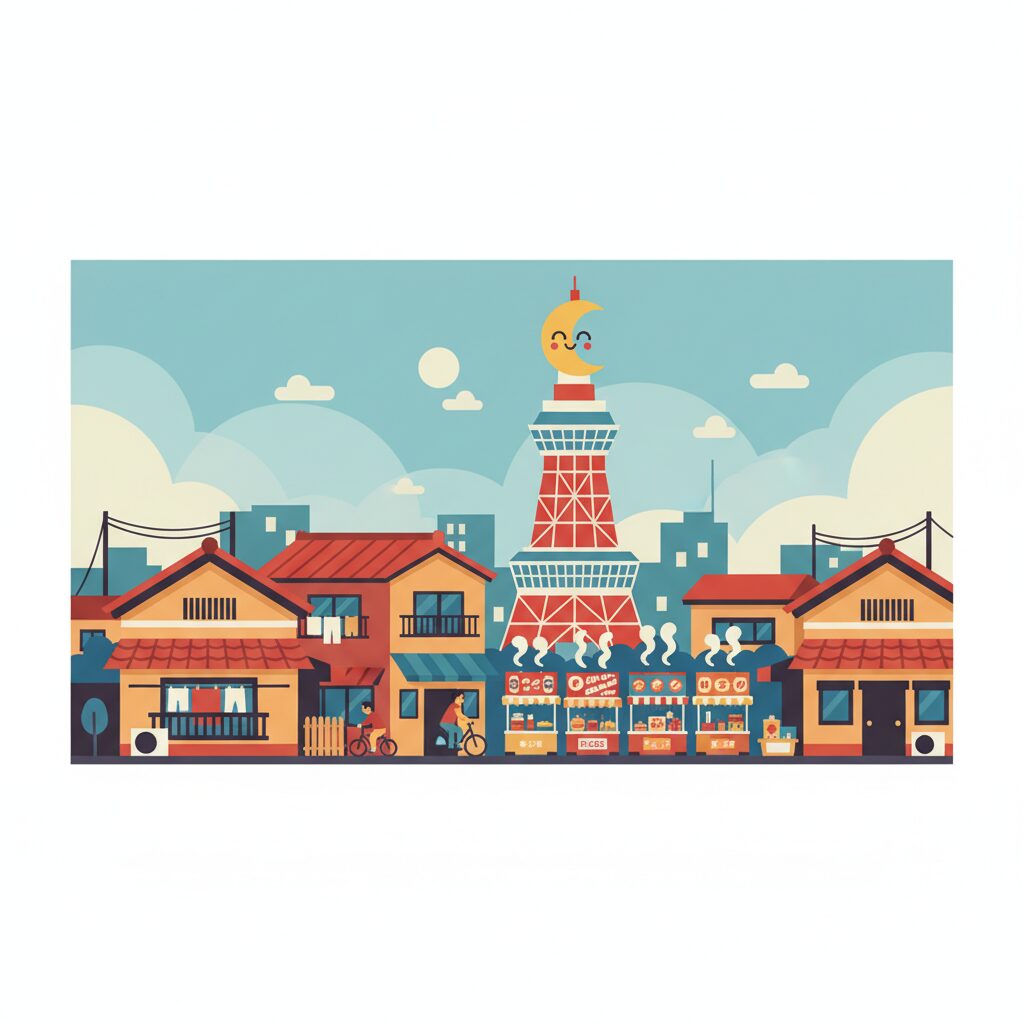
So, why is it so affordable? The answer lies in a mix of factors. First, the buildings are old—dating back to the 60s and 70s, from Japan’s post-war economic boom. They’re concrete, functional, but far from stylish. Forget sleek auto-lock entrances, parcel lockers, and soundproof walls typical of newer buildings in Umeda or Namba. Here, you might have a simple metal door, a rusty mailbox slot, and thin walls letting you hear your neighbor’s favorite TV show. The trade-off is clear: you pay for shelter, not for bells and whistles. Second is the neighborhood’s reputation. Nishinari, especially Kamagasaki (or Airin-chiku), has long been Osaka’s hub for day laborers. This background has maintained low property values and a transient population, blocking the kind of gentrification that inflates prices in other historically working-class urban areas worldwide. Landlords aren’t vying for wealthy young professionals; they provide essential housing for those on tight budgets. The whole economic ecosystem runs at this lower frequency, with rent as its foundational tone.
Utilities and Daily Groceries: Layered Savings
Electricity and gas bills here match those anywhere else in Osaka, but the real everyday savings come from food. Nishinari’s culture of extreme frugality becomes tangible and edible in this way. The undisputed champion is Super Tamade. Its bright yellow buildings and chaotic neon signs, flashing nonstop, look more like a pachinko parlor than a grocery store—and that’s by design. It screams one message: DEALS.
Shopping at Tamade is an event. The music blares, aisles are tight, and promotions are legendary. Their famous “1 yen sales” mean if you spend a certain amount (usually 1,000 yen), you can buy select items—a carton of eggs, loaf of bread, pack of tofu—for just one yen. This isn’t a rare gimmick but a daily tactic. Produce piles up, maybe not perfectly polished or uniform like in a department store basement, but incredibly cheap: massive bags of bean sprouts for 20 yen, blocks of udon for 19 yen, and pre-made bento boxes under 200 yen at day’s end. This completely alters how you approach your food budget. It’s not about splurging or saving; it’s a constant state of minimal expense. The focus isn’t on aesthetic quality but calorie-rich sustenance. It’s fuel. It’s survival. And it’s remarkably efficient.
Beyond Tamade, local shotengai (covered shopping arcades) like Tsurumibashi Shotengai offer another world. These aren’t tourist draws like Kuromon Market but vibrant commercial lifelines for residents. Tiny stalls sell freshly made croquettes for 50 yen each. Small butchers offer cuts far cheaper than major supermarket chains. Competition is fierce and direct. Shopkeepers stand outside, shouting daily specials. This raw form of commerce has been polished away in more modern parts of the city. In Nishinari, you don’t just save money on groceries; you engage in an economic system stripped back to its essentials: price, value, and volume.
Beyond the Yen: The Hidden “Costs” and Unspoken Realities
If your analysis ends at the bank account, you’re missing the full picture. Living in Nishinari involves a range of non-monetary costs and adjustments. These everyday realities shape the experience—the things you exchange for that affordable rent. It’s in the social and environmental fabric of the area that you’ll determine whether the bargain is genuinely worthwhile.
The Social Fabric: A Community of Survivors
Nishinari is not a homogeneous group of “the poor.” It’s a complex mosaic of individuals, each with their own story that brought them to this part of Osaka. There are the elderly living on limited pensions, for whom the low cost of living is essential. There are day laborers—the original backbone of the neighborhood—who still gather early each morning hoping for work in construction or shipping. A growing number of young backpackers and foreign students have found it a cheap base for exploring Japan. Plus, there are artists, musicians, and freelancers who have deliberately chosen financial freedom over social status. What unites this diverse group is a shared condition of living on the economic edge. There’s little pretense here. No one is trying to impress neighbors with new cars or designer clothes. Social currency is measured not by wealth or status, but by resilience and practicality.
This creates a social atmosphere that feels both liberating and potentially isolating. On one hand, there’s a significant absence of judgment. Your apartment is old? So is everyone else’s. Your clothes are worn? You’ll fit right in. This “live and let live” mentality can offer a refreshing break from the intense social pressures found elsewhere in Japan. No one cares about your job title or alma mater. On the other hand, it can be a lonely existence. The sense of community isn’t always obvious. It’s a community of individuals sharing space, not necessarily a close-knit village. Neighbors might be transient, working unconventional hours, or simply keeping to themselves. Building deep relationships can be tough if you’re used to more structured social environments. The unspoken rule is to mind your own business, born from a collective understanding that everyone is just trying to get by.
The “Safety” Question: Perception vs. Reality
Let’s confront the biggest stereotype directly: safety. Nishinari’s reputation is well-known. It’s one of the few places in Japan where you might see open-air gambling, men drinking cheap sake on the curb in broad daylight, and a sizable homeless population. The area around Shin-Imamiya and Dobutsuen-mae stations can be visually confronting for those used to Japan’s typically orderly image. The smell of alcohol and stale cigarettes lingers, and poverty is visibly present. For many—especially women—this environment can feel intimidating, and it would be disingenuous to ignore those feelings.
However, it’s important to distinguish between atmospheric unease and actual physical danger. While property crimes like bicycle theft occur, violent crime against random individuals is extremely rare, as is typical throughout Japan. The main difference in Nishinari is that social issues are out in the open rather than hidden. The men drinking on the street are usually non-aggressive; they’re simply living their lives in public. The risk lies not in being mugged in a dark alley but perhaps in witnessing a verbal dispute between two intoxicated locals. The perceived danger often stems from visible poverty and non-conformity rather than actual statistics on violence. This is a fundamental misunderstanding held by many foreigners and even some Japanese people, who equate the visible disorder with the street crime common in many Western cities. In Nishinari, the reality is more about social welfare problems playing out in plain sight. The true “cost” here is psychological comfort—you need to be willing to coexist with an imperfect reality. You have to learn to see the humanity beneath the hardship, not let the appearance of poverty distort your sense of risk.
The “Convenience” Cost: What You Trade for Cheap Rent
Living inexpensively in Nishinari requires significant compromises on modern conveniences. The old buildings that offer such cheap rent come with their own drawbacks. Insulation is often poor, leading to freezing winters and sweltering summers, which can drive up utility bills you hoped to reduce. Walls are thin, so a good pair of headphones is a smart investment. Pests like cockroaches are more common in older, less well-maintained buildings. You’re sacrificing modern comfort for affordability—a trade that feels particularly harsh on a cold January morning or a sticky August night.
Beyond your doorstep, neighborhood amenities cater mostly to necessities, not leisure. You’ll find plenty of coin laundries, public baths (sento), and inexpensive 食堂 (shokudo), but few trendy cafés, artisanal bakeries, or boutique fitness studios. If your ideal relaxing Saturday involves a specialty coffee shop and a yoga class, you’ll need to travel outside the ward. This creates a kind of social and cultural commute. Your home is your cheap sanctuary, but your social life often takes place elsewhere—in Namba, Shinsaibashi, or Umeda, all easily accessible by train. This can foster a sense of disconnect. You sleep in Nishinari and save money there, but you don’t necessarily live your social life in Nishinari. This is a tangible cost for those who value being immersed in a vibrant, contemporary social scene. It leaves you on the margins, more observer than participant in the city’s trendier rhythms.
The Nishinari Mindset: How Frugality Shapes a Culture
To truly grasp Nishinari, you need to understand the philosophy that underlies it. This place is not merely a cluster of inexpensive buildings; it is an ecosystem grounded in a particular mindset. It embodies the raw, unfiltered core of Osaka’s renowned pragmatism, stripped of all formalities and sharpened by necessity. Here, you witness how economic realities do more than influence lifestyles—they actively shape cultural norms and social interactions.
Mottainai on a Larger Scale
The Japanese concept of mottainai—a sense of regret over waste—is a well-known cultural value. Across much of Japan, it appears in actions like finishing every grain of rice or using a fabric furoshiki for wrapping. In Nishinari, however, mottainai reaches an artful level, serving as a crucial survival principle. Waste is not just regretted; it is regarded as virtually sinful. This is evident everywhere. Vending machines sell drinks for as little as 50 yen, often because they are close to expiration or less popular brands. Second-hand shops aren’t trendy vintage stores; they’re packed floor-to-ceiling with used electronics, clothes, and household items all sold for a few hundred yen. There is a palpable sense that every object and every yen must be wrung for maximum value before being discarded.
This mentality reflects the famed Osaka akindo (merchant) spirit, but in its street-level form. While a merchant in Shinsaibashi aims to maximize profit, the Nishinari resident aims to maximize survival. Both represent two sides of the same coin: an intense, unsentimental focus on value. This explains why people line up for the 1-yen sales at Super Tamade. It’s not merely about saving a 100 yen on eggs; it’s about taking part in a system where you’ve beaten the game. You got the deal. You won. This emphasis on efficiency and value rather than aesthetics is perhaps the defining trait of the neighborhood’s culture. It clarifies why restaurant decor doesn’t matter if the katsu curry costs 400 yen and fills you up, and why no one minds if the supermarket looks chaotic, so long as the prices are the lowest in the city.
A Different Kind of “Friendly”: Osaka’s Honesty
The stereotype that “Osaka people are friendly” can be misleading. It brings to mind images of smiling shopkeepers and warm greetings. While that exists, the friendliness you’re more likely to encounter in Nishinari is of a different, more forthright kind. It’s born from blunt honesty and a lack of pretension. It’s less about making you feel comfortable and more about offering practical, unsolicited advice. It’s the old woman in the grocery aisle who taps your shoulder and points out a cheaper brand of miso, matter-of-factly saying, “This one’s cheaper and tastes the same.” She’s not being intrusive; she’s helping in the most practical way she knows. She’s sharing valuable information within the community’s shared value system.
This stands in sharp contrast to the dominant culture in Tokyo and much of Japan, which revolves around tatemae (public facade) and honne (true feelings). Social interactions there are often highly coded and indirect to maintain harmony. In Nishinari, there’s very little tatemae. People say what they mean because life is too short and budgets are too tight for ambiguity. This can be surprising to foreigners used to Japan’s subtle social cues. Asking directly about how much you pay for rent is not rude; it’s a normal exchange of information. A shopkeeper might bluntly advise you not to buy something if he thinks it’s not a good deal for you. This is not hostility; it is a form of respect. It acknowledges that both of you share the same harsh, pragmatic reality. It’s a connection based on shared circumstances, not social niceties.
Who Should (and Shouldn’t) Live in Nishinari?
After considering the monetary savings alongside the social and environmental costs, the decision becomes a personal one. Nishinari is not a universal solution. It is a specific tool for a particular purpose, and whether it fits depends entirely on your priorities, personality, and tolerance for a certain kind of beautiful, gritty reality.
The Ideal Nishinari Resident
You might flourish in Nishinari if you match one of these profiles. First, the extremely budget-conscious student or language learner. If your main goal is to keep expenses low while studying in Japan, Nishinari is nearly unbeatable. The money saved on rent can be redirected toward tuition, books, or occasional trips, making your stay financially manageable. Second, the artist, musician, writer, or freelancer. For anyone whose work doesn’t require a prestigious address, the extremely low overhead costs can be a huge advantage. It provides you time and freedom to create, shielding you from commercial pressures found in pricier neighborhoods. Third, the seasoned traveler or cultural anthropologist. If you are genuinely curious to experience a raw, unfiltered side of Japan, free from tourist polish, living in Nishinari offers deep immersion. It will challenge your assumptions of Japan as a uniformly clean, orderly, and affluent society. Lastly, the true minimalist. If you don’t need luxurious amenities, find consumer culture exhausting, and your happiness isn’t tied to your surroundings, Nishinari’s practical, no-frills environment may feel liberating.
Who Might Want to Look Elsewhere
On the other hand, Nishinari can be difficult or unpleasant for some. If you are sensitive to your environment and highly value cleanliness, quiet, and order, this is likely not the right place for you. The visible and sometimes olfactory signs of social issues can be draining if unprepared. Families with young children might find it challenging. While not necessarily dangerous, the lack of clean parks, modern playgrounds, and the predominantly adult atmosphere make it less ideal for raising kids. If your career and social life depend on networking or maintaining a certain professional image, living in Nishinari might be a liability, fairly or not, due to the area’s stigma. Finally, if you are new to Japan and still prefer the picturesque, idealized version of the country, jumping straight into Nishinari might be too much of a culture shock. It’s better to first adjust to the basics of Japanese urban life before exploring its most extreme outlier.
The Final Tally: Is Nishinari Worth It?
So, what is the final verdict? Is living in Nishinari a good deal? The answer is that it’s a perfectly balanced equation. The financial savings are substantial, genuine, and immediate. You receive exactly what you pay for: a place to live at the lowest possible cost in a major metropolitan area. However, the currency you use to settle the rest of the cost isn’t yen. It’s your willingness to exchange aesthetics for function, comfort for cost, and social polish for raw honesty. The true price of living in Nishinari is the daily negotiation with a reality that is complex, often uncomfortable, and utterly captivating.
Living here is a learning experience. It teaches you about the economic foundations supporting the shining facade of a city like Osaka. It compels you to face the real-life consequences of economic disparity often ignored in Japan. You learn to value not brand names or attractive packaging, but pure utility. You learn to navigate a social environment governed by a different set of rules, where pragmatism is the highest virtue. In many ways, Nishinari is the most “Osaka” place in all of Osaka. It reflects the city’s historical identity as a town of merchants, hustlers, and survivors, all striving to make it through the day with a little cash left. It’s not attractive, and it’s certainly not for everyone. But for those willing to look beyond the reputation, it offers a kind of freedom money can’t buy, precisely because you’re not spending much of it.