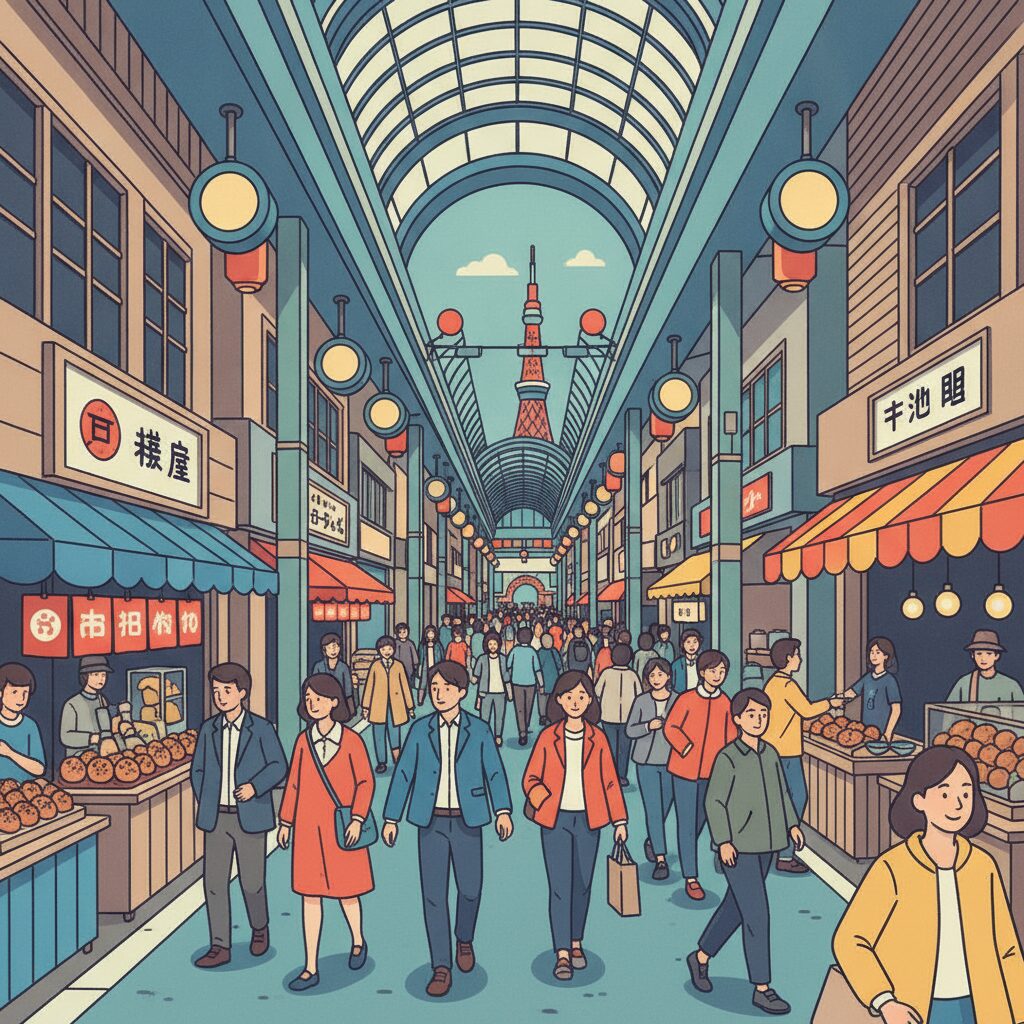
Step off the train in Umeda, and you’re swallowed by a world of polished steel and glass. Towering department stores gleam, their displays curated with surgical precision. The flow of people is a silent, efficient river, each person a solitary vessel navigating a sea of commerce. It’s impressive, it’s modern, it’s… anonymous. But just a few train stops away, a different universe unfolds. Under a weathered plastic roof, a cacophony of sound, smell, and color crashes over you. An old man in an apron bellows a welcome, his voice a gravelly counterpoint to the tinny pop music blasting from a nearby speaker. The air is thick with the scent of fried croquettes, grilled fish, and fresh daikon radish. This is the shotengai, the local shopping arcade, and if you want to understand the real pulse of Osaka, you have to look past the department store glitter and step into this chaotic, vibrant, profoundly human space.
For a newcomer, the shotengai can feel like a relic, a charming but perhaps obsolete piece of old Japan. It’s easy to see it as just a collection of small, independent shops struggling against the tide of convenience stores and mega-malls. But that’s a surface-level reading, a misunderstanding of its fundamental role. The shotengai isn’t just a place to buy groceries. It is the neighborhood’s living room, its social media feed, its informal security system, and its memory bank, all rolled into one. It’s where the city’s famous directness, its obsession with value, and its deep-seated sense of community are performed daily. To live in Osaka without engaging with your local shotengai is to watch a movie with the sound turned off. You see the action, but you miss the entire dialogue that gives it meaning.
This vibrant local scene not only preserves the soul of Osaka through its shotengai but also coexists with transformative trends such as global hotel investments in Kansai, which are fueling a luxury hotel boom across the region.
More Than a Market: The ‘Shotengai’ as a Social Network

In Tokyo, a transaction is often simply that—an exchange of goods for money, carried out with polite efficiency. In Osaka‘s shotengai, however, the transaction serves merely as an excuse for social interaction. This is the core difference. The arcade is a complex web of relationships nurtured over years, sometimes across generations. It runs on a currency of familiarity as much as on yen.
You don’t just buy fish; you buy fish from Yamamoto-san, the third-generation owner who knows you like your aji filleted and will honestly tell you when the squid isn’t as fresh as it was yesterday. You don’t just buy tofu; you get it from the elderly woman behind the counter of her small shop, where the tofu rests in a crystal-clear pool of cool water. She asks about your children, comments on the weather, and wraps your purchase with the slow, deliberate care of a ritual. These people aren’t anonymous staff—they are neighborhood fixtures, vital nodes within the community network.
This is the concrete proof behind the cliché of “friendly Osaka.” It’s not some vague, city-wide atmosphere of cheerfulness. It’s a specific, earned familiarity that grows through repeated, daily contact in these arcades. You are not just an anonymous buyer. You are the person who always picks up the slightly bitter goya in summer, the Canadian guy still exploring which pickles to try. Your identity is formed, interaction by interaction, within this ecosystem. The shopkeepers are the custodians of this local knowledge. They know who just had a baby, whose son is preparing for university exams, and which elderly resident needs a little extra care. This network functions offline, fueled by gossip, attention, and genuine concern. It stands in stark contrast to the isolating anonymity that can characterize life in a larger, more reserved city.
The Rhythm of Daily Life: A ‘Shotengai’ Morning
To truly understand its function, you need to experience the shotengai as it comes to life. It’s a sensory symphony marking the start of the day for countless Osaka residents. Around nine in the morning, the metallic clatter of shop shutters being raised echoes through the covered street. The air, still cool, begins to fill with layered scents. From the okazu-ya (deli shop), the sweet and savory aroma of simmering daikon and soy sauce. From the fishmonger, the sharp, clean fragrance of the sea. From the tiny kissaten (old-style coffee shop), the rich, dark smell of roasting beans, infused into the velvet seats and wooden walls for decades.
Then the people arrive. Not a rush, but a steady, purposeful flow. Elderly women with wheeled shopping carts, moving with practiced efficiency. Young mothers with children in tow, stopping to chat with a friend they’ve inevitably encountered. The local restaurant owner, carefully selecting vegetables for the day’s menu. It’s a procession deeply rooted in routine.
The soundscape grows. “Maido! Irasshai!” (“Thanks for your business! Welcome!”)—the signature Osaka greeting, shouted with booming familiarity. The rhythmic chop-chop-chop of a butcher’s cleaver. The sizzle of oil as a tempura shop readies its first batch. The squeak and jingle of bicycles, the main mode of shotengai transport, weaving skillfully through pedestrians. This isn’t the quiet, orderly atmosphere of a department store food hall. It’s loud, a bit messy, and gloriously alive. It’s the city’s communal kitchen, where the ingredients for thousands of family dinners are gathered not just from shelves, but from familiar hands.
The Unspoken Rules of the Arcade
Navigating the shotengai involves more than simply knowing what to purchase. It requires grasping a subtle, unspoken social code that shapes interactions. For a foreigner, deciphering this code is essential to moving from an outsider to an active participant.
The Art of the Greeting
The most well-known Osaka greeting, often used in business settings, is “Moukarimakka?” (“Making a profit?”). The typical response is “Bochi bochi denna” (“So-so, can’t complain”). A foreigner might interpret this as a sincere, or perhaps intrusive, question about a shop’s earnings. However, it is not. It is a ritual, a form of verbal shorthand meaning, “I see you. We belong to the same commercial community.” Using or at least recognizing this phrase signals a stronger connection than a simple “Konnichiwa.” Likewise, “Maido” goes beyond a mere “thank you.” It acknowledges repeat business and an ongoing relationship. It embodies the spirit of community commerce.
Value as a Conversation
The idea of negiro (price negotiation or haggling) is often misunderstood. This is not the aggressive bargaining typical of a tourist market. Instead, it is a subtle, often playful exchange that strengthens the bond between shopkeeper and regular customer. You wouldn’t haggle over a 100-yen radish, but if you’re buying a whole box of oranges, you might smile and say, “Chotto makete?” (“Can you give me a little discount?”). The shop owner might theatrically sigh, complain about tight profit margins, and then add an extra orange or two with a wink. The goal isn’t really about saving 50 yen; it’s about the interaction itself. This ritual expresses mutual appreciation. Such a practice is nearly unheard of in Tokyo, where the price tag is final. In Osaka, value is flexible, shaped by relationships as much as by cost.
The All-Seeing Eyes of the Arcade
The shotengai serves as the neighborhood’s original surveillance system, but one based on care rather than suspicion. The shop owners act as sentinels of daily life. They know Mrs. Sato buys her milk every morning at 10 AM, and if she doesn’t show up for two days, someone will notice and possibly check on her. They know which children are allowed to walk home from school alone and which are not. They are unofficial guardians of the community’s well-being, fostering a strong sense of safety and belonging. In a society with an aging population, this informal safety net is invaluable and life-saving—something no modern mall or online retailer can ever replicate.
‘Shotengai’ vs. The Modern Mall: A Tale of Two Osakas
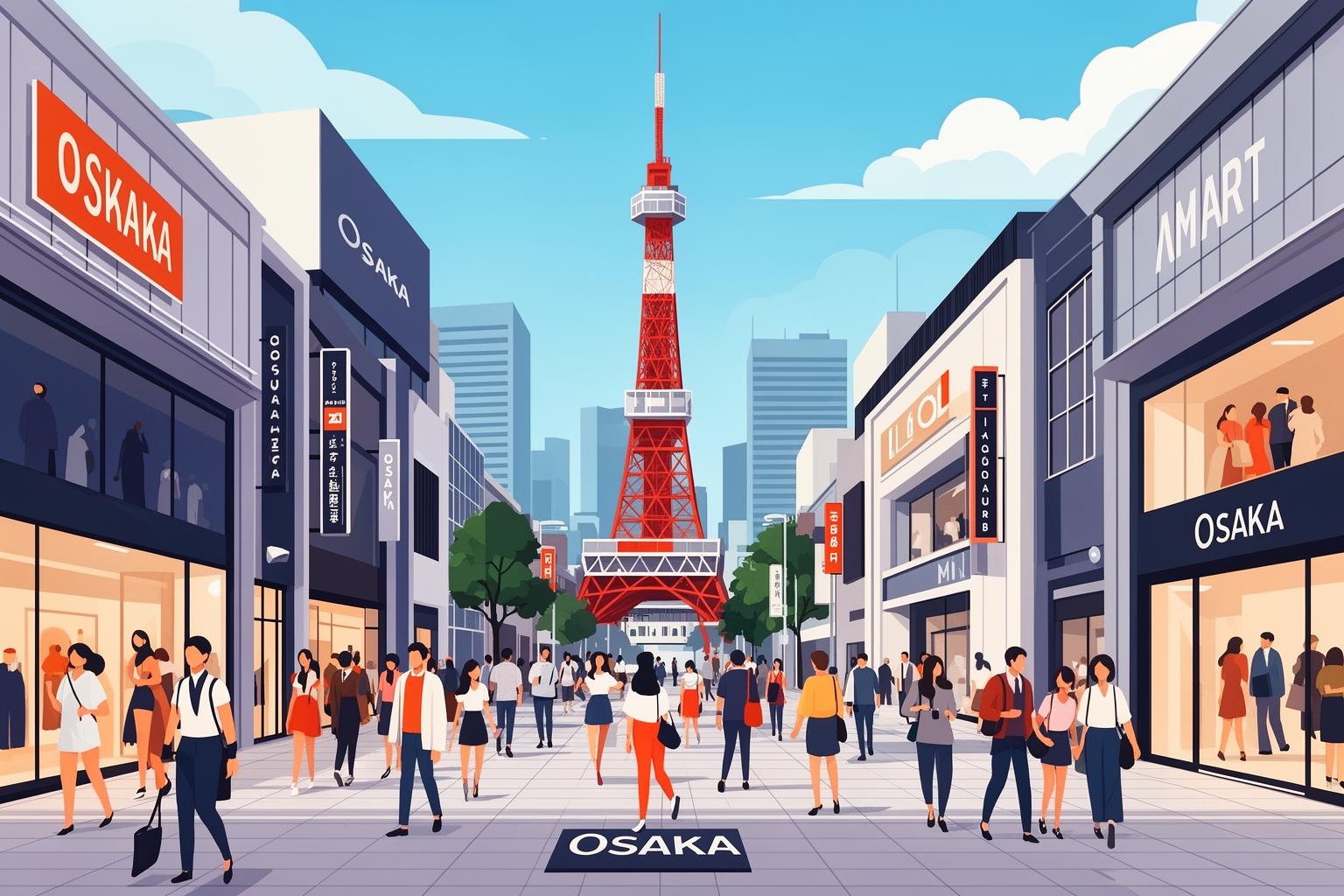
Osaka is a city of contrasts, and this is most evident in the coexistence of the modest shotengai and the enormous shopping mall. Places such as Grand Front Osaka or Abeno Harukas are temples of modern consumption. They provide a globalized experience: immaculate, climate-controlled spaces housing international brands, food courts with a variety of cuisines, and large, impersonal parking lots. They are extremely convenient and cater to a desire for choice and efficiency.
Living in Osaka often means navigating between these two worlds. You might visit the mall on a weekend to buy a specific brand of sneakers, catch a movie, or dine at a trendy restaurant. The experience is predictable, smooth, and solitary, serving a clear purpose.
But on a Tuesday afternoon, when you need fresh eggs, a block of quality tofu, and some vegetables for dinner, you head to the shotengai. You go for the quality and freshness offered by specialized vendors. You go for the prices, which are often better because there’s no massive corporate overhead. Most importantly, you go for the human interaction. You go to be recognized. You go to have three brief, seemingly trivial conversations that remind you that you belong to a community. The mall provides efficiency of purchase; the shotengai offers efficiency of community. One nourishes your household, the other nurtures your sense of belonging.
The Future of the Arcade: Survival and Adaptation
It would be misleading to present a purely romanticized view. Many shotengai throughout Osaka, and indeed across Japan, are confronting existential challenges. The “shutter street” phenomenon, where a majority of shops have permanently closed, poses a serious issue in certain areas. The aging of shopkeepers without successors, intense competition from 24-hour supermarkets, and the shift in consumer behavior toward online shopping are significant obstacles.
However, the narrative is not solely one of decline. It’s also about resilience and innovative adaptation. Some arcades have reinvented themselves by embracing their retro charm, drawing younger entrepreneurs who open trendy cafes, artisanal bakeries, or vintage clothing stores alongside traditional fishmongers and pickle shops. These new businesses infuse fresh energy and attract a different demographic, creating an intriguing mix of old and new. Others have specialized deeply, like Sennichimae Doguyasuji, which is entirely dedicated to kitchenware, attracting chefs and home cooks from the region. They thrive by offering what large stores cannot: specialized knowledge and a carefully curated selection. The most successful shotengai don’t attempt to be malls; they instead focus strongly on their distinctive, human-centered character.
Finding Your Place in the Arcade
For any foreigner eager to truly settle into Osaka life, the shotengai serves as your gateway. It can feel intimidating at first, with its unwritten rules and fast-paced Kansai dialect. But gaining entry is easier than you might expect.
It begins with a simple approach: become a regular. Don’t try to visit twenty different shops. Choose one—a butcher, a fruit stand, a tofu maker—and go there consistently. Initially, your interactions will be brief and transactional. However, after a few visits, they will recognize you. Smile. Use your limited Japanese. Ask a simple question: “Kore, oishii?” (“Is this delicious?”) or “Osusume wa nan desu ka?” (“What do you recommend?”). This is an invitation, showing interest beyond just the price.
Pay attention to the rhythm of the language. You’ll begin to pick up the local flavor—the common “ookini” for thank you, the softer intonations. Don’t be afraid to make mistakes. Your effort to engage is what truly counts. Soon, the shopkeeper’s greeting will change from a generic “Irasshaimase” to a personal “Maido!”. They will start anticipating your needs. They might even give your child a free candy. They will ask where you’re from. And just like that, you’ve started to weave yourself into the neighborhood’s social fabric. You are no longer just living in Osaka; you are becoming a part of it. That is a value you will never find in the brightly lit, perfectly organized aisles of a supermarket.