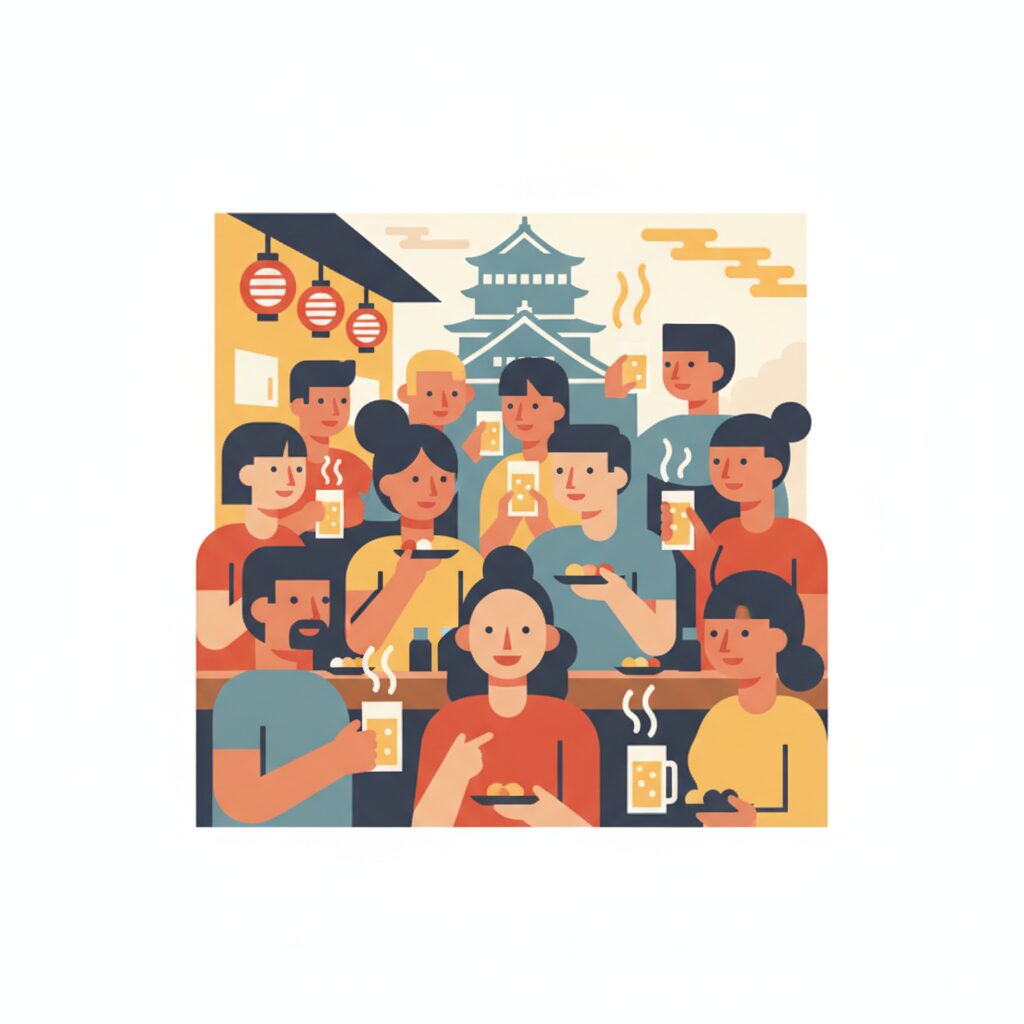
Step off the train in Osaka, into the humid embrace of the evening, and follow the sound. It’s a low hum of chatter, punctuated by sharp laughs and the clatter of plates. It pulls you down a narrow shotengai, a covered shopping arcade, past shuttered fishmongers and sleeping bicycle shops. Then you see it: a doorway glowing under a single red lantern, steam pouring out into the night. Inside, a crowd of people are packed shoulder-to-shoulder along a worn wooden counter. There are no chairs. This is a tachinomi, a standing bar, and it’s not just a place to get a cheap drink. It’s the thumping, beating heart of Osaka’s social life, an everyday theater where the city’s unwritten rules play out in real time. For a foreigner, it can look like an impenetrable fortress of local customs. It feels chaotic, loud, and impossibly crowded. You might wonder, how do I even get a drink in there? But what you’re really asking is, how do I get in? Not just through the door, but into the rhythm, the flow, the very essence of what makes this city tick. Forget what you think you know about Japanese formality. The tachinomi is a different universe, a place where the social code of Tokyo bends and breaks, replaced by a direct, pragmatic, and deeply communal spirit that is quintessentially Osaka.
For a deeper dive into the nuances of local life, consider exploring Osaka bargaining culture as another facet of the city’s vibrant social scene.
The Unwritten Rules of the Counter

The counter is the stage—where everything unfolds. Learning its choreography is your first step toward becoming more than just a customer; it means becoming a participant. In Tokyo, you wait for guidance: you’re escorted, seated, and attended to. In Osaka‘s tachinomi, you are your own guide. The system relies on a shared understanding of efficiency and an unspoken mutual respect for the space and the people within it.
Finding Your Spot: The Art of Squeezing In
Your initial challenge is the entrance. There’s no host or waiting list, just a wall of backs. The natural instinct is to hesitate, waiting for an invitation that will never come. The Osaka way is to gently but deliberately find your own space. Look for a gap at the counter, even one that seems impossibly small—maybe a sliver of wood between two salarymen or a corner near the beer taps. Catch someone’s eye, give a slight nod and a quiet “Sumimasen” (Excuse me), then slide in. This isn’t an intrusion; it’s an accepted, fluid part of the bar’s ecosystem. People will instinctively shift to create just enough room for your hands on the counter. This simple act reveals a lot about the Osaka mindset: it’s pragmatic. Wasted space is unacceptable in a city built by merchants. If there’s room for one more, then one more is welcome. It’s about assuming your right to be there while politely acknowledging those who arrived before you. It’s direct, efficient, and fundamentally communal.
Ordering Like a Pro: Quick, Clear, and Confident
Once you’re settled, your next challenge is ordering a drink. The staff, often the owner or a single employee, moves with lightning-fast, practiced efficiency. They aren’t there to guide you through a menu; they’re there to fulfill orders. Hesitation is the enemy. Before trying to catch their attention, know what you want. The classics are a safe choice: “Nama biru” for draft beer or “Haibōru” for a highball. When ready, don’t wave wildly. Wait for a flicker of eye contact. The moment their gaze sweeps your section of the counter, raise your hand slightly, lock eyes, and state your order: “Nama hitotsu, onegaishimasu” (One draft beer, please). It’s a quick, clean transaction. This isn’t the leisurely pace of a Kyoto bar or the meticulous service of a Ginza lounge. This is Osaka: fast, business-like, and rooted in the city’s history as Japan’s commercial engine. Time is money, even when relaxing. Being decisive shows respect for the staff’s time and the bar’s rhythm.
The Payment System: Cash on the Counter
Look down at the counter before you. You might notice a small tray or shallow bowl—not for your keys, but for your tab. This system, called “kyasshu on,” is a Japanized version of “cash on delivery.” You place a 1,000 yen or 5,000 yen bill in the tray. When your beer arrives, the server takes the exact amount from your bill and leaves the change. Order more, and they’ll do the same. This method is brilliantly efficient: no waiting for a check, no complicated calculations. It’s a transparent, trust-based system that maximizes customer turnover and keeps the flow moving. When your change runs out, you know it’s time to add another bill or move on. This approach feels distinctly Osakan: straightforward, no-frills, and designed for speed. It strips away payment ceremony, turning it into a simple, ongoing transaction so you can focus on the drink, the food, and the atmosphere.
The Social Dynamics: How to Break the Ice (or Not)
Osaka is known for being friendly, but calling it that is a lazy cliché. The word doesn’t fully capture the subtleties of social interaction here. People don’t just randomly invite you into their group. The “friendliness” is more about openness—an invitation that you need to recognize and accept. In a tachinomi, the physical barriers disappear, but the initial social ones remain, though they are much thinner compared to other parts of Japan.
The 30-Centimeter Rule: Your Personal Bubble
Standing elbow-to-elbow with strangers, you’ll notice an interesting phenomenon. For the first few minutes, you exist within a small, invisible bubble. The person beside you may be just inches away, yet they maintain your social space. This is the norm. People mind their own business. A common mistake foreigners make is to misread this initial distance as coldness. It’s not; it’s a form of respect. They’re giving you time to settle in, get your bearings, and be without pressure. The chance to break that bubble will come, but it’s rarely forced. The crowded environment lowers the social barriers but doesn’t erase them entirely. The key is to feel comfortable in that initial silence, observe, and understand that the community is something you join, not something that pulls you in.
The Conversation Starter: From Baseball to Takoyaki
How does that bubble burst? Almost always, it happens over something shared and immediate. Food is the easiest way in. Your neighbor orders a plate of doteyaki, a rich beef sinew stew with an amazing aroma. You can lean over slightly and say, “Oishisō desu ne.” (That looks delicious.) This isn’t an intrusion; it’s a shared appreciation. In Osaka, food is more than nourishment; it’s a key part of the city’s identity and a source of great civic pride. Complimenting the food is, in a way, complimenting the city. Another strong connector is sports, especially the Hanshin Tigers baseball team. On game nights, a tachinomi can feel like an extension of the stadium. A great play draws cheers from the whole bar; a bad one, a collective groan. Showing support for the local team acts like a secret handshake—it signals you’re not just a tourist but someone who cares, even a little, about the local culture. These aren’t random topics; they are pillars of Osaka’s identity, and engaging with them shows your desire to connect on their terms.
“Okyaku-san wa Minna Tomodachi”: The All-Customers-Are-Friends Mentality
After that initial connection forms, the atmosphere can change dramatically. The invisible walls between individuals and small groups melt away. This is where the magic of the Osaka tachinomi truly shines. Someone who was a stranger just minutes ago might offer you a piece of their tempura, insisting you try it. An elderly man at the end of the bar may begin enthusiastically explaining the subtle distinctions between local sakes. Soon, you’re not just a person at a bar; you’re part of a temporary, fleeting community. This stands in sharp contrast to Tokyo, where groups tend to stay insular. In Osaka, the default is more communal. A friend of mine once found himself in a lively but friendly debate with a construction worker about the best way to make takoyaki. By the end, the worker had bought him a beer and invited him to his favorite takoyaki stand the next day. This spirit—that for the hour you’re standing at the counter everyone is a potential friend—is at the heart of the city’s renowned warmth. It’s not abstract friendliness; it’s a real, situational camaraderie born from shared space and a mutual love for life’s simple pleasures.
Tachinomi Archetypes: The Cast of Characters You’ll Meet
Every tachinomi is a stage, and like any well-crafted play, it features a recurring cast of characters. Recognizing them adds to the enjoyment and also offers insight into the bar’s social structure. Each one plays a role in maintaining the delicate balance of the environment.
The Taisho (The Master)
Behind the counter stands the taisho, the master or owner. He may be a man of few words, his face focused as he slices sashimi or pours beer. Don’t mistake his quiet demeanor for indifference. He is the anchor of the entire operation. He observes everything. He knows who’s a regular, who’s new, and who’s had one too many. His movements are precise, the result of thousands of hours of repetition. He commands respect not through authority, but through skill. You earn his approval by being a good customer: order efficiently, avoid trouble, and don’t overstay your welcome. A slight nod from the taisho as you leave is the highest praise you can receive. It’s a silent recognition that you understand the rules and that you belong.
The Joren-san (The Regular)
The joren-san is the experienced regular. They have their usual spot, almost always the same one. They share a comfortable rapport with the taisho. They don’t need a menu—the taisho often begins preparing their typical drink the moment they enter. The joren-san serves as the cultural gatekeeper of the bar. They set the atmosphere. Watching them is like receiving a free lesson in tachinomi etiquette. Notice how they order, pay, and engage with others. They embody the bar’s unique subculture. Making friends with a joren-san can grant you access to the inner circle, but more importantly, observing them provides the blueprint for proper behavior.
The Salaryman on a Pit Stop
Look for the man in a slightly rumpled suit, briefcase at his feet. He’s not here for a wild night out. He’s making a short pit stop on the long commute from office to home. He’ll have one or two drinks, a quick snack like kushikatsu (deep-fried skewers) or edamame, and be gone within thirty minutes. This character is vital because he represents the primary role of the tachinomi in daily life. It’s a decompression chamber. It’s a third space, a brief, affordable escape from work pressures and family duties. It’s not about getting drunk; it’s about resetting. Understanding this role helps you appreciate the importance of turnover and the unspoken rule against lingering. You share this restorative space with people who truly need it.
Practical Etiquette for the First-Timer
Understanding the theory is one thing, but applying it confidently without feeling self-conscious is quite another. A few clear guidelines can help you navigate your first visits with assurance, ensuring you’re seen as a welcome guest at the bar rather than a disturbance.
Don’t Linger: The “Senbero” Philosophy
In Japanese drinking culture, there’s a concept called “senbero,” which literally translates to “1,000 yen drunk.” While not always exactly 1,000 yen, the idea behind it is central to the tachinomi experience. The goal is to enjoy yourself affordably—having a couple of drinks and small dishes before moving on. A tachinomi is not a place to linger for hours. The business thrives on a steady turnover of customers, so overstaying once you’ve finished eating and drinking is frowned upon. It prevents others from taking your spot. A good guideline is to spend around 45 minutes to an hour. This approach keeps prices affordable for all and honors the core purpose of the establishment. It’s meant to be a quick, sharp, and satisfying experience, not a long, drawn-out visit.
Keep it Clean: Your Space is Your Responsibility
The counter is your temporary territory. Treat it with care. If you spill some beer or drop food, clean it up promptly using the small wet towel (oshibori) provided. Avoid leaving a mess for the staff or the next guest. When you finish your plates and glasses, it’s often appreciated if you place them on the raised part of the counter if available, signaling that you’re done. This isn’t about being subservient; it’s about being a thoughtful part of the temporary community. In such a crowded space, everyone’s behavior directly affects others. Keeping your area tidy is a silent way of showing respect to the taisho, fellow customers, and the establishment itself.
Reading the Room: When to Talk and When to Stay Quiet
The biggest error is assuming all tachinomi bars are loud, social hubs. They’re not. Each bar has its own atmosphere and character. Before starting a conversation, take a moment to observe. What’s the vibe? Are people engaged in lively chatter across the counter, or quietly enjoying their drinks alone? Is the taisho talkative or reserved? Your role is to align with the room’s energy. If it’s a calm, reflective environment, appreciate the quiet. If it’s lively and friendly, feel free to join in. The ability to “read the air” (kuuki wo yomu) is highly valued throughout Japan, but in the intimate setting of a tachinomi, it’s crucial. Trying to initiate conversation in a quiet bar is as awkward as standing silently at a noisy party. This adaptability is the final key, showing that you not only know the rules but also sense the rhythm.
From Standing at the Bar to Understanding the City
The tachinomi is a reflection of Osaka itself. From the outside, it may appear intimidating and chaotic, but once you grasp its internal logic, you uncover a world that is remarkably efficient, deeply human, and refreshingly straightforward. Standing at that counter, you engage in a daily ritual that removes all pretense. There’s no fancy decor or elaborate service—just good, affordable food, strong drinks, and the chance for genuine connection. Here, the city’s merchant spirit comes alive: the practicality of the payment system, the emphasis on efficiency, and the impatience with airs and graces. Its communal heart is felt in the easy camaraderie sparked between strangers sharing a plate of grilled squid. Mastering tachinomi etiquette is more than a party trick—it’s a rite of passage. It’s the moment you move from navigating Osaka with a map to reading its social currents. It’s where you learn that connecting with this city doesn’t require being loud or flashy. You just need to find a small space at the counter, order confidently, and be open to the simple, honest humanity beside you.