Step off the train in Osaka, and you might feel a shift in the air. It’s not the humidity, though there’s plenty of that. It’s the sound. The cadence of conversation is faster, the laughter is louder, and the interactions feel… well, less scripted. You’ll hear a shopkeeper teasing a customer, friends trading rapid-fire insults that end in a shared grin, and strangers striking up conversations that sound more like a comedy routine than small talk. For anyone accustomed to the stereotype of Japanese people as reserved, polite, and formal, Osaka can feel like stepping into a different country. The question that hangs in the air for many newcomers is, “Are they always joking?” The short answer is yes. The long answer is that humor here isn’t just for entertainment; it’s the social currency, the city’s operating system, and your single best tool for moving beyond being a foreign resident and becoming a true local.
This isn’t about learning stand-up comedy. You don’t need to memorize punchlines or perfect your comedic timing. Instead, understanding Osaka’s unique brand of humor, known as Owarai, is about learning a new way to communicate. It’s a language of connection built on wit, self-deprecation, and a shared desire to keep life from getting too serious. In Tokyo, formality builds bridges. In Osaka, a well-placed, playful jab does the trick. Forget what you think you know about Japanese social etiquette; here, the rules are written in laughter, and learning to play along is your key to unlocking the city’s vibrant, beating heart.
Embracing Osaka’s infectious humor can extend to experiencing its vibrant street life, where you might also discover how local tachinomi culture offers a window into the city’s unique social etiquette.
The DNA of Owarai: Why is Comedy King in Osaka?
To understand why a joke holds more value than a business card in Osaka, you need to look back in history. Osaka wasn’t established by stoic samurai or powerful shoguns, but by merchants. For centuries, it served as Japan’s commercial hub, a bustling port where rice was traded and fortunes were made. In the business world, success relied on your ability to build rapport, negotiate cleverly, and win people over. Humor became an essential tool. A quick joke could ease a tense negotiation, a witty comment could forge instant camaraderie, and the ability to laugh at yourself demonstrated trustworthiness and humanity.
This merchant spirit (shōnin bunka) sharply contrasts with the samurai culture that shaped Edo, now Tokyo. In Edo, society was strict and hierarchical, with status determined by birth. In Osaka, however, wit and wealth mattered more. Humor acted as the great equalizer, cutting through formality to create a direct connection regardless of social rank. This mindset is ingrained in the city’s DNA. While Tokyo perfected the art of the polite bow, Osaka refined the art of the punchline.
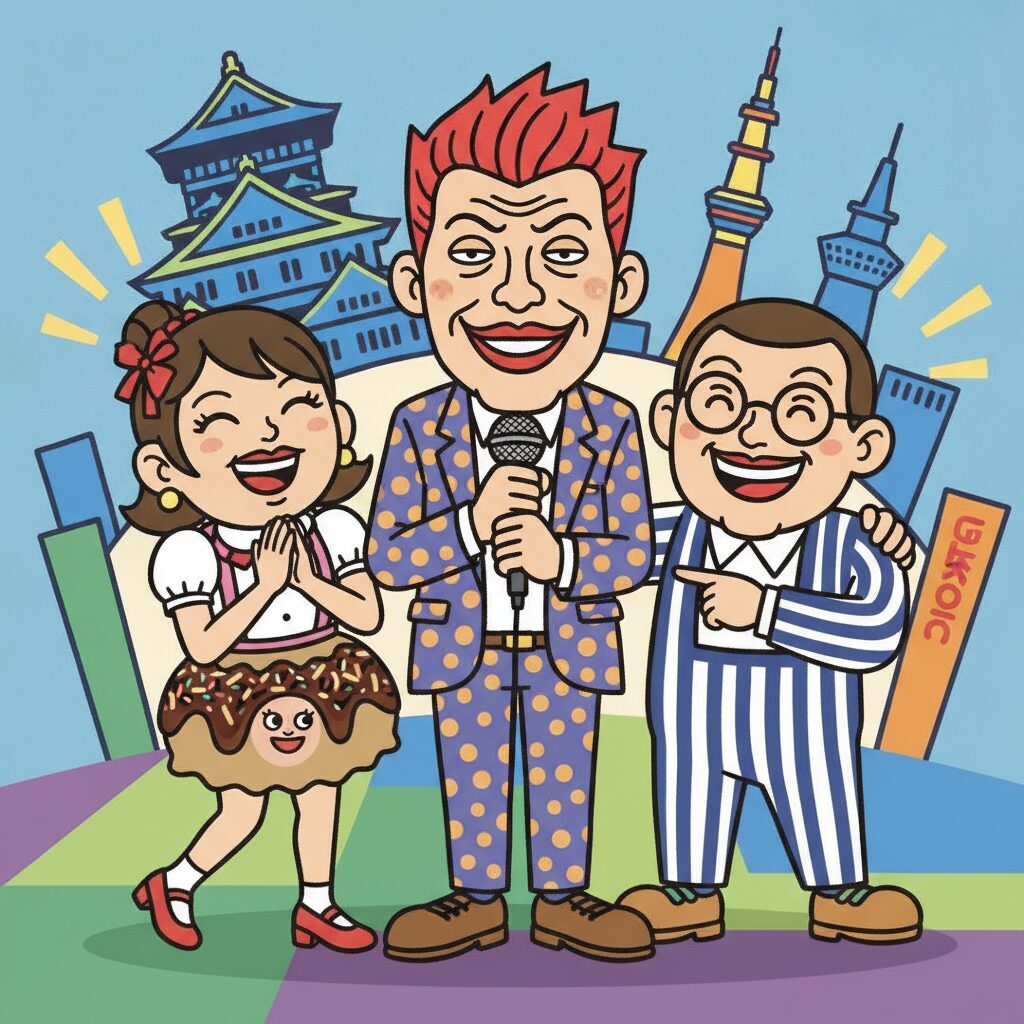
Moving into the 20th century, this cultural trait was intensified by the rise of Yoshimoto Kogyo. Founded in Osaka in 1912, this entertainment giant became the undisputed leader of Japanese comedy. By broadcasting its comedians nationwide on television, Yoshimoto solidified Osaka’s identity as the capital of Owarai. Children grew up watching Osaka-based comedians, mimicking their accents and absorbing their comedic timing. Comedy here is not just a stereotype; it’s a thriving industry and a constant, unavoidable part of the culture. It’s in the air you breathe, the conversations you overhear, and the way the cashier at the convenience store addresses you.
Reading the Room: The Unspoken Rules of Osaka Humor
So, how do you tap into this? The biggest mistake foreigners make is thinking they need to be a performer. They try to deliver a perfectly crafted joke, only for it to fall flat into awkward silence. That’s because Osaka humor is rarely a solo act. It’s a lively, interactive dance—about rhythm, reaction, and participation.
It’s Not About Being a Comedian, It’s About Being Relatable
Your aim isn’t to provoke a loud laugh but to show you’re on the same page. It’s about volleying, not serving. Imagine a local shop owner sighs about the rainy weather, saying, “Ah, what a miserable day.” In many cultures, a simple agreement would do. But in Osaka, this is an invitation. A better reply is to playfully exaggerate: “I know, I almost needed a boat to get here!” This small act of playful overstatement signals that you’re not just a passive listener, but an active participant in the conversation. You’re adding to the energy rather than just acknowledging it. It shows you don’t take things too seriously, and more importantly, you don’t take yourself too seriously.
The Art of the “Tsukkomi” and “Boke”
The foundation of Japanese stand-up comedy, or manzai, is built on two roles: the boke and the tsukkomi. This structure applies not only to the stage but is also the blueprint for everyday exchanges in Osaka.
- The Boke (the fool): The person who says or does something silly, absurd, or slightly offbeat. They set up the joke.
- The Tsukkomi (the straight man): The person who immediately points out the absurdity with a sharp, witty retort. They deliver the punchline.
This dynamic unfolds constantly in small, everyday moments. For example, if you’re shopping with a friend and accidentally try to pay with your transit card instead of your credit card, your friend might lean in and say, “Trying to take the train to Brazil with that?” That’s a tsukkomi. They’re not genuinely confused; they’re highlighting your silly mistake to create a shared laugh. The wrong reaction is to feel embarrassed or defensive. The right one is to embrace the boke and play along: “Yeah, I heard the fare is cheap this time of year.”
For foreigners, mastering the tsukkomi is often the simplest entry point. You don’t need to invent absurdity; you just have to respond to it. One of your most useful phrases is “Nande ya nen!” which roughly means “Why?!” or “What the heck?!” When your friend tells you they ate ramen for breakfast, lunch, and dinner, don’t simply nod. Look them in the eye and say, “Nande ya nen!” It’s a universal reply that shows you’re engaged, get the joke, and are playing along.
Self-Deprecation as a Superpower
In many Western cultures, confidence is shown through self-assurance. In Osaka, it often comes through self-deprecation. Making fun of yourself is a powerful social tool. It immediately lowers your perceived status, making you appear humble, approachable, and safe. It eases any tension or intimidation others might feel, especially when speaking with a foreigner.
If you stumble over a Japanese word, don’t apologize excessively. Laugh it off. Say something like, “Wow, my Japanese is taking a day off today.” If you’re wearing a loud shirt and someone comments on it, don’t get defensive. Agree with them enthusiastically: “I know, you can probably spot me from space!” This shows you’re in on the joke—and often, the joke is on yourself. It’s incredibly charming and the quickest way to break down barriers. People don’t want to see a perfect, polished foreigner; they want to connect with a genuine, flawed person who can laugh at their own mistakes.
Where You’ll See Owarai in the Wild: Daily Life Examples
This comedic culture isn’t limited to bars and social events. It’s intricately woven into the everyday commercial and civic life. The boundary between customer service and casual conversation is artfully blurred.
At the Supermarket: The cashier scanning your groceries might notice a lone onion and ask with playful seriousness, “Just one? Are you sure you can handle that much excitement for dinner?” They’re not questioning your choice; they’re creating a small moment for a fun, human connection. Join in. “It’s a wild night tonight.”
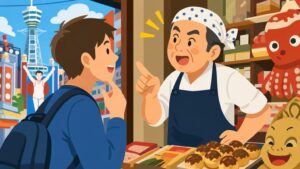
In the Local Shotengai (Shopping Arcade): The woman selling you takoyaki (octopus balls) might dramatically complain about how her arms are about to fall off from flipping them all day. This isn’t a real complaint—it’s a performance. A fitting reply is to be a grateful audience: “But they look perfect! A true master at work!” You’ve just turned a simple purchase into a memorable interaction.
Dealing with Neighbors: In my apartment building, an older woman saw me struggling with several grocery bags. In Tokyo, she might have offered a polite, quiet nod. Here, she smiled and said, “Stocking up for the apocalypse? Don’t forget the beer!” It was her way of being friendly, breaking the silence, and acknowledging our shared space with warmth rather than formality.
This is the essential difference between Osaka and Tokyo. In Tokyo, interactions tend to be smooth, efficient, and polite but often remain superficial. The aim is a seamless transaction. In Osaka, the aim is often a connection. The human element, with all its messy, humorous, and unpredictable qualities, isn’t a nuisance—it’s the whole point.
How to Participate Without Being Cringey: A Foreigner’s Guide
Jumping into this can feel intimidating. You don’t want to come across as the annoying foreigner trying too hard. The key is to start small and be a good listener.
Start by Reacting, Not Acting
Before attempting to be the boke, learn to be a good tsukkomi. Your first task is to appreciate others’ humor. A genuine laugh, a smile, and an engaged expression are your best tools. When someone makes a joke, show them you understand. This makes you an excellent conversational partner and relieves the pressure of having to be the one creating the humor.
Master the Essential Phrases
Beyond “Nande ya nen!“, a few other phrases are invaluable. “Honma ka?” (“Really?”) said with a skeptical tone is perfect for reacting to an exaggerated story. “Akan wa” (“Oh, that’s no good” or “I’m done for”) works well as a self-deprecating response when you make a small mistake. These phrases matter less for their literal meaning and more for their conversational function. They signal that you grasp the rhythm.
Understand the “Ochi”
Conversations in Osaka, especially stories, are expected to have an ochi, or a punchline. People don’t tell long, meandering stories without a point. There needs to be a funny, surprising, or satisfying conclusion. As a storyteller, keep this in mind—get to the good part. As a listener, wait for it. Don’t interrupt before the ochi lands. Respecting the structure of a good story is essential.
Never Punch Down
This is the most important rule. Osaka humor is sharp but rarely cruel. The targets are almost always oneself, a powerful person, a difficult situation, or a shared absurdity. Making fun of someone’s genuine weakness, appearance, or an embarrassing mistake is a serious no-no. The goal is to build solidarity through laughter, not to isolate anyone. Always aim your comedic jabs at yourself or upwards, never downwards.
What Happens When You Get It Right?
There will come a moment when everything clicks. You’ll deliver a small tsukkomi, and the person you’re talking to will light up. Their eyes will widen slightly, and you’ll hear a genuine laugh. In that instant, you stop being just a generic gaikokujin (foreigner). You become someone who gets it. You’ve cracked the code.
This is when the surface-level friendliness of Osaka turns into true friendship. Sharing a laugh means sharing a perspective. It shows you’re willing to be vulnerable, playful, and part of the group. The formal barriers that can exist between Japanese people and foreigners will melt away. People will invite you into their circles not out of obligation or politeness, but because they genuinely enjoy your company. They’ll recognize that you can keep up. This is the real meaning behind the “Osaka is friendly” cliché. The friendliness isn’t passive; it’s an invitation to engage. And humor is your RSVP.
The Final Takeaway: It’s Communication, Not Comedy
Don’t get caught up in trying to be “funny.” The pressure to perform will only make you tense and awkward. Instead, think of it as a different dialect—one where wit is the grammar and laughter is the vocabulary. It’s about showing you’re paying attention, not taking the world too seriously, and being open to connection.
Living in Osaka provides a unique opportunity to experience a side of Japan that breaks stereotypes. It’s a city that values quick wit over formal titles and shared laughter over polite silence. Mastering its comedic flow is more than just a party trick; it’s the most meaningful and effective way to grasp the soul of this city and its people. So listen for the setup, embrace the absurdity, and don’t hesitate to deliver your own “Nande ya nen!” The connection you find on the other side is the best punchline of all.