
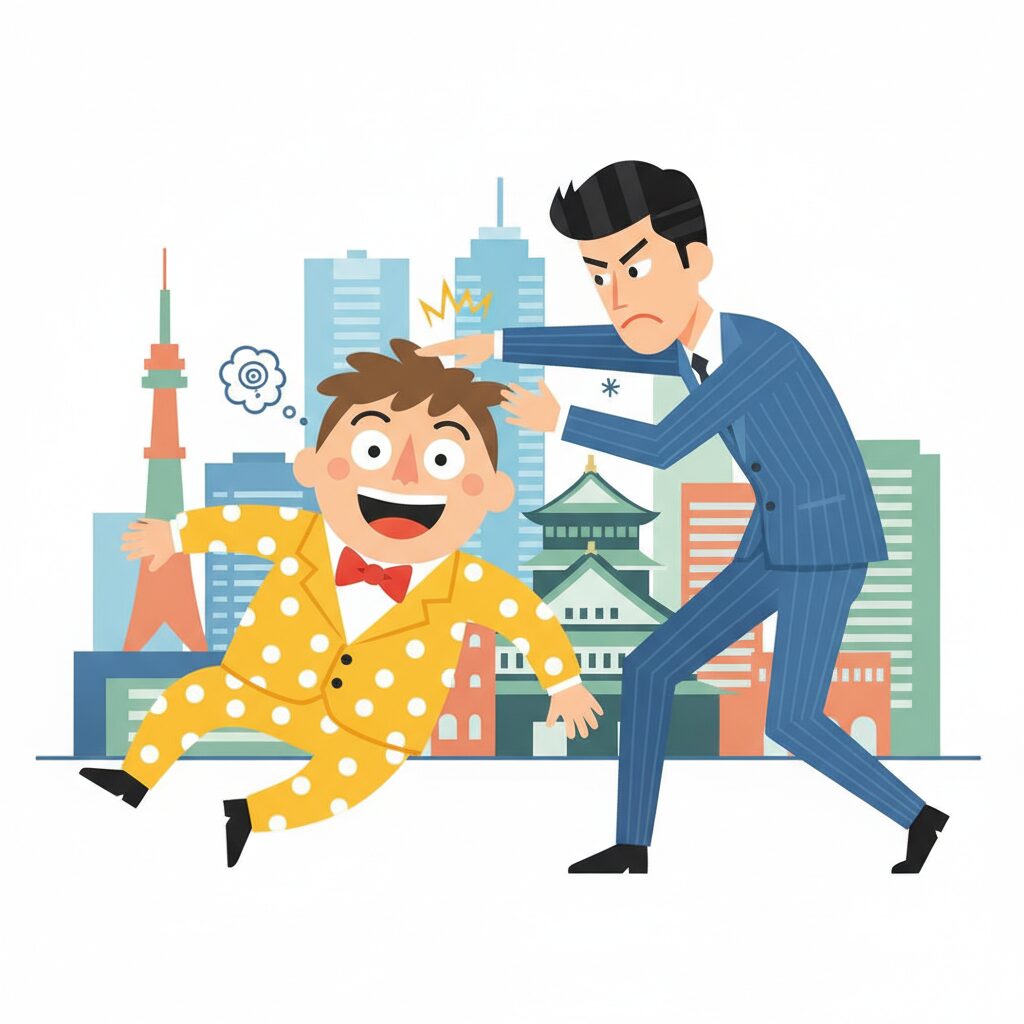
So, you’ve been in Osaka for a minute. You’re navigating the trains, you’ve found your favorite ramen spot, you’re starting to feel the rhythm of the city. But then you hear it. A conversation in a local izakaya, a chat between a shopkeeper and a customer, a group of friends laughing on a street corner. It sounds different. It’s fast. It’s loud. It almost sounds like a friendly argument, punctuated by sharp retorts and what looks like a playful tap on the arm. You’re hearing a language within a language, a cultural performance that happens a thousand times a day on every corner of this city. What you’re witnessing isn’t an argument. It’s an art form. It’s the conversational heartbeat of Osaka, a comedic duo act known as manzai, played out in real life through the roles of the boke and the tsukkomi. Forget everything you thought you knew about polite, reserved Japanese conversation. Here, the goal isn’t just to communicate. The goal is to entertain. It’s a dance, a rhythm, a game. And once you understand the rules, you don’t just understand Osaka better. You start to become a part of it.
Exploring further dimensions of Osaka’s unique conversational style, you might discover how locals infuse subtle sweetness into their banter through the unspoken magic of ame-chan.
The Boke and Tsukkomi Dynamic: More Than Just Jokes
At the heart of this entire social structure lies a simple, beautiful partnership. It’s the timeless comedy duo—the funny guy and the straight man, like Abbott and Costello, Laurel and Hardy. In Osaka, these roles are known as the boke and the tsukkomi. This dynamic isn’t confined to performances at Namba Grand Kagetsu; it’s the framework for everyday casual conversation. It’s what transforms a routine trip to the grocery store into a scene straight out of a sitcom. It’s a shared rhythm, a way to build connection through laughter, and it’s found absolutely everywhere.
What is ‘Boke’? The Art of the Absurd
The boke is the fool, the dreamer, the one who intentionally drops the conversational ball. Their role is to say something silly, absurd, or simply wrong. But don’t mistake this for genuine ignorance—playing the boke is a sophisticated social skill. It demands timing, wit, and a deep grasp of the situation. The boke’s purpose is to create an opening, delivering a perfect, juicy fastball of nonsense that their partner can knock out of the park. It’s a deliberate act of playfulness, a way to signal that you don’t take yourself too seriously.
Picture yourself at a takoyaki stand in Tenjinbashisuji Shotengai. The octopus balls are hot and fresh off the grill. A perfect boke moment might be to look at them wide-eyed and say, “Wow, these are amazing! Are they actually from this planet, or did you bring them from Mars?” It’s ridiculous. It’s unexpected. It breaks the usual routine of ordering and paying. Or maybe you notice a friend wearing a very bright yellow sweater. You could say, “Be careful wearing that; airplanes might mistake you for a landing strip.” The boke catches the surreal in the everyday and shines a light on it. It’s a gift to the conversation—an invitation for someone else to jump in and restore order.
What is ‘Tsukkomi’? The Anchor of Sanity
If the boke sends the conversation soaring into the stratosphere, the tsukkomi is the one who pulls it back down to Earth. The tsukkomi is the straight man—the voice of reason—the person who highlights the absurdity of the boke’s remarks. Their reply is sharp, immediate, and often delivered with a tone of affectionate exasperation. This is the punchline. The tsukkomi’s role is to correct the boke, thereby creating the shared laugh everyone was aiming for.
Returning to our examples: to the person asking if takoyaki come from Mars, the vendor, as the natural tsukkomi, might respond with the classic Osaka phrase: “Nande ya nen!” This phrase works like a multi-tool, meaning “Why?!”, “What the heck?!”, or “Don’t be ridiculous!” all at once. It’s the sound of Osaka. To the friend in the bright sweater, the tsukkomi might say, “Urusai wa!”, which literally means “You’re loud!” or “Be quiet!” but here playfully means “Oh, shut up!” It’s a rejection of the idea, not the person. Sometimes, the tsukkomi accompanies this with a light tap on the shoulder or head with an open palm. To an outsider, this might seem surprising, but it’s not violent—it’s punctuation. A theatrical gesture that means, “Your silliness has been noticed and corrected.” The tsukkomi role is vital; without it, the boke is just someone talking nonsense. Together, they create comedy.
How Boke-Tsukkomi Shapes Daily Life in Osaka
Grasping this dynamic is like receiving a decoder ring for Osaka culture. Suddenly, interactions that once seemed strange or even somewhat aggressive come into clear view. You realize it’s not chaos; it’s a meticulously choreographed dance where everyone knows the steps. This comedic rhythm permeates every aspect of life here, from buying vegetables to making friends.
Conversations as a Performance
In many cultures, especially compared to the more reserved atmosphere of Tokyo, conversations primarily serve to exchange information. They are efficient, polite, and follow predictable patterns. In Osaka, a conversation often becomes a collaborative performance. The goal isn’t just to share facts; it’s to build rapport and create a shared moment of enjoyment. People aren’t merely talking; they’re constructing a routine together, in real time. This can feel incredibly lively and engaging. It also explains why Osakans are known for being talkative. They aren’t just filling silence; they actively seek opportunities to spark a boke-tsukkomi exchange.
This makes the city’s soundscape feel distinct. It’s louder, more expressive, filled with sudden bursts of laughter. The rhythm is staccato, a quick setup followed by a sharp punchline. It contrasts sharply with the subtle nods and unspoken understandings that characterize interactions elsewhere in Japan. In Osaka, the subtext is often shouted from the rooftops before being immediately undercut with a joke.
The Shopkeeper’s Banter: A Transactional Comedy Routine
This is nowhere more evident than in Osaka’s famous shotengai, the covered shopping arcades at the heart of local neighborhoods. This is the grand stage for everyday manzai. If you go to buy fish, the owner might hold up an especially fine sea bream and say, “Look at this one! So beautiful, it probably went to a better school than my son!” That’s the boke. As the customer, it’s your turn to play the tsukkomi. You might reply, “Don’t say that! Your son is going to be a genius! Now, can you give me a little discount for this over-educated fish?” The owner will shoot back, “A discount? You’re trying to rob me blind!” before laughing and knocking a hundred yen off the price.
This isn’t just about haggling. It’s about building relationships. This playful exchange transforms a simple transaction into a human connection. That’s why people say Osaka is friendly. The friendliness isn’t passive, polite smiling. It’s active, participatory, and often hilarious engagement. The shopkeepers aren’t just selling goods; they’re inviting you to join the game. Taking part in that game shows you belong.
Navigating Boke-Tsukkomi as a Foreigner
For non-Japanese residents, this can be intimidating at first. You might worry people are mocking you or be unsure how to respond. The key is to relax. Understand that if you are the target of a friendly jab, it’s usually a sign of affection and inclusion. It means they feel comfortable enough to joke with you. A colleague pointing out you put way too much sugar in your coffee isn’t criticizing; they’re giving you a perfect chance to play the boke (“It’s my secret recipe for eternal youth!”) or just laugh it off.
You don’t need to be a professional comedian to join in. In fact, as a foreigner, you have an advantage: you can play the clueless boke effortlessly. When someone says something fast and jokey in the Osaka dialect that you don’t quite catch, a simple, honest “Ehhh? Wakarimasen” (“Huh? I don’t understand”) with a smile is a perfect setup. They’ll love it. They will take the tsukkomi role, explain the joke, and an instant bond forms. If you feel bold, you can even try a basic tsukkomi. If a friend tells an exaggerated story, a well-timed “Uso ya!” (“No way!” or “You’re lying!”) will earn big laughs and great respect. The bar for joining in is low, and the rewards are high.
Osaka vs. Tokyo: A Tale of Two Conversational Styles
The contrast with Tokyo is striking and offers an ideal perspective through which to grasp Osaka’s distinctive character. Although both are impressive, large Japanese cities, their social dynamics function on entirely different systems. This difference is most apparent in the way people communicate.
The Directness of Osaka Humor
Communication in Tokyo often follows the concepts of tatemae (public facade) and honne (true feelings). There is a subtle elegance to it—the art of reading the air (kuuki wo yomu) and interpreting what remains unsaid. It emphasizes harmony and steers clear of direct confrontation. Osaka’s style disrupts that approach. The boke-tsukkomi exchange is, in its own way, a means of being straightforward. It lets people share their honne while cushioning it inside a joke.
For example, if you have a questionable haircut, a Tokyo friend might kindly say, “Oh, a new style! It’s very fresh,” aiming to be polite and maintain harmony. Meanwhile, an Osaka friend would likely look you right in the eye and say, “Did you get into a fight with a lawnmower and lose?” That’s the boke setup. It’s a blunt remark, but since it’s so exaggerated, it’s not truly offensive. It invites you to respond with a tsukkomi like, “Shut up! This is the height of fashion!” This interaction, which might seem rude to outsiders, is actually a demonstration of close friendship. It signifies, “I know you well enough to be brutally and humorously honest, and I trust you to shoot back.” It’s an intimacy based on playful banter.
Why Clichés Like “Osaka is Friendly” Miss the Point
People often say Osaka residents are friendly and warm, while Tokyoites are more reserved. While that’s somewhat true, it oversimplifies the reality. Tokyo’s reserve is a form of civic respect—being quiet on the train, giving others space, and not intruding is a way of showing politeness in a densely populated city. Osaka’s friendliness isn’t passive; it’s an active invitation to connect. It’s the obachan (auntie/older woman) who offers you candy, but only after telling you that you look tired and should eat more. It’s the taxi driver who asks countless questions about where you’re from and then tells a bad joke. This kind of “friendliness” calls for your involvement. It’s a dialogue, not a one-sided speech. To truly experience it, you can’t remain a bystander—you have to be willing to step onto the stage and play your part, even if it’s a small role.
The Unspoken Rules of the Game
While it may appear to be a wild exchange of jokes and jabs, the art of Osaka banter follows its own unspoken rules. Mastering these unwritten guidelines is the final step in truly grasping the local mindset. It’s not just about knowing how to joke, but knowing when to do so.
Reading the Room: When Not to Banter
This comedic style isn’t appropriate for every occasion. Osakans excel at code-switching. The same person who jokes with you at a standing bar in Kyobashi will be impeccably polite and formal in a business meeting in Umeda the next day. The boke-tsukkomi interaction is reserved for casual settings with friends, family, local shopkeepers, and those with whom you share a friendly rapport. You wouldn’t attempt to banter with a police officer, a solemn government official, or your company’s CEO in a formal environment. Context is key. The playful, loud, and direct Osaka style is meant for spaces where human connection is valued over strict social hierarchy. Recognizing those spaces is an essential skill for anyone living here.
The Goal is Laughter, Not Offense
This is the most important rule of all. The entire purpose of the boke-tsukkomi exchange is to create a shared moment of laughter. It aims to strengthen bonds, not break them. A tsukkomi is sharp but never cruel. It targets the absurdity of the statement, not the person’s character. It’s a delicate balance, yet one that Osakans navigate with remarkable precision. The intent is always positive. If a joke falls flat or someone unintentionally crosses a line, the usual response is to laugh it off and quickly move on. The social contract rests on the understanding that everyone is working together to enjoy themselves. In Osaka, the worst social misstep isn’t telling a bad joke; it’s being boring.
Your Role in the Osaka Comedy Club
So, what does all this mean for you, the foreigner trying to establish a life in this vibrant, chaotic, and hilarious city? It means you’ve arrived in a place where conversation is a sport, and you’re invited to join in. Begin by simply listening. Tune into the rhythm of the conversations you overhear. Notice the setup and the punchline. Observe the smiles that follow a sharp tsukkomi. Then, start looking for your own chances to jump in. When the woman at the bakery tells you the melon pan is so good it will change your life, you don’t have to just say thank you. You can smile and reply, “I’m ready for a new life!” You’ve just played the boke. Her laugh will be your reward. You’ve successfully become part of the performance. Understanding the dynamic of boke and tsukkomi is more than just learning a fun cultural quirk. It’s the key to unlocking the soul of the city. It’s the secret behind Osaka’s warmth, energy, and relentless humanity. It reminds us that life doesn’t always have to be so serious and that sometimes, the quickest way to connect with someone else is simply to share a laugh. Welcome to the club.








