
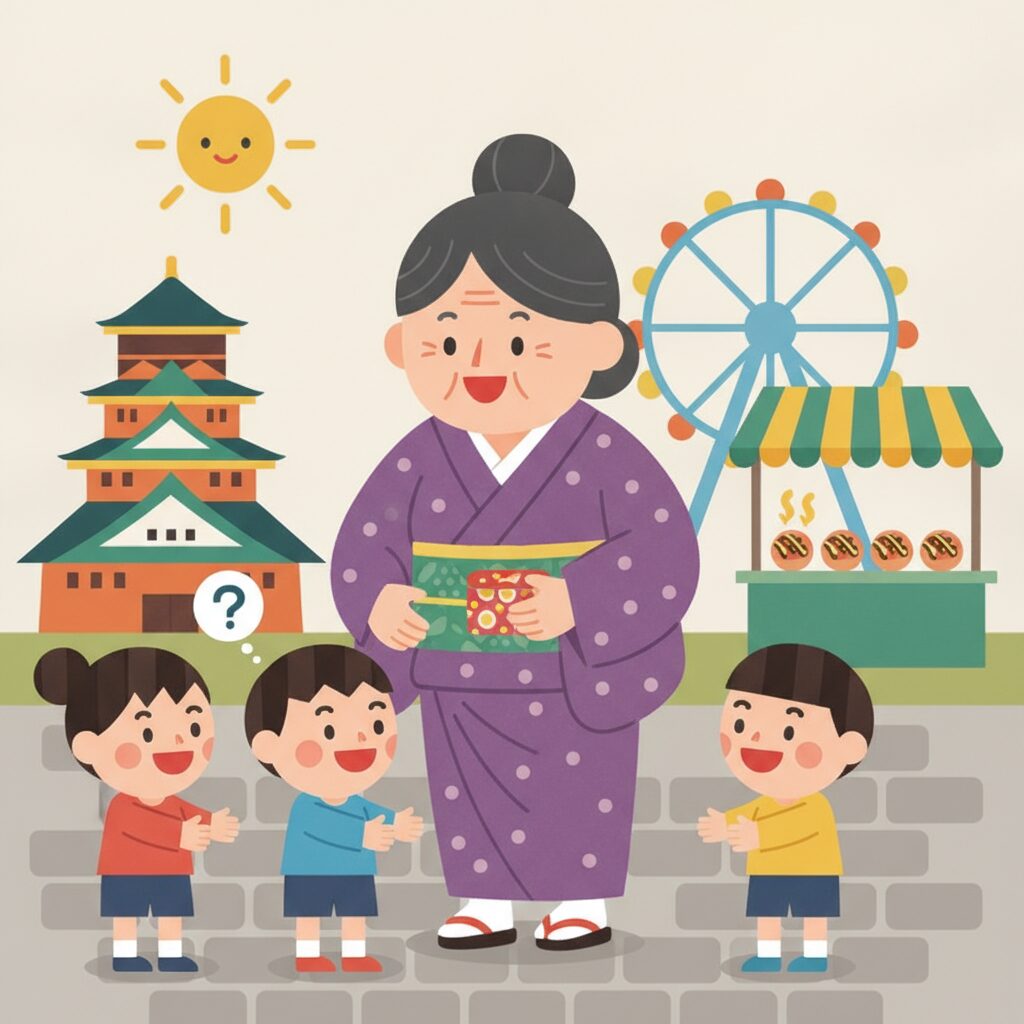
It’s gonna happen. You’ll be standing on a platform for the Hankyu line, maybe waiting for a seat at a tiny okonomiyaki joint in Tsuruhashi, or just navigating the controlled chaos of the Shotengai shopping arcade in Tenma. An older woman, maybe with a shock of purple hair and a dazzlingly bright leopard-print blouse, will catch your eye. She’ll rummage through a purse that seems to defy the laws of physics, pull out a small, cellophane-wrapped object, and push it into your hand with a gruff but warm “Hai, douzo.” You’ll look down. It’s a single piece of hard candy. A cough drop, maybe, or a simple milk caramel. You’re confused. You didn’t ask for it. You didn’t do anything to earn it. What just happened? Welcome, my friend, to one of the most fundamental, unwritten, and deeply revealing rituals of daily life in Osaka. You’ve just received an “ame-chan.” And that little piece of candy says more about this city than any travel guide ever could.
This isn’t just about sugar. This is about connection. It’s a social tool, a pocket-sized peace treaty, an icebreaker, and a unit of ambient kindness that keeps the engine of this city running. In a country often stereotyped for its reserve and formality, Osaka’s ame-chan culture is a loud, sweet, and sticky declaration of a different way of being. It’s a grassroots communication network that operates entirely offline, passed from one hand to another. Understanding the ame-chan is understanding the very soul of Osaka, a city that runs on a different kind of energy, a different social software than its eastern rival, Tokyo. Before we dive into the rules of this sugary game, let’s get our bearings on the city where it all plays out.
The warm, fizzy charm of ame-chan finds an economic counterpart in the rising tide of international hotel investment in Kansai, underscoring Osaka’s vibrant post-pandemic resurgence.
Deciphering the Name: It’s Not Just ‘Ame’
First, let’s analyze the linguistics. The Japanese word for candy is “ame.” Simple enough. But in Osaka, no one calls it just “ame.” Instead, it’s “ame-chan.” That “-chan” suffix is crucial. It’s a diminutive, a term of endearment typically added to a child’s name, a pet, or a very close friend. It immediately makes the object smaller, cuter, more familiar, and less formal. Think of it as the difference between “candy” and “a little sweetie.” By calling it ame-chan, Osakans are personifying this tiny piece of sugar, transforming it from a simple confection into a small, friendly character. This isn’t a formal gift; it’s a casual, warm, almost familial offering.
The candies that earn the ame-chan label are also very specific. You’re not talking about artisanal, hand-pulled, organic yuzu-flavored hard candy from a department store basement. No, this is the kind found in supermarkets and drugstores. The classics. There’s the mighty “Kuro-ame,” a rich black sugar candy with a deep, molasses-like flavor that feels like a warm hug for your throat. There are the ubiquitous “Nodo-ame,” essentially medicated throat lozenges, often with herbal or minty flavors. Then there’s the gentle “Milk Candy,” a creamy, simple delight. The key is that they’re all individually wrapped, durable, and able to survive for months at the bottom of a handbag alongside keys, tissues, and a folded-up shopping bag. They’re practical, unpretentious, and ready for use at a moment’s notice.
The Gatekeepers of Generosity: The Osaka Obachan
While anyone can theoretically give an ame-chan, the undisputed experts and main distributors of this tradition are the Osaka “obachan.” These middle-aged and older women of the city are a force of nature. Forget the stereotype of the quiet, demure Japanese grandmother. The Osaka obachan is often loud, direct, humorous, and impeccably styled with a focus on comfort and flair, heavily featuring animal prints. They serve as the social glue of their neighborhoods, the custodians of local history, and the leaders of a vast, unseen network of ame-chan distributors.
Their purses are more than just accessories; they function as mobile command centers. From these bags, they can produce an ame-chan for any occasion. A child starts fussing on the train? An ame-chan appears to soothe the mother. A shopkeeper offers them a small discount? An ame-chan is given as an additional thank you. You hold a door open for them? You’ll receive an ame-chan. It’s their way of engaging with the world, smoothing out the rough edges of daily urban life, and acknowledging the presence of others in their shared environment. They are not merely handing out candy; they are sending a signal of community and mutual recognition. Watching an obachan in action is witnessing a master of social engineering at work, using sugar as her preferred tool.
The Social Grammar of the Ame-chan Exchange
Giving and receiving an ame-chan is a delicate dance governed by unwritten rules. Foreigners often stumble here because they try to understand it through a Western perspective of gift-giving, which involves ideas of debt and reciprocity. But that’s the wrong approach. This is something completely different.
It’s a Connection, Not a Transaction
This is the most crucial rule. An ame-chan is not a payment. It’s not a bribe. It’s not offered with the expectation of getting something back. Its purpose is to create a brief, positive human connection. It’s a small interaction that says, “I see you. We are sharing this moment and space.” For example, if you’re sitting next to someone at a long, dull public meeting and they quietly slide you a cough drop, they’re not trying to buy your friendship. They’re saying, “Yeah, this is boring for me, too. We’re in this together.” The candy is the tangible symbol of that shared feeling. Trying to “repay” the favor immediately misses the point entirely. You don’t have to give one back right away. You simply accept the connection.
The Rule of Refusal: Don’t Do It
Unless you have a serious allergy, you almost never refuse an ame-chan. Saying no isn’t a polite “thank you, but no.” It’s perceived as rejecting the connection itself. It’s like someone offering their hand for a handshake and you just ignoring it. It creates an awkward social gap. The person offering the candy isn’t asking if you want a candy; they are extending goodwill. Your role is to receive that goodwill.
What if you don’t like hard candy? Or you’re on a diet? It doesn’t matter. You accept it. Smile, give a slight bow, and say “Arigato gozaimasu” or the more casual “Sumimasen, arigatou.” Then you can put it in your pocket. You might eat it later, re-gift it, or discard it at home. Actually eating the candy is secondary to completing the social ritual. The act of accepting is the whole point.
The Follow-Up: An Invitation to Talk
Often, the ame-chan is just the start of the interaction; it’s an olive branch, a conversation opener. Once the candy is accepted, a barrier has been crossed. This is especially true for foreigners. The giver, often an obachan, might now feel free to ask questions like, “Where are you from?” “Is it hot in your country?” or “Are you good with chopsticks?” This isn’t an intrusive interrogation. It’s genuine curiosity, a wish to connect. The ame-chan was the key that opened the door to a brief, friendly conversation. It’s how you go from an anonymous face in the crowd to someone with a story. It’s how the city becomes a little smaller and warmer, one conversation at a time.
The Great Divide: Why Ame-chan is an Osaka Thing
If you live in Tokyo for a year, the number of times a stranger will offer you candy on the street is likely zero. In Osaka, it might happen twice in a single week. This cultural contrast is striking and telling. Tokyo, despite all its marvels, functions on a social principle of polite, efficient anonymity. In public places like the subway, the unspoken rule is to minimize your presence, avoid eye contact, and respect everyone’s personal space. Giving candy to the person next to you on the Yamanote Line would be a strange violation of protocol. People might suspect you’re running a scam or that something is wrong with you. The social framework would break down.
Osaka’s social code is written in a different language. The city’s long history as Japan’s merchant capital nurtured a culture that values communication, negotiation, and relationship-building. Business (“akinai”) wasn’t merely about figures; it centered on people. You had to be able to talk with anyone, find common ground, be a bit more forward, a bit more human. This mentality extended beyond the marketplace into the streets. People in Osaka tend to be more direct, expressive, and comfortable with casual interactions compared to their Tokyo counterparts. They enjoy meddling, in a positive sense (“sewa-zuki”). They see a stranger not just as an obstacle to navigate around but as a potential person to engage with.
The ame-chan is an ideal tool for this mindset. It offers a low-risk, high-reward way to bridge the gap between strangers. It costs almost nothing, yet it can immediately create a moment of warmth and dissolve the barriers that city life often builds. It embodies the merchant spirit applied to social life: a small, clever investment in community goodwill.
Your Guide to the Ame-chan Lifestyle
So, you’re living in Osaka and want to actively participate rather than just watch. You aim to shift from being a passive receiver to becoming an active giver. This is a more advanced step, but it’s essential for genuinely connecting with the local vibe.
Building Your Arsenal
First, you need to be prepared. Head to any supermarket or convenience store and grab a bag of individually wrapped hard candies. Don’t overthink it. A classic pack of Kasugai Kuro-ame or a mixed fruit variety will work perfectly. The important part is the individual wrapping for hygiene and ease of sharing. Keep a few in your pocket or a specific compartment in your bag. You’re now ready for action. Feeling prepared is already half the victory.
Identifying an Opportunity
This is the challenging part. You can’t just hand them out randomly—that would be awkward. You need a reason, a “trigger” to start the interaction. Notice small moments. A child patiently waiting in a long line. A fellow hiker resting on the trail up Mount Ikoma, clearly tired. You and another person are the only ones waiting at a cold bus stop late at night. Someone next to you at a ramen counter passes the water pitcher. These are ideal ame-chan moments—a gesture of solidarity, a little reward, or a shared recognition of the situation.
The Execution
Keep it low-key. The Osaka style is casual confidence. Make eye contact, give a slight nod, and offer the candy with a simple “Douzo.” No lengthy explanation is necessary. The ame-chan speaks for itself. The person will likely be surprised, then pleased. They’ll accept, thank you, and you will have successfully completed your first mission. You’ve added a small touch of warmth to the city’s social fabric.
More Than Just Sugar
Ultimately, the ame-chan is a symbol—a symbol of a city that refuses to let urban life become cold and impersonal. It embodies a philosophy of public space that values human connection over sterile efficiency. Each time a candy is passed from one stranger to another, it represents a small act of defiance against the notion that everyone should keep to themselves.
Foreigners often arrive in Osaka expecting a livelier version of Tokyo. What they discover, however, is a city governed by a fundamentally different set of social assumptions. The ame-chan stands as proof. It is a means of communication that is both deeply traditional and remarkably practical. Though it costs only pennies, it generates immense social capital. So, the next time you find yourself in this vibrant, bustling, and wonderful city and a hand extends a small, sweet gift to you, you’ll know how to respond. Smile, accept it warmly, and realize that you have just been connected to the true network of Osaka. You are no longer just a visitor—you are now part of the conversation.








