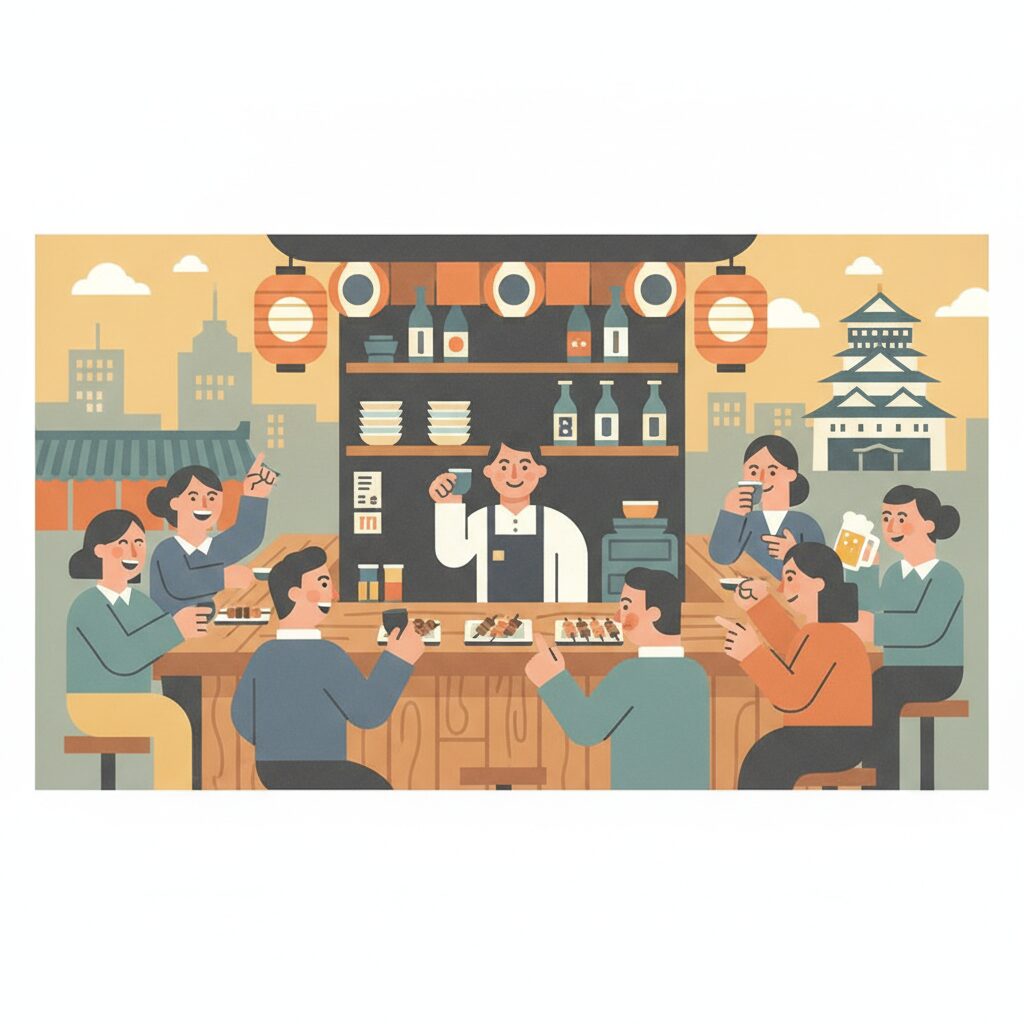
Step into an Osaka tachinomi on a Tuesday night and the scene hits you like a blast furnace of sound and energy. It’s a wall of noise, a chaotic ballet of salarymen loosening their ties, old-timers nursing sake, and young couples sharing plates of fried chicken. For a foreigner, the first impression can be pure intimidation. There are no seats, no hosts, no clear queues. Just a heaving mass of humanity packed into a space the size of a shipping container, all shouting, laughing, and drinking. It feels a world away from the serene, meticulously ordered Japan you see in travel brochures. But this, right here, is the real Osaka. This is the city’s heart, beating in time with the clatter of beer mugs and the sizzle of a grill. These standing bars, or tachinomi, aren’t just places to get a cheap drink. They are the social arenas where the city’s famous personality—its directness, its humor, its deep-seated pragmatism—is on full display. Forget quiet contemplation; this is social immersion by fire. It’s where you stop being an observer and, for a fleeting, glorious moment, become part of the city’s relentless, vibrant pulse. Understanding the tachinomi is understanding Osaka itself.
To further immerse yourself in Osaka’s lively social scene, consider exploring how locals master the art of quick drinks to unlock another layer of the city’s dynamic charm.
What Exactly is a Tachinomi?
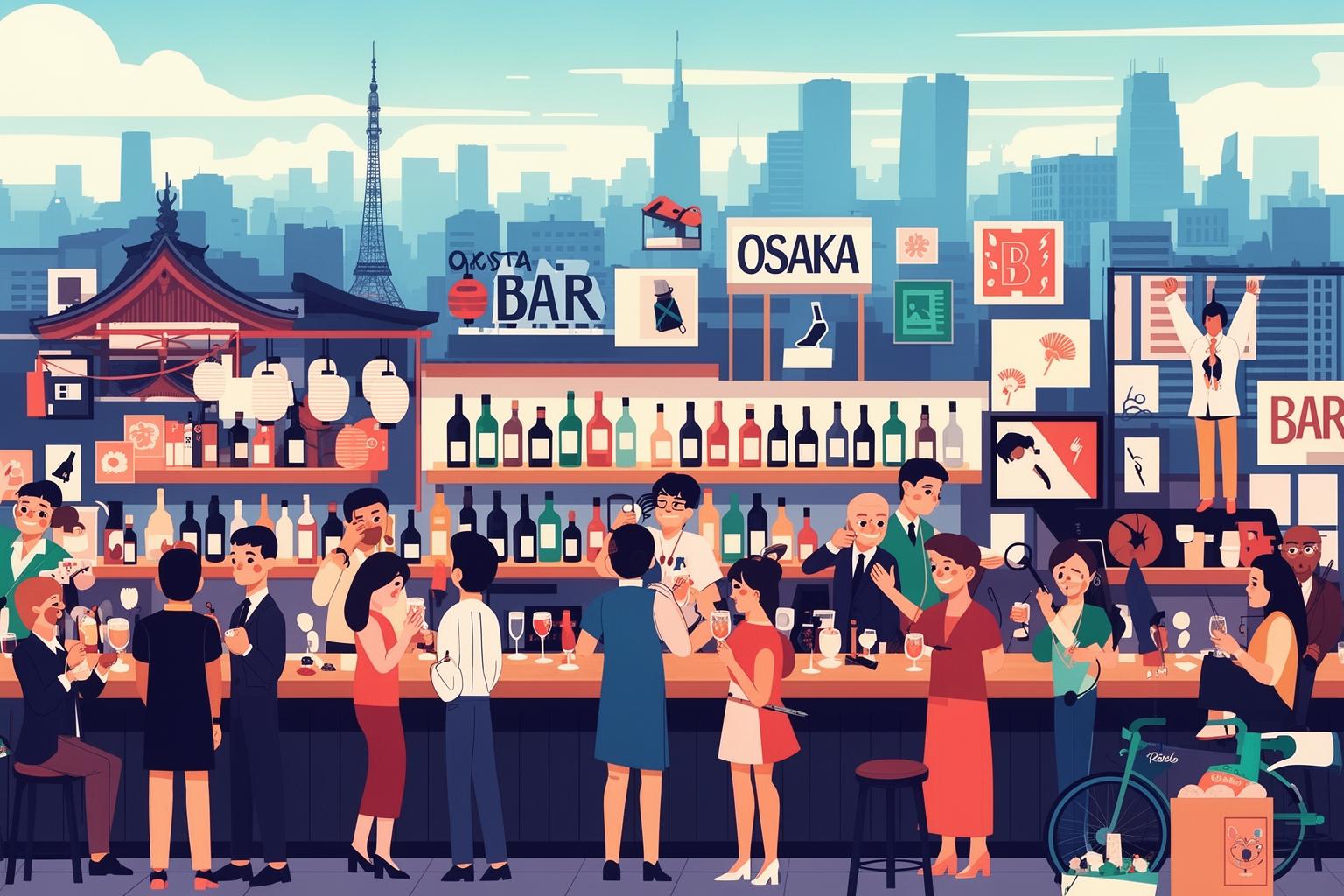
At its simplest, the word tachinomi means “standing drink.” But to stop there is like calling a New Orleans jazz club merely a room with music. The term refers to a distinct category of Japanese bar, an institution grounded in speed, value, and spontaneous community. It’s a place devoid of all pretense. There are no fancy chairs, no reservations, no hushed voices. There is only the counter, the drinks, and the people.
The Economics of Standing
Why stand? The answer is pure Osaka logic: cost performance, or kosupa as it’s called locally. By removing chairs and tables, a proprietor can accommodate more customers within a smaller space. This lowers expenses for rent and staffing, and those savings are passed directly to you, the customer. A draft beer might be a hundred yen cheaper than at a typical izakaya. A plate of yakitori or a chunk of simmered daikon might cost less than a cup of coffee. This economic model informs the entire experience. It encourages a high turnover rate. People don’t linger all night; they stop by for a quick drink and bite before heading home or moving on to the next place. This steady flow of patrons is what keeps the tachinomi vibrant. The crowd at 6 PM is entirely different from the crowd at 8 PM. It’s a living, evolving entity that moves with the city’s commuting rhythm.
More Than a Bar, It’s a Pit Stop
Think of the tachinomi as a social pit stop in the race of everyday life. It’s a third space, separate from the strict formalities of the office and the quiet solitude of home. Here, for a brief moment, social hierarchies soften. The department manager might be squeezed elbow-to-elbow with a construction worker, both venting about the Hanshin Tigers‘ latest loss. The absence of physical barriers—no tables, no booths—means a lack of social barriers. It’s a uniquely egalitarian setting where conversations can ignite between total strangers over a shared plate of pickles. The atmosphere is loud, practical, and unapologetically rough. The décor is often just handwritten menus taped to the walls and a television in the corner silently showing a baseball game. The focus isn’t on aesthetics; it’s on function. Its primary function is to serve cheap drinks, good food, and human connection, quickly.
The Unspoken Rules of the Standing Bar
For those unfamiliar, the fluid chaos of a tachinomi can feel overwhelming. There’s no guidebook. You learn by doing, by watching, and sometimes by making a small social mistake. Yet the rules, though unspoken, are surprisingly straightforward and grounded in a sense of communal respect and efficiency. Learning them is your ticket into this distinctly local world.
Finding Your Spot: The Art of the Gentle Squeeze
When you enter a crowded tachinomi, your first reaction might be to wait for someone to invite you in. Don’t. That moment won’t arrive. The correct approach is to scan the counter for any gap, even a tiny one. Make eye contact with the person next to the space, offer a slight nod or a quiet sumimasen (excuse me), and gently slide in. This isn’t aggressive; it’s a confident way of showing you belong there. You’re not crashing a private event; you’re joining the communal flow. The key is spatial awareness. Don’t drop your bag and claim a large area. Keep your footprint small. You’re temporarily borrowing a slice of this shared space, and recognizing that is what keeps the system running smoothly.
The Ordering Dance: Cash on the Counter
Many tachinomi follow a kyasshu on (cash on delivery) system. You order, receive your food or drink, and pay immediately. Often, you’ll get a small tray or bowl to place your money in. Leave a 1,000 yen bill or some coins in it, and the staff will provide change as you go. This is Osaka efficiency at its best. It removes the hassle of splitting bills at the end of the night and lets patrons leave whenever they want without a drawn-out checkout. To order, catch the busy staff’s eye. A raised hand, a quick “onegaishimasu!” (please!), and a clear, simple order suffice. Don’t ponder the menu for ten minutes. Know what you want, and point if needed. The aim is to keep things low-friction. You’re one of many customers, and the bar’s rhythm relies on these quick, smooth transactions.
Personal Space is a Communal Concept
In a packed tachinomi, Western ideas of personal space disappear. You’ll be shoulder-to-shoulder, elbow-to-elbow with strangers. Your beer may be placed right next to someone else’s sashimi plate. This closeness isn’t intrusive; it’s the whole point. It’s a physical expression of the communal vibe. This forced proximity breaks down typical Japanese reserve. It’s nearly impossible to ignore the person just inches away. This shared, cramped setting acts as a strong social lubricant, making it natural to comment on their drink or ask what they’re eating. You’re all, quite literally, in it together.
Tachinomi Talk: Breaking the Ice with Osakans
This is where Osaka’s culture truly stands out and where it differs the most from Tokyo. In a Tokyo tachinomi, it’s quite common to enjoy a drink in complete silence, surrounded by others doing the same. It often serves as a quiet space for individual relaxation. In Osaka, however, silence is the rarity. The tachinomi acts as a platform for conversation, and locals are almost always eager to engage.
The Opening Gambit
Don’t overthink it. The simplest way to start a conversation is by commenting on your immediate surroundings. Spot someone eating something that looks delicious? A straightforward “Sore, oishiso desu ne!” (That looks delicious!) is an ideal way to break the ice. The person will almost always respond, tell you what it is, and might even offer you a taste. Asking about someone’s drink is also a classic opening. Osakans often take pride in their local sake or shochu selections and gladly share their knowledge. The key is genuine curiosity and sincerity. You’re not attempting a complicated social ritual; you’re simply sharing a space and an experience. Locals, particularly the older generation, frequently take the initiative. They’ll notice you’re new and ask, “Nii-chan, doko kara kitan?” (Brother, where are you from?). Respond honestly, with a smile, and the conversation will naturally flow.
The Osaka Mindset: Humor and Generosity
Osaka’s past as a merchant city has shaped a communication style that’s direct, practical, and heavily infused with humor. Conversations at a tachinomi are seldom serious. They’re full of jokes, light teasing, and self-deprecation. This is the land of boke (the funny fool) and tsukkomi (the straight man). Don’t be surprised if a local gently jokes at your expense—the right response is to laugh along. It’s a sign of acceptance. This playful spirit extends to a culture of casual generosity. It’s the tachinomi equivalent of the famous Osaka obachan (auntie) who hands out candy (ame-chan) to strangers. Someone might buy you a drink, or the chef might sneak an extra skewer onto your plate. The proper etiquette is to accept graciously and, when possible, return the favor later. It’s a micro-economy of goodwill that keeps the atmosphere warm and inviting.
Navigating the Nuances: What Foreigners Often Miss
While tachinomi are extremely welcoming, there are some cultural subtleties that may not come across easily. Grasping these nuances can transform your visit from that of a curious tourist into that of a comfortable participant.
It’s Not a Western-Style Bar
A common misconception is to treat a tachinomi like a pub or cocktail bar back home. It’s not a place to settle in for hours, have deep conversations in a quiet corner, or work on your laptop. The atmosphere is fast-paced and fleeting. The intent is not to stay long but to pop in, enjoy the moment, and move on. Most patrons remain for only 30 to 60 minutes. This turnover keeps the space lively and allows new people to join in. Lingering too long, especially during busy times, may prompt subtle, passive-aggressive hints that it’s time to make room for others.
“Friendly” Doesn’t Mean Intrusive
Osakans are known for being friendly and chatty, but their warmth has its limits. Conversations in a tachinomi are often warmly casual but deliberately superficial. People come to relax, not to share life stories or exchange LinkedIn contacts. The connections are fleeting, tied to that particular moment and place. You might share a fantastic, amusing 20-minute chat with strangers, then part ways, likely never to meet again. And that’s perfectly fine. Appreciate the interaction as a brief moment of shared humanity. Don’t try to push for a deeper relationship. Let it be what it is.
Read the Room Before You Enter
Not all tachinomi are the same. While many are lively and welcoming, others are quiet neighborhood spots frequented by small groups of regulars. Recognizing the difference is important. A bar with its doors wide open, music spilling out, and a varied crowd visible from the street is almost always open to newcomers. A tiny, dimly lit place with closed doors, where the same five older men gather nightly, might be harder to break into. Though likely not unfriendly, the atmosphere may be more exclusive. Begin with the busy, vibrant spots near major stations like Tenma or Namba. Once you gain confidence, you can explore the quieter, more local venues.
Where to Start: A Neighborhood Guide to Osaka’s Tachinomi Flavors
Different neighborhoods in Osaka each offer unique tachinomi experiences. Deciding where to go depends entirely on the kind of atmosphere you want to enjoy. This is not a list of “the best” bars, but rather a guide to the character of each area.
Tenma: The Labyrinth of Libations
If you want to fully immerse yourself in tachinomi culture, head to Tenma. The area around JR Tenma Station is a sprawling, chaotic maze of covered shopping arcades and narrow back alleys, almost all filled with standing bars, grills, and izakayas. The sheer density is exhilarating in the best way. The crowd ranges from young to old, and the energy level is constantly high. This is the ideal place to bar-hop—have a drink and a skewer at one spot, then get enticed to the next by a tempting aroma or a boisterous laugh. Tenma is pure sensory overload and the quintessential Osaka drinking experience.
Kyobashi: The Salaryman’s Sanctuary
Kyobashi, located on the east side of the city, feels a bit grittier and more old-fashioned than Tenma. The tachinomi here are classic, no-frills spots that have catered to the same working-class clientele for decades. This is the heart of senbero culture, a term meaning “1,000 yen drunk.” Here, you’ll find incredible value, with drink-and-food sets that seem almost too cheap to be true. The atmosphere is less about trendy exploration and more about a comfortable, familiar routine. It’s a fantastic place to observe daily rituals of Osaka’s working population and to experience a touch of Showa-era nostalgia.
Ura-Namba: The Modern Twist
Just behind the flashy department stores of Namba lies Ura-Namba, or “Back Namba.” This dense network of alleyways has become a hotspot for a new generation of tachinomi. While still casual and affordable, bars here often have a slightly more modern or specialized focus. You might find a standing bar specializing in Italian food, craft beer, or an extensive wine selection. The crowd tends to be younger and more stylish. For those who might find Kyobashi’s rough-and-tumble vibe intimidating, Ura-Namba offers a perfect introduction. It captures the energy and social spirit of traditional tachinomi but with a slightly more contemporary flair.
Ultimately, the tachinomi scene is a microcosm of Osaka itself. It’s where the city’s love for good, cheap food (kuidaore), its practical business sense, direct communication style, and deep appreciation for a good laugh all merge in a loud, cramped, and beautiful symphony. Learning to navigate these spaces, find your spot, order confidently, and share a joke with a stranger is more than just a lesson in drinking. It’s a hands-on course in the social language of Osaka. It’s where you stop feeling like a visitor and start to truly understand what it means to live in this vibrant, unapologetic, and wonderfully human city.