If you have ever taken the bullet train from Tokyo to Osaka, you might have noticed a profound shift in the atmosphere the moment the doors slide open at Shin-Osaka Station. The air feels a little looser. The voices echoing through the corridors are a little louder, carrying a distinct melodic bounce that you simply do not hear in the capital. People do not just walk; they hustle with a certain rhythmic urgency. And when they talk to each other, they are not just exchanging information. They are performing. Welcome to Osaka, a city where everyday conversation is an intricate dance of comedic timing, playful jabs, and unspoken rules of engagement. For foreigners trying to navigate life in Japan, the transition from the polite, structured, and highly formalized communication of Tokyo to the chaotic, vibrant, and emotionally expressive streets of Osaka can be a massive culture shock. You might spend months mastering standard Japanese, learning the delicate nuances of Keigo, the honorific language, only to arrive in Osaka and find that the local izakaya master is calling you an idiot with a massive grin on his face.
This is where my role comes in. As an experienced tour planner and someone who spends their days decoding the cultural heartbeat of this incredible city at the Osaka Life and Culture Information Desk, I hear the same questions from expats, long-term travelers, and new residents every single day. Why are the people here so loud? Why do they keep slapping each other on the shoulder? And most importantly, how do I actually talk to them without feeling like I am missing the punchline? The secret to understanding Osaka is not found in a guidebook detailing the best angles to photograph Osaka Castle. It is found in understanding the art of the Tsukkomi. Tsukkomi is the conversational jab, the reality check, the rhythmic interruption that defines the local communication style. By mastering this concept, you are not just learning how to be funny in Japan. You are learning how to unlock the true warmth, honesty, and deeply communal spirit of the Osakan people. You will stop feeling like a bewildered outsider and start feeling like you are in on the joke.
What is “Tsukkomi”? Understanding Japan’s Comedy Culture
To truly understand Osaka, you need to grasp its foundational conversational style. In standard Japanese culture, especially in the Kanto region around Tokyo, conversation is primarily based on the concept of harmony. One person speaks while the other listens. The listener nods to show understanding, waits for a polite pause, and then shares their perspective. This exchange is linear and respectful, aiming to avoid conflict and keep social interactions smooth. Osaka, however, completely overturns this model. Here, a good conversation isn’t a calm flow; it’s a lively rally on a tennis court. You must return the ball—and do so with spin. This conversational style is deeply rooted in the traditional Japanese stand-up comedy known as Manzai, but in Osaka, Manzai is not just televised entertainment; it is lived daily.
The Dynamics of Boke and Tsukkomi
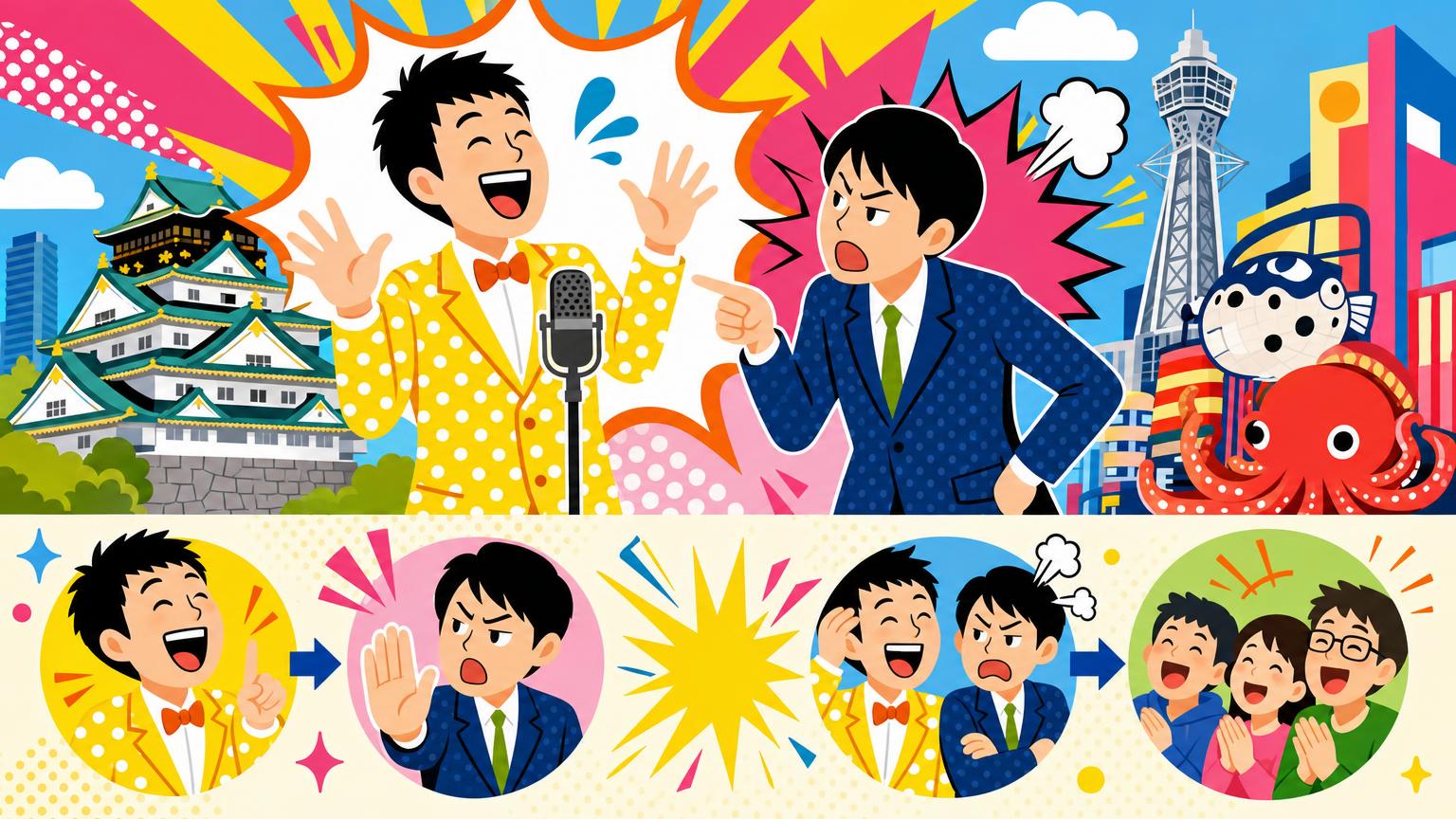
This communication style is built on two distinct roles: the Boke and the Tsukkomi. The Boke is the fool—the person who makes deliberately absurd statements, wildly misinterprets situations, or acts completely clueless. The Boke sets the trap. The Tsukkomi, on the other hand, is the straight man, the voice of reason, the sharp interjection that snaps the conversation back to reality. The Tsukkomi springs the trap. When someone plays the Boke, they are offering a gift—a moment of tension and absurdity that you resolve by delivering the Tsukkomi.
If someone in Tokyo says something illogical, the listener might laugh awkwardly, assume it was a genuine mistake, and politely ignore it to spare embarrassment. In Osaka, ignoring a Boke is the ultimate social faux pas. If a joke is set up and you don’t strike back with a Tsukkomi, you leave the other person hanging. The energy fades, the rhythm breaks. The Tsukkomi isn’t an insult; it’s an act of validation, saying, “I hear you, I see what you’re doing, and I’m playing along.” The speed and sharpness of the Tsukkomi reflect how closely you’re paying attention. It’s a form of aggressive empathy—a way to build instant camaraderie through shared absurdity.
Why Osaka is the Undisputed Comedy Capital of Japan
You may wonder why this unique style of banter evolved in Osaka and not elsewhere. The answer lies in the city’s history. For centuries, Tokyo was Japan’s political center, filled with samurai, bureaucrats, and strict hierarchies. You had to be cautious with your words, as a slip to a superior could literally cost you your life. Osaka, conversely, was the merchant capital—a city of traders, shopkeepers, and hustlers. In a merchant city, social rank mattered far less than your ability to strike a deal. And what’s the quickest way to build trust with a stranger, sell them a bolt of silk or a barrel of soy sauce? You make them laugh.
Humor became the ultimate social lubricant in Osaka. It was a tool to break the ice, level the playing field, and gauge the intelligence and quick wit of your trading partner. A merchant who could deliver a sharp Tsukkomi demonstrated attentiveness and mental agility. This merchant mindset became embedded in Osakan culture. Today, people in Osaka still see laughter as a vital human need. They don’t take themselves too seriously—and they don’t want you to, either. The willingness to look a little foolish as the Boke, and to playfully call out others’ foolishness through Tsukkomi, reflects a deeply egalitarian spirit. It strips away titles and formalities, leaving only raw, human connection.
Essential Osaka Tsukkomi Phrases Every Traveler Should Know
If you want to survive and thrive in Osaka’s vibrant social scene, you need to equip yourself with a few conversational tools. You don’t have to be fluent in Japanese to join in the local chatter. Just knowing a few well-timed Kansai-ben phrases, the local dialect, will instantly boost your status from clueless tourist to respected conversational partner. Kansai-ben is naturally more melodic, emotional, and punchy than standard Japanese, making it ideal for comedy. Let’s dive into some of the most important words in the Osakan vocabulary.
“Nandeyanen!” (Why the heck?!) – The King of Tsukkomi
If there is one word that truly captures the spirit of Osaka, it’s “Nandeyanen.” This phrase roughly translates to “Why the hell is that?” or “What are you talking about?!” but literal translations don’t capture its full meaning. Nandeyanen is the universal Swiss Army knife of Tsukkomi—a reflexive retort to any Boke. Its power lies in its rhythm and intonation; you can’t just mumble it. You have to really lean into it, with emphasis usually placed strongly on the “ya” syllable, often accompanied by a quick, light slap to the back of the other person’s hand or shoulder using the back of your own hand.
Picture yourself at a local restaurant where the bill is a reasonable two thousand yen, but the cheerful owner hands you the receipt and says, “That will be two million yen, please!” This is a classic, almost clichéd Osakan Boke. If you reach for your wallet confused, you fail the test and the owner sighs inwardly. But if you immediately grin, raise your hand, and hit them with a sharp “Nandeyanen!” the owner’s eyes brighten. You’ve completed the social circuit. You’ve validated their joke, showing you understand their culture, appreciate their humor, and are ready to join in. You’ll hear Nandeyanen echoing through grocery aisles, bar counters, and among high school students waiting for the train. It’s the city’s heartbeat.
“Aho Chauka” (Are you crazy?) – Use with Care
Using insults in Japan demands subtlety, especially when crossing regional lines. In Tokyo and the Kanto area, “Baka” is the common word for idiot or fool. Calling someone “Aho” there sounds sharply offensive. In Osaka, however, it’s the opposite: “Baka” feels cold, clinical, and genuinely hurtful, while “Aho” is a term of deep affection. When an Osakan calls you an Aho, it often means they like you and feel comfortable dropping formalities.
The phrase “Aho chauka” literally means “Are you an idiot?” or “Are you crazy?” but it works perfectly as a Tsukkomi response when someone suggests something wildly impractical or tells a story about doing something extremely foolish. For example, if your friend says they walked from Umeda to Namba during a raging typhoon because they forgot their umbrella and didn’t want to buy a new one, a dull “That was dangerous” is a typical Tokyo comeback. A wide-eyed, grinning “Aho chauka!” is the Osakan way to mock their poor judgment while affectionately acknowledging their eccentricity. However, because it literally means idiot, foreigners should use this phrase carefully. Make sure you have a warm, informal relationship before tossing out an Aho chauka, delivering it with a smile and light tone; if said in anger, it loses its humor and becomes an insult.
“Shiran Kedo” (I don’t know, though) – The Classic Osakan Punchline
While Nandeyanen is the sword used to strike down a Boke, “Shiran kedo” is the ultimate conversational escape hatch. This phrase means “I don’t know, though” or “But I have no idea.” Recently, this uniquely Osakan phrase has gained popularity all across Japan, but its roots and clever use remain deeply Kansai. Shiran kedo is tacked onto the end of a confident-sounding statement or explanation.
Picture an Osakan passionately describing the secret to perfect takoyaki: the exact dashi-to-flour ratio, the perfect grill temperature, the best pickled ginger brand, and the history of octopus sourcing in the Seto Inland Sea. They speak with the confidence of a Michelin-star chef. You take mental notes, impressed by their deep knowledge. Then, just as they finish, they casually shrug and say, “Shiran kedo.” All that authority and passion instantly disappear. They’ve either admitted they might be making it up or are refusing to be held responsible if your takoyaki ends up terrible.
Why do Osakans do this? It’s about entertaining. They want to tell a good story, hold your attention, and speak passionately, but they hate arrogance. They don’t want to sound like know-it-alls or strict teachers. Adding Shiran kedo is a self-deprecating Tsukkomi aimed at themselves. It softens the statement, relieves conversational pressure, and usually guarantees a laugh. As a foreigner, if you confidently explain something about your home culture and finish with a perfectly timed deadpan “Shiran kedo,” you’ll definitely win the crowd.
Real-Life Scenarios: Experiencing Osakan Humor on the Streets
Grasping the theory of Tsukkomi is one thing, but applying it in real life is quite another. Osaka is a city meant to be experienced at street level. You don’t uncover the soul of this town by reading signs in a museum; you find it by pulling up a stool at a greasy counter, weaving through crowded alleyways, and engaging directly with the people who keep the city alive. Let’s explore how these comedic interactions unfold in everyday situations you’ll inevitably face while living in or visiting Osaka.
Banter at a Local Izakaya
The izakaya, a traditional Japanese pub, is the perfect stage for Osakan communication. Unlike Tokyo, where groups usually stick to their own private tables and speak quietly, an Osakan izakaya—especially the small, standing-only bars called tachinomi—is a fully open social space. The lines between you, the bartender, and the salaryman beside you practically vanish. Once the beer flows, the whole room often becomes one lively, chaotic conversation.
As a foreigner, you naturally become a focal point. Locals will be curious and ask where you’re from, why you’re in Osaka, and if you enjoy the local food. This is where the Boke and Tsukkomi dynamic truly comes alive. An older man next to you might point to a plate of perfectly ordinary fried chicken and say deadpan, “In Osaka, we fry local pigeons. Try some.” He’s testing you, throwing out a Boke to see how you respond. If you look horrified and politely refuse, the moment fades. He’ll apologize courteously, and the barrier goes back up. But if you roll your eyes, push the plate away dramatically, and say, “Nandeyanen! That’s obviously chicken!” you’ve passed the test. The man will burst out laughing, slap you on the back, and probably buy your next drink. The izakaya teaches that Tsukkomi isn’t about aggression; it’s about showing you’re tough, playful, and ready to dive into the mess with everyone else. It’s a deep expression of social trust.
Chatting with Vendors in a Shotengai (Shopping Arcade)
Another essential place to hone your Tsukkomi skills is the Shotengai, the covered shopping arcades crisscrossing the city. Spots like the incredibly long Tenjinbashisuji Shotengai or the lively Kuromon Market serve as the heart of Osakan commerce. Here, you’ll meet the legendary “Osaka Obachan,” the formidable, affectionate, and fiercely chatty older women who run small clothing stalls, produce stands, and food carts. The Obachan are the reigning champions of Osakan banter.
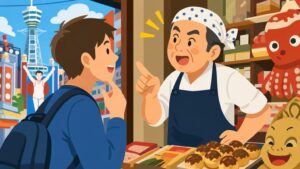
When dealing with vendors here, the city’s merchant culture is on full display. Haggling—generally frowned upon and almost unheard of elsewhere in Japan—is treated like a playful conversational sport in Osaka. But it’s not a harsh bargain over pennies; it’s a comedic performance. If you pick up a t-shirt with a loud tiger print, a staple of Obachan fashion, the vendor might say, “Ah, that looks perfect on you! Very handsome. For you, special price: ten million yen!”
We mentioned this earlier, but the real magic happens in a Shotengai. You can’t just ignore the ten million yen price. You have to engage. You might shout, “Nandeyanen! I don’t carry a suitcase full of cash!” Or, you could bounce back a Boke of your own, frantically patting your pockets and saying, “Oh no, I only brought nine million yen today!” By returning a Boke, you force the Obachan to play Tsukkomi. She’ll laugh, call you a funny foreigner, and probably give you a real discount or throw in a free pair of socks. The exchange stops being a cold transaction and becomes a warm human connection, sealed with laughter.
The Do’s and Don’ts of Tsukkomi for Foreigners
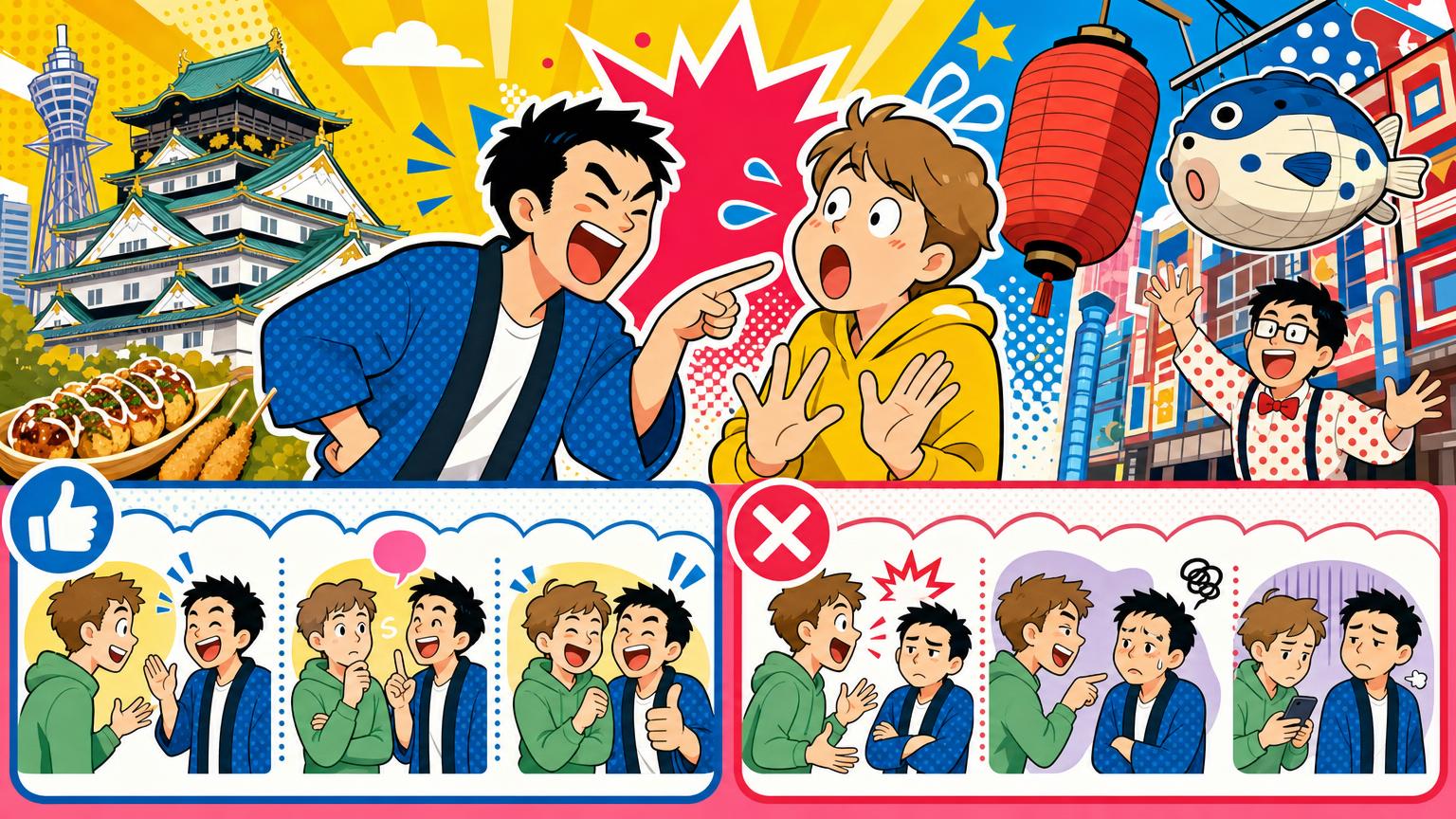
Mastering the Tsukkomi can open countless doors for you in Osaka, but it is entirely possible to get it wrong. Humor is deeply cultural, and even with the best intentions, there is a risk of crossing the line from playful banter to unintended rudeness. Foreigners often fall into the misconception that because Osaka is loud and friendly, all social rules are completely relaxed. This is a dangerous misunderstanding. Osaka still functions within the broader framework of Japanese society; the rules are simply bent and stretched in distinctive ways. Understanding the boundaries of the Boke and Tsukkomi dynamic is essential for building lasting, positive relationships.
Knowing Your Audience: When to React and When to Listen
The most important rule of Tsukkomi is reading the room, a concept known in Japanese as “kuuki wo yomu” or reading the air. Just because you have learned how to shout Nandeyanen does not mean you should use it when dealing with the immigration officer renewing your visa or the bank teller helping you open an account. There is a time and place for comedy. Formal business settings, official procedures, and interactions with authority figures still demand standard Japanese politeness.
Moreover, even in informal settings, you must wait for an invitation. You cannot simply deliver a Tsukkomi out of nowhere. A Tsukkomi requires a Boke to exist first. If a local is sharing a genuinely serious story about a hardship they experienced, jumping in with a comedic jab will make you appear insensitive and rude. You have to listen carefully for the setup. The Osakan will signal they are playing the Boke through their tone of voice, an exaggerated facial expression, or by stating something blatantly contrary to reality. Your role is to be an active, attentive listener. Only when the bait is clearly offered should you respond. Timing is everything. A Tsukkomi delivered even a few seconds too late becomes just an awkward comment. It must be a sharp, immediate reflex.
It is also critical to adjust your power dynamics. If you are interacting with someone significantly older or a senior colleague at your Osaka-based job, you can still engage in banter, but your Tsukkomi should be softer. Instead of a loud, forceful Nandeyanen, you might opt for a gentler, smiling “Sore wa nai deshou!” meaning “That cannot be right!” You are still playing the game but showing respect for the underlying hierarchy. As your relationship develops, you can gradually relax these boundaries, allowing the banter to grow rougher and more genuine.
The Role of the Osaka Dialect (Kansai-ben) in Comedy
One of the biggest mistakes foreigners make when trying to take part in Osakan humor is attempting a Tsukkomi using perfectly polite, textbook standard Japanese. It simply doesn’t work. Imagine trying to deliver a sharp, sarcastic New York street joke with the vocabulary and cadence of a nineteenth-century British aristocrat. The tonal mismatch ruins the joke. Standard Japanese, by design, creates distance and signals respect. It is smooth, precise, and emotionally restrained. Kansai-ben, on the other hand, is crafted to close that distance. It’s rhythmic, richly inflected, and emotionally expressive.
When you deliver a Tsukkomi, the dialect does half the work for you. The drawn-out vowels, the distinctive pitch accent that rises and falls rather than staying flat like standard Japanese, and the colloquial vocabulary all indicate to the listener that you are speaking from the heart, not reciting from a textbook. If someone plays the Boke and you reply with a stiff, textbook “Sore wa chigaimasu,” meaning “That is incorrect,” you sound robotic—a mere factual corrector rather than a participant in the joke. The humor is lost instantly. But if you switch to Kansai-ben and say “Chau chau!” the local, emphatic way of saying “Wrong, wrong!” the energy remains intact.
For a foreigner living in Osaka, learning a few key Kansai-ben phrases is not just a party trick to impress locals; it’s an essential tool for emotional integration. You don’t need to speak perfect Kansai-ben, which is famously difficult to master due to its complex pitch accent. Locals don’t expect you to sound exactly like them. What they value is the effort. By using their local expressions to take part in their local comedy, you demonstrate a deep respect for their regional identity. You’re telling them you don’t just want to live in Japan; you want to live in Osaka.
Where to Experience Authentic Comedy in Osaka
If you truly want to master the rhythm of the Tsukkomi, you need to learn from the professionals. While the streets and izakayas offer valuable daily practice, watching the masters perform on stage will deepen your understanding of the fundamental structure of Osakan communication. The city is overflowing with comedy venues, from grand historic theaters to small underground bars. Immersing yourself in this entertainment culture is essential to grasping the everyday life and mindset of the people here.
Visiting Namba Grand Kagetsu (NGK)
There is no better place to begin your comedic education than Namba Grand Kagetsu, known affectionately as NGK by locals. Situated in the lively Minami district, this theater is the ultimate hub of Japanese comedy. It serves as the flagship venue for Yoshimoto Kogyo, the enormous entertainment conglomerate that dominates the Japanese comedy industry and is headquartered in Osaka. To say Yoshimoto is vital to Osaka is an understatement; it is intricately woven into the city’s identity.
A visit to NGK is an intense sensory experience. The building is covered with vibrant, oversized caricatures of famous comedians. Outside, young, aspiring entertainers swarm to attract audiences for smaller shows. Inside, you will witness the gold standard of Manzai stand-up comedy and Yoshimoto Shinkigeki, a highly physical, slapstick style of ensemble theatrical comedy.
Even if your Japanese isn’t advanced enough to catch every rapid joke, attending an NGK show remains extremely worthwhile. You’re not just there to understand the lyrics; you’re there to study the rhythm of the language. Observe the physical distance between the Boke and Tsukkomi on stage. Notice the Tsukkomi’s sharp hand gestures, exasperated expressions, and the precise microsecond they cut off the Boke. Also, watch the audience. The crowd at NGK doesn’t laugh politely with covered mouths—they roar, slap their knees, and actively fuel the room’s energy. Witnessing this dynamic will transform your perception of how Japanese people express joy and amusement, completely breaking the stereotype of the quiet, reserved Japanese.
Finding Local English-Friendly Comedy Shows
While NGK stands as the grand cathedral of comedy, its performances are in rapid, complex Japanese. If you’re a foreigner seeking a space to participate actively, fully grasp the nuances, and practice your comedic timing, explore Osaka’s surprisingly vibrant international and bilingual comedy scene.
In neighborhoods like Shinsaibashi, Namba, and even hip areas like Nakazaki-cho, there are small bars and underground venues hosting regular stand-up nights, improv sessions, and open mics aimed at expats, tourists, and internationally minded locals. These events are cultural treasures. You’ll watch foreign comedians who have lived in Osaka for years humorously break down the culture shocks and everyday absurdities you’re facing. More importantly, you’ll see Japanese comedians performing in English, striving to convey the frantic energy of Osakan Tsukkomi through a different linguistic lens.
These local shows are much more intimate than the huge NGK theater. The comedians engage directly with the front row. The audience drinks together, mingles during breaks, and socializes after the show. Here, you can safely practice the cultural lessons you’ve absorbed. Chat with a bilingual local at the bar, wait for them to make a sarcastic remark about Osaka’s summer humidity, and reply confidently with a perfectly timed “Shiran kedo.” When everyone laughs, you’ll feel a deep sense of belonging. You’re no longer just watching the culture through a window—you’ve stepped onto the court, grabbed the racket, and returned the volley. You have mastered the art of the Tsukkomi, and in doing so, discovered the true voice of Osaka.