
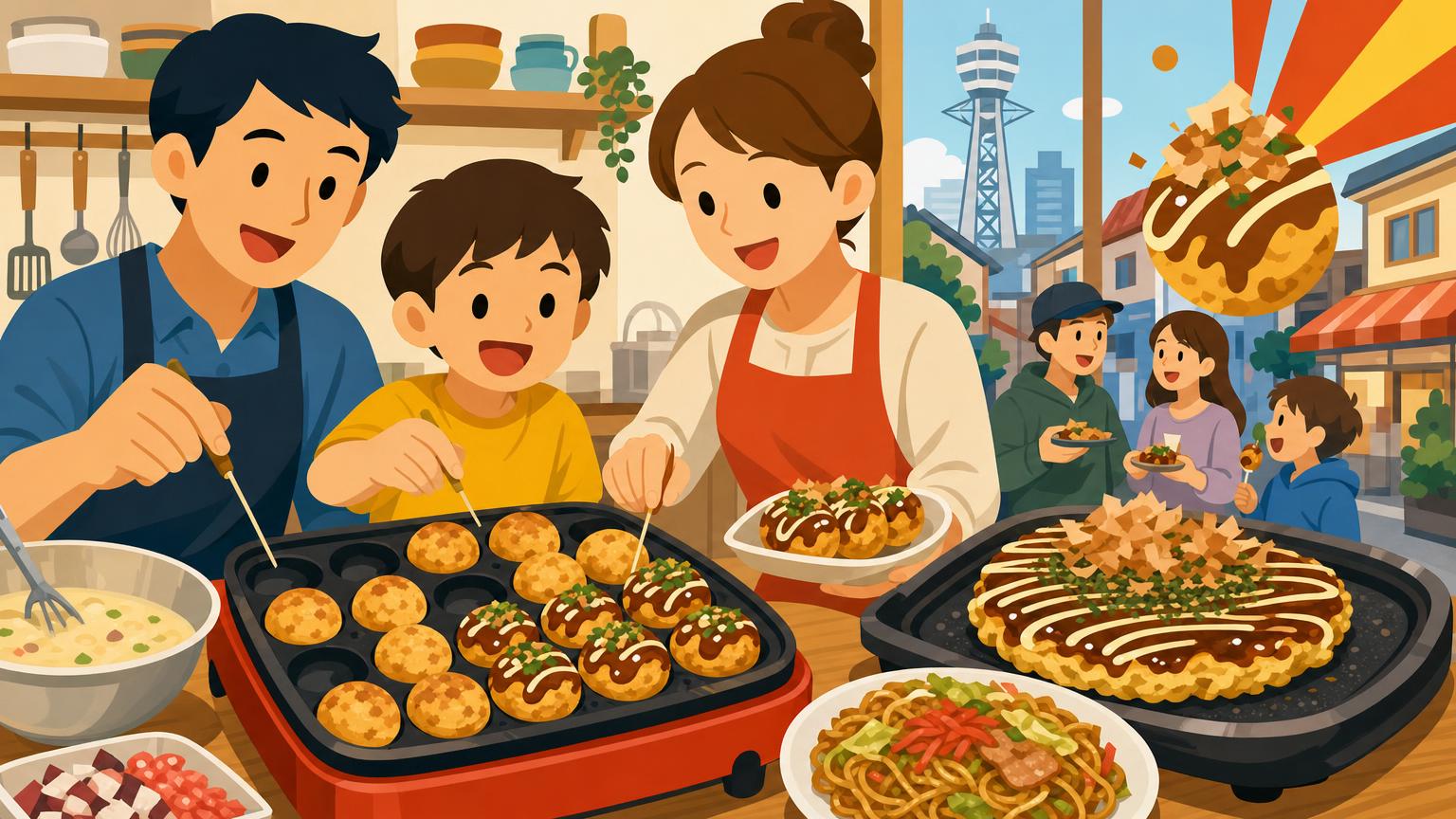
If you live in Osaka for the first time, one food question may arrive sooner or later: why do people here talk about okonomiyaki, takoyaki, udon, and other flour-based dishes as if they are part of the local personality?
The answer is not simply that Osaka has many famous foods. The deeper answer is that konamon, written 粉もん and pronounced roughly “koh-na-mohn,” belongs to ordinary life. It appears in family kitchens, apartment parties, neighborhood restaurants, shopping arcades, after-school snacks, quick dinners, and casual conversations about what to eat. It is not only something visitors buy under bright signs in Dotonbori. It is one of the ways Osaka people organize time together.
Konamon literally refers to food made mainly from flour or other powdered ingredients. In Osaka, the word usually brings to mind dishes such as takoyaki, okonomiyaki, negiyaki, ikayaki, and udon. Yet the category is cultural as much as culinary. Konamon is affordable, adaptable, filling, and designed to be shared. It allows people to cook while talking, adjust ingredients according to taste, and sit together without creating a formal atmosphere.
That matters if you are trying to understand living in Osaka. Food here often reveals a local attitude: practical but not dull, informal but not careless, generous without making a performance of generosity. Compared with Tokyo, Osaka can feel less concerned with polished presentation and more interested in whether the meal creates a good moment between people. Compared with some other Japanese cities, Osaka’s food culture can feel more openly conversational, more willing to joke, and more comfortable with eating the same simple dish again and again.
The map below points toward the Dotonbori area, not because the neighborhood represents all of Osaka, but because it helps place one visible part of the city’s konamon culture. The everyday reality is found beyond the famous food street too, in residential neighborhoods, local shopping streets, and homes where a takoyaki maker may be treated almost like a normal kitchen appliance.
Google Maps provides an iframe-based embedding method for displaying a selected place or area on a webpage.
What Is Osaka’s Konamon Culture?
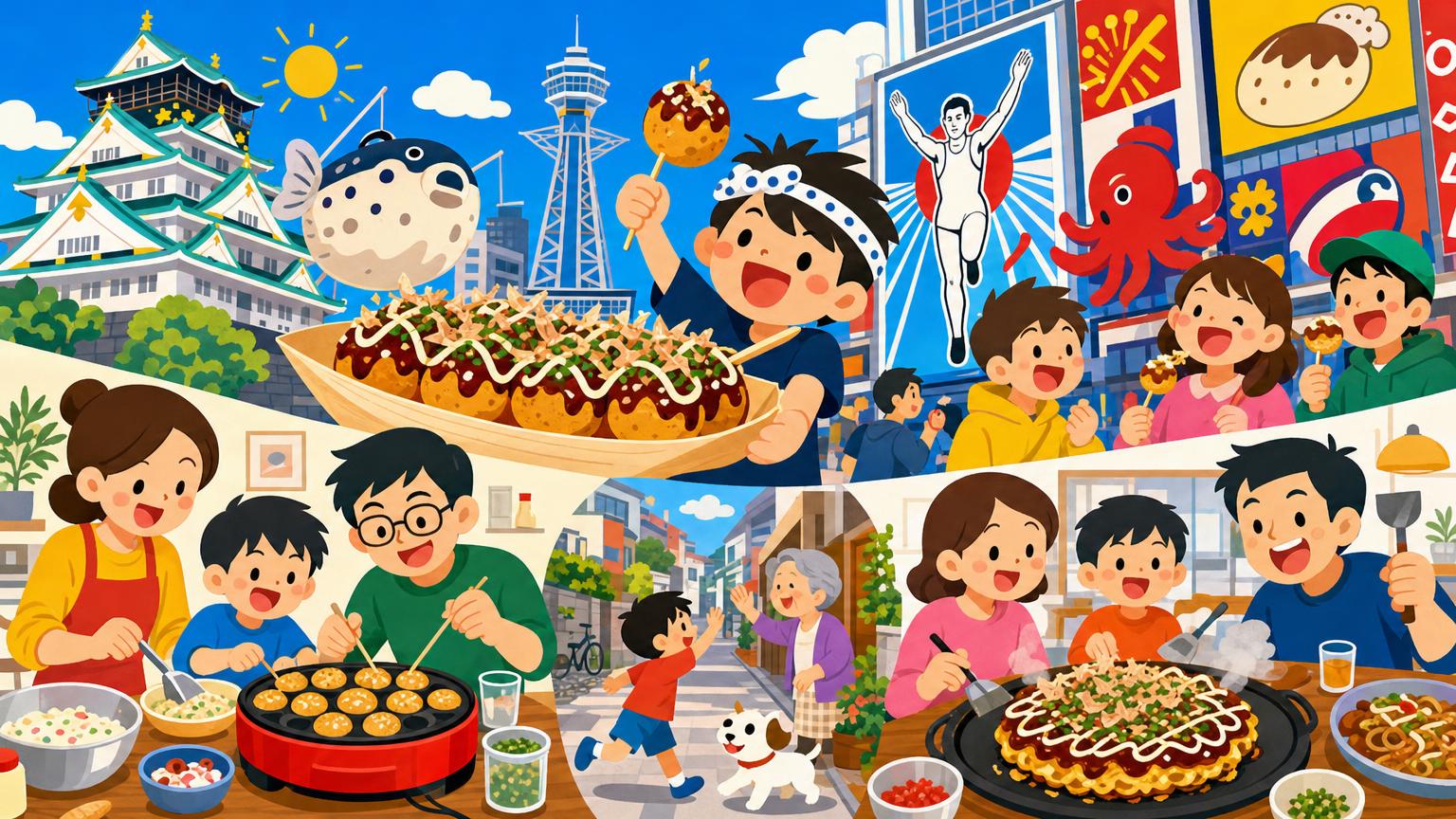
Konamon Means More Than “Flour Food”
The simplest translation of konamon is “flour-based food.” The word comes from 粉, meaning powder or flour, combined with the Osaka-style ending もん, a friendly local form of もの, meaning thing. In everyday speech, konamon often refers to foods made from wheat flour, but the feeling behind the word is broader than a dictionary definition.
It describes a family of foods that are easy to customize, share, and fit into ordinary schedules. A person may stop for takoyaki on the way home, make okonomiyaki for dinner, eat udon when feeling tired, or invite friends over for a takoyaki party. These activities may look different on the surface, but they belong to the same cultural world.
Konamon is also connected to the idea that food does not have to be expensive to be satisfying. An Osaka meal can be filling without being elaborate. It can include cabbage, green onion, flour, dashi, a little meat or seafood, and sauce. The pleasure comes from texture, heat, aroma, and conversation. There is skill involved, but the food does not need to be precious.
This is one reason foreigners sometimes misunderstand Osaka food culture. They see takoyaki stands and okonomiyaki restaurants and assume konamon is mainly a tourist experience. In reality, the more important question is not, “Where is the most famous restaurant?” but, “How does this food fit into people’s relationships and routines?”
A local family may not describe dinner as a cultural event. Someone may simply say, “Let’s make okonomiyaki tonight.” A friend may bring ingredients to a gathering without announcing a special plan. Children may learn how to turn takoyaki before they can explain the dish’s history. The culture survives because it is ordinary.
Why Osaka Became Known as Japan’s Kitchen
Osaka’s relationship with food is closely connected to its historical role as a commercial and distribution center. For centuries, goods moved through the city by water, while rice, seafood, vegetables, seasonings, and other products circulated through its markets. Osaka became associated with commerce, cooking, and the practical movement of ingredients.
The phrase “Japan’s kitchen” is often used to describe Osaka, but it should not be understood merely as a compliment about restaurants. It also reflects a city where food was closely tied to trade, household budgeting, work, and social life. Ingredients had to move efficiently. Meals had to feed people. Businesses had to serve customers quickly. Food culture developed within this practical environment.
In the twentieth century, particularly during the difficult years surrounding and following the Second World War, inexpensive flour-based meals became especially useful. Flour could be mixed with water and extended with vegetables or other available ingredients. A small amount of protein could add flavor without making the meal unaffordable. Street vendors and small neighborhood shops could prepare food using relatively simple equipment.
This history does not mean that every modern Osaka dish was invented because of poverty. That would be an oversimplification. Osaka’s konamon developed through a combination of necessity, convenience, local taste, commercial creativity, and the pleasure of eating together. People continued to eat these dishes even after incomes and food choices changed because the food had become part of the local identity.
The Secret Ingredient: Dashi Gives Konamon Its Depth
A person tasting Osaka-style konamon for the first time may notice that the food is not simply flour, cabbage, and sauce. The mixture often has a savory depth before any topping is added. That depth comes from dashi, the Japanese soup stock used in countless dishes.
Dashi may be made from kombu kelp, dried bonito flakes, dried sardines, or other ingredients. The exact blend varies according to the dish, restaurant, household, and region. In Osaka cooking, dashi provides a quiet layer of umami. It makes a simple batter taste rounded rather than flat.
This is important because foreigners sometimes focus on the visible elements of konamon: the brown sauce, mayonnaise, bonito flakes, seaweed, and crispy surface. Those toppings are memorable, but they are not the entire flavor. The foundation is often the dashi within the batter or the broth surrounding the noodles.
Osaka’s historical trade connections also helped establish the importance of kombu and other dried ingredients. Kombu from northern Japan moved through commercial networks and became deeply associated with Kansai cooking. In Osaka, the preference for a clear, savory stock influenced udon, simmered dishes, soups, and flour-based foods alike.
The result is a useful way to understand Osaka cuisine: the food may look bold, but its flavor is often built on a subtle base. The sauce catches your attention. The dashi keeps you eating.
Konamon in Daily Osaka Life
The Kitchen Is Often a Social Space
In many homes, cooking is not entirely separate from conversation. An okonomiyaki meal may take place at a table with a built-in hot plate, a portable griddle, or a frying pan brought to the center. People mix the batter, cut ingredients, wait for the surface to brown, and discuss when to turn it.
This creates a different rhythm from a meal in which one person prepares everything in the kitchen and carries finished plates to the table. With konamon, cooking can continue after everyone has sat down. The meal is partly prepared, partly assembled, and partly negotiated while people are already eating.
For a foreign resident, this can initially be confusing. Who is expected to cook? Is the restaurant staff handling everything? Should you turn the okonomiyaki yourself? Can you ask for more sauce? Is it rude to add ingredients?
The answer depends on the restaurant, but the broader rule is simple: watch what the people at the table are doing. In some places, the staff prepare the dish. In others, the cooking surface is part of the experience. If you are unsure, asking “Do we cook this ourselves?” is perfectly acceptable. Most people would rather explain than watch you struggle with a hot griddle.
At home, the rules are usually even more flexible. Someone may be the main cook, but others will mix, chop, turn, serve, or adjust the toppings. The food is not a test of culinary purity; it is a shared project.
Konamon Is Designed for Adjustment
Osaka’s flour-based dishes are naturally adaptable. Okonomiyaki can contain pork, squid, shrimp, cheese, mochi, green onion, or vegetables. Takoyaki usually centers on octopus, but households often experiment with other fillings. Udon can be served hot or cold, in broth or with dipping sauce, and with tempura, meat, tofu, or green onion.
This flexibility reflects an Osaka attitude toward food: use what you have, make it enjoyable, and do not become overly rigid about rules that were never meant to be rigid. A household may have a preferred recipe, but another family may prepare the same dish differently without believing that one version destroys the food’s meaning.
That does not mean Osaka people have no opinions. They can be extremely serious about texture, sauce, dashi, cabbage, the right amount of green onion, or whether a particular restaurant has changed its recipe. The point is that strong opinions and practical flexibility can exist together.
You may hear people argue about the best way to make okonomiyaki and then happily eat a completely different version at a friend’s house. In Osaka, food debate can be a form of affection. The argument is not always meant to end with a winner.
Neighborhood Restaurants Matter More Than Famous Names
When people talk about Osaka’s food culture, they often mention well-known businesses in Dotonbori or major shopping districts. Those places are visible, convenient, and useful for understanding what visitors notice first. However, daily konamon culture is also carried by small restaurants near train stations, shopping arcades, schools, offices, and residential streets.
A neighborhood okonomiyaki restaurant may have regular customers who have been visiting for years. The owner may know who prefers extra green onion, who comes after work, and which children are now old enough to sit at the counter. The atmosphere may matter more than the size of the menu.
Small local restaurants can also be where Osaka’s social style is easiest to observe. Customers may speak casually with staff. People may comment on the weather, baseball, local construction, or the price of vegetables. A conversation can begin simply because someone has ordered the same dish three times in one week.
Foreign residents sometimes worry that they need advanced Japanese to enter this kind of place. Language helps, but perfect Japanese is not required. A greeting, a smile, a clear order, and attention to what others are doing will take you surprisingly far. You do not need to perform a local identity; you only need to participate respectfully.
The Konamon Dishes That Explain Osaka
Takoyaki: The Smallest Dish with the Biggest Social Energy
Takoyaki are round pieces of batter cooked in a special molded pan, usually with octopus inside and toppings such as sauce, mayonnaise, green seaweed, and bonito flakes. They are strongly associated with Osaka, but their cultural importance extends beyond their shape.
Takoyaki are meant to be eaten in groups. The pan naturally becomes the center of attention. Someone pours in the batter. Someone adds octopus and green onion. Someone waits for the outside to firm up. Then the pieces are turned with picks or chopsticks. Everyone watches the process, offers advice, and waits for the first batch.
At home, this can become a takopa, short for takoyaki party. The word is casual and increasingly familiar even outside Osaka. A takopa may be hosted by university students, families, colleagues, or friends who simply want an easy gathering. The host provides the batter and equipment, while guests bring drinks, fillings, or toppings.
The social value is clear: a takopa gives people something to do with their hands. Conversation does not have to carry the entire gathering. Turning takoyaki creates pauses, small victories, jokes, and shared attention. Someone who is shy in a large conversation can still participate by cooking.
Foreigners sometimes expect takoyaki to be eaten immediately after it is served. Be careful. The inside can be extremely hot, even when the outside appears manageable. Local people know this too, but enthusiasm often overcomes caution. Take a small bite or let it cool before eating the center.
Takoyaki also teaches something about Osaka communication. People may tease someone who makes an uneven batch, but the teasing is often an invitation to join the fun. The standard is not professional perfection. What matters is whether everyone is enjoying the process.
Okonomiyaki: The Savory Meal That Means “Make It How You Like”
Okonomiyaki is often translated as “grill what you like,” a useful phrase because the dish is centered on choice. A batter made from flour, dashi, and other ingredients is mixed with shredded cabbage and then cooked on a griddle. Meat, seafood, green onion, pickled ginger, tempura bits, cheese, mochi, and other additions may be included.
The name suggests freedom, but recognizable Osaka preferences still exist. Osaka-style okonomiyaki commonly mixes the ingredients before cooking, creating a substantial, pancake-like form. Hiroshima-style okonomiyaki is associated with layered ingredients, including noodles in many versions. These are not simply competing recipes; they reflect different regional habits and identities.
In Osaka, okonomiyaki is often considered a proper meal rather than merely a snack. A family may make it for dinner. A group of coworkers may eat it after work. Friends may order several varieties and share them. A restaurant with a hot plate encourages people to stay, talk, and order another round.
Okonomiyaki also shows how Osaka balances individuality with cooperation. Each person may choose different toppings or a preferred sauce, but the table shares the cooking space. Your choices belong to you, yet the meal remains collective.
The most common toppings are also culturally expressive. Sweet-savory sauce, mayonnaise, powdered seaweed, and bonito flakes create layered flavor and a visually lively surface. The moving bonito flakes are not alive; they curl because of the heat. Visitors sometimes hesitate when they first see them, while local children may regard them as part of the fun.
If you are invited to eat okonomiyaki in an Osaka home, do not assume you are expected to bring an expensive gift. A simple dessert, drink, fruit, or small contribution is usually enough unless the host gives specific instructions. The important thing is to show appreciation and help with the shared meal.
Ikayaki: A Local Favorite with a Different Shape
Ikayaki means grilled squid, but Osaka-style ikayaki is often associated with squid pressed into flour-based batter and cooked on a hot plate. The result is flatter and more compact than takoyaki or okonomiyaki. It is particularly connected with quick eating and department-store food culture.
Ikayaki may be less internationally famous than takoyaki, yet it helps explain how Osaka food culture values speed and satisfaction. It can be eaten as a snack while passing through a busy area, but it also carries the flavor of an older urban food tradition in which vendors served workers and shoppers something hot, savory, and affordable.
The texture may surprise foreigners. It is neither simply bread nor simply squid. The squid adds chewiness, while the batter and sauce create a softer base. If you enjoy seafood but do not want a large meal, ikayaki offers a useful introduction to the variety within konamon.
Negiyaki: The Green-Scallion Counterpart
Negiyaki resembles okonomiyaki but uses a much larger amount of green onion and usually less cabbage. It tends to be thinner and more sharply aromatic. Soy sauce or a lighter seasoning may be used instead of the sweeter sauce associated with standard okonomiyaki, although styles vary.
Negiyaki can seem more restrained than okonomiyaki, but it is not bland. The green onion provides fragrance, sweetness, and a slight bite. It also demonstrates that Osaka’s flour culture is not limited to heavy, sauce-covered dishes.
For foreigners living in Osaka, negiyaki is worth noticing because it may appear on ordinary local menus without the international recognition given to takoyaki. It is the kind of dish people order because they know what they enjoy, not because it has been promoted as a symbol of the city.
Udon: The Quiet Foundation of Flour Culture
Udon is sometimes left out of discussions about Osaka’s konamon because it is usually described as noodles rather than street food. That is a mistake. Udon is one of the clearest examples of how flour, dashi, and daily practicality come together.
Osaka udon is widely associated with a lighter-colored broth that allows the flavor of dashi to remain prominent. The exact taste varies among restaurants, but the general impression is often gentle, savory, and aromatic rather than aggressively salty. Udon can be a quick breakfast, an inexpensive lunch, a comforting dinner, or a meal eaten when someone does not feel well.
A bowl of udon can also tell you something about Osaka time. It does not require a special occasion. It can be eaten alone without feeling lonely. It suits a busy office worker, a student between classes, a parent with children, or someone returning home late.
Kitsune udon, with sweetened fried tofu, is especially associated with Osaka. The sweet tofu and savory broth create a contrast that feels simple but carefully balanced. Tempura udon, beef udon, curry udon, and chilled udon show how broadly the category can extend.
If takoyaki is the noisy face of konamon, udon is the dependable one. It feeds people quietly, repeatedly, and without demanding attention.
Osaka Habits That Foreigners Often Misunderstand
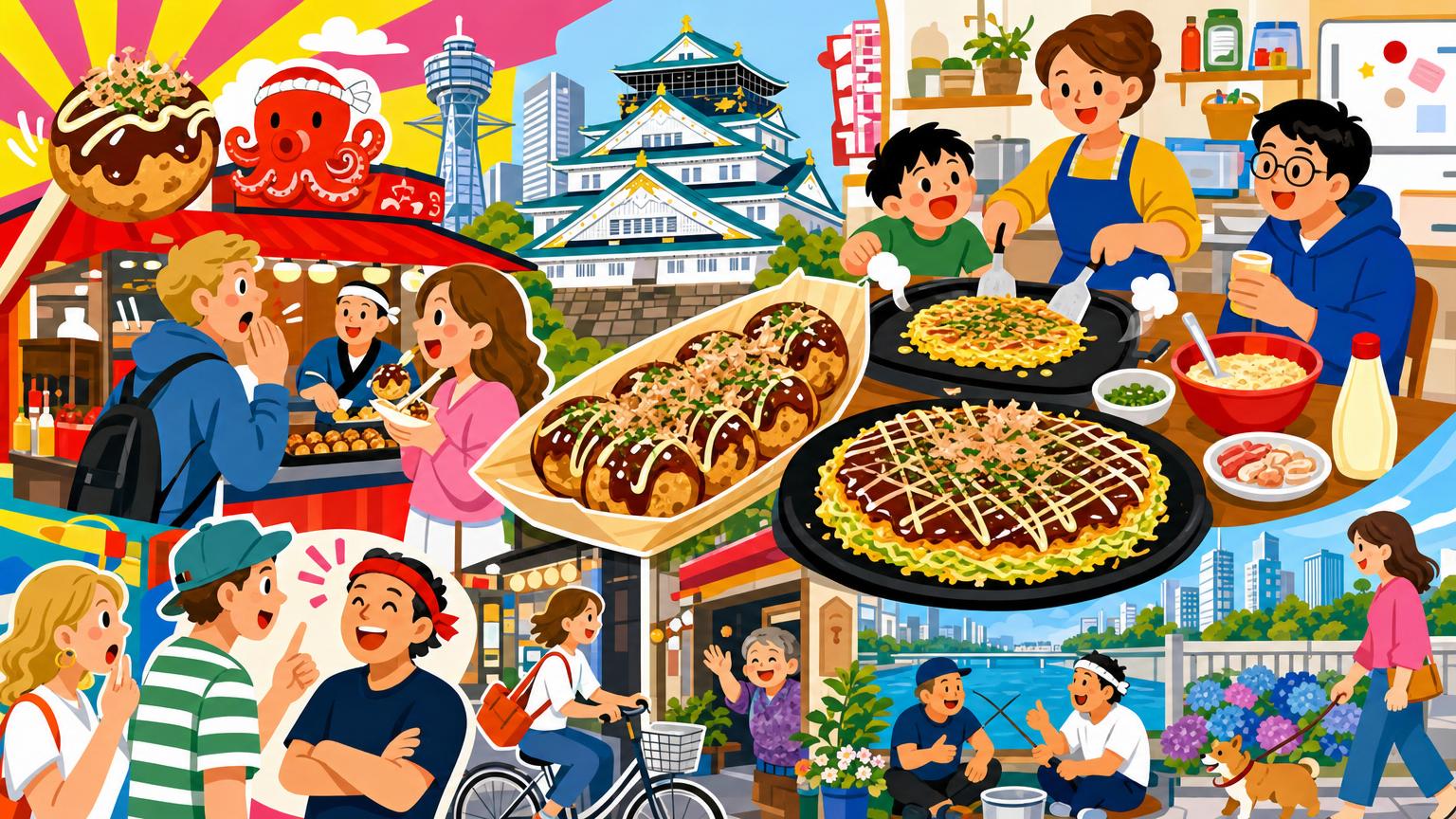
The Carb-on-Carb Meal: Okonomiyaki Teishoku
One of the most discussed Osaka food habits is okonomiyaki teishoku, a set meal that may include okonomiyaki, rice, miso soup, and pickles. To many foreigners, as well as some people from other parts of Japan, the combination looks unusually heavy. Why eat a flour-based pancake with rice?
The first thing to understand is that this meal is neither a joke nor an accident. It is a legitimate local eating pattern. Rice is the central staple of a traditional Japanese meal, while okonomiyaki provides vegetables, protein, and a savory main dish. Together, they create a filling lunch that suits people who do physical work, commute long distances, or simply enjoy a substantial meal.
The Osaka perspective is often practical: if it tastes good and keeps you satisfied, why make an issue of it? From this viewpoint, the foreign idea that rice and flour must never appear together can seem arbitrary. Osaka food culture does not always organize meals according to outside expectations of nutritional elegance.
This does not mean that every Osaka resident eats okonomiyaki with rice. Some people dislike the combination, especially if they did not grow up with it. Others order it regularly. The important point is that it is culturally understandable, rather than strange behavior that requires an apology.
The same pattern can occur with yakisoba and rice, or with a bowl of rice served alongside other starchy dishes. If you are invited to eat this way, you do not need to copy it. You can simply accept that people may have a different idea of what makes a satisfying meal.
Takopa and the Household Takoyaki Maker
Many Osaka homes do not literally have a takoyaki maker, so foreigners should avoid treating the stereotype as a rule. Still, the idea has a real basis. Portable electric takoyaki makers are common enough to be considered familiar household equipment, especially in homes where friends or relatives gather regularly.
The reason is not that Osaka families eat takoyaki every day. Rather, the appliance is useful for social occasions. It can sit in the middle of a table and allow everyone to participate. It also represents a style of entertaining that is informal and relatively affordable.
A takopa may include traditional ingredients, but it can also feature cheese, sausage, corn, mochi, kimchi, shrimp, vegetables, or leftovers. This kind of experimentation is not necessarily a rejection of tradition. It is part of the tradition of making the food your own.
For a foreign resident, joining a takopa can be a good way to understand relationships in Osaka. You may notice that people help without assigning formal roles. Someone refills the batter. Someone wipes the table. Someone gives advice on turning. Someone jokes about a badly shaped takoyaki. The activity creates a shared mood without requiring deep conversation from the start.
Sauce Preferences Can Become Personal Identity
People in Osaka can be particular about sauce, mayonnaise, dashi, and texture. This is not always simply a matter of taste. Food preferences can become small markers of family background, neighborhood experience, or personal identity.
One person may prefer a sweeter sauce, while another may insist on a more savory style. Some people want mayonnaise; others do not. Someone may believe that adding too many toppings hides the flavor of the batter, while another person may consider the toppings the best part.
These disagreements are usually low-stakes, but they can be lively. The tone may sound stronger than the actual conflict. Osaka speech often includes teasing, exaggeration, and quick reactions. A person who says, “That is completely wrong,” may simply be continuing a familiar food conversation rather than expressing serious anger.
Foreigners sometimes misunderstand this directness. In Tokyo or more formal settings, people may soften disagreement through indirect wording. In Osaka, a sharper comment may serve as an invitation to interact. The safest approach is to pay attention to the tone, facial expressions, and relationship between the speakers rather than translating every sentence literally.
Sharing Food Does Not Always Mean Sharing Everything
Konamon is associated with sharing, but local etiquette still matters. At a restaurant, people may order several dishes for the table, while individual preferences remain important. Ask before taking the last piece. Use shared utensils when they are provided. If the restaurant has a hot plate, be careful around other people’s portions.
At home, the host may encourage you to try everything, but you do not need to overeat to show gratitude. A polite comment about the flavor and a willingness to participate are usually more meaningful than forcing yourself to finish a large amount of food.
Also remember that “help yourself” can carry different meanings. In some homes, it means you are free to take what you need. In others, the host expects to serve the guests. Observe how the family behaves, and ask if you are unsure. Osaka hospitality is often generous, but it is not always explained formally.
Osaka Compared with Tokyo Through Food
Osaka Often Feels Less Concerned with Culinary Distance
Tokyo has an enormous range of food cultures, from inexpensive neighborhood restaurants to highly formal dining establishments. It would be unfair to reduce Tokyo to a single personality. Still, many newcomers feel that Osaka’s food spaces can seem more immediately accessible.
A small Osaka restaurant may feel less like a place where you must demonstrate the correct behavior and more like somewhere you are expected to join the atmosphere. The food may be prepared in front of you, the staff may speak casually, and other customers may openly react to what is happening around them.
This does not mean Osaka lacks hierarchy or etiquette. Japanese politeness still matters, and some places are quiet or formal. The difference is often one of social temperature. Osaka’s everyday food culture can leave room for joking, negotiation, and visible enjoyment.
In Tokyo, a busy person may eat quickly alone because the city’s scale encourages individual efficiency. Osaka also has busy people eating alone, but konamon spaces often preserve a sense of shared rhythm. A person can sit at a counter, exchange a few words with the staff, and still feel part of the room.
Osaka’s “Friendly” Reputation Needs Explanation
People often describe Osaka as friendly. That description is incomplete unless we explain the behavior behind it.
Osaka friendliness may take the form of a question, a joke, a comment about what you ordered, or an unsolicited suggestion. Someone may tell you that you chose the wrong sauce, recommend a nearby udon shop, or ask whether you are enjoying the city. This style can be direct enough to surprise foreigners who expect more distance from strangers.
At the same time, this does not mean every person in Osaka wants a deep relationship with you. A brief conversation may remain brief. A shopkeeper may be warm during an interaction without becoming your personal friend. Osaka friendliness often means lowering the barrier to contact rather than promising permanent closeness.
Konamon supports this style because it gives people a shared subject. Food provides a reason to talk without revealing private information. You can discuss the texture of takoyaki, the amount of sauce, or whether the dashi is good. Conversation begins with something concrete.
Osaka Directness Is Not Always Anger
A customer may complain more openly in an Osaka restaurant than you expect. A friend may criticize a dish. A family member may argue about how to turn okonomiyaki. This can sound harsh in translation, especially when the words are short and the voice is energetic.
Often, the emotional meaning is softer than the literal wording suggests. Osaka speech can use humor and exaggeration as social tools. A complaint may be a way of keeping the conversation going. A joke may show that people are comfortable enough not to maintain formal distance.
You should not assume that every harsh comment is friendly, of course. Context still matters. However, foreigners living in Osaka may benefit from waiting before judging a conversation by volume alone. Observe whether people remain engaged, share food, laugh, and continue helping one another. Those actions may reveal more than the sharpness of a single sentence.
Where Konamon Culture Appears in Osaka
Dotonbori Is Osaka’s Visible, Commercial Face
Dotonbori is often described as a famous food street, and it is certainly one of the most recognizable places to see Osaka’s food branding in action. Large signs, bright storefronts, crowds, and restaurant displays create a concentrated image of the city’s appetite.
For understanding daily life, Dotonbori is useful not because it represents every Osaka neighborhood, but because it shows how local food becomes a public identity. Takoyaki, okonomiyaki, crab, sushi, and other dishes are presented as symbols that visitors can recognize quickly. The area turns food into an urban language.
The limitation is that Dotonbori is commercial and crowded. Visitors may experience a performance of Osaka food culture rather than its quieter routines. This does not make it false, but it does make it incomplete.
Look beyond the large signs. Notice the groups deciding what to order, the workers eating quickly, the families managing children around hot food, and the way restaurants use open kitchens to create energy. The neighborhood reveals how Osaka sells its identity, while residential areas reveal how people live it.
Shinsekai Shows the Relationship Between Food and Neighborhood History
Shinsekai is another area often associated with Osaka food culture, especially kushikatsu and its retro urban atmosphere. Its importance for understanding konamon does not lie in the fact that every dish there is flour-based. Rather, the neighborhood helps show how inexpensive food, entertainment, and local identity can come together in one district.
Food streets such as Shinsekai may feel less polished than newer commercial developments. That roughness can be part of their appeal, but it should not be romanticized. Neighborhoods change, businesses close, rents rise, and the people who live nearby may have complicated feelings about how their area is presented to outsiders.
For foreigners living in Osaka, the useful lesson is to view food as part of urban history. A restaurant is not separate from the district around it. Prices, customer types, opening hours, and service styles can all reflect the neighborhood’s past and present.
Shopping Arcades and Station Areas Are Often More Useful
If you want to see konamon as part of everyday Osaka life, visit local shopping streets and station areas instead of focusing only on major attractions. A small okonomiyaki shop near a train station may tell you more about local routines than a restaurant designed specifically for international visitors.
Shopping arcades are especially important because they bring together food, errands, services, and social contact. People may buy vegetables, visit a pharmacy, pick up a repaired item, and stop for a snack in the same area. Konamon fits naturally into this environment because it can be quick, affordable, and familiar.
In residential neighborhoods, you may also see signs advertising takeout takoyaki, inexpensive udon, or lunch sets. These businesses serve people who already know the area. Their menus may not explain everything in English, but their purpose is usually clear: to feed nearby residents without making the experience complicated.
If you are new to Osaka, this is where you can learn practical local behavior. Notice when people line up, whether customers order at a counter or from a ticket machine, where umbrellas are placed, and how diners dispose of their trays. These small details are part of living in the city.
How Foreign Residents Can Participate Without Pretending to Be Local
Learn the Words You Will Actually Use
You do not need to memorize an entire Japanese menu. Learning a few food-related words can make everyday interactions easier. Konamon broadly refers to flour-based foods. Okonomiyaki is the savory griddle dish. Takoyaki are the round, octopus-filled pieces. Negiyaki emphasizes green onion. Udon refers to thick wheat noodles. Dashi is the soup stock that provides umami.
You may also hear “teishoku” for a set meal and “takeout” spoken in Japanese as “teikuauto.” “Omori” means a larger portion, while “futsu” means a regular portion. “Nami” can indicate a standard size, depending on the restaurant.
The goal is not to sound fluent but to reduce uncertainty. Ordering becomes less stressful when you recognize the main parts of a menu and know how to ask for help.
Do Not Treat Local Food as a Performance
Foreign residents sometimes feel pressure to prove that they are adventurous. They may order the strongest sauce, eat extremely hot takoyaki, pretend to understand a joke, or accept every unfamiliar ingredient. This is unnecessary.
People in Osaka may appreciate enthusiasm, but they generally do not need you to perform an Osaka identity. You can say that you prefer less sauce, that you are not used to eating rice with okonomiyaki, or that you need to wait for the takoyaki to cool. Honest reactions are easier for others to respond to.
What matters is showing curiosity without condescension. Do not describe a local habit as bizarre simply because it differs from your own. At the same time, you do not have to claim that every dish is your favorite. Respectful honesty works better than exaggerated praise.
Accept Invitations Carefully and Clearly
If a coworker invites you to a takopa or an okonomiyaki meal, ask some practical questions. Is it at someone’s home or in a restaurant? Should you bring something? What time should you arrive? Will children or other guests be attending? Is there a cost?
In Japanese social life, people may extend invitations casually. Sometimes “Let’s eat together sometime” is a genuine invitation that will be arranged later. Other times, it is simply a friendly expression without an immediate plan. If you want to accept, respond with a specific question about the date or place.
At a home gathering, helping with cleanup is usually appreciated. You do not need to take over, but carrying plates, wiping the table, or asking where things go shows that you understand the gathering as shared work rather than as a service provided for you.
What Konamon Reveals About Osaka People
Practicality Is Not the Opposite of Pleasure
Osaka’s konamon culture shows that practical food can also hold emotional importance. Inexpensive ingredients do not make a meal meaningless. A familiar dish can carry family memories, neighborhood identity, and the comfort of knowing exactly what you enjoy.
People sometimes describe Osaka as commercial or money-conscious. There is some truth in the city’s reputation for valuing price and usefulness, but this does not mean residents care only about saving money. A better description is that value matters. A meal should be worth its price, its time, and the effort of bringing people together.
This is why even a simple bowl of udon can be judged seriously. The question is not whether it is luxurious. The question is whether the dashi is good, the noodles are right, the portion is fair, and the experience feels satisfying.
Humor Helps People Share Space
Konamon meals often involve a certain amount of joking because cooking together creates opportunities for commentary. Someone turns the food too early. Someone adds too much batter. Someone insists that their family recipe is the best. These moments allow people to express themselves without making the conversation too intimate too quickly.
Humor can also soften disagreements. Osaka people may use a joke to criticize someone, then offer help immediately afterward. A person may tease you about your cooking while showing you exactly what to do. The words and actions work together.
Foreigners may need time to recognize this pattern. If you respond too seriously to every joke, the conversation can become awkward. If you laugh at everything without understanding, you may miss when someone is genuinely uncomfortable. Pay attention to whether the relationship remains cooperative.
Familiarity Is Built Through Repetition
Osaka’s neighborhood culture is not created by one dramatic act of hospitality. It grows through repeated, small interactions. The same customer comes back. The same shop owner remembers an order. The same family makes takoyaki during the holidays. The same coworkers go out for okonomiyaki after a difficult week.
For foreigners living in Osaka, this is an important lesson. You may not feel included after a single visit to a local restaurant. That is normal. Familiarity takes time. Return to places you genuinely enjoy, greet people, learn small routines, and allow relationships to develop without demanding immediate closeness.
Konamon fits this slow process because it is easy to repeat. You can eat it next week, next month, or at the same time every Friday. Culture becomes visible through repetition, not only through special events.
The Honest Limits of Osaka’s Konamon Image
Not Everyone Eats It Constantly
It is easy to exaggerate Osaka’s local food identity. Not every Osaka resident eats okonomiyaki every week. Some people prefer rice-based meals, pasta, curry, convenience-store food, vegetarian dishes, or international cuisine. Younger residents may have little interest in defending a traditional food identity.
Konamon is important, but it does not represent the entire city. Treating it as the only authentic Osaka food can create a new stereotype. The point is not that everyone behaves in the same way. Rather, these dishes provide a shared cultural reference that many people recognize, even when their personal habits differ.
Traditional Does Not Always Mean Old-Fashioned
A takoyaki party can be traditional in spirit while incorporating social media, imported ingredients, electric appliances, and creative fillings. A neighborhood restaurant may preserve an old recipe while adapting its menu to changing customers. Culture is not frozen in the past.
This matters to foreigners who want to understand modern Osaka. Local identity is often maintained by changing the details while preserving the social function. The food remains something people can make, share, discuss, and enjoy repeatedly.
The City Is Not One Large Family
Osaka’s reputation for openness can lead outsiders to expect instant acceptance. Real life is more complicated. People have different personalities, boundaries, political opinions, incomes, and experiences. Some neighborhoods are welcoming, while others are more private. Some shopkeepers enjoy conversation; others prefer to work quietly.
Konamon creates opportunities for contact, but it does not eliminate social distance. You still need to respect privacy, avoid blocking narrow spaces, control your noise, and understand that a friendly exchange does not give you permission to enter someone’s personal life.
The most accurate picture of Osaka is not a city where everyone talks to everyone. It is a city where casual contact can happen more easily when people share an activity and have a practical reason to interact.
A Local Way to Read an Osaka Meal
When you eat konamon in Osaka, try to notice more than just the ingredients. Ask yourself what the meal is doing socially.
Is it feeding someone quickly before work? Is it providing a family with an inexpensive dinner? Is it helping coworkers unwind after a long day? Is it creating an activity for children? Is it giving neighbors a place to exchange news? Is it allowing friends to joke together without arranging a formal gathering?
The answer may differ from one table to the next. That is exactly why konamon is useful for understanding the city. It is flexible enough to fit many different forms of life in Osaka.
Watch how people order. Notice whether the dish is shared or served in individual portions. See who cooks and who waits. Listen to the rhythm of the conversation. Observe whether people focus on price, texture, portion size, speed, or atmosphere. These details reveal local priorities more clearly than a slogan about Osaka being a food capital.
You may also notice that Osaka’s food culture often accepts a certain degree of imperfection. Takoyaki does not need to be perfectly round when made at home. An okonomiyaki can have uneven edges. A family recipe may change depending on what is left in the refrigerator. The meal succeeds when people are fed and connected, not when every piece looks identical.
That attitude can be reassuring for foreigners. You do not need to master every unspoken rule all at once. You can learn by watching, asking, returning, and participating. Osaka culture is not a performance that you either pass or fail. It is a set of habits that becomes clearer through ordinary contact.
Conclusion: Konamon Is a Way Osaka Makes Community
Osaka’s konamon culture is often introduced through famous dishes: takoyaki, okonomiyaki, negiyaki, ikayaki, and udon. These dishes matter, but their deeper meaning lies in how people use them.
Konamon brings food to the center of the table. It gives people a chance to cook together, adjust ingredients, lightly argue, share costs, and keep the conversation flowing. It appears in neighborhood restaurants, station areas, shopping arcades, family kitchens, workplace lunches, and gatherings at home. It connects the practical need to eat with the social desire to spend time together.
The dashi in the batter and broth serves as a useful metaphor for Osaka itself. The strongest elements may be visible first: sauce, heat, humor, direct speech, crowded streets, and lively opinions. Beneath them is a quieter structure built on habit, trade, work, household economy, and recurring relationships.
If you are deciding whether Osaka is a good place to live, konamon will not answer every question. By itself, it cannot explain housing costs, commuting, schools, healthcare, language barriers, or workplace culture. However, it can help you understand the city’s emotional rhythm. Osaka often values usefulness without sacrificing pleasure, informality without abandoning consideration, and strong personal taste without requiring everyone to eat exactly the same way.
The next time someone in Osaka suggests takoyaki, okonomiyaki, or udon, listen for what is being offered beyond the food. It may be a quick meal, a chance to relax, an invitation into a neighborhood routine, or simply a way of saying that people are hungry.
That combination of practicality and connection is the heart of konamon. It is not merely street food; it is one of the everyday ways Osaka people make room for one another.