You may hear that Osaka people are “more friendly” than people in Tokyo, then enter a tachinomi standing bar and wonder why nobody is speaking to you. Or you may enjoy a lively conversation with someone at the counter, only to realise that you have been standing in the same narrow place for two hours while other customers quietly wait for space.
Both experiences are normal.
The difficult part is that Osaka friendliness is not the same as unlimited openness. In a tachinomi, the atmosphere can be relaxed, humorous, and surprisingly personal, but the space is still organised by quick reading, short exchanges, and respect for the people already using the counter. The social rules are casual on the surface and quite precise underneath.
For foreign residents, this is one of the most useful everyday differences between Osaka and Tokyo nightlife. Tokyo often places more emphasis on privacy, reservation culture, polished service, and keeping interactions within clear boundaries. Osaka can feel looser and more conversational, especially in neighbourhood standing bars, but the looseness depends on your ability to notice the room, respond naturally, and avoid taking more space—physical or conversational—than the situation allows.
This is not a guide to collecting the most famous bars. It is a practical explanation of how communication works in Osaka tachinomi, particularly around Tenma, Kyobashi, and Namba. The goal is simple: to help you understand what people mean when they are being brief, teasing, welcoming, or quietly asking you to move along.
What Tachinomi Reveals About Osaka Daily Life
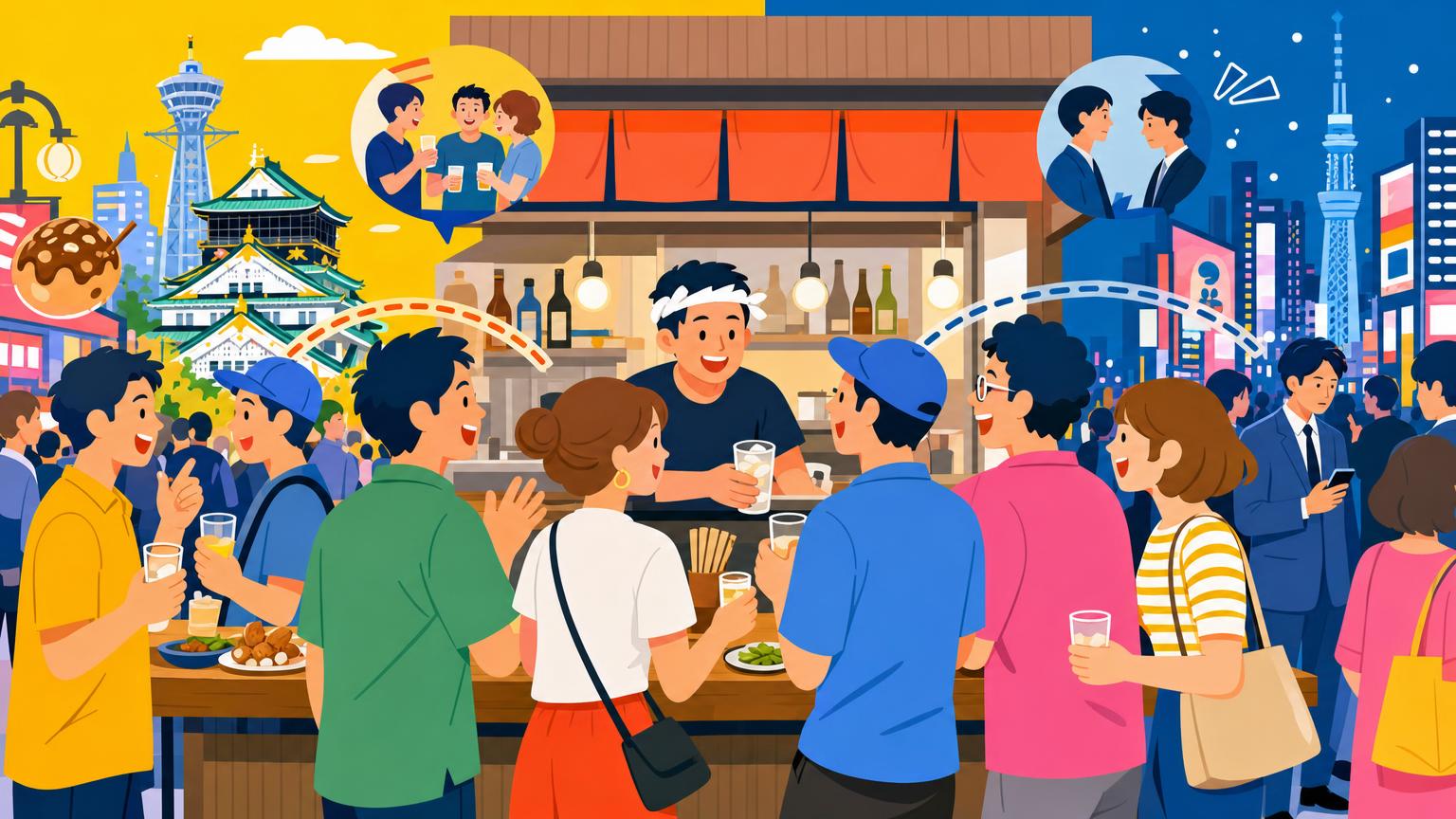
Tachinomi literally means “standing drinking.” A tachinomiya, or standing bar, may have no chairs at all or just a few stools along the wall. Customers drink, eat small dishes, chat briefly, and leave once they have finished. Some are tiny counters beneath railway tracks. Others offer a larger standing area with plastic curtains, handwritten menus, and a constant flow of regulars.
The important point is not the lack of chairs. It is the social rhythm.
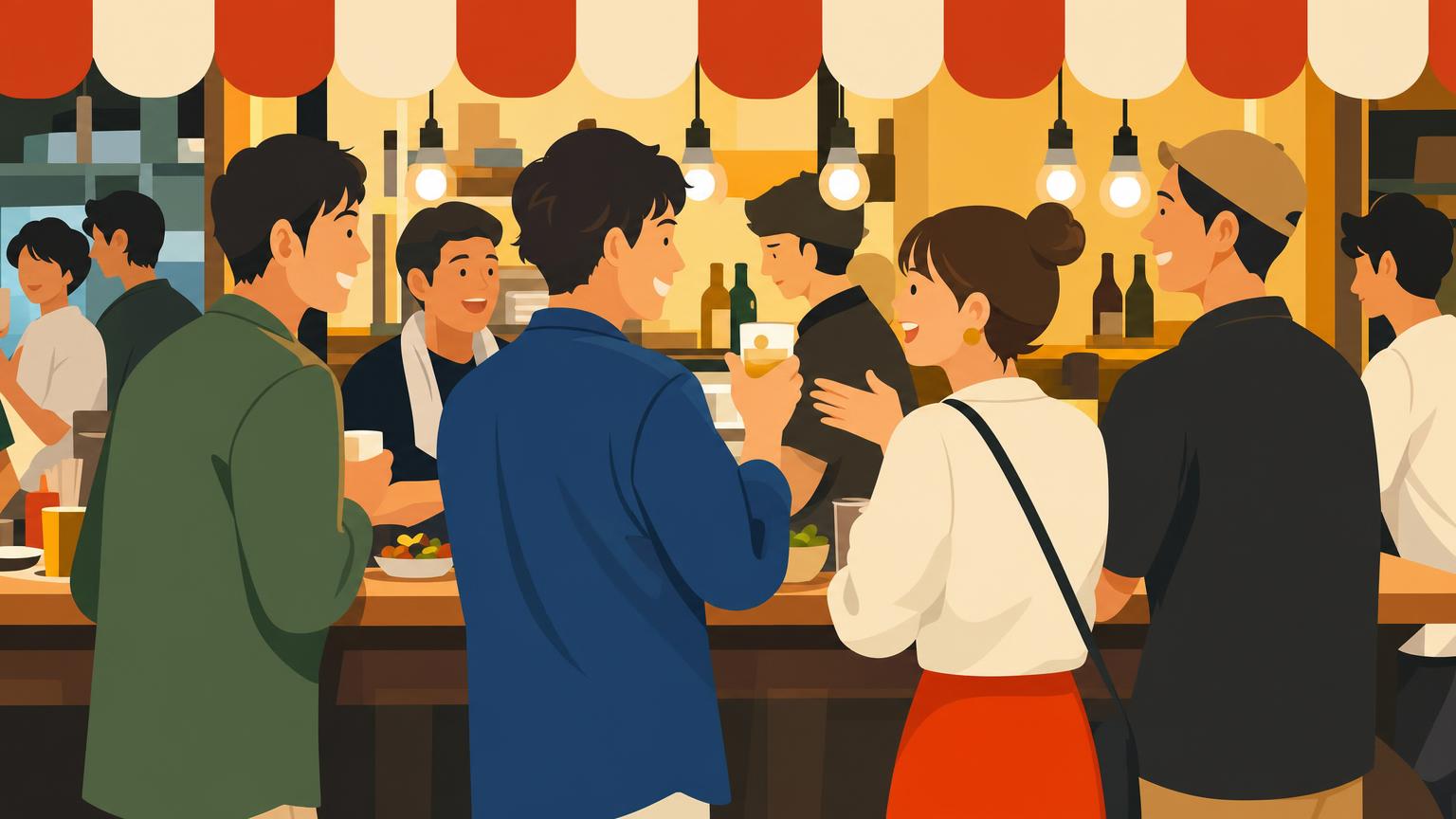
A tachinomi works because customers do not act as though they have rented a private table. The counter is shared territory. Your drink, food, conversation, and even body position must fit into an ongoing flow. People arrive, shift sideways, order, eat, pay, and make room. The bar feels lively because no one expects to control the entire environment.
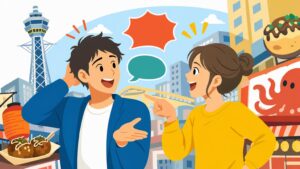
This helps explain a common Osaka contrast. Osaka is often more verbally expressive than Tokyo, but that does not mean every interaction has to become a relationship. Someone may joke with you, ask where you live, or comment on your Japanese. Then, a minute later, they may turn back to their drink without saying goodbye. This is not necessarily rejection. It is often simply a brief social exchange reaching its natural end.
Casual does not mean unstructured
Foreign residents sometimes interpret Osaka’s relaxed atmosphere as a lack of rules. In practice, the rules are often less formal but more dependent on observation.
At a standing bar, you may need to understand all of the following without anyone explaining them:
- Where you can stand without blocking the entrance
- Whether a space at the counter is actually free
- Whether the bar expects payment in cash at the time of purchase
- Whether the person beside you wants conversation
- How much room your bag, coat, and elbows are taking up
- Whether the next customer is waiting to order or waiting to enter
- When your visit has naturally come to an end
The staff may not correct you directly. A regular may not tell you that your bag is in the way. Instead, people may create a brief pause, gesture toward an open space, move a plate, or say a short phrase such as “sumimasen” while looking at the area they need. These are communication signals, not personal criticism.
Why the atmosphere can feel different from Tokyo
Tokyo nightlife is not unfriendly. It is simply more likely to maintain distance between strangers, especially in places designed around reservations, table seating, office-worker groups, or carefully separated customer experiences. A Tokyo customer may enjoy a quiet drink without speaking to the person beside them. Silence can be the default social agreement.
In Osaka, silence is also acceptable, but the threshold for making a small comment is often lower. A customer may ask whether you like the dish, make a joke about the weather, or complain about the Hanshin Tigers without expecting a lengthy conversation. The exchange can be warm while remaining temporary.
This difference matters for foreign residents because many people arrive with one of two mistaken assumptions. Some expect Osaka to be constantly chatty and feel disappointed when nobody speaks to them. Others become overly familiar because they have heard that Osaka people are open, then fail to notice the physical and conversational boundaries of a compact bar.
The more accurate view is this: Osaka often offers more opportunities for informal contact, but you are expected to notice whether the opening is genuine, brief, playful, or already over.
The Osaka Tachinomi Counter Is a Shared Conversation Space
A counter in a standing bar is more than just a place to set down your drink. It is a communication system. People stand close together, which makes small signals important.
Your position tells others whether you are settled, ordering, waiting, or leaving. Your eye contact lets the staff know whether you need service. Your body angle tells the person beside you whether you are open to conversation. Your volume affects everyone nearby because there may be no wall, table, or booth to contain your voice.
Stand beside people, not across their conversation
When entering a busy bar, do not immediately move toward the most attractive position. Pause near the entrance and observe carefully. The staff may direct you to a space, or a customer may shift to make room.
If there is a narrow gap, stand with your body turned slightly toward the counter instead of facing outward into the room. This reduces the space you occupy and makes it easier for people behind you to pass.
If the space seems uncertain, a simple phrase works well:
- “Koko, ii desu ka?” means “Is it okay here?”
- “Aitemasu ka?” means “Is this free?”
- “Sumimasen” is useful when entering, passing, or asking someone to move slightly.
You do not need perfect Japanese pronunciation. A calm voice, a small gesture, and awareness of the room usually communicate more than a complicated sentence.
Make room before someone asks
The unwritten rule of shared standing space is that everyone adjusts a little. This might mean moving half a step, turning your shoulders, placing your bag between your feet, or lifting your coat from the rail when the bar becomes crowded.
In Osaka, customers may be more direct about this than you expect. Someone may say “chotto dake” while gesturing for a little room. Another person may lightly touch the counter and indicate the area beside you. This is usually practical rather than hostile.
The best response is immediate and relaxed. Move first, then continue your conversation. Do not turn the request into a public negotiation.
This is one of the clearest situations in which Osaka’s casual style can confuse foreign residents. The language may sound blunt, but the intention can be cooperative. The person is not necessarily saying, “You are behaving badly.” They may simply mean, “Let us make this space work.”
Keep your belongings under control
A large backpack on your back is difficult to manage in a crowded tachinomi. It can hit someone when you turn, take up space needed by another customer, or knock over a glass. Remove it if possible and keep it between your feet or in a designated area.
Do not spread your phone, wallet, umbrella, camera, and shopping bag across the counter. The counter is working space for the staff and shared space for customers. Put away anything you are not using.
For people living in Osaka, this habit matters beyond nightlife. Shops, train platforms, narrow restaurants, and bicycle parking areas all reward the same basic skill: knowing how much room your body and possessions occupy.
How Communication Begins at a Tachinomi
A tachinomi conversation rarely opens with a formal introduction. More often, it begins with a practical comment.
Someone might say that the dish is good. They may ask whether you are visiting Osaka or living there. They may notice your accent, your football shirt, or the fact that you are studying the menu with the expression of someone trying to decode an ancient legal document.
You do not need to respond with a complete personal history.
A brief answer is enough:
- “Osaka ni sundeimasu.” — I live in Osaka.
- “Mada nihongo benkyou-chuu desu.” — I am still studying Japanese.
- “Kore wa nan desu ka?” — What is this?
- “Oishii desu ne.” — It is delicious, isn’t it?
- “Kyou wa nomu dake desu.” — I am just having a drink today.
These phrases leave the door open without forcing the conversation to continue. If the other person wants to talk more, they will usually ask another question.
The first exchange may be a test of comfort rather than an invitation to friendship
A local customer may ask whether you can eat spicy food, whether you understand Osaka dialect, or whether you support a particular baseball team. To someone from a more reserved culture, these questions may feel personal. Often, however, they are simply easy ways to establish a light connection.
Answer briefly and ask a question in return if you feel comfortable. For example:
“Chotto nigate desu. Tanaka-san wa?”
“I am not very good with spicy food. How about you?”
You do not need to perform Osaka humour. You do not have to be loud or prove that you understand every joke. A gentle smile and a simple response are enough.
Teasing is common, but do not assume that every joke is an invitation
Osaka conversation may include teasing, exaggeration, and playful complaints. Someone might comment on your pronunciation or joke that you are ordering too carefully. This can be a sign that they feel comfortable enough to speak casually.
However, Osaka humour is not a licence to make personal comments about strangers. Avoid copying jokes about weight, age, income, nationality, appearance, or relationships until you understand the people involved. What sounds amusing among longtime friends can seem intrusive when said by a foreign resident who has just arrived.
A useful rule is to match the intensity without exceeding it. If the other person makes a small joke, respond with a small joke. If they are speaking quietly, do not turn the exchange into a performance for the entire bar.
Reading Osaka’s Friendly but Limited Boundaries
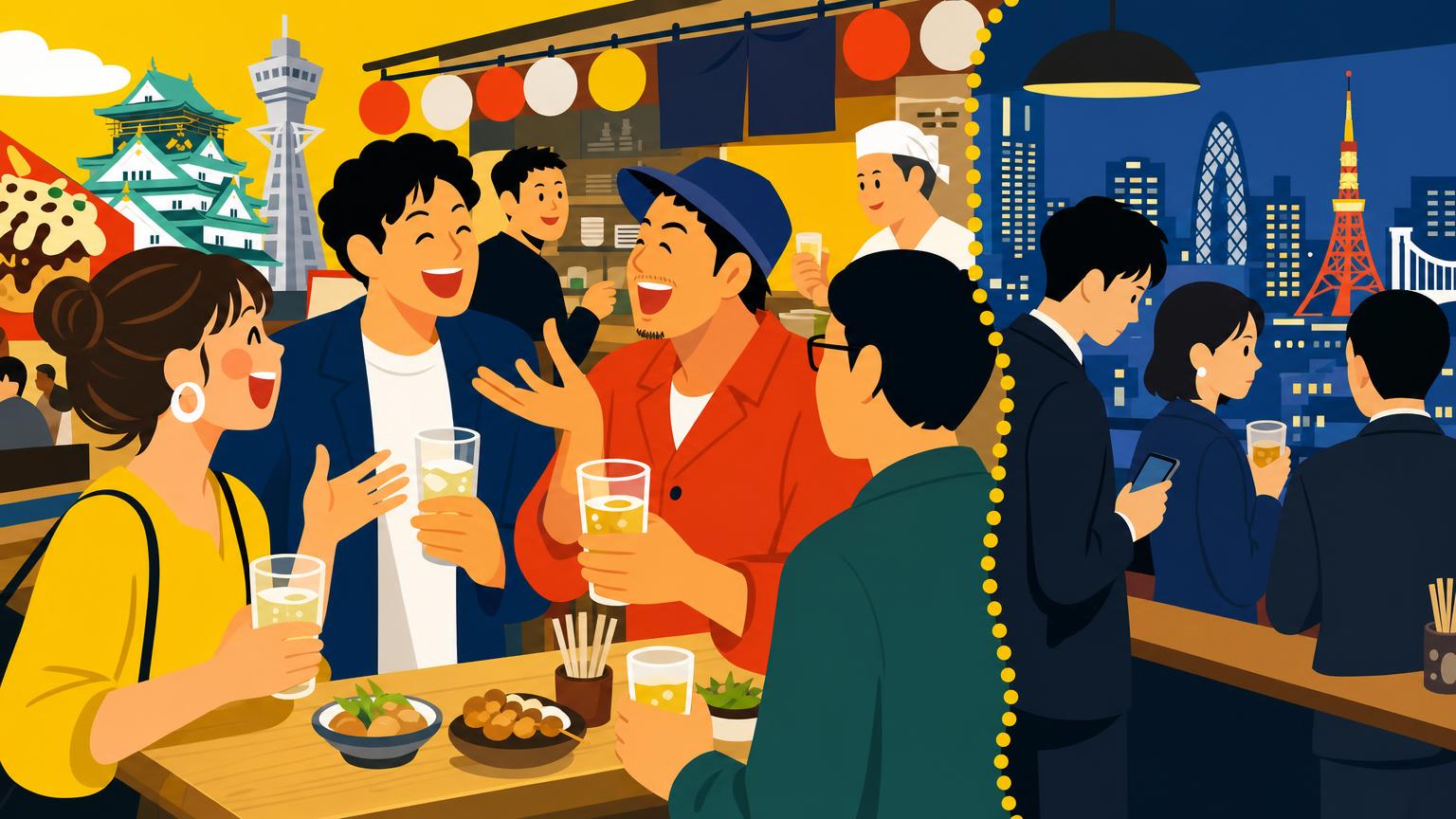
The phrase “Osaka people are friendly” is too vague to be particularly useful. A better description is that many interactions in Osaka allow warmth without requiring ceremony.
People may speak in a relaxed tone, ask direct questions, and complain openly. Staff may use humour instead of maintaining polished distance. Regulars may welcome a newcomer with a comment rather than a formal introduction. However, that warmth often comes with an expectation that you understand the timing.
A friendly question can still have a short answer
If someone asks where you are from, you can simply answer with your country or city. You do not need to explain your employment history, visa category, family situation, or reasons for moving to Japan unless you want to.
If someone asks whether you like Osaka, “Hai, suki desu” is enough to continue the conversation politely. You can add a practical detail, such as “I like the food” or “I live near Juso,” without turning the exchange into an interview.
A conversation can end without a goodbye
In many Western settings, a conversation may feel incomplete if people do not formally bring it to a close. In a tachinomi, a conversation may simply fade out. The other person turns toward the counter. You both order another drink. Someone new arrives. The subject changes.
Do not pursue the conversation because you think you have done something wrong. The exchange may already have served its purpose: a brief moment of shared amusement in a crowded room.
If you need to leave, a quiet “Osaki ni shitsurei shimasu” or “O先に失礼します” is polite, though not always necessary. A small nod toward the people beside you also works.
Direct speech is not always anger
Osaka speech can sound sharper than textbook Japanese. Kansai dialect may use different endings, a stronger rhythm, and more expressive reactions. Even standard Japanese can sound direct when spoken in a busy bar.
Consider the whole situation:
- Is the person smiling or relaxed?
- Are they making space for you after speaking?
- Is the staff continuing to serve you normally?
- Are other customers acting as if the exchange is ordinary?
- Is the volume increasing, or is the person simply speaking over the background noise?
A short, energetic phrase may be nothing more than a practical instruction. Do not interpret every strong-sounding sentence as a conflict.
Osaka Tachinomi Etiquette Menu: How to Ask Without Feeling Lost
Searching for “Osaka tachinomi etiquette menu” often brings up photographs of handwritten slips, wall menus, and dishes whose names are not immediately obvious from their ingredients. The menu is part of the social experience, but it is not designed to make every choice effortless for first-time customers.
Many standing bars use handwritten menus posted on the wall, small cards placed near the counter, or daily specials written on a board. Prices may appear beside each item, sometimes using Japanese numerals or abbreviations. Some dishes are available only until they sell out.
How to study the menu without blocking the bar
Stand close enough to read the menu, but avoid holding your phone in front of it for several minutes while people wait behind you. If the bar is crowded, order one simple drink first and then ask about the food.
Useful phrases include:
- “Osusume wa nan desu ka?” — What do you recommend?
- “Kore wa nan desu ka?” — What is this?
- “Niku desu ka?” — Is it meat?
- “Sakana desu ka?” — Is it fish?
- “Karai desu ka?” — Is it spicy?
- “Hitotsu kudasai.” — One, please.
- “Mou ippai.” — One more drink.
Pointing is acceptable when paired with a polite phrase. You do not need to pronounce every menu item perfectly. Staff at neighbourhood bars are accustomed to customers asking questions through gestures, simple Japanese, and translation apps.
Read the flow before asking for a long explanation
If the staff are serving several people at once, choose something visible and familiar. A beer, highball, lemon sour, edamame, tofu, grilled skewers, or daily special may be easier to order than a complex dish whose ingredients would require a lengthy explanation.
When the pace slows down, ask about something else. This is not because questions are unwelcome, but because the bar’s service rhythm matters to everyone.
Do not assume the menu is fixed
A dish may sell out, and a handwritten price may refer to a small portion rather than a large plate. The staff may also tell you that an item is available only for that day. Accepting this without frustration is part of the culture.
If you have allergies, explain them clearly before ordering. Saying “Allergy ga arimasu” followed by the ingredient is more useful than hoping the staff will notice a minor dietary preference. If your restrictions are serious, a tachinomi with a compact kitchen may not be the easiest place to manage them.
Payment Communication: Cash-on, Paying at the End, and Leaving Smoothly
Payment is one of the main sources of anxiety for foreign residents. The most important rule is to observe what other customers are doing before ordering several items.
Cash-on payment at the counter
Some standing bars use cash-on payment, sometimes called cash-on-delivery. You place money in a small tray on the counter before the staff prepares your drink or dish. The staff takes the exact amount and returns change if necessary.
The process may look like this:
- Check the price on the menu or ask the staff.
- Place the cash in the tray rather than directly into someone’s hand, unless instructed otherwise.
- Receive your drink or food.
- Collect your change if the staff leaves it in the tray.
- Keep the tray clear for the next order.
Do not place a large wallet, foreign coins, or a handful of notes in the tray while the staff is serving someone else. Prepare your money without blocking the next customer.
If you are unsure, ask, “Cash-on desu ka?” The staff may point to the tray or tell you to pay later.
Payment at the end
Other bars keep a running tab. The staff may record orders on a small paper slip, write them on a board, or remember the total. When you are ready to leave, say, “Okaikei onegaishimasu,” or simply, “Okaikei.”
Do not walk out assuming that payment is understood because you have been standing near the door. Wait for the staff to respond. If the bar is busy, catch the staff’s eye and raise one finger slightly while saying, “Okaikei.”
Split payments can slow the room
If you are with friends, decide before ordering whether one person will pay. Dividing a small bill into several card transactions can be inconvenient in a compact bar, especially when the system is cash-based.
Cash remains the safest option for many independent standing bars. Keep smaller notes and coins available. A large bill may be accepted, but it can create extra work when the bar is busy.
Tipping is not part of ordinary Japanese bar etiquette
Tipping is not customary in Japan and is unnecessary in a tachinomi. Leaving extra money on the counter may confuse the staff, who may think you forgot your change or that the payment is incorrect.
Pay the displayed price, including any clearly stated table charge or otoshi if the establishment uses one. You do not need to add a percentage for good service. A polite “Arigatou gozaimasu” is the usual way to show appreciation.
If you want to thank the staff for an especially enjoyable evening, returning another day, following the house rules, and treating the bar respectfully will usually communicate more than leaving money behind.
When to Continue a Conversation and When to Give Space
The most important social skill in a tachinomi is not starting conversations but knowing when to stop.
Pay attention to posture. Someone facing the counter with both hands around a drink may be looking for a quiet evening. Someone turned toward you, making eye contact, and asking follow-up questions is more open to conversation. Someone wearing headphones, reading, or repeatedly looking toward the staff is probably occupied.
Signs that conversation is welcome
Conversation is more likely to be welcome when:
- The person turns their body toward you.
- They ask a question after you answer.
- They laugh and add information of their own.
- They introduce a dish or drink to you.
- They include you when talking to another customer.
- They continue the exchange even after their food arrives.
Even then, keep the first exchange brief. A good conversation can continue later, so you do not need to use every opening immediately.
Signs that the exchange is ending
Give the person space when:
- Their answers become very short.
- They turn back toward the counter.
- They begin eating or checking their phone.
- They stop asking questions.
- Another customer joins their group.
- The staff needs to pass between you.
Do not interpret this as a judgment about your Japanese or nationality. In Osaka, people may enjoy a conversation and still return quickly to their own evening.
Avoid turning the bar into your language classroom
Many foreign residents want to practise Japanese, and a tachinomi can be a good place for short exchanges. However, regular customers did not necessarily come to teach Japanese. Ask concise questions, listen carefully, and avoid repeatedly demanding corrections.
If someone helps you with a phrase, thank them and use it naturally. You can ask once whether your pronunciation was understandable. After that, let the conversation move forward.
Likewise, do not assume that the foreign customer at the next place is available to translate. They may be trying to relax after work. A friendly greeting is fine, but a long request for personal assistance is not.
How Osaka Social Boundaries Differ from Tokyo Nightlife
The difference between Osaka and Tokyo is not that one city has boundaries while the other does not. Both cities have boundaries; they simply make them visible in different ways.
Tokyo often communicates boundaries through formality, quietness, reservation systems, staff distance, and clear separation between groups. If nobody speaks to you, you can usually understand that the evening is private.
Osaka may communicate boundaries through timing, humour, body position, and short, direct phrases. Someone may joke with you, complain to you, and then expect you to understand that the exchange is over. The boundary is not necessarily stated formally; you are expected to sense the change in the room.
Osaka can be more personal and less intimate at the same time
This may sound contradictory, but it is one of the most useful observations for living in Osaka. People may ask direct questions sooner than you expect. They may use a nickname, comment on your clothes, or ask why you moved to Japan. However, that personal conversation does not automatically create a close relationship.
In Tokyo, strangers may remain formally distant for longer, but the distance is easier to interpret. In Osaka, you may receive more contact while still needing to recognise that it is temporary and situational.
Do not confuse bluntness with permission
A local may tell you directly that your bag is in the way. That does not mean you can be equally blunt about their appearance, income, marriage, or age.
A local may joke about your Japanese. That does not mean every joke about nationality will be welcomed.
A local may invite you to join a conversation. That does not mean you should join every conversation at the counter.
Osaka’s relaxed style rewards responsiveness rather than overconfidence.
Do not imitate Kansai dialect too quickly
Learning a few Kansai expressions can be fun, but forced dialect may sound theatrical. Foreign residents sometimes repeat phrases they have heard in comedy shows and expect an immediate bond. The result can be charming when used lightly, but awkward when performed too strongly.
Use ordinary Japanese first. If a regular teaches you a phrase, repeat it naturally, but do not turn the entire conversation into a comedy routine. Osaka people appreciate humour; they do not need every visitor to audition for a television panel show.
Common Mistakes Foreign Residents Make in Tachinomi
Staying too long in a tiny bar
A standing bar is not always the right place for a three-hour evening. If the bar is quiet and you are talking with the owner, staying longer may be perfectly acceptable. However, if customers are waiting outside or standing closely around you, finish your drink and consider leaving.
You do not need to rush, but you should recognise the difference between enjoying the atmosphere and occupying a scarce spot.
Treating a standing bar like a private table
Do not claim a large section of the counter with only one drink. Also, do not leave a friend’s spot empty for a long time while they are shopping or smoking. If someone in your group leaves, another customer may use the space.
Speaking too loudly because the room is noisy
The noise in a tachinomi can encourage everyone to raise their voices. This can quickly become exhausting, especially in a narrow bar with hard surfaces. Keep your voice lively but controlled. If the person beside you leans away, lower your volume.
Ordering several items without understanding the payment system
If you are unsure whether the bar uses cash-on or a tab system, ask before ordering. It is much easier than discovering at the end that you have lost track of five small dishes and four drinks.
Refusing unfamiliar food dramatically
You do not have to eat anything you dislike. However, a strong reaction can embarrass the person who recommended it. Say “Sumimasen, tabeta koto ga nai node” or “I have not tried it before,” and then decide calmly.
Expecting staff to provide tourist-style explanations
Many neighbourhood bars are designed for regular customers. The staff may be kind but busy, and they may not have English menus, photographs, or a carefully explained ordering process. This is not necessarily poor service. It simply means the establishment is built around a local rhythm rather than visitor convenience.
Assuming every customer wants to practise English
Some people will be happy to speak English. Others may be tired, shy, or simply looking for a quiet drink. Offer the possibility without forcing it. “English is okay?” is enough. If the answer is uncertain, continue with simple Japanese, gestures, or a translation app.
Tenma, Kyobashi, and Namba: Different Neighbourhood Rhythms
Osaka does not have a single, uniform tachinomi personality. The atmosphere varies by area, time, mix of customers, and the relationship between the bar and its neighbourhood.
Tenma
Tenma is often associated with dense streets, small bars, food counters, and a strong after-work rhythm. In a crowded Tenma tachinomi, managing space is especially important. Customers may move quickly between establishments, and the counter can fill up without warning.
The communication style may feel lively and direct. People might make quick comments, recommend a dish, or include you in a joke. Do not assume that every exchange will continue for long. Tenma rewards flexibility: order simply, keep your belongings compact, and be prepared to shift when the room changes.
For foreign residents, Tenma can be useful for learning how Osaka’s casual public communication works because the social signals are easy to observe. You can watch how regulars enter, where they stand, how they pay, and when they leave.
Kyobashi
Kyobashi has a strong commuter and after-work character. Some customers arrive alone, particularly after finishing work, and may want a drink before going home rather than a social evening.
Conversation can happen quickly, but it may be less available during peak hours. Pay attention to the person’s pace. Someone who has just arrived, ordered immediately, and is checking the train timetable may not want to discuss Osaka dialect or your relocation story.
Kyobashi also shows how a neighbourhood can feel friendly without being intimate. People may recognise one another, exchange brief comments, and still maintain their own routines.
Namba
Namba includes a broader mix of residents, workers, shoppers, performers, visitors, and nightlife customers. A tachinomi there may be more accustomed to first-time customers and foreign residents, but that does not eliminate the basic rules of shared space.
Because the area can be busier and more varied, avoid judging Osaka’s overall communication style based on one Namba bar. A place near a major entertainment street may have a different rhythm from a small local counter near someone’s home.
For those considering living in Osaka, this distinction matters. “Osaka nightlife” is not a single social world. The same city can offer polished cocktail bars, quiet neighbourhood counters, lively food streets, and family-oriented districts within a short train ride.
A Practical Communication Routine for Your First Visit
You do not need to memorise an extensive etiquette manual. A simple routine will prevent most misunderstandings.
Before entering
Look through the doorway if possible. Notice whether customers are standing, whether there is a queue, and whether the staff are accepting new orders. Keep your bag somewhere manageable and prepare a few small notes or coins.
When entering
Make eye contact with the staff and say “Konbanwa” or “Sumimasen.” Wait for a gesture before choosing a position. If you see an obvious open space, ask, “Koko ii desu ka?”
When ordering
Begin with one drink. Check whether the price is visible and whether payment is cash-only. Pointing is fine. Ask about one menu item at a time.
While standing
Keep your elbows, bag, coat, and conversation within a reasonable area. Move aside when people arrive. Match the volume of the room. Speak to neighbours when there is a natural opening, but let the exchange end naturally.
When paying
Observe the other customers. If they place money in a tray, do the same. If the staff mark orders or tell people to pay at the end, ask for the bill when you are ready. Do not tip.
When leaving
Say “Arigatou gozaimashita.” If you were speaking with someone nearby, add a small nod or say, “Otsukaresama desu.” Leave without making the exit dramatic. The next person is probably already waiting for your space.
What Foreign Residents Often Misunderstand About Osaka People
The first misunderstanding is that Osaka friendliness is universal and constant. It is not. Osaka residents can be warm, funny, reserved, impatient, generous, or tired, just like anyone else. The city’s reputation comes partly from how easily small public interactions can become informal—not from an expectation that everyone be outgoing.
The second misunderstanding is that directness equals aggression. In a busy tachinomi, speaking directly often saves time. A brief request to move, pay, order, or make space may sound forceful in English translation but be entirely ordinary in context.
The third misunderstanding is that a joke signals closeness. Humour can ease the pressure of a first exchange, but it does not eliminate the need for consent, timing, or restraint.
The fourth misunderstanding is that foreigners must choose between staying silent and being extremely sociable. You can participate through small comments, simple Japanese, and careful observation. You do not need to become the loudest person in the room.
The fifth misunderstanding is that Tokyo is cold while Osaka is easy. Both cities require social awareness. Tokyo may make its boundaries more formal and visible. Osaka may invite you closer while expecting you to notice when it is time to step back.
Why This Matters for Living in Osaka
A tachinomi is a small setting, but the habits it teaches are useful throughout daily life in Osaka.
You will find the same balance in apartment buildings, workplaces, local festivals, school communities, shopping streets, and neighbourhood restaurants. People may speak casually while still respecting an invisible structure. They may offer help without seeking a deep friendship. They may joke with you and then expect you to follow the group’s ordinary flow.
Learning this style can make Osaka feel easier to live in. You become less anxious about every blunt phrase and less likely to mistake every friendly gesture for a personal invitation. You learn to respond rather than overexplain.
The city becomes easier to understand when you recognise that social warmth and social distance are not opposites. In Osaka, they often operate together.
The Main Lesson of Osaka Tachinomi Etiquette
A good tachinomi customer is not the person who speaks the most Japanese, tells the funniest jokes, or befriends every regular. It is the person who notices the room and helps it function smoothly.
Make space. Order clearly. Pay correctly. Keep your belongings close. Accept a brief conversation without demanding a lengthy one. Understand that direct words may be practical rather than hostile. Keep humour light. Do not tip. Leave when the rhythm tells you your evening is complete.
Compared with Tokyo nightlife, Osaka may offer more casual openings: a comment from a stranger, a recommendation from the staff, a joke about your accent, or a brief conversation with someone who has been coming to the same counter for years. These openings are genuine, but they are not contracts.
Osaka’s social boundary is often a moving line rather than a closed door. Someone may invite you one step closer, then expect you to know when to stop. Once you understand that rhythm, the tachinomi counter no longer feels like a test. It becomes what it is for many Osaka residents: a shared place to eat, drink, exchange a few words, and return to ordinary life.