
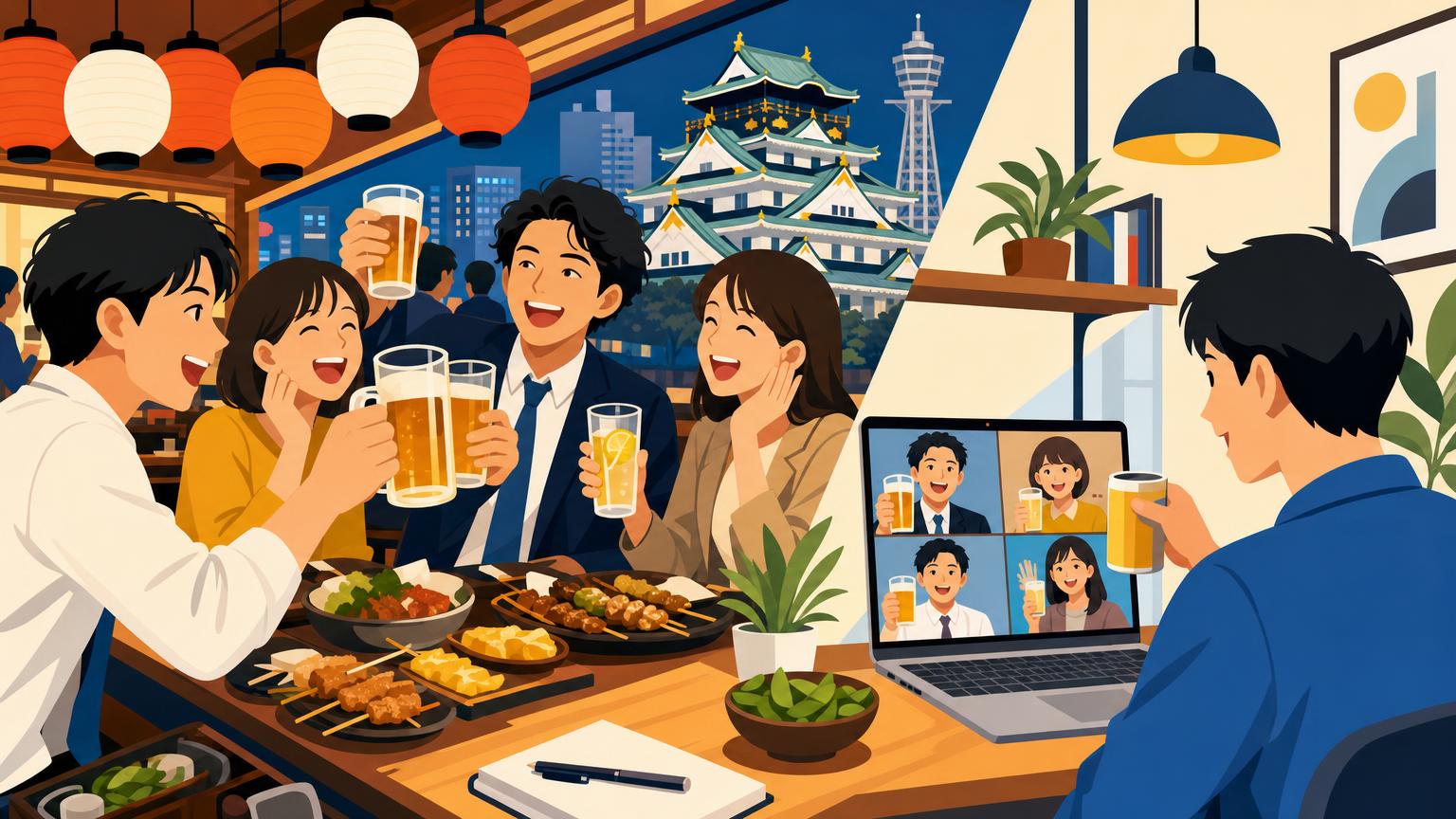
You work from home in Osaka. Your Japanese colleagues are friendly in meetings, but the conversation stays careful and professional. Then, one evening, someone says, “Let’s go for a drink sometime.” You are not sure whether this is a real invitation, a polite phrase, or a test of your willingness to join the group.
A few days later, you meet at a small izakaya. The manager orders the first round. Everyone says kanpai. The conversation becomes louder, more personal, and less formal. Someone complains about the train. Someone else talks about their parents. A colleague who barely spoke during a video call suddenly tells a funny story in Osaka-ben. You leave with a better understanding of the team, but also with several questions.
Was the drinking necessary? Why did people share more after work than during office hours? Why did nobody clearly explain who was paying? Why did your coworkers invite you to drink but not ask you to join their weekend plans?
These questions lead to Osaka’s distinctive form of nominication, often written in Japanese as nomi-nication or 飲みニケーション. The word combines nomu, meaning “to drink,” with communication. It describes the way alcohol, food, and an informal setting can create conversations that are difficult to produce inside a workplace or a formal social situation.
But Osaka’s drinking communication is not frozen in the image of older salarymen gathering after work. It is changing. Remote work has weakened the automatic connection between office, neighborhood, and drinking place. Foreign residents have also changed the conversation. Some speak Japanese fluently but do not understand the social timing. Others work for international companies and do not share the same assumptions about alcohol, hierarchy, or after-work obligations.
The result is not the disappearance of nominication. It is a quieter negotiation. Osaka people are still using food and drink to build trust, but the invitation is becoming more flexible, the locations are becoming more varied, and the meaning of “joining the group” is becoming less rigid.
The map below shows the central Osaka area as a point of orientation. It is not a sightseeing route. It is a reminder that daily communication happens across ordinary districts, train stations, residential streets, office neighborhoods, and small eating-and-drinking places.
What “Nomi-nication” Really Means in Osaka
It is not simply about drinking together
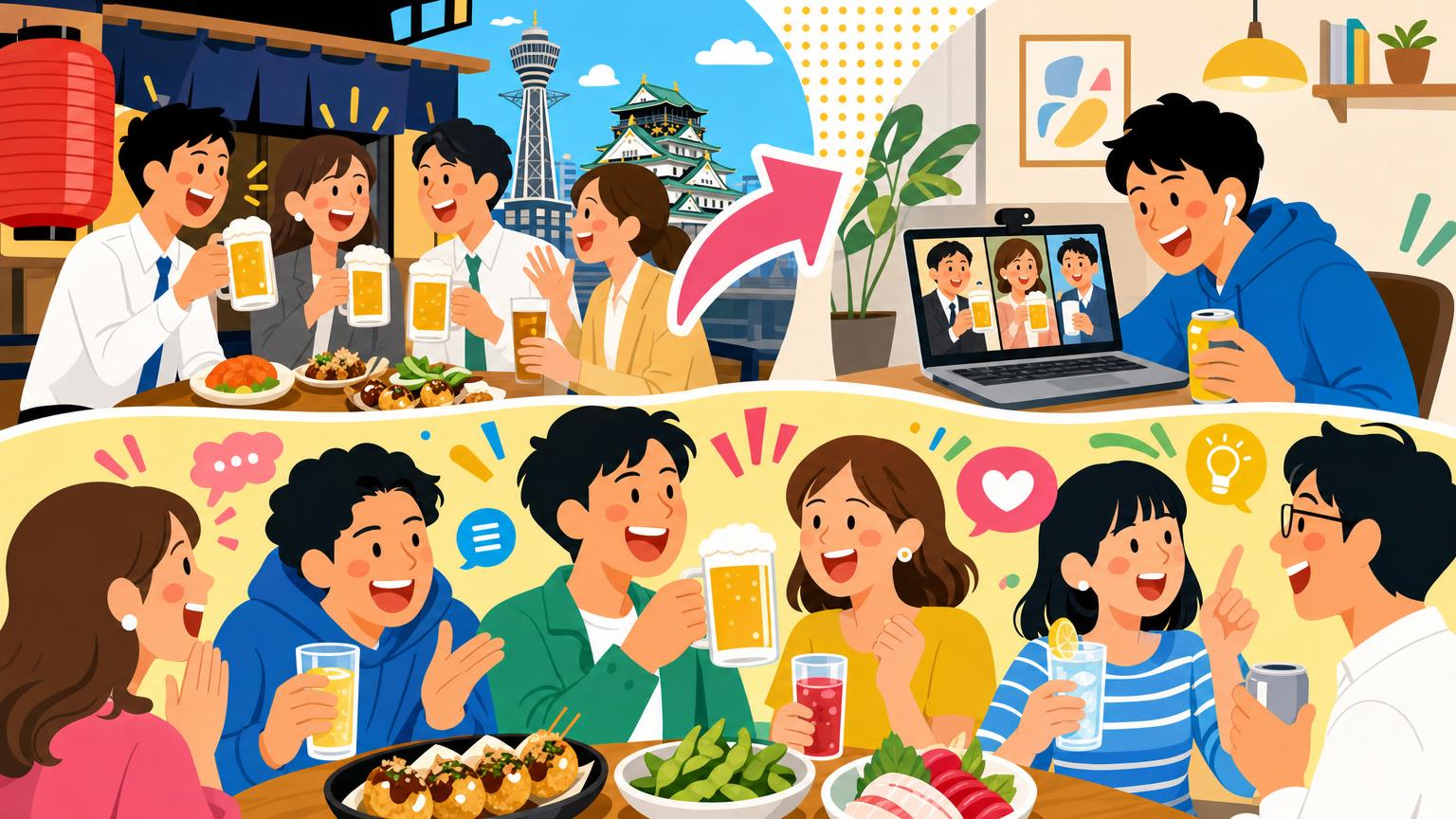
A common misunderstanding is that nominication means Japanese people need alcohol before they can communicate. That is too simplistic and often unfair. Many Osaka residents do not drink alcohol at all. Some leave early. Some order tea, soft drinks, or alcohol-free beer. Others enjoy the social setting but dislike the pressure of a formal drinking party.
The deeper meaning is about changing the conditions of conversation.
At work, people protect their roles. A manager speaks as a manager, while a junior employee speaks as a junior employee. A foreign employee may worry about making a grammatical mistake. A colleague may avoid criticizing a project because the person who designed it is sitting nearby.
At an izakaya, the setting gives everyone a different script. Food arrives on shared plates. Glasses are refilled. People sit closer together. The conversation shifts from work to trains, food, family, football, television, housing, and local complaints. The relationship becomes less official, even if the hierarchy has not disappeared.
Osaka makes this shift especially noticeable because local communication often values immediacy. People may react quickly, tease lightly, disagree openly, or ask personal questions earlier than a foreign resident expects. The point is not always to reach a serious conclusion. It may simply be to make the relationship feel more relaxed.
This is why a short conversation over noodles or grilled fish can sometimes reveal more about a coworker than several weeks of polite office conversation. It is not necessarily deeper because alcohol is present. It is deeper because the environment allows a wider range of behavior.
Osaka’s version has a merchant-city rhythm
Osaka has long been shaped by trade, small businesses, food markets, family enterprises, and face-to-face negotiation. That history should not be reduced to a neat slogan, but it helps explain a pattern many foreign residents notice: Osaka communication often develops through practical exchange.
People talk while eating. They ask where you live. They comment on the price. They recommend a restaurant. They complain about the weather. They ask whether you know a particular neighborhood. They may joke before becoming serious.
This can feel different from Tokyo, where professional and personal spheres are often kept more clearly separate, especially when people have just met. Tokyo certainly has warm and informal communities, and Osaka can also be reserved. The difference is not that one city has friendly people and the other does not. It is often a difference in the speed and style of social testing.
In Osaka, a joke may be a way to see whether you can respond. A complaint may be an invitation to agree. A question about food may be a way to begin a relationship without discussing anything emotionally direct.
A foreign resident who answers every comment literally may miss the social movement underneath. If someone says, “You paid too much for that apartment,” they may not be asking for your exact rent. They may be opening a conversation about neighborhoods, commuting, or the cost of living. If someone says, “You can’t handle spicy food?” they may be teasing you into joining the next meal.
The safest response is often not a perfect joke, but a relaxed answer, a smile, and a question in return.
How Osaka’s Drinking Culture Developed
From after-work obligation to social infrastructure
Older forms of nominication were closely connected to the company. A group would finish work, move to an izakaya, and continue their relationship outside the office. These gatherings could help new employees understand workplace expectations. They could also create pressure. Refusing too often might be interpreted as creating distance, even when the refusal was reasonable.
The classic pattern was simple: office, train station, izakaya, second venue, last train. In Japanese, moving from one drinking place to another is called hashigo-zake. It literally suggests climbing a ladder, one place after another. In practice, it might mean starting with food, moving to a standing bar, and ending at a small snack bar or ramen shop.
For some workers, this was a form of informal training. They learned who made decisions, which problems were safe to discuss, and how different colleagues behaved when formal titles were temporarily set aside. For others, it was unpaid emotional labor after a long day.
Foreign employees were often placed in an awkward position. They were invited because their participation mattered, but the rules were rarely explained. “Come if you want” could mean exactly that, or it could mean “We hope you will come.” A fixed price might cover food and drinks even if someone barely drank. A second venue might be optional, but leaving before it could still feel socially significant.
The old system was never universal, yet it was influential enough to shape expectations.
The pandemic broke the automatic sequence
Remote work interrupted the physical routine that connected colleagues. People no longer passed one another at the office entrance, shared a crowded elevator, or casually decided where to eat after work. Video meetings created communication, but they did not reproduce the small pauses that allow relationships to grow.
Japan’s government continues to promote telework as a flexible working arrangement that can improve work-life balance, reduce commuting congestion, support continuity during disasters, and contribute to regional revitalization. At the same time, the actual experience varies across industries and occupations. A 2025 national communications survey reported that 50.1 percent of businesses had introduced some form of telework, but this figure does not mean that half of all employees work remotely every day.
This distinction matters in Osaka. A software engineer living near Tennoji may work for a company based in Tokyo. A designer in Joto may have colleagues in Singapore, Fukuoka, and California. A language teacher may work partly from home and partly at several schools. A foreign resident may live in Osaka but rarely meet Japanese coworkers in person.
The old question was, “Will you come out after work?” The new question is, “How do we create a reason to meet when work is no longer the place where we naturally meet?”
Drinking became more intentional
When office attendance is automatic, an after-work gathering can happen almost by accident. In a remote or hybrid workplace, someone must organize it. That small act changes the meaning of the event.
The gathering is now more likely to be described as a welcome dinner, a project meal, a neighborhood meet-up, or a casual team night. People may choose a restaurant with better vegetarian options, clearer menus, private rooms, non-alcoholic drinks, or earlier closing times. The event may last ninety minutes instead of continuing until the last train.
This is not only a response to foreign residents. Younger Japanese workers, parents, non-drinkers, people with health concerns, and employees who dislike company drinking culture are also reshaping the format. The shift is broad. Foreign residents make the change more visible because they often ask questions that Japanese coworkers have treated as obvious.
Why is there a table charge? Is attendance expected? Can I leave after the first place? Do I need to pour drinks for senior colleagues? Can I invite my partner? Are we splitting the bill equally?
When these questions are asked openly, the culture becomes easier for everyone to navigate.
Why Osaka Can Feel Different from Tokyo at the Table
The difference is conversational, not moral
People often ask whether Osaka is friendlier than Tokyo. That question is too broad to answer honestly. Tokyo has countless warm neighborhoods and welcoming communities. Osaka also has impersonal offices, closed social circles, and people who do not want to speak with strangers.
A more useful question is this: how quickly does a conversation become personal, playful, or practical?
In Osaka, that transition may happen more quickly. Someone you met through work might ask about your commute, your favorite food, or whether you are settling into your neighborhood. They may joke about your Japanese. They may tell you that your pronunciation sounds like someone from another region. They may ask whether you have tried a local dish and then explain where to buy it.
This can feel welcoming, but it can also seem intrusive. A foreign resident may interpret a direct question as a request for private information. An Osaka resident may interpret a cautious response as a sign that the other person is uninterested.
Neither interpretation is automatically correct. The interaction depends on tone, age, workplace, and the relationship between the speakers.
Osaka’s teasing is not always hostility
Osaka humor often relies on exaggeration, timing, and mild contradiction. The speaker may say the opposite of what they mean to provoke a response. A colleague may call a small mistake “a disaster.” A friend may say your new haircut makes you look like a television comedian. A bar owner may pretend to be offended that you did not visit the previous week.
Foreign residents sometimes make one of two mistakes. They may take every joke as a serious judgment, or they may assume that every joke is harmless. Both approaches can cause problems.
Pay attention to what happens after the joke. Does the person help you? Do they include you in the next conversation? Do they change their tone when you look uncomfortable? Do other people laugh with you, or only at you? Context matters more than the words alone.
You do not need to become a comedian. A simple response such as “That sounds serious,” “I’m still learning,” or “You have high standards” can keep the exchange light. If the comment crosses a line, it is perfectly acceptable to say so calmly.
Tokyo may separate roles more clearly
In Tokyo, many professional relationships remain polite and carefully defined for longer. Invitations may be less direct. A colleague may avoid asking about private matters until trust has developed. The city’s size also makes spontaneous gatherings more difficult. People may commute long distances, and the cost of changing plans can be high.
Osaka’s compact social geography can make informal contact easier. Many work districts, shopping streets, and residential areas are located close to one another. The same station may contain an office, a supermarket, a family restaurant, a standing bar, and a community center. Daily life creates more opportunities for repeated contact.
That repetition matters. Osaka relationships are often built through recognition. The shop worker remembers your order. The neighbor sees you taking out the recycling. The colleague knows which line you use. The owner of a small restaurant notices when you have not visited for a month.
Nomi-nication develops through this repeated contact. The drink is only one part of the system. The real foundation is seeing the same people often enough that conversation feels less risky.
What Foreign Residents Often Misunderstand
An invitation is not always a command
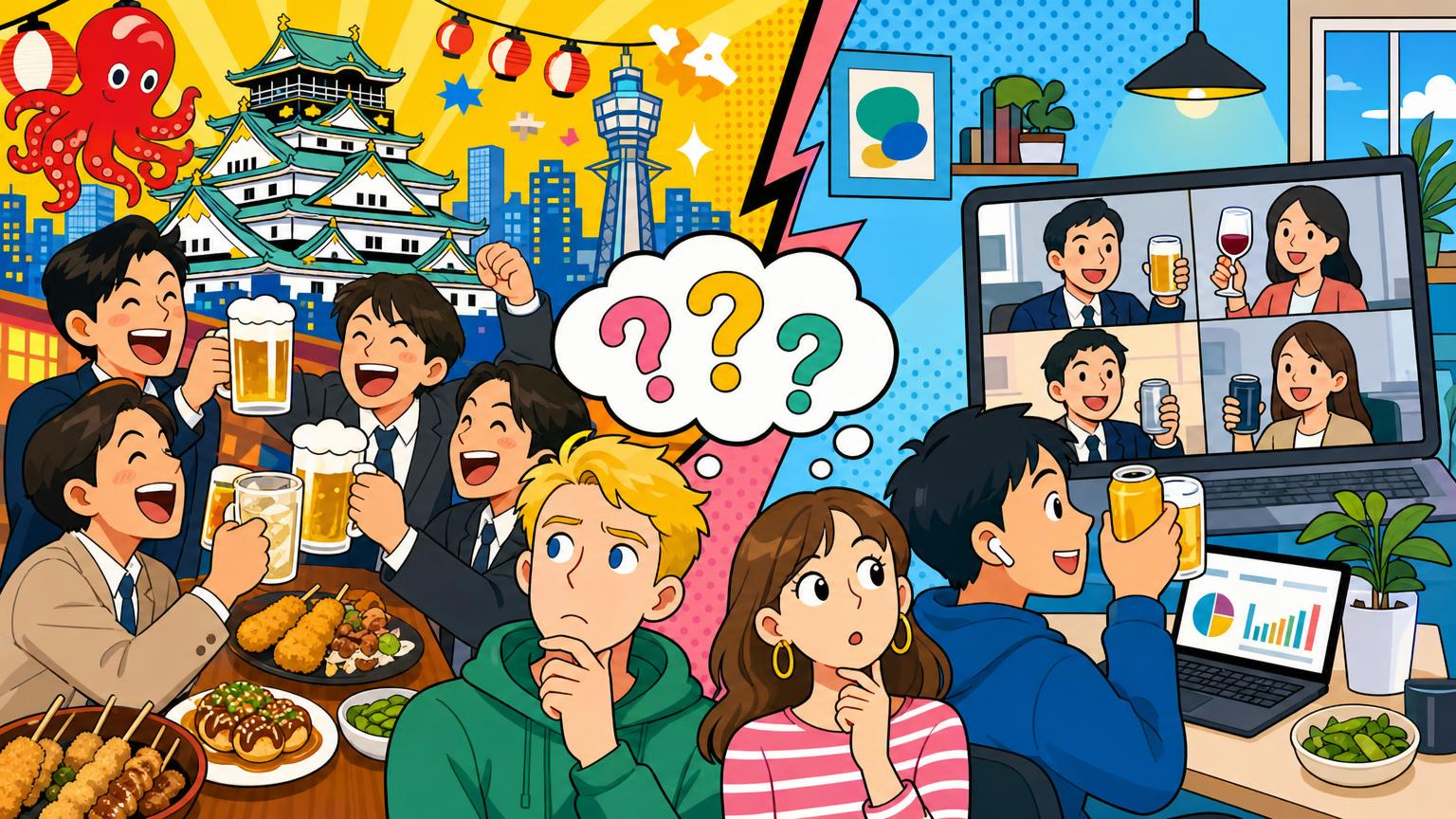
Many foreign residents worry that turning down a drinking invitation will harm their relationship with Japanese coworkers. Sometimes workplace pressure is genuine, and a senior person may expect people to participate. However, in contemporary Osaka, many invitations are more flexible than they may sound.
The phrase “If you are free, come along” often leaves the choice up to you. The difficulty is that people may not express this flexibility directly. A useful reply is specific rather than vague:
“I can join from seven to eight-thirty, but I need to leave after that.”
“I do not drink alcohol, but I would like to join for dinner.”
“I cannot come tonight, but please invite me next time.”
This gives the other person useful information. It also shows that you are not rejecting the relationship itself.
Joining does not mean drinking heavily
The word nomikai means a drinking gathering, but attending does not require becoming intoxicated. You can order tea, soda, water, or a non-alcoholic drink. In many groups, people pay more attention to whether you are engaged in the conversation than to what is in your glass.
The pressure can still be genuine in some workplaces. If a senior person repeatedly urges you to drink, the problem is not your lack of cultural understanding. You can say, “I cannot drink for health reasons,” or “I am driving,” even if neither explanation is literally necessary. A direct “No, thank you” should also be sufficient.
A respectful group will accept your decision.
Paying is part of the conversation
Money can be confusing because Osaka has many different ways of handling payment. A formal work nomikai may have a fixed fee. A small group may divide the bill equally. A senior colleague may pay more. A younger employee may be expected to pay less or may insist on contributing. At a casual bar, each person may pay for what they ordered.
The best approach is to ask before the event or when the first order is placed. “Is this a set price?” and “Are we splitting the bill?” are ordinary questions. Asking early is less awkward than discovering the arrangement at the end.
Do not assume that the person who invited you will pay for everyone. Likewise, do not assume that splitting the bill equally is always fair. Osaka’s reputation for practical conversations about money can be helpful here. A clear discussion is often appreciated.
“Friendly” does not mean instantly close
A person may speak to you warmly at an izakaya and still not invite you into their private life. Osaka friendliness often indicates conversational openness, not automatic intimacy.
Someone may tell you about a family problem but never contact you outside work. A bar owner may remember your name while still maintaining a professional distance. A colleague may tease you every week but avoid discussing personal relationships.
This is normal. Trust develops gradually. Nomi-nication can open a door, but it does not remove the door.
The Vocabulary of Everyday Drinking Communication
Nomikai
A nomikai is a drinking gathering. It may be a company event, a university gathering, a neighborhood meet-up, a club dinner, or a group of friends getting together after work.
The word itself does not indicate how formal the gathering is; context does. A bōnenkai is a year-end party, traditionally held as a chance to forget the difficulties of the past year. A shinnenkai is a New Year gathering, while a welcome party may be called a kangeikai. Depending on the group, these events can be either formal or relaxed.
Kanpai
Kanpai means “cheers,” but it also signals that the group is beginning together. At a formal gathering, wait for the organizer or senior person to give the toast. In a small, casual group, anyone may start.
You do not need to finish your drink after saying kanpai. Raise your glass, make eye contact if you feel comfortable, take a small sip, and continue at your own pace.
Otooshi and tsukidashi
Many izakayas serve a small appetizer before you order much food. In much of Japan, this may be called otooshi. In the Osaka and Kobe area, tsukidashi is also commonly used. It may function as both a small dish and a table charge.
Foreign residents sometimes feel tricked when this appears on the bill. The charge should not be treated as a secret, but the system is not always explained in English. If you are unsure, ask, “Is this the table charge?” before eating. The dish is usually part of the restaurant’s operating model rather than a random penalty.
Tachinomi
Tachinomi means drinking while standing. Standing bars are common in working-class and commuter neighborhoods, including areas around Tenma, Kyobashi, and parts of Ura-Namba. They are often inexpensive, fast-paced, and social.
The unspoken rule is to keep your stay proportional to the available space. Order, enjoy your drink and food, speak with the people beside you if the atmosphere allows, and move on when the place becomes crowded. A standing bar is not always intended for a three-hour private meeting.
Hashigo-zake
Hashigo-zake means bar-hopping. In Osaka, this may involve moving from a food-focused izakaya to a standing bar and then to a small counter bar. The point is not simply to consume more alcohol; each place serves a different social function.
One venue may be for eating, another for meeting acquaintances, and a third may be quiet enough for a personal conversation. Understanding this helps explain why a colleague says, “Let’s go somewhere else,” even when nobody seems ready to leave.
How Remote Work Is Rebuilding the Social Map
The office is no longer the sole meeting point
Remote work has reshaped the physical geography of relationships. In the past, a person’s work-related social life might have centered on Umeda, Yodoyabashi, Honmachi, or another office district. Now, the social center may be closer to home.
A foreign resident living in Suita might invite coworkers to a neighborhood restaurant instead of traveling into central Osaka. Someone in Sakai may prefer an early dinner near the station. A hybrid employee might choose a café after a shared office day, since there is no reason to return to headquarters.
This has made nominication less company-centered in some groups. People meet through hobbies, language exchanges, local volunteer activities, parenting circles, sports, professional communities, and coworking spaces. The gathering may still involve alcohol, but the relationship begins outside the company.
The local bar can become a third place
For a remote worker, home and the virtual office can start to feel like the same place. A neighborhood café, sento, library, restaurant, or standing bar can offer a third setting. It is neither home nor the workplace. It allows someone to be visible without needing a formal appointment.
This is especially meaningful for foreign residents. A person may have many online contacts but few local relationships. A regular restaurant can provide low-pressure repetition. You do not need to share your life story on the first visit. You can begin with “The usual, please,” and gradually learn the names of other customers.
Not every establishment wants to become a community center. Respect the atmosphere. Some places are designed for quick meals. Others are quiet. Some welcome conversation only with regulars. The key is noticing whether the space invites interaction.
Online groups often lead to offline meals
Remote workers and foreign residents now organize many social connections online. A message group might begin with a question about taxes, housing, Japanese study, or a local event. After several conversations, someone may suggest meeting for lunch or drinks.
The transition can be easier in Osaka because food provides a practical reason to meet. “Let’s get okonomiyaki,” “Let’s try the new curry place,” or “Let’s have coffee near the station” may feel less intense than saying, “Let’s become friends.” The meal creates structure. People can talk, eat, and leave without making a major emotional commitment.
This is one reason Osaka’s food culture remains socially important, even for people who drink less. Eating can fulfill much of the same relationship-building role.
Where Daily Nomi-nication Appears in Osaka
Tenma: conversation that begins with food
Tenma is often associated with crowded streets, small restaurants, standing bars, and a high concentration of places where people can eat without making elaborate plans. For residents, its importance extends beyond nightlife. It is a place where the boundaries between “restaurant,” “bar,” and “neighborhood meeting point” become flexible.
A foreign resident may enter alone, order a small dish, and discover that the first conversation is about the menu. The second may concern where they live. The third may be about whether they know the local shopping street.
Tenma can also feel overwhelming. Its density, noise, and narrow spaces are not suited to every personality. You do not need to force yourself into the busiest venue. Look for a place with enough room to sit comfortably, observe the atmosphere, and communicate clearly.
For remote workers, Tenma works well as a change of scenery after a day indoors. Go early if you prefer calmer conversations. If you arrive during the busiest period, expect less privacy and faster turnover.
Ura-Namba: mixed generations and mixed purposes
Ura-Namba broadly refers to the smaller streets behind the main Namba areas. The district includes many types of establishments, from long-standing local businesses to newer restaurants and bars influenced by international food culture.
Its social value comes from this mixture. A young worker, a long-time resident, a visitor from another part of Kansai, and a foreign employee may sit in neighboring seats. The atmosphere can be open, but it is not automatically intimate.
Ura-Namba is useful for understanding how Osaka adapts. Some places preserve older forms of counter conversation, while others use social media, multilingual menus, reservation systems, and modern design. A traditional dish may be ordered through a smartphone. A foreign resident may introduce a new topic of conversation in a very old-style neighborhood.
The important point is not that old and new have merged perfectly. Sometimes they have not. A menu may appear multilingual while the actual service remains Japanese-only. A business may welcome international customers but still expect quiet, orderly behavior. Read the room instead of assuming that a foreign-friendly sign means every custom has changed.
Kyobashi: working life after the office
Kyobashi has a strong connection to commuters, office workers, small bars, casual restaurants, and the everyday rhythm of people heading home. It shows a less polished side of Osaka’s drinking culture, but “less polished” does not mean less organized.
Regulars often know where to stand, when to order, and how long to stay. A newcomer who blocks the entrance or speaks loudly may create friction without meaning to. In a small bar, physical space conveys social information.
Kyobashi can be a useful place to observe the relationship between work and home. People may stop for one drink before taking the train. They may chat with a familiar owner. They may release office-related frustration without wanting to spend the entire night out.
For foreign residents, the safest strategy is to be modest. Start with a simple order. Watch how people use the space. Keep your belongings close. Do not assume that a lively atmosphere means everyone wants to speak English or meet new people.
Shinsekai: public sociability with clear boundaries
Shinsekai is often discussed for its retro atmosphere and kushikatsu restaurants, but residents experience it as a real neighborhood with residents, workers, businesses, and daily routines. The area can be lively while still requiring ordinary consideration.
A foreign resident may notice a more direct public style. Conversations can be louder, food is often casual, and the social distance between tables may feel smaller. However, this does not mean that visitors can treat the neighborhood as a stage.
In kushikatsu restaurants, follow the restaurant’s rules, including any instructions regarding shared sauce or serving utensils. Do not touch food after it has been served to someone else. Ask if you are unsure. Practical respect is more important than performing confidence.
Shinsekai also reminds us that Osaka’s drinking culture is not limited to corporate workers. It includes older residents, independent workers, couples, friends, shop owners, and people meeting for a quick meal. The social world is broader than the image of salarymen in suits.
How Foreign Residents Are Changing the Conversation
More people are asking for clarity
Foreign residents often seek information that Japanese groups once left implicit. They ask whether an event is optional, whether spouses may attend, whether the group is smoking or non-smoking, whether a fixed price includes alcohol, and how long the gathering will last.
At first, some Japanese coworkers may feel that these questions make the event seem too formal. In reality, clarity can make participation easier. Someone who understands the plan is more likely to join. A non-drinker is less likely to feel trapped. Someone with childcare or religious obligations can make an informed decision.
The culture is not becoming less social. It is becoming more understandable.
English is not the only issue
A foreign resident may speak excellent English but little Japanese. Another may speak Japanese fluently but have difficulty understanding indirect workplace language. Someone else may come from a culture where invitations are either clearly optional or clearly expected.
The main challenge is often not vocabulary but interpreting intention.
For example, “We should go drinking sometime” may be a genuine future plan, but it may also be a friendly closing phrase. If you want to find out, suggest a specific day. If the person responds with a concrete option, the invitation was probably sincere. If the conversation remains vague, do not take it personally.
In Osaka, people may also use humor to soften a request. “You are always working from home, so we have forgotten your face” may mean, “We would like to see you.” A relaxed response can turn the joke into a plan: “Then let’s meet next Thursday.”
International workplaces are creating hybrid customs
A foreign-owned company in Osaka may hold weekly social drinks without hierarchy-based pouring, offer clear individual payment, and provide several non-alcoholic options. A Japanese company with international staff may retain a formal toast while providing written details in English. A mixed team may choose lunch because it is more convenient for everyone.
There is no single “new Osaka style.” Different workplaces are experimenting. Some are becoming more inclusive, while others retain older forms of pressure. Some may appear modern but still reward employees who attend every gathering.
If you are deciding whether to take a job in Osaka, ask practical questions during the hiring process. Do employees socialize outside working hours? Are events optional? Are remote employees included? Is communication expected through private messaging apps? Are social events paid for by the company or by employees?
These questions reveal more about daily life than a general statement about company culture.
Practical Rules for Joining Without Losing Yourself
State your limits before the night begins
A clear boundary is easier to accept when communicated early. Tell the organizer when you will arrive and leave. Mention any dietary restrictions. Say whether you drink alcohol. If you need to catch a train, explain this without apologizing excessively.
Japanese communication often values consideration for the group. Providing this information allows everyone to plan around you. Disappearing without an explanation may create more confusion than leaving early.
Begin with the group’s rhythm
At the first toast, follow the timing. When the food arrives, wait briefly if someone is making a speech. If the group is sharing dishes, take a reasonable portion. If you order for yourself, avoid making the meal complicated unless health or religious reasons require it.
You do not need to imitate every behavior. You only need to show that you are aware of the group.
Do not pour endlessly
In traditional company settings, younger employees sometimes poured drinks for seniors. This practice still exists in some groups, but it is not universal, and many younger people dislike the pressure. You may offer once, especially if the atmosphere is formal, but do not treat constant refilling as mandatory.
Likewise, do not repeatedly refill someone else’s glass. They may be pacing themselves. Ask first.
Use the first gathering to observe
You do not need to reveal your entire personality on the first night. Listen to how people talk about absent colleagues. Notice whether disagreement is welcomed. Observe whether non-drinkers are respected. See whether the organizer explains the bill.
This will tell you what kind of group you are dealing with.
An Osaka gathering can be lively and still be healthy. It can also be lively while concealing pressure. Warm jokes do not automatically indicate that a workplace is inclusive.
Leave cleanly
When you are ready to leave, tell the organizer or the person beside you. “Thank you for tonight. I need to leave now because of the last train” is enough. If the group moves to a second venue, you can decline without criticizing the plan.
The second venue is often where conversations become more intimate, but it is not a test everyone must pass. If you want to go, go. If you do not, leave politely.
Is Osaka a Good Place to Live for People Who Do Not Drink?
Yes, but you may need to understand what drinking represents.
In Osaka, many social invitations are framed around food and drink because that is the familiar format. Refusing alcohol does not mean refusing connection. Suggest lunch, coffee, breakfast, ramen, a walk around the neighborhood, or a non-alcoholic dinner.
The city’s social life is not centered only on bars. People meet at supermarkets, shopping streets, public facilities, sports clubs, language classes, coworking spaces, volunteer groups, schools, and apartment communities. Remote work can make these alternatives even more important, as colleagues are no longer always nearby.
If you do not drink, explain what you do enjoy. “I do not drink alcohol, but I love food” is more useful than offering a long apology. People in Osaka may immediately recommend a restaurant, ask what you can eat, or challenge you to try a particular dish.
The city’s famous appetite is not just about consuming more. It is about using food as a reason to spend time together.
What Nomi-nication May Become Next
Smaller gatherings
Large company parties are expensive, difficult to schedule, and uncomfortable for people with different needs. Smaller groups are easier to organize. A project team might meet for lunch. A remote worker might invite three colleagues to a neighborhood restaurant. A manager might hold a short coffee meeting instead of a drinking party.
This does not eliminate hierarchy, but it can make the social purpose clearer.
Earlier gatherings
Remote work has also changed when people socialize. A late-night event can be difficult for parents, caregivers, commuters, and people with health concerns. Early evening meals and weekend lunches can include more people.
For foreigners, earlier gatherings may also be easier because the conversation is less likely to become dominated by fast Japanese, heavy drinking, or an unexpected second venue.
More explicit invitations
The future of Osaka’s drinking communication will probably include more direct explanations. Organizers may include the price, time, location, and drink options in the invitation. Companies may state that attendance is optional. Teams may ask participants whether they prefer lunch, dinner, or an online conversation.
This may seem less spontaneous, but it creates more room for people to participate.
More neighborhood-based relationships
As people work across locations, they may identify less with a single office district and more with the place where they live. A foreign resident in Nishinomiya may socialize with people in Osaka through a shared hobby. A worker in central Osaka may join a neighborhood event in Higashinari. A coworking space may become more important than a company cafeteria.
Osaka’s local identity will not disappear. It will be carried through smaller, more diverse networks.
Less alcohol, more communication
The central change is simple: the drink is becoming less important than the opportunity to communicate informally.
A beer may still help start the evening. An izakaya may still provide the right atmosphere. A standing bar may still create quick connections. However, the future does not require everyone to drink in the same way.
A bowl of noodles, a cup of tea, a shared plate of grilled vegetables, or an early dinner can serve much of the same social purpose if the group is willing to slow down and speak honestly.
Reading Osaka Through the Table
To understand Osaka, watch what happens around the table.
Notice who starts the conversation. Notice who interrupts and who waits. Notice whether people tease newcomers or quietly bring them into the group. Notice how the bill is handled. Notice whether someone can say no. Notice whether the group asks about your life or simply wants you to perform as an “interesting foreigner.”
These details reveal the city more clearly than any slogan about friendliness.
Osaka’s nominication culture developed through work, food, proximity, humor, hierarchy, and the human desire to become less formal for a while. Remote work has disrupted the old automatic pattern, but it has not eliminated the need for connection. Foreign residents have made the unspoken rules more visible. Younger workers and non-drinkers are asking for different options. Companies are realizing that participation cannot be taken for granted.
The culture is shifting from obligation toward invitation, although the transition remains uneven. Some groups still expect the old rhythm. Others are creating a new one: shorter gatherings, clearer plans, more food, more non-alcoholic options, stronger neighborhood connections, and less pressure to prove belonging through endurance.
For a foreign resident, the goal is not to imitate every Osaka habit. The goal is to understand what the habit accomplishes.
When someone invites you to drink, they may be offering an opportunity to move from formal contact to ordinary human connection. You can accept the invitation without giving up your boundaries. You can decline alcohol without rejecting the relationship. You can ask direct questions without being rude. You can leave before the last train and still remain part of the group.
That is the most useful way to understand Osaka’s changing nominication: not as an obligation to drink, but as a local language of belonging. In the remote-work era, that language is being rewritten. The conversation is still taking place. The table is simply becoming larger, more diverse, and easier to enter.