

Have you ever said something perfectly ordinary in Osaka, only to receive a quick reply that sounded like a tiny criticism, a joke, or both at the same time? Someone asks what you ate, you answer, and they say, ‘That is not breakfast, that is a full festival.’ You mention a small problem, and they answer, ‘Nandeyanen, why are you making life so dramatic?’ Everyone laughs. You wonder whether you have just been teased, corrected, welcomed, or gently attacked by an auntie with excellent timing.
Usually, the answer is: a little of everything.
In Osaka, everyday conversation often includes a friendly tsukkomi—a quick interjection, correction, exaggeration, or playful jab. It may sound more direct than the Japanese you learned from textbooks. It may even sound rude if you translate each word literally. But in many casual situations, the purpose is not to put you down. The purpose is to keep the conversation moving, show that the other person is listening, and create a shared laugh.
This matters if you are living in Osaka, working with Osaka people, raising children here, joining a neighborhood group, or simply trying to understand why a five-minute conversation at a local shop can feel like a small comedy performance. The important question is not only what the words mean. You also need to understand the timing, relationship, tone, facial expression, and the amount of exaggeration involved.
The map below is included as a general reference for Osaka City, where many different speech styles meet in workplaces, shopping streets, apartment buildings, schools, and neighborhood communities. Osaka-ben is not limited to one tourist district. It changes slightly by age, family background, workplace, and area.
What a Tsukkomi Really Is in Osaka Conversation
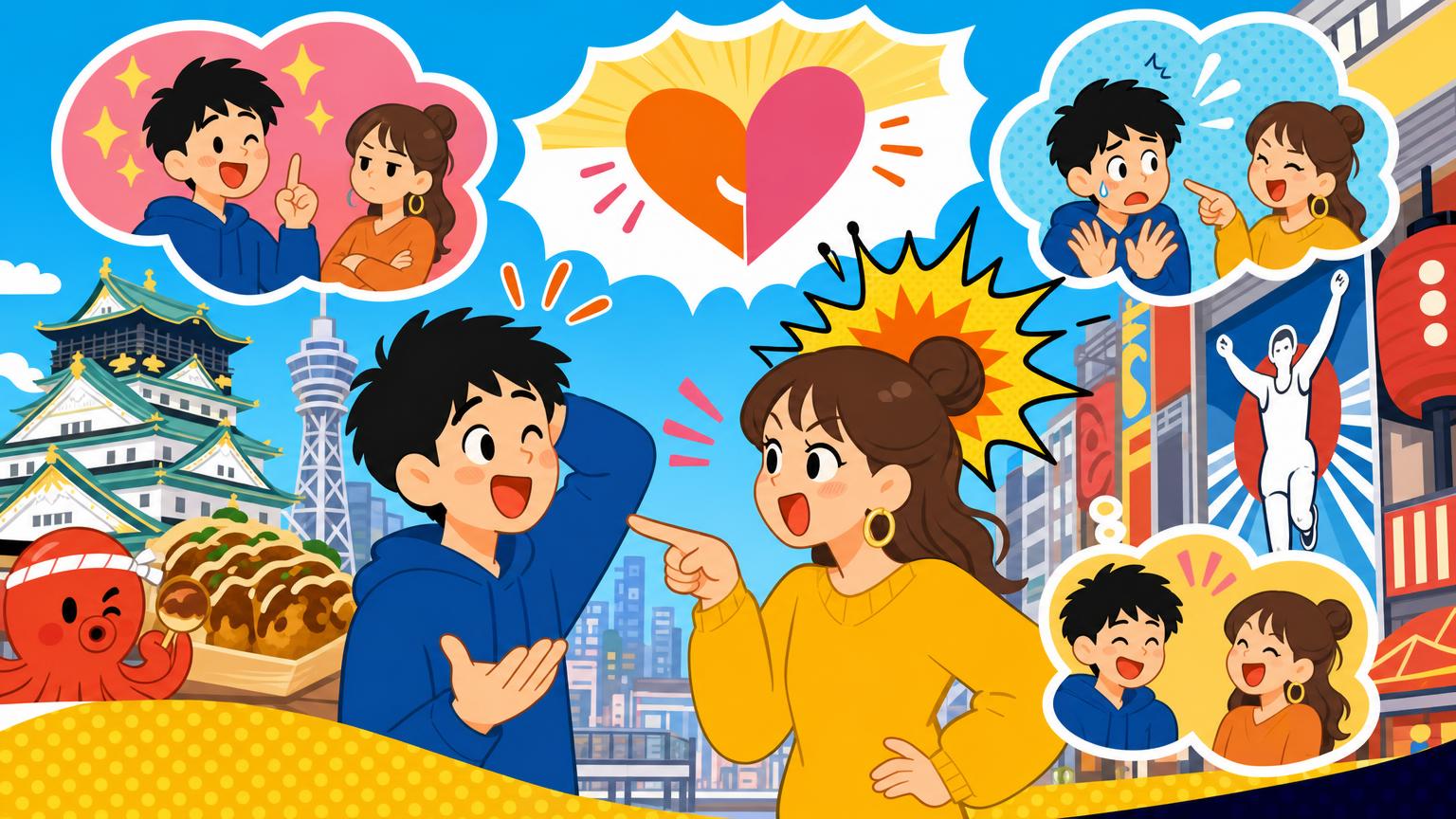
A tsukkomi is often translated as a retort, interjection, or straight-man response. That translation is useful, but it is incomplete. In everyday Osaka conversation, a tsukkomi can be a verbal nudge that says, ‘I noticed what you said,’ ‘I understand the joke,’ ‘That sounds surprising,’ or ‘Let us make this conversation more lively.’
The term comes from the structure of manzai, a Japanese comedy style strongly associated with Osaka. In manzai, the boke presents a silly idea, misunderstanding, exaggeration, or strange statement. The tsukkomi responds quickly, points out the absurdity, and brings the conversation back to reality. Japanese government cultural material describes this relationship as a comedy pairing between the funny person and the straight person, featuring rapid delivery, wordplay, deliberate misunderstandings, and quick corrections.
In everyday life, people are not necessarily performing manzai. Your colleague is not secretly auditioning for television over lunch. However, the rhythm of that comedy culture can influence ordinary speech. People may enjoy creating a small opening and seeing whether someone responds. They might make a deliberately over-the-top comment because it gives the other person something easy and enjoyable to say in return.
A tsukkomi can be very brief:
- なんでやねん — Nandeyanen — What are you talking about? / No way.
- ちゃうやろ — Chau yaro — That is not right, is it?
- ほんまかいな — Honma kaina — Really? Is that true?
- どないやねん — Donaiyanen — What is that supposed to mean?
- なんでそうなんねん — Nande sonan nen — How did you arrive at that conclusion?
- いやいや — Iyaiya — No, no, hold on.
The words can be playful, annoyed, amazed, or genuinely corrective. You cannot determine the meaning from the phrase alone. In Osaka, the melody of the voice often does as much work as the vocabulary.
Why Osaka-ben Can Feel More Direct Than Tokyo Japanese
Foreign residents often compare Osaka with Tokyo because Tokyo Japanese is generally the variety taught in language schools, textbooks, apps, and formal business training. Standard Japanese is not cold, and Osaka-ben is not automatically warm. The difference is more practical: Osaka conversation often makes the speaker’s reaction more audible.
In Tokyo, a person may respond to an unexpected statement with a pause, a smile, or a soft phrase such as sou desu ka or hontou desu ka. In Osaka, the same moment might receive a more energetic response such as honma?, nande yanen, or sore wa chau de. The Osaka reply may sound stronger, but it can also make the conversation easier to read. You do not have to wonder whether the other person found your story surprising. Their face and voice may show it immediately.
This does not mean that every person in Osaka is loud, humorous, or constantly joking. Many people are quiet, private, and careful. Osaka has office workers who speak very formally, university students who use online slang, older residents who use local expressions, and people from other parts of Japan who have adopted only a few Kansai habits. There is no single Osaka personality.
The difference is a conversational preference that appears frequently: a little more reaction, a little less distance, and a willingness to make ordinary situations entertaining.
Standard Japanese and Osaka-ben Side by Side
The following contrasts are useful for recognizing the tone. They are not exact translations in every situation.
- Standard Japanese: Hontou desu ka? — Really?
- Osaka-ben: Honma? — Really? / You mean it?
Honma? is shorter and more conversational. It may express genuine surprise, friendly disbelief, or an invitation to continue the story.
- Standard Japanese: Chigaimasu yo. — That is different.
- Osaka-ben: Chau de. — That is not it.
Chau de can sound blunt when spoken sharply. With a smile, it may simply mean that the other person has misunderstood something obvious.
- Standard Japanese: Doushite desu ka? — Why is that?
- Osaka-ben: Nande yanen? — Why on earth is that the case?
Nandeyanen is often more theatrical than an ordinary question. It can be used when a friend says something absurd, when a family member makes a predictable mistake, or when a colleague tells a ridiculous story.
- Standard Japanese: Sou desu ne. — That is right / I agree.
- Osaka-ben: Seyana. — Exactly / That is right.
Seyana often creates a sense of shared understanding. It can be warm, humorous, or matter-of-fact depending on the situation.
- Standard Japanese: Omoroi desu ne. — That is interesting or funny.
- Osaka-ben: Omoroi na. — That is funny / interesting.
The Osaka expression may sound casual, but it does not necessarily mean that the speaker is laughing at you. It can mean that your idea, story, or reaction has energy.
The Basic Pattern: Someone Creates an Opening, Someone Else Closes It
A friendly tsukkomi often follows a simple conversational pattern.
The boke creates a small opening
The first person says something exaggerated, confused, overly literal, or slightly silly. It does not need to be a formal joke; it may simply be an ordinary comment presented dramatically.
Example:
‘It took me forty minutes to find my keys. I think they have started a new life without me.’
The tsukkomi identifies the strange part
The second person picks out the most obviously unrealistic detail.
‘Your keys have not moved house. You left them in your hand.’
In Osaka-ben, this might become:
‘Nandeyanen. Te ni motteru yan.’
This means something like, ‘What are you talking about? You are holding them.’ The humor comes from correcting the emotional exaggeration with a physical fact.
The first person accepts the correction
A successful tsukkomi usually works because the first speaker allows the joke to land. They may laugh, pretend to be offended, or add another exaggerated comment.
‘Ah, so they are still living with me. Very disappointing.’
The conversation continues
The goal is not to win but to create another turn. A tsukkomi that ends the conversation is usually less friendly than one that gives the other person a chance to respond.
For foreigners, this is a useful clue. If the other person jokes and then continues helping you, asking questions, or including you in the conversation, the jab was probably part of social connection rather than rejection.
How to Tell a Friendly Tsukkomi from a Real Criticism
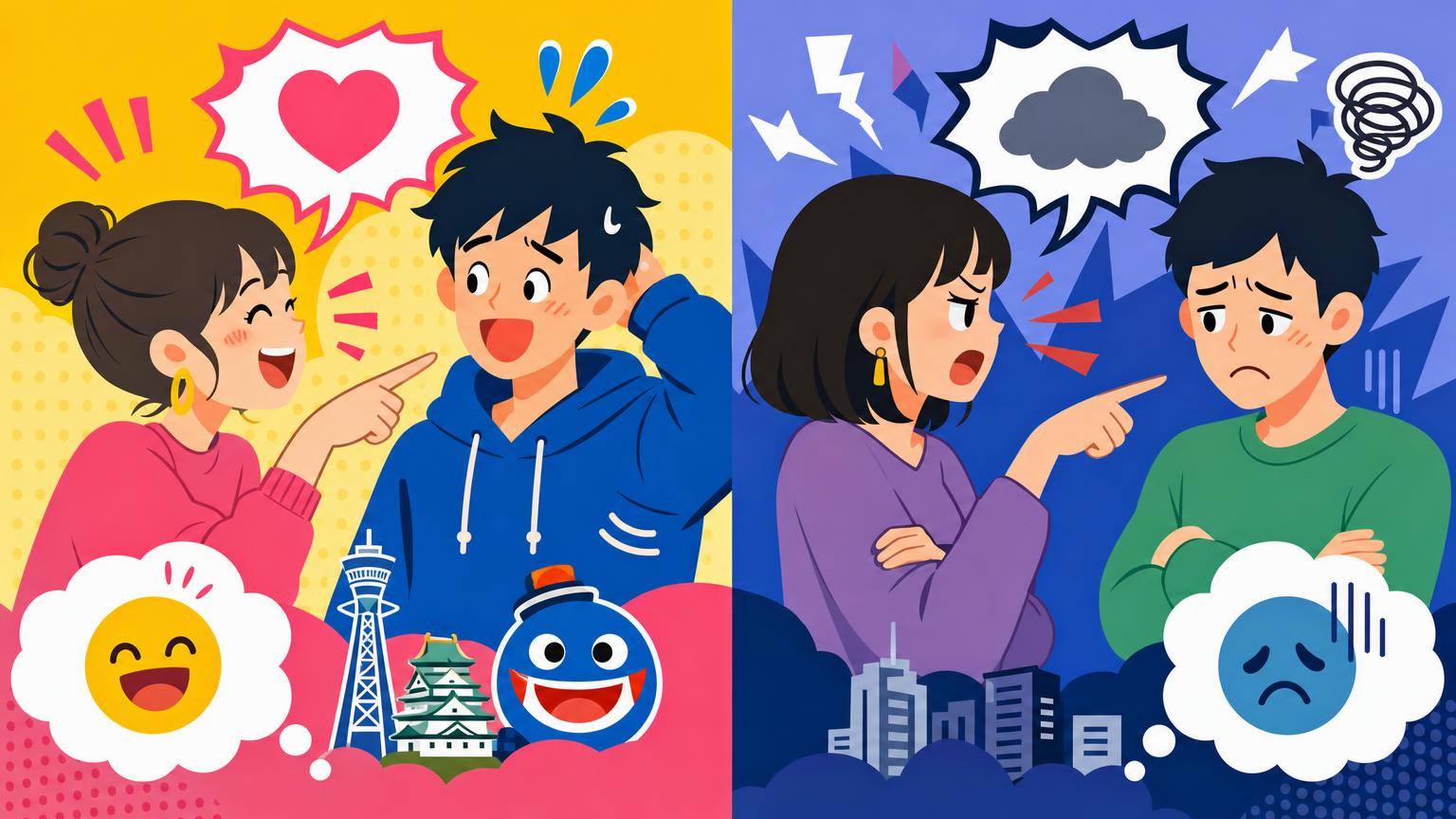
This is the most difficult part for many non-Japanese residents. Osaka people can be direct, but directness does not always indicate intimacy. A stranger, supervisor, landlord, or older neighbor may use a casual-sounding phrase that you should still respond to respectfully.
Consider the entire situation rather than focusing on a single expression.
Signs that the tsukkomi is probably friendly
The speaker smiles or laughs immediately afterward. Their voice is lively rather than quiet or cold. They continue the conversation instead of turning away. They tease themselves as well as other people. The comment focuses on what happened rather than on your identity. Other people in the group react comfortably. The speaker helps you afterward or includes you in the next topic.
For example, if you arrive at a neighborhood meeting carrying three umbrellas on a sunny day and someone says, ‘You are prepared for the entire rainy season, aren’t you?’, they may simply be making a friendly observation. If they then show you where to put your shoes and introduce you to the group, the comment was probably intended as an icebreaker.
Signs that it may be criticism
The voice is flat or irritated. The person repeats the same comment after you have shown discomfort. The joke targets your nationality, appearance, accent, gender, disability, or another personal characteristic. The speaker has authority over you and uses the joke to avoid giving clear instructions. Everyone becomes quiet rather than amused. The comment is made in front of others to embarrass you.
A friendly tsukkomi should never be used as an excuse for harassment. Osaka humor has a reputation for being tough, but you are still allowed to set boundaries. You can laugh at a harmless joke while also saying that a personal comment makes you uncomfortable.
A useful response when you are unsure
You can smile lightly and ask:
‘Joudan desu ka?’ — Are you joking?
In Osaka-ben, you may hear:
‘Joudan yan ne?’ — You are joking, right?
This gives the person an opportunity to clarify. If they say yes and soften their tone, the situation may be harmless. If they become more aggressive, you have gained useful information about the relationship.
The Most Common Tsukkomi Triggers in Daily Osaka Life
A tsukkomi does not appear randomly; certain conversational situations invite one.
Exaggerated complaints
People in Osaka may complain dramatically because the drama encourages a response.
You say:
‘The train was three minutes late. My entire future has collapsed.’
Someone may reply:
‘Nandeyanen. You are still alive, aren’t you?’
This is not necessarily a denial that delays are annoying. Rather, it is a playful correction of the scale of your complaint.
A good response is:
‘Okini. I have returned from the edge.’
Or simply:
‘Seya na. I may have overreacted.’
Obvious statements
You look outside and say, ‘It is raining.’ Someone replies, ‘You noticed?’
In Standard Japanese, a similar response might be sou desu ne or ame desu ne. In Osaka, the response may be more pointed because the obviousness itself becomes the joke.
Useful replies include:
- Sonna kanji ya na — Yes, it does seem that way.
- Mita mama ya — Exactly as it looks.
- Iya, kakunin shitakatta dake — I only wanted to confirm it.
Small mistakes
You press the wrong button in a shared office kitchen, and the microwave starts making an alarming noise. A colleague may say:
‘Hajimete no Osaka ya nai de.’
This could roughly mean, ‘It is not your first day in Osaka.’ The speaker may be joking that you should know how the machine works by now.
A light response is:
‘Gomen, mada Osaka ni narete hen nen.’
‘Sorry, I am still not used to Osaka.’
The ending hen is a Kansai-style negative form often heard in casual speech. You do not need to force it, but recognizing it can be helpful.
Overly serious explanations
If you give a lengthy explanation for a simple mistake, someone may interrupt with:
‘Wakatta, wakatta. Nagai nagai.’
‘Okay, okay, that is a long story.’
This can be playful, but it may also signal that the listener wants you to get to the point. Osaka conversation often values quick movement. If you are explaining a problem at work, give the essential facts first, then add the background.
Common Osaka-ben Reactions You Will Hear
You do not need to become a comedian to understand Osaka. Begin by learning the small reactions commonly heard in everyday conversations.
Nandeyanen — What are you talking about?
Romaji: Nandeyanen
Standard Japanese equivalent: Nande desu ka or Nani itten no
Direct meaning: Why is that? / What are you saying?
Typical use: A playful response to an absurd, exaggerated, or unexpectedly foolish comment.
Daily example:
You tell your coworker, ‘I forgot my lunch, so I am thinking about moving to another prefecture.’ They reply, ‘Nandeyanen.’
Do not use nandeyanen with your manager unless you have a very relaxed relationship. Among friends, it can be funny. With someone older or higher-ranking, Nande desu ka? is safer.
Chau — That is wrong or different
Romaji: Chau
Standard Japanese equivalent: Chigau
Direct meaning: It is not that / No, that is different.
Typical use: Correcting a misunderstanding, sometimes with friendly impatience.
Daily example:
You ask whether the meeting is on Thursday. Your colleague says, ‘Chau, ashita ya de.’
‘No, it is tomorrow.’
The longer forms chau nen or chau de can sound more conversational. The phrase is useful, but remember that correcting someone without softening your tone can feel abrupt. Add gomen or a smile when correcting someone you do not know well.
Honma — Really
Romaji: Honma?
Standard Japanese equivalent: Hontou?
Direct meaning: Really?
Typical use: Expressing surprise, interest, doubt, or concern.
Daily example:
Your neighbor says that the local children’s event begins at seven in the morning. You respond, ‘Honma?’
If you want to sound more polite, say:
‘Honma desu ka?’ or ‘Hontou desu ka?’
Honma can be used sincerely; it does not always imply a joke.
Seyana — Exactly or That is right
Romaji: Seyana
Standard Japanese equivalent: Sou da ne or Sou desu ne
Direct meaning: That is right / Exactly.
Typical use: Agreeing with someone and creating a sense of shared understanding.
Daily example:
A friend says, ‘The summer humidity is not playing around.’ You reply, ‘Seyana.’
You may also hear seya seya in a more emphatic or humorous rhythm. Do not worry about copying every variation. A relaxed sou desu ne is always acceptable.
Omoroi — Funny or interesting
Romaji: Omoroi
Standard Japanese equivalent: Omoshiroi
Direct meaning: Funny, interesting, entertaining.
Typical use: Reacting energetically to a story, person, idea, or situation.
Daily example:
You describe your attempt to assemble furniture using an English instruction manual and three online videos. Your friend says, ‘Omoroi na.’
They may mean that the story is funny, not that your furniture-building attempt was successful. In Osaka, omoroi is often positive, but the subject of the humor matters.
Akan — No good or That will not work
Romaji: Akan
Standard Japanese equivalent: Dame
Direct meaning: Not good / Impossible / That will not do.
Typical use: Responding to a bad idea, failed plan, or minor disaster.
Daily example:
You realize that you bought a non-refundable train ticket for the wrong day. You say, ‘Akan.’
An older person may say akan de or akan wa. The tone can be serious or comic. A parent might say it to a child who is about to touch something dangerous. A friend may say it when your plan is simply inconvenient.
How Tsukkomi Works at Work
The workplace calls for greater care because relationships are not equal. A coworker may joke casually with you, but a supervisor’s tsukkomi is not necessarily an invitation to respond in the same style.
In an Osaka office, speed can signal trust
If colleagues interrupt one another with brief reactions, do not assume the meeting is disorganized. The interruptions may be a way to test an idea quickly. One person proposes a plan, another immediately points out a problem, and the group adjusts the plan without a lengthy formal discussion.
This may feel very different from a workplace where people wait their turn and soften every disagreement. Osaka-style directness can help a team move faster, but it may also confuse foreign employees who interpret interruptions as hostility.
Listen for the difference between a productive correction and a personal attack.
Productive correction:
‘Sore, deadline ni maniawan de.’
‘That will not meet the deadline.’
Personal attack:
‘Itsumo anta no plan wa dame ya.’
‘Your plans are always useless.’
The first focuses on the project. The second attacks the person. They should not be treated as the same simply because both are direct.
How to respond to a coworker’s playful jab
Give a brief acknowledgement and return to the task.
- Seya na. Naoshimasu. — Exactly. I will fix it.
- Akan na. Mou ichido kangaemasu. — That will not work. I will think it over again.
- Chau ka. Oshiete kurete arigatou. — Is that so? Thanks for pointing it out.
- Naruhodo. Soko wa mite nakatta desu. — I see. I had not noticed that point.
These replies show that you understood the correction without attempting to perform a comedy routine. That is generally the safest approach.
When not to joke back
Avoid replying to a senior colleague with nandeyanen simply because they used it with you. First, observe how other people respond. Someone may use casual Osaka-ben with you while still expecting you to maintain workplace respect.
You can speak politely in Standard Japanese while still understanding the Osaka rhythm. There is no requirement to use a strong Kansai dialect in order to belong.
Tsukkomi in Shops, Apartment Buildings, and Neighborhood Life
Osaka’s conversational style is especially apparent in repeated local interactions. The same shop worker, caretaker, school volunteer, or neighbor may come to recognize you over time. Familiarity is often built through small exchanges rather than a single major introduction.
At a local shop
You buy the same bread several times, and the shop worker says:
‘Mata kore ka. Suki ya na.’
‘This again? You really like it.’
The comment is not a sales pitch but an expression of recognition. A good response is:
‘Meccha suki yanen.’
‘I really like it.’
Or:
‘Kore ga ichiban anzen ya.’
‘This is the safest choice.’
The word yanen adds a distinctly Kansai-style conversational feeling. It can sound like ‘you know’ or ‘that is how it is.’
In an apartment building
A neighbor sees you carrying a large delivery box and says:
‘Nani kau tan?’
‘What did you buy?’
This may feel surprisingly personal to someone from a culture where neighbors do not comment on deliveries. In Osaka, however, it may simply be a friendly way to start a conversation. You can answer generally:
‘Kodomo no mono ya.’
‘It is for the children.’
Or, if you would rather not explain:
‘Himitsu yaね.’
‘It is a secret.’
The playful response lets you maintain your privacy without bringing the conversation to an abrupt stop.
In a neighborhood association
Someone may complain that the community notice is too long:
‘Kono chirashi, honma ni nagai na.’
‘This flyer is really long.’
They may then laugh and continue reading it. The complaint is a social moment, not necessarily a request to rewrite the document immediately. If you produced the flyer, you can respond:
‘Sumimasen, tsugi wa mijikou shimasu.’
‘Sorry, I will make the next one shorter.’
A little self-deprecation is often effective:
‘Kakunin shiteitara, ji ga fuete shimatte.’
‘When I checked it, the words somehow multiplied.’
Why Foreign Residents Often Misunderstand Osaka Jabs
Many misunderstandings arise from translating the words without translating the relationship.
Mistaking volume for anger
Osaka speech can involve strong pitch changes and an expressive rhythm. A person may sound excited, amused, or surprised rather than angry. This is especially common in a busy family kitchen, shopping street, school gathering, or casual workplace.
However, do not force yourself to assume that every loud interaction is friendly. Observe the person’s body language and whether the conversation remains cooperative.
Mistaking speed for impatience
A quick response may indicate that the person is engaged. If someone immediately says honma? or nande yanen, they may be giving you an easy opportunity to continue. A slow, polite response is not necessarily more respectful than a quick, lively one.
Thinking every casual phrase is permission to be casual
Understanding Osaka-ben does not mean you should use it with everyone. Language has different levels. You can recognize akan without saying it to your landlord. You can understand chau de without using it to correct your supervisor.
Assuming a joke must be answered with another joke
You do not have to be funny. A smile, nod, or brief response is enough. Many foreign residents worry that they must come up with a perfect Osaka-style comeback. They do not. Showing that you understood the mood is more important than creating a brilliant line.
Useful non-comic responses include:
- Sou nan desu ka. — Is that so?
- Naruhodo. — I see.
- Wakarimashita. — I understand.
- Hontou ni? — Really?
- Sore wa komatta na. — That is a problem.
- Arigatou, tasukarimashita. — Thank you, that helped.
How to Give a Safe Tsukkomi in Japanese
If you want to participate, begin with harmless, easily reversible observations. Do not start by commenting on someone’s body, age, income, marriage, family structure, or Japanese ability.
Use the situation, not the person, as the target
Safer:
‘Kono kaigi, coffee ga nai kara akan.’
‘This meeting is no good because there is no coffee.’
Riskier:
‘Anata wa coffee ga nai to hatarakenai ne.’
‘You cannot work without coffee.’
The first jokes about the situation, while the second judges the person.
Exaggerate yourself first
Self-directed humor is often easier for others to accept.
- Mata machigaeta. Watashi, kyou wa akan wa. — I made another mistake. I am no good today.
- Nihongo, mada mada ya nen. — My Japanese still has a long way to go.
- Kono ryouri, reshipi to zenzen chigau. — This dish is completely different from the recipe.
Self-deprecation can create warmth, but avoid constantly describing yourself as incompetent. In the workplace, too much self-criticism may make people question your reliability.
Keep the timing short
A tsukkomi is usually most effective when delivered quickly and ended quickly. Long explanations often undermine the humor. Say the reaction, smile, and return to the conversation.
For example:
Friend: ‘I bought a small amount of vegetables.’
You see four huge shopping bags.
You: ‘Sore de chiisai no?’
‘That is small?’
That is enough. You do not need to explain why the bags are not small.
Use a softener if you are uncertain
Add ya na, ne, or a smile, depending on the relationship. You can also use Standard Japanese with a light tone:
‘Sore wa chotto ookii desu ne.’
‘That is a little big, isn’t it?’
This is safer than trying to imitate a strong accent or a television comedian.
What to Do When You Become the Boke by Accident
Foreign residents often become the boke without meaning to. You may pronounce a word strangely, misunderstand a local custom, bring the wrong document, or make a very literal comment. The group laughs, and you are left unsure how to respond.
The best response is usually not to panic.
Laugh lightly if the mistake is harmless
You can say:
‘Aa, boke shite shimatta.’
‘Ah, I accidentally became the funny one.’
This is understandable, although you do not need to use technical comedy vocabulary. A simpler response is:
‘Machigatta. Gomen.’
‘I got it wrong. Sorry.’
Ask for the correct expression
If the joke involves your Japanese, ask:
‘Dou iu no ga shizen desu ka?’
‘What would sound natural?’
This turns the moment into a language lesson. Many people enjoy explaining the difference, especially when you show interest rather than embarrassment.
Do not apologize repeatedly
One apology is enough for a small mistake. Repeating sumimasen several times can make the other person feel that the situation has become too serious. Osaka conversation often aims to reduce unnecessary heaviness, so accept the correction and move on.
Osaka-ben and Tokyo: A Practical Comparison for Daily Life
The contrast between Osaka and Tokyo is often exaggerated online. Both cities are home to many different personalities, and neither has a single communication style. Still, foreign residents often notice some differences.
Osaka often makes reactions more visible
In Tokyo, disagreement may be conveyed through careful phrasing, silence, or a formal alternative. In Osaka, it may come as a direct verbal response. This can make Osaka feel more approachable, but it can also make the first few weeks socially tiring because you are processing more sound and emotion.
Osaka often allows more playful negotiation
In a shop, restaurant, office, or neighborhood conversation, people may use humor when negotiating a minor inconvenience. This does not mean every price is negotiable or that every rule is flexible. It means the conversation surrounding the rule may have more personality.
Tokyo can feel more conscious of roles
Tokyo workplaces can also be warm and humorous, but some foreign residents experience a stronger separation between formal and informal roles. In Osaka, the same person may speak formally one moment and make a quick joke the next. That shift can feel confusing until you realize that the joke does not necessarily erase the hierarchy.
Neither style eliminates the need for politeness
An Osaka person who jokes with you may still expect you to submit documents on time, greet the building manager, follow recycling rules, and use appropriate honorific language at work. Casual warmth and social responsibility can operate together.
When a Tsukkomi Becomes Uncomfortable
It is important not to romanticize every Osaka joke. A culture that values humor can sometimes make it difficult for people to acknowledge that a joke has hurt them. Foreign residents may also be told that they are being too sensitive when they are actually recognizing a genuine boundary issue.
Clear warning signs
Be cautious when the same person repeatedly jokes about your accent, visa status, skin color, religion, relationship status, or ability to understand Japanese. Be cautious when a supervisor uses public jokes to pressure you. Be cautious when a landlord or neighbor treats your foreign background as a reason to question your character.
You can respond calmly:
‘Sono hanashi wa chotto komarimasu.’
‘That topic is difficult for me.’
Or:
‘Joudan demo, sono iikata wa iya desu.’
‘Even if it is a joke, I do not like the way you are saying it.’
You do not need perfect Japanese to set a boundary. Simple English may also be appropriate, especially at work or when making a formal complaint.
A practical three-step response
First, clarify: ‘Are you joking?’
Second, explain the effect: ‘I am not comfortable with that comment.’
Third, redirect or end the conversation: ‘Let us talk about the schedule instead.’
If the behavior continues, document what happened and seek support through your workplace, school, housing provider, or a local consultation service. Friendly communication should not require you to tolerate repeated disrespect.
Useful Responses You Can Memorize
These phrases are not performance lines; they are small tools for staying in the conversation.
When you understand the joke
- Seyana, sore wa sou ya. — Exactly, that is true.
- Nandeyanen, watashi mo sou omotta. — What are you talking about? I thought the same thing.
- Omoroi na. — That is funny.
- Honma ya. — It is really true.
When you agree with the correction
- Chau na. Machigatta. — You are right; I got it wrong.
- Akan na. Yarinaosu wa. — That will not work. I will do it again.
- Wakatta. Ki o tsukeru. — Got it. I will be careful.
When you want more information
- Mou ichido itte kuremasu ka? — Could you say that one more time?
- Kore wa joudan? — Is this a joke?
- Nani ga omoroi no? — What part is funny?
- Seikaku ni wa dou iu imi? — What exactly does it mean?
When you need to slow things down
- Gomen, hayakute wakaranakatta. — Sorry, I could not understand because it was too fast.
- Yukkuri onegaishimasu. — Slowly, please.
- Kansai-ben wa mada benkyou-chuu yanen. — I am still studying Kansai-ben.
This last sentence can itself invite a friendly response. Someone may say, ‘Jouzu jouzu,’ meaning ‘Good, good,’ even if your Japanese is still developing. Accept the encouragement without assuming that you have suddenly become a native speaker. Osaka kindness can be generous, but it is not always a formal assessment.
How Families and Children Use Tsukkomi
If you live with children or interact with Osaka families, you may often hear playful corrections. Children frequently learn the rhythm before they understand the social rules. They may imitate television comedy, repeat something a parent has said, or respond to an adult with a dramatic nande yanen.
Adults usually adjust the level of teasing depending on the child. A parent may tease a child for putting their socks on the wrong feet, then immediately help them correct the problem. The joke makes the correction feel lighter, but the correction itself remains real.
For foreign parents, this can sometimes be confusing. A Japanese adult who jokes with your child may not be criticizing your parenting; they may be building a relationship through shared play. At the same time, you do not have to accept teasing that frightens or humiliates your child. Pay attention to whether the child is laughing comfortably, participating in the exchange, and recovering easily.
A useful phrase to teach your child is:
‘Joudan wa wakaru kedo, iya na toki wa itte ii yo.’
‘You can understand that it is a joke, but you can say so if you do not like it.’
That is good advice for adults, too.
Why Osaka Daily Life Can Feel Socially Easier—and More Tiring
Many residents find Osaka easier to enter socially because small talk can start quickly. A shop worker comments on your purchase, a parent at school jokes about the weather, a coworker reacts to your lunch, or a neighbor asks whether you have finally learned the recycling schedule. These brief exchanges can help you feel visible rather than anonymous.
However, the same quality can also be tiring. You may need to process more informal comments, emotional signals, and fast-moving speech. If you are new to Japan, the combination of Japanese grammar, Kansai vocabulary, and humor can feel like trying to read subtitles while riding a bicycle.
It is perfectly acceptable to establish quiet routines. You do not need to chat with every neighbor or perform friendliness at all times. A brief greeting, a small smile, and consistent behavior are enough to build trust over time.
In Osaka, social connection is often less about one impressive conversation and more about repeated, ordinary contact. You show up, remember someone’s name, return a borrowed item, laugh when you can, and clearly say when you do not understand.
A Week-by-Week Approach to Understanding Osaka Conversation
During your first few weeks
Focus on recognizing tone rather than copying the dialect. Learn honma, chau, akan, omoroi, and nandeyanen. Pay attention to who uses them, with whom, and in what situations.
When someone jokes, respond in Standard Japanese if that feels safer. Sou desu ne and naruhodo are perfectly useful. You are not being any less Osaka by speaking clearly.
After you get to know people better
Try short, low-risk responses such as seyana, honma?, or chau na. Use them with friends or relaxed colleagues first, and notice whether the conversation continues comfortably.
Do not imitate the accent too strongly. Forced Osaka-ben can sound like a television character, especially if you learned the phrases from comedy clips rather than everyday conversation.
Once you understand the relationship
You can start making gentle observations and self-directed jokes. Keep the target harmless and give the other person room to respond. If they do not pick up on the joke, let it go rather than explaining it.
When living in Osaka long term
You may find that your speech becomes a mixture. You might use Standard Japanese grammar with a few Kansai endings, or Osaka vocabulary with an accent from your home country. This is normal. Osaka does not require linguistic purity. Communication, timing, and trust matter more than sounding local.
Frequently Asked Questions
What does tsukkomi mean in everyday Osaka conversation?
It refers to a quick reaction, correction, or playful jab that points out something strange, exaggerated, or amusing. In everyday Osaka conversation, it often keeps the exchange lively and shows that the listener is engaged.
Is every Osaka joke a tsukkomi?
No. A tsukkomi is specifically a response that corrects, challenges, or reacts to a boke-like statement. People in Osaka also use ordinary jokes, teasing, sarcasm, storytelling, and affectionate complaints. The terms may overlap in casual explanations, but they are not identical.
Do I need to speak Osaka-ben to fit into Osaka life?
No. Clear Standard Japanese is perfectly acceptable. Understanding common Osaka expressions will help you follow conversations, but using the dialect unnaturally can sound awkward. Introduce Osaka-ben gradually and only when you feel comfortable.
Is Osaka-ben rude?
Not necessarily. Osaka-ben can sound direct because it often uses strong reactions and casual endings, but tone and the relationship between speakers determine whether it is polite. Some expressions are friendly among close friends but inappropriate at work or with strangers.
How can I respond if I do not understand a joke?
You can say, Gomen, nani ga omoroi no?—‘Sorry, what is funny?’—or Joudan?—‘Are you joking?’ Asking directly is better than pretending to understand. Many people will explain the context or repeat the sentence more slowly.
What should I say when someone says Nandeyanen to me?
If the mood is friendly, you can laugh and say Seya na—‘Exactly’—or acknowledge the exaggeration with Mou, ii yan—‘Come on, it is fine.’ If you are unsure, simply smile and say Wakarimashita—‘I understand.’ You do not need to respond with another comedy line.
Can I use Nandeyanen with my boss?
Usually, no. Use it only when your relationship is clearly informal and other colleagues speak to the boss in that style. In most workplaces, choose a softer phrase such as Nande desu ka? or Sou nan desu ka?
What is the difference between Osaka humor and bullying?
Humor is generally mutual, brief, and connected to the situation. Bullying is repetitive, personal, humiliating, or difficult to escape. If someone continues after you show discomfort, the behavior should not simply be dismissed as Osaka culture.
Why do people interrupt so quickly in Osaka?
Quick reactions can be part of the local conversational rhythm. They may show interest, create humor, or correct an idea before the conversation moves on. However, workplace norms vary, and not every interruption is helpful. Consider the content and the relationship rather than assuming that every interruption is friendly.
Is Osaka a good place to live if I prefer quiet communication?
It can be. Osaka has quiet neighborhoods, reserved people, formal workplaces, and many ways to maintain personal space. You may encounter more casual comments or visible reactions than in some other cities, but you are not expected to become highly outgoing. Reliable, polite, and clear communication works well.
The Main Lesson: Listen for the Invitation Inside the Jab
A friendly tsukkomi often includes an invitation: join the rhythm, show your reaction, and keep the conversation going. It may come as nandeyanen, honma, chau, or a dramatic complaint about coffee, the weather, trains, lunch, or someone’s impossible timetable.
The safest way to respond is not to pursue perfect Osaka-ben. Listen to the tone, consider the relationship, and notice whether the other person is laughing with you, helping you, and leaving room for your response. Begin with short acknowledgements. Use humor about situations before turning it toward people. Let yourself be the boke sometimes. Ask for clarification when needed, and set boundaries when a joke becomes personal.
Daily life in Osaka is not one continuous comedy show. People here have bad days, busy schedules, private worries, and ordinary routines. Still, conversation often has a little more bounce. A correction can turn into a laugh. A complaint can become an introduction. A mistake can mark the beginning of a relationship.
Once you understand this pattern, Osaka people become easier to read. A quick jab is not always a challenge; often, it is a small door left open for you to answer.