Have you ever walked into a neighborhood shop in Osaka, heard a cheerful “Irasshaimase,” and then wondered whether the shopkeeper was inviting you to speak—or simply performing a standard greeting? Perhaps an older woman behind the vegetable counter called out “Maido!” to a regular customer. Perhaps a man selling snacks asked, “Nambo?” with a smile, and you were unsure whether he was asking about your budget, making a joke, or starting a negotiation.
This confusion is common among foreigners living in Osaka. The words may be simple, but the social meaning is not. In a local shotengai, or covered shopping arcade, conversation is often part of the transaction. A greeting can carry recognition. A complaint can signal familiarity. A joke can be a test of comfort rather than an attempt to embarrass you. Even silence has a place.
Osaka is famous for its vibrant shotengai culture, but the important point is not simply that these arcades sell food, clothing, household goods, and services. They show how Osaka works as a city. The people who use them are neighbors, repeat customers, shop owners, delivery workers, children, older residents, office workers, and newcomers. They share a narrow public space, and their repeated encounters create a style of communication that is warmer, louder, quicker, and more openly playful than many foreigners expect from daily life in Japan.
This is not a guide to Osaka attractions. It is an explanation of a social environment. If you are considering living in Osaka, already renting an apartment here, or comparing Osaka with Tokyo, understanding the banter of a shotengai will help you read everyday interactions more accurately. The goal is not to teach you to imitate an Osaka accent. It is to help you recognize when a shopkeeper is being formal, when they are being friendly, when they are teasing you, and when you should simply smile, answer briefly, and let the moment pass.
Why Shotengai Conversation Matters in Everyday Osaka
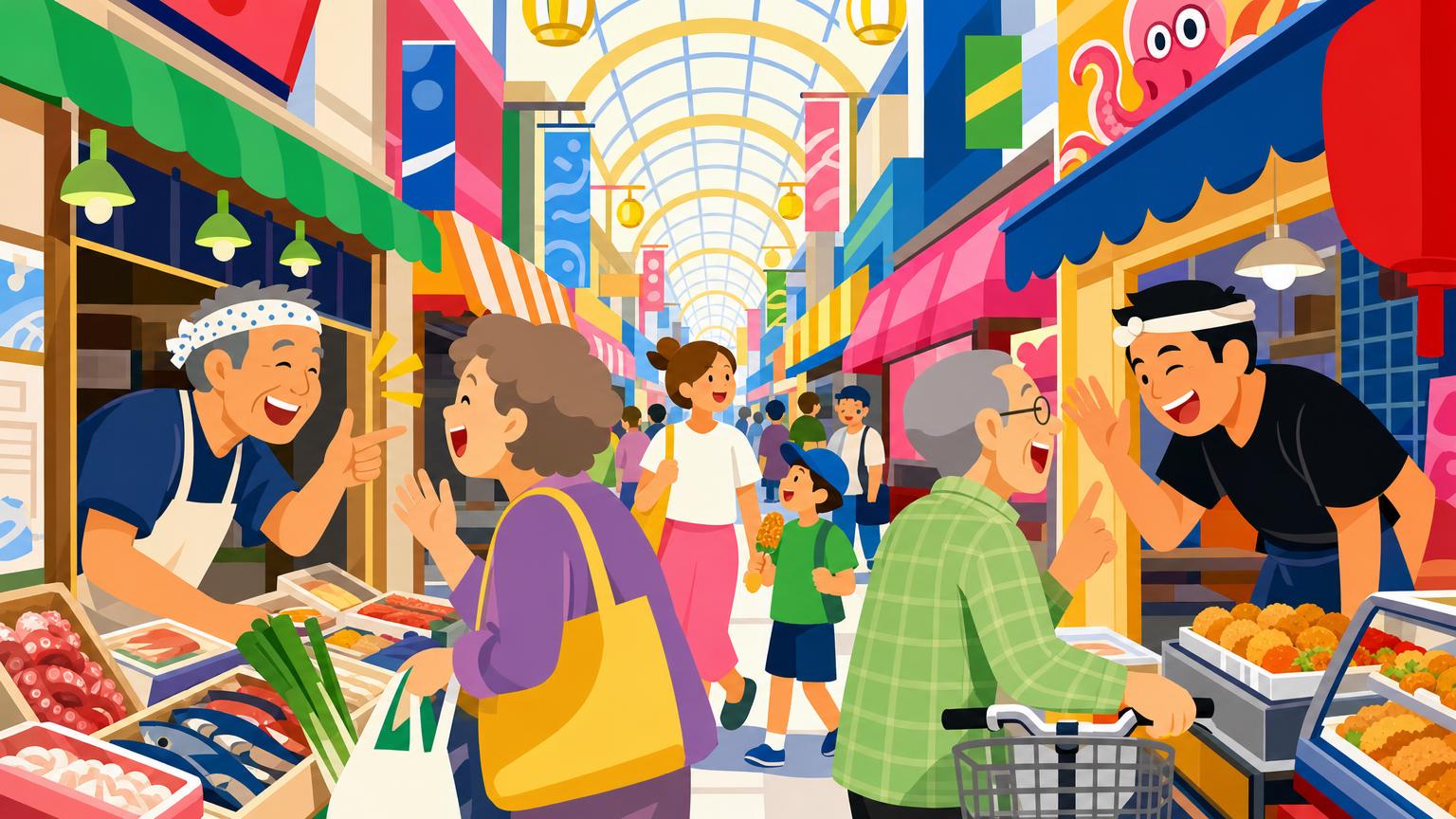
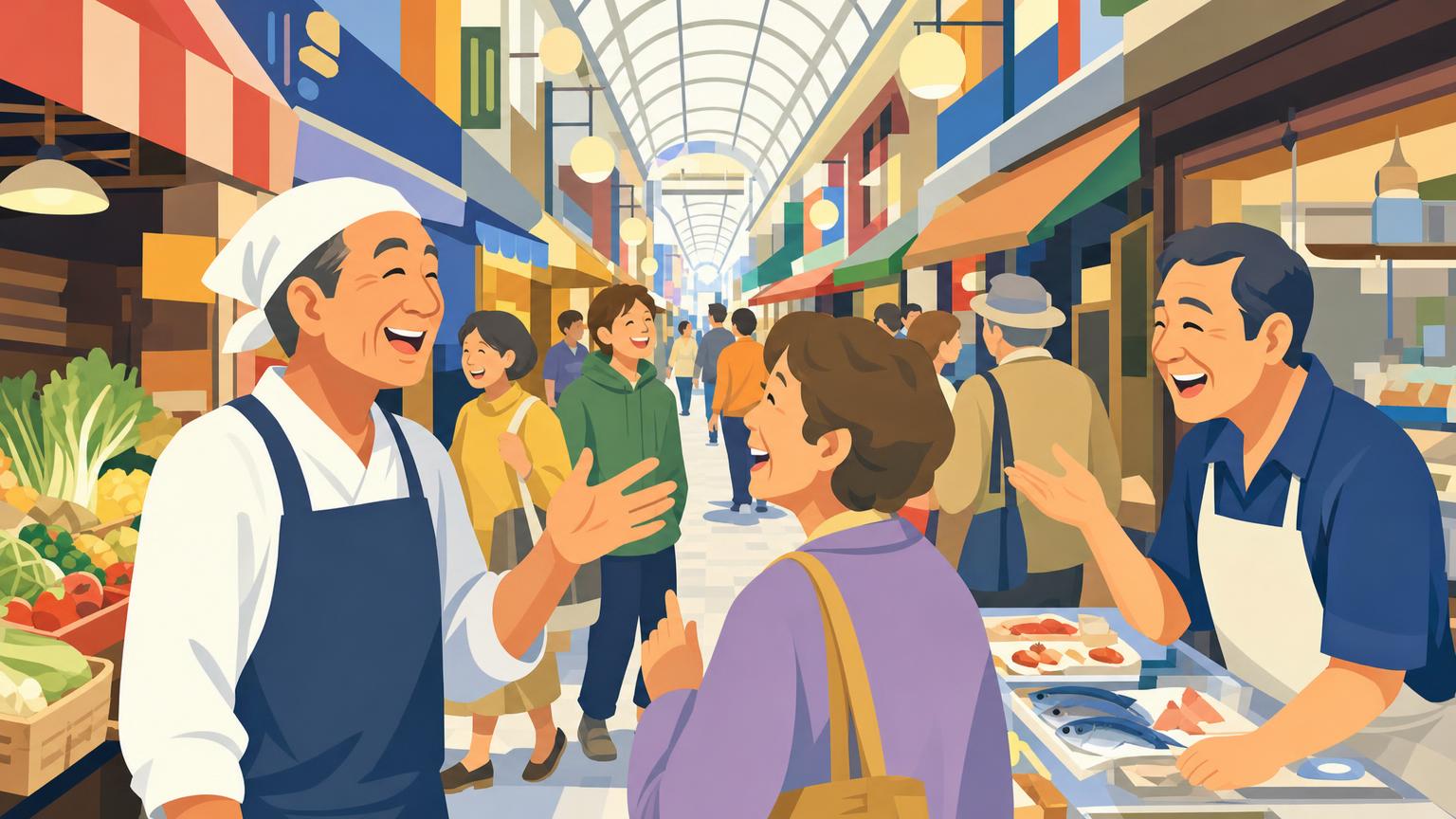
A shotengai is often translated as a shopping street, but that translation can sound overly commercial. In Osaka, a traditional shotengai is also a neighborhood structure. The covered roof shields people from the summer sun and heavy rain, but the social shelter matters as well. A customer can stop at a fish shop, greet the owner, notice a neighbor buying tofu, and hear a bicycle bell approaching from behind. The street is a retail space, but it is also a moving conversation.
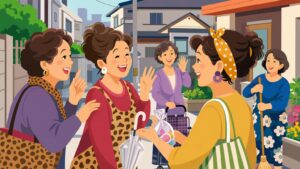
The best way to understand the atmosphere is to imagine a place where many people have seen one another regularly for years. The shopkeeper knows who buys small portions because they live alone. They know which customer wants the least expensive seasonal fruit. They recognize the child who comes by after school for a snack. They may know that one customer has recently retired, that another is caring for an elderly parent, or that a family has moved away. These details are not always discussed directly. They emerge through small comments, remembered preferences, and changes in the tone of a greeting.
That is why a shopkeeper’s voice may sound unusually personal even when the conversation is only about cabbage or socks. The relationship is not necessarily intimate in a private sense. It is a form of public familiarity. The customer does not have to become a friend; they only need to become a recognizable person within the rhythm of the street.
Osaka’s history helps explain why commerce and conversation are so closely connected. The city developed as a major center of trade, markets, transport, and merchant activity. Osaka City Library describes how waterways, storehouses, markets, and merchant communities shaped the city’s early urban development. The image of Osaka as a commercial city is not merely a modern advertising slogan; it is connected to the way neighborhoods were organized around exchange and practical business.
The result is not that every Osaka resident talks to strangers all day. That would be an exaggerated stereotype. Rather, Osaka has many settings where small talk is seen as useful rather than unnecessary. Conversation can make a sale smoother, soften a refusal, provide a little entertainment, or establish that two people are not complete strangers.
The First Misunderstanding: “Irasshaimase” Is Not an Invitation to Chat
Foreign residents often notice “Irasshaimase” first. It means something like “Welcome” or “Please come in,” but in a shop, it is usually a professional greeting rather than a request for a response. You do not need to say anything in return. A small nod, a smile, or simply continuing to browse is enough.
The sound can feel intense because Japanese shop staff often say it loudly and repeatedly. In an Osaka shotengai, several stores may call out at the same time. A butcher may greet someone entering from the left while a bakery employee calls to a customer near the counter. The volume is partly practical: the arcade is noisy, refrigerators hum, scooters pass, and customers speak over one another. It is not necessarily an attempt to pressure you into buying something.
The difference between “Irasshaimase” and more personal Osaka expressions becomes clearer with regular customers. “Irasshaimase” can be directed at anyone. “Maido,” by contrast, conveys a sense of continued business or repeated contact. It is associated with the phrase “Thank you for your continued patronage,” shortened into a merchant’s greeting. Osaka guidance on the local dialect describes “Maido” as a familiar expression used by merchants and businesspeople, including shop staff in neighborhood food stores.
If a shopkeeper says “Maido” to you after seeing you several times, it may mean, “Good to see you again,” “Thanks as always,” or simply, “You are now part of the familiar flow here.” It does not mean that you have signed a contract or become a close personal acquaintance. It is a small acknowledgment that repeated contact has social value.
For a foreign resident, the appropriate response can be very simple. You might say “Maido” back once you feel comfortable, or use standard Japanese such as “Konnichiwa” or “Arigatou gozaimasu.” You do not need to reproduce the exact accent. In fact, forcing a dramatic Osaka dialect can sound less natural than speaking ordinary Japanese with a relaxed expression.
“Maido,” “Okini,” and the Language of Continued Contact
Osaka dialect is not merely a collection of colorful words. In a shotengai, certain expressions reveal how people position themselves in relation to one another.
“Maido” is closely associated with business relationships and repeat service. Although it may sound old-fashioned in some situations, it remains recognizable in neighborhood commerce. When a shopkeeper says it in a light tone, the phrase can convey warmth without requiring a lengthy conversation.
“Okini” means “thank you” in Osaka dialect. You may hear it at the end of a purchase, especially from older shopkeepers or in traditional businesses. It is not necessarily more intimate than standard “Arigatou,” but it can feel more local. Responding with “Arigatou gozaimasu” is perfectly acceptable. If you later use “Okini,” do so naturally and sparingly rather than treating it as a performance.
“Bochi-bochi” is another expression that can confuse people. The phrase “Mōkarimakka?” literally suggests, “Are you making money?” However, it has historically functioned more as a merchant’s greeting than as a serious request for financial information. The familiar response, “Bochi-bochi denna,” implies that things are going along moderately. Osaka’s official cultural explanations describe this exchange as a greeting reflecting the city’s commercial background rather than a literal inquiry into someone’s income.
A foreigner who answers the question seriously—“Actually, my salary is…”—has misunderstood the social meaning of the phrase. The exchange is closer to a light acknowledgment. It recognizes business, money, and the ordinary difficulties of life without requiring an accounting.
You may also hear “Nambo?” meaning “How much?” or “How much is it?” In Osaka, the word can sound particularly direct because the city’s speech often reduces the distance between customer and seller. This does not always mean the customer expects a discount. Sometimes it is simply a practical question, while in certain secondhand, market, or informal settings, bargaining may be possible. In many modern stores, however, the price is fixed.
The useful rule is to pay attention to tone and context. A shopkeeper who points to a price tag and says “Nambo?” is probably asking about the item. A customer who says it with a laugh may be commenting on the price. A visitor who hears the word should not assume that every Osaka purchase involves negotiation.
The Osaka Style: Direct, Warm, and Economical With Emotion
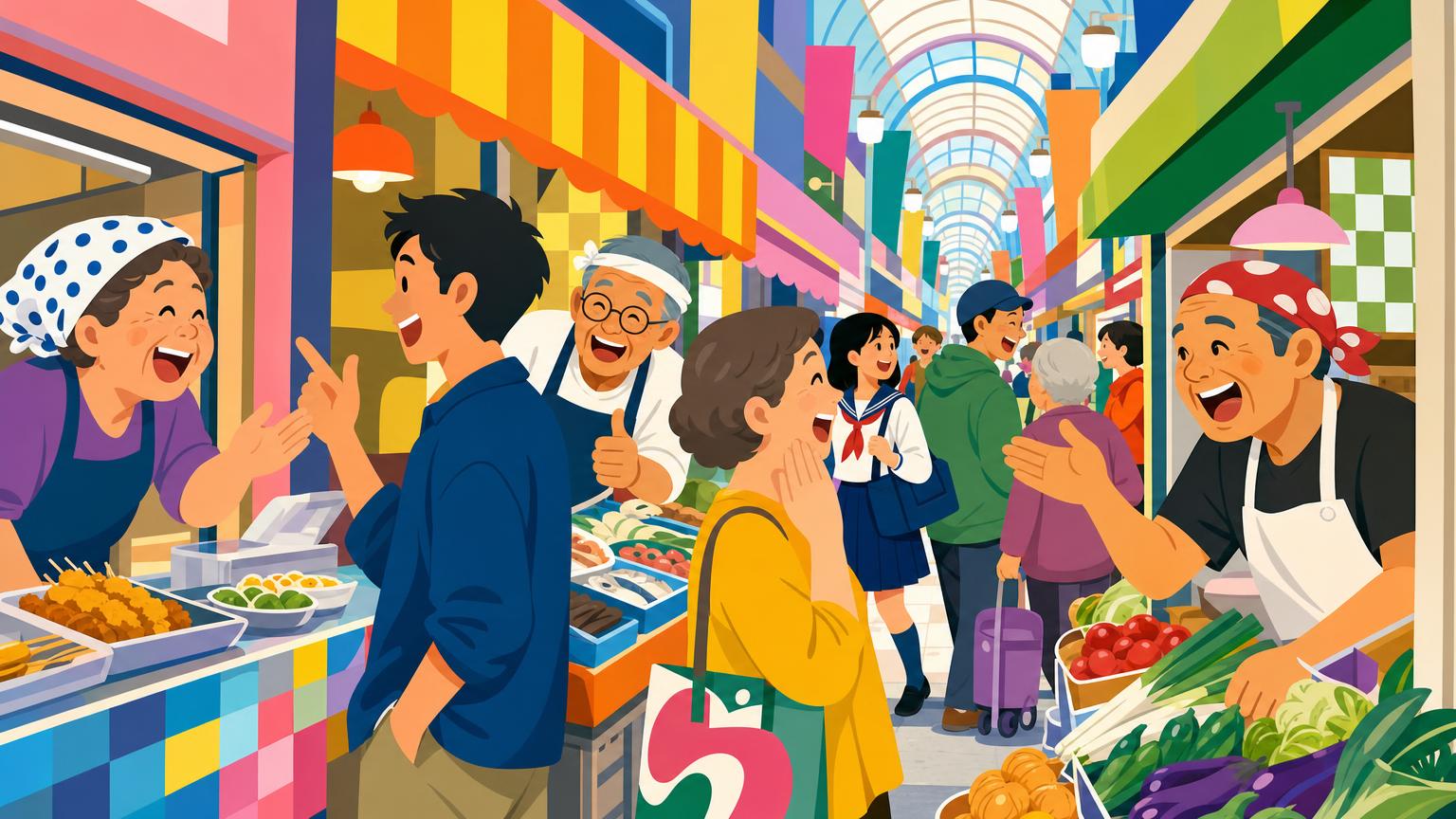
People often describe Osaka residents as friendly, but “friendly” is too vague to be especially useful. A more accurate description is that interactions in Osaka often make warmth visible through directness.
A shopkeeper may comment that you have bought a lot of vegetables. They might ask whether you are cooking for a party, tell you that the expensive strawberries are not worth the price today, or point out that your Japanese pronunciation is understandable but unusual. None of these comments necessarily represents a formal invitation into their personal life. Rather, they are forms of situational contact.
In Tokyo, a similar comment might be softened, avoided, or delivered in a more private setting. In Osaka, the same comment may arise openly, between weighing potatoes and wrapping a purchase. This difference does not mean that Tokyo people are cold or that Osaka people are universally open. It means that the acceptable boundary for casual public speech can feel different.
Osaka conversation often values a clear reaction. If someone makes a small joke, a blank expression can make the interaction feel unfinished. You do not need to laugh loudly, but a smile, nod, or brief answer helps the exchange land. If you understand the joke, you can respond. If you do not, “Wakaranakatta,” meaning “I didn’t understand,” may be enough. A shopkeeper may explain it, laugh, or simply move on.
The city’s association with manzai comedy also shapes its broader cultural image. Manzai commonly features a fast exchange between a “funny person” and a correcting or reacting partner. The style is known for rapid delivery, deliberate misunderstanding, and the contrast between the boke and tsukkomi roles. Japan’s government cultural publication identifies the modern form of manzai as strongly associated with Osaka and explains how the interaction depends on quick verbal rhythm.
Not every shopkeeper is secretly performing manzai. That would be another stereotype. However, the cultural comfort with quick reactions, playful correction, and verbal timing can influence ordinary conversation. A shopkeeper may make a comment, wait for your response, and then add a second comment based on your expression. The pleasure comes from the exchange, not merely from the information.
When Teasing Is a Form of Recognition
One of the most difficult things for foreigners to judge is teasing. A shopkeeper might say that you are buying enough bread to feed a football team. They might joke that your Japanese is getting too good. They might point to a bright shirt and ask, “Osaka style?” If you come from a culture where strangers avoid personal remarks, the comment may feel intrusive.
In Osaka, teasing can serve as a low-risk way to create familiarity. It gives the other person an easy opportunity to respond. If you laugh, the relationship becomes more relaxed. If you look uncomfortable, the speaker may change direction. This is not always done skillfully, and not every joke is harmless. Osaka’s reputation for banter should never be used to excuse racism, sexism, harassment, or invasive questions.
The important distinction is between teasing that creates a shared moment and teasing that places all the pressure on you. A shopkeeper who jokes about the amount of food you are buying may be trying to include you in the ordinary rhythm of the store. Someone who repeatedly comments on your body, nationality, relationship status, or private life is crossing a different line.
You are allowed to set boundaries. A polite “Chotto…” accompanied by a small smile can signal that you do not want to continue. Saying, “I’m still learning Japanese,” can slow down the exchange. If the interaction becomes genuinely uncomfortable, you can end the purchase and leave. Living in Osaka does not mean accepting every comment simply because it was delivered with a laugh.
At the same time, foreigners sometimes interpret every direct question as hostility. A shopkeeper asking where you live may be trying to find out whether you are a nearby resident. Someone asking whether you like natto may simply be looking for a safe topic. A comment about the weather may develop into a question about your commute. The conversation often begins with the immediate environment rather than a carefully prepared topic.
A useful response is to answer briefly and then ask a small question in return. “I live near Namba. Do you live nearby?” or “I like takoyaki, but I’m still learning about other Osaka foods. What do you recommend?” This shows openness without requiring you to share more personal information than you want to.
The Difference Between a Customer and a Regular
Shotengai relationships often develop through repetition rather than a single impressive conversation. A customer becomes familiar by returning on Tuesday evenings, buying the same type of bread, or asking for a particular cut of fish. The shopkeeper may not know the customer’s full name, but they recognize their habits.
This creates a social category that can be difficult for foreigners to understand. You may feel that you are either a stranger or a friend. In a shotengai, however, there are many stages in between. You can be a familiar customer without being invited into someone’s home. You can be greeted warmly without being expected to share personal information. You can receive a recommendation without owing anyone a favor.
A regular customer often receives more than just a product. The shopkeeper may remember their preferences, suggest a cheaper alternative, or explain that the quality will be better on another day. They may say, “Today’s one is not as good,” even though selling it would be in their financial interest. This is not universal, and businesses still need to make money, but the long-term value of trust can matter as much as the immediate sale.
Osaka’s idea of practical value also appears in its food culture. The local concept of “shimatsu” emphasizes using ingredients carefully, avoiding waste, and making the entire purchase or meal add up. It is often misunderstood as simple stinginess. Osaka’s cultural explanations describe it more accurately as thrift, resourcefulness, and the creative use of what is available.
That mindset can also appear in conversation. A shopkeeper may tell you not to buy more than you need. They may recommend a less expensive cut for a stew or say that yesterday’s vegetables are fine for soup but not ideal for salad. Such advice can sound blunt if you expect every seller to praise every product. In a neighborhood setting, honesty about value can be part of good service.
For a foreign resident, becoming a regular does not require spending a great deal. Buy something appropriate, greet the staff, pay carefully, and return occasionally. Learn the shop’s rhythm. If the store is crowded, do not force a conversation. If the owner is free and begins talking, respond naturally. Familiarity grows through reliable behavior, not dramatic friendliness.
How Shopkeepers Read Your Behavior
Before deciding how much to talk, shopkeepers often read practical signals. Are you browsing or ready to buy? Do you understand how the counter works? Are you blocking the narrow entrance? Do you want help, or would you prefer privacy? Are you a nearby resident, a curious newcomer, or someone taking photographs?
This is why body language matters. If you stand in front of a display and stare at your phone, the shopkeeper may not know whether you are choosing an item or waiting for a friend. If you make eye contact and nod, they may come over. If you say “Daijoubu desu,” they may understand that you do not need assistance, although the phrase can also mean “I’m fine” or “No thank you,” depending on your tone.
In many shotengai stores, the staff are not trying to provide a complete explanation of every product. They are working quickly. A simple question in Japanese can be more effective than a long sentence in English. “Kore wa nan desu ka?” means “What is this?” “Osusume wa?” means “What do you recommend?” “Kore wa ikura desu ka?” means “How much is this?”
If you cannot understand the answer, do not panic. You can use your phone’s translation function, point to the item, or say “Mou ichido onegaishimasu,” meaning “One more time, please.” Many shopkeepers will slow down, although their local dialect may still be difficult to understand. Even Japanese speakers from Tokyo or other regions sometimes need time to adjust to Osaka speech.
A common mistake among foreigners is apologizing too much. You do not need to say “Sumimasen” every time you enter a store, ask a question, or fail to understand a joke. Use it when appropriate, but pair it with a clear request. “Sumimasen, kore wa?” is more useful than repeatedly apologizing without asking a question.
Another mistake is treating the shopkeeper as an attraction. Taking photographs of products may be acceptable, but photographing someone’s face without permission is not made polite simply because the setting feels charming. Ask before taking close-up pictures. In a small store, move aside when other customers need to pass. These actions communicate respect more effectively than perfectly pronounced dialect.
The Quiet Side of Osaka Banter
The popular image of Osaka conversation is often loud, comic, and energetic. Yet daily life in a shotengai also contains long stretches of quiet. Shopkeepers may sit behind a counter, sort produce, read a newspaper, or watch the street without speaking to every customer. A quiet interaction is not a failed interaction.
This is relevant to foreigners who feel pressured to be entertaining. You do not have to perform friendliness or respond to every joke with an even better one. A nod, a purchase, and “Arigatou gozaimasu” may be enough.
Some older residents may be talkative with people they know but reserved with new customers. Some stores are family businesses whose staff are focused on preparation. Some employees come from other parts of Japan or from outside the country and do not use Osaka dialect. Some younger workers may prefer efficient service to banter. Shotengai culture is not frozen in the past; it changes with rents, aging populations, chain stores, online shopping, immigration, and new forms of work.
The Osaka resident you meet in a shopping arcade may also act differently at work, on a crowded train, or in a government office. Personality depends on context. “What are Osaka people like?” cannot be answered with a single adjective. A better answer is that Osaka offers many public situations in which informal, practical, and humorous communication is accepted.
Osaka Compared With Tokyo: Less Distance, Not Less Politeness
Foreigners often ask whether Osaka is friendlier than Tokyo. The question is understandable, but it can lead to an unhelpful comparison. Tokyo is enormous and socially diverse, while Osaka is also a large metropolitan area with many different neighborhoods, industries, and personalities. Neither city has a single, uniform personality.
The difference many newcomers notice is not that Osaka lacks manners, but that Osaka may reduce the distance between politeness and informality. A person can speak directly while still showing respect. A shopkeeper can joke with a customer without treating that customer like a close friend. A stranger can comment on the immediate situation without intending to establish a long-term relationship.
Interactions in Tokyo may feel more controlled in formal commercial spaces, particularly where staff use standardized service language. Osaka has those spaces as well. However, in local shotengai, the shopkeeper’s individual voice may be more noticeable. The service can feel less polished and more personal at the same time.
This difference can lead to opposite misunderstandings. A foreign resident from Tokyo may feel that an Osaka shopkeeper is being too familiar. A foreign resident from a more verbally expressive culture may find the interaction wonderfully open, then feel surprised when the same person does not offer deeper personal support. Informal speech is not the same as emotional intimacy.
The most accurate approach is to distinguish among three things: tone, intention, and boundaries. The tone may be playful. The intention may be to make the transaction more comfortable. Your boundary may still be that you do not want to discuss your salary, marriage, appearance, or private life. All three can be true at once.
Why “Friendly” Does Not Mean “Always Available”
Osaka’s reputation for sociability can create unrealistic expectations. Some foreigners move to the city expecting to form spontaneous friendships everywhere. They may feel disappointed when a shopkeeper who jokes with them does not invite them to dinner, or when a neighbor who chats with them in the elevator does not become a close friend.
A shotengai relationship is often situational and built through repetition. It may feel warm because both people share the same place and routine. That warmth is genuine, but it has limits. The shopkeeper may remember your order, ask about the weather, and tease you about your cooking while still keeping their private life separate.
This is not false friendliness. It is a social form found in many cultures, even though its style varies. The regular customer relationship offers recognition without requiring emotional exposure. For people who live alone, work from home, or have moved to Osaka from another country, this can become an important part of feeling rooted.
At the same time, foreigners should not assume that everyone in a local arcade wants to practice English. Some shopkeepers enjoy speaking with international residents, while others are busy, shy, or concerned that their English will not be good enough. If they respond in Japanese, this is not necessarily a rejection. It may simply be the language that allows them to work comfortably.
You can make the relationship easier by learning the names of a few products, using cash or another payment method the shop accepts, and showing that you understand the queue. Small acts of competence reduce the shopkeeper’s workload. Once the practical side becomes easy, there is more room for conversation to develop.
What Foreigners Often Misunderstand About Osaka Humor
Osaka humor is sometimes characterized as aggressive, but this description overlooks the role of mutual participation. Much everyday banter relies on the listener offering a small response. The speaker is not always presenting a complete joke; they are tossing a conversational ball in your direction.
If you respond with a smile, a brief laugh, or a question, the exchange can continue. If you look puzzled, the speaker may explain. If you remain silent, they may stop. This humor often depends more on timing and recognition than on a carefully constructed punchline.
Foreigners can also misunderstand self-deprecation. A shopkeeper may complain about sales, the weather, the cost of ingredients, or their own age. This does not necessarily mean they want sympathy or that the business is failing. Complaining can be a way of creating agreement. Saying “Taihen desu ne,” meaning “That sounds difficult,” is generally safer than immediately offering advice.
Another potential misunderstanding involves money. Osaka’s commercial identity has created a popular image of people who care intensely about prices. In daily life, many residents are careful shoppers, but careful spending does not mean that everyone is cheap or that every conversation centers on bargains. Asking “Nambo?” can be practical, humorous, or simply a form of local speech.
Food is another common point of connection. Osaka’s culinary identity is often summed up through takoyaki, okonomiyaki, kushikatsu, and the phrase “kuidaore,” meaning to eat until you are financially ruined. These foods are not merely tourist symbols; they are part of a culture that treats eating as social, conversational, and emotionally expressive. Government cultural coverage describes takoyaki as more than a snack in Osaka, linking it to local pride, tradition, humor, and shared culture.
Still, do not assume that every shopkeeper wants to talk about food. Someone selling vegetables may be more interested in your neighborhood, your work schedule, or whether you have managed to find a good doctor. Allow the topic to develop naturally from the interaction instead of presenting a prepared list of Osaka stereotypes.
A Practical Script for Your First Few Visits
You do not need advanced Japanese to build comfortable relationships in a shotengai. Consistency matters more than fluency.
When you enter, a small nod is enough. If the staff greet you, you can say “Konnichiwa” during the day or “Konbanwa” in the evening. If you are browsing, simply browse. If you need help, make eye contact and ask a brief question.
When buying something, say “Kore o kudasai,” meaning “This one, please,” or name the item. If you would like a recommendation, ask “Osusume wa nan desu ka?” If the staff make a joke and you do not understand it, say “Sumimasen, wakarimasen deshita,” or simply smile and say, “Japanese is still difficult for me.”
At the end, “Arigatou gozaimasu” is always a safe choice. If you become a regular, “Maido” or “Okini” may eventually feel natural. Do not worry if the shopkeeper continues using standard Japanese with you. Local expressions are not a test you have to pass.
If someone asks where you live, you can give a general answer such as “near Tenma” or “in Higashiyodogawa.” You do not have to share your apartment building, employer, income, or relationship status. If someone asks a personal question, answer only what feels comfortable and change the subject.
If you want to encourage conversation, ask about the product rather than the person. “Is this vegetable good for soup?” “Which bread is popular?” “Is this very spicy?” Practical questions are culturally comfortable and often lead to useful local advice.
If the shop is crowded, keep the exchange brief. Osaka banter may be lively, but the line still matters. A shopkeeper who is friendly with one customer may need to serve five others. Respecting the rhythm of the business is one of the clearest signs that you understand the setting.
The Unspoken Rules of a Local Shotengai
A shotengai is public, but it is not anonymous. People notice whether you are considerate, and the following habits help make daily life smoother.
Do not block the flow of the arcade
Covered shopping streets can be narrow and busy. Step to the side when checking your phone, waiting for someone, or deciding where to go. Avoid stopping in front of a shop entrance for a long conversation.
Do not treat every shop like a photo set
Ask before photographing staff, customers, or the inside of a store. Product displays may also be covered by store policy. If someone says no, accept the answer without arguing.
Do not assume that a joke gives you permission to joke about everything
Respond lightly, but avoid comments about a shopkeeper’s body, age, income, or family. Osaka communication may be direct, but respect is still important.
Do not confuse casual language with permission to use rude language
You may hear shopkeepers use informal speech with one another. That does not mean a new customer should immediately address everyone in rough dialect. Begin with polite Japanese and relax gradually as the relationship develops.
Do not negotiate automatically
Ask for the price first and check whether the store displays fixed prices. Bargaining may be welcome in some settings, but demanding a discount at an ordinary neighborhood shop can be uncomfortable.
Do not overstay because the conversation is interesting
A shopkeeper may enjoy talking while still having work to do. Finish your purchase, thank them, and return another day. Regular visits build more trust than one long conversation.
Do not mistake silence for dislike
Some of the strongest neighborhood relationships begin with quiet, repeated transactions. Someone who does not chat may still remember you and appreciate your reliability.
How to Become Part of the Neighborhood Without Performing Osaka
Foreign residents sometimes assume they need to become louder, funnier, or more extroverted to fit into Osaka. They do not. The most effective way to participate is to be observant and dependable.
Return to the same shops when appropriate. Remember a shopkeeper’s recommendation. Mention that you enjoyed the vegetables. If you asked for a special item, come back to say thank you. These small follow-ups show that the conversation mattered.
Learn a few local expressions, but do not use them like costumes. Saying “Okini” naturally is pleasant. Repeating “Okini” loudly to every person you meet can sound theatrical. The same applies to “Nambo?” or “Maido.” Language works best when it responds to a genuine need.
Accept that your relationship may remain limited. A shopkeeper can become an important familiar face without becoming your personal mentor. You can feel more connected to Osaka through repeated greetings even if your Japanese remains imperfect. Belonging is often built through small recognitions rather than dramatic declarations.
For people considering whether Osaka is a good place to live, this is one of the city’s practical strengths. Neighborhood life can provide more opportunities for low-pressure contact than a purely apartment-and-supermarket routine. You may learn where to buy good fruit, which bakery opens early, which pharmacy explains prescriptions patiently, or which shop will honestly tell you that today’s product is not worth buying.
The limitation is that shotengai culture is not equally strong in every neighborhood. Some arcades are busy and well maintained. Others have vacant storefronts, aging owners, shorter opening hours, or a quieter atmosphere. Osaka is changing, and local commerce faces the same pressures found throughout Japan. Online shopping, supermarkets, chain stores, demographic change, and rising operating costs all influence the future of these streets. The Osaka Prefectural Government has recently emphasized shopping arcades as places of conversation, local atmosphere, and community experience rather than merely places to buy goods, reflecting the continuing effort to keep these neighborhood spaces meaningful.
That change is also part of real Osaka life. The shotengai is not a museum of traditional friendliness. It is a living workplace adapting to new customers, new languages, and new economic realities.
When the Banter Becomes a Bridge
The most meaningful shotengai conversations often begin with ordinary things. A shopkeeper asks whether you know how to cook a particular vegetable. You explain that you are from the United States, and they ask whether the food is similar there. You mention that you are still learning Japanese, and they teach you a local word. You return the following week and remember it.
Nothing dramatic has happened, but the city has become more legible. You now know where to stand, how the shop operates, which expressions are jokes, and which questions are practical. The shopkeeper knows that you are not simply passing through. You are someone who may return.
This is the deeper meaning of banter in Osaka. It is not merely entertainment; it is a way of reducing social distance without requiring formal intimacy. It allows people to acknowledge one another through work, food, weather, money, family routines, and the small problems of the day.
The exchange may sound rougher than the polite Japanese taught in textbooks. It may include dialect, teasing, complaints, and comments that would feel too direct elsewhere. But within the right limits, it can also be generous. The shopkeeper is giving you an opportunity to respond. You are being invited to participate in the neighborhood’s rhythm, rather than observe it from behind glass.
Reading Osaka More Accurately
If you remember only one idea, remember this: Osaka warmth is often expressed through interaction rather than formal hospitality.
A shopkeeper may not offer a polished explanation. They might tell you that your choice is too expensive. They may laugh at your pronunciation, complain about the weather, or ask a question that feels more personal than expected. The surface can seem blunt. The underlying message may be, “I see you. You are here. Let’s make this ordinary moment a little more human.”
But warmth has boundaries. You can answer briefly, decline a topic, or leave. You do not need to become fluent in the Osaka dialect or turn yourself into a comedian. Respect the shop’s work, observe the pace of the street, and let familiarity develop gradually.
Compared with Tokyo, Osaka may allow more room for casual conversation in public commercial life. Compared with the stereotype of Japan as uniformly reserved, Osaka can feel remarkably direct. Compared with the stereotype of Osaka as nonstop comedy, everyday life is quieter, more practical, and more varied.
That balance is what foreigners often miss. Osaka is not simply “friendly.” It is a city where commerce, food, humor, and repeated neighborhood contact often overlap. In a local shotengai, a greeting can become recognition, recognition can become trust, and trust can become one of the small reasons a foreign resident begins to feel at home.