You may hear that Osaka people are open, humorous, and easy to talk to. That description is not entirely wrong, but it is too smooth to explain daily life here. Osaka friendliness is often practical, noisy, teasing, and built around shared routines rather than formal introductions.
A local sentō, or public bath, shows this especially clearly.
For many residents, a sentō is not a sightseeing stop or a dramatic cultural performance. It is where someone goes after a long shift, after caring for children, after sweating through summer, or simply because the apartment bath feels too small. You wash, soak, cool down, exchange a few words, and return home. The experience is ordinary. That is exactly why it is useful for understanding Osaka.
A sentō reveals how people share space without becoming intimate, how Osaka conversation begins without a formal invitation, and how the city’s practical attitude can feel warmer than its reputation suggests. It also shows why foreigners sometimes misunderstand Osaka. The person who jokes with you at the shoe lockers may not be offering a friendship. The older regular who says nothing may still be making room for you. The loud conversation across the changing room may sound confrontational, but it may simply be the local rhythm of relaxation.
This article is about living in Osaka, not collecting bathhouse experiences. It explains what a sentō means in everyday life, how to behave without anxiety, what Osaka people may expect from you, and how the bathhouse differs from the more polished image of urban life associated with Tokyo. The basic rules are simple: wash before entering the bath, keep clothing and underwear out of the bathing area, keep towels and long hair out of the water, and dry yourself before returning to the changing room. These rules are also confirmed by the Osaka bathing association and the Osaka Convention & Tourism Bureau.
What Is a Sento? Sento vs. Super Sento vs. Onsen
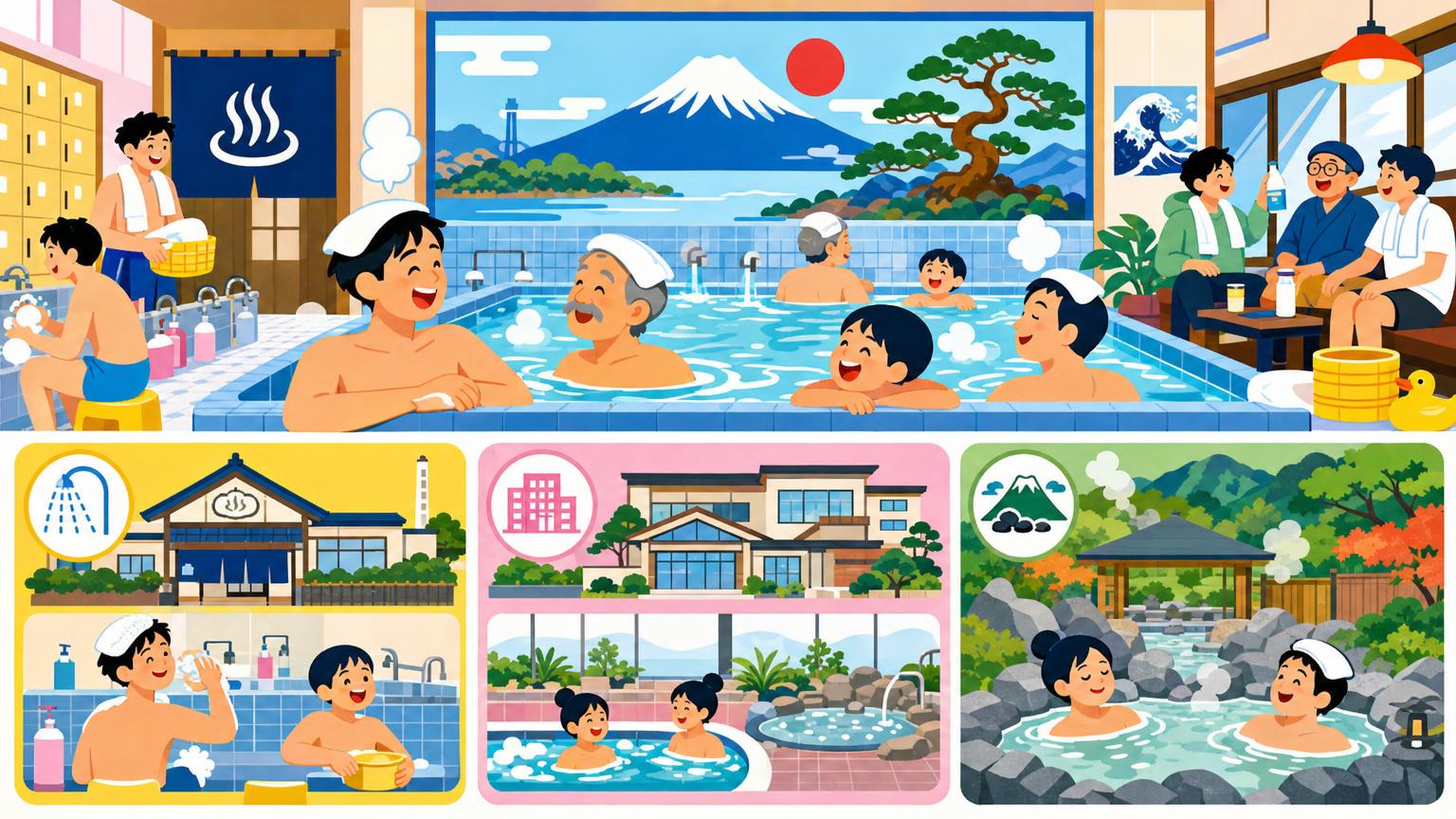
A sentō is a neighborhood public bath. You pay an admission fee, put your clothes in a locker, wash at a shared station, and soak in large communal tubs. The bathwater is generally heated tap water rather than naturally sourced hot spring water. The atmosphere may be small and old-fashioned or renovated and highly modern, but the basic concept remains the same: a shared bathing place used as part of everyday life.
An onsen is technically different. Its water must come from a recognized natural hot spring source. An onsen may be a small local facility, a ryokan bath, a resort, or a large urban complex. Not every place that advertises itself as an “onsen” feels traditional, and not every sentō feels basic. The key distinction is the source of the water, not whether the building appears luxurious.
A super sentō is a larger commercial bathing complex. It may offer several indoor baths, outdoor baths, saunas, cold plunges, restaurants, massage areas, nap spaces, manga corners, and family facilities. It is closer to a complete leisure center than a small neighborhood bath. Some large facilities use natural hot spring water, while others use heated or treated water, so check the facility’s own description.
The terms often overlap in conversation. An Osaka resident may casually say “furo” for the bath, “onsen” for a relaxing bathhouse, or “sentō” for a local public bath, even when the technical categories are more complicated. When choosing a place to visit, ask yourself what kind of evening you want.
A small sentō is usually best if you want to observe neighborhood life. A super sentō is better if you want more facilities, some privacy around the edges, and a longer stay. An onsen is the choice when the quality or source of the water matters to you.
The bathhouse is ordinary, not ceremonial
Foreign residents sometimes imagine that entering a sentō requires extensive knowledge of Japanese culture. It does not. It requires consideration.
The bathhouse is not a temple. You do not need to follow an elaborate ritual, nor do you need to speak perfect Japanese. You do need to pay attention to what other people are doing and avoid making the shared water or space unpleasant for them.
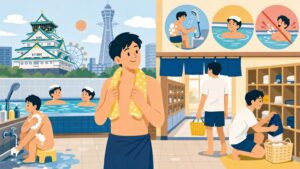
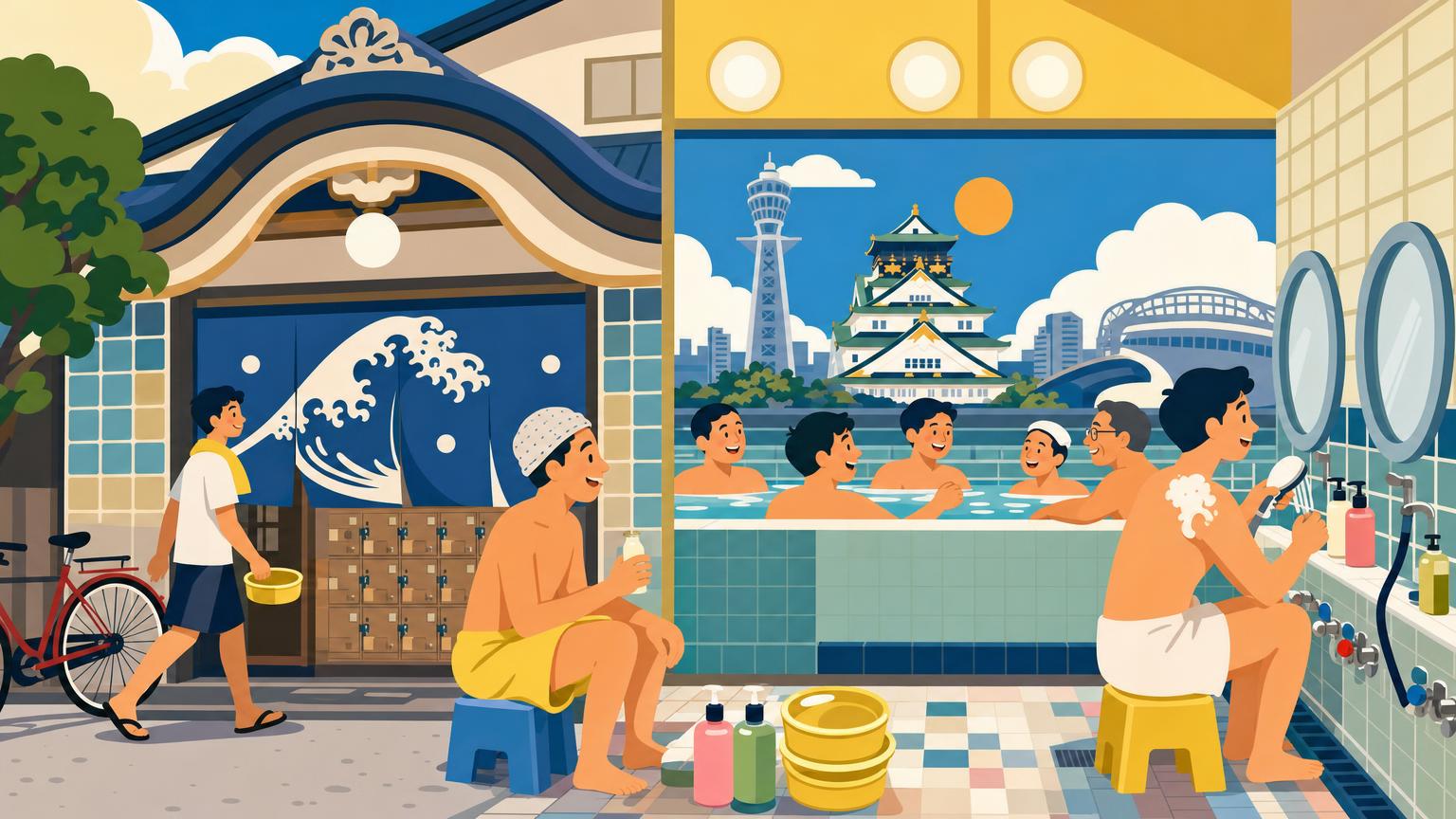
That distinction is important. Osaka is often easier to understand through ordinary habits than through formal cultural explanations. You learn the rhythm by observing: shoes come off first, payment takes place near the entrance, the men’s and women’s changing rooms are separate, clothing remains in the locker, bodies are washed before bathing, and people move calmly between the tubs.
The Osaka Prefectural Public Bath Association describes a sentō as a public bath that anyone can use during its designated hours, while stressing that shared use makes basic manners important. That is the central social idea. The bath belongs to no one person, so everyone must help maintain it.
Why sentō culture suits Osaka
Osaka has a strong culture of practical pleasure. People work hard, complain openly, eat quickly, laugh loudly, and look for ways to make everyday life more comfortable without turning comfort into a luxury product. A neighborhood sentō fits that outlook.
The building may feature a faded sign, a vending machine, a high ceiling, a painted wall, and several baths at different temperatures. The experience may include an electric bath that sends a surprising pulse through your muscles, a jet bath that directs water against your back, or a cold bath that regulars enter confidently, knowing their own limits.
The pleasure is immediate. You do not have to explain why you are tired. You do not need to book a wellness treatment or dress for a spa. You pay, wash, soak, and feel better.
This is one reason Osaka can feel different from Tokyo. Tokyo offers many polished, highly designed forms of relaxation, often organized around reservations, personal space, brand identity, or efficiency. Osaka certainly has those places as well. But the neighborhood sentō often seems less concerned with presentation. It is part of the infrastructure of everyday living.
That does not mean Osaka is always casual or Tokyo is always distant. It means the social meaning of a place can vary. In Osaka, a low-cost shared facility may become a small community room without anyone officially describing it that way.
Step-by-Step Sentō Etiquette for First-Timers
The easiest way to feel at ease is to know the sequence before you enter. Think of the bathhouse as a series of small transitions rather than one confusing room.
You do not need to copy every movement perfectly. Follow the main rules, move calmly, and ask staff if you are unsure. A simple “sumimasen” accompanied by a gesture is usually enough to get started.
Arriving and the Locker Room
At the entrance, remove your shoes and place them in a shoe locker. Many sentō have small lockers with keys, while others provide open shoe shelves. If an attendant is seated near the entrance, pay the bathing fee there. Some places have a ticket machine, so look near the front desk if you do not see an obvious payment counter.
The men’s and women’s bathing areas are normally separate. Look for 男 or 男性 for men and 女 or 女性 for women. If you are unsure, ask staff before walking through a curtain. This is especially important in older facilities, where the entrance layout may not be obvious to a foreign visitor.
After paying, enter the correct changing room and find an empty locker. Remove all clothing, including underwear, and place it inside. Do not bring your phone into the bath area unless the facility clearly allows it. Photography in the bathing area is generally inappropriate because other people are undressed and privacy is important.
Take only what you need. Usually, this means a small washing towel, a larger towel for drying, and any personal toiletries. Some sentō sell or lend towels, and larger facilities often provide shampoo and body soap. A small local sentō may not provide everything, so check beforehand if you need specific products.
The washing towel is not worn as clothing. It is used to wash your body and, later, to modestly cover yourself while walking between the washing area and the baths. The larger towel should remain in the changing room or on a shelf outside the bathing pools.
Before entering the bathing room, pause briefly. Notice where people leave their buckets and stools, whether the floor is slippery, and which tubs are in use. This short pause is helpful in Osaka because many local facilities are compact. There may be no staff member explaining every step in English.
The Washing Area Ritual
Wash your body before entering any shared bath. This is the most important rule.
Sit on one of the low stools in front of a shower or faucet. Rinse the stool before using it, then wash your hair and body. If the facility provides shampoo and body soap, they are usually placed near the washing stations or attached to the wall. If not, use your own supplies.
Do not stand while spraying water across other people. Keep the water within your own small area. When you finish, rinse the stool and return the bucket neatly.
This is not simply a hygiene rule. It reflects the logic of the sentō: the water in the bath is for soaking, not washing. Everyone shares it. Someone who enters without washing may appear to be disregarding the group, even if they did not mean to be rude.
Wash thoroughly, but do not turn the station into a long private shower. In a busy neighborhood bath, someone may be waiting for the seat. Osaka people are often relaxed about minor delays, but they also notice wasteful behavior. Do what you need to do, then make room.
If you have long hair, tie it up so it cannot touch the bathwater. Keep your towel out of the tub. You can place it on the edge of the bath, on a small rack, or on top of your head if that is comfortable. The towel should never be left floating in the water. These points are specifically included in public-bath guidance from the Osaka association and local tourism authorities.
Soaking in the Baths
Enter the bath slowly. Test the temperature with your hand or lower yourself gradually. Some Osaka baths are hotter than foreigners expect, and a bath marked “hot” may be genuinely hot rather than mildly warm.
Do not jump in, swim, splash, or spread your arms across a crowded tub. Keep your voice low enough that people nearby do not have to listen to your conversation. You may talk, especially in a social neighborhood bath, but the bath is not a swimming pool or a party room.
Try one bath at a time. A typical local sentō may offer a main bath, a warm bath, a jet bath, an electric bath, a cold bath, and perhaps a sauna. You are not expected to use all of them. The electric bath can feel unusual because the current creates a rhythmic tingling or muscle contraction. If you have a medical concern, feel unwell, or are unsure, skip it and ask staff.
The cold bath is optional as well. Regulars may move between hot and cold water as part of a contrast-bathing routine, but you do not need to imitate them. The official Discover Osaka feature on Sankukai Onsen describes a particular hot-and-cold sequence while also making clear that each person has their own way of finding comfort. Treat it as an example, not an instruction.
When someone else enters a small tub, make space if possible. If you want to adjust a temperature control in a facility where users can change it, ask first. In compact baths, the temperature may be part of the regulars’ shared routine.
If you need to leave the bathing room, rinse your body lightly if appropriate, use your small towel to remove excess water, and dry yourself before entering the changing room. The Osaka association specifically asks bathers to wipe themselves before returning to the dressing area because wet floors create a slipping hazard.
What Osaka People Are Doing in a Sentō
A sentō may appear quiet from the outside, but it is often socially active in subtle ways. People are not necessarily trying to make friends; they are sharing a familiar rhythm.
An older man might greet the attendant, choose the same locker area, soak in the same tub, and leave without saying much. A mother may bring her children and manage several towels at once. Two neighbors might discuss the weather, local construction, baseball, or the price of vegetables while sitting near the changing-room hair dryers.
The interaction is usually casual. You are not expected to introduce yourself to everyone. You are expected to acknowledge the space around you.
That distinction can help foreigners understand what “friendly” means in Osaka. Friendliness is often expressed through small acts rather than emotional disclosure.
Someone might point out an empty shower seat. Someone may warn you that a bath is extremely hot. Someone else may joke about your careful movements. The joke can be a way to reduce tension, not an invitation to have a long conversation.
Osaka speech often conveys more visible personality than the formal Japanese many foreigners learn in classrooms. People may use teasing, exaggerated reactions, and direct comments. Still, the bathhouse remains a shared public space. A humorous comment does not give you permission to ask personal questions, stare at bodies, or speak loudly in English across the room.
You can respond simply.
- “Arigatō” when someone helps you.
- “Sumimasen” when you need to pass or ask a question.
- “Atsui desu ne” when the water is hot.
- “Kimochi ii desu ne” when you want to say that the bath feels good.
You do not need to use Osaka dialect to participate. A few ordinary phrases, a calm manner, and attention to the rules are more useful than forced local slang.
The bathhouse as a temporary equalizer
One reason sentō culture feels socially meaningful is that clothing disappears. In the changing room, people are not presented as office workers, landlords, managers, students, or foreign residents. Everyone is simply getting ready to bathe.
This does not erase social differences. Age, confidence, language, and local knowledge still matter. However, the bathhouse reduces the performance of status. A person who looks intimidating outside may be quietly searching for the soap dispenser. Someone who seems reserved may offer you the most practical advice.
For someone living in Osaka, this can be a useful form of social contact. You may not form a close relationship, but you begin to recognize the character of your neighborhood. You learn when the bath is crowded, which hours are quieter, and how the regulars respond to newcomers.
The relationship is often weak in the formal sense but strong through repetition. You become familiar because you keep appearing again and again.
Why the ritual can matter after work
Many Osaka residents live in apartments with compact bathrooms. Even when the bath at home works perfectly well, a large public bath can change the feeling of the evening. You can stretch your legs, sit without rushing, and let the day come to an end in a public but non-commercial environment.
For shift workers, restaurant staff, factory workers, delivery drivers, caregivers, and people living alone, the sentō can create a boundary between work and home. The bath is not therapy in a clinical sense. It is a reset.
You wash away the sweat and mental noise of the day. Then you return to the changing room, drink water or a bottled coffee-milk drink, dry your hair, and step back onto the neighborhood street. The city has not changed, but your position within it has.
That is a very Osaka kind of pleasure: not escaping the city, but becoming comfortable in it once again.
Best Sento in Osaka for International Travelers
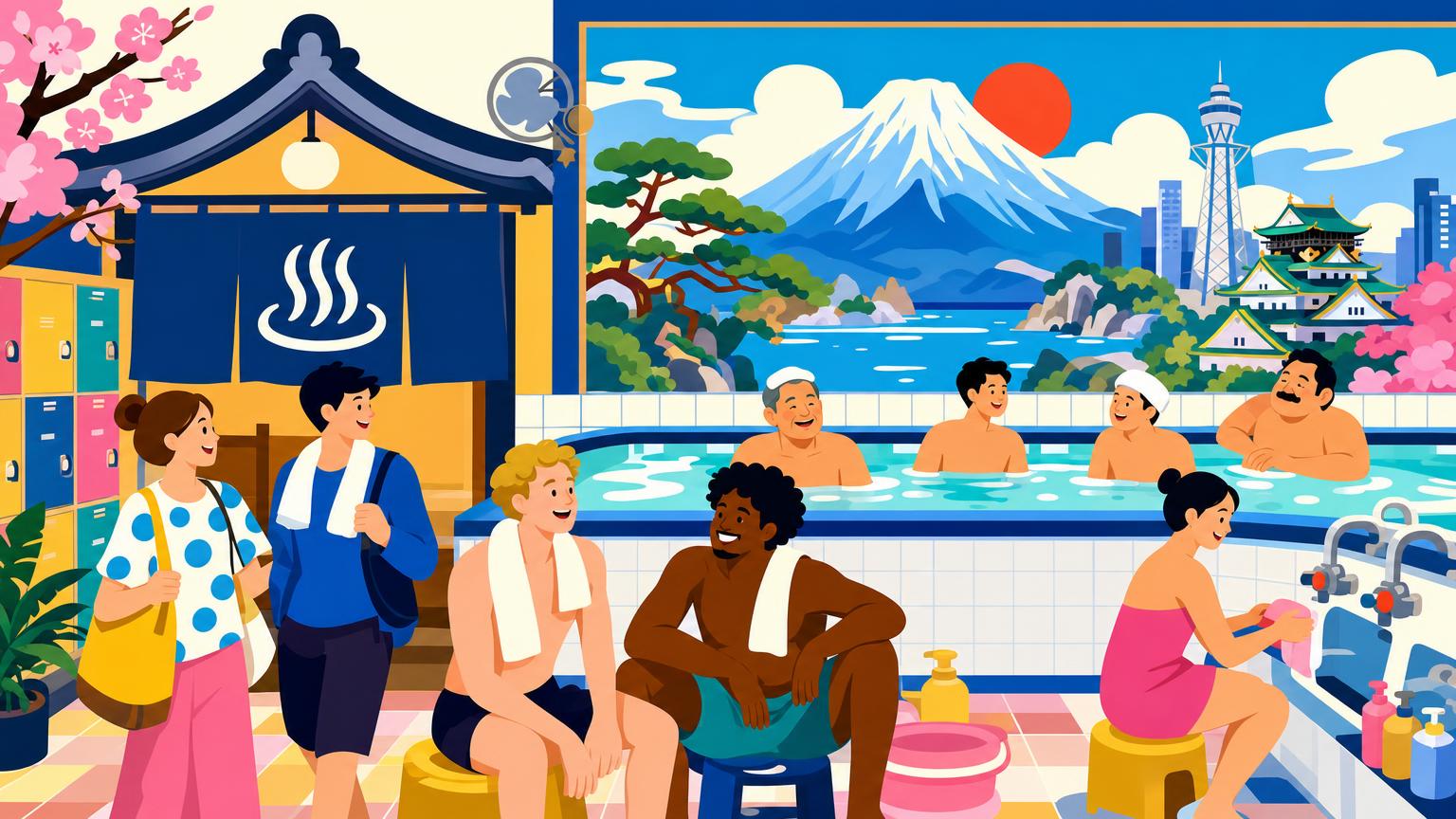
If you are looking for a sentō as a foreign resident, choose one based on the kind of relationship you want with Osaka. The best place is not necessarily the most famous; it is the one you can reach easily and visit regularly.
Policies, opening hours, facilities, and tattoo rules can change, so check the facility’s official information before visiting. The following categories are more useful than a fixed ranking.
Authentic Local Neighborhood Sentos
A small neighborhood bathhouse is the closest match to everyday sentō culture. It may be located in a residential district, near a shopping street, or behind a main road. The exterior may look modest, while inside you may find retro tiles, a bandai-style attendant’s counter, a high ceiling, a painted landscape, and a mix of regulars who have used the facility for years.
In Osaka City, Ikuno Ward is often associated with a high concentration of public baths. A Discover Osaka feature reported that, as of January 2024, Osaka Prefecture had 272 open sentō and that 25 of them were concentrated in Ikuno Ward. Numbers can change as facilities close or reopen, but the broader point remains: sentō culture is spread throughout residential Osaka and is not limited to central tourist areas.
Neighborhood options are useful when you want to understand how people live rather than how a facility markets itself. You may see regulars arriving alone, families visiting together, and people turning a place that is not designed for tourists into part of their evening routine.
The trade-off is that English support may be limited. Do not interpret limited English as hostility. The staff may simply be operating a small local business where most customers already understand the procedure.
Your best strategy is quiet observation. Pay at the appropriate place, follow the flow, and ask for help only when necessary. If you return more than once, the environment will gradually feel less mysterious.
Super Sentos and Large Bath Complexes
A super sentō is often easier for first-time visitors who want more facilities and a longer, less intimate visit. You may find several indoor and outdoor baths, saunas, cold baths, restaurants, relaxation rooms, massage services, and amenities such as shampoo, towels, and skincare products.
Solaniwa Onsen OSAKA BAY TOWER is one example of a large urban hot spring complex. Its official information describes multiple natural hot spring baths, outdoor areas, carbonated baths, saunas, private baths, and included amenities. It also uses a more structured facility system, including yukata clothing and electronic payment procedures within the complex.
This type of place can feel less like a neighborhood institution and more like a leisure business. That is not necessarily a criticism. It may be exactly what you need after moving to Osaka, particularly while you are still learning the language or looking for a predictable environment.
The trade-off is cost and atmosphere. A super sentō is generally more expensive than a local sentō, and you may spend much of your time among visitors from outside the neighborhood. It can show you how Osaka creates relaxation on a larger commercial scale, but it may not reveal the quiet social familiarity of a small bathhouse.
For people searching for Osaka onsen for foreigners, large facilities often offer clearer signs, multilingual pages, rental towels, and staff who are accustomed to international visitors. Still, do not assume that “foreigner-friendly” means that the rules are optional. You must still wash before bathing, keep swimsuits out of the communal bath, and follow tattoo policies.
Tattoo-Friendly Sento in Osaka
Tattoo policy is one of the most important practical considerations for foreign residents. There is no single rule that applies to every bathhouse. Some facilities refuse tattoos, some allow them when covered, and others allow them without concealment. Some may make decisions based on size, location, or their own individual policy.
Do not rely on an old blog post or a casual recommendation. Check the official policy directly before visiting, and ask the staff if the English information is unclear.
Healthy Spa Tateba is one Osaka example publicly presented as allowing guests with tattoos through an Osaka tourism experience listing. The same listing describes it as a traditional local bath popular with residents and mentions facilities such as aerobic and jet baths. Since policies and operating conditions can change, confirm before visiting instead of treating an old listing as a permanent guarantee.
Some large onsen complexes take a different approach. Solaniwa Onsen states that tattoos and other body art are generally not permitted, but its current official policy allows entry when all tattoos are fully covered with the facility’s own concealing stickers. The policy also explains that any visible tattoo can result in removal from the facility.
When asking about tattoos, a simple sentence is enough:
“Tattoo wa daijōbu desu ka?”
You can also show a written translation on your phone, but do not photograph the bathing area or other customers. If the answer is no, accept it calmly. The rule may feel unfair or outdated, but arguing at the front desk rarely improves the situation and may make a small business uncomfortable.
Natural hot springs in Osaka and the idea of escape
Osaka is a large city, but natural hot springs are not limited to distant mountain resorts. Urban complexes can pump hot spring water from underground, while rural facilities in the wider prefecture offer a different experience surrounded by greenery.
This matters culturally because Osaka residents often move between intense urban life and short, practical forms of escape. A large city bath, a neighborhood sentō, and a countryside hot spring can all serve the same emotional purpose: creating distance from work without requiring a complete change in identity.
You do not have to travel far to experience that distance. Sometimes the shift takes place between your apartment door and the entrance to the bathhouse.
Essential Tips for Your Osaka Bathhouse Visit
What to Bring with You
For a local sentō, bring a small towel, a larger towel, shampoo, body soap, a change of clothes, and a small bag for wet items. Some facilities rent or sell towels, but do not assume that every small bathhouse follows the same system.
You may also want to bring:
- A small coin purse, as some older facilities still operate mostly with cash.
- A water bottle for after bathing, especially in hot weather.
- A plastic bag for damp towels and toiletries.
- Hair ties if you have long hair.
- Any medication or personal care items you normally need, kept outside the bathing area unless the facility allows them.
Do not bring expensive jewelry, unnecessary electronics, or valuables. The locker system is intended for ordinary use, but you remain responsible for your belongings.
Avoid entering immediately after heavy drinking. Osaka’s tourism guidance warns that drinking alcohol before soaking can cause physical problems, and the combination of alcohol, heat, and dehydration is not a safe way to relax.
If you are sick, dizzy, extremely tired, or have a medical condition affected by heat, do not force yourself to bathe. A sentō is meant to provide comfort, not test your endurance.
Sento Hotels in Osaka
Some hotels have their own sentō-style public baths, while others are connected to larger onsen or spa facilities. This can be convenient if you want to experience the bathhouse routine without navigating a small neighborhood establishment on your first visit.
When looking for Osaka sento hotels, read the description carefully. Terms such as “public bath,” “large bath,” “onsen,” and “spa” may refer to different facilities. Check whether the bath is included in the room price, whether day visitors can use it, whether the bath is gender-separated, whether tattoos are accepted, and whether towels and toiletries are provided.
A hotel bath often feels more controlled than a local sentō. The signs may be clearer, operating procedures more standardized, and staff more accustomed to non-Japanese guests. This makes it a comfortable starting point, but it can also keep you within a visitor-oriented bubble.
If you live in Osaka rather than simply passing through, try both. Choose a hotel or large bath when you want convenience, and visit a neighborhood sentō when you want to understand the area where you actually live.
When to Go
There is no universally perfect time to visit. Early evening can be busy as people finish work. Later in the evening may be quieter, though some families and older regulars may still be using the bath. Weekends can bring more children and groups.
The best time depends on the facility and the atmosphere you want. If you are nervous, go during a quieter hour and avoid the busiest period. If you want to observe neighborhood life, early evening can be more revealing.
Pay attention to the rhythm for yourself. After two or three visits, you may start to notice a pattern: the same bicycle outside, the same person buying milk, or the same staff member at the counter. That repetition is the beginning of belonging in Osaka—not a dramatic welcome, but a familiar face.
How to Handle Language Gaps
Do not wait until you can speak perfect Japanese. Use a few words, gestures, and patience.
Useful phrases include:
- “Sento wa hajimete desu.” — This is my first time at a sentō.
- “Kashii towel wa arimasu ka?” — Are towels available for rent?
- “Shampoo wa arimasu ka?” — Is shampoo available?
- “Tattoo wa daijōbu desu ka?” — Are tattoos allowed?
- “Doko desu ka?” — Where is it?
- “Arigatō gozaimasu.” — Thank you very much.
A staff member may respond in Japanese, and that is fine. The goal is not to have a perfect conversation, but to resolve the practical question without embarrassment.
Osaka people may seem direct when they are helping. Someone may point, repeat a word, or use a strong facial expression. Try not to interpret every expression as anger. In everyday Osaka interactions, efficiency and emotional warmth can exist side by side.
What Foreigners Often Misunderstand About Osaka Sentō Culture
“Everyone will talk to me”
Not necessarily. Osaka’s reputation for conversation does not mean that every public space is socially open at all times. People may joke with strangers in one setting while maintaining complete privacy in another.
A bathhouse is communal, but that does not automatically make it conversational. Begin with simple greetings and practical comments. If someone continues speaking, respond; if they return to silence, allow the conversation to end.
“A local joke means we are friends”
It may simply mean that the atmosphere feels comfortable for a moment. Osaka humor often lowers barriers, but it does not always establish a personal relationship. Do not immediately ask about income, age, marriage, tattoos, or family just because someone made a joke about the hot water.
Usually, the best response is to laugh lightly, answer briefly, and continue behaving respectfully.
“Quiet people are unfriendly”
A quiet regular may be showing respect by avoiding intrusion. Some people visit the sentō specifically to enjoy a space where no one expects conversation.
In Tokyo, foreigners sometimes describe public interactions as distant because people avoid direct engagement. In Osaka, the same reserved behavior may be misunderstood because the city has a reputation for louder conversation. The reality is mixed. Osaka includes both highly social people and those who simply want to soak in peace.
“The rules are old-fashioned, so they do not matter”
The rules matter because the bath is shared. You may disagree with a tattoo policy or find the no-swimsuit rule unfamiliar, but ignoring it affects everyone in the room.
A sentō is not a place to prove that your own cultural habits are equally valid. It is a place to learn how this particular shared system works. You can decide later whether it suits you.
“A sentō is the same as bathing at home”
The physical act is similar, but the social setting is different. At home, you control the temperature, timing, noise, and privacy. At a sentō, you are one person in a shared environment.
As a result, small actions become more noticeable. Leaving a wet floor, occupying a shower seat for too long, placing a towel in the bath, or entering without washing can seem more significant than it would at home.
Frequently Asked Questions
Can you wear underwear or a swimsuit in a sentō?
No, you generally cannot wear underwear or a swimsuit in a sentō’s communal bathing area. Remove all clothing, including underwear, before entering the bathing area and baths. Swimsuits are also generally prohibited unless the facility specifically states otherwise.
This may feel uncomfortable if you come from a culture where public bathing involves swimwear. Remember that everyone follows the same system. Keep your small washing towel with you for practical modesty while walking, but do not use it as clothing in the bath or place it in the water.
If you prefer a private bathing experience, look for a private bath, family bath, or hotel room with an attached bath. These options have different rules and may require an advance reservation.
Are sentō always separated by gender?
Most sentō have separate men’s and women’s bathing areas, although some facilities offer private baths or special arrangements for families and certain users. Check the facility’s current rules before visiting. Large complexes may have separate bathing floors, while private baths may have their own restrictions.
Do not enter a changing room based only on its color or the position of the curtain. Look for the Japanese characters 男 and 女, or ask a staff member. Asking a simple question is better than making an embarrassing mistake.
Gender separation does not mean the atmosphere is formal or silent. Within each bathing area, people may talk, laugh, bring children, or relax quietly. The important boundary is maintaining privacy between the bathing areas and showing consideration within each one.
Is a sentō the same as an onsen?
No. A sentō is a public bath that usually uses heated tap water, while an onsen uses naturally sourced hot spring water recognized under Japanese standards. In everyday conversation, however, people sometimes use the terms loosely, and large facilities may combine sentō-style services with natural hot spring baths.
The distinction matters if you care about the water’s source and mineral qualities. It matters less if your main goal is to wash, warm up, rest, and experience an ordinary Osaka routine.
Are tattoos allowed in Osaka sentō?
Some Osaka sentō allow tattoos, while others do not. The policy is determined by each facility and may change over time. Confirm the rules directly before visiting, especially if you have visible or large tattoos. Healthy Spa Tateba has been publicly described by an Osaka tourism listing as accepting guests with tattoos, while Solaniwa Onsen currently describes a cover-sticker system under a generally restrictive policy.
Do not assume that a tattoo-friendly sentō Osaka search result is still accurate months later. Check the facility’s official information or call ahead.
Can foreigners use a local neighborhood sentō?
Yes, foreigners can use sentō as long as they follow the facility’s rules. You do not need to be a Japanese citizen, speak fluent Japanese, or understand every local custom before your first visit.
The more local the facility, the more helpful it is to be self-directed. Bring your own basic supplies, observe the flow, keep your voice at a moderate volume, and ask politely when you need assistance. The bathhouse may not have multilingual signs, but that does not mean you are unwelcome.
Should you talk to people in a sentō?
Talk if conversation develops naturally, but do not assume that it is expected. A greeting, a brief comment about the temperature, or a thank-you is enough.
Osaka’s social life often develops through repeated, low-pressure contact. You do not need to turn one bath into a friendship. Visit regularly, behave considerately, and let familiarity grow at its own pace.
Learning Osaka Through the Water
A local sentō will not explain Osaka to you in a polished speech. It will reveal the city through small movements.
You will see how people make space for one another without announcing their generosity. You will notice that direct speech can exist alongside careful boundaries. You will experience how a low-cost public facility can offer dignity, comfort, and a sense of routine. You will also learn that Osaka’s famous openness is not a constant performance. Sometimes it is a joke. Sometimes it is a warning about the hot water. Sometimes it is simply the fact that no one makes you feel strange for being new.
Compared with Tokyo’s more polished image, Osaka can feel less controlled at the edges. The bathhouse may be louder, more visibly worn, more personal, and less interested in concealing ordinary life. That does not make it better in every situation. It may also mean fewer explanations in English, tighter spaces, stronger smells, unpredictable temperatures, and rules that are not negotiated on an individual basis.
But for someone deciding whether Osaka is a good place to live, that unpolished quality is part of the answer. Osaka is often most comfortable when you take part in its routines instead of waiting for the city to entertain you. You shop at the local supermarket, recognize the convenience-store staff, learn which train car is crowded, greet your neighbor at the garbage station, and eventually figure out which sentō is busiest after work.
You do not become an Osakan by mastering a dialect or imitating a comedian. You feel more at home when you understand the practical rhythm of shared life.
So start simply. Choose a bathhouse you can reach without a difficult journey. Check its current rules, especially those concerning tattoos. Bring a towel. Wash carefully. Keep the shared water clean. Let the conversation happen if it happens. Then walk home with warm skin and a clearer feeling for the neighborhood around you.
That is the everyday lesson of sentō culture: relaxation is not always private, expensive, or silent. In Osaka, unwinding can be a public habit. It can be ordinary, slightly noisy, quietly social, and deeply local.