You may walk into a small Osaka kissaten, point to a sandwich, and then realize that the bread contains milk, the filling contains mayonnaise, the soup is made with chicken stock, and the kitchen has no separate preparation area. For many foreign residents, this is the moment when a simple coffee break becomes a careful negotiation.
The difficult question is not only, “What can I eat?” It is also, “How much can I ask for?” In Osaka, a neighborhood kissaten is often a family-run business with a small kitchen, a short menu, and a long memory of regular customers. The owner may be willing to help, but the shop may not be organized like a modern allergen-conscious restaurant. A request that feels ordinary in another country can sound unusually demanding in a tiny café where one person is taking orders, cooking, serving, and handling payment.
This is not a guide to fashionable cafés or famous sightseeing stops. It is a practical look at everyday Osaka: how people communicate, how neighborhood businesses protect their rhythm, how special dietary needs are understood, and how you can ask for changes without creating confusion or false confidence.
A kissaten can still be one of the most comfortable places in Osaka. You may find a quiet table, a small toast set, a glass of tea, a simple fruit drink, or a pudding made with care. But the experience works best when you understand the difference between a preference and a medical necessity, choose the right kind of shop, and make your request before the kitchen has already started cooking.
What Is a Kissaten in Japan?
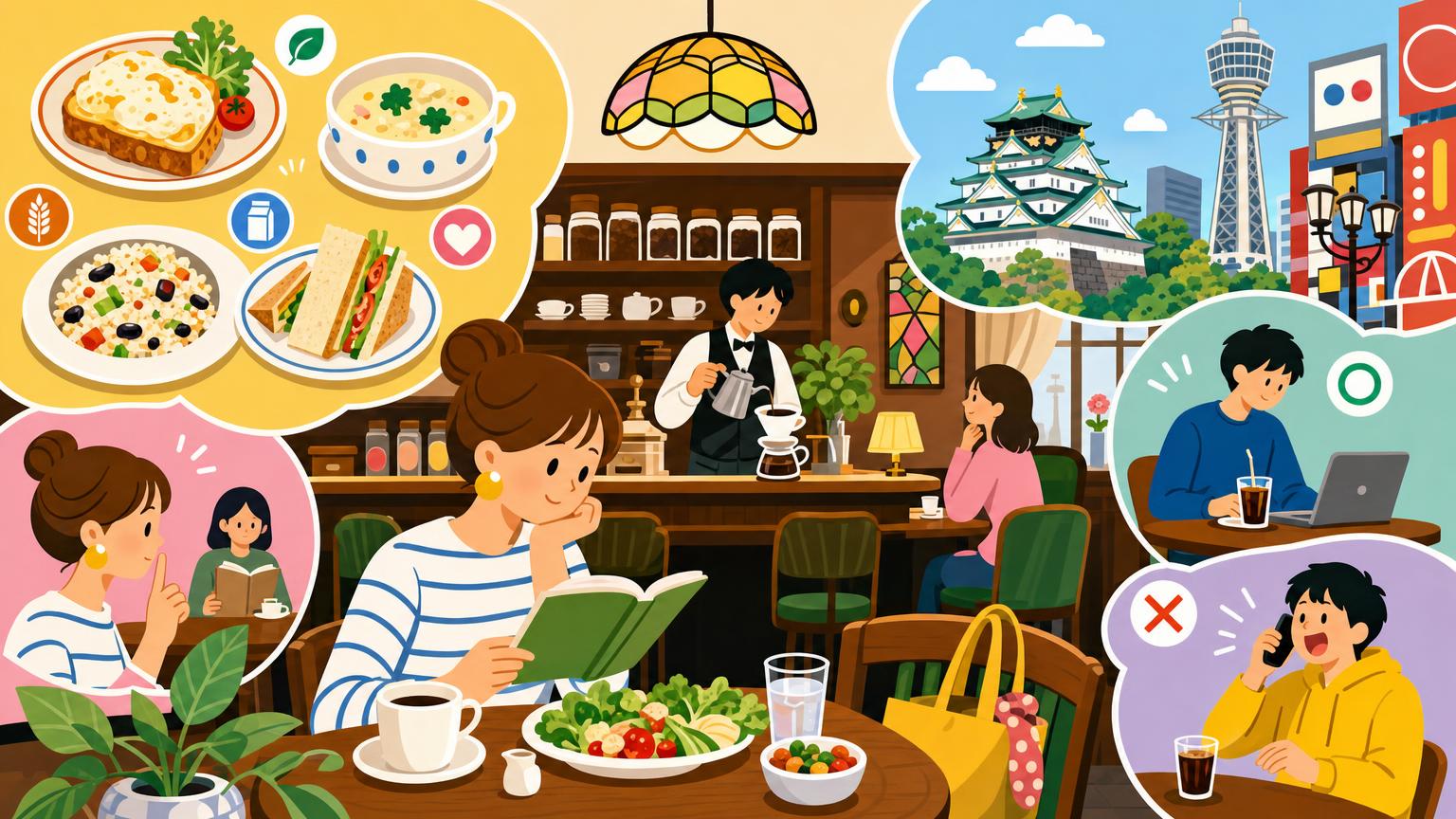
A kissaten is a traditional Japanese coffee shop, typically centered on coffee, tea, light meals, sweets, and a calm place to sit. A pure kissaten, or junkissa, traditionally focuses on non-alcoholic café food and drinks rather than offering a full restaurant menu. The term does not automatically mean that the shop is old, smoke-filled, or unhealthy. It describes a style of business and a social atmosphere, although many older shops do feature retro interiors and long-established recipes.
The atmosphere differs from that of a modern chain café. A chain café generally promises consistency, quick ordering, standard ingredients, and predictable seating. A neighborhood kissaten often offers something less formal: the owner’s coffee blend, a familiar breakfast set, a particular egg sandwich, or the same pudding that has been served for decades. The menu may be printed on a laminated sheet, written on a board, or explained verbally. The kitchen may be visible, and the person taking your order may also be the one who knows which regular customer prefers less sugar.
This distinction matters when you have special dietary needs. A large chain may publish allergen information and have a customer-service procedure. A small kissaten may know the ingredients in its signature dishes very well, but may not know every hidden ingredient in commercial bread, mayonnaise, margarine, ham, soup stock, or dessert toppings. The shop’s confidence and its ability to guarantee safety are not necessarily the same thing.
A junkissa and a jazz kissa are also different. A junkissa is primarily a traditional coffee shop serving light meals and sweets. A jazz kissa is a listening-focused coffee shop where the music, sound system, and quiet atmosphere may be more important than conversation. A jazz kissa may offer coffee and a small snack, but it is generally not the best place for a lengthy discussion about substitutions. The room may be designed for serious listening, and the owner may prefer to keep the menu very limited.
For daily life in Osaka, kissaten are useful because they occupy a space between home and work. They are places for a morning set before a shift, a quick coffee after a doctor’s appointment, a quiet meeting, or a short rest while running errands. People do not always visit them to discover something new. They go because the shop is nearby, familiar, and dependable.
Why Dietary Requests Feel Different in Osaka
Foreign residents sometimes describe Osaka as more relaxed than Tokyo, particularly in casual conversation. There is some truth to this, but “relaxed” does not mean that every request will automatically be easy. Communication in Osaka is often direct, humorous, and practical. Staff may say, “That’s difficult,” sooner than you expect. This can sound unfriendly in English, but it is often a useful response rather than a personal rejection.
In Tokyo, a staff member may use very formal language and try to soften an impossible request. In Osaka, a shopkeeper might respond with a brief explanation, a raised eyebrow, or a direct suggestion: “That one is not possible. This drink is okay.” The style can feel blunt, but it may spare you from a dangerous misunderstanding.
Osaka also has a preference for keeping things moving. A request is easier to accept when it is clear, limited, and made at an appropriate moment. It becomes more difficult when it changes several parts of the menu, holds up the queue, or asks the shop to create a dish it does not normally serve.
This is not because people in Osaka do not care. Neighborhood hospitality often involves practical adjustments rather than elaborate service. Someone may quietly remove a garnish, suggest toast without butter, or tell you to choose a drink instead of a meal. The kindness is sometimes concealed within a refusal.
A foreign customer may misunderstand three things:
- A smile does not always mean that the staff understood the allergy.
- “No problem” may mean “we can remove the obvious ingredient,” not “we can guarantee that there will be no trace of it.”
- A direct “impossible” may be a responsible answer rather than poor service.
If your condition is medically serious, treat a vague answer as a no. In a small kissaten, cross-contact may be impossible to control even when the staff is careful. A shop that offers a gluten-free-looking salad may still use shared knives, cutting boards, tongs, or counters. A fruit drink may be prepared in the same blender as a milkshake. A sandwich without cheese may still contain butter or mayonnaise.
Osaka’s Traditional Light Meals and Where Hidden Ingredients Appear
Osaka kissaten food is often simple in appearance yet layered in ingredients. The most familiar light meals include toast, sandwiches, napolitan spaghetti, curry rice, omelet rice, hot cakes, pudding, fruit drinks, and morning sets. These dishes may be convenient, but “simple” does not mean free of ingredients.
Toast and Morning Sets
A morning service, or morning set, commonly pairs a drink with toast, an egg, salad, or a small side dish. In Osaka, this style of breakfast is part of everyday café culture rather than a special occasion. Some shops offer a low-cost set during the morning, while others serve a more substantial plate.
Toast raises several questions. Is butter already spread on it? Is margarine used? Is the bread made with milk, eggs, soy, or wheat? Does the egg come with mayonnaise? Is the jam shared from a container? If you are avoiding dairy but can eat wheat, plain toast may be possible, but you should ask for “バターなし,” meaning without butter. If you need to avoid wheat, ordinary toast is unsuitable even if the topping is removed.
A useful request is:
- “バターなしでできますか?” — Can you make it without butter?
- “パンに乳製品は入っていますか?” — Does the bread contain dairy?
- “卵は大丈夫ですが、マヨネーズなしでお願いします。” — Eggs are okay, but please make it without mayonnaise.
Keep your sentence short and state one important condition first. If you list ten ingredients in rapid English, the conversation may become less safe rather than more precise.
Egg Sandwiches and Thick Tamago Sando
The thick egg sandwich is a classic kissaten light meal. It may be prepared with a soft omelet, boiled egg salad, or both. The bread may be lightly toasted or served soft. It is filling without feeling like a full restaurant meal, which is why it is popular with office workers and students.
Egg sandwiches are not automatically vegetarian. The bread may contain dairy, the filling may include ham, and the seasoning may contain chicken stock or bacon flavoring. Mayonnaise is also common. Customers who avoid meat should ask specifically about ham, bacon, and meat-based stock instead of simply saying “vegetarian.”
Useful vocabulary includes:
- “肉なし” — no meat
- “ハムなし” — no ham
- “ベーコンなし” — no bacon
- “マヨネーズなし” — no mayonnaise
- “だしに肉や魚は入っていますか?” — Does the stock contain meat or fish?
The last question is especially important in Japan. A dish may appear vegetarian while using dashi made from bonito, sardines, chicken, or pork. Some staff interpret vegetarian requests as “no visible meat,” not “no animal-derived ingredients.” You need to explain the level of restriction clearly.
Mixed Juice and Fruit Drinks
Osaka’s mixed juice is a famous kissaten drink made from fruit, often with milk or another creamy ingredient. The exact recipe differs from shop to shop. At established shops, the mixture may contain banana, orange, peach, pineapple, milk, syrup, or ice cream. The signature mixed juice at Junkissa American in Namba uses fresh fruit and is presented as one of the shop’s defining drinks. Its official menu also lists separate fruit juices and non-creamy options.
Mixed juice can be helpful for someone who needs a light snack rather than a full meal, but it is not automatically vegan, dairy-free, or low-sugar. Ask whether it contains milk, ice cream, yogurt, or syrup. If the blender is shared, ask whether it can be washed before preparation. For a severe milk allergy, a separate juice served in a clean glass may be safer than a modified mixed juice, although the shop may still be unable to guarantee the process.
Napolitan, Curry, and Omelet Rice
Kissaten spaghetti, usually called naporitan, often includes ketchup, onions, green peppers, sausage, ham, or bacon. Even when the visible meat is removed, the cooking surface may still be shared. Curry rice can contain beef, pork, chicken, or commercial roux containing milk, wheat, soy, or animal ingredients. Omelet rice may be prepared with butter, demi-glace sauce, chicken stock, or meat-filled rice.
These dishes are generally poor choices for a quick special request. They require several cooking steps and sauces. If you have a strong allergy or follow a strict religious diet, choose a shop that clearly lists its ingredients or specializes in accommodating dietary needs rather than expecting a small kissaten to reconstruct its main dish.
Pudding, Hot Cakes, and Cream Soda
Traditional kissaten desserts often contain eggs, milk, wheat, butter, or whipped cream. Classic pudding may be made in-house, but “homemade” does not mean allergen-free. A hot cake may be cooked on a shared griddle. Cream soda usually contains ice cream, while the soda itself may be dairy-free.
If you only need to avoid cream, ask whether the drink can be served without the ice cream. If you have a milk allergy, ask about the soda, syrup, glass, and shared equipment. If you avoid alcohol, confirm that the dessert sauce does not contain liqueur. Most traditional café sweets are not vegan unless the shop specifically states otherwise.
How to Find a Kissaten That Can Handle Your Needs
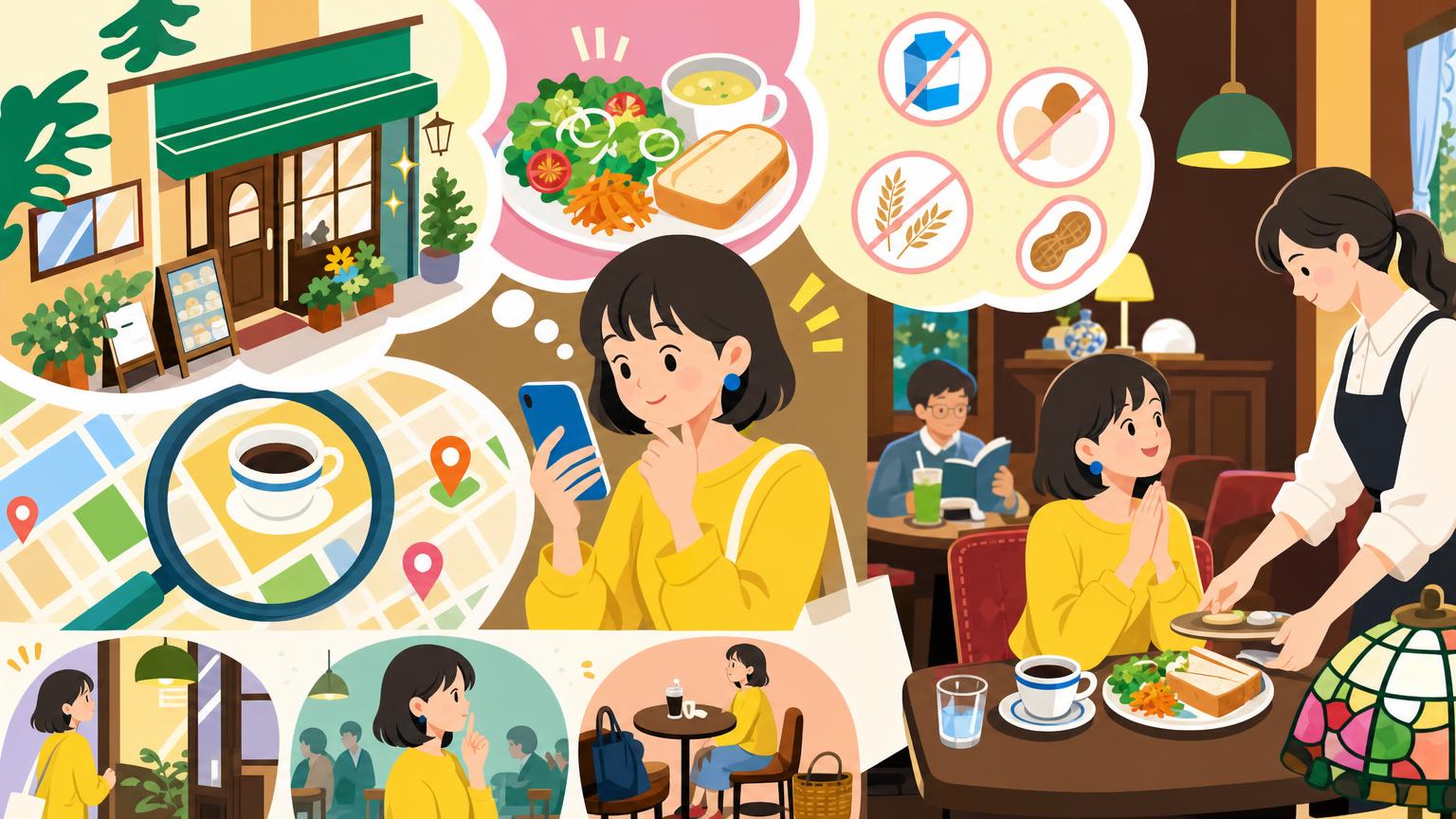
The most important decision is not what to say at the counter, but where to go. A neighborhood kissaten may be excellent for flexible preferences, but it may not be suitable for strict allergy management.
Read Menus Before You Leave Home
Look for a current menu, official website, social-media post, or recent photo. Do not rely on a single old review. Menus change, owners change, and a café may stop serving a dish without removing an old photograph from the internet.
Words that may be useful include:
- アレルギー — allergy
- ヴィーガン — vegan
- ベジタリアン — vegetarian
- グルテンフリー — gluten-free
- 乳製品 — dairy products
- 卵 — eggs
- 小麦 — wheat
- 大豆 — soy
- ナッツ — nuts
- 魚 — fish
- 肉 — meat
A menu that mentions only “vegetarian” may not clarify whether fish stock is used. A menu that shows a fruit drink may not indicate whether it contains milk. Treat menu research as preparation, not proof.
Choose Shops With Ingredient Information When Safety Matters
Some Osaka cafés publish allergen charts, ingredient lists, or explicit kitchen policies. Buddha, a vegan and gluten-free café with locations in Morinomiya and Minamimorimachi, explains which ingredients it does not use and identifies other allergens in individual dishes and baked goods. It also asks customers to consult in advance about additional allergies. This type of detailed information is a better fit for strict dietary requirements than a small kissaten without written ingredient information.
This does not mean that a traditional kissaten is unsafe or careless. It means that the business model is different. If you need a guaranteed allergen-free meal, look for a specialist café or restaurant. If you simply prefer less dairy, no meat, or no mayonnaise, a neighborhood kissaten may be able to accommodate you.
Call Ahead for a Serious Allergy
Calling in advance is not always easy if your Japanese is limited, but it is the most respectful option for a small shop. Call outside busy periods, such as mid-morning after the breakfast rush or mid-afternoon before the evening crowd. Avoid calling when the shop is visibly busy or during the main lunch period.
A short Japanese message can be prepared ahead of time:
“食物アレルギーがあります。小麦を完全に避ける必要があります。こちらのお店で食べられるものはありますか?”
This means: “I have a food allergy. I need to completely avoid wheat. Is there anything I can eat at this shop?”
For multiple conditions, write them down. Showing a translated card can be helpful, but do not assume that a translation app has accurately explained cross-contact or medical severity. Use simple words and ask the staff to confirm what they understood.
The Unspoken Etiquette of Making a Special Request
Special requests in Osaka are not prohibited. They simply need to fit the scale and rhythm of the business.
Ask Before You Sit Down When the Request Is Significant
If you need several changes, ask at the entrance before selecting a seat. This helps prevent an awkward situation in which the staff takes your order, begins preparing it, and only then discovers that half the ingredients need to be replaced.
For a small request, such as no sugar or no butter, asking when you order is normal. For a medical allergy, strict vegan diet, halal requirement, or multiple exclusions, ask immediately after entering.
Order One Clear Modification at a Time
A long explanation can overwhelm a busy shop. Begin with the most important restriction, then confirm the answer.
For example:
“乳製品を避けています。トーストをバターなしにできますか?”
If the answer is yes, ask about the bread:
“パンにも乳製品は入っていますか?”
Then ask about the drink if necessary. This step-by-step approach is more reliable than giving a speech in English and hoping the staff understood every condition.
Do Not Treat a Request as a Negotiation
In some countries, customers expect to negotiate substitutions. In a Japanese kissaten, the menu is often based on a fixed preparation routine. Asking once is fine, but repeating the request after the staff has said it is difficult can create pressure.
If the answer is no, accept it calmly and choose another item or another shop. Saying “わかりました” — understood — is enough. A direct refusal is often the shop’s way of avoiding a promise it cannot keep.
Understand the Meaning of “できません”
“できません” means “we cannot do that.” It may refer to the kitchen, the ingredients, the cooking equipment, the staff, or the shop’s policy. Do not assume that asking again in a louder voice will change the answer.
You can ask one useful follow-up:
“では、食べられるものはありますか?”
This means: “In that case, is there anything I can eat?” The staff may suggest a drink, plain rice, a packaged item, or nothing at all.
Avoid Bringing Outside Food Without Asking
If you cannot eat anything on the shop’s menu, do not quietly open outside food at the table. This is especially important in a small neighborhood shop where food service is the reason the business exists. Ask first, and expect the answer to be no.
If you need emergency food because of a medical condition, explain briefly before sitting down. The shop may allow it if you buy a drink, or it may direct you elsewhere. Osaka people may be practical about emergencies, but permission still matters.
Buy Something Appropriate for the Seat
Many kissaten operate with a one-person, one-order expectation, especially during busy hours. A drink may be enough during a quiet period, but do not occupy a table for a long time with only tap water. Some cafés state this policy directly; others communicate it through the pace of service.
If you are with a group, having each person order a drink is the safest approach. If one person has strict dietary needs and can only order tea, it is considerate for the group to order food and drinks from the shop rather than treating it as a waiting room.
Practical Japanese Phrases for Special Dietary Needs
You do not need fluent Japanese; accurate keywords and a calm way to confirm the answer are sufficient.
General Questions
- “これは何が入っていますか?” — What does this contain?
- “原材料を確認できますか?” — May I check the ingredients?
- “アレルギーがあります。” — I have an allergy.
- “少しでも入っていると食べられません。” — I cannot eat it, even if it contains only a small amount.
- “完全に避けたいです。” — I need to avoid it completely.
- “これは難しいですか?” — Would this be difficult to do?
Dairy-Free Requests
- “乳製品なしにできますか?” — Can you make it without dairy?
- “牛乳、バター、チーズは入っていますか?” — Does it contain milk, butter, or cheese?
- “ホイップクリームなしでお願いします。” — Please make it without whipped cream.
Vegan Requests
- “動物性の食材を使わないものはありますか?” — Do you have anything made without animal-based ingredients?
- “卵と乳製品を使わないものはありますか?” — Do you have anything without eggs or dairy?
- “だしに魚や肉は使っていますか?” — Is fish or meat used in the stock?
Gluten-Free Requests
- “小麦アレルギーがあります。” — I have a wheat allergy.
- “小麦を完全に避ける必要があります。” — I need to avoid wheat completely.
- “同じ調理器具を使っていますか?” — Do you use the same cooking equipment?
Do not use “gluten-free” as though every staff member will understand its medical significance. The Japanese phrase “グルテンフリー” is becoming increasingly familiar, but “小麦アレルギー” may communicate the seriousness more directly. If you have celiac disease, explain that even small amounts and shared equipment may be a problem.
Cash, Smoking, Seating, and Other Everyday Realities
Dietary requests are only one aspect of the kissaten experience. Older neighborhood shops may also have rules that surprise foreign residents.
Payment May Be Cash Only
A traditional kissaten may accept cash but not credit cards or contactless payments. Some shops now accept mobile payments, but you should not assume this. Carry enough yen to cover your meal, especially when visiting a small shop away from major stations.
The issue is not the amount. A failed payment can disrupt the rhythm of a small business. Check the payment sign near the entrance or ask before ordering if you are unsure.
Smoking Rules Can Be Complicated
Older kissaten have traditionally been associated with smoking, and some still allow it in part or all of the interior. Others have changed their policies, installed separate areas, or banned smoking entirely. A shop’s appearance does not necessarily indicate its current rules.
If smoke affects your health, ask before sitting down:
“店内は禁煙ですか?” — Is smoking prohibited inside?
If the answer is unclear, ask:
“喫煙席と禁煙席は分かれていますか?” — Are smoking and non-smoking seats separated?
For people with asthma or serious sensitivities, a separate area may not be sufficient. Choose a shop that clearly states it is smoke-free.
Seating Is Not Always Flexible
Some kissaten have narrow tables, counter seats, or layouts designed for one or two people. Moving chairs, combining tables, or choosing a different seat without asking can disrupt service. If you need a seat away from smoke, near the entrance, or with room for medication, ask politely and accept the available option.
The Shop May Be Quiet Without Being Formal
A traditional café may be quiet, but that does not mean the atmosphere is ceremonial. People may read newspapers, speak softly, or sit alone. Loud video calls are generally unwelcome. Headphones are acceptable when used quietly, but speakerphone is not.
A jazz kissa requires even greater awareness. The music may be the main focus, and conversation can be limited. If your dietary request will take several minutes to explain, contact the shop before visiting rather than discussing it loudly at the table.
Osaka Versus Tokyo: What the Difference Really Feels Like
The contrast between Osaka and Tokyo is often expressed through stereotypes, but daily life is more nuanced. Tokyo’s cafés can feel more standardized because the city has many chains, office districts, and customers constantly moving at speed. Osaka’s neighborhood kissaten often feel more personal because the same customers return from nearby homes, offices, shopping streets, and schools.
That personal atmosphere can work in your favor. Staff may remember that you do not take sugar. They may suggest a different drink without making a big production of it. They may also tell you honestly when a request is impossible.
It can also make you more noticeable. In a small Osaka shop, a complicated request is not anonymous, and everyone may notice the conversation. This is not necessarily judgment; it is simply the reality of a small room where one order affects the entire kitchen.
Communication in Osaka often rewards a little humility and humor, but you should not joke about a serious allergy. You can smile, thank the staff, and keep your request practical. The goal is not to prove that the shop should serve you, but to find out whether it can safely serve you today.
This is one reason living in Osaka can feel different from visiting the city. A visitor may look for a famous retro interior, while a resident needs a place that works on an ordinary Tuesday: close to home, reasonably priced, open when needed, and honest about what it can provide. You may eventually develop a personal list of shops for different situations: one for coffee, one for dairy-free drinks, one for reliable vegan food, one for a quiet afternoon, and one for guests who want to experience a traditional kissaten.
Neighborhood Examples and How to Use Them Wisely
You do not need to treat famous kissaten as a checklist; instead, use them as examples of different business styles.
Umeda and Osaka Station Area
Kissa Sunshine, established in Umeda in 1973, provides menu information in Japanese, English, Chinese, and Korean. Its traditional offerings include coffee, hot cakes, omelet rice, homemade pudding, and morning service. The shop also notes that its hours and closing days may change, so it is sensible to check the latest information before visiting.
For special dietary requests, multilingual information is helpful, but it does not automatically mean that every substitution is possible. Ask about the specific dish. A hot cake without whipped cream may still contain milk and eggs, while omelet rice without visible meat may still be prepared with sauce or stock.
Namba and Shinsaibashi
Junkissa American in Namba is a useful example of a traditional shop with a strong identity. Its official information describes its history, house-roasted coffee, mixed juice, fruit drinks, and cream soda. The drink menu lists separate fruit options, which may offer customers more choices than a creamy mixed drink, although questions about ingredients and cross-contact still need to be asked directly.
The point is not that one shop can meet every dietary need. Rather, a detailed menu provides a better starting point. When the menu is clear, you can ask a focused question instead of requiring the staff to explain every item from memory.
Residential Shopping Streets and Smaller Neighborhoods
Away from the busiest central districts, a kissaten may be closely connected to its shopping street. The owner may recognize nearby customers by face, and the menu may reflect local habits rather than international dietary terminology. You may find simple tea, coffee, toast, or fruit drinks, but there may be fewer written explanations.
These shops can be welcoming, but do not assume that friendliness means they can accommodate every request. A warm conversation and a safe meal are separate matters. If your restriction is strict, choose a shop with written allergen information. If your preference is flexible, a local kissaten may become part of your daily routine.
When a Kissaten Is Not the Right Choice
There is no shame in leaving. If the staff cannot identify the ingredients, cannot confirm whether a sauce contains your allergen, or says that the same utensils are used for everything, do not take the risk simply because the interior is charming.
A kissaten is not required to become a specialty dietary restaurant. The owner may be entirely honest about the kitchen’s inability to accommodate your needs. Thank the staff and go somewhere better prepared.
For severe allergies, religious dietary requirements, or medically necessary gluten avoidance, consider restaurants and cafés that publish allergen lists, use dedicated preparation areas, or clearly advertise a specific specialty. Buddha’s official information, for example, explains its vegan and gluten-free positioning and lists the specific ingredients used in different products. That level of detail is closer to what a medically cautious customer needs.
For less strict preferences, you may still be able to enjoy a kissaten by choosing naturally simple items, such as black coffee, tea, clearly identified fruit juice, or toast with a confirmed topping. Even then, ask whenever the ingredient matters.
A Comfortable Way to Make the Request
The most Osaka-friendly approach is simple, direct, and honest.
Begin by stating the restriction:
“食物アレルギーがあります。”
Explain the key ingredient:
“乳製品を避けています。”
Ask about a specific item:
“このトーストはバターなしにできますか?”
Confirm whether there is a hidden ingredient:
“パンにも乳製品は入っていますか?”
Accept the answer:
“わかりました。ありがとうございます。”
If the answer is no, there is no need to apologize repeatedly. If the answer is yes, do not assume that every other menu item is safe as well. Ask again about each dish.
This approach respects both sides. You are taking responsibility for your health, while allowing the shop to explain its actual limitations. That is the foundation of trust in a small neighborhood business.
The Everyday Meaning of Kissaten in Osaka
A neighborhood kissaten shows Osaka in its most ordinary form. It is not just about retro design, dark coffee, or nostalgic desserts. It is also about how a city organizes small acts of dependence. Regulars trust the owner to remember their preferences, while the owner trusts customers not to create unnecessary confusion. People share limited space, a limited menu, and a familiar working rhythm.
For foreign residents, the first challenge is often the language. The deeper challenge is learning that service is not always expressed through unlimited choice. Sometimes service means being told exactly what cannot be done. Sometimes kindness means being advised to order tea. Sometimes a small shop helps quietly, while at other times it protects its kitchen by refusing a request.
Once you understand that difference, Osaka becomes easier to read. You stop interpreting every direct answer as hostility and stop treating every smile as confirmation. You begin to notice timing, tone, queue length, kitchen size, and the distinction between a personal preference and a medical necessity.
That is how you find the right light meal—not by demanding that every kissaten operate like a modern international café, but by learning which neighborhood businesses can meet your needs, asking clearly, and respecting the answer.
For daily life in Osaka, that is the real etiquette: be prepared, be specific, and leave the shop with your dignity intact, whether the answer is yes or no.