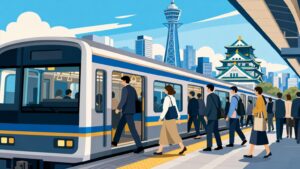
At 7:45 on a weekday morning, Osaka is already awake in a very specific way. Convenience-store lights are bright. Bicycle bells cut through the side streets. Office workers move quickly but rarely look as if they are enjoying themselves. At the station, people form lines beside painted marks on the platform, checking the approaching train without appearing to check it.
Then the Midosuji Line arrives.
For many people living in Osaka, this is not simply a subway line. It is part of the daily machinery of life. The line runs through major working, shopping, and residential areas, connecting places such as Shin-Osaka, Umeda, Yodoyabashi, Honmachi, Shinsaibashi, Namba, Tennoji, and beyond. A person may use it to reach an office, a school, a hospital, a childcare centre, or a second train. The same commuters may make the same journey for years.
Foreign residents often ask a reasonable question: “What exactly am I supposed to do when the train is full?” The answer is not only about standing quietly. It is about understanding how people share limited space without discussing it. Osaka’s subway etiquette combines general Japanese habits with local details: the right-side escalator convention, a quicker conversational rhythm, a practical attitude toward personal space, and a strong expectation that you will notice what is happening around you.
This is not a guide to sightseeing. It is a guide to the small decisions that make ordinary life smoother: where to stand, when to move, how to handle a backpack, why nobody answers a phone call inside the carriage, and why a short, sharp “すみません” may be more useful than a long apology.
For a map showing the Midosuji Line corridor through central Osaka, see the embedded map below.
Why the Midosuji Line Feels Like a Moving Workplace
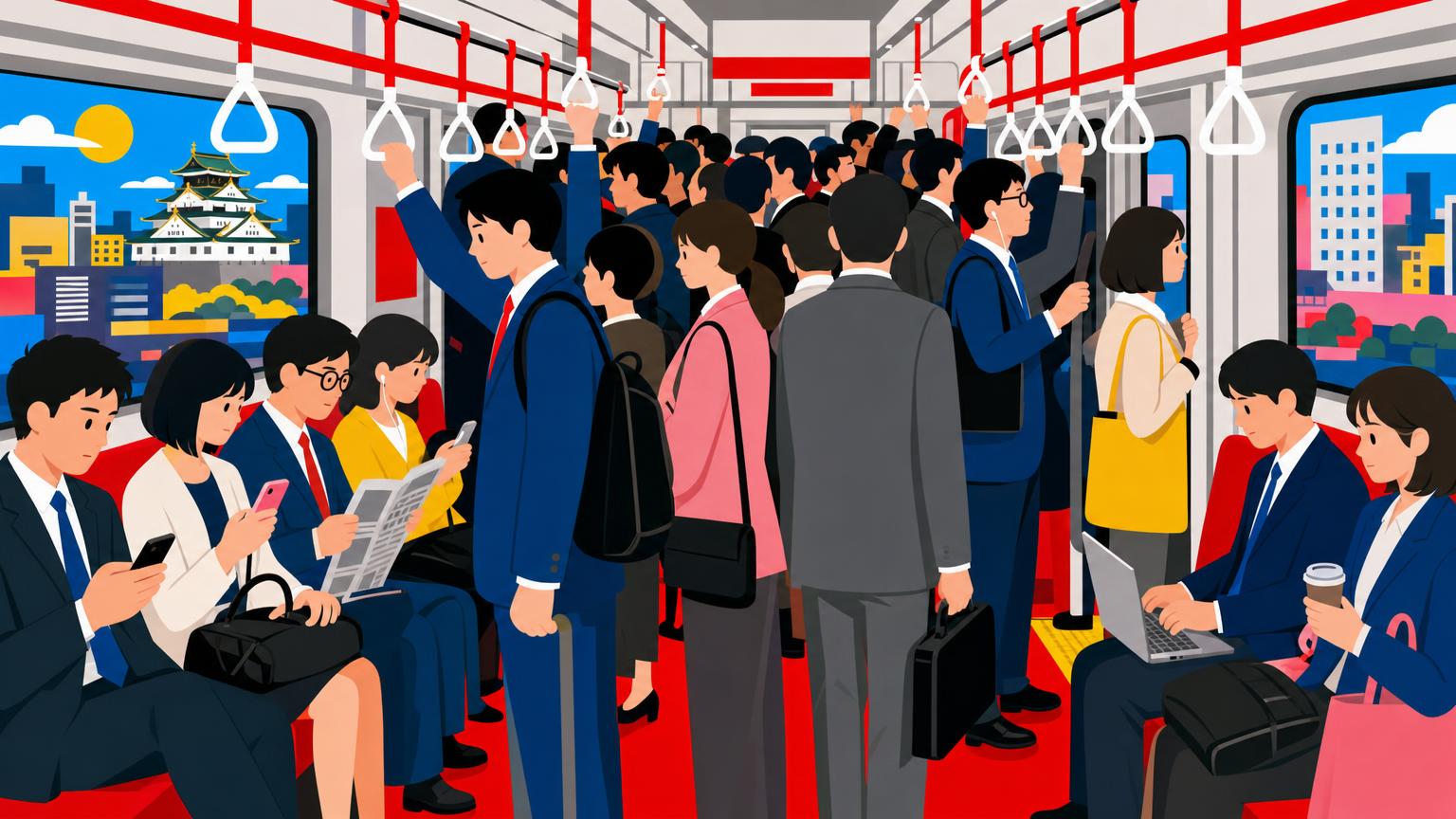
The Midosuji Line is often described in terms of its stations, but regular users experience it through patterns. At certain times, the train is not a collection of separate journeys. It is a moving arrangement of bodies, bags, screens, umbrellas, briefcases, school uniforms, and quiet calculations.
A commuter knows which door will open closest to the stairs. They know which carriage is usually less crowded. They know when to move toward the centre and when to remain near the door because they will get off at the next stop. They may not know the names of the people around them, but they recognise the timing of their movements.
This is one reason Osaka’s busiest subway line can feel different from a short-term visitor’s idea of public transport. A visitor sees a train, while a resident sees a daily system. The system works because people generally avoid making their private needs everyone else’s problem.
That does not mean Osaka commuters are emotionless or unfriendly. Rather, it means that friendliness is often expressed indirectly. Someone may not start a conversation with you on a crowded platform, but they may move their bag so you can pass. A station worker may give directions in a brisk voice and then walk several metres with you toward the correct exit. A passenger may look irritated when you block a doorway, but their irritation is usually directed at the obstruction, not at your nationality.
A useful mindset is this: on a crowded Osaka subway, awareness matters more than perfection. You do not need to know every rule before your first commute. You simply need to keep noticing who is trying to get off, where the queue is moving, and whether your luggage is taking up space that somebody else needs.
The First Rule: Let People Off Before You Get On
This is the most important rule on the platform, and also the one people are most likely to break when they are nervous, late, or distracted by their phones.
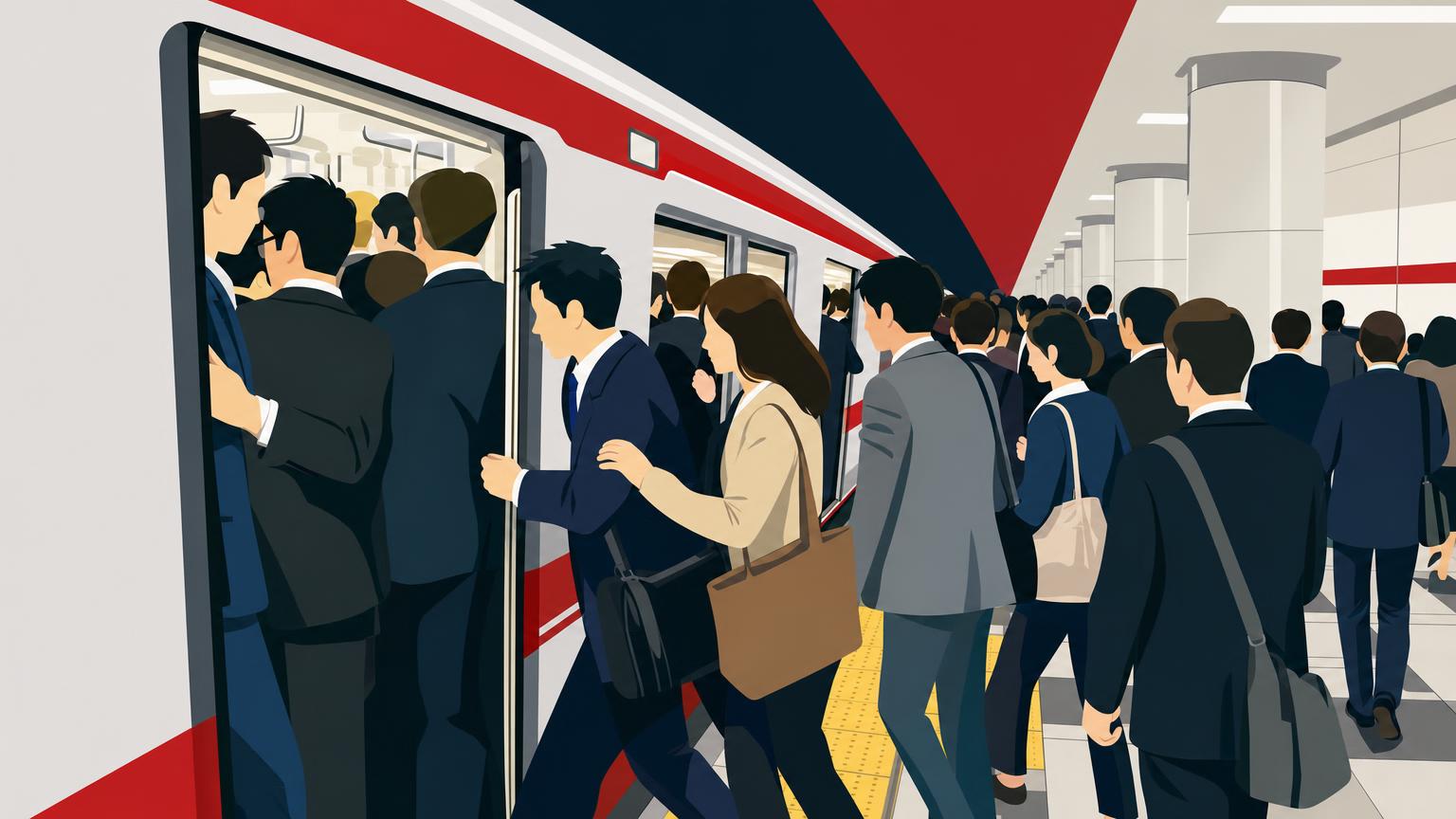
When a train arrives, stand to either side of the doors instead of directly in front of them. The passengers inside need a clear path to exit. Once they have stepped out, those waiting can board in an orderly flow.
The rule may sound obvious, but on the Midosuji Line, it is physically important. At busy stations such as Umeda, Honmachi, Shinsaibashi, Namba, and Tennoji, several people may need to get off before a similar number can board. If the first person waiting steps into the doorway immediately, everyone behind them becomes part of a human traffic jam.
For residents, this is not a moral drama but a practical delay. One person blocking the exit can add unnecessary seconds at every station. Over the course of a morning commute, those seconds can mean a missed transfer, a late arrival, or an unpleasant sprint up the stairs.
Stand behind the marked boarding line. Watch the passengers getting off, and board only when the doorway is sufficiently clear. If the train is already extremely crowded, do not push forward simply because there is technically room for one more shoulder. Sometimes taking the next train is the sensible choice.
What to Do When You Are Unsure Where to Stand
Look at the platform markings and follow the example of people who are waiting calmly. Osaka Metro stations may have lines, arrows, or painted boarding positions. People do not always form a perfect queue, especially at complex stations, but there is usually a visible pattern.
Avoid standing on the tactile paving used by people with visual impairments. Do not place a suitcase across the yellow line or in the centre of the boarding area. If you are waiting with a child, keep them close to you rather than letting them wander toward the edge.
When the train arrives, do not interpret the crowd’s movement as a signal to rush. It is usually a signal to make space.
Keep Your Voice Low and Your Phone Quiet
Osaka is famous for lively conversation, but the subway is not usually the place for a loud conversation between friends. Osaka residents may speak more directly and energetically than people in Tokyo in certain social situations, yet a busy commuter carriage still follows a quiet public rhythm.
Osaka Metro asks passengers to keep phone calls and loud conversations to a minimum. Mobile phones should be set to silent mode, and passengers are requested not to talk on the phone while riding. Near priority seats, passengers are asked to turn off their mobile phones when the train is crowded.
This can be confusing for foreigners because Japanese commuters often use their phones constantly. They read messages, watch videos with earphones, check train information, and scroll through social media. The phone itself is not considered the problem; the voice is.
If you receive a call, let it ring silently or reject it. If the call is urgent, leave the carriage at the next station and call from the platform. A quiet message such as “I’m on the train; I’ll call you back” is usually sufficient.
Why Silence Matters More Than Conversation
A quiet carriage is not necessarily peaceful. You may hear announcements, doors, brakes, station melodies, and the occasional cough. The expectation is not complete silence, but controlled sound.
People are tired. Many are commuting early, travelling home after work, or managing a family schedule. They do not want to hear a stranger’s business meeting, relationship argument, or video clip playing at full volume. Even a friendly conversation can feel intrusive when the carriage is crowded and nobody can move away.
In Osaka, directness does not mean that people want constant interaction. A cashier may joke with you at a neighbourhood shop, while that same person remains silent beside you on the train. These behaviours are not contradictory. Different spaces serve different purposes.
Manage Your Backpack Before the Train Does It for You
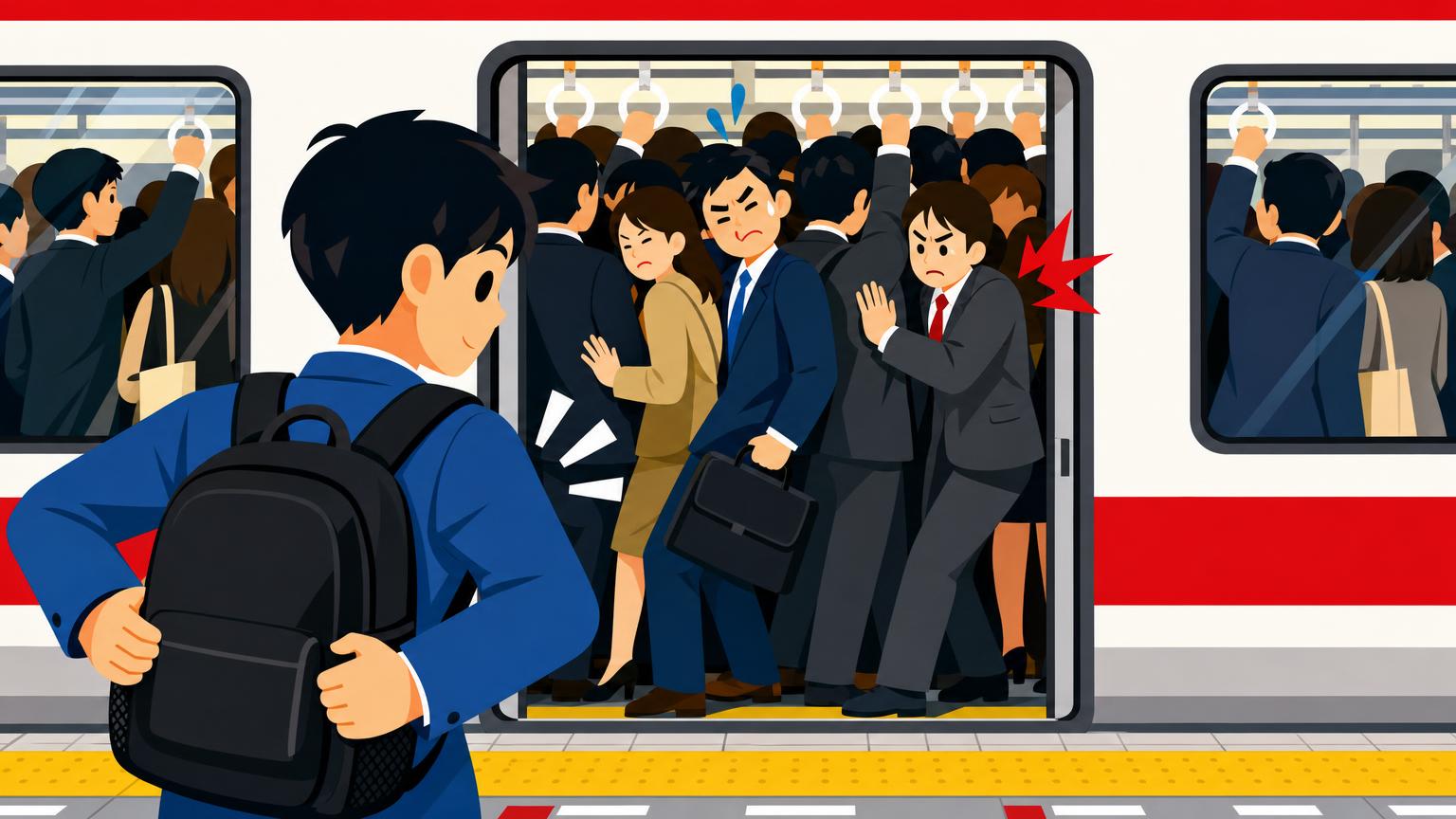
A backpack is manageable on a quiet train. During the morning rush, however, it becomes a moving object with hard corners, zips, straps, and a surprising ability to hit someone in the face.
When the carriage is crowded, take your backpack off and hold it in front of you or place it between your feet. If there is an overhead rack and you can use it safely without delaying other passengers, that may be practical, but do not stretch across people to reach it.
Large luggage should be kept out of the way. Osaka Metro’s own etiquette guidance asks passengers to prevent large bags from inconveniencing others. It also asks passengers not to stop around ticket gates and ticket machines, where they can block the flow of people.
This is especially relevant to foreign residents who are moving apartments, carrying musical instruments, using a large work sample case, or returning from an airport journey. The issue is not that luggage is forbidden; the issue is where it is placed.
Keep suitcases upright and close to your body. Avoid placing luggage in front of a door. If the carriage is crowded, stand near the side rather than creating a barrier in the middle. When you need to leave, say “すみません” in a clear voice and start moving before the doors open.
The Door Area Is Not a Permanent Parking Space
Standing near the door is normal if you are getting off soon. It becomes a problem when you remain there while passengers behind you need to exit or board.
If you are near the door and the train stops at a crowded station, step onto the platform to let people out, then re-enter if there is space. Regular commuters do this without ceremony. They are not giving up their place permanently; they are helping the door function.
If you are not confident about re-entering, stand to the side of the doorway rather than directly in its centre. Watch the flow. On a very crowded train, do not expect to remain in exactly the same position from station to station.
Eating and Drinking: What Is Actually Acceptable?
The short answer is that eating on a crowded commuter train is generally considered bad manners. Quietly drinking water may be tolerated, especially if you are unwell or travelling a long distance, but food, strong smells, open drinks, and messy packaging are best avoided.
This is one of the most common questions asked by foreign residents: “Can I eat on the train in Japan?” On long-distance trains, limited express trains, and some less crowded services, eating may be perfectly normal. On an urban subway during the morning rush, however, it is usually not appropriate.
A sealed bottle of water is different from a bowl of noodles. A small sip may go unnoticed, while a takeaway breakfast can create smells, spills, rubbish, and a practical risk when the train brakes. Osaka’s subway is designed for short urban journeys, not for sitting down and eating a meal.
If you need breakfast, eat before entering the station or wait until you reach your destination. If you need to take medicine with water, do so discreetly. If a child needs a snack, move to a station area where you will not block the flow of people on the platform.
The same principle applies to cosmetics. Applying a small amount of lip balm is unlikely to cause a problem, but completing a full makeup routine in a crowded carriage can make people uncomfortable because of movement, smells, and the possibility of touching others.
Osaka’s Famous Escalator Rule: Stand on the Right
This is the detail that most clearly distinguishes Osaka from the common image of Tokyo.
In Osaka, the familiar convention is to stand on the right side of an escalator and leave the left side open for people who are moving. In Tokyo, the usual convention is the opposite: stand on the left and leave the right side open.
For someone traveling between Osaka and Tokyo, this can create a brief but genuine moment of confusion. You arrive at an escalator, choose the side that feels automatic, and suddenly realise that the entire crowd is doing the opposite.
However, the modern safety message is more complicated than simply “walk on the left.” Osaka Metro and other railway operators increasingly encourage passengers not to walk on escalators at all. Standing still and holding the handrail is safer, particularly for older passengers, children, people carrying bags, and anyone with reduced mobility. The local social convention still matters, but station signs and staff instructions take priority.
The practical rule is simple: if people are standing, stand on the right in Osaka unless signs or crowd conditions indicate otherwise. Do not force your way onto the left side to walk. If the escalator is crowded, remain still. If you prefer to walk, use the stairs when available.
Why This Difference Is Cultural, Not a Personality Test
Foreigners sometimes interpret the escalator rule as evidence that Osaka is more relaxed or more impatient than Tokyo. That explanation is too simplistic.
Escalator habits developed through local transport culture and repetition. People learn the convention by watching others and then reproduce it every day. It becomes a small piece of regional identity, like local vocabulary or the way a restaurant serves a familiar dish.
The difference does reveal something about Osaka, though. Osaka residents are often comfortable with practical local conventions that may not be explained each time. You are expected to look around, recognise the pattern, and adjust. Nobody will normally give a formal lecture about standing on the right. The crowd itself is the instruction manual.
Osaka’s Local Rhythm: Direct, Quick, and Usually Practical
The idea that Osaka people are “friendly” is not wrong, but it is too vague to be especially useful. A better description is that Osaka often has a more openly expressive public style than Tokyo. People may speak with stronger intonation, joke with strangers, complain more visibly, or give directions in a more conversational manner.
On the subway, however, this expressiveness is shaped by the situation. A station worker may speak briskly because the platform is crowded. A commuter may gesture firmly when you stand in the wrong place. A shop employee may tease you after helping you. These behaviours can seem contradictory if you expect friendliness to mean constant softness.
In Osaka, warmth often comes with efficiency. Someone may say, “There, there, move this way,” rather than provide a long, polite explanation. Someone may correct you quickly because they want to prevent a problem, not because they dislike you.
Foreigners sometimes mistake this directness for anger. Others make the opposite mistake by assuming that a joking tone means all rules are flexible. Neither interpretation is reliable. Osaka’s public manner can be informal in tone while still being strict about timing, queues, doors, and personal space.
Listen to the words, but also observe what people are doing. If everyone moves away from the doors, move away as well. If people lower their voices, lower yours too. If a platform sign shows a different arrangement, follow the sign even if you have seen another pattern elsewhere.
Priority Seats Require Awareness, Not Panic
Priority seats are intended for people who may need them, including older passengers, people with disabilities, pregnant passengers, injured people, and adults travelling with very young children. They are usually clearly marked, often with different-coloured seats or signs.
The practical etiquette is to keep those seats available whenever possible and to offer your seat when someone appears to need it. You do not need to question anyone about their health. You should also avoid assuming that everyone who needs a priority seat will look visibly elderly or injured.
Some conditions are invisible. A person may be pregnant before they start to look pregnant, living with chronic pain, recovering from surgery, or experiencing exhaustion. Osaka Metro’s public messaging continues to emphasise consideration and the courage to offer priority seating appropriately.
If you are seated in a priority area and someone who may need the seat boards, stand up and offer it. If the person refuses, accept their refusal without making the moment more significant. They may prefer to stand, be getting off soon, or not want attention.
Phone etiquette also matters near priority seats. When the train is crowded, Osaka Metro asks passengers to turn off their mobile phones near priority seats. This rule is not always followed perfectly, but residents understand that the request is intended to reduce possible concerns for passengers using medical devices and to keep the area calm.
Women-Only Cars on the Midosuji Line
Women-only cars are another aspect of Osaka’s commuter system that may surprise foreign residents. On the Midosuji Line, the women-only car is the sixth car from the Nakamozu side and operates all day on weekdays. Osaka Metro also has women-only arrangements on the Tanimachi Line, with different operating hours.
Signs and platform markings indicate the designated car. This arrangement is intended to help prevent sexual harassment and operates with passengers’ cooperation. It is not something to discover only after boarding and realizing that you are in the wrong carriage.
For male passengers, the practical approach is simple: check the signs before boarding and use another car if the marked women-only car is in operation. In exceptional circumstances, such as when a parent is travelling with a young child or a passenger needs assistance, the situation may be handled differently. However, do not assume that an exception applies merely because the train is crowded.
For women, using the car is optional rather than a compulsory part of commuting. Some women choose it for comfort or safety, while others use a different car because it is closer to their transfer route or less crowded. Passengers should not be judged for choosing either option.
The important cultural point is that Osaka’s train etiquette is not limited to being quiet. It also reflects concerns about safety, harassment, disability access, pregnancy, age, and the unequal experience of sharing a crowded carriage.
The Morning Rush Is a Time Problem as Much as a Crowd Problem
The busiest period is not the same fixed block every day. It varies depending on school schedules, weather, events, work patterns, service disruptions, and the direction of travel. A train that feels impossible at 8:15 may be noticeably more manageable at 7:20 or 9:30.
Osaka Metro has published crowding information for the Midosuji Line, with levels ranging from seats being available to passengers standing closely together throughout the train. The operator has also introduced crowding prediction information through its official services, including rush-hour forecasts for both morning and evening periods.
In daily life, this means that changing your departure time by ten or fifteen minutes may be more helpful than changing your entire route. Ask your workplace whether a flexible start time is possible. If you have children, calculate the school drop-off journey realistically rather than assuming the shortest route will be the least stressful.
What to Do When the Train Is Full
If possible, do not stand in the middle of the doorway; move farther inside instead. The centre of the carriage is often easier for everyone because it allows more people to board and reduces pressure around the doors.
Keep both feet steady and hold a strap or handrail. If you are carrying a shoulder bag, move it to the front of your body. When the carriage is packed, avoid using your arms to create a large private bubble.
If your stop is approaching, start preparing early. Move toward the door before the announcement if there is enough space, but do not push through people. A quiet “すみません” usually communicates that you need to pass. Repeat it calmly if necessary.
If you miss your stop because the carriage is too crowded, get off at the next station and return from the opposite platform where possible. This is less embarrassing than forcing your way through a packed doorway. Everyone misses a stop sometimes, including people who have lived in Osaka for decades.
Rainy Days and Umbrellas
Rain changes the practical rules. Wet umbrellas drip, slide, and take up more space than people expect. Use a plastic umbrella cover where one is provided, or fold the umbrella and keep it upright between your feet. Do not swing it at hip height while walking through the station.
At the ticket gates, do not stop immediately after passing through to check your phone or look for a route. Move to the side first. This small habit is useful every day, especially when commuters are entering and leaving in opposite streams.
ICOCA Makes the Daily System Easier
If you live in Osaka, an ICOCA card or compatible mobile IC card can eliminate much of the daily confusion at ticket machines. Osaka Metro provides guidance on using IC cards, including the requirement to exit with the same card used to enter and to touch the reader for approximately one second.
The key habits are simple:
- Use one card for each journey. Do not touch two IC cards at the same time.
- Have your card or phone ready before reaching the ticket gate.
- Do not stop immediately beyond the gate to check your balance or message someone.
- If a gate rejects your card, move to the side and ask a station employee for assistance.
- Keep in mind that some routes involving different railway companies may have transfer conditions, so an IC card does not guarantee that every possible journey will be processed in one uninterrupted trip.
Osaka Metro lists ICOCA sales at pink ticket machines and commuter pass counters, and ICOCA can be used on Osaka Metro and Osaka City Bus services with the appropriate ticket function.
For a resident, the real benefit is not just speed; it is mental space. You do not have to stand in front of the fare map while people stream around you. You can enter, travel, and leave with less hesitation.
What Foreign Residents Often Misunderstand
“People Are Ignoring Me”
A commuter who does not make eye contact or respond to your greeting is not necessarily being rude. On a crowded train, people may be focused on keeping their balance, protecting their personal space, or preparing for the next transfer. Public transport is often treated as private time.
“Everyone Is Pushing”
Crowding can appear aggressive, but much of the movement is caused by pressure from the passengers behind you. There is a difference between deliberately forcing someone aside and moving forward because the train has filled the space around the platform. Keep your movements controlled and avoid applying unnecessary force.
“Osaka Is Relaxed, So the Rules Are Flexible”
Osaka’s speech may sound casual, but daily systems still have boundaries. A joking station announcement does not mean you can block the doors. A friendly shopkeeper does not mean queues are optional. Informality and order exist side by side.
“Tokyo and Osaka Use the Same Etiquette”
The basic principles are shared throughout Japan: let passengers exit, keep phones quiet, manage your luggage, and avoid disturbing others. The most noticeable regional difference is the escalator convention: Osaka generally stands on the right, while Tokyo generally stands on the left. Even this convention may be overridden by safety instructions or local signs.
“A Quiet Train Means Nobody Wants to Help”
People may assist you without starting a conversation. If you appear visibly lost, someone may point, gesture, or walk with you toward the correct platform. Assistance can be quick and practical rather than obviously warm.
A Small Vocabulary for Commuting
You do not need to speak fluent Japanese to use the Midosuji Line, but a few expressions can be helpful.
“すみません” means “excuse me” or “sorry” and is the most useful phrase when passing someone or asking for help.
“降ります” means “I’m getting off.” Saying it clearly when the area near the door is crowded can help people understand why you are moving.
“お願いします” is a polite way to say “please” and is useful when asking a station employee for assistance.
“ありがとうございます” means “thank you.” It is appropriate after someone helps you, gives you space, or explains a route.
Tone matters more than perfect pronunciation. Speak clearly without shouting, and combine the words with a small gesture in the direction you need to move.
The Best Commuter Is Not the Most Invisible One
There is a temptation to think that good Japanese etiquette means becoming completely silent, motionless, and invisible. However, that is not realistic, especially for foreign residents raising children, carrying work equipment, travelling with mobility needs, or learning the system.
Good etiquette does not mean having no needs. It means managing those needs with consideration for others.
You may need to ask someone to move, exit through a crowded doorway, or travel with a baby, a suitcase, or a bicycle helmet. The solution is not to apologise endlessly or freeze. Instead, signal clearly, move carefully, and avoid making other passengers guess what you are doing.
This is where Osaka’s practical character becomes visible. People often appreciate a clear request more than a complicated explanation. A short “すみません” and a confident step toward the door can work better than standing silently while the train departs.
Daily Life on the Midosuji Line Is a Lesson in Shared Space
The morning rush can feel intimidating when you are new to Osaka. The announcements may be hard to understand. The platforms may seem designed by someone who enjoys underground mazes. The train may arrive packed, and the person beside you may appear to have perfected the art of looking calm while being pressed against three strangers.
Over time, the system becomes easier to read.
You learn that the person facing the platform door may be preparing to leave. You learn that the quietest passenger may still be looking out for everyone around them. You learn that an irritated gesture may be a practical correction rather than a personal insult. You learn to keep your backpack in front, your phone on silent, your ICOCA ready, and your breakfast outside the carriage.
Most importantly, you learn that Osaka’s subway etiquette is not intended to make daily life feel cold. It is designed to make crowded daily life possible.
The Midosuji Line works because thousands of people carry out small acts of cooperation without announcing them. They queue, shift, wait, lower their voices, hold their bags, offer seats, and keep the doorway clear. These actions are not dramatic. They are the ordinary architecture of the city.
Once you can read that architecture, commuting becomes less mysterious. You begin to understand why Osaka can feel direct yet considerate, fast but not necessarily unfriendly, informal while still highly organised. You are no longer simply trying to survive the morning rush.
You are taking part in one of the city’s most ordinary and revealing forms of community life.