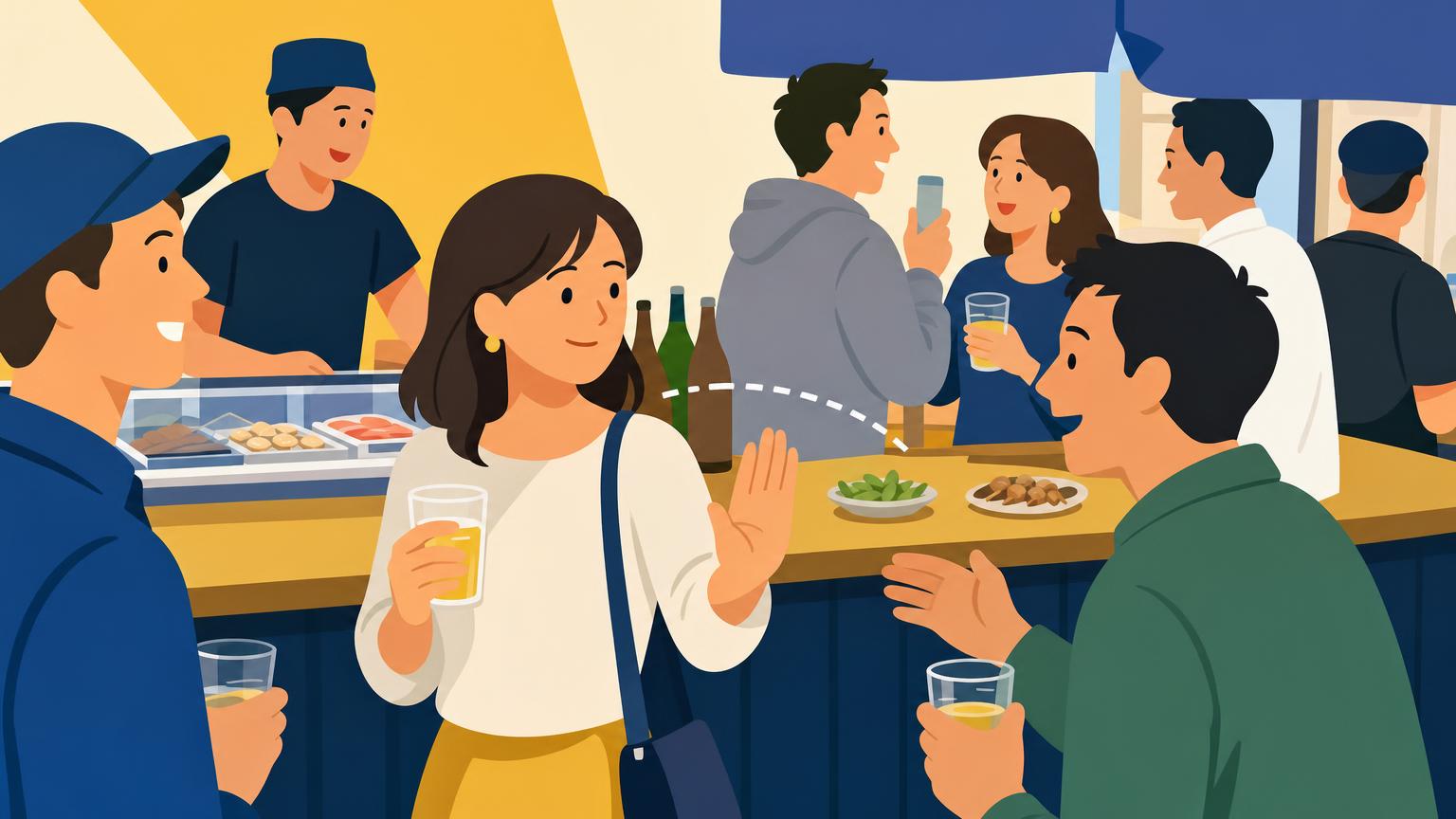
You may have heard that Osaka people are unusually friendly. Then you spend an evening in a small tachinomi bar, hear a stranger ask where you are from, laugh with three people you have never met, and leave feeling that you have made new friends. A week later, you return to the same place, expect the same warmth, and discover that nobody remembers your name. The conversation is pleasant, but shorter. The welcome is real, but the intimacy was not guaranteed.
This is one of the most useful realities to understand when living in Osaka. Osaka can feel socially open without being personally available. People may tease you, ask direct questions, comment on your Japanese, recommend a dish, or pull you into a conversation within minutes. That does not automatically mean they want a close friendship, a private meeting, or an ongoing relationship. In many cases, the warmth belongs to the moment, the bar, and the shared pleasure of talking.
Small neighborhood tachinomi bars are a good place to see this balance clearly. They are compact standing bars where customers drink, eat small plates, and move on rather than occupying a table for the entire night. The setting creates quick contact. You stand close, order at a counter, share narrow space, and naturally hear fragments of other people’s conversations. Yet the same structure also creates limits. Nobody has much physical room. Nobody wants one person to dominate the counter. And nobody is obliged to turn a ten-minute chat into a friendship.
This article is not a list of bars to visit. It is a guide to reading the social atmosphere around them if you live in Osaka, are considering a move, or want to understand why daily interactions here can feel both warmer and more elusive than expected. The map below is only a central Osaka reference point; the important subject is not sightseeing, but how people use shared neighborhood spaces.
The Question Behind “Are Osaka People Really Friendly?”
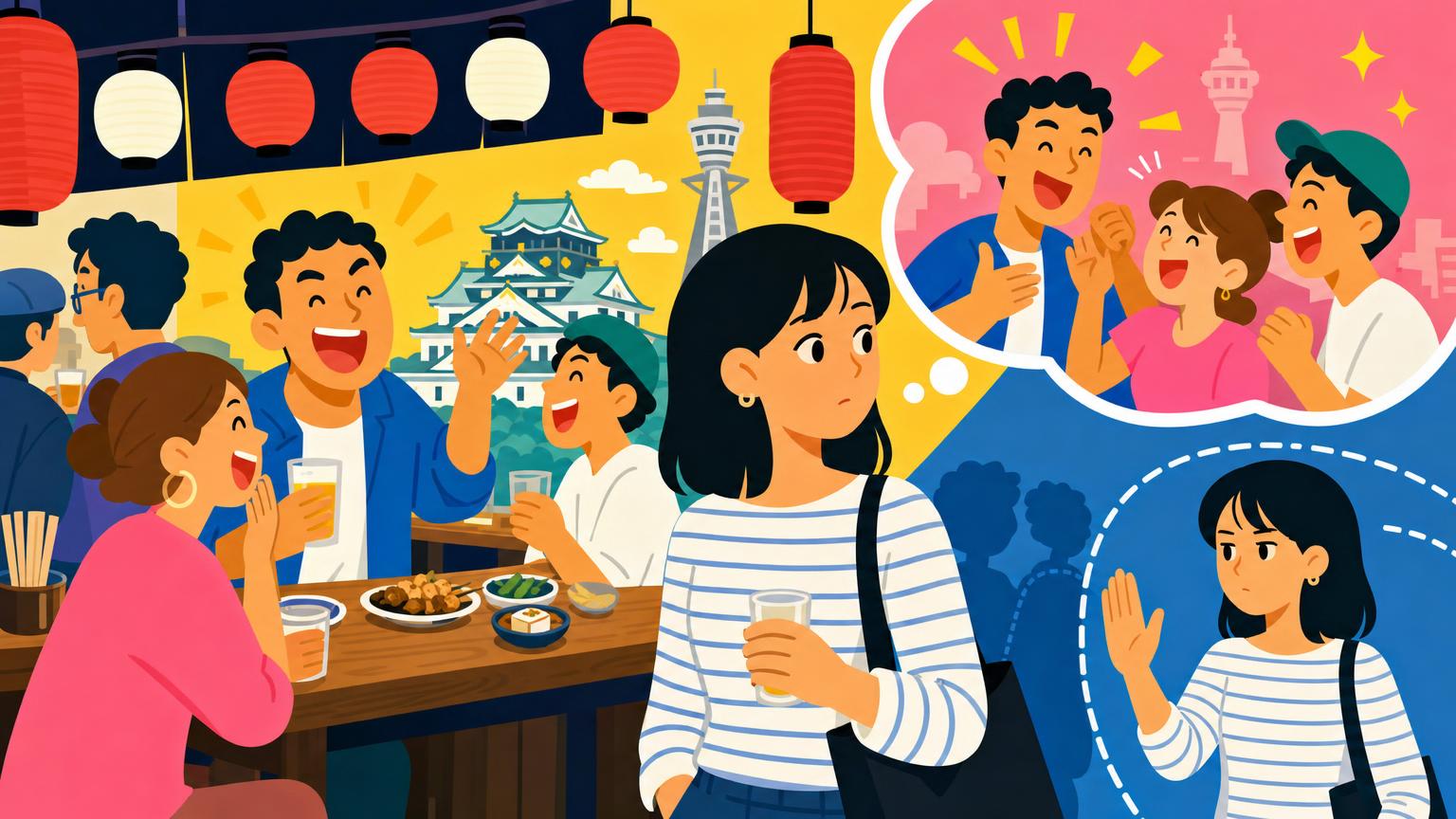
The short answer is yes, but the word “friendly” requires careful translation.
In English, “friendly” can imply emotional openness, personal interest, reliability, and a willingness to develop a relationship. In Osaka, however, the behavior foreigners describe as friendly may carry a narrower and more immediate meaning. It may mean that someone feels comfortable speaking to strangers, enjoys making jokes, does not mind a little informality, and believes a lively room is more enjoyable than a silent one.
That is not fake friendliness. It is simply a different kind of social action.
A customer next to you may ask, “Where are you from?” The question may be sincere, but it may also be an easy way to start a conversation. Someone might ask how long you have lived in Japan, whether you can eat natto, or whether you like Hanshin Tigers baseball. A person may tell you that your Japanese pronunciation is good and then immediately correct it. Another customer might recommend doteyaki, a slow-cooked beef tendon dish, while laughing at your difficulty pronouncing the word.
These moments often feel personal because they are direct. However, directness does not always signal deep trust. In a tachinomi, conversation is often a way of creating atmosphere. It keeps the bar lively, reduces the awkwardness of standing shoulder to shoulder, and gives regulars a way to acknowledge a newcomer without making a formal introduction.
Friendly conversation is often situational
A tachinomi conversation commonly arises from the shared situation:
- You are standing at the same counter.
- You are drinking the same kind of beer.
- You have ordered an unfamiliar dish.
- You are visibly trying to understand the menu.
- The bar is quiet enough for people to hear one another.
- Someone has made a joke and you have responded well.
When the situation ends, the conversation may end as well. This is normal. It does not mean the person disliked you; it means the interaction was connected to that particular place and moment.
Foreign residents sometimes interpret this as inconsistency. They may think, “Yesterday everyone wanted to talk to me, but today nobody does.” Usually, the more accurate explanation is that the social conditions have changed. The bar may be busier, the regulars may be with workmates, or you may have arrived during a quiet weekday period instead of a lively evening. Someone who chatted freely while waiting for food may not want to resume the conversation while eating with a friend.
Osaka’s warmth can be flexible rather than constant.
A joke is not always an invitation
One common misunderstanding involves humor. Osaka has a strong reputation for comedy, playful teasing, and quick verbal exchanges. In everyday life, people may use humor to soften a question, create a small sense of connection, or test whether someone understands the local rhythm.
If a regular says, “Your Japanese is dangerous,” that may be a joke rather than serious criticism. If someone laughs when you use the wrong word, they may be inviting you to laugh with them rather than excluding you. If a bartender reacts dramatically to an extremely spicy dish, the performance may be part of the hospitality.
However, humor is not a universal permission slip. Someone can joke with you and still prefer not to discuss their family, income, relationships, or private life. You can laugh together and still need to respect personal distance. Osaka humor may make the first layer of interaction easier, but it does not erase the boundary between public friendliness and private trust.
Why Tachinomi Bars Create Fast Intimacy
A typical izakaya may provide each group with a table, booth, or private corner. A tachinomi removes much of that separation. Customers stand close to one another, often with only a small ledge for plates and drinks. This physical arrangement encourages what might be called a temporary community.
You do not need a formal introduction to start a conversation. You can comment on the food, ask how the payment system works, or point to a dish and say, “What is that?” You might exchange a few words while making room for another customer. The bar’s design turns small, practical interactions into opportunities for social connection.
This can be particularly helpful for foreigners living in Osaka. Japanese social life can sometimes feel difficult to enter because existing friendships are structured around workplaces, schools, family networks, hobby circles, and long-term neighborhood relationships. A tachinomi does not erase those networks, but it provides a smaller doorway into them.
The doorway is not necessarily a permanent entrance. It is simply a place to stand for a while.
The bar is public, but not anonymous
Tachinomi spaces are public in the sense that strangers can enter. However, they are not public in the same way as a large chain restaurant, where everyone can remain separate. A small neighborhood bar often has a local memory. The owner knows the regulars, and customers notice who arrives at what time. People recognize the person who always orders grilled mackerel, the office worker who comes in after a late shift, or the older customer who speaks to everyone but never stays for more than thirty minutes.
As a foreign resident, you may be noticeable even when you are trying not to be. This is not necessarily a negative thing. It simply means that people may remember your face before learning your name. Your appearance, language, or uncertainty about the menu can make you a natural subject of conversation.
The best response is not to put on an exaggerated personality. Instead, be calm, polite, and curious. A simple “I’m still learning how this place works” is usually more effective than trying to appear completely confident. People often respond well when they can help with something concrete.
Standing changes the length of a conversation
Because customers are standing, conversations tend to come in short waves. Someone may speak with you for five minutes, turn back to their food, and then say something else twenty minutes later. This is not a rejection; it is the natural rhythm of a standing bar.
The space also encourages turnover. A customer who has finished eating may leave so that someone waiting outside can come in. A group may shift positions, or someone may ask you to move half a step. This movement is part of the environment, not a judgment about your social value.
If you live in Osaka, this is worth remembering beyond tachinomi. Many local interactions are warm but lightweight. A neighbor may chat with you in the elevator without ever inviting you home. A shopkeeper may remember your usual purchase but not ask about your personal life. A coworker may joke with you at lunch while keeping work and private relationships separate.
The city can be socially lively without being socially confessional.
How Small Talk Usually Begins
Small talk in a neighborhood tachinomi rarely begins with a carefully planned introduction. It often starts with an object, a sound, or a practical problem.
Someone may ask what you ordered. The bartender might explain how to eat a dish. A customer may notice the camera hanging from your shoulder and ask whether you take photographs. You may hear a comment about the price of a drink, the weather, baseball, a train delay, or the quality of the day’s sashimi.
These topics matter because they are safe. They create common ground before anyone decides whether to go deeper.
Useful openings for foreigners
If you want to join a conversation, you do not need sophisticated Japanese. A few simple phrases can work well:
- “Is this your usual place?”
- “What do you recommend here?”
- “I’m new to this kind of bar.”
- “I live nearby.”
- “I’m still learning Japanese, so please speak slowly.”
- “What does this word mean?”
- “Is that Doteyaki?”
- “Do people usually order one dish at a time?”
These questions are effective because they relate to the environment. They do not require immediate emotional openness.
If your Japanese is limited, a combination of simple Japanese, English, gestures, and patience is often enough. The goal is not to demonstrate fluency, but to make the interaction comfortable for both sides.
The difference between a question and an interrogation
Some Osaka people ask questions quickly and directly. This can feel intense to foreigners from cultures where personal questions are introduced more cautiously. You may be asked your age, marital status, job, nationality, Japanese ability, or reason for living in Japan.
The important point is that the question may be conversational rather than investigative. In a tachinomi, people often use visible facts to create a temporary connection. They may ask where you live because they want to know whether you are part of the neighborhood. They may ask what you do because work is an easy topic. They may ask whether you have a partner because they are joking, being nosy, or following a familiar conversational pattern.
You still have the right not to answer.
A useful reply can be friendly but incomplete:
- “I live in Osaka, but I keep my exact neighborhood private.”
- “I work in design. It is a long story.”
- “I’m single, and I’m very happy with my dinner.”
- “That is a difficult question in simple Japanese.”
- “I would rather talk about food.”
- “I’m not comfortable discussing that.”
You do not need to apologize for having a boundary. A smile and a change of subject are often enough. If the person continues after you have clearly refused, the issue is no longer a cultural difference; it is simply poor behavior.
The Reality Check on Foreigner Friendliness
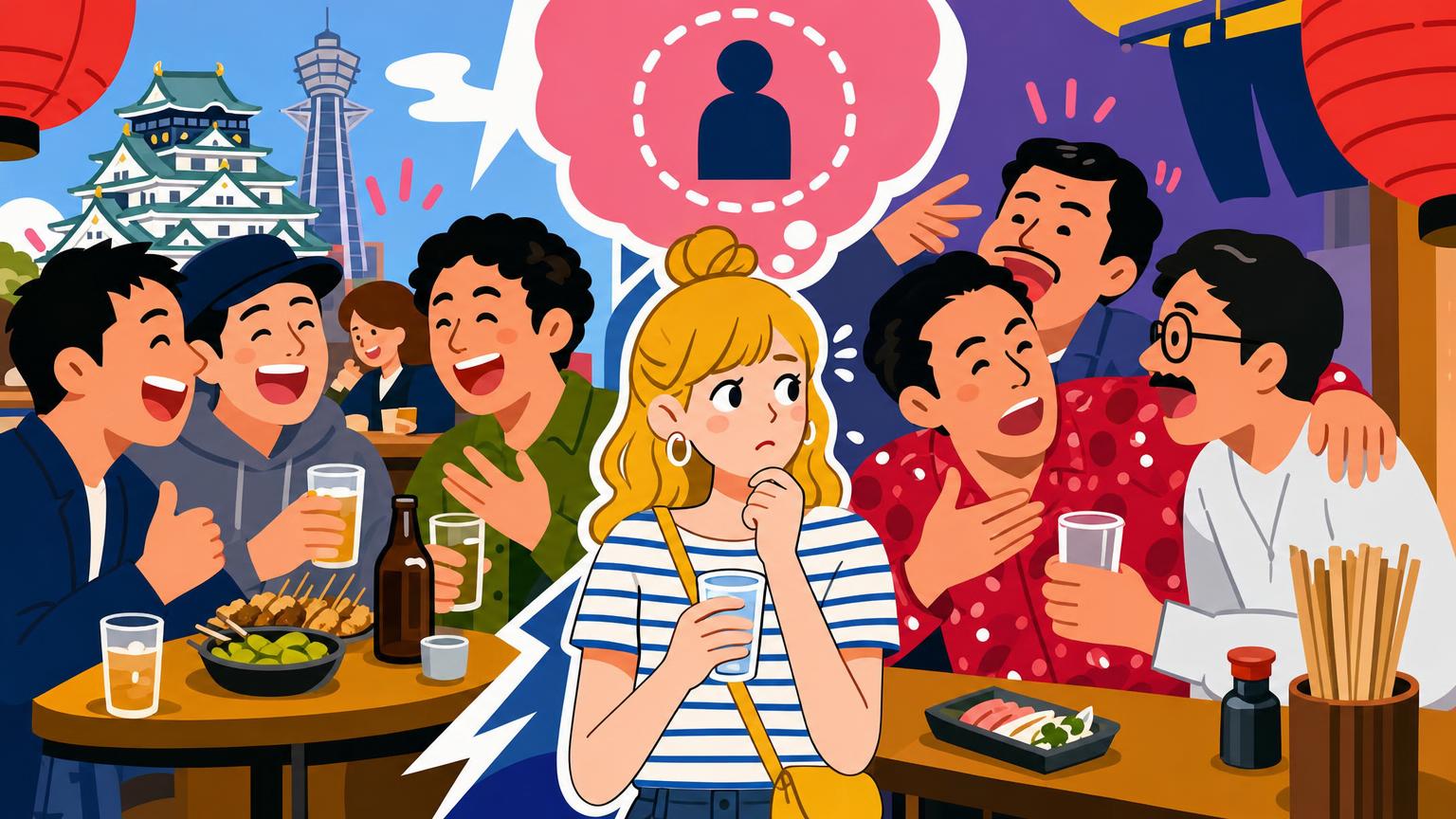
Foreigners in Osaka often encounter a combination of genuine curiosity, hospitality, amusement, and distance. These feelings can exist simultaneously.
A person may sincerely enjoy talking with you while still having little interest in learning about your life beyond the bar. A bartender may remember your drink but not your job. Regulars may welcome you when you arrive and still continue their private conversation without including you. Someone may invite you to join a group meal, but the invitation may be spontaneous and informal rather than a serious promise.
This combination can be confusing because many foreigners have experienced the opposite pattern elsewhere: polite distance at first, followed by deeper warmth after repeated contact. In Osaka, the initial interaction may be warmer than expected, while the relationship that follows may develop slowly.
Surface openness and deeper trust are different layers
It can help to think of social contact as consisting of several layers:
The public layer
This includes jokes, greetings, food recommendations, comments about the weather, and questions that can be answered in a sentence. This layer is often easy to enter in Osaka.
The familiar layer
This develops as people see you repeatedly. They begin to remember your drink, your schedule, your progress in Japanese, or your usual topics. You may receive a nickname, hear about a neighborhood event, or be introduced to another regular.
The trusted layer
This takes more time. It may include private worries, family matters, work problems, personal beliefs, or invitations into someone’s home. It is not created simply because you had a funny conversation one evening.
A foreign resident may be accepted at the public layer for months before being trusted at the deepest layer. That is not necessarily exclusion. It is often how ordinary relationships develop.
Do not turn one invitation into a contract
A person may say, “Let’s drink again,” “Come with us next time,” or “I will show you around.” In some contexts, this is a genuine invitation. In others, it is simply a warm closing phrase. The only way to understand the difference is to see whether a concrete plan follows.
If you want to follow up, ask clearly but lightly:
“Would you like to meet next Thursday?”
If the person gives a specific time or suggests another date, the interest is probably practical. If the response remains vague, let it rest. Do not repeatedly pursue the invitation, and do not assume that the original conversation created an obligation.
This is especially important for expats who feel lonely. A brief burst of social warmth can seem like the beginning of a solution to isolation. Sometimes it is. Sometimes it is simply a pleasant evening. Enjoying it without giving it a larger meaning protects both you and the other person.
Personal Boundaries: What Is Comfortable and What Is Not
Being open to local conversation does not mean tolerating every kind of behavior. Foreigners sometimes overcorrect because they fear appearing rude. They accept unwanted touching, intrusive questions, unwanted drinks, or repeated invitations because they believe Osaka people are expected to be friendly.
That is not cultural understanding. It is abandoning your own judgment.
Physical boundaries in a crowded bar
A small tachinomi can be physically cramped. People may brush past you, reach across the counter, or ask you to shift so another customer can stand. Much of this is practical rather than intimate.
Still, unwanted touching is different. A hand on your shoulder, an arm around you, or repeated contact may feel normal to one person and uncomfortable to another. You can move away, say “Please don’t touch me,” or inform the staff. You do not need to laugh to make the other person comfortable.
For women and gender-diverse foreigners, this distinction can be especially important. A lively bar can be welcoming while still including individuals who treat friendliness as permission to flirt aggressively. Osaka’s casual atmosphere does not remove the ordinary risk of harassment.
Conversation boundaries
You can decide how much of yourself to disclose. Your nationality, job, relationship status, religion, immigration status, salary, and housing situation are not public property simply because someone asks.
A direct answer is optional. You can give a broad category instead of a specific detail. “I work in technology” is enough. “I live near the river” is enough. “I came to Osaka for work” is enough.
You can also ask questions in return. This shifts the balance of the conversation and helps you determine whether the other person is interested in mutual exchange or merely treating you as a curiosity.
Alcohol boundaries
A customer may encourage you to try a drink, share a dish, or order something stronger. That can be generous, but it can also become uncomfortable if the encouragement continues after you say no.
Use a simple sentence and repeat it without offering a lengthy explanation:
“No, thank you. I’m finished for tonight.”
If necessary, tell the staff that you are leaving. You do not owe anyone a performance of gratitude for pressure you did not request.
Reading the Difference Between Osaka and Tokyo
The contrast between Osaka and Tokyo is often simplified as “friendly Osaka” and “cold Tokyo.” That description is too shallow to be useful.
Tokyo is not devoid of warmth, and Osaka is not free of reserve. The difference is often a matter of public style, conversational timing, and acceptable informality rather than a difference in human kindness.
Osaka often makes contact sooner
In Osaka, it may be easier for a stranger to comment on what you are eating, ask where you are from, or make a joke in a shared setting. The language may be more casual, and the emotional temperature may rise quickly. A bartender may react dramatically to your order. A customer may point out a funny mistake rather than allowing it to pass quietly.
This can make daily life feel less formal and more accessible, especially if you are lonely or still learning Japanese.
Tokyo often protects social distance more visibly
In Tokyo, strangers may be more likely to keep their attention within their own group, particularly in crowded or highly organized environments. People may avoid commenting on your appearance, food, or behavior. This does not mean they are less kind; it may mean they are prioritizing privacy, efficiency, and non-interference.
A foreigner who prefers personal space may find this easier, while a foreigner seeking spontaneous interaction may find Osaka more comfortable.
Osaka informality can conceal expectations
A relaxed tone does not mean there are no rules. A casual voice can still carry the expectation that you will notice when another customer needs space, avoid making the bar uncomfortable, and understand when a conversation is ending.
This is where some foreigners misread Osaka. They hear a joke and assume anything goes. They see customers talking loudly and assume the group wants them to join for the rest of the night. They receive a direct question and assume they should respond with equal directness.
Osaka may lower the barrier to entry without removing the social architecture behind it.
What Foreign Residents Commonly Misunderstand
Living in Osaka means encountering the same people repeatedly, which can make misunderstandings more consequential. A misunderstanding at a bar may affect how comfortable you feel about returning to the neighborhood.
“They are laughing, so they must be laughing with me”
Sometimes they are. Sometimes they are laughing at a language mistake, a situation, or the reaction of one of their friends. Japanese laughter can express embarrassment, surprise, politeness, or genuine amusement.
You do not need to panic whenever people laugh. Pay attention to what happens next. Do they explain the joke, include you, continue speaking normally, or offer help? If the atmosphere returns to normal, the moment was probably minor.
If people imitate you, repeat your words mockingly, or continue after you show discomfort, you can leave. A foreigner should not have to accept humiliation as the price of integrating locally.
“They asked for my contact details, so we are friends”
Exchanging contact details can mean many things. It may reflect personal interest, business convenience, a desire to practice English, an invitation to drink together in the future, or simple curiosity. The meaning becomes clearer through their later behavior.
Do not assume that following each other on social media means you are close. Avoid sending a large amount of personal information right away. Let the relationship develop at a pace that feels mutual.
“They did not invite me, so they dislike foreigners”
A group may already have its own private rhythm. They could be coworkers, cousins, longtime friends, or regulars discussing something personal. Their choice not to include you may have nothing to do with your nationality.
Consider their overall behavior. If the staff greet you, make room, answer your questions, and treat you fairly, you may be welcome even if the conversation remains mostly among regulars.
“Osaka people will always explain everything”
Some people enjoy helping foreigners. Others may be tired after work, shy about their English, or simply focused on their meal. If someone gives you a brief answer, do not immediately interpret it as hostility.
Try asking a clearer question, speak with the staff, or accept that the exchange has ended. Being able to leave a small interaction unfinished is an important part of living comfortably in a dense city.
How to Join Without Taking Over
The best foreigner in a small neighborhood bar is not the person who talks the most. It is the person who pays attention to the room.
Start by observing. Is the bar quiet or noisy? Are customers chatting with one another, or are most people eating alone? Is the counter already crowded? Are people standing for a quick drink, or settling in for a longer evening?
Order first and learn how payment works. Keep your bag close and your body compact. If you want to talk, begin with the food or the immediate situation.
Keep the first conversation light
A good first exchange may last only a few minutes. Avoid asking a stranger for personal details before sharing something about yourself. If you ask where they are from, you can also mention where you are from. If you ask how long they have lived in Osaka, you can share a little about your own situation.
Mutuality reduces the sense that one person is being examined.
Notice the small closing signals
A conversation may be coming to an end when someone:
- Turns back toward their food.
- Gives a brief answer without asking anything in return.
- Starts talking to the bartender.
- Checks their phone or wallet.
- Puts on a coat.
- Turns their body toward another group.
- Stops making eye contact.
These signals do not always indicate deliberate rejection. They may simply mean that the person is ready to return to their evening. Allowing the conversation to fade naturally is a social skill.
Make space before you are asked
In a tachinomi, physical awareness is a form of politeness. Move your glass or plate when someone needs space. Keep your elbows close. Do not spread a large coat across the counter. If the place gets busy, finish your current drink and consider leaving instead of holding a prime position while talking.
This matters socially because regulars judge whether a newcomer understands the shared space. You do not need perfect Japanese to be accepted. You do need to be aware.
The Role of the Bartender
The bartender or owner is often the quiet center of the room. They may introduce customers, translate a menu item, manage the pace of orders, and determine whether the atmosphere remains comfortable.
Foreign residents sometimes view the bartender as a personal host, which can create pressure. The owner may be friendly but busy, managing payments, food, stock, and the behavior of several customers at once. A brief response does not necessarily mean they are displeased with you.
If you are unsure how the bar operates, ask one clear question. “Do I pay now or later?” is better than waiting silently and becoming anxious. If you do not understand a bill, ask politely before leaving. Most problems are easier to resolve while the details are still visible.
A regular bartender may gradually become a bridge into the neighborhood. They might tell you which customers speak English, explain local events, or help you understand the tone of a joke. However, do not force that role. A bartender is not automatically your translator, therapist, dating intermediary, or immigration adviser.
When a Friendly Bar Is Not the Right Bar for You
Some foreigners assume that integration means staying in places that make them uncomfortable. It does not.
You may prefer a quiet bar where no one talks to you. You may dislike smoking, loud voices, teasing, or crowded counters. You may feel uneasy when strangers ask personal questions. You may want to drink alone after a difficult day. These preferences are valid.
A neighborhood bar can help you understand Osaka without being the right personal environment for you. You do not have to prove your openness by returning to a place where your boundaries are repeatedly ignored.
If you leave, do so simply. Pay your bill, thank the staff, and go. You do not need to announce a cultural criticism or offer a detailed explanation. If you enjoyed the food but not the atmosphere, that is useful information about your preferences.
Building Real Relationships Through Repetition
If you want more than occasional small talk, repetition matters. Relationships in Osaka often become easier when people see that you are not appearing once as a novelty and then disappearing forever. Visit at reasonable intervals. Greet people when you arrive. Remember names when possible, and ask about something they mentioned before.
The change may happen gradually. At first, someone may ask where you are from. Later, they may remember your neighborhood. Then they may ask whether work has been busy. Eventually, they might tell you about a family event or invite you somewhere else.
Do not demand this progression. Let it happen naturally.
Show that you are part of the neighborhood, not merely a consumer
A foreign resident becomes easier to understand when their life has some local texture. You shop at the same supermarket. You greet the same neighbor. You complain about the same train line. You know which bakery closes early. You have a favorite seasonal dish. You are not simply visiting Osaka to collect experiences; you are living within its routines.
This does not mean you must abandon your own culture. It means that relationships deepen through repeated, ordinary contact rather than dramatic cultural exchange.
Friendship may look less explicit than you expect
An acquaintance in Osaka may not say, “We are friends.” Instead, they might save you a place at the counter, tell you that a particular dish is sold out, send you a photo of a local event, or remember that you dislike raw fish. These small actions can carry more meaning than enthusiastic words.
At the same time, do not romanticize every gesture. A free snack may simply be hospitality. A saved place may be practical. Pay attention to patterns instead of assigning deep meaning to a single action.
A Practical Script for a First Visit
If you feel nervous, imagine the evening in simple stages.
You enter and pause near the door. If there is no obvious seating, that is normal; wait for the staff to show you where to stand. Say hello. If you are unfamiliar with the system, ask whether you pay first or later.
You order one drink and one small dish. A beer may cost around ¥400 to ¥600, while a small dish may cost around ¥300 to ¥500, depending on the establishment and ingredients. Prices vary, so check the menu or ask before ordering. These figures are working estimates, not a promise of a fixed bill.
You stand without blocking the entrance or counter. Eat slowly enough to enjoy the food, but do not occupy more space than necessary. If someone speaks to you, answer simply. If you want to continue the conversation, ask a related question. If it fades, return to your drink.
When you are ready to leave, ask for the bill if the system is unclear. Pay calmly and thank the staff. If you enjoyed the place, say that you will come again. Then let the next visit show whether the connection continues.
The point is not to become instantly local. The point is to behave in a way that leaves room for another encounter.
Is Osaka a Good Place to Live If You Want Community?
For many foreigners, Osaka can be a good place to live because everyday social contact is often easy to access. A small joke from a shopkeeper, a brief conversation at a standing bar, or a practical favor from a neighbor can make the city feel less anonymous.
However, Osaka is not a permanent social welcome committee. You may still experience loneliness and struggle to build close friendships. Language ability, work schedules, age, gender, class, and neighborhood all influence how easily you enter local networks.
The city’s casual atmosphere helps with initial contact, but it does not eliminate the deeper work of belonging.
If you need a reliable community, build one through several channels rather than relying on tachinomi conversations alone:
- A language exchange or study group.
- A sports club or creative hobby.
- A workplace relationship that develops gradually.
- A volunteer activity.
- A neighborhood association or local class.
- A small group of foreign and Japanese friends.
- Regular contact with one or two places where you feel comfortable.
Tachinomi can be one thread in your social life, but it should not carry the full weight of your emotional life.
What Osaka People May Be Reading in You
When you enter a neighborhood bar as a foreigner, people may be trying to figure out several things at once. Are you comfortable in Japan? Are you interested in the food? Do you understand the space? Are you looking for conversation, or would you prefer to be left alone? Are you likely to come back?
Your behavior answers these questions before your Japanese does.
If you greet the staff, order without making a fuss, make room for others, respond to conversation, and leave politely, you communicate that you are safe to have around. If you speak loudly in English over everyone else, film people without permission, interrupt regulars, or treat the bar as a stage for your Japan experience, you communicate something else.
This is not uniquely Japanese. Every community observes how newcomers behave. Osaka may simply offer more immediate feedback through jokes, facial expressions, and direct comments.
Try to listen to the feedback without becoming defensive. At the same time, maintain your judgment. A joke may provide useful information, or it may be unfair. A local custom may deserve respect, or it may conflict with your safety. Integration is not obedience.
The Most Honest Definition of Osaka Friendliness
Osaka friendliness often comes through a willingness to make a small opening.
It may be a question at the counter, a laugh over a difficult menu word, a warning that the mustard is stronger than it looks, or a customer shifting aside so you can stand. It may be a bartender explaining why the local regulars are arguing about baseball, a brief invitation to try Doteyaki, or a joke that would never appear in a formal office conversation.
The opening is real, and so is the boundary around it.
You can step into the conversation without assuming ownership of the relationship. You can enjoy the attention without needing to perform gratitude. You can decline a question without insulting the culture. You can return to the same bar without expecting each visit to recreate the first one.
This balance is especially important for foreigners because Osaka’s casual tone can feel like a shortcut into belonging. Sometimes it is the beginning of something lasting. Often, it is simply a humane moment in an ordinary evening.
Both are valuable.
If you remember only one idea, remember this: Osaka may invite you into the conversation quickly, but trust still grows at the pace of repeated ordinary life. Speak warmly. Watch the room. Keep your boundaries. Let familiarity develop without forcing it. That is how a foreign resident moves from being an interesting stranger to becoming someone the neighborhood quietly recognizes.