
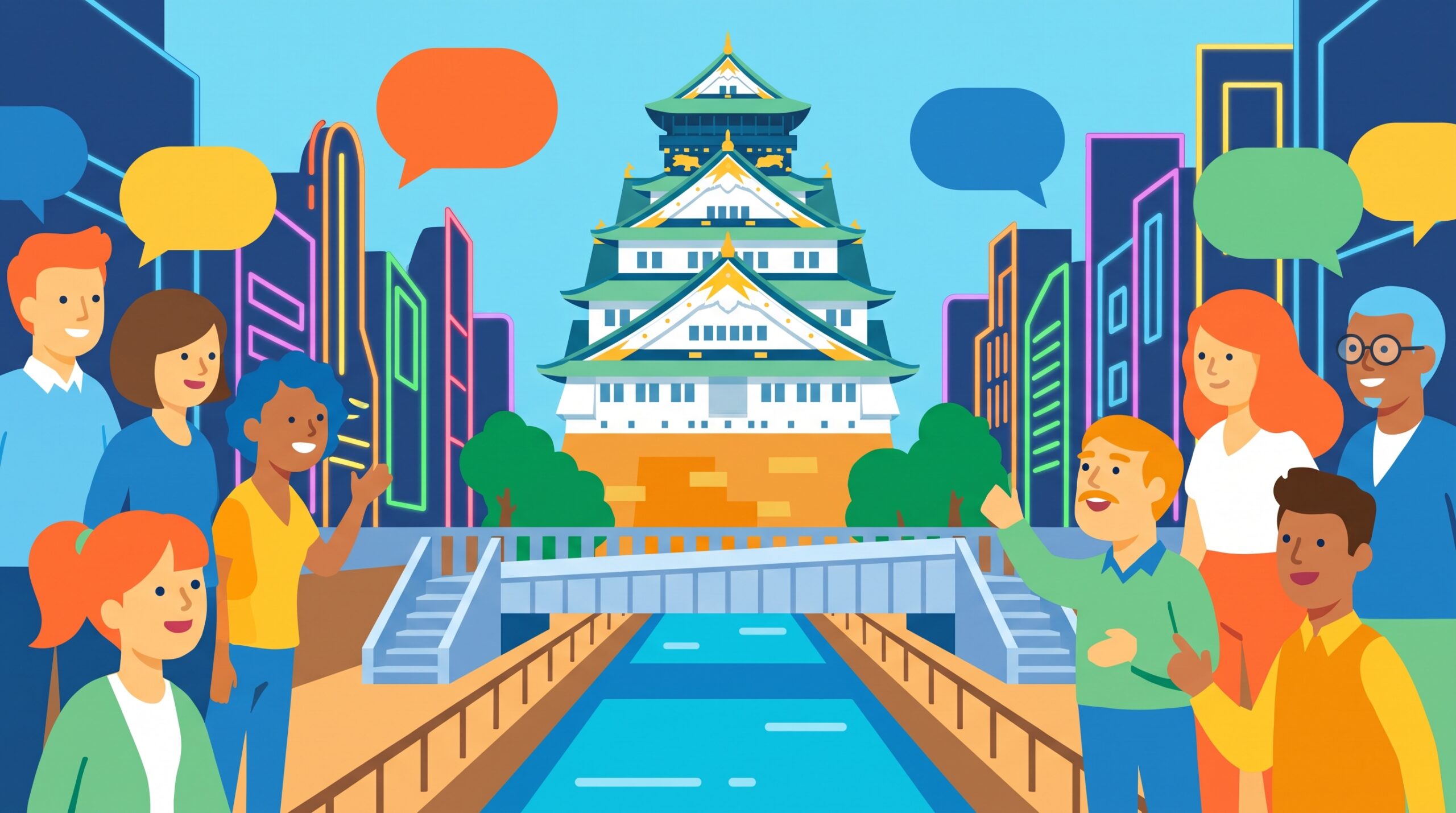
Tokyo is a symphony of silence. Millions of souls move in perfect unison, slipping past one another like ghosts in the rain. Boundaries are rigid. Privacy is sacred. To speak to a stranger on a commuter train in the capital is to break an invisible, ironclad law of urban survival. But when you board the bullet train, cross the cultural equator, and step onto the concrete platforms of Osaka, the silence shatters. The air grows thick with voices. The boundaries blur into nothingness. The rules of engagement are instantly rewritten in the warm, staccato rhythm of the local dialect.
Here, anonymity is an illusion. You are not a ghost; you are a participant. The moment you step into a neighborhood okonomiyaki joint, or lean against the sticky wooden counter of a standing bar, you are woven into the fabric of the community. In Osaka, small talk is not a mere polite gesture. It is a friendly intrusion. It is the social glue that binds the sprawling concrete grid together. For the foreigner arriving with textbooks full of formal, distant Japanese phrases, this sudden lack of personal space can feel jarring. You might be staring at your phone, minding your own business at a bus stop, when a stranger taps your shoulder to comment on your shoes, your height, or the sudden drop in temperature.
This is the essence of daily life in Japan’s gritty, glowing second city. As a photographer wandering the back alleys and neon-lit arcades, I have learned to put my camera down and simply listen. To live in Osaka is to accept that you will be spoken to. You will be questioned. You will be teased. But beneath this perceived nosiness lies a profound, unmatched warmth. Decoding this friendly intrusion is the ultimate key to unlocking the true spirit of Kansai. It teaches you that shedding your armor is the only way to truly experience the beating heart of the neighborhood.
Why Osaka is Japan’s Capital of Small Talk
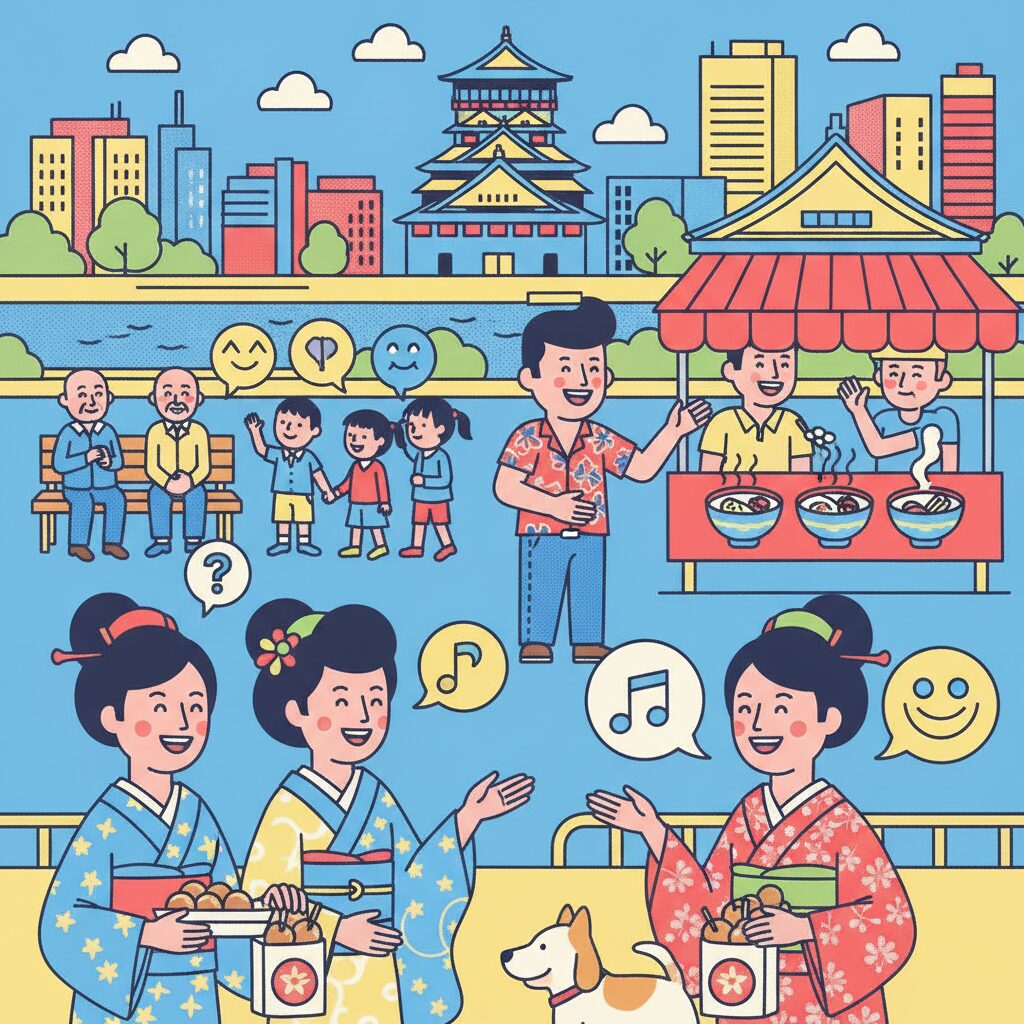
To grasp the intensely social mindset of the modern Osakan, one must revisit the pages of history. This means looking back to the time when this lively port was known as the kitchen of the nation. Unlike Edo, governed by the strict, hierarchical samurai swords and the rigid etiquette of the noble class, Osaka was a city shaped by merchants. It was founded by traders, brokers, and working-class visionaries. In a merchant society, silence is disastrous for business. Deals can’t be made, contracts can’t be signed, nor character judged without conversation. Talk was currency, and banter was a finely honed tool for building absolute trust.
This historical legacy remains deeply embedded in the city’s DNA. The merchant class’s heritage fostered a vibrant culture that values effective communication far more than stiff formality. In many other parts of Japan, there is a strong, unspoken focus on tatemae, the polite public facade, and honne, the true inner feelings. People tend to speak politely and indirectly to avoid even the slightest offense, maintaining harmony through distance.
Osakans, however, are renowned nationwide for their refreshingly blunt honesty. They cut through the polite haze with sharp candor. They want to know your thoughts, your feelings, and, above all, what you are willing to share. This mercantile history also gave rise to a profound, lasting sense of egalitarianism. In the busy river markets of old Osaka, a person’s value wasn’t measured by bloodline or title but by quick wit, reliability, and ability to connect. That spirit remains vibrantly alive today. When you enter a small neighborhood eatery, the owner doesn’t care if you’re a corporate executive in a tailored suit or a wandering photographer with dust on your boots. You are simply another hungry soul seeking comfort from the neon storm outside. The small talk bridging the gap between stranger and regular acts as the ultimate equalizer, stripping away titles and pretensions to reveal the raw, shared experience of surviving in the same chaotic city.
Understanding the Local Vibe: Warmth and Comedy
The heartbeat of Osaka is unquestionably its unyielding sense of humor. Laughter acts as the heavy grease that keeps society’s wheels turning smoothly. If Tokyo is a serious, high-stakes drama, Osaka is a lively, chaotic improvisational comedy show. Osakans use humor to ease tension, express sincere affection, and swiftly welcome strangers into their inner circle. You don’t need to be fluent in Japanese to catch the punchline; you only need to be willing to smile, nod, and let go of your ego.
The Legendary Osaka “Obachan” Culture
There is no figure more iconic in the Kansai region than the legendary Osaka Obachan. The middle-aged and elderly women of this city are a formidable force of nature. They are easily recognizable, often dressed in bold, unapologetic leopard-print clothing, practical sun visors, and riding heavy bicycles brimming with swinging plastic grocery bags. However, their defining trait is an absolute refusal to acknowledge personal boundaries. The Obachan is the self-appointed matriarch of the neighborhood. She treats the entire sprawling city as her personal living room and everyone in it as a distant relative who urgently needs to be fed, scolded, or fussed over.
For a foreigner adapting to life in Japan, an unexpected encounter with an Obachan is a significant rite of passage. You might be standing in the chilly produce aisle of a local supermarket, staring blankly at an unfamiliar root vegetable, when suddenly an Obachan appears beside you as if from nowhere. She won’t offer a polite, distant greeting. Instead, she’ll immediately tell you exactly how to boil the vegetable, ask if you’re getting enough protein, and thoroughly question why you’re wearing such a thin jacket in the middle of November. Before you can fully process this rapid-fire interaction, she will press a piece of hard fruit candy into your palm—the legendary ame-chan—and vanish down the aisle before you can even say thank you.
This behavior can feel startlingly intrusive to those raised in Western cultures, where privacy is fiercely protected. Why does this woman care if I’m cold? Why is she forcing candy on me? The answer lies in the city’s deeply rooted communal spirit. The Obachan’s intrusion is a sincere, raw act of care. In an increasingly isolated and cold digital world, she stubbornly refuses to let you be alone. She uses rapid-fire small talk as a maternal radar system, constantly gauging the emotional and physical state of the people around her. Accepting her unsolicited advice and sweet candy is your very first step toward becoming a true local.
Everyday Comedy: The Art of Boke and Tsukkomi
No discussion of communication in Osaka is complete without exploring the massive influence of Manzai. This traditional, rapid-fire style of stand-up comedy originated in the Kansai region and has deeply influenced the everyday speech patterns of its millions of residents. Manzai centers around a classic duo. First, there’s the Boke, the foolish, air-headed character who makes absurd statements, misinterprets situations, or commits obvious blunders. Then, there’s the Tsukkomi, the sharp, quick-witted partner who promptly corrects the Boke with a fast-paced retort, a groan of disbelief, or a playful, theatrical smack on the head.
This dynamic isn’t restricted to TV screens or dimly lit comedy clubs; it unfolds daily on busy streets, in cramped corporate offices, and in smoky bars throughout the city. Friends and coworkers easily slip into these familiar roles without hesitation. A husband may play the Boke, making a ridiculous, exaggerated claim about his youthful athleticism, and his wife will effortlessly deliver the Tsukkomi, bringing him back down to earth to the uproarious delight of everyone at the table.
As a foreigner navigating this intricate social dance, you have a unique advantage. Being a bit of an outsider and still learning the ropes makes you the perfect, natural candidate to play the Boke. Making harmless cultural mistakes, slightly mispronouncing menu items, or acting playfully confused allows locals to comfortably assume the dominant Tsukkomi role. They’ll quickly correct you, laugh heartily with you, and instantly feel a strong connection. By embracing foolishness rather than fearing embarrassment, you show that you don’t take yourself too seriously. You demonstrate a fundamental understanding of the city’s unique, bouncing rhythm. It’s a beautiful, highly interactive dance where the ultimate reward is genuine human connection.
Best Places in Osaka to Chat with Locals
To truly feel the overwhelming conversational energy of Osaka, you need to know exactly where to focus your attention. The city is generally split into two main cultural zones. There is Kita, the polished, towering, refined northern district centered around Umeda. Then there is Minami, the raw, vibrant, neon-lit southern area revolving around Namba and Dotonbori. Yet the genuine, unfiltered magic unfolds in the deeply residential neighborhoods nestled quietly in the shadows of skyscrapers, where the tourist veneer disappears completely, revealing the real, gritty rhythms of daily life.
Tachinomi (Standing Bars) and Izakayas
The intricate social dynamics of Osaka are best witnessed in a tachinomi, a traditional Japanese standing bar. These cherished spots are often cramped, pleasantly smoky, and gloriously chaotic. They stand in stark contrast to the modern, sterile, quiet dining experience. In a tachinomi, there are no chairs to anchor you to a single, isolated place. The layout naturally encourages close proximity. You’ll inevitably brush elbows with the weary salaryman sipping a highball beside you. You’ll have to politely ask the lively group of college students next to you to pass the soy sauce.
Neighborhoods like Tenma, with its endless maze of glowing, lantern-lit alleys, and Kyobashi, the gritty, working-class transit hub, abound with these standing sanctuaries. Here, a quick apology for bumping into a stranger’s shoulder can quickly turn into a full-fledged inquiry about your home country, occupation, and marital status. The absence of seating creates a wonderfully fluid and dynamic social scene. People move around, mingle freely, and buy each other rounds of affordable drinks. The experienced bartender serves as an expert conductor, seamlessly weaving together overlapping conversations among completely different groups. Standing at a worn wooden counter with a cold draft beer and a greasy plate of fried meat skewers, you become physically part of the crowd. The threshold for small talk disappears entirely. You are there, shoulder to shoulder with them; therefore, you belong.
Bustling Markets and Shopping Arcades
Another essential venue for mastering neighborhood small talk is the shotengai, the extensive covered shopping arcades that thread through the city like arteries of concrete. The Tenjinbashisuji Shotengai, known as the longest shopping street in all of Japan, is a prime example. Walking through these arcades is a dazzling sensory overload of shouting street vendors, sizzling food stalls, and the constant clatter of bicycle bells.
Shopping at a neighborhood shotengai is never a passive or quiet event. It is an active, vocal negotiation. Proud vendors don’t sit quietly behind modern digital cash registers; they stand upfront, shouting to passersby, loudly promoting the unmatched freshness of their morning fish catch or the perfect golden crunch of their potato croquettes. Making eye contact with a vendor is a clear invitation to engage in banter. If you pause to buy a single inexpensive piece of fried chicken, the vendor will immediately ask why you’re wandering around Osaka. They’ll boast loudly about their grandmother’s secret recipe. If you respond with a warm smile, genuine enthusiasm, and try to speak even some broken local dialect, you might suddenly find an extra piece of hot food generously added to your paper bag. This is no mere commercial transaction; it is an essential social exchange. They eagerly trade calories for conversation, building a fiercely loyal community one happy customer at a time.
Essential Kansai-ben Phrases to Break the Ice
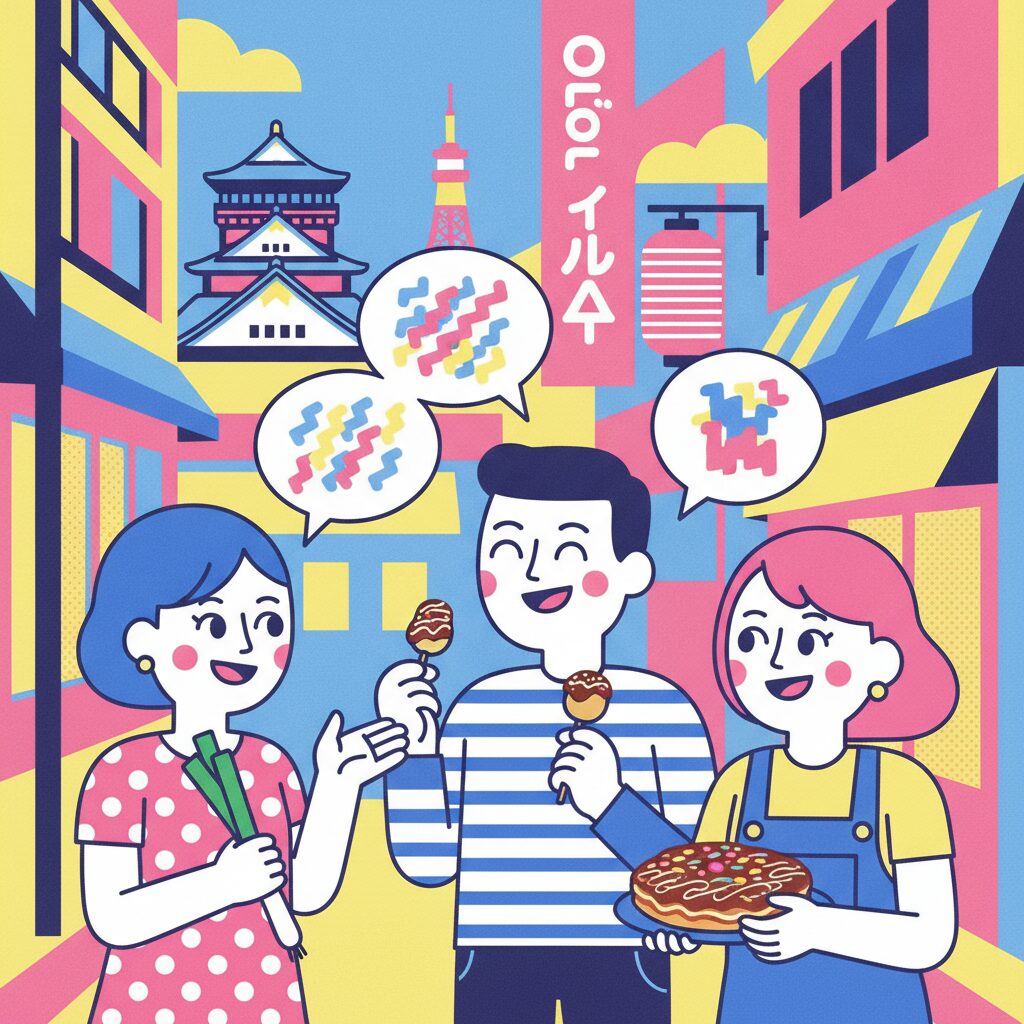
The standard, polite Japanese commonly taught in foreign textbooks is perfectly understood throughout Osaka, but relying solely on it can unfortunately keep you at a polite, safe distance from the locals. To genuinely break the ice, escape the tourist treatment, and enchant the residents, you need to enthusiastically mix Kansai-ben, the cherished regional dialect, into your daily vocabulary. Kansai-ben is highly melodic, deeply emotional, and intrinsically linked to the city’s loud, comedic spirit. Using these phrases demonstrates a profound respect for their local culture and a courageous willingness to step well beyond your linguistic comfort zone.
Friendly Greetings for Any Situation
Forget the stiff, highly formal greetings typical of the eastern capital. In the cramped shops and lively bars of Osaka, the single word you’ll hear bouncing most often off the walls is maido. Originally a traditional greeting used exclusively by merchants to thank their most loyal, returning customers, maido has beautifully evolved into a universal, catch-all expression. It means hello, thank you, and welcome back to my shop. When you confidently enter a familiar neighborhood bar and loudly cheer maido, you instantly mark yourself as someone in the know, transforming from a tourist into a temporary local.
Similarly, ohkini is the soft, uniquely Kansai equivalent of the standard arigatou, or thank you. The word carries a wonderfully gentle, rolling, almost musical cadence, completely lacking the sharp, formal edges of standard Tokyo Japanese. When you hand over your coins to pay for a steaming tray of takoyaki at a breezy street stall, offering a sincere, smiling ohkini will almost always bring a broad, surprised smile to the vendor’s tired face.
And then there’s nande ya nen, the ultimate, undisputed king of Tsukkomi phrases. It loosely translates to what the hell are you talking about, or absolutely no way. It’s the perfect, playful retort when someone cracks an absurd joke, playfully overcharges you in a fake negotiation, or lightly teases you about your chopstick skills. Delivering a sharp, well-timed nande ya nen with a huge smile instantly shows that you truly grasp the city’s comedic rhythm. It’s the linguistic equivalent of a high-five, breaking down cultural walls in seconds.
Praising the Local Food
Osakans are fiercely, almost aggressively proud of their rich culinary heritage. This is the fabled city of kuidaore, the risky philosophy of eating until you physically fall into bankruptcy. Food is taken very seriously here, and loudly praising it is the fastest way to win a local’s heart and secure your spot at the counter.
While standard Japanese politely uses oishii for delicious, Kansai-ben prefers the much punchier, more robust umai. But to truly express deep, overwhelming satisfaction, you must amplify the word. Adding the local prefix meccha, meaning very or insanely, creates the ultimate compliment. Leaning back heavily from a hot grill after devouring a massive, savory pancake and declaring meccha umai is absolute music to a sweaty chef’s ears. It completely bypasses polite, rigid etiquette and speaks straight from the soul to the stomach. When you vigorously validate their food, you validate their city. And when you validate their beloved city, they welcome you with open arms as one of their own.
Safe Topics and Cultural Etiquette
While social boundaries in Osaka are delightfully looser and far more permeable than in other major Japanese cities, there remain unspoken, essential rules of engagement that must be respected. The ultimate aim of friendly intrusion is always to foster comfort, joy, and laughter, never tension or conflict. Consequently, successful small talk tends to revolve smoothly around universal, deeply unifying themes.
Food, naturally, is consistently the safest and most passionately debated topic. Casually asking the person next to you what they are eating, or humbly requesting a secret recommendation for a late-night ramen shop, is an absolutely guaranteed way to start a conversation. Sports, especially the tough game of baseball, form another major, unshakable pillar of local culture. The Hanshin Tigers, the fiercely beloved and historically cursed local baseball team, inspire a fanatical, almost religious following throughout the region. Expressing even a mild, passing interest in the Tigers’ fortunes can instantly create a deep, brotherly bond with a complete stranger at a bar.
On the other hand, it is extremely wise to completely avoid deep, heavy political discussions, dark subjects, or harsh, sweeping criticisms of Japanese society during these casual interactions. The sole purpose of the banter is lightheartedness. It’s about sharing a fleeting laugh, loudly complaining together about the oppressive summer humidity, or passionately comparing the specific merits of various local sake breweries. As a foreigner, you will frequently be asked where exactly you are from, what you do for a living, and if you can handle spicy food or raw fish without getting sick. These repetitive questions are absolutely not meant to alienate you or emphasize your foreignness; they are genuine, eager attempts to find a shred of common ground. Respond with great good humor. Ask similar questions in return. The exchange doesn’t need to be philosophically deep; it just needs to be warmly sincere.
Embrace the Friendly Spirit of Kansai
Living your daily life in Osaka is a continuous, beautiful lesson in genuine human connection. It strongly encourages you to shed the heavy, protective armor of urban anonymity that we often wear in modern, sprawling cities. It invites you to be fully present, express yourself openly, and willingly engage with the lively, chaotic world spinning right around you.
The warm intrusion of neighborhood chit-chat isn’t an annoyance to ignore or brush aside; it is a cultural gem to be cherished. It is the loud, unapologetic sound of a city that genuinely cares about your existence. It is the sudden, beautiful realization that the old woman pressing a piece of candy into your hand, the gruff vendor shouting prices across the wet fish market, and the tired businessman buying you a cold beer on a Tuesday night are all part of a grand, ongoing, invisible conversation. They eagerly weave the thick, unseen threads that hold the heavy concrete community together against modern isolation.
When you finally stop resisting the overwhelming noise, put down your defenses, and start truly listening to the rhythm of the streets, Osaka reveals its true, breathtaking beauty. You realize you are no longer just a temporary resident hiding in an apartment; you become a recognized neighbor. You understand that in a vast, spinning world full of ghosts and strangers, a simple, confidently spoken maido is truly all it takes to find your way home.








