You hear the word before you even really understand it. It’s whispered in guidebooks, splashed across neon signs in Namba, and dropped casually by local friends when you ask for a dinner recommendation. Kuidaore. The characters, 食い倒れ, paint a dramatic picture: ‘kui,’ to eat, and ‘daore,’ to fall down, collapse, or go bankrupt. The common translation, “to eat until you drop,” conjures images of gluttonous abandon, a city of people unbuckling their belts and succumbing to a food coma in the middle of a crowded street. And sure, on a wild Friday night in Shinsaibashi, you might see something that comes close.
But after years of living here, navigating the steam-filled alleys and packed shotengai arcades, I’ve come to understand that this translation, while punchy, misses the point entirely. It’s like describing New York City as just “a place with tall buildings.” It’s true, but it’s a postcard-deep understanding. Kuidaore isn’t a command to overeat. It’s a philosophy. It’s an economic principle. It’s a social contract. It’s the operating system of Osaka, a city built not by shoguns and emperors, but by merchants with full bellies and a sharp eye for a good deal. To live in Osaka is to learn the true language of Kuidaore, to see it not as an act of consumption, but as a lens through which the city’s entire identity—its pragmatism, its boisterous spirit, and its deep-seated sense of community—comes into focus. It’s the single biggest cultural difference you’ll feel when you move here from the polished, reserved world of Tokyo. It’s louder, messier, and infinitely more delicious.
This deep communal spirit found at every lively street food stall is mirrored in the city’s social fabric, where Osaka’s nori helps build genuine bonds among its people.
The Great Misunderstanding: It’s Not Gluttony, It’s Passionate Investment

Let’s begin by breaking down the cliché. The ‘daore’ in Kuidaore is best understood in its financial sense: to go bankrupt. “Eat yourself into bankruptcy.” That sounds even harsher, doesn’t it? It suggests a reckless, self-destructive indulgence in culinary delights. But for an Osakan, it’s a statement of values. It’s an exaggeration, of course, but it declares that if you’re going to spend your money on anything, it should be on good, life-affirming food and the joyful moments that come with it. It’s a preference for fleeting happiness over the steady accumulation of material wealth.
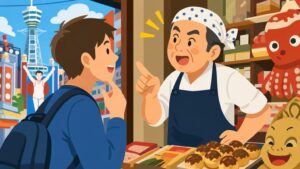
This isn’t about mindlessly stuffing food into your mouth. It’s quite the opposite. It’s about being highly discerning. I once saw an elderly couple standing in front of three different takoyaki stalls, all within ten feet of each other. They didn’t just choose the one with the shortest line. They debated. They pointed. They observed the vendor’s technique—the speed of the wrist flick turning the octopus balls, the batter’s consistency, the quality of the bonito flakes fluttering in the heat. It was a five-minute discussion over an eight-piece, 500-yen snack. That, right there, marks the beginning of understanding Kuidaore. It’s not about quantity; it’s about precision. It’s the conviction that every meal, even a simple street snack, deserves serious attention.
In Tokyo, dining can often feel like a display of status. The Michelin stars, the nearly impossible reservations, the hushed reverence of the dining room—it’s about appreciating food as high art, often in a formal setting. Osaka’s approach is more democratic, more down-to-earth. The question isn’t, “Is this place famous?” The question is, “Is it umai (delicious)?” And just as importantly, “Is the price right?” This unwavering focus on value is the true core of the philosophy.
The Merchant’s Stomach: Kuidaore as an Economic Philosophy
To understand why Osaka is the way it is, you need to consider its history. While Tokyo (formerly Edo) served as the seat of the samurai government and Kyoto housed the imperial court, Osaka was known as the Tenka no Daidokoro—the Nation’s Kitchen. It was a merchant city, a vast hub where rice and goods from all across Japan were gathered, stored, and traded. This history shaped a mindset that is profoundly pragmatic, intensely competitive, and disdainful of pretension.
This merchant spirit runs deep in the city’s food culture. A restaurant in Osaka cannot survive on hype alone. It won’t last on fancy decor or a trendy location if the food isn’t exceptional. The local customers are famously discerning and, to be frank, stingy in the most admirable way. They have a finely tuned internal calculator for what things should cost. This idea is known as kospa, a Japanese blend of “cost performance.” While kospa matters in Tokyo, in Osaka, it is almost a creed.
This results in a harsh but beautiful form of natural selection among restaurants. If a ramen shop charges 1,200 yen for a bowl that a competitor down the street offers for 800 yen, that extra 400 yen must be justified by something you can taste immediately. Is the chashu pork slow-braised for 72 hours? Is the broth a complex harmony of ten different ingredients? If not, the place will be empty within six months. Osakans share their opinions quickly, and the judgment is swift. This is why you’ll discover some of the most incredible food in tiny, slightly grimy-looking shops tucked beneath railway bridges, run by single elderly women who have perfected a dish over fifty years. Here, the quality-to-price ratio is the sole currency that matters.
This mindset encourages remarkable innovation. Street food vendors are constantly trying to outdo each other, whether by adding a secret ingredient to their takoyaki batter or inventing new kushikatsu skewers. It’s a dynamic, living ecosystem where only the tasty and reasonably priced survive. For residents, this is paradise. It means they are surrounded by an almost endless number of affordable, high-quality options. Their biggest daily dilemma isn’t finding something delicious but deciding which of the five amazing choices within two blocks suits their mood.
More Than a Meal: Food as Osaka’s Social Language

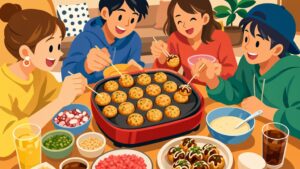
In many cultures, sharing a meal serves as a bonding experience. In Osaka, it functions as the primary mode of communication. Business isn’t sealed in sterile boardrooms over PowerPoint presentations; the genuine negotiations take place when the manager invites the client out for okonomiyaki, a sizzling, savory pancake cooked together on a tabletop griddle. The shared act of cooking, passing sauces, and shouting over the clang of metal spatulas dissolves formality and fosters rapport. You’re no longer just colleagues; you’re two people who have just conquered a mountain of cabbage and pork together.
This is why many Osaka eateries feel loud and chaotic by Tokyo standards. The boundary between the kitchen and dining area is often nonexistent. At a quality tachinomi (standing bar), the master might hand you your drink while grilling skewers, taking another order, and exchanging jokes with a regular at the counter’s end. You aren’t treated as a customer in a culinary temple; you’re a guest in their kitchen. This informality can be surprising for newcomers, but it captures the essence of Osaka’s social fabric. It’s an invitation to let go of pretenses and simply be human.
Foreigners often mistake this vibrant atmosphere for mere “friendliness.” It’s more nuanced than that—it’s a form of functional intimacy. The chatter, shared plates, and clinking glasses are all integral to the experience. It’s a mutual understanding that eating should be joyful, communal, and a bit messy. The concept of hashigo-zake, or bar-hopping, perfectly illustrates this. An evening isn’t about settling in one spot for hours; it’s a culinary adventure. You begin at a tachinomi for a quick beer and some doteyaki (slow-cooked beef sinew). Next, you move to a specialty kushikatsu joint for fried skewers. Then, perhaps, you pick up takoyaki from a street stand to enjoy by the canal. Finally, you end the night with a bowl of ramen for the shime, the final, soul-satisfying dish that wraps up the evening. Each stop offers a different scene, flavor, and conversation. It’s a dynamic, flowing style of socializing built entirely around the pursuit of the next delicious bite.
The Osaka Palate: Deconstructing What They Value
So what do Osakans truly obsess over? Tourists recognize the big three: takoyaki, okonomiyaki, and kushikatsu. And indeed, these are cornerstones of the local cuisine. But living here means appreciating the deeper principles that shape the local palate.
The Soul is Dashi
Above all else, it revolves around dashi. This savory broth, usually made from kombu (kelp) and katsuobushi (dried bonito flakes), forms the unseen backbone of Kansai-region cuisine. This distinction marks perhaps the most notable culinary difference between Osaka and Tokyo. Kanto-style dishes, from the Tokyo area, favor a strong, dark broth rich in soy sauce. Kansai-style dashi, by contrast, is lighter in color, more delicate, and seeks to enhance the natural flavors of the ingredients rather than overpower them. This is most evident in a simple bowl of kitsune udon. In Osaka, the broth is a pale, golden liquid, nearly translucent, with a deep, mellow umami flavor that perfectly complements the sweet fried tofu and tender noodles. To an Osakan palate, the dark, salty Kanto broth can taste harsh and one-dimensional. This devotion to dashi is why Osaka is renowned for dishes that highlight it, such as the delicate egg custard of chawanmushi or the clear broth of osuimono.
The Church of Konamon
Next is the steadfast passion for konamon, which literally means “flour things.” Takoyaki, okonomiyaki, and the lesser-known but equally cherished ikayaki (grilled squid pancake) all belong to this category. Historically, these dishes were common folk food—affordable, hearty, and endlessly versatile. Yet in Osaka, they have been elevated to a culinary art form. The batter for perfect takoyaki remains a closely guarded secret, a carefully calibrated mix of flour, dashi, eggs, and other ingredients that produces a ball crispy outside and irresistibly molten inside. This affection for flour-based foods reflects the city’s humble, working-class roots. It’s not about fancy, rare ingredients; it’s about transforming simple, modest materials into something extraordinarily tasty through skill and passion.
The Thrill of the Hunt
Lastly, the Osaka palate treasures discovery. A true Osakan takes great pride in knowing “a little place.” It might be a tiny curry shop tucked away in Tenma’s backstreets or a family-run udon restaurant in a quiet residential area that’s been around for generations. The pleasure lies not just in eating but in the search itself. Conversations buzz with this kind of insider knowledge. “Have you tried that new gyoza spot in Fukushima?” “I heard the woman at the tempura stall in Kuromon Market has a fresh seasonal menu.” Talking about food this way is how people connect, share insights, and uphold their collective identity as residents of the Nation’s Kitchen. It’s a citywide, never-ending treasure hunt for the best kospa.
How to Live the Kuidaore Life
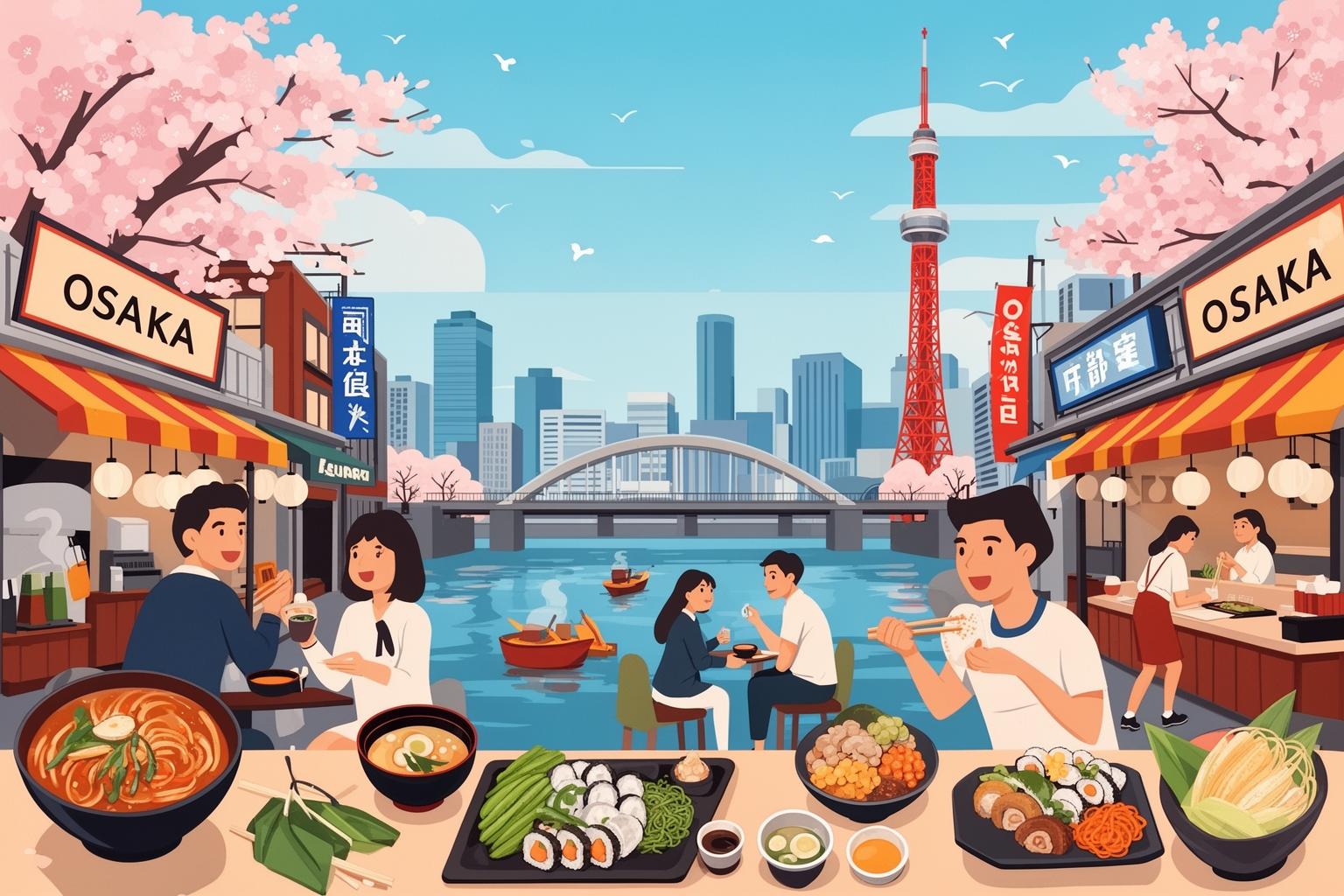
For a foreigner settling in Osaka, embracing Kuidaore is the quickest way to feel at home. It’s your gateway into the local culture. So, how do you go about it?
Follow the Locals, Not the Blogs
First, learn to interpret the signs. The best indication of a good restaurant isn’t a high app rating; it’s a queue of local office workers or neighborhood grandmas waiting outside at noon. Be bold. Explore the narrow, maze-like yokocho alleys and the extensive, covered shotengai arcades. These are the lifeblood of the city’s authentic food scene. If a place looks old, a bit worn, and is packed with happy patrons, you’ve likely found a gem. Don’t worry if there’s no English menu. Pointing and smiling go a long way.
Master the Art of the Counter Seat
Many of Osaka’s best eateries are small, counter-only establishments. Embrace this. The counter seat is more than just a place to eat; it offers a front-row view of the action and your best opportunity for interaction. Watch the chef’s hands as they prepare your meal. If you know a bit of Japanese, ask a simple question about the food. Even a straightforward “Oishii!” (Delicious!) or the more Osakan “Meccha umai!” (Sooo good!) will often earn you a big smile and perhaps a recommendation for your next dish. These little exchanges are what weave you into the fabric of the neighborhood.
Make Food Your Go-To Conversation Starter
When you meet new people, don’t just ask what they do for a living. Ask where they go for ramen. Ask about their favorite takoyaki stand. Ask them to settle the eternal debate: which okonomiyaki style, Hiroshima or Osaka, is better? (The correct answer, when in Osaka, is always Osaka). These aren’t throwaway questions. They are genuine inquiries that show your interest in the local culture on its own terms. People will eagerly share their opinions, and through that exchange, a connection is formed.
The Philosophy on Your Plate
Living in Osaka gradually reshapes your brain. You begin to perceive the city not just as a collection of train stations and landmarks, but as a map of flavors. You find your way by recalling the udon shop on that corner or the coffee place down that alley. You come to understand that Kuidaore was never about eating until you physically collapse. It’s about investing your energy, curiosity, and yes, your money, into seeking things that bring immediate, tangible joy.
It’s a philosophy of active engagement. It’s about knowing your neighborhood, forming relationships with the people who nourish you, and participating in the ongoing, city-wide conversation about what’s good. It’s a loud, unpretentious, and deeply human way of life. It’s the realization that the best things in life aren’t material—they’re a perfectly fried lotus root skewer, a soul-warming bowl of broth, and the sound of laughter shared across a crowded counter. It is the generous, messy, and delicious soul of Osaka, served on a plate for anyone willing to take a bite.