Walk down any residential street in Osaka, deep in the maze of low-rise apartments and single-family homes, and you might see it. A proud, temple-like roofline, a short curtain hanging in the doorway, the gentle hiss of steam escaping into the evening air. This is the neighborhood sentō, the public bathhouse. My first thought, like yours probably, was a simple one: Why? In a country where nearly every home has a perfectly functional bathroom, why do people still pay a few hundred yen to go bathe with their neighbors? The answer, I discovered, has very little to do with getting clean. It has everything to do with understanding Osaka.
Forget the serene, meditative images of mountain hot springs you see in travel brochures. The Osaka sentō is not a place of quiet contemplation. It’s a living room, a community center, a newsroom, and a therapy session, all rolled into one steamy, tile-lined space. It’s where the city’s famous personality—its warmth, its directness, its lack of pretense—is stripped down to its most essential form. Here, in the heart of neighborhoods far from the neon glow of Namba or the commercial hum of Umeda, you’ll find the unfiltered rhythm of daily life. To understand the sentō is to understand the social glue that holds this city together, a concept that feels worlds away from the polite, reserved distance you might find in Tokyo. This isn’t just about bathing; it’s about belonging.
The communal vibe extends beyond the sentō, inviting locals to uncover Osaka’s hidden corners by embarking on authentic private railway journeys that reveal the city’s remarkable character.
The Unspoken Rules of the Neighborhood Living Room
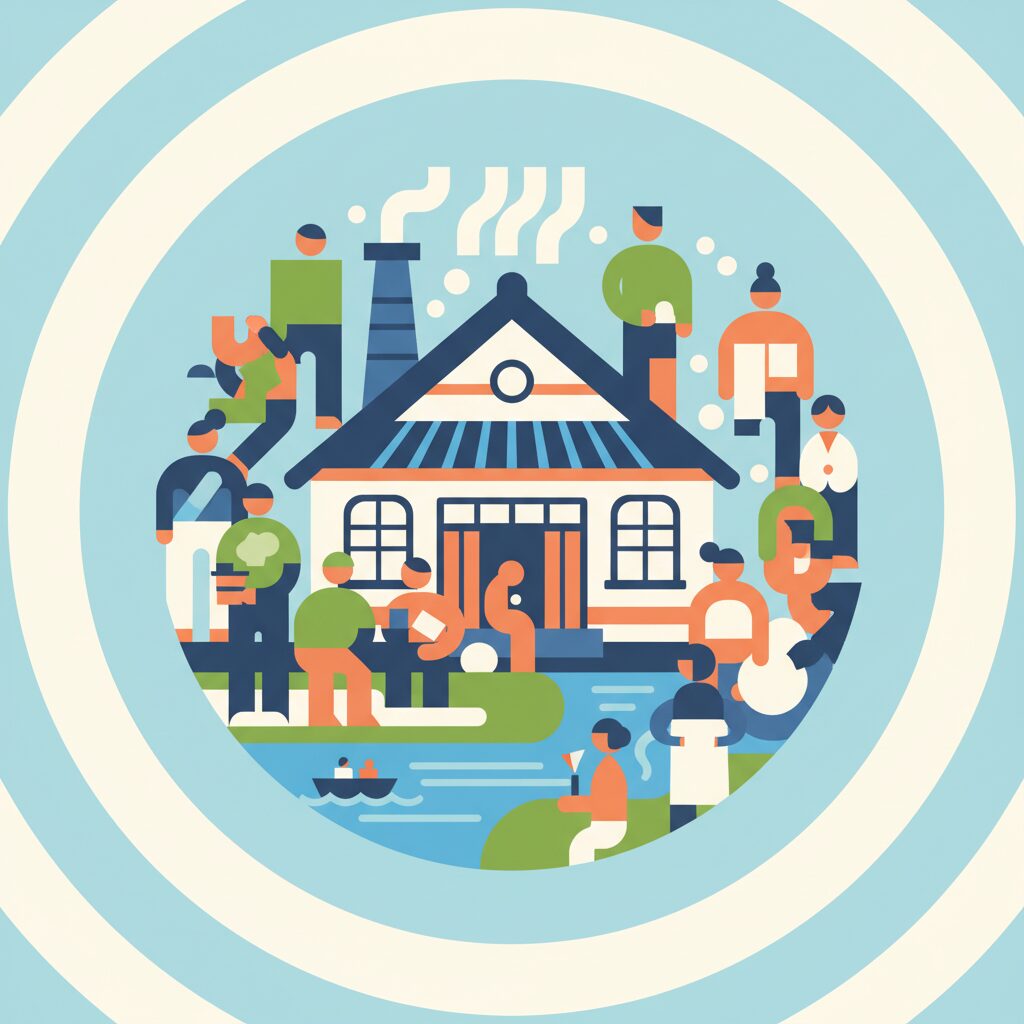
Stepping into an Osaka sentō for the first time feels like entering a private party you weren’t invited to. The air hums with chatter, laughter, and the booming echo of voices bouncing off tiled walls. It’s loud. It’s communal. And it follows a set of social codes that are sensed rather than spoken. At the heart of it is the Japanese concept of hadaka no tsukiai, or “naked communication.” This idea suggests that without the status symbols of clothes, brands, or uniforms, people can connect on a deeper, more human level. In Osaka, this isn’t a quiet, philosophical notion; it’s a lively, lived reality.
Watch the regulars. An elderly man slips into the scalding hot bath, lets out a theatrical groan of relief, and instantly receives an update on the Hanshin Tigers from another bather across the tub. A group of mothers, their toddlers splashing in the shallower bath, exchange news about a local daycare’s waiting list. Two small business owners, a baker and a mechanic, lean against the tiles, discussing the rising cost of supplies. This isn’t small talk. It’s the neighborhood’s central nervous system firing in real time. Information flows, support is given, and social bonds are strengthened, all in the nude.
The etiquette goes beyond the familiar rules of washing before entering the tubs. It’s about social navigation. You learn to recognize faces and offer a slight nod of acknowledgment. You understand that the plastic stool and washbasin you pick aren’t merely tools; they represent a temporary claim to personal space within a shared environment. You learn to gauge the atmosphere. Unlike in Tokyo, where a sentō might feel like a more anonymous, almost spa-like escape from the city, the Osaka sentō presumes a baseline of social interaction. You don’t have to join in, but you are present together in a shared space. The quiet of a Tokyo bath can feel like polite respect for privacy; the noise of an Osaka bath feels like a warm, collective embrace.
Decoding the Osaka Dialect in the Steam
There is no better place to learn raw, unfiltered Osaka-ben than the local sentō. Here, the dialect is spoken naturally, untouched by the softening effects of formal settings or conversations with outsiders. The language you hear is quick, direct, and rich with a unique musicality and humor that perfectly reflects the city’s spirit. It’s where a shopkeeper might greet a friend not with a standard “Konnichiwa,” but with a hearty “Mokarimakka?”—a phrase that literally means “Are you making a profit?” but serves as a casual “How’s business?” or “How are you doing?” This greeting springs from a merchant city’s core, where work, life, and community are deeply intertwined.
You’ll catch the playful bluntness of expressions like “Akan!” (“No way!” or “That’s no good!”) and the warm familiarity in ending sentences with “-nen” instead of the formal “-desu.” Conversations unfold as rapid-fire exchanges of teasing, storytelling, and complaining, all delivered with affection beneath the surface. A grandmother might scold a child with a stern yet loving tone, friends mercilessly tease each other’s receding hairlines, and it all forms part of the intimate performance. For foreigners, it can feel overwhelming—a wall of sound that’s hard to decipher.
But the key is to grasp the intent. The directness isn’t rude; it’s efficient and honest. The humor isn’t mean-spirited; it’s a way of building connection. The volume isn’t aggressive; it’s enthusiastic. You don’t need to be fluent to engage. A simple smile, a nod, or a basic comment about the water temperature—“Ee oyu desu ne” (“This is nice hot water”)—is often enough to be welcomed in. The steam seems to lower communication barriers, making it a surprisingly forgiving place to listen, learn, and even try out a few words. It’s a soak in the local vernacular as much as in hot water.
Beyond the Bath: The Sentō Ecosystem
The sentō experience doesn’t begin at the bath’s edge nor end when you dry off. It’s a full, multi-stage ritual that extends into the areas surrounding the tubs. These spaces are equally important to the sentō’s function as a social hub. The entire facility operates as a finely tuned machine for community engagement, designed for lingering and interaction.
The Changing Room: More Than Just Lockers
The datsuijo, or changing room, is where many of the most meaningful conversations happen. With tatami mats or wooden benches for seating, it’s a space meant for post-bath relaxation. Here, you’ll find the renowned Osaka obachan (middle-aged and older women) holding court, sharing gossip and advice with the casual authority of community matriarchs. Elderly men stand before the large, shared mirrors, carefully combing their hair and chatting about their health, exchanging notes from recent doctor visits. Many sentō feature old-school, coin-operated massage chairs rumbling in the corner and a scale that becomes part of a daily ritual and public commentary. The changing room acts as the sentō’s green room, where the community prepares for and unwinds from the main event.
The Sacred Post-Bath Beverage
No trip to a sentō is complete without the post-bath drink. After soaking in nearly boiling water, the sensation of drinking an ice-cold beverage is a special kind of bliss. Every sentō has a glass-fronted refrigerator stocked with classic beverages: coffee milk, fruit milk, and yogurt drinks, all in small glass bottles sealed with paper caps. The act of peeling back that paper cap and sipping the sweet, cold milk is a shared cultural touchstone, a simple pleasure bridging generations. It’s an essential part of the ritual. You’ll often see fathers and sons, mothers and daughters, or groups of friends sitting on the benches in the changing room, drinking their milk and continuing their conversations. It serves as a moment of collective reward and a punctuation mark at the end of the bathing experience.
The Lobby: The Final Frontier
Many sentō have a small lobby or resting area, usually with a television tuned permanently to a baseball game or variety show. This is the final layer of social interaction. It’s where different groups come together. Children, energized from their baths, might pester their parents for ice cream from the freezer. Elderly patrons may sit watching TV for an hour, not necessarily to watch the program but simply to be in the company of others. In this space, the sentō completes its transformation from a bathhouse to a true community center—a warm, safe place to pass the time before heading back out into the night.
A Tale of Two Cities: Why Osaka’s Sentō Feel Different
While Tokyo certainly possesses its own sentō culture, the atmosphere and purpose often differ significantly. This contrast highlights a fundamental divergence in the urban philosophies of Japan’s two largest cities. Tokyo, constantly engaged in sleek reinvention, has witnessed the emergence of the “designer sentō.” These are frequently renovated with a modern, minimalist style, featuring carbonated baths, high-end saunas, cold plunge pools, and chic relaxation lounges. They are attractive, clean, and comfortable. Fundamentally, they serve as facilities for individual wellness. Visitors come to enjoy a service, focusing on personal relaxation in a quiet, carefully curated setting. Social interaction is possible, but not the primary aim.
Osaka, especially in its extensive residential areas, has largely resisted this movement. The traditional Osaka sentō prioritizes function over design—and that function is social. The emphasis is not on cutting-edge bathing technology but on maintaining a familiar, dependable community space. The tiles may be chipped, the lockers worn, and the amenities basic, but the space thrives on human connection. Its value lies not in the facility itself but in the community it serves. An Osaka sentō is a utility, as vital to the neighborhood’s well-being as a park or library. It acts as a piece of social infrastructure.
This illustrates a deeper cultural perspective. Osaka has long been a city of merchants, of tight-knit communities built on mutual support and practical sensibility. The culture values jō—a concept encompassing human feeling, empathy, and personal connection—over strict formality or aesthetic perfection. The sentō perfectly embodies this. It is a place where these connections are nurtured daily, face-to-face, without pretense. The owner, or bantō, is not an anonymous manager but a familiar presence who knows the regulars by name and might ask why they haven’t seen your cousin recently. This deeply rooted, almost familial sense of community is what makes the Osaka sentō feel less like a business and more like an extension of home.
What Foreigners Get Wrong: It’s Not Awkward, It’s Essential
For many non-Japanese people considering a visit to the sentō, the biggest obstacle is, of course, the nudity. The thought of being naked in a room full of strangers can be intimidating, sparking concerns about awkwardness, judgment, or social errors. This is likely the most significant cultural misunderstanding, as it completely misses the point.
The shared nudity is not about exposure; it’s about erasure. In the sentō, the external identifiers that separate us in the outside world—our clothes, jobs, wealth, nationality—are removed. A company CEO bathes beside a construction worker. A university professor talks with a high school student. You are not your profession or passport; you are simply a fellow human being, a part of the neighborhood. This is the great equalizer. It forms the foundation of Osaka’s unpretentious, straightforward culture. No one is staring, no one is judging. Everyone is there for the same simple reasons: to get warm, to relax, and to connect.
Entering an Osaka sentō is accepting an invitation into the city’s inner life. It is a space of shared vulnerability that cultivates a remarkable sense of community. Initial discomfort fades quickly, replaced by an appreciation for a social dynamic that is rare in modern urban life. My advice to any foreigner living in Osaka is to try it. Go with an open mind and a small towel. Don’t feel pressured to start conversations, but be open if they arise. Simply sit, soak, and listen. Notice the easy intimacy, the casual kindness, the constant hum of human connection. You’ll soon realize this isn’t a performance of “Japanese culture” for visitors. This is the real deal. This is the backstage of Osaka life, and being there is a privilege.
So, next time you see that classic curved roof in your neighborhood, don’t just pass by. People still go not because they lack a bath at home, but because the sentō offers something a private bathroom never can: a sense of place, a connection to those around you, and a feeling of belonging. It’s a powerful reminder that in a vast, bustling city like Osaka, the most meaningful moments often happen in the smallest, steamiest, and most unpretentious spaces. It’s a deep, warm bath in the very soul of the city.