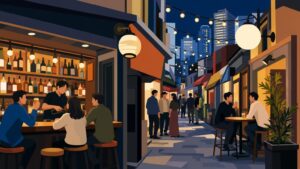

You may think finding a place to work in Osaka is a simple question: Which café has Wi-Fi, outlets, and enough tables for a laptop?
In practice, the better question is: What kind of Osaka day do you want to have?
Do you want to work inside the fast-moving corporate rhythm of Umeda, where people carry laptops between meetings and nobody is surprised by a video call? Would you rather sit in Nakazakicho, where an old wooden house, a handmade chair, and a conversation with the person at the next table may matter as much as your deadline? Or do you need the practical calm of Honmachi, Osaka’s traditional business district, where work is treated as a serious daily activity rather than a lifestyle performance?
These differences matter if you live in Osaka, are considering a move, or work remotely from Japan. Osaka’s coworking cafés are not just convenient places with coffee. They reveal how the city organizes work, community, personal space, and casual social contact.
Foreign residents often notice that Osaka feels less formal than Tokyo, but that does not mean every space is relaxed in the same way. A café in Nakazakicho may welcome conversation but dislike a loud online meeting. A professional coworking space may allow phone calls but expect you to use earphones for a web conference. A quiet chain café may offer a power outlet but still expect you to keep your stay reasonable during busy hours.
The most useful distinction is this: a regular café sells food and drinks, while a coworking café sells time, comfort, and permission to work. The second category is usually the better choice when you need dependable Wi-Fi, charging, meetings, or a full working day.
The prices and policies below are practical reference points, not permanent promises. Japanese businesses can change rates, hours, registration procedures, and seating rules. Check the official information before making a long trip, especially on weekends and around holidays.
The Rise of Coworking Cafés in Osaka

Osaka has long had several kinds of work culture existing side by side. There are large companies, family businesses, independent shop owners, freelancers, students, artists, traders, designers, and people who work from small apartments because commuting across the city is unnecessary.
That mix has created demand for spaces somewhere between a traditional office and an ordinary coffee shop.
A regular café is designed around a purchase. You order a drink or meal, take a seat, and stay for a reasonable amount of time. If the café is quiet and the staff are comfortable with laptop users, you may be able to work for two or three hours. If the space becomes crowded, however, the social expectation changes. You may be asked to order something else, move to a smaller table, or leave so another customer can sit down.
A coworking café makes the arrangement clearer. You pay by the hour, by the day, or through a membership. In return, you receive a workstation, Wi-Fi, electricity, and greater social permission to stay. Some spaces also provide free drinks, monitors, phone booths, meeting rooms, printers, or assistance in English.
This is especially useful in Osaka because residential apartments can be compact. A person may have a comfortable home but no separate room for work. A couple may share a single room. A family may live near a noisy shopping street. A foreign resident may also be waiting for internet installation, working between leases, or temporarily staying in a furnished apartment.
Why Osaka can feel easier than Tokyo
Tokyo often makes workspaces feel like part of a large professional machine. The city has enormous office districts, high rents, and a strong culture of efficiency. Osaka has the same modern infrastructure, but the boundaries between business, neighborhood life, and personal relationships often feel more relaxed.
A small Osaka coworking space may have a manager who remembers your name. Someone might ask what kind of work you do. A regular may joke about the weather, the Hanshin Tigers, or the price of coffee. That does not automatically mean you have made a close friend. Osaka conversation can be warm without becoming intimate.
This is one of the first things foreigners misunderstand. Osaka’s casual tone is not an invitation to ignore boundaries. People may speak directly, tease you lightly, or use humor quickly, but they still notice whether you are considerate. The friendliness is often practical: someone explains how the coffee machine works, points out an available outlet, or tells you which train exit is easier to use in the rain.
The Osaka difference is often about distance, not volume
People sometimes describe Osaka as louder or more outgoing than Tokyo. The comparison is too simple. The deeper difference is that Osaka often allows a little more informal contact in ordinary situations.
A Tokyo interaction may maintain distance until there is a clear reason to become familiar. In Osaka, a short exchange can become conversational more quickly. However, the city is not one large open social club. Many residents still want quiet commutes, private weekends, and uninterrupted work.
In a coworking café, this creates several distinct moods:
- A professional Umeda space may feel social but focused on work.
- A creative Nakazakicho café may feel personal but unsuitable for business calls.
- A Honmachi workspace may feel efficient, calm, and organized around the working day.
- A Namba space may be useful for people moving between clients, shops, entertainment businesses, and offices.
Choosing the neighborhood is therefore a way of choosing your working relationship with Osaka.
Best Coworking Cafés in Umeda and the Kita Area
Umeda is Osaka’s largest concentration of transportation hubs, offices, department stores, hotels, commercial towers, and business meeting spaces. Locals may refer to it as “Umeda,” “Osaka Station,” “Higashi-Umeda,” “Nishi-Umeda,” or “Osaka-Umeda,” even though these names describe a connected but confusing area.
This is the neighborhood for people who value convenience, speed, and a high likelihood of meeting others who are also working. It is also the area where using a laptop in a café looks most normal, since business activity is everywhere.
The downside is noise. Umeda is not automatically peaceful simply because a space looks polished. Trains, underground passages, office workers, delivery traffic, and constant movement create a background rhythm that can become tiring during deep work.
ONthe UMEDA: structured, practical, and built for long sessions
ONthe UMEDA is one of the clearest examples of a coworking facility rather than an ordinary café. It is directly connected to Whity Umeda and about one minute from Higashi-Umeda Station, with access from the broader Osaka and Umeda station area. The official facility describes drop-in access, Wi-Fi, electricity, meeting facilities, and a space where conversation and calls are permitted.
This is a good choice if you need to stop worrying about whether your laptop is welcome. The space includes open work areas, booths, rooms, and a café counter. The atmosphere is more business lounge than coffee shop, but it is not stiff. You can work alone, make a call, or use a private room when your project requires greater concentration.
- Nearest station: Higashi-Umeda Station, about one minute on foot; also convenient from Osaka Station and the wider Umeda complex.
- Wi-Fi: Available throughout the coworking facility.
- Outlets: Available at many work seats; private booths and work rooms also list power access.
- Drop-in price: The current non-member structure starts at ¥480 for the first 30 minutes, followed by ¥160 per 10 minutes, with a stated daily cap of ¥4,500. A one-day pass is listed at ¥4,000 when declared and paid for at entry. A night pass after 7:00 p.m. is listed at ¥1,000 until closing.
- Vibe: Flexible, professional, and conversation-friendly.
- Meetings: Better suited than a normal café for calls and online meetings, although you should still use earphones and choose an appropriate seat.
- English support: The facility provides information in English, but procedures and staff support may vary by shift. Keep your identification ready for first-time registration.
ONthe UMEDA is well suited to foreign residents who have a full afternoon of work ahead and do not want to perform the complicated social calculation of “Am I staying too long?” You are paying for the right to stay, and that clarity is valuable in Japan.
CAFÉ ONthe Dochika: a café atmosphere with coworking rules
CAFÉ ONthe Dochika is located in the Dojima underground area near Nishi-Umeda. It was designed as a work-oriented café where customers pay according to time rather than simply purchasing a drink. The space offers high-speed Wi-Fi, power at every seat, free drinks, outside food and beverages, and printing and scanning equipment.
This arrangement is especially comfortable for people who want the atmosphere of a café but the practical certainty of a workspace. You can order specialty coffee or a snack, but you do not have to rely on that purchase to justify a long stay.
- Nearest station: Nishi-Umeda Station and the Dojima underground area; the location is also accessible from Osaka Station and Kitashinchi.
- Wi-Fi: High-speed Wi-Fi is advertised by the facility.
- Outlets: Every seat is listed as having power access.
- Drop-in price: ¥700 for the first hour, followed by ¥350 for each additional 30 minutes, with a stated daily maximum of ¥2,500. A one-day pass is listed at ¥2,500 with re-entry.
- Vibe: Quiet enough for focused work while retaining a genuine café feel.
- Meetings: Suitable for moderate online communication, but do not assume that a café-style setting means loud calls are acceptable.
- English support: The service information is primarily in Japanese, so be prepared to show the pricing screen or use a translation app if the procedure is unclear.
The cultural lesson here is important. Osaka does not always divide work and leisure into separate worlds. A space can accommodate coffee, conversation, and business at the same time. The key difference is whether the business model has been designed to support long stays.
Common Room Umeda: a conventional coworking room for people who want clear rules
Common Room Umeda is located near Osaka and Osaka-Umeda stations, about three minutes on foot according to the facility’s published information. It offers drop-in use, free Wi-Fi, drinks, monitors, multifunction equipment, and a free-address setup. Conversation and calls are allowed, while web meetings require earphones.
This is less romantic than finding a beautiful independent café, but it is often more useful. You can arrive with a specific task, use a larger desk, charge several devices, and leave without wondering whether you have occupied a café table unfairly.
- Nearest station: JR Osaka Station or Hankyu Osaka-Umeda Station, roughly three minutes on foot.
- Wi-Fi: Free Wi-Fi is available.
- Outlets: Work desks are designed for laptop use; confirm the exact seat arrangement at reception if you need several outlets.
- Drop-in price: Published drop-in examples include ¥1,100 for up to three hours and ¥2,200 for a full day during the stated reception hours.
- Vibe: Calm, open, and centered on work.
- Meetings: Conversation and calls are allowed; web meetings require earphones.
- English support: The online information is mainly in Japanese. Registration is designed to be simple, but English assistance may not be guaranteed on every visit.
Common Room Umeda is useful for a first working day in Osaka because the environment makes it clear how to behave. Other people are working. Drinks are available. Laptop use is expected. You do not need to decode the room before opening your computer.
Nakazakicho: Creative Nooks and the Osaka Habit of Making Space
Nakazakicho is close to Umeda, yet it can feel psychologically much farther away. The large towers and crowds around the station give way to narrow streets, older houses, independent shops, small galleries, vintage clothing stores, and cafés with distinct personalities.
The neighborhood is often described as creative, though that word can be misleading to foreigners. Nakazakicho is not a theme park for artistic people. It is a lived-in area where old buildings, businesses, homes, and small projects exist side by side. Some residents work in design, food, music, fashion, education, or community activities, while many are simply operating a small local business.
That distinction affects how you should work there. Nakazakicho is a good place to observe Osaka’s informal, self-directed side, but it is not always the best setting for a six-hour video conference.
Salon de AManTo: community atmosphere rather than guaranteed office infrastructure
Salon de AManTo occupies a renovated traditional house near Nakazaki-cho Station. According to its official information, the space is an art and dialogue café featuring antique furniture, music, events, and a community-oriented atmosphere. The café is around three minutes from Nakazaki-cho Station Exit 4 and approximately ten minutes from the Umeda area. Its listed opening hours are noon to 10:00 p.m. every day.
This is the kind of place where the neighborhood’s character becomes apparent. You may see people talking, reading, preparing for an event, or meeting someone after work. The space is not merely a neutral backdrop for productivity; it has an identity of its own.
- Nearest station: Nakazaki-cho Station on the Tanimachi Line, about three minutes on foot from Exit 4.
- Wi-Fi: Do not assume that business-grade Wi-Fi is available, and test the connection before planning important online work.
- Outlets: Outlet availability is not clearly advertised as a standard feature, so ask before selecting a seat.
- Drop-in price: No coworking day rate is published. Expect to make a normal café purchase rather than pay a time-based workspace fee.
- Vibe: Artistic, conversational, intimate, and deeply connected to the neighborhood.
- Meetings: It is a poor choice for loud Zoom calls. Use it for writing, reading, sketching, light email, or a short, quiet task.
- English support: The official access page provides information in English, though daily café service may still depend on the staff member working that day.
Foreign residents sometimes interpret a relaxed café as a place where anything is acceptable. In Nakazakicho, the opposite may be closer to the truth. The space may feel casual because it has a strong social identity. This means you should pay attention to the room, not only the furniture. If people are speaking quietly, attending an event, or treating the space like a living room, lower your voice and keep your work modest.
The Nakazakicho rule: do not confuse charm with infrastructure
Nakazakicho’s cafés are often appealing because they feel different from the standardized interiors found in major station districts. That charm also involves certain trade-offs.
- Tables may be smaller.
- Outlets may be limited or unavailable.
- Wi-Fi may be intended for casual use rather than continuous work.
- Seating arrangements may change for events or private activities.
- Staff may not want customers to stay all day with only one drink.
- English menus or instructions may not be provided.
If you need reliable working conditions, use a coworking space in nearby Umeda or Nakatsu, then visit Nakazakicho for a break, a meal, or a short creative session. This is often a more respectful and enjoyable way to experience the neighborhood.
Common Room Nakatsu: the practical bridge between Umeda and Nakazakicho
Common Room Nakatsu is not technically located inside Nakazakicho, but it is one of the most useful work options for people who want access to the creative Kita area without giving up workplace reliability. It is about one minute from Osaka Metro Nakatsu Station and approximately seven minutes from Osaka-Umeda, according to the facility’s description. The space spans two floors and offers free Wi-Fi, drinks, phone booths, monitors, charging cables, and office equipment.
This is a suitable choice for foreign residents living near Nakatsu, working around Umeda, or hoping to work in the morning and explore the smaller streets north of the station in the afternoon.
- Nearest station: Osaka Metro Nakatsu Station, about one minute on foot; Hankyu Nakatsu is also nearby.
- Wi-Fi: Free Wi-Fi is available.
- Outlets: The space provides power-related equipment, extension cables, smartphone charging cables, and monitors; confirm your exact desk at reception.
- Drop-in price: Published examples include ¥1,100 for up to three hours, ¥1,650 for a day, and ¥1,100 for evening use during the listed hours.
- Vibe: Casual, colorful, and more relaxed than a corporate office.
- Meetings: Calls are possible; web meetings require earphones, and a telephone booth is available.
- English support: The main information is in Japanese, but the straightforward drop-in system is manageable with basic preparation.
Common Room Nakatsu reflects a familiar Osaka pattern: practicality does not need to look formal. The interior can be friendly and colorful while the rules remain clear. This is often more comfortable than trying to impose a foreign understanding of “casual” on a small independent café.
Namba and Shinsaibashi: Work in the City’s Social and Commercial South

Namba and Shinsaibashi move at a different pace from Umeda. The area brings together offices, restaurants, retail, nightlife, entertainment businesses, long-established local shops, and dense residential neighborhoods. People come here not only to work but also to meet friends, shop, eat, perform, socialize, and move between several small commitments.
For a remote worker, this makes the area energetic but unpredictable. You can find a productive seat, but the noise level and crowd patterns may shift quickly. A café that feels calm at 10:00 a.m. may become busy after lunch. A commercial building may be convenient during office hours but less suitable once the surrounding area transitions into evening activity.
WeWork Namba SkyO: international business language in a Japanese office district
WeWork Namba SkyO is a professional coworking and shared-office facility in the Namba area. Its official location information presents it as a workspace for individuals and companies, with communal areas and access intended for business use.
Because WeWork operates internationally, it may feel familiar to foreign residents. Registration, membership, and facility information may be easier to navigate for people accustomed to global coworking brands. However, do not assume that a familiar brand means every day-pass option is available without checking the current membership terms.
- Nearest station: Namba Station and Nankai Namba Station; the building is directly connected to the Namba SkyO complex.
- Wi-Fi: Professional coworking Wi-Fi is included in the workspace offering.
- Outlets: Shared desks and work areas are designed for laptop use, but confirm seat-specific power access before settling in.
- Drop-in price: Day-pass and access conditions may vary by membership type, current plan, and availability. Confirm the current rate directly before arriving instead of relying on an outdated listing.
- Vibe: International, polished, and business-oriented.
- Meetings: More suitable for professional calls than a regular café; use phone booths or meeting rooms when available.
- English support: English-language service is more likely than at an independent café because the brand operates internationally, although building procedures may still include Japanese signage.
WeWork Namba SkyO is useful when your day involves a client meeting, presentation, or work requiring a professional impression. It is less useful if you are simply looking for the cheapest place to answer emails.
Brookline Roasting Company Namba: coffee first, work second
Brookline Roasting Company is a coffee-focused option in the Namba area and may suit short laptop sessions when seating is comfortable. It represents an important category that foreigners sometimes overlook: a café may tolerate laptop use without being a coworking space.
That distinction is not a criticism. A coffee shop can be ideal for writing for an hour, planning your day, or taking a break between appointments. The problem starts when you expect it to operate like an office without paying for office-like conditions.
- Nearest station: Namba Station and the Nankai Namba area; check the branch location carefully because the district contains many similarly named commercial zones.
- Wi-Fi: Confirm the current network and its reliability when you arrive.
- Outlets: Outlet availability may depend on the seat and branch layout; do not assume you can charge without checking.
- Drop-in price: There is no separate coworking fee. Pay for your food or drink.
- Vibe: Coffee-centered, social, and appropriate for a shorter stay.
- Meetings: Avoid loud calls. Use earphones for a quiet one-to-one meeting only when the room is not busy.
- English support: Basic ordering may be manageable, but English support is not guaranteed.
The appropriate Osaka behavior here is straightforward: buy something, use a seat suitable for the size of your party, keep your equipment compact, and leave when the café needs the table. If you want to work all afternoon, choose a dedicated workspace instead.
Share Lounge and station-based workspaces: convenience over neighborhood identity
The Namba and Shinsaibashi area also includes commercial lounge formats connected to large bookstores, department stores, and transport hubs. These spaces can be useful when you need a flexible desk for an hour or two, particularly between appointments.
They generally feel less like community offices and more like carefully managed public interiors. That can be an advantage. You can enter, work quietly, charge your phone, and leave without needing to establish a relationship with the space.
- Nearest station: Usually Namba, Shinsaibashi, or a connected commercial complex; confirm the exact building entrance.
- Wi-Fi: Generally intended for short-term laptop work, but test it before starting a video call.
- Outlets: Often available at selected seats rather than every seat.
- Drop-in price: Varies by location, time, and plan. Expect a paid lounge or hourly structure rather than a single coffee purchase.
- Vibe: Quiet, polished, and anonymous.
- Meetings: Usually better for quiet work than for extended conversation.
- English support: Registration screens may offer some English depending on the operator, but Japanese instructions are common.
This format suits people who do not need a sense of community. Osaka is sometimes described as relationship-oriented, but many residents also appreciate low-friction anonymity. A paid lounge lets you participate in the city without making small talk.
Quiet Workspaces in Honmachi and the Central Business District
Honmachi is where Osaka’s working identity becomes particularly visible. It is a traditional office district shaped by its wholesale history, corporate buildings, professional services, and a weekday rhythm that becomes noticeably quieter on Sundays and holidays.
If Umeda feels like a transport hub and Namba feels like a social-commercial zone, Honmachi feels like a place built around the working day. People walk with purpose. Lunch queues form at predictable times. Coffee shops fill with office workers. Meetings are brief, practical, and often arranged around train stations.
For a foreign resident, Honmachi can be easier to understand once you stop looking for “fun.” Its value lies in its routine.
The DECK: English-friendly, creative, and business-capable
The DECK is located in Minamihonmachi, at the heart of Osaka’s business district. It welcomes drop-in users and offers daily, weekly, and monthly plans. The daily rates listed by the facility are ¥1,300 for less than two hours and ¥2,500 for all-day use. Its amenities include high-speed Wi-Fi, free drinks, soundproof booths, free-to-use monitors, ergonomic chairs, and whiteboards.
The facility is particularly useful for foreigners because it openly supports international users. Its official information states that English-speaking staff can respond to inquiries, and the community is aimed at digital nomads, entrepreneurs, makers, and people developing projects in Osaka.
- Nearest station: Sakaisuji-Hommachi or Hommachi Station, depending on the route and building entrance.
- Wi-Fi: High-speed Wi-Fi is advertised.
- Outlets: The space is designed for full work sessions; confirm the exact desk if you need multiple charging points.
- Drop-in price: ¥1,300 for less than two hours and ¥2,500 for all day, according to the current published plan.
- Vibe: International, collaborative, and creative without feeling chaotic.
- Meetings: Soundproof booths and meeting facilities make it more suitable for calls than a typical café.
- English support: Stronger than average. The facility specifically notes that English-speaking staff are available.
The DECK offers a useful picture of modern Osaka. It is not trying to replicate Tokyo’s anonymous corporate efficiency or exactly imitate a Western startup lounge. Instead, it combines practical work infrastructure with a personal community atmosphere. A maker space, coworking desks, business support, and accommodation assistance all exist under the same broader idea: helping people build an everyday life in Osaka.
CAFÉ ONthe Hommachi: a soft landing for focused work
CAFÉ ONthe Hommachi was developed as a café-style workspace offering Wi-Fi, electricity, and booth options. An Osaka Metro press release describing the facility notes Wi-Fi and power at the seats, with wired LAN available in some TALK BOX areas, along with a time-based pricing model similar to the wider ONthe concept.
This is a useful compromise for people who want a quieter setting than a busy chain café but do not want the full office atmosphere of a conventional coworking floor.
- Nearest station: Hommachi Station and the central business district.
- Wi-Fi: Available for work use.
- Outlets: Power is available at the seats; some booth areas may also provide wired LAN.
- Drop-in price: Confirm the latest price before visiting because the facility’s time-based rates may change.
- Vibe: Café-like, controlled, and suitable for concentration.
- Meetings: Booths can be useful for calls, but choose a private option if you will be speaking continuously.
- English support: Japanese is likely to be the main service language; prepare the exact facility name and payment method in advance.
CAFÉ ONthe Hommachi is a good example of how Osaka’s workspace culture is developing. The city does not need to transform every café into a startup lounge. Instead, it is creating places where the social comfort of coffee and the practical infrastructure of work can coexist.
Honmachi’s ordinary cafés: good for routine, not entitlement
Honmachi has many cafés used by office workers. These can be excellent for a short work session, particularly early in the morning or after the lunch rush. However, their usefulness depends on timing.
The unspoken rule is often clear from the behavior of local customers. People order quickly, keep their belongings compact, and do not treat a four-person table as a private office. During busy periods, someone may finish their drink and leave even if they could technically stay.
For a foreign resident, this can feel unnecessarily strict. In reality, it is a form of urban cooperation. Osaka’s central districts are dense. A table is shared infrastructure, not simply the possession of whoever arrived first.
Important Etiquette for Working in Japanese Cafés
The most common mistake foreigners make is assuming that politeness means simply staying silent. In Japanese cafés, considerate behavior also involves being mindful of time, space, volume, and demand.
Know which business model you are using
Before opening your laptop, determine what type of place you are in.
- Regular café: Buy a drink or meal, work for a reasonable amount of time, and be prepared to leave when the café becomes busy.
- Time-based coworking café: Pay based on how long you stay; extended work sessions are part of the business model.
- Coworking office: Treat the space as a workplace, follow the rules for calls and meetings, and ask whether visitors must register.
- Community café: Respect the character of the space. It may place more value on conversation, art, or local activities than on continuous laptop use.
A beautiful café is not necessarily a suitable office. A plain coworking room may meet your actual needs much better.
Order again when the room is busy
There is no universal Japanese law requiring you to place a new order every one or two hours. Expectations vary depending on the shop, the seat, the crowd, and the time of day. Even so, ordering another drink or snack is a considerate gesture if you stay in a regular café for several hours.
Do not assume that a ¥500 coffee entitles you to an all-day desk rental unless the café clearly operates that way. If you need five hours, compare the cost of several drinks with a coworking day pass. Once you factor in comfort, electricity, and the freedom to stay, the paid workspace may be less expensive.
Keep calls private and controlled
A laptop microphone can carry farther than you expect, particularly in a quiet Japanese café. Use earphones and keep your voice low. Do not use the computer’s speaker mode. If you need to lead a meeting, reserve a booth or move to a coworking facility that permits calls.
Dedicated spaces do not automatically mean you have permission to speak loudly. ONthe and Common Room allow conversation or calls, but facilities may still require earphones for web meetings. The DECK provides soundproof booths, while some spaces offer telephone booths to prevent one person’s work from overwhelming the room.
Do not spread into neighboring seats
Japanese workspaces often have smaller desks than American cafés. Keep your bag under the table or next to your chair. Do not occupy a second seat with a coat, monitor, or notebook. If you need a large surface for papers, select a coworking room designed for that purpose.
This is especially relevant in Osaka, where the city’s charm partly comes from its compact, efficient spaces. A small room can feel comfortable when everyone makes slight adjustments. It becomes stressful when one person brings an entire home office.
Ask before photographing or recording
Nakazakicho’s older houses and independent cafés may be visually appealing, but a building may also contain private rooms, local residents, or ongoing community activities. Ask before photographing interiors, people, displays, or events. Do not record a conversation simply because it sounds amusing.
Osaka’s informal atmosphere may make visitors feel that everything is more relaxed. The actual social rule is closer to this: you can be casual after demonstrating that you are observant.
Check payment and registration
Many Japanese facilities accept cards and digital payments, but not every café or small business does. Coworking spaces may require identification during initial registration. Some use Japanese-language forms, QR codes, or a membership app.
Prepare the following:
- Your passport or Japanese residence card if identification is requested.
- A payment method that works in Japan.
- The exact Japanese name of the facility.
- A translation app for registration screens.
- Your own charging cable and a compact power bank.
- Earphones for online meetings.
- A backup mobile connection for important calls.
Even when English information is available online, the person at reception may be assisting several users at once. Arriving calmly and prepared makes the interaction easier for everyone.
How to Choose the Right Osaka Neighborhood for Your Workday
The neighborhood should suit the task, not your fantasy of the city.
Choose Umeda when you need access and flexibility
Umeda is the best choice when you have train connections, client meetings, or a changing schedule. It offers the highest concentration of professional coworking options and makes it easy to move between Osaka, Umeda, Kitashinchi, and the northern side of the city.
Choose Umeda if you need:
- A professional impression.
- A full workday near major stations.
- Easy access to meeting rooms.
- A greater chance of English-friendly procedures.
- A place where working on a laptop feels completely normal.
Accept that Umeda can feel crowded and visually intense. Its convenience comes with constant movement.
Choose Nakazakicho when you need atmosphere and creative stimulation
Nakazakicho is ideal for writing, sketching, thinking, and observing. It is useful when your work benefits from a shift in emotional pace. It is less suitable when you need stable infrastructure for a presentation or a long series of calls.
Choose Nakazakicho if you need:
- A more personal neighborhood atmosphere.
- A break from large commercial buildings.
- Inspiration from small businesses and independent projects.
- A café for a short, quiet work session.
- A chance to see how old housing and new creative work coexist.
Do not mistake an interesting interior for a public office. Use the area thoughtfully.
Choose Namba and Shinsaibashi when your day is socially active
The southern city center suits people moving between appointments, food businesses, entertainment companies, shopping areas, and evening plans. It can be productive, but you will need to manage noise and timing more carefully.
Choose Namba or Shinsaibashi if you need:
- A central location for meetings and errands.
- Access to international coworking brands.
- A workspace before an evening appointment.
- A lively setting that does not feel corporate.
- Easy access to restaurants and late-day activity.
This is not always the best area for eight hours of deep work. The city will continue happening around you.
Choose Honmachi when you want routine
Honmachi is best for people who want to establish a repeatable workday. It is practical, central, and business-oriented without the constant spectacle of Umeda or Namba.
Choose Honmachi if you need:
- Quiet concentration during weekday business hours.
- A professional workspace with predictable rules.
- Access to English-speaking coworking staff at selected facilities.
- A central location between Kita and Minami.
- A neighborhood that supports routine rather than novelty.
Honmachi may feel quiet outside business hours. That is not a weakness if your goal is to complete your work.
Final Thoughts: Finding Your Perfect Workspace in Osaka
The best coworking café in Osaka is not necessarily the one with the most beautiful interior, the strongest coffee, or the greatest number of Instagram photos. It is the place whose social rules align with the work you need to do.
If you want a reliable desk and a full day of work without guilt, pay for a coworking facility. ONthe UMEDA, CAFÉ ONthe, Common Room, The DECK, and similar spaces make the arrangement clear. If you want to understand Osaka’s creative side, spend a shorter period in Nakazakicho and treat the café as a neighborhood space rather than a free office. If you need movement, meetings, and evening energy, Namba may be a better fit. If you want a repeatable weekday rhythm, Honmachi is often the most straightforward choice.
Osaka people may seem casual, but daily life here depends on careful adjustment. You read the room. You notice who is waiting. You understand when a joke is welcome and when someone is simply busy. You pay attention to the difference between a place that permits something and a place designed for it.
That is the real lesson of Osaka’s coworking cafés. The city offers many ways to work, but it expects you to choose thoughtfully. Once you do, the neighborhoods begin to feel less like categories and more like different versions of everyday Osaka: Umeda moves quickly, Nakazakicho leaves room for experimentation, Namba maintains its social energy, and Honmachi quietly gets the job done.
The right workspace is the one that lets you participate without making the city adapt around you.