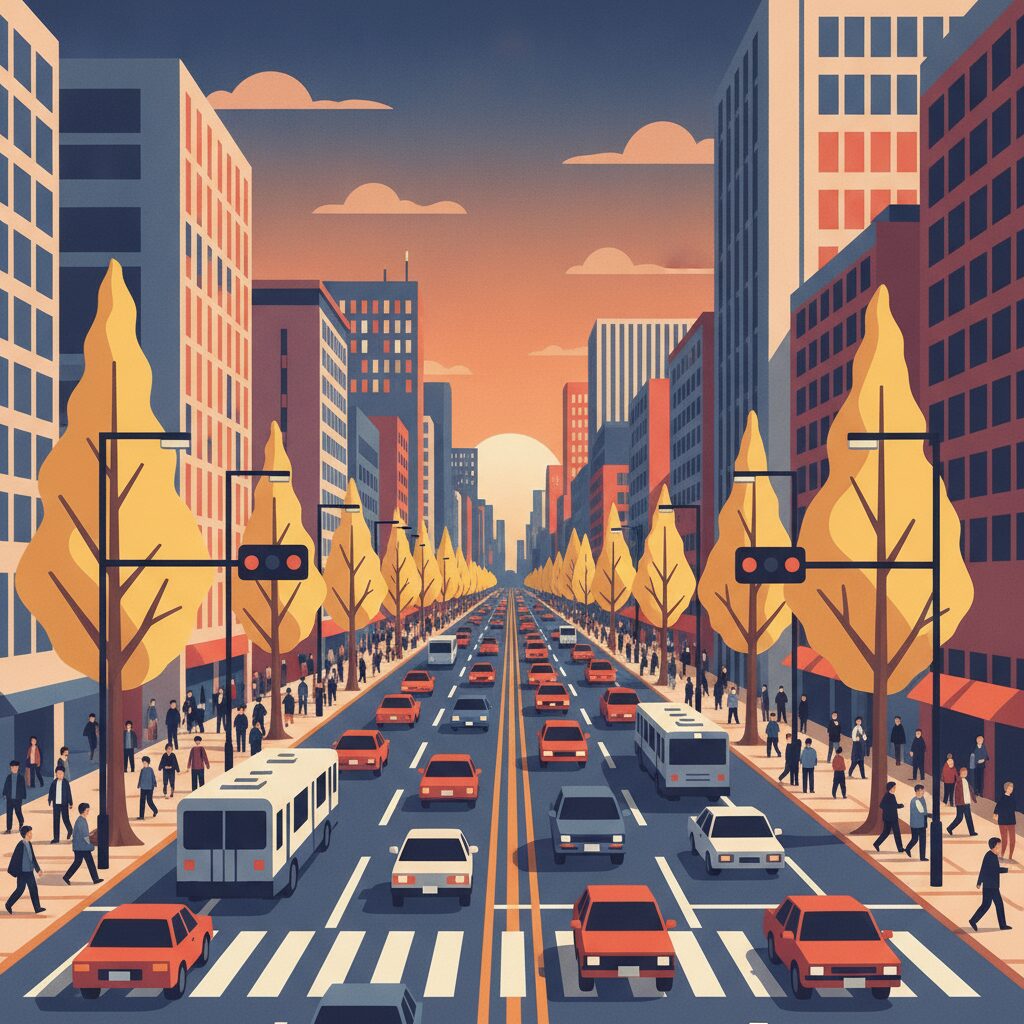
The first sign isn’t a sight, but a sound. It’s a low rumble that starts deep within the earth, the sound of a thousand approaching trains funneling into the city’s core. Then, from the mouths of the subway stations—Yodoyabashi, Honmachi, Shinsaibashi—the river crests. It’s a torrent of humanity, a relentless flow of dark suits, determined faces, and the rhythmic beat of leather on pavement. This isn’t just a crowd. It’s a current, a living organism, a force of nature that surges down the grand boulevard of Midosuji every single weekday morning. For a newcomer, it can feel overwhelming, a chaotic stampede with no discernible rules. But if you stand still for a moment and watch, you begin to see the patterns, the unspoken language, the intricate dance that defines not just the commute, but the very soul of Osaka’s work culture. This daily spectacle is more than just people going to work; it’s a raw, unfiltered look into the city’s pragmatic, efficient, and deeply misunderstood heart. It’s the engine of Osaka turning over, and you’re standing right in the middle of it.
The intricate pulse of Osaka’s morning rush offers a glimpse into a broader urban rhythm, and learning how locals navigate Umeda’s underground network can reveal even deeper layers of the city’s vibrant character.
The Unspoken Rules of the Human River
What appears chaotic from afar is, up close, a masterclass in collective efficiency. Here, rules are deeply ingrained and universally followed, though you’ll never find them posted on a sign. This is the silent choreography of the Osaka commute, a dance everyone instinctively knows.
The Flow and the Ebb
The core principle is momentum. The entire system is built to keep moving. People walk on the left, a rule observed with near-religious dedication. The pace is brisk, a purposeful stride that signals, “I have somewhere to be.” It’s neither a frantic sprint nor a panicked dash, but a steady, ground-covering rhythm. This is the Osaka Stride, and you pick it up quickly. Stopping suddenly is the ultimate taboo, disrupting the entire ecosystem. It’s like dropping a rock into a smooth-flowing stream, creating ripples that affect dozens behind you. Newcomers often learn this the hard way, typically with a gentle yet firm nudge from a passing salaryman.
The true artistry lies in the micro-movements. It’s the subtle dip of a shoulder to let someone by, the slight pivot of hips to avoid a briefcase, the instinctual pace adjustment to merge smoothly into denser crowds without collision. It’s a constant, subconscious negotiation for space. Osaka commuters seem to have a kind of sonar—an extraordinary spatial awareness that lets thousands move as one. This isn’t aggressive jostling; it’s a highly evolved form of cooperative movement. It’s the physical expression of a pragmatic mindset: conflict is inefficient, and efficiency is everything.
The Soundscape of the Commute
Despite the crowds, the Midosuji rush is surprisingly quiet. The dominant noise isn’t conversation but the percussion of movement: the rhythmic clatter of countless heels on tiled floors, the soft whoosh of trench coats brushing past, and the unified beep of numerous IC cards at the ticket gates. Over it all rings the steady, hypnotic chime of crosswalk signals—the city’s own metronome.
Phone calls while walking are a major taboo. You rarely see anyone talking on the phone amid the thick crowd. It’s considered distracting, both to the speaker and to those around them, and a potential disruption to the essential flow. Conversations between companions are kept to a low murmur. This isn’t coldness; it’s concentration. The commute is a liminal space, a transition between the private world of home and the public world of work. It’s a time for mental preparation, listening to music through earbuds, or mentally running through the day’s to-do list. The silence serves as a shared respect for this transitional moment. It’s a collective understanding to grant one another the mental space needed to start the workday.
Osaka vs. Tokyo: A Tale of Two Rushes
Every major city experiences a rush hour, but not all are the same. The daily commute offers one of the clearest insights into the cultural contrasts between Osaka and its eastern rival, Tokyo. Experiencing both reveals the deep psychological differences that define Japan’s two largest metropolises.
The Pressure Gauge
The Tokyo rush, especially on lines heading into Shinjuku or Shibuya, feels like being inside a pressure cooker. The silence there is heavier, charged with tension. The intense physical crowding inside the train cars is renowned—a place where personal space evaporates. It’s a system of overwhelming, anonymous pressure where the main goal is simply to endure. The famous white-gloved station attendants, the oshiya or “pushers,” highlight this reality—a formal system is necessary to manage the crush.
Osaka’s rush is different. It is certainly dense, and the Midosuji subway line can be astonishingly crowded. But the pressure feels less intense. There’s a rough, unspoken camaraderie, a sense that “we’re all in this together.” Although few converse, there is a shared tolerance. When a train is packed, people shift and breathe in to create just enough space for one more person. This isn’t done with smiles but a quiet, mutual understanding. It feels less like a high-pressure environment and more like a high-volume one. You are a salmon swimming upstream alongside thousands of others, and the collective struggle forges a peculiar, unspoken connection.
The Dress Code of Commerce
You can tell a city’s story by the clothes its people wear to work. In Tokyo, the corporate attire is often flawless, reflecting polished professionalism. Brands matter. The suit’s cut, the shoes’ shine, the designer handbag—all contribute to the professional armor.
On Midosuji, the uniform is subtly different. Dark suits remain common, but worn with a distinct sense of pragmatism. Shoes tend to be sensible, often well-worn leather made for walking. The briefcase is a practical tool rather than a fashion accessory; it might show scuffs from countless commutes and sales meetings. This reflects Osaka’s merchant spirit, the shonin ethic. Here, the focus has always been on the quality of goods and the shrewdness of deals, not superficial appearances. The Midosuji commute is a display of functionalism—a visual reminder that this city values substance over style, where results are expected to speak far louder than attire.
Deconstructing the “Osaka Mindset” on Midosuji
The morning rush is more than just a commute; it serves as a daily exercise in the core principles of the Osaka mindset. It’s the moment when the city’s historical role as a center of commerce and pragmatism is enacted by hundreds of thousands of people all at once.
Pragmatism in Motion
The fluid movement of the Midosuji crowd perfectly embodies Osaka’s appreciation for the rational and logical, or gouriteki. Every element of the commute follows an unwritten rule of efficiency. Why waste time and energy on unnecessary delays? Why cause a bottleneck by stopping to check your phone? The objective is straightforward: get from the station to the office as efficiently as possible. This attitude is a direct legacy of Osaka’s past as Japan’s kitchen and commercial hub. For the merchants of old, time was money, and every wasted moment meant a lost sale. That same drive fuels the modern salaryman. The entire system operates like an economic engine, with the morning rush as the sound of it running at full power. It clearly shows that in Osaka, practicality isn’t merely a preference; it’s a core value.
The Misunderstanding of “Friendliness”
This is one of the biggest sources of confusion for outsiders. You arrive in Osaka having heard countless tales of how friendly, open, and talkative the locals are. Then you encounter the morning rush—a sea of serious, silent, determined faces—and you wonder if those stories were true. Are these people upset? Unfriendly? The answer is no. You’re simply seeing a different facet of the Osaka character: Work Mode.
Osaka residents excel at reading context and knowing the right time and place for everything (TPO). The loud, joke-loving friend you met at an izakaya last night is the same individual who will pass you by on Midosuji this morning without so much as a glance. It’s nothing personal. The morning commute isn’t the time or place for casual socializing. The “friendliness” shown here is of a distinct, more practical variety. It’s reflected in the quiet cooperation of the crowd, the shared effort to make this challenging daily ritual run smoothly for everyone. The social grace lies in the efficiency, not the chatter. The warmth and humor will return—but only once the workday is over.
What It’s Like to Live It
Understanding the Midosuji rush is one thing; navigating it daily as a resident is quite another. It can be daunting, but once you find the rhythm, becoming part of the flow is oddly satisfying.
Navigating as a Resident
The advice is straightforward: go with the flow. Don’t resist it. Keep pace, stay to the left, and anticipate the movements of those nearby. Wear your backpack on your front or hold it in your hand. Have your train pass ready well before reaching the ticket gate. These small preparations signal that you understand the system and respect others’ time. They are subtle ways you earn your place in the current.
As you grow accustomed to the daily routine, you begin to notice its beauty. You see the stunning golden canopy of ginkgo trees lining Midosuji in autumn. You observe the elaborate light displays in winter. You smell coffee brewing at station kiosks and recognize familiar faces daily, all sharing this urban experience. It stops being an anonymous crowd and becomes a community of fellow commuters, each with their own destination, yet sharing the same path for a time.
The Rush as a Unifying Force
In the end, the Midosuji morning rush shouldn’t be viewed as a negative or stressful ordeal. It is a powerful, unifying ritual at the very heart of Osaka’s identity. For about an hour each morning, social hierarchies dissolve. The new hire, the department manager, and the company president all follow the same rules, keep the same pace, and endure the same crush on the train. For that brief moment, they are all simply commuters.
It is a visceral, daily reminder that Osaka is a city that functions. Built by merchants, driven by industry, and defined by an unyielding push forward, the morning rush is more than just the journey to work; it is, in many ways, the start of the work itself. Standing on a street corner watching the stream of people flow by is to witness the city’s heartbeat—strong, steady, and purposeful.