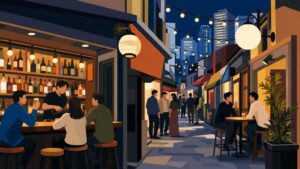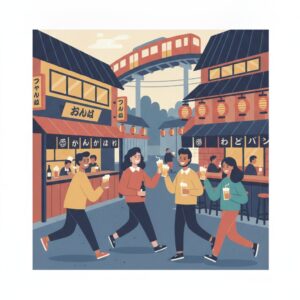
You see it first as a glow. A warm, lantern-lit haze spilling out from under the train tracks of the JR Loop Line. You hear it next. A rising tide of laughter, clinking glasses, and sizzling grills, a sound so dense it feels like a physical thing. This is Tenma. You step off the main street and into one of its narrow alleys, and the city you thought you knew disappears. Suddenly, you’re in a human river. People are packed shoulder-to-shoulder in tiny, open-fronted bars, smoke is curling into the night air, and the energy is a chaotic, intoxicating buzz. For a foreigner, especially one used to the polite distances of Tokyo or the reserved nature of other cities, the first reaction is often a step back. It feels like crashing a private party, a hundred of them all at once. It looks impenetrable, a secret language of community you weren’t taught. This isn’t a place you visit; it’s a place you have to survive. That feeling, that initial wall of sensory overload and social anxiety, is exactly where understanding Osaka begins. Because Tenma’s chaotic alleys aren’t a barrier designed to keep you out. They’re the city’s living room, its heart laid bare, and that overwhelming scene is actually an open invitation. You just have to learn how to read it.
As you wander through Tenma’s lively maze, consider delving deeper into Osaka’s urban soul to uncover the subtle interplay of bustling contrasts that define this city’s dynamic character.
The Unspoken Rules of the Standing Bar (Tachinomi)

Before you can truly understand the people, you first need to understand the space. In Tenma, the defining space is the tachinomi, or standing bar. These aren’t grand venues. Many consist of little more than a counter, a grill, and just enough room for ten people to stand upright. Yet these tiny stages are where the daily drama of Osaka’s social life unfolds each night. They operate under a set of unwritten rules that shape the flow, the interactions, and the overall atmosphere. Master these, and you’ve unlocked the first level of the game.
Personal Space is a Suggestion, Not a Command
The first thing you notice in a Tenma tachinomi is the closeness. You’ll find your back pressed against someone else’s, your elbow mere centimeters from a stranger’s beer, your conversation overheard by at least four others. In Tokyo, this would be a social nightmare. Tokyoites maintain an invisible bubble, a personal space force field respected on crowded trains and in quiet bars. Crossing that boundary is taboo. In Osaka, that bubble doesn’t exist. Here, proximity is the point. It’s a physical equalizer that breaks down barriers before a word is even spoken. You can’t stay aloof when you’re literally sharing the same square meter of floor with a construction worker, a bank teller, and a student. This forced intimacy reflects the Osaka mindset—a belief that we’re all just people squeezed into this lively, chaotic city together, so why pretend otherwise? The tight space isn’t a flaw; it’s a feature. It generates shared energy, creating the feeling that you’re all part of the same temporary, slightly tipsy tribe.
The Art of the Quick Entry and Exit
Don’t get too comfortable. A tachinomi isn’t a place to settle in for hours. Look around—you won’t see people glued to their phones or nursing a single drink for two hours. The pace is brisk. People come in, find a spot, order a drink plus maybe a dish or two. They eat, drink, chat with their neighbor, and within thirty or forty minutes, they leave. This is the essence of hashigo-zake, the culture of bar-hopping. The goal isn’t to find the one perfect bar but to sample many. This constant movement is deeply tied to the Osakan merchant spirit. It’s about value and variety. Why stick to one place when a dozen more are just steps away, each with its own specialty, vibe, and crowd? It’s a low-risk, high-reward approach to a night out. This transient nature means the social scene is constantly shifting. The person you’re talking to now might be gone in ten minutes, replaced by someone new. It keeps the energy lively and the conversations flowing.
Paying Your Way: The Cash-on-the-Tray System
Look at the counter in front of you. There’s likely a small plastic tray, a wooden box, or a ceramic bowl. This is your tab. Many tachinomi run on a cash-on-delivery system reflecting Osaka’s practicality. You put a 1,000 yen bill in the tray. When you order a 400 yen beer, the staff takes the bill and returns 600 yen change to the tray. When you order a 300 yen plate of yakitori, they take 300 yen out. It’s simple, transparent, and very efficient. No waiting for a bill at the end, no math involved. It supports that quick in-and-out rhythm we just described. When the tray is empty, you either add more cash or move on. This system is based on casual trust and a shared desire to keep things moving smoothly. It says, “We’re all adults here, so let’s skip the formalities.” It’s a small detail that reveals a culture valuing efficiency and a no-fuss approach to everyday transactions, whether buying train tickets or rounds of drinks.
Cracking the Code: How to Actually Talk to People
The real challenge for most newcomers isn’t the crowds or the cash system—it’s the social code. How do you join a conversation that’s already underway? Will people find it strange if you start talking to them? In many cultures, striking up a conversation with a complete stranger at a bar can be a delicate, even risky, move. In Tenma, however, that’s exactly the reason to be there. But you need to know the proper way to enter.
“Sore, nani?” (What’s that?): The Universal Icebreaker
Forget clever opening lines. The simplest way to join a conversation is through the food and drink before you. Spot someone eating something that looks delicious? Just lean in a little, make eye contact, and ask, “Sore, nani? Oishiso desu ne.” (What’s that? It looks tasty.) This isn’t rude or intrusive—in fact, it’s quite the opposite. It’s a compliment and a sign of genuine interest, both highly valued by Osakans. In nine cases out of ten, the person will brighten up. They’ll eagerly tell you what it is, insist you try it, and maybe even offer you a bite. From there, the door opens. You can ask where they’re from, what they do, or which bars they recommend. Food is the common language. In Osaka, a city passionate about eating, appreciating someone’s choice of food is like appreciating their taste in music or art. It signals a kindred spirit. This approach works far better than a generic “Hello” because it’s based on the shared experience of the moment.
The “Maido!” and “Okan!” Relationship
The staff are more than employees; they are the hosts of the party. The person behind the counter—whether the grizzled old taisho (boss) or the sharp-witted okan (mom)—is the social center of the entire place. Building a connection with them is crucial. When you enter, greet them with a confident “Maido!” (loosely meaning “Thanks always for your business!”). Even if it’s your first visit, this sets a friendly, local tone. Observe how they interact with regulars. They’re not just taking orders; they remember details, crack jokes, and often act as social connectors. The okan might notice you’re a foreigner and say to the person next to you, “Hey, this guy’s from America. You were just there last year, weren’t you?” And just like that, a conversation begins. This dynamic is worlds apart from the polite but impersonal service of a Tokyo chain restaurant. It’s deeply personal. The staff see their bar as an extension of their home and view customers as their guests. Show them respect and a bit of personality, and they’ll welcome you into the fold.
Why Tenma is Not Just Another Foodie Destination
It’s easy to group Tenma together with Dotonbori or Shinsekai as just another spot in Osaka for great street food and photo ops. However, this is a fundamental misconception. While those areas are enjoyable, they primarily cater to tourists and present Osaka as a spectacle. Tenma, on the other hand, represents Osaka as everyday life. Grasping this distinction is essential to truly understanding the city’s character.
A Living Neighborhood, Not a Theme Park
Above all, Tenma is a neighborhood. The people drinking in its bars aren’t tourists; they’re heading home from nearby offices, running the small shops in the shotengai arcade, or studying at local universities. You’re stepping into their everyday routine. Tenma’s pace isn’t designed for tourists; it’s driven by the 6 PM rush of salarymen loosening their ties and the late-night return of chefs and service staff finishing shifts. This is why it feels so genuine, and also why it doesn’t make a special effort to be “easy” for outsiders. Menus might be solely in Japanese, customs can be puzzling, and the place wasn’t designed with you in mind. Yet, you are welcome to join. This reality offers a true glimpse into life here. You’re not watching culture from behind glass; you’re right in the midst of it.
The Economics of Joy: Cheap, Fast, and Delicious
The prices in Tenma are eye-opening. A large beer for 350 yen. A grilled chicken skewer for 150 yen. A plate of sashimi for 500 yen. You could enjoy three drinks and several dishes at three different bars and still barely spend 3,000 yen. This isn’t just about affordability. It reflects a deep cultural value in Osaka: accessibility. Socializing, unwinding after work, and savoring good food shouldn’t be a luxury, but an everyday right. This philosophy, called kuidaore (‘eat till you drop’), isn’t about overindulgence; it’s a celebration of life that’s affordable for all. The concept of kosupa (cost performance) is almost a religion here. An Osakan proudly shares tales of amazing meals at surprisingly low prices. It’s a point of pride and a testament to the city’s merchant heritage, where offering great value was the ultimate business skill. This economic mindset shapes the social scene, encouraging spontaneity. There’s no need for a big, costly night out. You can simply drop into Tenma for an hour, meet new people, and be on your way without hesitation. It’s a low-cost, high-return investment in community.
Common Misunderstandings and How to Avoid Them
Navigating Tenma means adjusting your cultural expectations. What appears one way on the surface is often something completely different underneath. Interpreting the signals correctly can be the difference between an amazing evening and a confusing, intimidating ordeal.
Mistaking Chaos for Rudeness
The overwhelming energy of Tenma—the noise, the smoke, the constant movement—can feel aggressive to newcomers. It’s easy to mistake this for a lack of manners or consideration. But that’s a misunderstanding. The chaos is not rudeness; it’s communal vitality. Osaka communication operates on a different wavelength. It’s louder, more direct, and more physical than what you’ll find in much of the rest of Japan. People laugh openly. They call out to staff from across the room. They bump into you and quickly say “Gomen!” (Sorry!) without missing a beat. This isn’t disrespect. It’s the sound of a community relaxed and comfortable enough to shed the formalities of Japanese society and simply be themselves. The chaos signals vibrancy—a life embraced openly.
Assuming Everyone Wants to Be Your Best Friend
An Osakan in a Tenma bar will speak to you as if you’ve been friends for years. They’ll ask personal questions, offer unsolicited advice, and buy you a drink. A foreigner might take this warmth as the start of a lasting friendship. While it could be, it’s more often a brief, situational connection. The unspoken social contract in a tachinomi is to be open and friendly to create a positive vibe for that particular time and place. It’s about making those 30 minutes at the counter enjoyable for all. The bond is with the moment, not necessarily the person. Don’t be upset if someone you shared a deep conversation with says a quick goodbye and disappears, never to return. Appreciate the exchange for what it was: a perfect, temporary moment of human connection, Osakan-style. It’s all about the here and now.
The Language Barrier Myth
Your Japanese might not be flawless. Perhaps you know only a handful of words. You might feel tempted to stay quiet, fearing mistakes. This is the biggest obstacle, and it’s almost entirely mental. In a formal setting like Tokyo, grammatical accuracy might matter. But in a Tenma alley, what counts is the effort. The willingness to communicate matters far more than correct verb conjugations. Pointing at a menu and asking “Kore, oishii?” (Is this delicious?) will be met with smiles and encouragement. A simple “Kanpai!” (Cheers!) to those around you is a universal gesture of goodwill. People will meet you halfway, using simple words, gestures, and the shared language of raising a glass to bridge the gap. Don’t let fear of imperfect Japanese keep you from enjoying a perfect Osaka night. Your effort will be rewarded many times over.
Tenma is more than just a collection of bars under a train track. It’s a living guide to Osaka culture. It’s where the city’s core values—practicality, community, directness, and a passion for good value—become tangible. The lofty ideals of Tokyo feel worlds away in these loud, smoky, joyful backstreets. Here, life unfolds at street level, without pretense. It’s messy, it’s human, and it’s incredibly welcoming—if you’re willing to take that first, slightly intimidating step inside. So next time you find yourself at the edge of that river of people, don’t just watch it flow past. Find a small eddy, a tiny spot at a counter. Squeeze in. Order a beer. And just be present. You won’t merely be having a drink. You’ll be learning to speak Osaka.