
So you’ve landed in Osaka. You’ve navigated the train systems, you’ve found your favorite takoyaki stand, and you’re starting to feel at home. Then you step into the office, and the rulebook you so carefully studied about Japanese business etiquette seems to catch fire. Your boss doesn’t just hint that your proposal needs work; she looks you in the eye and says, “Akan wa, kore,” which translates roughly to, “Yeah, this is no good.” And before you can even process the blunt feedback, she follows it up with a joke about her own terrible handwriting on the whiteboard, and everyone in the room erupts in laughter. You’re left standing there, wondering, “Did I just get criticized or welcomed into the group?”
Welcome to the beautiful, baffling world of professional communication in Osaka. It’s a place where laughter isn’t just a pastime; it’s a core business tool. It’s where directness isn’t rude; it’s a sign of respect. For foreigners, especially those coming from cultures that prize indirectness or who have been coached on the subtle, harmony-first approach of Tokyo, this can be a massive culture shock. It feels like the opposite of everything you’ve learned. Is everyone being rude? Is this all a joke? The answer is a resounding “Chau chau!”—No, no, that’s not it at all.
This isn’t about being impolite. It’s about a different kind of politeness, one forged in the fires of commerce and community for centuries. It’s about efficiency, warmth, and building human connections that go deeper than surface-level pleasantries. To truly thrive here, you need to understand the rhythm behind the frankness and the strategy behind the smiles. This is your guide to decoding the culture of ‘warai’ (laughter) and the straightforward dialogue that powers Japan’s most vibrant and misunderstood city. Let’s peel back the layers and discover why that blunt feedback might just be the best thing that ever happened to your career in Japan.
Discover how the Akindo spirit behind modern work relationships further illuminates the power of candid communication in Osaka’s dynamic professional landscape.
The Bedrock of Business: ‘Warai’ as a Communication Strategy
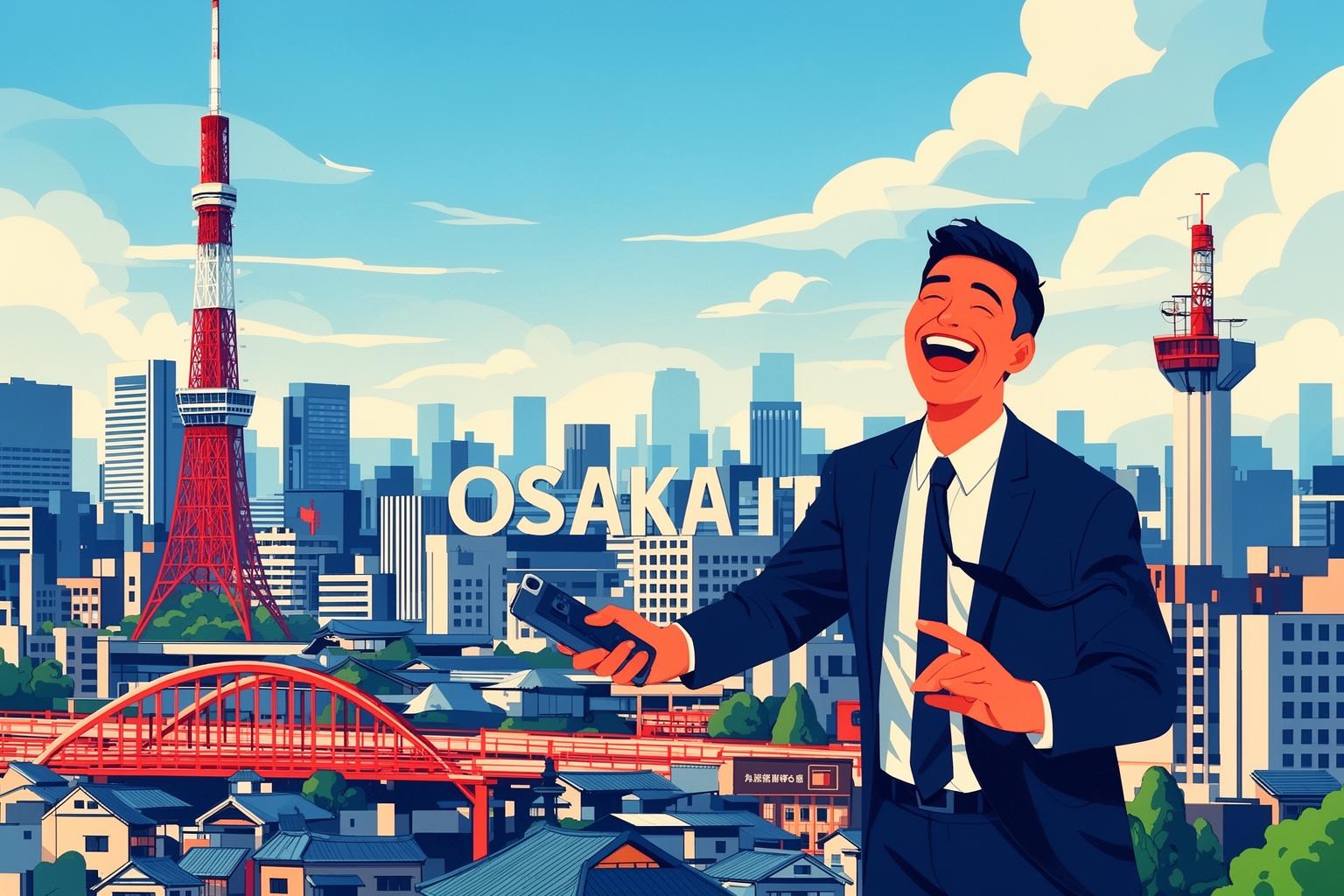
In Tokyo, a business meeting might begin with a formal exchange of bows, a solemn presentation of business cards, and a quiet, measured discussion. In Osaka, it could start with your counterpart pointing out a tiny piece of lint on your suit and saying, “Lookin’ sharp today, except for that little guy!” followed by a hearty laugh that instantly breaks the tension in the room. This isn’t unprofessionalism. This is strategy. This is ‘warai’ culture in action.
The Merchant’s Legacy: Building Rapport at High Speed
To understand Osaka, you must understand its history as the nation’s kitchen and commercial center. It was a city of merchants, of ‘shonin’. For these merchants, time was money, and trust was the ultimate currency. They didn’t have the luxury of long, drawn-out rituals to build relationships. They needed to size someone up, create a connection, and close a deal, often in a single encounter. How did they manage it? Through humor.
Laughter is a shortcut to intimacy. A shared joke instantly signals, “We’re on the same wavelength. We’re human. We can work together.” This mindset is deeply woven into the city’s DNA. A joke in a meeting isn’t a distraction from the business at hand; it is the business at hand. It’s the social lubricant that keeps the entire engine running smoothly. It’s a quick, effective way to assess someone’s personality. Can they take a joke? Can they make one? Are they relaxed and confident, or rigid and nervous? An Osakan businessperson is subconsciously making these judgments within the first five minutes of meeting you.
This stands in stark contrast to the samurai-descended bureaucratic culture of Tokyo, where form, hierarchy, and process often dominate. In Tokyo, preserving harmony means avoiding potential conflict. In Osaka, creating harmony means breaking down barriers with a shared laugh, even if it involves poking fun at yourself.
Self-Deprecation as a Power Move
A common tool in the Osaka warai toolkit is self-deprecation. You’ll hear a successful company president joke about their receding hairline or a top salesperson laugh at a clumsy mistake they made that morning. A foreigner might interpret this as insecurity. It’s quite the opposite. It’s a sign of supreme confidence. It says, “I am so confident in my skills that I can openly laugh at my own minor flaws.”
This has a powerful impact. It makes the person immediately more relatable and less intimidating. It encourages others to let their guard down, fostering an environment where ideas can be exchanged more openly. If the boss can admit to a silly mistake, then a junior employee feels safer pointing out a potential issue without fear of reprisal. Humor, in this context, is a tool for psychological safety and open communication.
“That Won’t Work”: Decoding Osaka’s Directives
If the ‘warai’ culture gently draws you in, the direct communication style acts as the firm push that keeps things moving forward. This is often the biggest challenge for newcomers. The Japanese language is renowned for its ambiguity, its layers of politeness, and its ability to say “no” in a dozen ways without ever using the word. Osaka-ben, the local dialect, often disregards that conventional approach.
‘Akan’ and ‘Chau’: The Efficiency of No
In a typical Japanese business setting, if you present an unworkable idea, the response might be, “大変興味深いご提案ありがとうございます。社内で検討させていただきます。” (Thank you for your very interesting proposal. We will discuss it internally.) This is frequently a polite, face-saving way of indicating a dead end. You might wait weeks for a follow-up that never arrives.
In Osaka, the reply is more likely to be a quick, “いや、それはあかん。” (Nope, that won’t work.) This might be followed by a clear, straightforward reason: “The budget’s not there,” or “Our clients will never agree.” The first time you hear this, it can feel like a blow to the gut. It comes across as harsh, dismissive, and rude. But you must resist the temptation to view it through a non-Osaka perspective.
From the Osakan point of view, this directness is a form of kindness and respect. They are honoring your time. Why let you spend weeks chasing an idea with no future? Why create ambiguity that fosters false hope and wasted effort? A quick “akan” lets everyone pivot immediately, stop wasting resources, and focus on finding a solution that will work. The aim is progress, not politeness for politeness’s sake. They believe you are strong enough to handle the truth and show respect by delivering it without sugarcoating.
It’s About the Issue, Not the Person
This is the crucial distinction. In many cultures, criticism of an idea is taken as criticism of the person who proposed it. In Osaka’s pragmatic business world, the idea and the individual are separate. The blunt feedback—“This report is confusing,” “That design is too cluttered,” “Your numbers are wrong”—is about the work, not your value as an employee or a person.
In fact, this directness often signals that you are regarded as part of the team. If people are overly polite and indirect with you, it might mean they still see you as an outsider who needs delicate handling. When your colleagues start teasing you and giving you unfiltered feedback, it’s a sign of acceptance. They feel comfortable enough with you to drop the formalities. They see you as one of them, a member of the inner circle who can handle the local communication style.
The Art of Banter: Surviving and Thriving in Daily Interactions
Grasping the theory is one thing; putting it into practice is another. The constant back-and-forth, the ‘boke’ (funny person) and ‘tsukkomi’ (straight person) dynamic that defines Japanese stand-up comedy, or ‘manzai’, is mirrored in miniature in every Osaka office, every day.
Reading the Room: When and How to Participate
Picture a colleague presenting their work who stumbles over a word. In a quiet office, people might politely overlook it to spare the presenter embarrassment. In an Osaka office, someone is likely to quip, “Did you forget how to speak Japanese?” This isn’t meant to be harsh. It’s a ‘tsukkomi’, a straight-man retort intended to ease the tension. The presenter is expected to respond with a self-deprecating ‘boke’ comment like, “My brain stopped working five minutes ago!” before the meeting resumes, the brief awkwardness dissolved by shared laughter.
For a foreigner, joining in this rapid-fire banter can be daunting. The worst thing you can do is try to force it. The best approach is to become a good audience. When a joke is made, laugh. Smile. Show that you understand and appreciate the humor. Your positive reaction is a vital part of the exchange. It affirms the joke-teller and signals your inclusion in the group’s social dynamic.
As you grow more confident, you can begin with small steps. If a colleague is known for their passion for the Hanshin Tigers baseball team, and the team suffers a loss, a gentle, “Tough game last night, Tanaka-san?” with a sympathetic smile can be a good way to engage. You’re recognizing a shared cultural reference and connecting on a personal level. From there, you can gradually expand your involvement.
The Hierarchy of Humor
It’s important to realize that although the communication style seems flat and informal, a hierarchy remains in place. Humor typically flows downward or between equals. The section chief (‘kacho’) can tease a junior staff member, but the reverse is much more delicate. A junior making a joke at the boss’s expense is a risky move that demands a very strong, established relationship.
Your safest choice is always self-deprecation. Making a lighthearted joke about your struggles with Japanese or your confusion over a local custom is almost always effective. It demonstrates humility, makes you relatable, and invites assistance. It’s a way of joining the ‘warai’ culture without causing offense.
Friendliness vs. Politeness: Why Osaka Feels Different
Much of the confusion foreigners face stems from a fundamental misunderstanding of what social grace entails. Tokyo, and by extension the typical image of Japan, is rooted in a culture of politeness. This involves maintaining a respectful distance, using formal language (‘keigo‘), and prioritizing group harmony by avoiding any potential conflict or imposition. It is smooth, elegant, and can feel wonderfully serene.
Osaka, on the other hand, is grounded in a culture of friendliness. This is not about keeping distance; it’s about closing it. It’s about treating a new acquaintance like an old friend. That’s why the woman at the checkout might comment on the contents of your grocery basket, or a coworker might ask a question that feels very personal, like “Are you married?” or “How much is your rent?”
The Intention Behind the Intrusion
These questions are not intended to be invasive. They are attempts to find common ground and serve as conversation starters in a culture that highly values human connection. The person is trying to build a bridge to you. Responding with a cold, one-word answer can be seen as rejecting that bridge. A better approach is to answer honestly but briefly, then return the question. “My rent is X yen. Is that about average for this area?” This shifts an ‘interrogation’ into a ‘conversation’.
This friendliness culture explains the phenomenon of the “Osaka obachan” (middle-aged lady) who might randomly give you candy on the train or offer unsolicited advice. She isn’t being nosy; she is participating in a community-based form of care. To her, you are now part of her extended neighborhood, and she feels a social obligation to look out for you. This behavior, which might seem intrusive in a more reserved culture, is the very essence of Osaka’s social safety net.
A Practical Toolkit for the Osaka Workplace
So, how can you apply all this without embarrassing yourself? Here are some straightforward, actionable tips.
Embrace the Compliment-Insult
You’re bound to receive comments that feel like backhanded compliments or outright insults, such as “You’re surprisingly good at using chopsticks for an American!” or “You’ve gained a little weight, haven’t you?” Don’t take these personally. It’s actually a sign of familiarity. The best response is to laugh and agree. For example, “Yes, the food here is just too delicious!” This demonstrates that you’re easygoing and not overly sensitive.
Learn a Few Key Phrases in Osaka-Ben
You don’t need to become fluent, but incorporating a few local expressions into your Japanese shows considerable goodwill. Using “Meccha oishii” (Very delicious) instead of “Totemo oishii” or “Honma?” (Really?) instead of “Hontou?” will quickly earn you smiles. It shows you’re not just a temporary visitor but someone genuinely trying to connect with the local culture.
Don’t Mistake Laughter for Frivolity
Just because an office is filled with laughter doesn’t mean people aren’t working hard. Osakans are extremely pragmatic and results-driven. Their humor acts as the oil that prevents the high-performance engine from overheating. They work hard and laugh hard. These two go hand in hand; they’re deeply intertwined.
When in Doubt, Ask Directly
One advantage of a direct communication culture is that you can be straightforward, too. If you’re unclear about feedback or don’t fully grasp the nuances of a situation, it’s perfectly okay to ask for clarification. A simple, “I’m sorry, I want to make sure I understand. Do you mean I should redo the entire report, or just this section?” will get you a clear answer. They’ll appreciate your pursuit of clarity rather than pretending to understand.
The Real Bottom Line
Living and working in Osaka demands a mental reset. It challenges you to rethink your ideas of politeness, professionalism, and communication. It can be startling, confusing, and at times, somewhat exhausting. You may feel like you’re constantly a step behind the rapid-fire banter, and you might yearn for the calm, predictable subtlety you were led to expect in Japan.
However, if you can push past that initial unease, you’ll discover something extraordinary. You’ll find relationships grounded in genuine honesty and shared humanity. You’ll encounter a workplace where you clearly understand your position, freed from the stress of interpreting hidden meanings. You’ll belong to a community that will tease you relentlessly one moment and fiercely support you the next.
In Osaka, there’s no time for pretenses. The laughter and directness are two sides of the same coin—a profound eagerness to reach the real stuff, the real work, the real connection, as quickly as possible. It’s a communication style shaped by a merchant’s pragmatism and a comedian’s spirit. And once you catch its rhythm, you’ll see that you’re not merely adapting to a different set of rules; you’re embracing a more vibrant and genuine way of life.