

You stand upon the concrete platform of the subterranean transit system, the air thick with the ambient hum of a city that never quite rests. The carriages of the subway pull into the station, a streak of crimson cutting through the fluorescent gloom. The doors slide open with a sharp pneumatic hiss. You step inside, find an empty seat, and settle in for the ride. If you were in Tokyo, the script for this moment would be written in the language of silence. In the capital city to the east, public transport is a sanctuary of isolation. Commuters fold themselves inward, eyes cast downward to the glowing screens of their smartphones or lost in the middle distance, wearing a collective armor of polite indifference. Tokyo teaches you to fade into the background, to occupy as little space as possible, to avoid becoming a burden to the collective peace.
But you are not in Tokyo. You are in Osaka. And Osaka operates on a completely different frequency.
Here, the silence is regularly punctuated by the vibrant cadence of human connection. The air is alive with the rhythmic, rolling vowels of the Kansai dialect. Through the lens of a photographer, someone who spends their life observing the subtle interplay of light, shadow, and human behavior, the contrast is stark and immediate. Osaka does not ask you to fade away. Osaka demands that you step into the light, that you participate, that you acknowledge the shared space of the community. As you sit on this train, perhaps looking a little lost, perhaps simply staring at the route map above the door, you might feel a sudden, gentle tap on your shoulder. You turn, expecting to be told you are sitting in a reserved seat or blocking a pathway. Instead, you are met with a bright, expectant gaze. A hand reaches out, its palm open, revealing a single, brightly wrapped hard candy.
“Ame-chan, taberu?”
Would you like a candy?
This simple offering is not merely a gesture of sharing a sweet treat. It is a profound cultural artifact, a key that unlocks the deep-seated warmth, the merchant history, and the unapologetic friendliness of this vibrant metropolis. To understand the city, you must understand this gesture. It is a ritual enacted thousands of times a day across train carriages, park benches, and shopping arcades. It is the unspoken language of the city, spoken fluently by its most formidable and beloved residents. For those moving to this part of Japan, or those simply wishing to peer beneath the surface of daily life, mastering the nuances of this exchange is essential. It tells you more about the local mindset than any guidebook ever could. It reveals a society built on breaking down barriers rather than erecting them.
What is Osaka’s Ame-chan Culture?
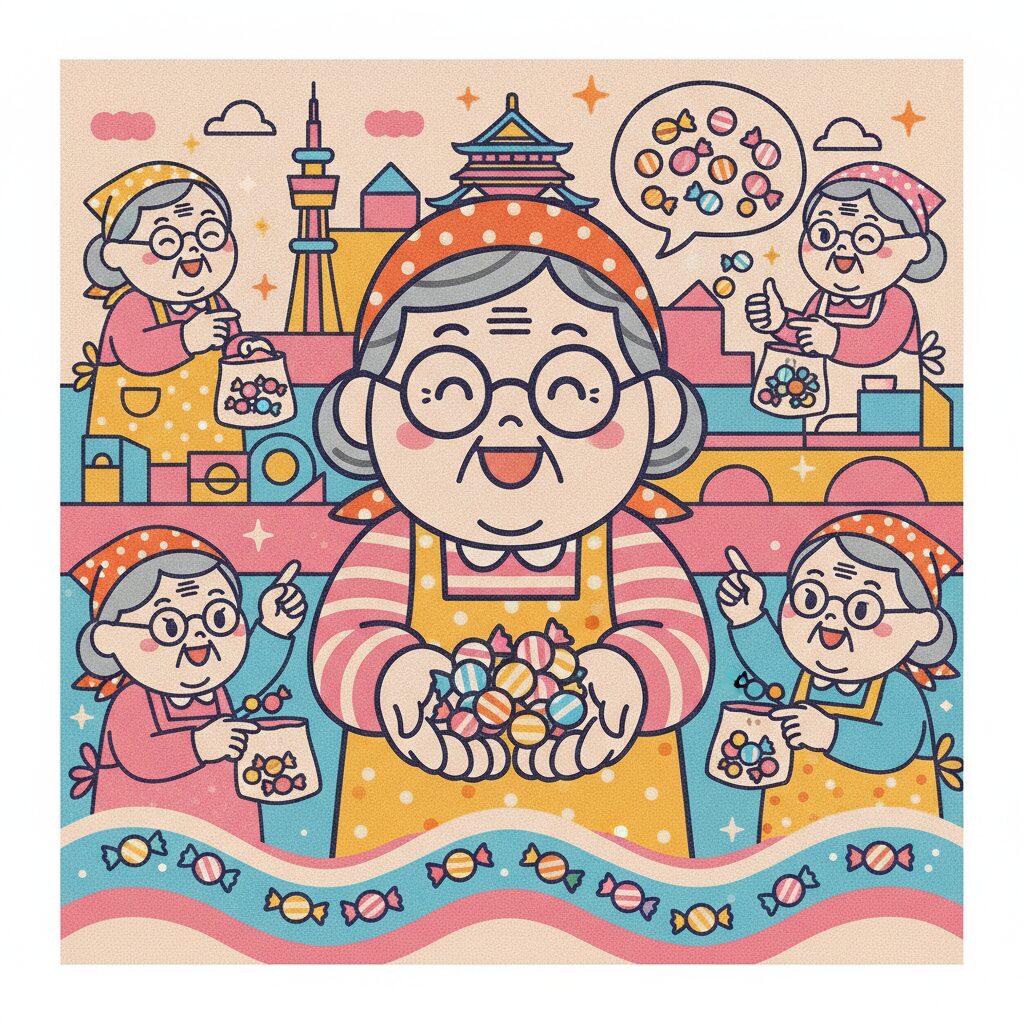
To understand the scale of this phenomenon, we must first analyze the terminology. The Japanese word for candy is straightforward: ame. It is a functional noun, denoting the boiled sugar confections found in any grocery aisle. However, in this particular region, the word is rarely used on its own. Instead, it is embellished, softened, and anthropomorphized with a suffix that entirely alters its emotional tone.
The Linguistic Quirk: Why Add “-chan” to Candy?
The suffix “-chan” is usually reserved for small children, cherished pets, or very close friends. It is an honorific of endearment, a linguistic gesture of affection. When applied to an inanimate object like a piece of candy, it transforms a mere commodity into a tiny companion. An ame is something you eat. An ame-chan is something you invite into your life.
This linguistic peculiarity is a hallmark of the regional dialect and reflects a broader cultural mindset. The people here have a longstanding tradition of personifying their food and everyday items, treating the tools of daily survival with familiar, almost familial reverence. You will often hear locals refer to sweet potatoes not merely as satsumaimo, but as o-imo-san. The simple bowl of rice porridge is elevated to o-kai-san. The honorable prefix “o-” combined with the respectful yet intimate suffix “-san” bestows the food with the status of a respected acquaintance.
This animistic approach to language is deeply ingrained in the region’s history. Once known as the nation’s kitchen, this city was the central hub where rice, vegetables, and goods from across the archipelago were gathered, traded, and distributed. Food was more than nourishment; it was the lifeblood of the economy, the currency of merchants, the foundation of prosperity. By attaching affectionate and respectful names to their food, locals continuously express a subconscious gratitude for the harvest and trade. When someone offers you an ame-chan, they are not just handing you a piece of sugar. They are presenting you with a small, cherished treasure. They are inviting you into a shared linguistic space where the sharp edges of the world are softened by warmth and mutual respect. It is a worldview that frames the ordinary with kindness, turning the daily grind into a series of intimate, shared moments.
Enter the Osaka Obachan: The Unofficial Ambassadors
The purveyors of this sweet currency belong to a very particular demographic. They are the matriarchs of the city—the formidable, loud, and incredibly warm older women lovingly known as the Osaka Obachan. To live in this city without recognizing their presence is to live with your eyes shut. They are the social glue that binds neighborhoods together, the self-appointed keepers of public order, and the most dependable source of unsolicited advice and spontaneous generosity you will ever meet.
Leopard Prints and Warm Hearts: Who Are They?
Visually, they are unmistakable. In a country where the usual fashion palette tends to favor muted tones of navy, beige, and gray—a sartorial reflection of the cultural desire to blend in—these women deliberately choose to stand out. They are a vibrant explosion of texture and color. They favor bold animal prints, especially leopard, often combined with bright purples, sparkling embellishments, and dramatic floral patterns. Their hair is commonly styled in tight, voluminous perms, sometimes tinted with shades of magenta or auburn. Through a camera lens, they are stunning subjects. They defy the understated aesthetic of traditional Japanese minimalism. They claim visual space with the same unapologetic confidence with which they occupy physical and acoustic space.
Foreigners arriving in the country often bring a preconceived image of Japanese society: quiet, reserved, deeply respectful of privacy, and perhaps somewhat distant. The women of this city completely dismantle that stereotype. They don’t look past you; they look right at you. They notice the smallest details of their surroundings. If your shoelace is undone, they will point it out. If you seem puzzled by a train ticket machine, they will step in, often taking coins right from your hand to press the correct buttons. They embody the philosophy of “honne”—true feelings and honest intentions—bypassing the “tatemae,” the polite facade that dominates much social interaction in the eastern capital. Their fashion is a bold statement of their spirit: vibrant, fearless, and impossible to ignore.
Why Do They Hand Out Candy to Strangers?
The practice of handing out sweets to strangers, acquaintances, and crying children on buses is deeply connected to the historical identity of the region. This is fundamentally a city of merchants. For centuries, the “akindo,” or merchant spirit, has driven the rhythm of life here. In commerce, connection is everything. You can’t sell your goods if you can’t engage with the person on the other side of the stall. You need to break the ice, build trust, and create a brief bond.
The ame-chan is the perfect icebreaker. It’s inexpensive, universally appreciated, and easy to carry in the deep pockets of a leopard-print jacket. When an older woman offers you candy, she is using a centuries-old method of social interaction. It bridges the intimidating gap between two strangers in public. It says, “I see you, you are safe with me, let’s share a moment.”
Moreover, it reflects a deep, almost maternal impulse to care for others. The city can be isolating, especially for foreign residents navigating a complicated language and unfamiliar surroundings. Offering a small, sweet treat is a way to ground you. It brings you back to the present moment. It is a tangible expression of the well-known local friendliness, proving that the reputation is not just a cliché but a daily reality. It is their way of claiming emotional stewardship over their city, ensuring the atmosphere remains welcoming, warm, and distinctly human.
A Tourist’s Guide to the Ame-chan Encounter
Grasping the theory behind this cultural exchange is one matter; experiencing it firsthand is quite another. If you spend time in the region—whether going about your daily routine, commuting to work, or exploring the sprawling urban environment—an encounter is nearly unavoidable. You don’t need to actively seek it; it will find you when you least expect it. However, understanding where these interactions occur and the appropriate way to respond can turn a potentially puzzling moment into a treasured memory.
Where Are You Most Likely to Experience It?
The setting plays a vital role in these spontaneous exchanges. While they can take place anywhere, some locations are especially favorable for the distribution of sweets. The Midosuji Line, the main subway artery running north to south through the city’s center, is a prime spot. In the mid-morning hours, after the chaotic rush of the corporate commute has ended, the train cars are often filled with elderly residents running errands. If you are seated on the soft, heated seats, visibly struggling with a map or simply appearing tired, you become an ideal candidate for an intervention.
Above ground, the extensive covered shopping arcades serve as the natural territory of the matriarchs. The Tenjinbashisuji Shotengai is perhaps the most well-known. Stretching over two and a half kilometers, it’s the longest straight shopping arcade in the nation. Walking beneath its vaulted glass roof is a sensory overload. The air carries the aromas of roasted green tea, frying takoyaki batter, and fresh fish. The narrow pedestrian street is a lively ballet of slow-moving shoppers, ringing bicycle bells, and merchants loudly promoting their daily specials. Here, amid the bustle of the crowd, the exchange of sweets is a constant current. You might strike up a brief conversation while waiting in line for croquettes, and before you leave, a hand will place a piece of candy into yours.
Public parks, particularly the benches surrounding the grand stone walls of the central castle, are also common venues for exchanges. Sitting alone, appreciating the transient beauty of plum blossoms or autumn leaves, your quiet reflection may be interrupted by a warm greeting and the rustling of a cellophane wrapper.
How to React When Offered an Ame-chan
For many newcomers, especially those used to the more reserved social customs of other Japanese areas or the cautious stranger-danger conditioning common in the West, the sudden offer of food from a stranger can provoke a moment of alarm. The immediate reaction might be to decline politely. You might worry that accepting would be burdensome. In Tokyo, a courteous refusal is often the socially preferred response.
However, in this southern city, politely declining is a social faux pas. Refusing the candy means rejecting the connection. It ends the interaction before it has a chance to begin and leaves the giver with an unreciprocated gesture of kindness. The unspoken rule is clear: you must accept.
The correct response isn’t a simple, standard “Arigato.” While the usual Japanese word for thank you is well understood, it belongs to the refined, formal world of standard speech. To truly honor the exchange, you need to draw from the local dialect. Look the giver in the eye, smile, and say, “Ookini.”
“Ookini” is the pulse of the local vernacular. Originally meaning “greatly” or “very much,” it evolved over centuries within the merchant quarters to become the customary expression of gratitude. It carries a warmth and depth that standard phrases lack. By accepting the candy and replying with “Ookini,” you show that you grasp the rules of their world. You are partaking in the culture, not merely observing it. You acknowledge their gesture, complete the cycle of the merchant’s trade, and secure your spot, however fleeting, as a welcomed member of their community. You unwrap the candy, savor it, and let the sweet flavor seal the connection.
The Best Ame-chan to Buy as Osaka Souvenirs
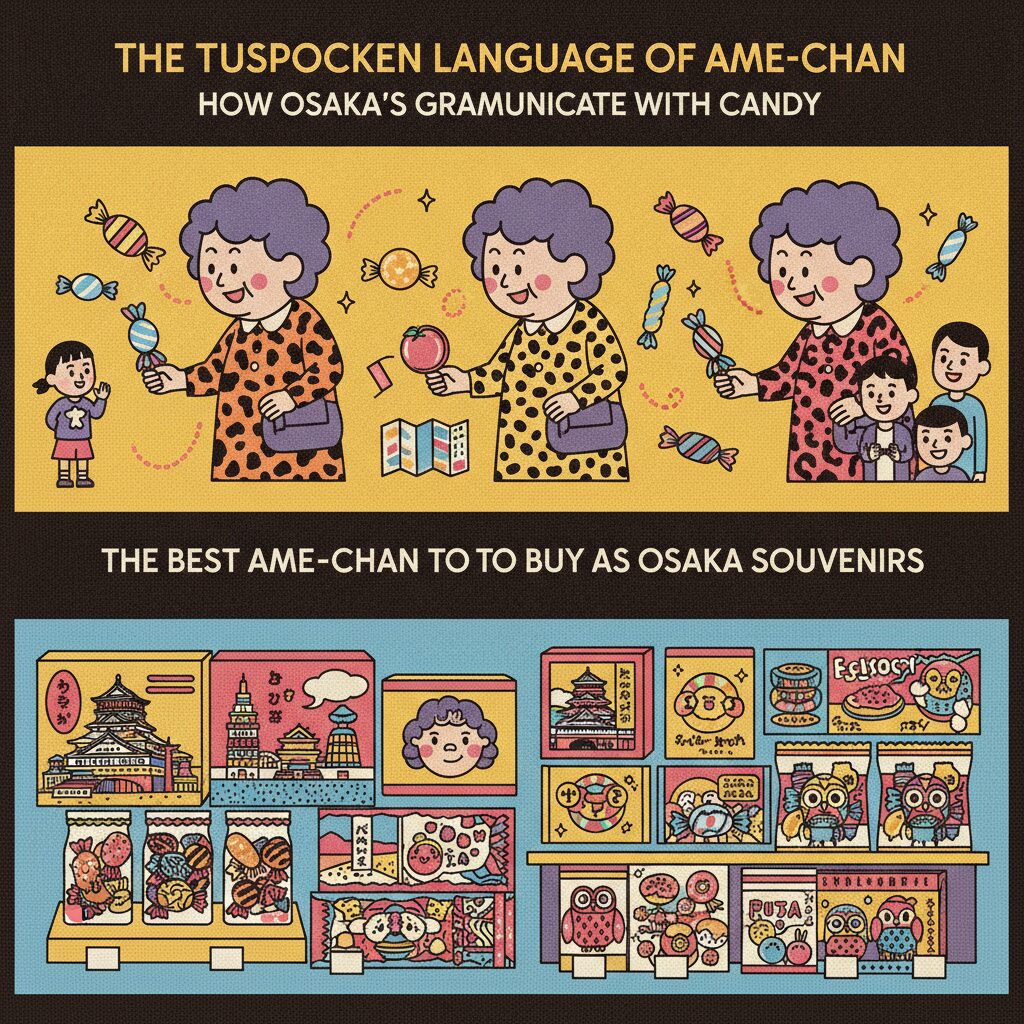
Once you’ve experienced this charming tradition as a recipient, you may feel drawn to take part from the other side. Whether your goal is to connect more deeply with your new neighborhood or to bring home a tangible piece of this distinctive cultural phenomenon to share with friends and family, selecting the right sweets is essential. You can’t just pick up any ordinary confection; you need the authentic treasures of local street-level commerce.
Pine Ame: The Iconic Yellow Ring
If there’s one particular sweet that holds a special place in the pockets of local matriarchs, it’s the legendary Pine Ame. Originating during the sugar-scarce years immediately after the Second World War, this candy was crafted to mimic the taste of canned pineapple, an extraordinary luxury at the time.
Its appearance is instantly recognizable: a bright, translucent yellow disc with a perfectly punched hole in the center, designed to resemble a real pineapple slice. The flavor strikes a flawless balance between sharp tartness and rich, comforting sweetness. Beyond its taste, Pine Ame embodies the city’s resilience, creativity, and lasting optimism. The packaging, featuring retro fonts and boldly bright colors, has remained mostly unchanged for decades. Offering someone a Pine Ame is like sharing a piece of local history. It is the gold standard of everyday interaction, immediately recognized by anyone who has spent more than a week in the area. Buying a bag of Pine Ame means equipping yourself with the most widely accepted social currency around.
Where to Stock Up on Local Candies
Don’t seek these vital sweets in the spotless, brightly lit souvenir shops near major train stations or the airport. Such stores cater to tourists searching for elegant boxes of neatly arranged cakes. To find the genuine fuel for local exchanges, you need to go where the residents shop—right into the heart of neighborhood commerce.
Your first stop should be Super Tamade. This supermarket chain is a landmark, a visual spectacle that defies conventional retail design. Approaching Super Tamade is like stepping into a rogue carnival. Its exterior is covered with flashing neon signs in glaring primary yellow, red, and blue. The lights blink wildly, twenty-four hours a day, demanding attention. Inside, the aisles are narrow, the music is an incessant upbeat frenzy, and the shelves are piled high with the city’s most affordable goods.
Past the deeply discounted seafood and heaps of fresh produce, you’ll find the confectionery aisle. Here, sweets aren’t sold individually; they come in large bulk bags meant for widespread sharing. You’ll encounter endless varieties of throat lozenges, matcha-flavored hard candies, sour plum drops, and, of course, towering stacks of Pine Ame. Prices are remarkably low, reflecting the fact that these treats are intended to be freely given, not hoarded as luxuries.
Alternatively, many local convenience stores tucked into side streets will have a decent selection. The trick is to choose the large, family-sized bags instead of small, single-serving packs.
Buy a bag. Tear it open. Slip a handful into your pocket before you leave the house. The next time you’re sitting on a park bench or standing on a crowded train and catch the eye of a stranger who looks a little weary or lost, you’ll know what to do. Reach into your pocket, offer a handful, and share the city’s unspoken language. In these small, sweet moments, you cease to be a visitor and begin truly living in Osaka.








