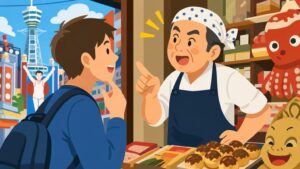
You may live in Osaka for months before someone invites you to a Takopa. Then, one evening, a friend places a heavy electric griddle on the dining table, pours batter into small round wells, and tells you to stop worrying about making perfect balls. The room fills with steam. Someone argues about whether the octopus pieces are large enough. Someone else adds cheese to the next batch without asking. A person you met only that night hands you a pick and says, “Turn it now.”
This is not simply dinner. It is one of the clearest ways to understand how Osaka works.
A Takopa, short for takoyaki party, is a home gathering built around making and eating takoyaki together. It belongs to the wider world of konamon, the Osaka word for flour-based foods. Okonomiyaki, negiyaki, takoyaki, and other affordable dishes sit inside this culture, but the important point is not only what is eaten. The important point is what happens around the food: people share labor, joke while they cook, compete gently, interrupt one another, and allow a meal to become a social performance.
For foreigners living in Osaka, this can reveal more than the familiar image of a busy food district. It shows how friendship is built, how hospitality is expressed, how hierarchy becomes softer in private, and why Osaka can feel less formal than Tokyo without being free of rules. Osaka people are not simply “friendly.” They often create situations in which friendliness becomes easy to perform.
What Is a Takoyaki Party, or Takopa?
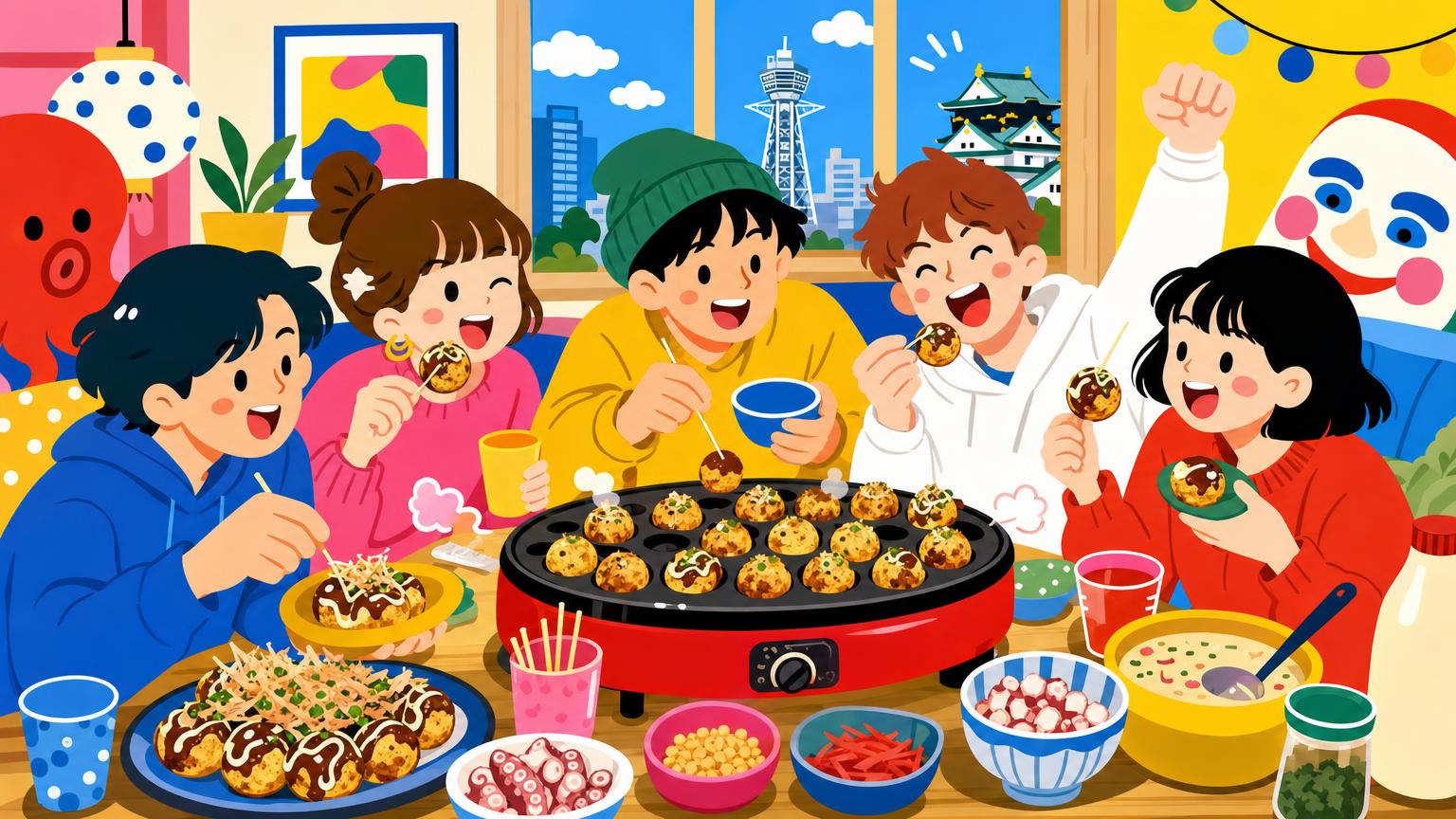
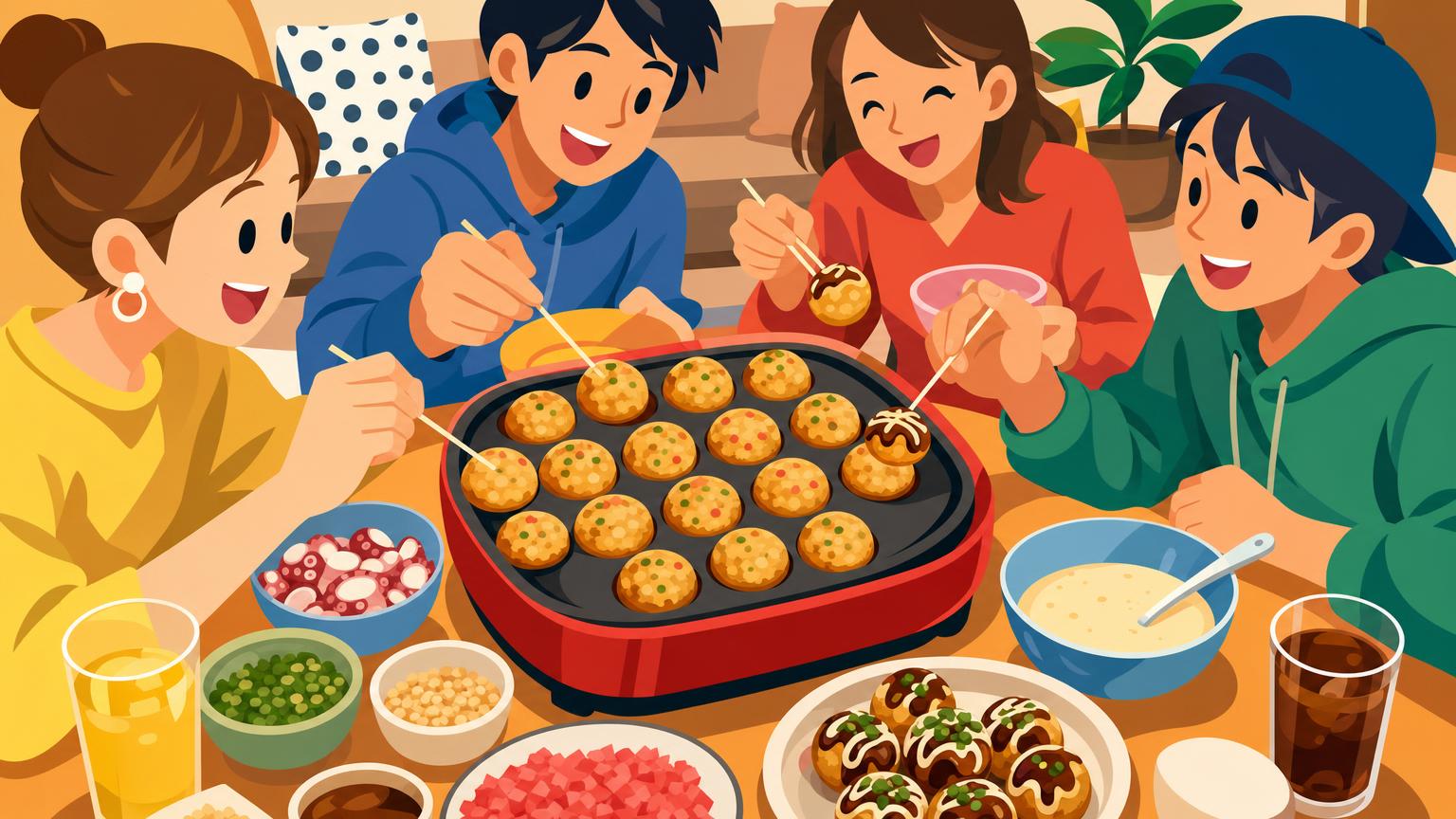
A Takopa is a shared meal centered around a takoyaki pan. The batter is poured into round wells and then filled with ingredients such as octopus, green onion, pickled ginger, and tenkasu, the small, crunchy pieces of fried tempura batter. As the outside cooks, diners use picks or chopsticks to turn each piece gradually until it becomes round, browned, and soft on the inside.
That description is accurate, but incomplete. A Takopa is not defined solely by the recipe; it is defined by participation. One person may prepare the batter, another may cut the fillings, and someone else may control the heat. The least experienced guest may be given the first pan because nobody expects the initial batch to look perfect. Cooking becomes the structure that holds the conversation together.
In an ordinary Japanese home, the table is often a place for eating food that has already been prepared. At a Takopa, the table becomes a small workshop. Everyone watches the same surface, and everyone has a reason to speak. Silence does not feel as heavy because there is always something to check: Is the batter ready to turn? Is the bottom burning? Who took the last piece of octopus?
This is why Takopa has become especially useful for groups that do not yet know one another well. A meal at a restaurant can create a clear division between the people eating and the staff serving them. A Takopa removes that division. Guests become cooks, and the cook’s role changes every few minutes.
A Staple of Osaka Local Culture
Osaka’s konamon culture is often translated as a love of flour-based food, but the phrase carries a broader social meaning. These foods are relatively inexpensive, adaptable, filling, and easy to prepare in large quantities. They suit a city shaped by commerce, dense neighborhoods, working households, and a strong tradition of eating outside the home as well as within it.
The everyday importance of konamon does not mean that every Osaka resident eats takoyaki every day. That would be a cartoon version of local life. The deeper point is that foods such as takoyaki and okonomiyaki fit the city’s preference for practical pleasure. They do not require luxury ingredients to become satisfying. They can be adjusted according to budget, appetite, leftovers, and the number of people at the table.
A family can make a large amount of batter and provide a few basic fillings. A group of university students can add whatever is inexpensive at the supermarket. A couple living in a small apartment can buy a compact pan and turn an ordinary Friday night into an event. The food is casual, but the gathering can still be meaningful.
This flexibility is important in Osaka. Social life does not always require a carefully planned reservation, an expensive meal, or a special occasion. A friend may say, “Come over. We have a takoyaki machine.” That sentence can serve as an invitation to relax, talk, and become part of the household’s rhythm.
Konamon also reflects a particular attitude toward cooking. In some settings, cooking is treated as a skill reserved for an expert. At a Takopa, cooking is more like a shared game. You learn by doing. You make mistakes in public. Someone tells you that you are turning too early. You improve during the same meal.
This creates a useful kind of informality. You do not need to feel confident before joining. You become confident because the group gives you a small task.
Why Takopa Is the Ultimate Social Activity
A Takopa slows down time without requiring silence. It is not a formal dinner with courses arriving at fixed intervals. Instead, it consists of a series of small cycles: pour, wait, turn, fill, eat, talk, repeat.
Those cycles matter socially. A person who is shy during direct conversation may feel more comfortable while concentrating on the pan. A newcomer can ask a practical question instead of searching for an abstract topic. “Should I turn this one?” is a natural opening line. So is “What is inside this batch?”
The pan also creates a shared focus. In a large group, people may split into separate conversations. When the next batch is ready, everyone’s attention returns to the table. Someone announces that the batter is running low. Another person reaches for the sauce. For a moment, the group acts as one unit.
There is also a quiet sense of equality in the cooking. A senior colleague may know more about the workplace, but at the pan, that person can still produce a badly shaped takoyaki. A foreign resident who has just joined the group may be given the same pick as everyone else. The activity does not erase social hierarchy, but it makes that hierarchy less visible.
This is one reason Takopa can be valuable in Osaka workplaces, share houses, university clubs, and neighborhood groups. It gives people a way to interact without forcing emotional openness. Nobody has to say, “Let us build a stronger relationship.” The relationship develops while everyone is trying to rescue half-cooked batter from the edge of the pan.
Konamon Culture and the Osaka Mindset
To understand Takopa, it helps to understand what konamon conveys about Osaka. The food is humble, but the social style surrounding it is lively, observant, and often direct.
Practical Pleasure Instead of Formal Display
Osaka hospitality often expresses itself through action rather than ceremony. A host may not offer a lengthy explanation of the meal. Instead, they may keep your plate filled, insist that you try another topping, or quietly move the best pieces toward you without calling attention to the gesture.
At a Takopa, hospitality may take the form of correcting your technique. A local friend might say, “Not yet. Wait a little longer,” then take your pick and demonstrate the movement. To a foreigner, this may initially sound bossy. In context, however, it may mean that the person wants you to enjoy the experience and does not want you to struggle unnecessarily.
Tone is important. Osaka communication can be direct, but directness does not always indicate anger. A quick comment, exaggerated complaint, or teasing remark may be a way of showing involvement. If someone ignores you entirely, that can feel more distant than someone who says, “That one is going to burn.”
This does not mean you should assume that every sharp comment is affectionate. Osaka still has ordinary conflicts, workplace stress, and social boundaries. The useful lesson is to listen for the relationship behind the words. Is the person smiling? Do they help you afterward? Do they speak to everyone in the same way? Context matters more than any single sentence.
The Difference Between Osaka and Tokyo
Foreigners often ask whether Osaka is more relaxed than Tokyo. The answer depends on what you mean by relaxed.
Osaka is not without rules. Trains are crowded, workplaces can be demanding, apartments may be small, and people are just as capable of being cautious around strangers. The difference is often found in conversational distance and in how quickly people allow informality.
In Tokyo, particularly in professional or public settings, people may maintain a more controlled distance until a relationship is clearly established. In Osaka, someone may start teasing, offering advice, or commenting on a situation sooner. This can feel warm, but it may also seem intrusive if you come from a culture where personal boundaries are expressed verbally and explicitly.
The contrast is not absolute. Osaka has formal institutions and reserved people, while Tokyo has generous neighbors and lively home gatherings. Regional stereotypes become misleading when treated as fixed rules. Still, many residents notice a difference in social temperature. In Osaka, the transition from polite distance to casual interaction can sometimes happen more quickly.
A Takopa makes this difference visible. The gathering is informal, but it is not unstructured. The group may expect you to help, accept teasing, try the food, and contribute to the conversation. You are welcomed partly through your participation.
“Friendly” Does Not Mean “Always Available”
A common misunderstanding is the idea that people in Osaka are permanently open and ready to become your close friends. This expectation can lead to disappointment.
Osaka’s conversational warmth may be situational. Someone may joke with you on a train platform, chat with you at a local bar, or invite you to a Takopa without immediately wanting a deep relationship. The interaction can be genuine without being a promise of lasting intimacy.
Japanese social life often develops through repeated contact. You may see the same neighbor, coworker, parent, shop owner, or club member many times before the relationship becomes dependable. An invitation to a Takopa can be meaningful, but it is still only one step. The best response is not to demand closeness. Show up, help out, remember people’s preferences, and invite them again later.
For foreigners living in Osaka, this is practical advice. Do not judge local friendliness solely by how quickly someone speaks with you. Notice whether they include you in ordinary plans. Do they tell you about a neighborhood event? Do they remember that you cannot eat shrimp? Do they ask whether your apartment search went well? Everyday continuity is often more meaningful than one enthusiastic conversation.
What a Takopa Reveals About Daily Life in Osaka
The home Takoyaki party belongs to the ordinary city, not merely to the image sold to visitors. It makes sense in rented apartments, family homes, student rooms, share houses, and community centers.
The Dining Table as a Social Room
Many Osaka homes are compact, so the dining table often needs to serve several functions. It may be used for meals, homework, remote work, paperwork, conversation, and storage. A Takoyaki machine is therefore more than a cooking appliance; it temporarily reorganizes the room.
Chairs are moved. Extension cords appear. Ingredients take over the table. Plates are placed wherever there is room. Someone opens a window because the smell of oil and sauce has become strong. The home becomes slightly inconvenient, but that inconvenience is accepted because it supports the gathering.
This offers a useful contrast to the polished image of Japanese domestic life sometimes presented to foreigners. A Takopa is not necessarily elegant. Batter spills. The first batch may stick. Sauce gets on the table. People may eat standing up while waiting for the next round.
The pleasure comes from making the space work.
Shared Labor Without a Formal Assignment
At a Takopa, tasks are rarely assigned through a written plan. People notice what needs to be done. Someone brings water. Someone wipes the table. Someone buys more green onion. Someone keeps the pan from getting too hot.
If you are new to the group, you may not know when to help. A good approach is to watch for opportunities. Offer to cut ingredients, carry plates, refill drinks, or clean the used containers. You do not need to take over; small contributions are enough.
This principle applies beyond Takopa. In many Osaka social settings, people appreciate practical help more than a formal announcement that you are willing to help. If the room is crowded, move your bag. If the food is gone, ask whether anyone wants more. If a host is cooking, do not sit passively throughout the evening unless they clearly insist.
The unspoken rule is simple: participate in the shared situation.
Food as a Safe Way to Negotiate Personality
A Takopa allows people to reveal themselves gradually. One person may be cautious with toppings. Another may insist on crisp edges. Someone else may invent combinations that the group considers strange but secretly enjoys.
These preferences become conversation. Food provides a safe subject through which people can express humor, stubbornness, generosity, competitiveness, and curiosity. In Osaka, where teasing often helps establish a social rhythm, the pan gives everyone material to work with.
You may be told that your takoyaki is too pale, too large, too serious, or shaped like a potato. This kind of comment can be an invitation to join the playful atmosphere. Responding with a small joke often works better than defending your technique.
You do not have to become loud or perform an Osaka-style personality. Quiet participation is perfectly acceptable. The main mistake is treating the meal as a service being provided for you.
How Foreign Residents Often Misunderstand Takopa
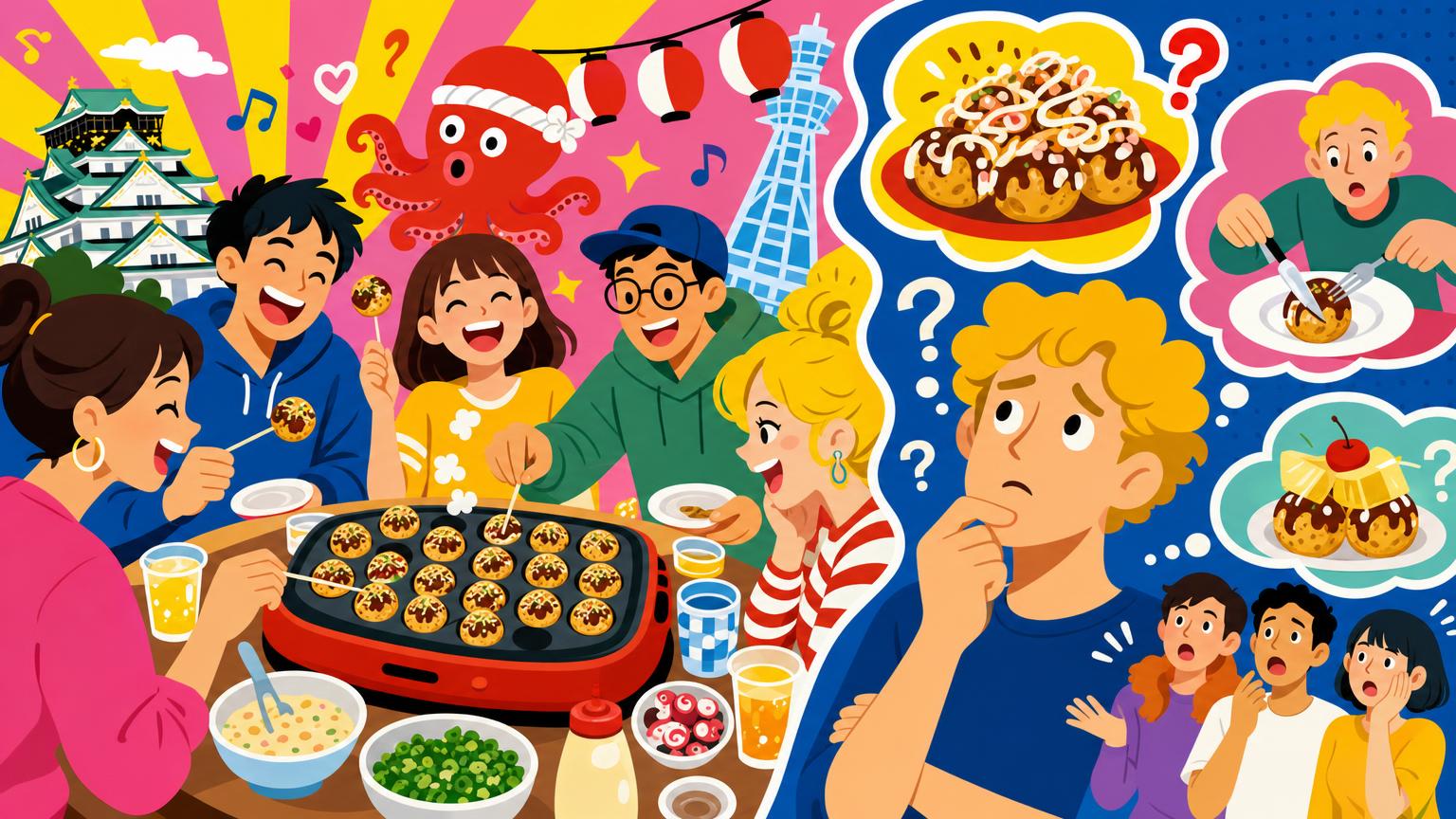
A foreigner may see a Takopa and assume it is simply a Japanese-style dinner party. That is partly true, but several details are easy to overlook.
It Is Not Just a Novel Cooking Experience
Visitors sometimes approach takoyaki as a fun activity: make the balls, take photographs, eat them, and move on. In a home setting, the activity is less about novelty. Most residents are not gathering because they have never seen a takoyaki pan before.
They gather because the format is convenient. It feeds several people, encourages conversation, accommodates different budgets, and gives the evening a central focus.
If you live in Osaka, this distinction matters. You do not need to treat every Takopa as a cultural performance. You can simply enjoy it. Asking questions is welcome, but constantly comparing the experience with your own country can make the evening feel like an interview. Notice how people organize the meal before explaining what it reminds you of.
“Authentic” Does Not Mean One Fixed Recipe
There is no single official Takopa menu followed by every Osaka household. Some people use octopus and nothing unusual. Others add shrimp, sausage, mochi, cheese, corn, kimchi, or leftover vegetables. A vegetarian household may replace the octopus entirely.
This flexibility is not a failure of authenticity. It is part of the point. Home cooking changes according to available ingredients and personal taste. A frozen bag of seafood, a half-used pack of mushrooms, or a piece of cheese can become part of the evening.
The sauce and mayonnaise may be applied heavily or lightly. Some people prefer bonito flakes and aonori, a green seaweed powder. Others prefer salt, ponzu, or no topping at all. If you are a guest, try the host’s usual version before suggesting changes.
Teasing Is Not Always Insulting
Osaka humor can be difficult for foreigners because it may appear before trust has been fully established. A person may laugh at a mistake, exaggerate a complaint, or draw attention to a small awkward moment.
The safest response is to observe the group’s pattern. If everyone is being teased, you are probably seeing a shared style. If only one person is being targeted, the situation may be less comfortable. You can smile, offer a light response, or change the subject. You are not required to accept every joke.
Likewise, do not imitate strong Osaka teasing right away. Local humor depends on timing, tone, and relationship. A phrase that sounds funny in a television program may feel rude when used by a stranger. Begin with warmth and observation.
The Ingredients of a Real Takopa
A Takopa does not require expensive ingredients, but the balance among the basic components makes a difference.
The Classic Fillings: Octopus, Tenkasu, Beni Shoga, and Negi
The most recognizable filling is cooked octopus, cut into small pieces. Each piece should be large enough to notice but small enough to fit comfortably inside the batter. If the pieces are too large, the takoyaki may be difficult to turn and unevenly filled.
Tenkasu is tempura batter fried into small, crunchy pieces. It adds richness and helps create contrast within the soft batter. Many beginners underestimate it, but it contributes a familiar savory depth.
Beni shoga is finely chopped red pickled ginger. Its sharp, slightly sour flavor cuts through the richness of the batter and sauce. Use it sparingly if you are not accustomed to pickled ginger; a little goes a long way.
Negi means green onion or scallion. It adds freshness and a mild onion flavor. The green parts are often scattered into the batter or added on top after cooking.
The batter itself is usually made with flour, eggs, dashi, and water, although prepared mixes are also common and perfectly practical. A thinner batter generally helps create a soft interior, but it can also make the turning process more demanding.
Fun and Creative Toppings
Cheese is a popular addition because it melts into the center and gives the takoyaki a richer texture. Kimchi adds heat and acidity. Mentaiko, or spicy cod roe, provides saltiness and a gentle seafood flavor. Corn, sausage, shrimp, mushrooms, and mochi can all work well when cut into small pieces.
Creative fillings are especially useful when hosting a mixed group. Some guests may dislike octopus, while others may avoid meat. Offering several fillings makes the meal more inclusive without requiring separate dishes.
Keep a small amount of each ingredient on hand instead of filling the whole pan with one experimental combination. Labeling unfamiliar fillings can also help, especially when guests have allergies or dietary restrictions.
When cooking for foreigners or international housemates, ask directly about seafood, pork, dairy, gluten, eggs, and alcohol-based sauces. Do not assume that a small piece of filling is harmless. Takoyaki batter often contains more ingredients than it appears to.
Dessert Takoyaki
Dessert takoyaki is playful rather than traditional, but it follows the same social logic. The pan becomes a tool for experimenting with sweet fillings such as banana, chocolate, apple, sweet red bean paste, or marshmallow.
Use less oil and lower heat for sweet mixtures, since sugar burns quickly. You can finish the pieces with powdered sugar, fruit, whipped cream, or a small amount of chocolate sauce. Cook sweet ingredients in a separate round so that savory oil and seafood flavors do not dominate.
Dessert takoyaki works well at the end of a long evening because it changes the mood. People who were arguing about the correct amount of beni shoga suddenly become cautious about melting chocolate without making a mess.
The point is not to prove that every variation belongs to Osaka tradition. Rather, it is to understand how home konamon culture allows people to improvise together.
How to Host Your Own Takoyaki Party
If you live in Osaka, hosting a Takopa is one of the easiest ways to bring together people from different backgrounds. You do not need a large apartment or advanced cooking skills. However, you do need to plan for heat, smoke, timing, and the fact that everyone will want to eat at the same time.
Required Tools and Equipment
You will need a takoyaki pan or electric takoyaki maker, a heat-safe table surface, a bowl for the batter, a ladle or measuring cup, and picks for turning the pieces. A silicone or small brush is useful for spreading oil into the wells. Chopsticks can work, but dedicated takoyaki picks make turning easier.
Prepare small bowls for the fillings, and keep plates and napkins nearby. Sauce, mayonnaise, aonori, and bonito flakes should be within easy reach, but avoid crowding the hot appliance.
Ventilation is important. Takoyaki does not create as much smoke as deep-frying, but oil, batter, sauce, and steam can make a small apartment smell strongly for hours. Open a window if practical, use a ventilation fan, and protect surfaces from oil splashes.
Check the voltage and plug requirements if you purchased the appliance outside Japan. Do not use an unfamiliar machine near water or overload an extension cord. If you are using a stovetop pan, make sure it is compatible with your cooking surface.
Preparing the Batter
A basic batter can be made with flour, eggs, dashi stock, and water. The mixture should be smooth and fairly fluid—thinner than pancake batter. Letting it rest briefly can help the flour hydrate, although a party does not need to turn into a laboratory experiment.
Add seasonings sparingly, since the toppings will contribute salt, sweetness, and richness. If you are using a commercial mix, check whether it already contains dashi, salt, or other seasonings.
Prepare all the fillings before heating the pan. Once the batter is poured, the cooking process moves quickly. You do not want to be searching for chopped green onion while the edges are already setting.
Step-by-Step Takoyaki Cooking
Heat the pan thoroughly before adding the batter. A properly heated surface helps the outside set quickly and reduces sticking. Add plenty of oil to the wells and spread a light coating across the flat surface between them.
Pour the batter into the wells and let it overflow slightly across the top. Beginners often pour too little because they want neat portions. Extra batter is useful because it becomes part of the rounded exterior as you turn the pieces.
Add octopus, tenkasu, beni shoga, and negi while the batter is still wet. Work across the pan instead of perfecting one well at a time. Takoyaki is easier when you treat the entire pan as one connected cooking surface.
Wait until the edges begin to set. The tops will still look wet, but the underside should have enough structure to move. Use a pick to separate the batter between the wells. This is one of the most important steps. If the pieces remain connected, they will be difficult to turn cleanly.
Insert the pick at an angle along the edge of a piece rather than stabbing directly into the center. Lift and rotate it gradually, turning it about a quarter or half turn at first. If the batter resists, wait a little longer instead of forcing it. A takoyaki that refuses to turn may simply need more time to cook.
As the cooked surface becomes exposed, pull loose batter underneath the piece. This helps create the round shape. Continue turning each ball in small movements until the outside is browned and the inside feels soft but not liquid.
Transfer the cooked pieces to a plate, add sauce and mayonnaise if desired, and finish with aonori, bonito flakes, or green onion. Warn guests that the center will be extremely hot. The first bite can burn even when the outside feels safe.
Tips for Perfectly Round Takoyaki Balls
Use enough oil. Sticking is usually caused by too little oil, an underheated pan, or turning too early. The oil should reach the sides of each well rather than merely sit at the bottom.
Do not expect perfect spheres right away. The first batch is a chance to learn the heat of the appliance. Different pans cook at different speeds, and electric machines often have hotter areas near the center or edges.
Turn the pieces in stages. A full rotation can tear a soft piece. Small turns allow uncooked batter to flow into the gap and gradually form a round shell.
Keep the heat moderate once the surface has set. Very high heat can brown the outside before the center is cooked. If the balls are darkening too quickly, lower the heat or move them to a cooler part of the pan.
Avoid overfilling. A generous amount of batter is helpful, but too much of one filling can keep the piece from rotating. Cut the ingredients into small pieces and leave enough room for the batter to surround them.
Use two picks if you feel comfortable doing so. One pick can hold a piece while the other loosens the edge. Do not use metal tools on a nonstick pan unless the manufacturer permits them.
Most importantly, keep the mood relaxed. At a Takopa, an irregular ball is not a failure. It is proof that everyone is still cooking.
Hosting a Takopa With International Friends
A home Takopa can be an excellent way to build a social life in Osaka, particularly when your friends come from different countries. The format gives everyone something concrete to do and reduces the pressure to keep a conversation going in one language.
Make the Rules Visible
Explain the basic process before everyone starts. Show guests how to oil the pan, when to separate the pieces, and how hot the center can become. If your guests have never used a takoyaki pick, demonstrate the process slowly.
Explain that some ingredients may be seafood-based even if they look like ordinary toppings. Mention whether the sauce contains alcohol or whether the batter includes fish-based dashi. Clear information makes the gathering more comfortable for vegetarians, Muslims, people with allergies, and anyone unfamiliar with Japanese ingredients.
Let Guests Choose Their Level of Participation
Some people will want to control the pan, while others may prefer to prepare fillings or watch. Invite participation without applying pressure. You might say, “Would you like to try turning this one?” rather than placing a pick in someone’s hand.
A good host makes room for both enthusiasm and caution. The social goal is not to produce the fastest batch, but to create a setting where everyone can participate at a comfortable level.
Do Not Turn the Evening Into a Culture Lesson
You can explain the meaning of konamon, the role of tenkasu, or the difference between home-style and restaurant takoyaki. However, let the evening remain ordinary. People do not need a lecture before eating.
The most convincing explanation of Osaka culture may be found in the way the gathering unfolds. Someone complains about the heat. Someone laughs at a misshapen ball. A guest who was quiet at the beginning starts recommending kimchi. By the end, people are discussing where to buy a better pan.
That is cultural understanding through participation.
Takopa and the Meaning of Community in Osaka
A home Takoyaki party is valuable because it represents a form of community that is neither entirely formal nor entirely spontaneous.
Japanese life often includes strong systems of belonging: workplaces, schools, neighborhood associations, clubs, family networks, and long-standing friendships. These systems can be difficult for foreigners to enter because they are formed through repeated contact and shared history.
A Takopa does not eliminate that difficulty, but it offers a gentle entrance. You can participate through a practical role. You can contribute before fully understanding every conversational rule. You can discover who is careful, who is generous, who jokes, who cooks, and who quietly clears the table.
The meal also demonstrates that belonging is not always explicitly declared. It is often shown through small acts. Someone gives you the less spicy batch. Someone explains why one side of the pan is hotter. Someone tells you to wait before eating because the center is still dangerously hot.
These actions may seem minor. Together, they create a feeling of being cared for.
This helps explain why Osaka can feel different from cities where social warmth is expressed mainly through verbal enthusiasm. In Osaka, warmth may be loud, teasing, practical, and slightly inconvenient. It may come as a plate pushed toward you or a correction delivered in a sharp voice.
The city is not automatically easy for everyone. Some foreigners find its directness tiring. Some struggle with the dialect, rapid speech, or the expectation that they will respond to jokes. Others find these same qualities liberating after living in more distant or formal environments.
The honest answer to “Is Osaka a good place to live?” depends partly on the kind of social life you want. If you prefer clear boundaries and limited conversation with neighbors, Osaka’s informality may feel intrusive. If you want repeated casual contact and opportunities to connect through food, humor, and shared activities, it may feel unusually welcoming.
A Takopa does not prove that every person in Osaka is outgoing. It shows something more useful: Osaka has everyday settings that make connection possible without requiring a formal invitation to intimacy.
Frequently Asked Questions About Takoyaki in Osaka
Why Is Osaka Famous for Takoyaki?
Osaka is closely associated with takoyaki because the dish reflects the city’s broader konamon culture: affordable flour-based food, flexible home cooking, casual dining, and social gatherings centered around shared preparation.
The association is also practical. Takoyaki suits dense urban life well. It can be sold from a small shop, prepared at home with a compact appliance, or cooked for a group at the table. It is filling, customizable, and fun to make.
The deeper reason is social rather than purely culinary. Takoyaki gives people something to do together, which has helped it become part of Osaka’s identity both inside and outside the home.
Is It Hard for Beginners to Make Takoyaki?
The first batch may be difficult, but the basic technique is easy to learn. The main challenges are controlling the heat, using enough oil, waiting for the edges to set, and turning the pieces without tearing them.
Do not judge yourself by the shape of the first few pieces. Experienced cooks also adjust their technique depending on the pan. Start with a simple filling, cook at a moderate temperature, and turn the pieces gradually.
A beginner who takes part in the process is already doing the important part of a Takopa. Perfectly round takoyaki matters less than making enough food for everyone to keep talking.
What Should I Bring to a Takopa as a Guest?
Ask the host first. Drinks, fruit, dessert, extra toppings, or a small ingredient can all be helpful. If the host is providing the main food, avoid bringing a complicated dish that requires oven space or special preparation.
You could bring chopped green onion, cheese, mochi, kimchi, mushrooms, or a non-seafood filling. If you bring something unusual, explain what it is and check whether anyone has dietary restrictions.
A willingness to help is often more valuable than an expensive gift. Offer to wash the dishes, take out the rubbish, or clean the table after the meal.
What If I Do Not Eat Octopus?
Tell the host before cooking starts. Takoyaki can be prepared with other fillings, or some wells can be left plain and topped after cooking. Cheese, mushrooms, corn, mochi, shrimp, chicken, and vegetables are common alternatives, although ingredients differ from household to household.
If you are vegetarian or vegan, check the batter, dashi, mayonnaise, and sauce as well as the filling. Some seemingly simple ingredients may contain fish, eggs, or dairy.
Do I Need to Speak Japanese to Enjoy a Takopa?
No, although a few practical phrases can help. You can say “Mada?” to ask whether it is ready, “Atsui” to say that it is hot, and “Oishii” to say that it is delicious. More important than vocabulary is observing the group’s rhythm.
Ask before taking the last piece. Offer to help, and clearly mention if you have an allergy or cannot eat a particular ingredient. If you do not understand a joke, it is perfectly acceptable to smile politely and ask for an explanation.
People may appreciate your Japanese, but they do not expect you to demonstrate fluency. Participating communicates more than perfect grammar.
Is a Takopa a Good Way to Make Local Friends?
It can be, especially when it develops from an existing connection such as work, school, a neighborhood group, a language exchange, or a shared house. The pan encourages conversation, but lasting friendship still depends on repeated contact and mutual effort.
Do not treat the event like a networking session. Help with the meal, listen, and enjoy the ordinary parts of the evening. If the atmosphere feels comfortable, invite the group to meet again or offer to host the next Takopa.
What Is the Biggest Mistake Foreigners Make at a Takopa?
The most common mistake is treating the gathering as a passive meal. Guests sometimes wait for the host to cook everything because they are trying to be polite. In Osaka, this can unintentionally create more work for the host.
Watch the pan, ask what you can do, and accept a pick when someone offers you one. You do not need to become an expert; you only need to take part in the shared activity.
Learning Osaka Through the Pan
If you want to understand what daily life in Osaka is really like, do not focus only on famous food streets or public performances of local character. Pay attention to what happens in an ordinary apartment when friends gather around a takoyaki machine.
Notice how quickly a formal invitation becomes casual. Notice how people teach one another through teasing. Notice how the meal uses inexpensive ingredients while creating a sense of abundance. Notice how nobody needs to make a grand statement about community; they simply keep the pan moving.
The Takopa is a small event, but it contains a great deal of Osaka. It reveals a city that values pleasure without excessive ceremony, conversation that grows warmer through practical action, and hospitality that may sound like criticism before you recognize its generosity.
For foreigners living in Osaka, the lesson is not that you must become loud, humorous, or obsessed with takoyaki. The lesson is that social belonging can be built through participation in ordinary things. Cut the negi. Pass the beni shoga. Let someone show you how to turn the next one.
The ball may come out unevenly. The table may get messy. Someone may laugh at your technique. Then you will understand that the evening has probably gone well.