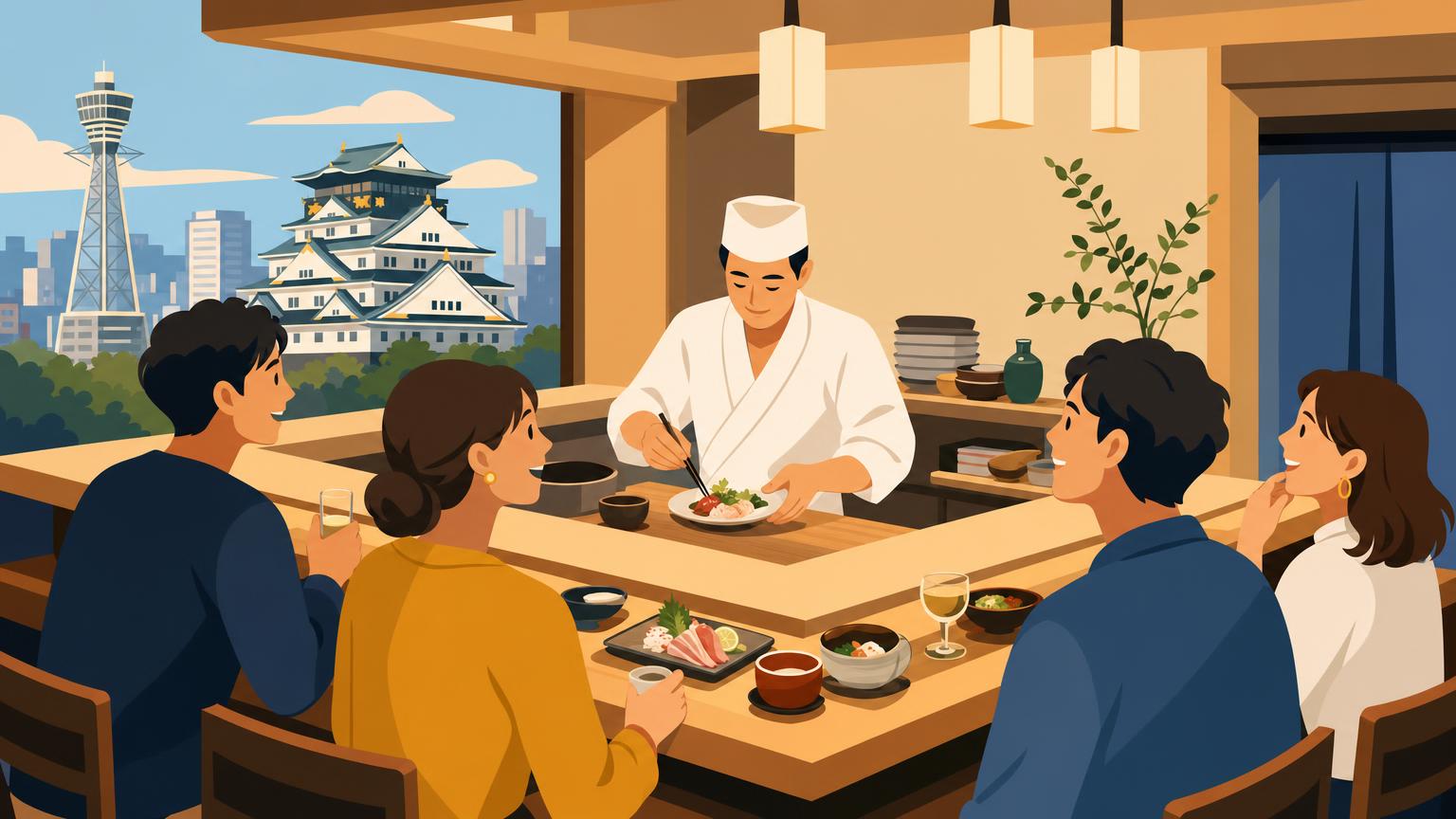
You may already know the basic image: a chef stands behind a wooden counter, slices fish with quiet precision, and serves one small dish after another. Yet many foreign residents in Osaka still hesitate before entering a kappo restaurant. Is it formal like kaiseki? Casual like an izakaya? Should you order from a menu, accept whatever the chef gives you, or simply sit in silence?
The confusion is understandable because kappo does not fit neatly into the categories many people bring from overseas. It is expensive, but it is not always stiff. It can be highly refined, yet the chef may ask what you feel like eating. It can involve a carefully planned course, while still allowing the evening to change according to the fish delivered that morning. The most important part is not only the food. It is the relationship created across the counter.
For people living in Osaka, this matters because kappo reflects a wider local habit: conversation is part of service, taste is negotiated rather than announced, and a good evening should feel personal rather than standardized. Osaka’s famous food culture is not simply about eating a lot. It is about knowing what is good today, talking about it, and enjoying the exchange.
This guide explains how to understand that exchange in practical terms. It looks at how kappo works, how Osaka’s style differs from Tokyo’s more formal image of Japanese fine dining, what foreign residents often misunderstand, and how to behave naturally without pretending to be Japanese. The examples include established places such as Kappou Kubota in Nishi-Tenma, Kappou Hashimoto near Nakatsu, and Naniwa Kappo Kigawa in the Minami area. Restaurant details, prices, reservation systems, and language support can change, so confirm directly before booking.
What Kappo Really Means in Osaka
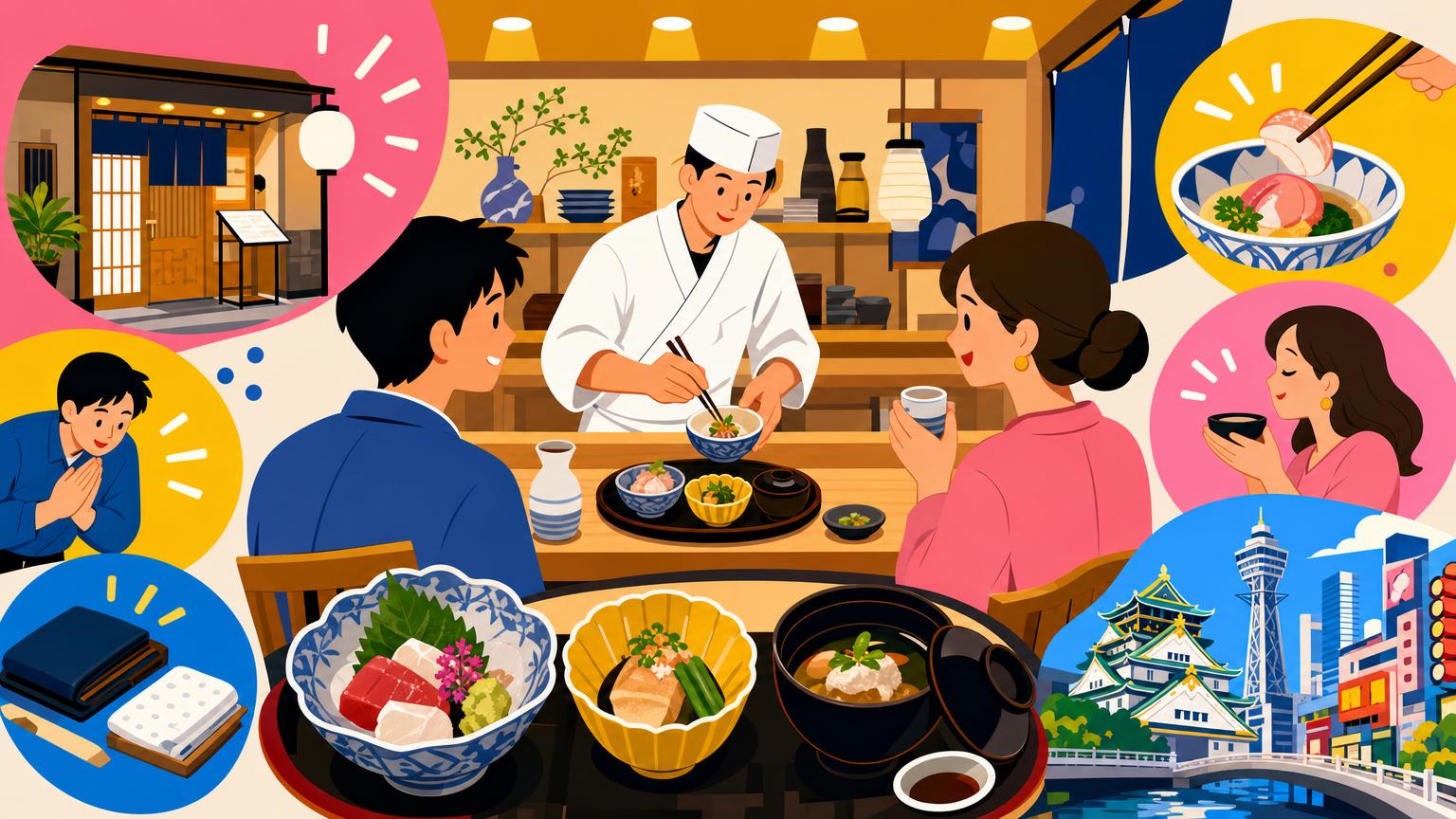
The word kappo is written with characters associated with cutting and cooking. In practice, it refers to a Japanese dining style in which the chef prepares food close to the guests, often at a counter. The Japanese Ministry of Agriculture, Forestry and Fisheries describes it as an intimate form of dining where the chef presides over the counter and diners may order dishes one by one. The same explanation also emphasizes conversation as part of the experience.
That definition is useful, but it does not fully capture the Osaka feeling. In Osaka, the counter is not merely an efficient way to display the kitchen; it is a social space. The chef observes the rhythm of the customers. Customers watch the chef’s hands, ask what has arrived from the market, and sometimes change their order based on the answer.
A typical exchange might be simple:
“Anything good today?”
“There is a nice madai sea bream.”
“How would you serve it?”
“Sashimi is good, but the head would be better simmered.”
“Then let’s do both.”
The language may be more polished in an expensive restaurant, but the basic attitude remains the same. You are not simply consuming a finished product. You are participating in a conversation about ingredients, timing, and preference.
Osaka’s official tourism information describes kappo as a style that became established in Osaka around the middle of the Taisho period, when diners wanted Japanese food that felt more accessible and enjoyable than older restaurant traditions. The chef’s open kitchen, the sound of simmering food, and the ability to order dishes as they are prepared became central attractions.
This history helps explain why kappo feels different from a ceremonial meal. It is sophisticated, but it is also connected to Osaka’s merchant culture. The city developed through trade, wholesale markets, restaurants, theater, and business relationships. Food was important, but so was the ability to read another person and adjust the interaction.
Kappo Is Not Simply “Expensive Japanese Food”
Foreign residents sometimes translate kappo as “high-end Japanese restaurant.” That is not incorrect, but it is incomplete. Many kappo restaurants are expensive because they use seasonal fish, carefully selected vegetables, specialized knives, labor-intensive preparation, and limited seating. However, price alone does not define the style.
A restaurant may call itself kappo while serving a modest lunch. Another may offer a dinner course costing more than ¥30,000 per person. Some establishments are primarily counter restaurants, while others combine counter seats with private rooms. Some focus on seafood, whereas others emphasize meat, vegetables, crab, fugu, or regional ingredients.
The common thread is usually proximity and responsiveness. The kitchen is not hidden behind a wall, and the chef’s decisions are visible. The meal is shaped by what is available, what the chef does best, and what the guests want within the boundaries of the restaurant’s style.
This is also why two restaurants with similar menus can feel completely different. One chef may speak constantly and joke with regulars, while another may create a quieter atmosphere and explain only the essential details. Neither approach is automatically more authentic. Osaka has room for both.
Kappo vs. Kaiseki: The Difference You Feel at the Table
Kappo and kaiseki overlap, and restaurants sometimes use the terms loosely. Both may include seasonal ingredients, soup, sashimi, grilled food, simmered food, rice, and dessert. Both can be served as an omakase course, meaning that the chef selects the dishes for you.
The difference is best understood as a matter of structure and atmosphere rather than a strict legal definition.
Kaiseki is generally associated with a planned sequence of dishes, formal presentation, seasonal symbolism, and a carefully controlled progression. Traditionally, kaiseki also has connections to the tea ceremony, although modern restaurant kaiseki includes many variations.
Kappo is usually more interactive. The chef is close enough to speak with you. You may order à la carte, ask about a fish, request a different preparation, or decide how much you want to eat. Even when you choose a set course, the counter creates the sense that the meal is being completed in front of you rather than simply delivered.
A useful comparison is this: kaiseki often asks you to follow the composition created by the restaurant, while kappo often allows the composition to develop through an exchange between the restaurant and the guest.
That does not mean kappo is casual in the everyday sense. You should still expect good ingredients, careful service, and a bill that may be considerably higher than that of an ordinary izakaya. It means that warmth, flexibility, and direct communication are part of the experience.
Why Osaka Developed Such a Strong Counter Culture
Osaka’s relationship with food is closely tied to its history as a commercial city. Osaka has long been described as a center of trade and distribution, and its food culture developed around merchants, markets, waterways, wholesalers, and restaurants serving people who worked, negotiated, and socialized throughout the city. The city’s own food-culture materials connect this background with a practical attitude toward ingredients, frugality, and the belief that food should be enjoyed rather than treated solely as a symbol of status.
The famous expression kuidaore is often translated as “eat until you drop,” but the local mentality is more nuanced than endless consumption. Osaka people often seek value—not necessarily cheap food, but food that feels worth the price. A small dish can be expensive if the ingredient, timing, technique, and hospitality justify it. A fashionable restaurant may be criticized if it seems showy but offers the customer nothing memorable.
This helps explain the popularity of counter seating. At a counter, customers can see whether the chef is careful. You can observe how fish is cut, how a flame is controlled, how vegetables are arranged, and whether the chef is paying attention to the people eating. The counter makes quality feel visible.
Osaka’s official food information describes the city’s kappo culture as something refined through communication between chefs and guests across the counter. That phrase is important. The relationship is not simply chef-to-customer; it is a shared performance, with the chef responsible for the food and the customer responsible for providing useful signals.
Osaka and Tokyo: A Difference in Social Temperature
It is risky to make broad claims about entire cities, since Tokyo has relaxed restaurants and Osaka has formal ones. Still, foreign residents often notice a difference in social temperature.
Tokyo’s high-end dining image is often associated with precision, reservation systems, quiet service, and a clear separation between the chef’s professional space and the diner’s private space. This image is not universal, but it is common enough to shape expectations.
Osaka’s counter restaurants can feel more conversational. The chef may ask where you are from, what you enjoy, whether you have tried a particular ingredient before, or whether you would like to change the preparation. A regular customer may make a joke, while another guest may comment on the season. The room may feel less like a performance of luxury and more like a small community with a skilled host.
Do not mistake this for informality without boundaries. Osaka friendliness is often situational. People may speak directly, tease one another, or use humor, but they still notice whether you are considerate. The warmth depends on mutual participation. If you treat the restaurant as a photo studio, speak loudly over the chef, or arrive late without contacting anyone, the atmosphere can change quickly.
The local expectation is not that you must speak fluent Japanese. Rather, you should show interest, respond politely, and avoid making the staff work unnecessarily hard to understand your needs.
What a Normal Kappo Meal Looks Like
There is no single standard menu, but an evening often follows a recognizable rhythm. You may start with a small seasonal appetizer, followed by sashimi, soup, grilled food, a simmered or fried dish, a stronger main ingredient, rice, and dessert. Some restaurants offer a fixed omakase course, while others begin with a few recommended dishes and then allow you to order more.
The word omakase does not mean “the chef can do anything he wants while you have no rights.” Rather, it means that you are entrusting the selection to the chef. You should still mention any allergies, foods you cannot eat, alcohol preferences, and your budget before the meal begins.
A counter chef may use whatever is best that day. In spring, that might include bamboo shoots, young fish, or mountain vegetables. In summer, hamo conger pike may appear. Autumn brings mushrooms, matsutake, chestnuts, and richer fish. Winter may feature crab, fugu, oysters, buri, or hot-pot dishes. Osaka restaurants often value dashi, seasonal seafood, and the natural taste of ingredients, though the exact balance depends on the chef.
Price Ranges You Should Actually Expect
For an ordinary but serious kappo dinner, a realistic starting point is often around ¥10,000 to ¥15,000 per person before drinks. More established restaurants commonly range from ¥15,000 to ¥30,000. Highly specialized restaurants, premium seasonal ingredients, large crab or fugu meals, and famous chefs can cost more than ¥30,000.
For reference, Kappou Kubota in Nishi-Tenma currently lists dinner courses at around ¥14,500, ¥19,500, and ¥24,500, tax included, through its reservation information. Kappou Hashimoto near Nakatsu primarily offers an à la carte style, with restaurant information showing an evening price range of around ¥12,000 to ¥14,999 and specific small omakase options on its booking page. Naniwa Kappo Kigawa is a more established Minami name, and prices should be confirmed directly because course details may vary by season and booking channel.
Drinks can significantly change the final bill. Sake by the glass may be reasonably priced, but several pours, rare labels, wine, or shochu can add thousands of yen. Ask whether prices are per glass, per serving, or per bottle. If you have a firm budget, mention it before ordering rather than waiting until the bill arrives.
A useful sentence is:
“My budget is around ¥20,000 per person, including food but not drinks. Is that possible?”
In Japanese, you can say:
“お料理は一人二万円くらいで考えています。飲み物は別で大丈夫です。”
This is not rude; it is practical. Osaka people generally understand direct discussions about value better than vague embarrassment.
Omakase, À La Carte, and the Question of How Much Food to Order
If you are new to kappo, an omakase course is often the easier option. The restaurant can control the sequence, portions, and balance of ingredients. It also reduces the stress of reading an all-Japanese menu.
À la carte dining can feel more local in spirit, especially at a restaurant where the chef welcomes conversation. You might order sashimi, a seasonal vegetable, grilled fish, and rice according to your appetite. However, this requires more communication, and the price can be less predictable.
Do not assume that ordering several dishes immediately is the safest approach. At a counter, the chef may prefer to serve food in stages. Ask what portion size is appropriate. If you are dining with another person, explain whether you want to share. Some dishes are designed for one person, while others are naturally divided.
A good approach is to begin with two or three recommendations and then continue. You are not expected to prove that you know every Japanese dish; you are expected to pay attention.
How to Behave at the Counter Without Feeling Awkward
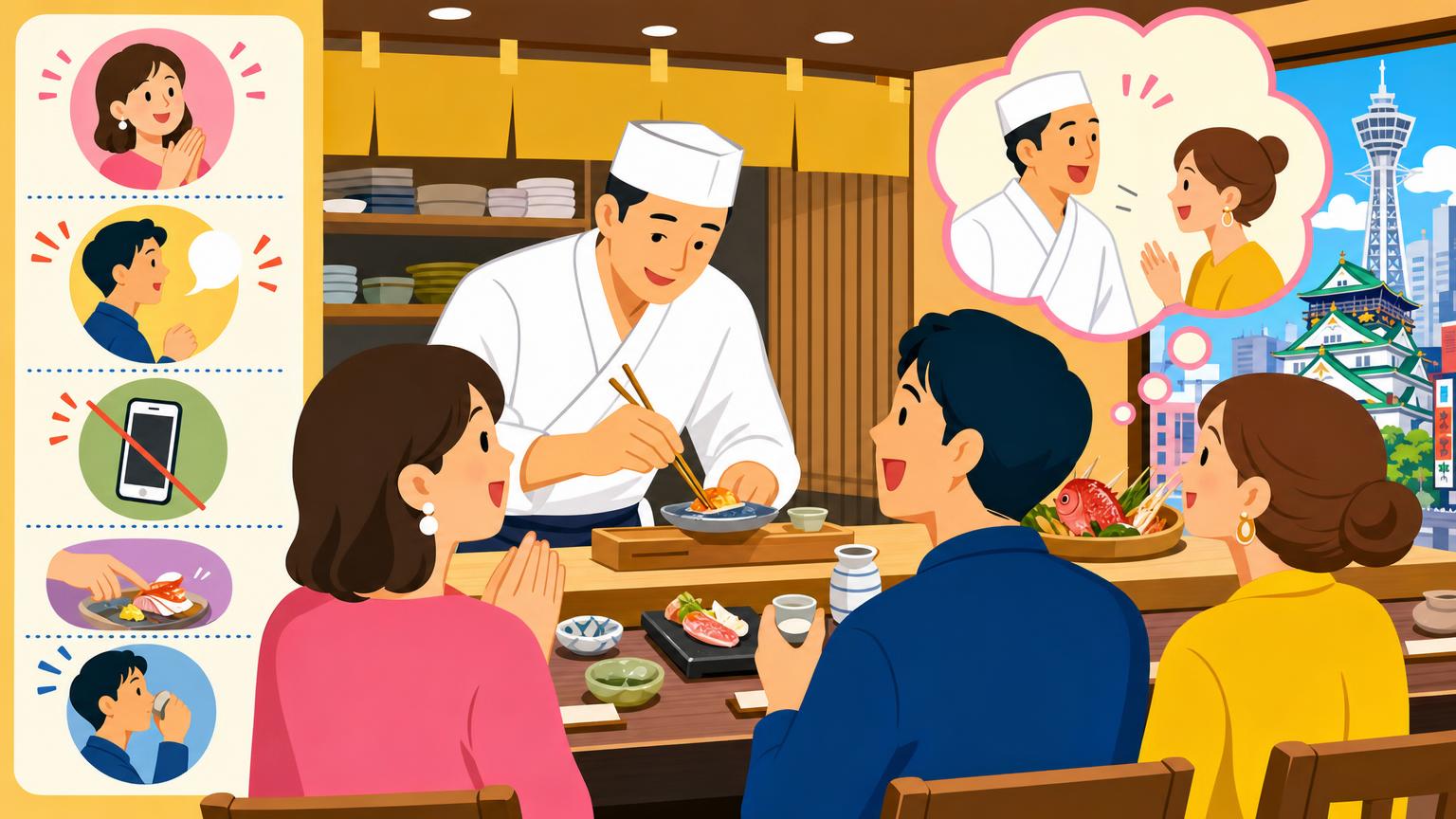
The most important rule is simple: be present. A kappo counter is nearby, and small actions are noticeable. You do not need formal table manners from a historical manual, but you do need awareness.
Arrive on Time
Many kappo restaurants have limited seating and prepare ingredients based on the number of reservations. If the restaurant begins its course at a specific time, arrive a few minutes early. If you are delayed, call as soon as possible.
Some restaurants serve all guests in a single seating, so arriving late can interrupt the flow for everyone. Other restaurants offer two dinner seatings. For example, an English-language restaurant document from Oryouri Yamada in Nishi-Tenma explains its fixed evening start times and asks guests to arrive on time because the group begins together.
Do Not Treat the Counter as a Display
The counter may look beautiful, but it is also a working surface. Avoid placing your phone, wallet, camera, or bag directly on it unless the staff says it is acceptable. Keep bags beside you or use the storage area provided.
A wooden counter may be polished, treated, or made from valuable timber. You do not need to admire it dramatically; simply treat it as part of the chef’s workplace.
Watch Before Photographing
Photography is often permitted, but ask first. A quick question such as “May I take a photo?” is enough. Avoid using flash, especially in a small room. Do not photograph other customers or record an extended video of the chef without permission.
The counter is an intimate space. What feels like a harmless travel memory to you may feel like surveillance to someone sitting nearby.
Speak to the Chef, But Read the Room
Conversation is welcome in kappo, and the official description of itamae kappo specifically notes that conversation is often a highlight. Still, not every chef wants to talk continuously while working.
Begin with a practical question:
“What is especially good today?”
“How is this fish usually prepared?”
“Is this a local ingredient?”
If the chef responds at length, continue the conversation. If the answer is brief, enjoy the food quietly for a while. A quiet chef is not necessarily unfriendly; he may be concentrating, or the restaurant may be designed around a calmer rhythm.
Eating Sounds and Chopsticks
Japanese dining is not governed by one universal rule for every sound. Slurping noodles is widely accepted, but loud chewing is not. Keep conversation at a level that does not overwhelm the room. Use chopsticks carefully, and avoid pointing with them or passing food directly from one pair of chopsticks to another.
If you are unsure how to eat something, ask. It is better to say, “What is the best way to enjoy this?” than to struggle silently or use an inappropriate utensil.
Alcohol Is Optional
Kappo and sake are often paired, but you do not have to drink alcohol. Ask for tea, sparkling water, or soft drinks instead. If you want to understand sake, tell the chef which flavors you like rather than asking only for the most expensive bottle.
You can say that you prefer dry, fruity, light, rich, or less alcoholic styles. A good chef or server can guide you. This is another area where the relationship at the counter becomes useful.
Tipping and Payment
Japan generally does not use the same tipping system as the United States. You normally pay the bill as listed, unless a service charge or private-room charge is clearly included. Check whether tax and service are included in the reservation price.
At a small restaurant, cash may still be preferred even when cards are accepted. Ask before the meal if you need to know. Avoid turning payment into a public discussion at the counter. If possible, settle the bill discreetly and thank the staff.
How Foreign Residents Commonly Misunderstand Kappo
“It Must Be Silent and Formal”
Not necessarily. Some kappo restaurants are quiet, but Osaka’s counter tradition often welcomes conversation. You do not need to sit rigidly or whisper; a natural exchange can enhance the meal.
The mistake is assuming that “formal” means emotionally distant. Kappo can feature elegant plates and serious technique while still feeling human.
“The Chef Will Explain Everything in English”
Do not assume this. Some Osaka restaurants have English menus or staff who can help, while others do not advertise language support. Kappou Hashimoto’s current booking information, for example, provides reservation details in Japanese but does not publicly confirm English online booking, an English menu, or English-speaking staff.
This is not a criticism. Many small restaurants cater to local regulars and have limited staff. If you need detailed communication, ask a hotel concierge, a trusted Japanese-speaking friend, or a reservation service to confirm your needs.
“No English Means Foreigners Are Not Welcome”
This is also an oversimplification. A restaurant may welcome foreign customers but lack the staff, systems, or vocabulary needed to handle complex requests in English. The practical solution is preparation, not anger.
Write down any allergies in Japanese. Explain whether you eat raw fish, shellfish, meat, or alcohol. Provide your arrival time and number of guests. If you are unsure about a booking condition, ask someone to translate it before confirming.
“A Famous Name Guarantees the Best Experience”
Famous restaurants can be excellent, but the best choice depends on your preferred atmosphere. A small neighborhood kappo with a talkative chef may teach you more about everyday Osaka than a prestigious restaurant where the meal is mostly silent.
Look for the type of interaction you want. Do you want a planned course, a lively counter, a quiet room, a chance to practice Japanese, or a place where you can ask questions? These preferences matter just as much as awards.
“The Menu Price Is the Final Price”
Confirm the costs of drinks, service charges, private-room fees, tax, and cancellation rules. Kappou Hashimoto’s booking information, for example, states that cancellation charges may apply from two days before the reservation for certain arrangements and that private rooms may incur an additional charge. Policies vary, so never rely on a general assumption.
Osaka Kappo Restaurants That Help Explain the Culture
The following restaurants are useful not only for their food but also because they reveal different sides of Osaka’s kappo landscape. They are not intended as a universal ranking, but rather as examples of how location, history, price, and language support can shape the experience.
Kappou Kubota: Nishi-Tenma and the Business-District Counter
Kappou Kubota is located in Nishi-Tenma, in Osaka’s Kita area. Its current reservation information lists an eight-dish dinner course at ¥14,500, a ten-dish chef’s selection at ¥19,500, and a special ten-dish course at ¥24,500, all tax included.
Nishi-Tenma is not the neon-filled image many overseas visitors associate with Osaka. It is a district of offices, legal firms, galleries, restaurants, and narrow evening streets. The atmosphere suits diners who want a serious meal without the theatrical scale of a major hotel dining room.
Kubota is a useful option for diners who prefer the structure of a set course. You can reserve in advance, arrive with an approximate idea of the food cost, and let the kitchen guide the evening. The restaurant’s online information does not guarantee full English service, so foreign residents should confirm dietary requirements and communication needs before booking.
The local lesson here concerns routine. Restaurants in business districts may serve people who return regularly for meals with colleagues, clients, or friends. The service may be polished without being designed as an attraction. You are entering part of the city’s working social life.
Kappou Hashimoto: A More Flexible Style Near Nakatsu
Kappou Hashimoto is located near Nakatsu Station, a short distance from the Umeda area. Its booking information describes the restaurant as primarily à la carte, with ingredients selected from the market and seasonal dishes developed according to what is available. It lists a twelve-seat counter and a private room, with dinner service beginning at 17:30.
This offers a different way to experience kappo than a completely fixed omakase. The appeal lies in the flexibility: you can discuss what is good that day and order according to your appetite. This may feel closer to the traditional Osaka conversation between chef and customer, though it also requires more confidence.
Kappou Hashimoto has appeared in Michelin-related selections in the past, including the Michelin Kyoto Osaka selection. However, awards and listings change, so verify the current status rather than relying on an older article.
For foreign residents, communication is the main challenge. Public booking information does not confirm English-language online reservations or English-speaking staff. A Japanese-speaking colleague, hotel concierge, or experienced reservation service may be helpful. If you book directly, prepare a short message including your name, date, number of people, dietary restrictions, and phone number.
Naniwa Kappo Kigawa: Minami, Hozenji, and the Older Osaka Mood
Naniwa Kappo Kigawa is associated with the Minami area and the Hozenji-Dotonbori neighborhood. Osaka tourism information describes it as a well-known restaurant run by a second-generation owner-chef who also trained in French cuisine. The listed address is 1-7-7 Dotonbori, and the restaurant’s published hours include both lunch and dinner service, with Monday listed as a regular closing day.
Kigawa helps explain why Osaka kappo is often described as a live culinary experience. The Ministry of Agriculture’s washoku material identifies Kigawa as one of the pioneer itamae kappo restaurants and describes a counter where guests can enjoy both à la carte dishes and multicourse menus.
The surrounding Hozenji Yokocho area is also culturally significant. It is close to the busy Minami entertainment district, but its narrow stone lanes and small restaurants offer a quieter atmosphere. Osaka’s tourism information describes the alley as home to long-standing kappo restaurants, bars, and other local eateries, with a relaxed Naniwa mood.
The contrast is distinctly Osaka: a lively commercial district outside, a restrained restaurant entrance inside, and a meal shaped by conversation rather than spectacle. Kigawa may appeal to diners seeking a stronger sense of culinary history, but reservation and language details should be confirmed directly.
How to Make a Kappo Reservation in Osaka
Reservation is often the most challenging part for foreign residents, especially when a restaurant has only ten seats, no English website, and a chef who also manages the kitchen. The safest approach is to start several weeks in advance. For popular restaurants, seasonal periods, weekends, and holidays, booking several months ahead may be reasonable.
Decide What You Need Before Contacting the Restaurant
Prepare the following information:
- Your preferred date and one or two alternative dates
- Number of guests
- Preferred arrival time
- Whether you want a course or an à la carte meal
- Allergies and foods you cannot eat
- Whether you eat raw fish, shellfish, meat, and alcohol
- Approximate food budget per person
- Whether you need English-language support
- A phone number that works in Japan
Do not write only, “Can I book dinner?” A small restaurant may need to ask several follow-up questions, and each unclear message increases the chance of an error.
Use the Restaurant’s Own Booking System First
If the restaurant has an official reservation page, use it. Kappou Kubota directs guests toward reservation arrangements and also publishes its telephone number and business information. Before finalizing, check the date, time, number of guests, menu, cancellation policy, and payment method.
Japanese booking platforms can be useful, but the information may appear in Japanese and may not reflect every detail of the restaurant’s current policy. Third-party pages are helpful for research but are not a substitute for confirmation.
Ask a Hotel Concierge or Local Friend
A concierge is especially useful for restaurants that accept reservations only by phone. This is not because foreigners are automatically refused, but because a concierge can communicate the practical details quickly and take responsibility for confirming the booking.
If you live in Osaka, ask a Japanese-speaking coworker or friend only if they are comfortable doing so. Give them complete information, and do not ask them to guess about allergies or budget. A clear written note makes the favor easier.
Be Careful With Cancellation Rules
Kappo restaurants purchase ingredients and arrange staff according to reservations. A late cancellation can therefore cost more than a cancellation at a typical restaurant. Some places charge starting two days before the reservation; others charge the full course price on the day of cancellation. Private rooms and no-show reservations may have separate rules.
Read the conditions before confirming. If your train, flight, work schedule, or child-care plans are uncertain, do not book a restaurant with a strict policy until your schedule is stable.
Tell the Restaurant About Allergies Early
Saying, “I do not like fish,” after arriving is not the same as reporting a serious allergy. Explain the difference clearly. If you cannot eat dashi made from fish, shellfish, soy, alcohol, or particular seasonings, say so before booking.
Kappo chefs plan the menu around specific ingredients. A late request may be difficult or impossible to accommodate. The restaurant may also decide that it cannot safely serve you. That is disappointing, but it is better than creating a dangerous situation at the counter.
How to Read Osaka Through the Kappo Counter
The deepest value of kappo is not that it gives you a special evening. Rather, it shows you how Osaka often operates on a smaller scale.
A customer asks a direct question, and the professional responds with practical knowledge. The customer refines the request, and the professional makes a recommendation. Both sides help preserve the atmosphere by paying attention.
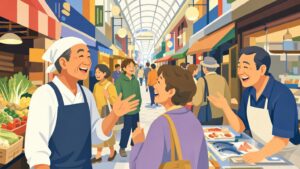
This pattern appears outside restaurants as well. At a neighborhood fish shop, the staff may tell you which item is best that day instead of offering a lengthy explanation. At a local bakery, regular customers know when a fresh batch comes out. At a small bar, the owner remembers how strong you like your drink. Communication in Osaka often depends on repeated, specific exchanges rather than abstract promises of hospitality.
This is why the idea that “Osaka people are friendly” is too vague. That friendliness is often expressed through useful involvement. Someone tells you which train exit is easier, warns you that a shop is closed, recommends a cheaper alternative, or jokes while helping solve your problem. It may not sound ceremonious, but it is a form of care.
At a kappo counter, the chef’s care is expressed through food. The chef notices your pace, whether you are drinking, whether you seem interested in a particular ingredient, and whether the portion is sufficient. Your role is to respond honestly but respectfully.
If you love a dish, say so. If you need to stop eating, say so before ordering another course. If you do not understand something, ask. If the price is unclear, confirm it. A local-style experience does not require silent obedience; it requires clear communication.
A Practical Conversation Guide for Foreign Residents
You do not need advanced Japanese, but learning a few phrases can make communication at the counter more comfortable.
“今日は何がおすすめですか?” means “What do you recommend today?”
“これは何の魚ですか?” means “What kind of fish is this?”
“どんな食べ方がおすすめですか?” means “How do you recommend eating this?”
“少なめにできますか?” means “Could you make the portion smaller?”
“お酒は飲みません。” means “I do not drink alcohol.”
“アレルギーがあります。” means “I have an allergy.”
“予算は一人二万円くらいです。” means “My budget is around ¥20,000 per person.”
“写真を撮ってもいいですか?” means “May I take a photo?”
You can also use a translation app, but do not hold your phone over the chef while he is working and expect him to read a long paragraph right away. Keep your message short, and show a written allergy card if the issue is serious.
Japanese residents will usually appreciate the effort, even if your pronunciation is imperfect. The goal is not to demonstrate fluency, but to make the interaction easier.
Choosing the Right Kappo Experience for Your Life in Osaka
If you are new to Osaka, start with a restaurant that matches your comfort level instead of choosing the most famous name.
Choose a fixed omakase course if you want a predictable price and a guided introduction. For a first visit, this is often the least stressful option.
Choose an à la carte counter if you enjoy conversation, want to compare different preparations, and feel comfortable discussing prices and portions.
Choose a Nishi-Tenma or Kitashinchi restaurant if you want to understand Osaka’s business-district dining culture, where meals may be connected to work, clients, and long-term relationships.
Choose a Minami or Hozenji restaurant if you want to experience the connection between restaurant culture, theater, nightlife, narrow streets, and the older Naniwa mood.
Choose a smaller neighborhood kappo if your goal is to understand daily life rather than mark a special occasion. The experience may be less polished in English, but it can reveal more about how local regulars actually dine.
For anyone considering living in Osaka, this distinction matters. Osaka does not have just one atmosphere. Umeda, Nishi-Tenma, Nakatsu, Tenma, Namba, and the residential neighborhoods all have different rhythms. A counter restaurant can show you the relationship between those rhythms and the people who work within them.
Enjoying Kappo Like a Local Does Not Mean Pretending to Be Local
There is a common mistake in the search for an “authentic” Japanese experience: trying too hard to imitate local behavior. You do not need to use exaggerated Japanese, pretend to understand a dish you do not, or avoid asking questions because you are afraid of appearing inexperienced.
Local regulars are not performing authenticity. They are simply eating, talking, and making choices based on their needs. They ask what is good. They speak up when something is unclear. They praise a dish when it deserves praise. They respect the staff’s work and do not treat the restaurant like a stage set.
That is the real lesson.
Arrive when you said you would. Reserve honestly. Explain any restrictions early. Watch the chef. Ask useful questions. Accept recommendations, but remain mindful of your budget and appetite. Speak when conversation is welcome, and grow quiet when concentration matters. Thank the staff without turning your gratitude into a performance.
You may leave knowing the names of several fish, or you may remember only one bowl of soup and the sound of a knife on the cutting board. Either is fine. Kappo is not an examination.
It is a relationship built over dinner.
The Osaka Mindset You Can Take Away
Kappo helps explain why Osaka can feel both informal and demanding. People may speak casually, but they still notice the details. A chef may joke with you, yet the fish must still be cut correctly. A restaurant may welcome conversation, but the reservation must be respected. A meal may feel relaxed, while the ingredients are handled with discipline.
This combination is central to life in Osaka. Warmth does not replace standards. Directness does not eliminate manners. Value does not always mean a low price. A high bill can be acceptable when the experience feels honest, skilled, and human.
If you understand that, you will understand more than how to sit at a kappo counter. You will also understand why many Osaka people value restaurants where the chef knows the ingredients, the customer speaks clearly, and both sides can enjoy the evening without unnecessary ceremony.
That is how to navigate Osaka’s counter-style kappo restaurants like a local: not by memorizing rules, but by joining the conversation among the food, the chef, and the people around you.