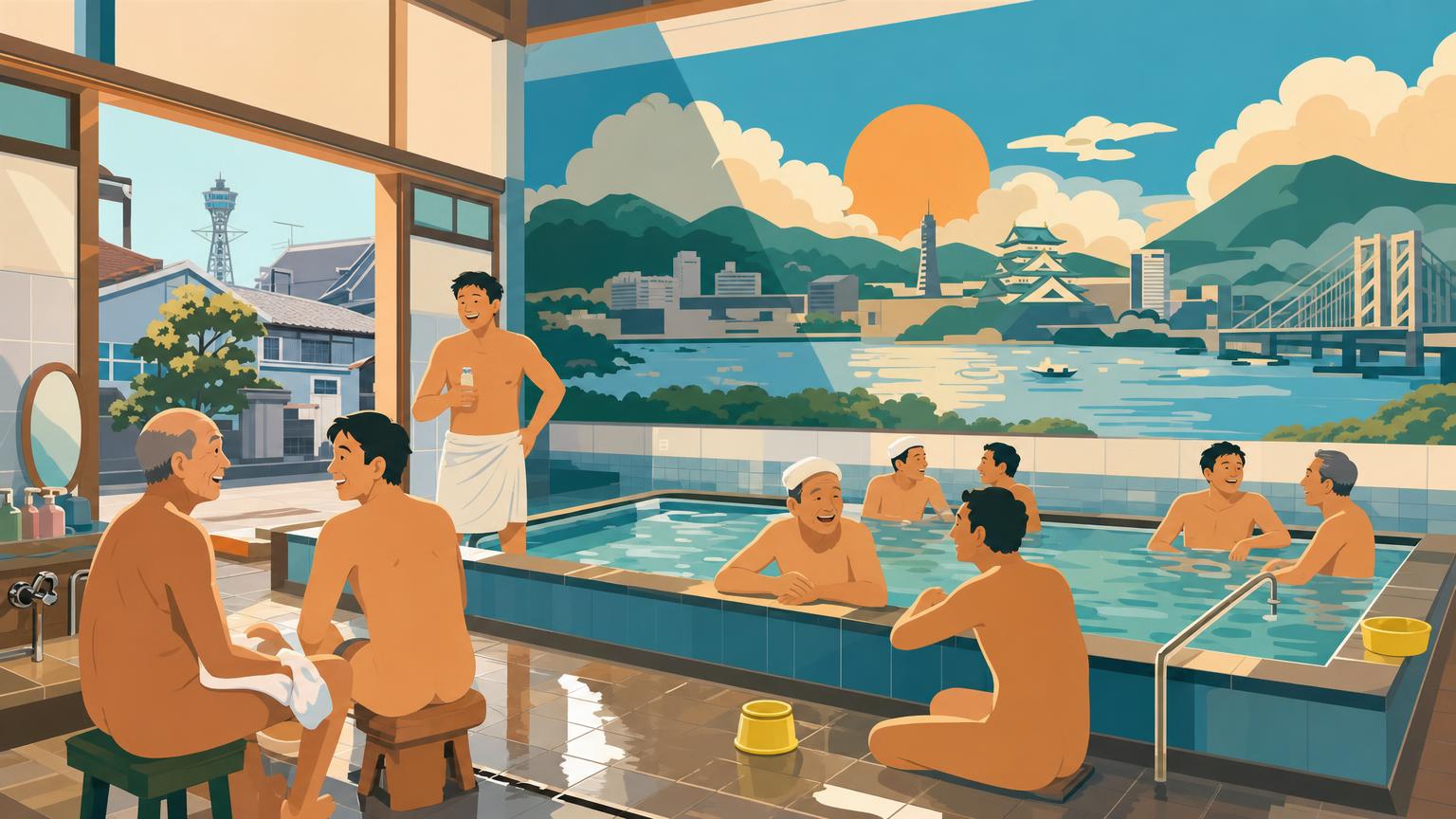
If you live in Osaka long enough, you eventually notice a small contradiction.
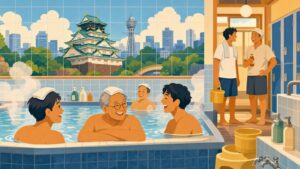
The city is known for late nights, quick jokes, crowded shopping streets, and people who seem ready to talk across almost any social boundary. Yet some of the most revealing places in Osaka are quiet before breakfast. A neighborhood sento opens its doors while the streets are still cool. Older residents arrive with small plastic bags. A runner comes in wearing sandals. Someone who worked a night shift leaves just as the first trains begin to fill. Inside, people wash, soak, exchange only a few words, and return to ordinary life.
This is asa-furo, or morning bathing. It is not an everyday habit for every Osaka resident, and it is not a formal ceremony. In many neighborhoods, it is simply one possible way to begin a Sunday, a holiday, a day off, or a workday after a night shift. Its importance lies less in how many people do it than in what the practice reveals: how Osaka treats public space, how neighbors recognize one another, and how a city can feel communal without requiring constant conversation.
For foreigners living in Osaka, the morning sento can be easy to misunderstand. It may look like a leisure activity, a tourist experience, or an old-fashioned substitute for a private bathroom. In reality, it sits somewhere between household routine, local infrastructure, health habit, and social safety net. A sento is a place where people come to wash, but also a place where a neighborhood quietly checks that life is still functioning.
The map below is intended as a broad orientation to Osaka’s neighborhood bathing culture. It is not a sightseeing route. The most meaningful sento experience usually begins with the bathhouse closest to where you live, work, or shop.
What Asa-furo Really Means in Osaka
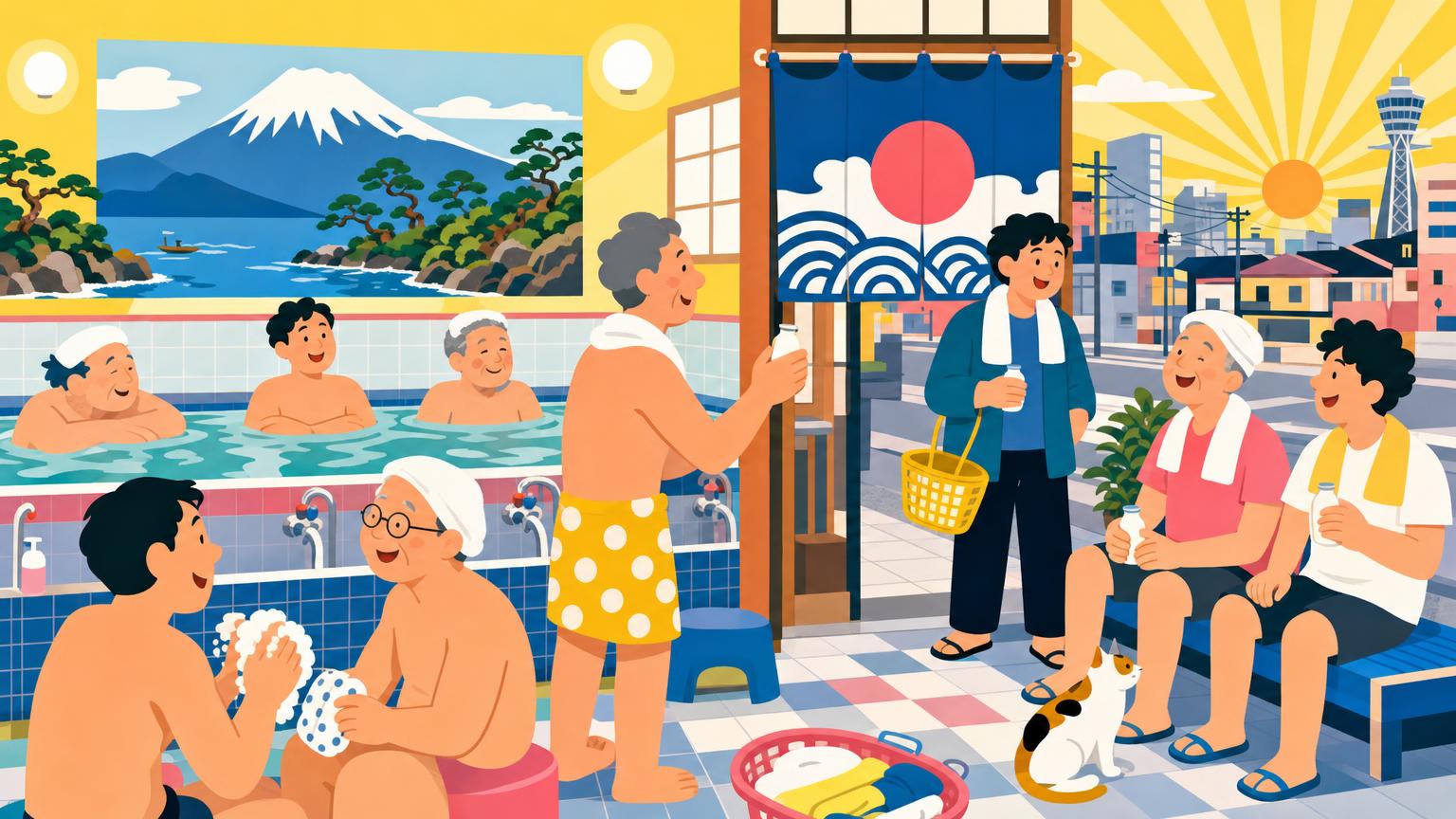
The term asa-furo literally means “morning bath,” but its social meaning is broader than the dictionary translation suggests. In Osaka, it may refer to bathing early at a neighborhood sento, often on a Sunday or public holiday, before the day gets busy. It can also describe the early opening hours of a bathhouse serving people whose schedules do not fit the standard evening routine.
The key point is that asa-furo is not necessarily about luxury or modern, marketing-style self-care. It is often practical. You may have just finished a night shift. Your apartment may have only a small shower and no comfortable bathtub. Your building’s hot-water system may be unreliable. You may be caring for children and prefer to bathe while another family member is awake. Or you may simply find that a large shared bath makes the morning feel more manageable.
Some facilities open at around six in the morning, while others offer early bathing only on certain days. Hinodeyu in the Tennoji area, for example, advertises morning opening from 6:00 a.m. until late evening. Yutopia Shiratama Onsen in Joto is also known for starting its morning-bath service at 6:00 a.m. Hours may change because of maintenance, holidays, or staffing, so checking with the individual bathhouse before leaving is a normal part of sento life.
This uncertainty is important for foreigners to understand. Osaka’s small bathhouses do not always operate like large commercial facilities with stable, English-language schedules. A handwritten notice, a social-media post, or a calendar at the front desk may provide the most accurate information. If the door is closed when you arrive, it does not necessarily mean you have made a cultural mistake. The facility may be observing its weekly closing day, undergoing temporary repairs, or following a special morning-only schedule.
Morning sento culture is therefore flexible and local. It is not a citywide ritual that everyone follows at the same time, but rather a neighborhood rhythm that becomes visible when you live close enough to notice it.
Why the Morning Sento Matters More Than the Bath
A private bathroom is convenient, while a sento is social infrastructure.
That distinction helps explain why public baths have survived even though most Japanese homes now have their own bathing facilities. Osaka’s public-bath association describes sento not only as places for hygiene and relaxation, but also as public resources connected to health, preventive care, community support, and disaster response. The prefecture’s own materials similarly characterize sento as part of Japanese culture and note that public baths have continued supporting residents even as household bathrooms became common.
A private bath separates you from the neighborhood. A sento places you within it.
You do not have to make friends there. You do not have to introduce yourself. You do not have to join a formal community group. But you become recognizable. The person at the counter may remember that you usually come on Sunday morning. Another customer may notice that you have changed your hair. A regular may complain about the weather without expecting a response. These small repetitions create a form of local belonging that is easy to overlook if you define community only through close friendships.
In Osaka, this matters because daily relationships are often direct but not ceremonious. People may not use elaborate language to express concern. Instead, concern can appear as a brief question, a practical suggestion, or a complaint that indirectly means, “I noticed you were absent.” At a sento, “Haven’t seen you lately” may sound casual, but it can convey genuine attention.
The bathhouse does not demand intimacy. It creates the possibility of recognition.
That is one reason asa-furo can feel different from visiting a spa. A commercial spa organizes its services around the customer’s experience. A neighborhood sento is organized around repetition. The same people return because the place fits into their lives, not because every visit feels special.
A Typical Morning at a Neighborhood Sento
Imagine a Sunday morning in a residential neighborhood of Osaka.
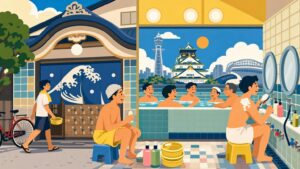
The shopping arcade is not fully awake yet. A convenience store is open, but several shutters remain closed. Bicycles are parked outside a small sento. They are not arranged for photographs; they belong to residents who have come from nearby apartments, row houses, and side streets.
Inside, the entrance is compact. Shoes come off first. You place them in a locker or on a shelf, then pay at the counter. Depending on the bathhouse, soap, shampoo, towels, and razors may be available for purchase or rent. Prices are usually regulated under Japan’s public-bath pricing system, but the exact charge and any additional fees may vary. The Osaka bathhouse association and individual facilities provide the most reliable current information.
The changing room is not necessarily silent, but it is not a lounge either. Plastic baskets hold clothes, and hair dryers may be coin-operated. Some people move quickly because they are on their way to work. Others take their time, checking a phone or drinking water after bathing.
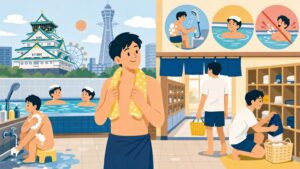
In the washing area, each person uses a small stool and bucket. You wash before entering the shared bath. This is not simply a rule about cleanliness. It reflects a basic idea of shared space: the bathwater is for soaking, not for washing your body. Once you understand this distinction, most of the etiquette becomes intuitive.
The bath itself may be warmer than you expect. Osaka sento are not designed on the assumption that every visitor wants a mild, hotel-style pool. Some regulars enter without hesitation, while others lower themselves in slowly, especially when a deep or hot bath is involved. You do not need to compete with anyone. Sit on the edge, rinse first, and enter gradually.
Conversation depends on the room. Some mornings are quiet. On others, two regulars discuss a local shop, a baseball game, a family matter, or the price of vegetables. The conversation may sound loud enough to seem argumentative to a foreign listener. Osaka communication often has a broader range of volume and emotional expression than visitors expect. A sharp tone does not automatically indicate hostility. Pay attention to facial expressions, pauses, and whether the conversation continues comfortably.
After bathing, people return to the changing room. Some drink water. Some buy a small bottle of milk. Others stand outside to smoke or check the train timetable. Then the neighborhood absorbs them once again.
The bath was not an escape from ordinary life. It was part of ordinary life.
The Osaka Difference: A Public Place Without a Performance
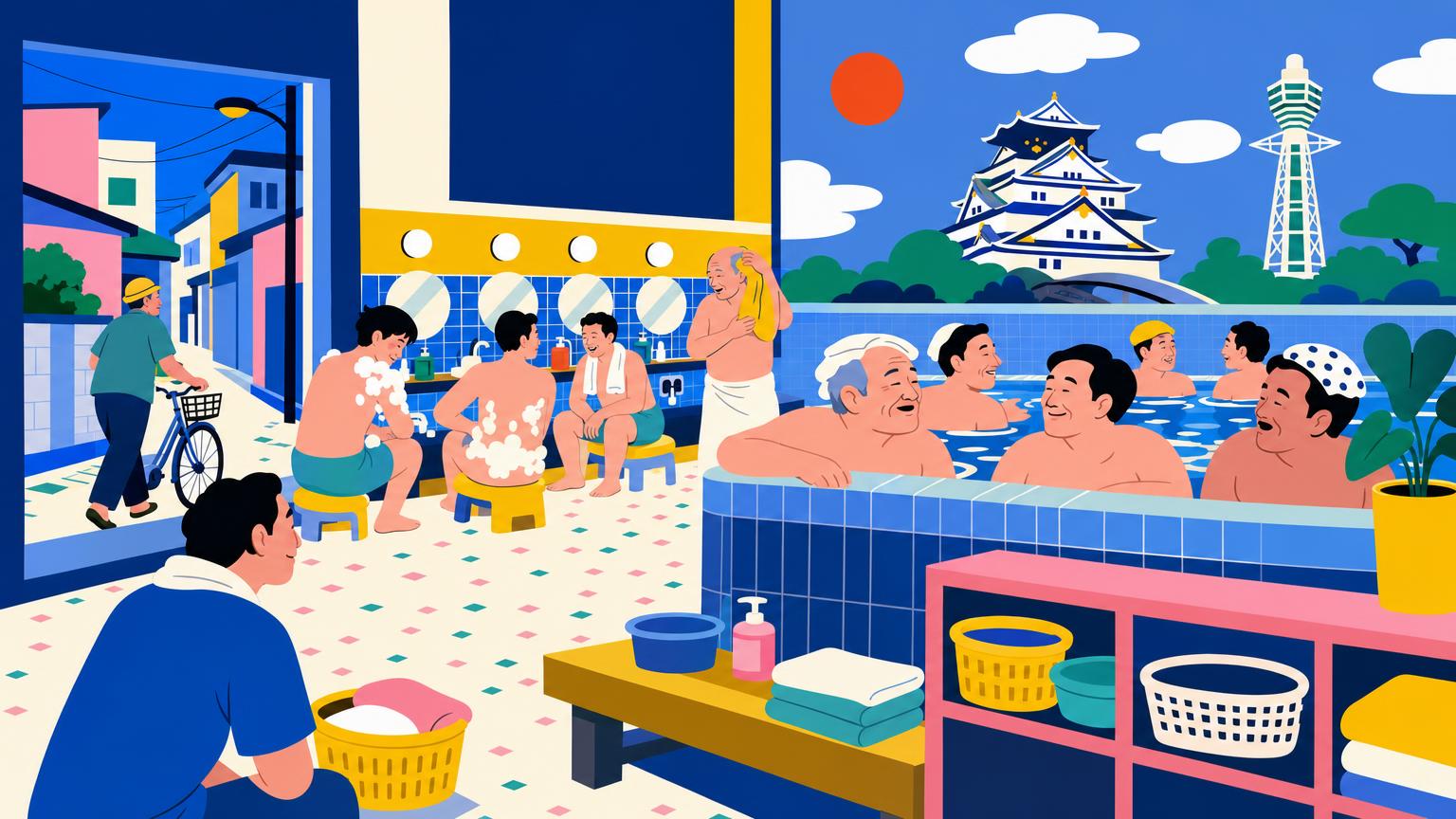
Foreigners often hear that Osaka is friendlier than Tokyo, but this comparison is too vague to be particularly useful.
A more practical difference is that Osaka can make informal contact feel less risky. In Tokyo, strangers may be careful to maintain distance in public. This does not mean that people in Tokyo are cold; rather, the city often protects personal boundaries through restraint, silence, and role-based behavior. In Osaka, people may cross those boundaries more visibly through humor, direct questions, teasing, or spontaneous comments.
At a sento, this difference becomes easier to notice.
A newcomer to Tokyo may expect the room to be strictly quiet and orderly. A newcomer to Osaka may encounter more conversation, more joking, or a more openly expressive reaction to the temperature of the water. However, Osaka’s informality should not be mistaken for unlimited openness. People may talk to you, but that does not necessarily mean they want a long personal conversation. Someone may ask where you are from because the question is interesting in that moment, not because they are inviting a lasting friendship.
This is one of the most common misunderstandings about people in Osaka. The city’s social style can be warm and direct, but it is also practical. A joke can serve as a way to reduce distance, but it can also test whether you understand the mood. If you take every comment literally, you may think people are criticizing you when they are actually trying to make the situation feel less formal.
At the same time, Osaka’s directness has limits. The sento is a shared space, and regulars expect you to recognize those limits without being told. Do not stare. Do not bring a phone into the bathing area. Do not take photographs. Do not occupy a washing station while leaving your belongings spread across several places. Do not enter the water before washing.
In Osaka, friendliness does not override the rules. It often depends on everyone quietly following them.
Why Sunday Morning Is Different from Weeknight Bathing
Weeknight sento use is often shaped by work schedules. People arrive after dinner, after a shift, after exercising, or after picking up their children. The bathhouse becomes part of their evening route.
Morning bathing has a different emotional atmosphere. People are less hurried, though not necessarily more talkative. The neighborhood is still transitioning between sleep and activity. Regulars may include older residents, independent workers, shift workers, runners, and parents with young children. The mix can vary from one area to another.
For someone living in Osaka, this makes asa-furo a useful way to understand a neighborhood. You begin to notice which parts of the local population are visible early in the day and which are not. You may see the same elderly man walking with a cane, a woman carrying a small towel bag, or a group of workers finishing a night shift. Their routines reveal the city more accurately than a list of famous landmarks.
Morning bathing also reveals how layered Osaka’s neighborhoods are. A place may include longtime residents, newly arrived foreign workers, students, families who have lived there for generations, and people who commute to another district. They may not share the same language, income, or lifestyle. The sento gives them one temporary setting with a common sequence: pay, undress, wash, soak, dry, and leave.
That sequence is modest, but it matters. It creates a shared rhythm without requiring a shared identity.
The Sento as a Support System for Older Residents
Many neighborhood sento users are older, but this does not mean the bathhouse is only for elderly people. Rather, it means that sento can be especially important for residents whose homes, bodies, or social lives have changed.
An older person may prefer a large bath because it is easier to enter than a small bathtub at home. Someone living alone may appreciate seeing familiar faces. A person whose bathroom is difficult to heat may find the sento more comfortable during winter. The bathhouse can also provide a reason to leave the house, walk a short distance, and maintain a routine.
This is why the closure of a sento can affect a neighborhood more deeply than outsiders expect. The loss is not simply the disappearance of a bathing option. It may also remove a walking destination, a regular point of contact, and a place where staff notice unusual absences.
Osaka’s public-bath organizations have emphasized the broader social role of sento, including health, preventive care, and emergency support. During the 2018 northern Osaka earthquake, some bathhouses offered free bathing to affected residents. Local government materials also describe sento as valuable during disasters and as places that remain connected to everyday welfare.
This does not mean that every sento is an organized welfare center. Most are small businesses trying to cope with rising energy costs, repairs, staffing problems, and declining customer numbers. The point is that their social value is greater than their balance sheet suggests.
When a neighborhood sento closes, residents may suddenly realize how many small routines depended on it.
Why Osaka’s Sento Network Is Shrinking
The bathhouse association says Osaka Prefecture had around 2,400 sento at its peak in the late 1960s. According to the association’s published overview, that number has since fallen by roughly 87 percent, to about 319 facilities.
The reasons are familiar: private bathrooms became standard, fuel and electricity costs rose, buildings aged, and younger family members often did not want to take over the business. This decline is not unique to Osaka. Public baths across Japan face similar pressures.
However, Osaka’s changing sento landscape reveals something about urban life. The city has many densely populated residential areas where a bathhouse once served as a neighborhood anchor. As homes became more comfortable and schedules more individualized, the need for shared facilities weakened. At the same time, the need for human contact did not disappear; it simply became less visible.
This raises an uncomfortable question for people considering life in Osaka: is the city becoming less communal as old neighborhood institutions disappear?
The honest answer is partly yes. You cannot assume that every neighborhood still has the dense network of local relationships associated with older Osaka. Some streets are filled with residents who rarely meet one another. Some bathhouses have closed, and some shopping arcades feel quieter than they did a generation ago.
Yet the remaining sento are also adapting. Some have replaced traditional counters with front-desk layouts. Others have renovated their interiors, added saunas, organized stamp rallies, supported runners, or collaborated with local community groups. The Osaka association promotes events and directories intended to connect residents with bathhouses in their area.
The culture is not frozen. It is negotiating with modern life.
Traditional Sento, Super Sento, and What the Difference Feels Like
Foreign residents often use “onsen,” “sento,” and “spa” as though they mean the same thing. They do not.
A traditional sento is a public bathhouse designed for affordable, regular local use. The water may be heated tap water or well water. The facility may include several baths, a washing area, a changing room, and perhaps a sauna. It is usually compact and closely connected to the neighborhood.
A super sento is a larger commercial bathing complex. It may feature multiple baths, outdoor areas, saunas, restaurants, massage services, relaxation rooms, and extended opening hours. SpaWorld near Shin-Imamiya and Tennoji is a large-scale example, while Soraniwa Onsen Osaka Bay Tower offers a more themed, resort-like approach. These places can be enjoyable, but they do not provide the same social environment as a small bathhouse near your apartment.
An onsen, strictly speaking, uses naturally hot spring water that meets Japan’s legal definition of a hot spring. Some Osaka facilities casually described as sento or onsen combine different types of water, while some neighborhood bathhouses use natural hot spring sources. Ten-nen Onsen Naniwa no Yu in the Tenjinbashisuji area is a well-known urban natural-hot-spring facility with both indoor and outdoor baths.
The difference is not merely technical. It also affects how people behave.
At a traditional neighborhood sento, a regular may arrive, bathe, and leave in less than an hour. The space may feel familiar and unpolished. At a super sento, people may spend half a day. They may come for relaxation, food, sauna sessions, or a weekend outing. Both are legitimate, but they serve different needs.
If you want to understand how Osaka residents live, start with the smallest bathhouse you can easily reach. If you want to enjoy a long bathing day with numerous facilities, choose a super sento. The mistake is expecting one experience to explain the other.
How Foreign Residents Can Join Without Feeling Awkward
The first visit can feel intimidating because communal bathing removes many of the social protections that foreigners are accustomed to. You cannot rely on clothing, personal space, or a private shower cubicle. The rules are simple, but the setting may still feel exposed.
A few practical habits can make the experience easier.
Visit during a less crowded time if possible. Early morning may be calm, though it can also be busy at a bathhouse known for asa-furo. A weekday in the late afternoon may provide a quieter first visit.
Bring a small towel, a change of clothes, soap, shampoo, and a plastic bag for wet items. Many facilities sell or rent these supplies, but not every small sento has extensive signage in foreign languages.
Remove your shoes before entering the changing area. Place them in the designated locker or on the appropriate shelf.
Wash your entire body before entering any shared bath. Rinse the stool and bucket after use, then return them neatly.
Keep your small towel out of the bathwater. Place it on your head, beside the bath, or on a dry ledge.
Tie back long hair. Do not swim, splash, or use the bath as a place to wash clothes.
Keep conversations at a level appropriate for the room. Osaka may be lively, but lively does not mean careless.
Drink water after bathing. The heat can affect you more quickly than expected, particularly in a sauna or hot bath.
Do not take photographs. Leave your phone in the changing-room locker unless the facility clearly provides another arrangement.
If you are unsure, observe the regulars for a moment. Following the sequence is often more useful than trying to translate every sign.
The most important attitude is not perfect performance, but awareness. Residents generally understand that a foreign newcomer may not know every detail. What causes tension is not uncertainty; it is behaving as though the shared space has no rules.
Tattoos: The Difference Between a Local Sento and a Commercial Spa
Tattoo policies are among the most confusing aspects of Japanese bathing culture for foreign residents.
A traditional local sento generally does not operate under the same blanket tattoo restrictions found at many private super sentos, hotels, and tourist-oriented hot-spring facilities. In practice, small neighborhood bathhouses are often more accepting of tattoos because they serve local residents and function as ordinary public facilities. However, this does not mean every facility will respond in the same way. A visible tattoo may still prompt questions, particularly if staff are unfamiliar with foreign customers or if the bathhouse has a specific posted policy.
Large commercial bath complexes are more likely to enforce no-tattoo rules or require tattoos to be covered. Policies can change, and signs may distinguish between small covered tattoos, private baths, and tattoos that cannot be concealed. Always check with the individual facility before entering.
For tattooed residents, the most practical approach is to ask directly and politely. A simple phrase such as “Tattoos are okay?” is usually understandable, especially when accompanied by a gesture toward your tattoo. You can also show a photograph or use a translation application before paying.
Radium Onsen in Shinsekai is often mentioned by international visitors as a more tattoo-tolerant local-style bathhouse, although policies and staff practices can change. Irifune Onsen near Shin-Imamiya is another neighborhood-style facility frequently described as more flexible than large commercial spas. These should not be considered guaranteed exceptions. Confirm before visiting, and do not assume that acceptance at one bathhouse applies to another.
The broader cultural point is that tattoos remain socially complicated in Japan. A tattoo may be interpreted through several histories at once: personal expression, foreign fashion, organized crime, workplace rules, or changing youth culture. Many younger Japanese people are more accustomed to tattoos than previous generations, but public bathing policies often change more slowly.
Do not interpret a refusal as a personal judgment about you. It may reflect insurance rules, customer expectations, or the owner’s desire to avoid conflict. At the same time, do not assume that every tattoo-friendly local sento is automatically comfortable with large groups, photography, or unfamiliar behavior. Acceptance still depends on respectful participation.
The Sento and Osaka’s Communication Style
A bathhouse is a useful place to observe Osaka speech because conversation there is free from many formal constraints.
In an office, people may use standard polite language and maintain a professional distance. In a sento, someone might comment on the weather, the hot water, or a neighborhood construction project in a much more relaxed tone. The speech may be blunt, include teasing, and shift quickly from complaint to laughter.
Foreigners sometimes interpret this as evidence that Osaka people are unusually open, but that interpretation is incomplete. Communication in Osaka often involves quick testing. Someone says something slightly playful and watches how you respond. If you laugh, the conversation may continue; if you look uncomfortable, the speaker may change direction. This can feel less predictable than Tokyo’s careful politeness, but it is not necessarily less considerate.
The difficulty is that humor does not translate perfectly. A comment about your Japanese, height, food choices, or accent may be intended as an invitation to interact, yet it can still feel invasive. You are allowed to dislike it. Being in Osaka does not mean you must accept every joke.
A useful response is to keep your answer light but clear. Smile if you want to continue, give a short answer if you do not, or change the subject. You do not need to perform exaggerated friendliness in order to be accepted.
The sento teaches a broader lesson about Osaka: social warmth is often negotiated in real time. It is not a permanent promise that everyone will welcome everything. Rather, it is a style of contact that depends on reading the room.
Neighborhood Sento as a Measure of Where You Live
When foreigners choose an Osaka neighborhood, they often compare rent, access to stations, supermarkets, international schools, cafés, and commute times. These are sensible priorities. However, a nearby sento can reveal something different about the area.
Look at the streets around it. Are there small shops within walking distance? Do older residents still use the sidewalks? Are bicycles common? Does the neighborhood combine apartment buildings with older houses? Is there a local shopping street, a small clinic, or a community center nearby? These details help you understand whether the area functions as a place to live, rather than merely as a convenient station district.
A sento cannot tell you everything about a neighborhood. It may be closed, struggling, or disconnected from younger residents. Still, its existence suggests that people continue to share some local routines. Its opening hours indicate whom the owners expect to serve. Its changing room may reveal whether the atmosphere is formal, family-oriented, older, or increasingly mixed.
For a foreigner considering whether Osaka is a good place to live, this is more useful than asking whether the city is friendly. A better question is: Can I build a repeatable daily life here?
Can you walk to a bathhouse, supermarket, clinic, train station, or small park? Can you recognize the same cashier twice? Can you find a place where you do not need to explain your entire identity every time you enter?
That is the kind of belonging Osaka can offer. It is not always dramatic; it develops through repeated errands.
Morning Bathing and the Feeling of Time in Osaka
Asa-furo also changes your sense of time.
A private morning routine can be efficient: shower, dress, and leave. A sento adds a pause. You walk there, remove your shoes, wash, soak, dry off, and walk back. The process may take longer, but the time is not empty. It gives the day a beginning that is physical rather than digital.
This can be especially valuable for foreigners living in a large city. Osaka is busy, but it is not organized around the same degree of speed and anonymity as central Tokyo. Many daily activities still take place within a relatively local radius. You may commute through major stations, yet your actual life can be shaped by the few blocks around your home.
The morning bath makes those blocks more visible. You notice the bakery opening, see the delivery truck, hear shutters lifting, and pass people who are already returning home while your own day has barely begun.
For someone recovering from the stress of moving abroad, this repetition can be grounding. You do not need to understand every social code all at once. You only need to return, behave consistently, and let familiarity accumulate.
That is how many Osaka relationships develop. They become comfortable not through one deep conversation, but through being present often enough to become part of the background.
When the Sento Feels Uncomfortable
Some sentos are old and may not be accessible to people with mobility problems. Floors can be slippery, and the water may be very hot. Instructions may be available only in Japanese. Changing rooms may offer little privacy. Some bathhouses may have gendered facilities that are not comfortable for every transgender or nonbinary visitor. Policies regarding children, swimwear, menstrual products, and assistance can vary.
If you have a medical condition, ask a healthcare professional about hot bathing and sauna use. If you feel dizzy, nauseated, or unusually weak, leave the bath immediately and cool down safely. Communal bathing is not a test of endurance.
You may also encounter a bathhouse where the atmosphere feels closed off. Regulars may not speak to you, and staff may seem abrupt. A foreign resident could easily interpret this as rejection, but sometimes it is simply the practical style of a small business serving people who already know the routine.
You are not required to love every sento. If one place makes you uncomfortable, try another. Osaka’s bathing culture is not a single community. Each facility has its own age range, layout, temperature, owner, and local personality.
The goal is not to force yourself into a cultural experience, but to find a form of public life that fits your own routine.
What a Sento Reveals About Osaka People
A neighborhood sento does not prove that Osaka residents are inherently kind, relaxed, or community-minded. Those descriptions are too broad.
What it reveals is more specific.
People in Osaka often value practical usefulness over abstract image. A bathhouse does not need to be fashionable as long as it is clean, affordable, comfortable, and part of the neighborhood. People may complain openly, but they may also continue supporting a place because it serves a useful purpose. They may joke with strangers, yet still expect everyone to respect shared rules. They may seem casual, but they pay attention to repeated behavior.
Osaka’s social style also allows contradictions to remain visible. A person can be generous and nosy. A shopkeeper can be warm and impatient. A regular can offer helpful advice and then make a joke at your expense. These qualities are not separate categories; they often appear in the same interaction.
Foreigners sometimes want a simple answer to the question, “What are Osaka people like?” The sento suggests a better answer: they are often responsive to context. If you participate in a familiar rhythm, they may treat you as part of the scene. If you ignore that rhythm, they may become direct very quickly.
That directness can be uncomfortable, but it can also be easier to understand than silent disapproval.
How to Begin if You Live in Osaka
You do not need to start with a famous facility; begin with the bathhouse closest to your home.
Search the Osaka public-bath association’s local directory, confirm the facility’s current hours, and look for the words 朝風呂, meaning morning bath, or 朝6時, meaning from 6:00 a.m. Individual bathhouses may list their schedules differently, and operating hours can change with little notice. The association’s directory is helpful for finding facilities, but the bathhouse itself remains the best source of same-day information.
On your first visit, go alone if possible. A group of foreign visitors can unintentionally make a small local bathhouse feel like an event. One person can enter quietly, learn the layout, and decide whether the atmosphere feels right.
Do not arrive expecting a cinematic encounter. Nobody may speak to you. The water may be too hot. The building may look ordinary. That does not mean you have failed. The value lies in seeing the place as residents do: not as a cultural performance, but as another part of the week.
Return a second time. The second visit is usually more informative than the first. You know where to leave your shoes. You understand the washing area. You are less distracted by your own nervousness and begin to notice the people around you.
By the third or fourth visit, the route may become part of your life.
The Smallest Form of Belonging
A morning sento will not cure the loneliness of moving to Osaka. It will not teach you every dialect expression or explain all the customs of the workplace. It will not automatically turn a foreign resident into a local.
But it can offer something more modest and realistic.
It can give you a place where you are recognized without being scrutinized. It can show you how neighbors share space without becoming friends. It can reveal the difference between Osaka’s informal warmth and simple friendliness. It can place you within the city’s ordinary rhythms: bicycles, shutters, hot water, plastic baskets, early trains, and brief conversations.
The most important moment may come after the bath, on the walk home. The streets are brighter now. A bakery has opened. Someone is watering plants. A child is pulling a parent toward a convenience store. The person who sat two places away from you is walking in the same direction, but neither of you needs to speak.
You have shared a routine.
That is often how Osaka begins to feel like home—not through a grand welcome, but through the quiet accumulation of ordinary mornings.