If you are trying to understand what daily life in Osaka is really like, should you watch the crowds in Dotonbori, study the office workers around Umeda, or listen to conversations in a local shopping arcade?
For me, the answer is the shopping arcade.
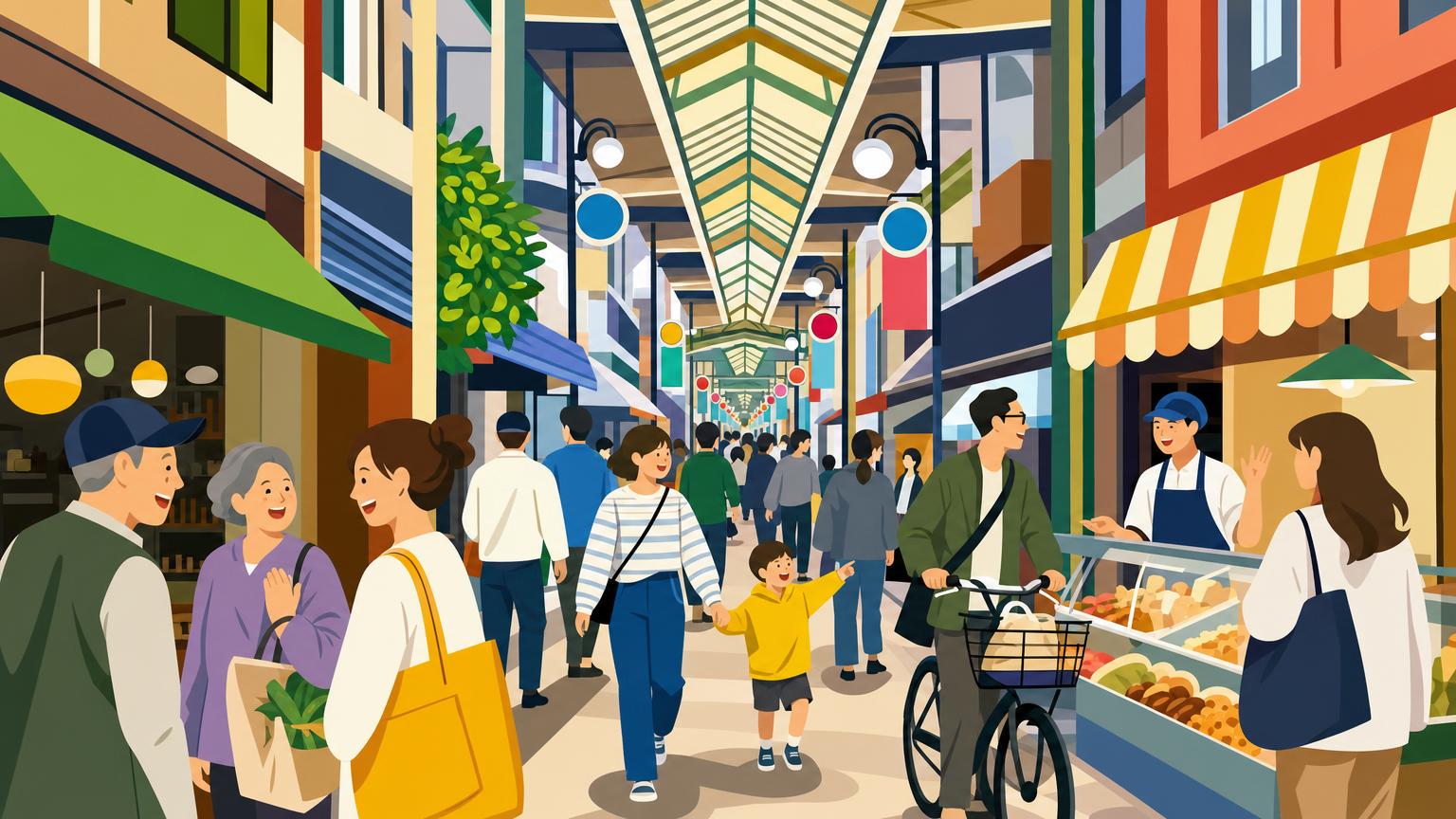
Senbayashi Shopping Street, in Asahi Ward in northern Osaka, is not important because it offers a grand landmark. It matters because people still use it as part of an ordinary day. Residents buy vegetables, collect medicines, repair shoes, eat a quick lunch, greet shopkeepers, complain about the weather, and sometimes stop for a conversation that was never on their schedule. The street is a commercial space, but it is also a social system.
That distinction is useful for foreigners living in Osaka, considering a move here, or trying to understand why Osaka can feel more personal and more casually expressive than Tokyo. Senbayashi does not provide a perfect picture of every neighborhood. Osaka is not one personality. Yet the street shows something important: in many parts of Osaka, community is not created mainly through formal events or carefully organised networking. It is created through repeated, low-pressure contact.
You see the same cashier. You recognise the same elderly customer. A shopkeeper remembers that your child dislikes green onions. Someone makes a joke while weighing fish. A neighbour complains about prices and then recommends a cheaper store two doors away. None of this looks dramatic. That is precisely why it matters.
Senbayashi Shopping Street stretches for roughly 660 to 700 metres between Keihan Senbayashi Station and Osaka Metro Senbayashi-Omiya Station. The official shopping-street organisation describes approximately 220 shops, while Osaka’s tourism information describes around 200 businesses and a dense residential population within walking distance. The figures vary by counting method, but the basic point is clear: this is a substantial local commercial district, not a decorative lane preserved for visitors.
Why Senbayashi Shopping Street Is a Useful Window into Osaka
A shopping arcade is more than a place to buy things
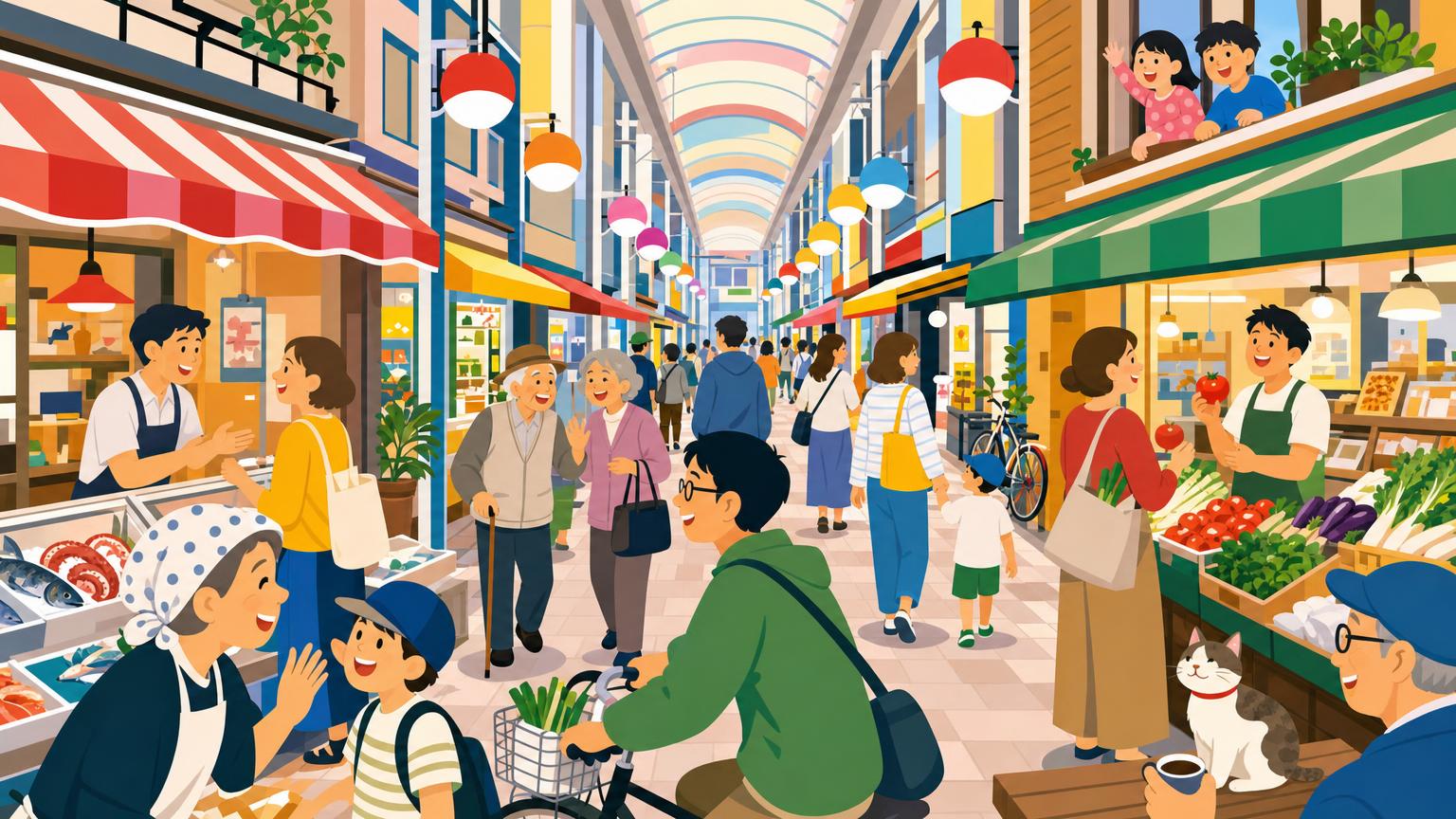
Foreign residents sometimes see a Japanese shopping arcade and assume that it is simply a smaller version of a mall. However, that interpretation overlooks its central feature. A mall is usually designed around controlled consumption, while a local shopping arcade is built around repeated relationships between businesses and the surrounding neighbourhood.
Senbayashi has shops selling food, household goods, clothing, medicine, haircuts, books, flowers, snacks, and quick meals. This variety reveals how the area functions. Residents do not need to make one large weekly trip to a distant supermarket or shopping centre. Different needs can be met through small encounters, often on foot and with familiar faces.
The arcade therefore serves as part of the neighbourhood’s infrastructure. It provides a route to the station, a place to shelter from the rain, a source of affordable meals, and an informal information network. If a shop closes, the loss is not only economic; the neighbourhood also loses a point of contact.
That is why the language used by the Senbayashi organisation is significant. It presents the street as a regional community and describes its aim as contributing to society through commercial activity. This does not mean that every customer and shopkeeper has a warm, personal relationship. Rather, it means that commerce is understood as one of the ways a local area remains connected.
The community is built through repetition, not instant intimacy
Osaka is often described as friendly, but that word can be confusing for foreigners. A stranger who smiles at you or starts a conversation is not necessarily offering deep friendship. In Osaka, friendliness often means something more practical and immediate.
It may mean that a shopkeeper offers a small suggestion instead of a formal explanation. It may mean that a customer jokes about the weather while waiting in line. It may mean that someone tells you another store sells the same product for less. It may mean that a neighbour remembers your face before remembering your name.
The relationship is allowed to remain light. You do not have to reveal your private life, exchange contact details, or do anything more than meet again.
This is one of the most important differences between a commercial relationship and a community relationship. In a chain store, the interaction resets each time. In a local arcade, however, a transaction may leave a small trace. The next time you visit, that trace becomes recognition. After several visits, recognition becomes expectation. Eventually, a brief greeting becomes part of the day.
For foreigners, this can feel more approachable than formal socialising. You do not need perfect Japanese to become familiar. You need consistency: visit the same places, say hello, and do not demand more attention than the situation allows. Let the relationship develop at the pace of ordinary life.
The arcade has a memory
Senbayashi’s physical character also helps explain its social atmosphere. The street is associated with a prewar urban layout, and it escaped the wartime destruction that transformed much of Osaka. Its history includes the opening of Daiei’s first postwar store, followed by intense price competition between large retailers and local shops. That competition helped establish Senbayashi’s image as one of Japan’s cheapest shopping streets.
This history is not merely a museum story. It remains visible in the relationship between the old and the new. A modern drugstore may stand beside a family-run food shop. A brightly lit chain business may occupy a unit that once housed another local store. A long-established shop may use social media while still operating according to habits formed decades ago.
The result is not a perfectly preserved Showa-era scene. Instead, it is something more complicated and realistic: an old community adapting unevenly to new economic conditions.
That unevenness is part of everyday Osaka. Some businesses are thriving, while others are ageing. Some spaces are vacant, and some owners are experimenting with new events, workshops, or temporary shops. The shopping street is not a frozen image of the past; it is a living negotiation between memory, affordability, and survival.
What Osaka People Mean by “Local”
Local does not mean isolated from the rest of the city
A common misunderstanding is that “local Osaka” refers to a remote or traditional area untouched by modern life. Senbayashi is neither remote nor separate from the modern city. It is connected to central Osaka by rail, and its residents use smartphones, delivery services, supermarkets, chain restaurants, online shopping, and global brands just like everyone else.
What makes it local is not the absence of modernity, but the presence of face-to-face routines that modern systems have not completely replaced.
A resident may order household goods online while still buying vegetables from a nearby shop. They may work for a large corporation but eat lunch at a modest local diner. They may use cashless payment at one store and need cash at the next. They may speak standard Japanese at work and shift into a more relaxed Osaka style at home.
This mixture is important to keep in mind when thinking about living in Osaka. The city is not neatly divided into “traditional” and “modern” districts. Both exist side by side, often within the same person’s daily routine.
Osaka communication often reduces distance quickly
Osaka speech can sound direct, humorous, or unexpectedly personal to foreigners. The intention is not always immediately clear. A comment about your shopping choice may be criticism, humour, curiosity, or an attempt to make the interaction less formal. Context matters more than the individual words.
When a shopkeeper says something that sounds teasing, pay attention to the tone of the exchange. Is it sharp or playful? Does the person continue helping you? Are other customers joking in the same way? Is the comment part of a broader rhythm of conversation?
People from Tokyo and Osaka can both be polite, kind, reserved, or difficult. The difference is not a simple comparison of national character. Rather, it concerns the acceptable distance between strangers in certain settings. Osaka often allows a quicker shift from formal service language to casual conversation, especially in small businesses.
That does not mean you should imitate the Osaka dialect immediately. Foreigners sometimes overuse phrases such as “ookini” or try to perform a comic version of Osaka speech. This can create distance rather than closeness. A natural greeting, a clear thank-you, and a willingness to laugh at your own mistakes are more useful than forced dialect.
Community does not mean everyone wants to be close
Another misunderstanding is that a strong community must be emotionally warm at all times. In reality, local life can be supportive and inconvenient simultaneously.
People notice one another. They may know which apartment is occupied by an elderly resident, which shop closes early, or which family has recently moved in. This knowledge can provide help, but it can also feel like surveillance if you are used to a more anonymous urban environment.
Osaka community life is not a free service. It comes with expectations. You are expected to avoid disturbing others, dispose of rubbish properly, follow local rules, greet people when appropriate, and take responsibility for your part of shared spaces. Help is more likely to appear when people see that you are also making an effort.
A foreign resident who says, “I want local friends,” may be asking the wrong question. A better one is, “How can I become a recognisable and reliable person in my neighbourhood?” Friendship may follow, but it cannot be demanded as a cultural product.
The Everyday Social Roles of Senbayashi’s Arcades
The street as a daily route
In many Japanese cities, shopping arcades are physically designed as covered routes. In Senbayashi, this practical function becomes social because the route is used repeatedly by the same community.
People pass through on their way to the station. Parents travel with their children. Older residents walk more slowly and stop more often. Students buy snacks. Workers pick up a quick dinner. Someone who is not shopping may still use the arcade simply because it is the familiar way home.
This repeated movement creates what urban sociologists sometimes call passive contact: being around other people without needing to arrange a meeting. You do not have to join a club or attend a formal community event. You become part of the neighbourhood by appearing there.
For a foreigner living in Osaka, this is one reason a local shopping street can be valuable. It provides an everyday public space. Your apartment may be private and your workplace may be international, but the arcade places you within the rhythms of the area where you live.
The street as an informal noticeboard
Local businesses often know more about the neighbourhood than a new resident does. They know when seasonal events are taking place, which roads become crowded, where children gather, which products are difficult to find, and what kinds of customers have recently moved into the area.
The official organisation has also developed community projects around a local space known as Senbayashi Fureai-kan. Government and business-support materials describe the space as a base for community activities, including workshops, trial shops, sales activities, and local information.
The word “fureai” suggests contact or human connection. It is a useful word for understanding the street’s ambitions. The goal is not simply to preserve shops, but to create places where residents, business owners, new entrepreneurs, and local groups can encounter one another.
Of course, a community space does not automatically solve the problems facing shopping streets. Vacant units, changing shopping habits, ageing owners, and competition from online retailers remain serious pressures. However, the decision to use empty commercial spaces for local activities reveals a particular idea of urban resilience: the street should continue serving social needs even when ordinary retail becomes more difficult.
The street as a place for small acts of care
The most meaningful community actions are often too small to appear in a promotional brochure.
A shopkeeper may carry a heavy bag for an elderly customer. Someone may explain how to prepare an unfamiliar vegetable. A neighbour may tell a newcomer when the rubbish collection schedule changes. A café owner may notice that a regular customer has not appeared for several days. A child may be told not to run into the road, not because the speaker is a relative, but because adults in the area feel responsible for the shared environment.
These actions may seem intrusive to foreigners from countries where privacy is strongly protected through social distance. They can also be comforting. The difference depends on the relationship, the tone, and whether the person respects your response.
The useful lesson is not that people in Osaka are always caring. It is that the city leaves room for care to take place through ordinary public encounters.
Senbayashi Compared with Tokyo and Other Japanese Cities
Osaka versus Tokyo: a difference in social texture
Searches for “Osaka vs Tokyo” often produce simple contrasts: Osaka is informal, Tokyo is formal; Osaka is inexpensive, Tokyo is expensive; Osaka is friendly, Tokyo is cold. These slogans are too crude to guide everyday life.
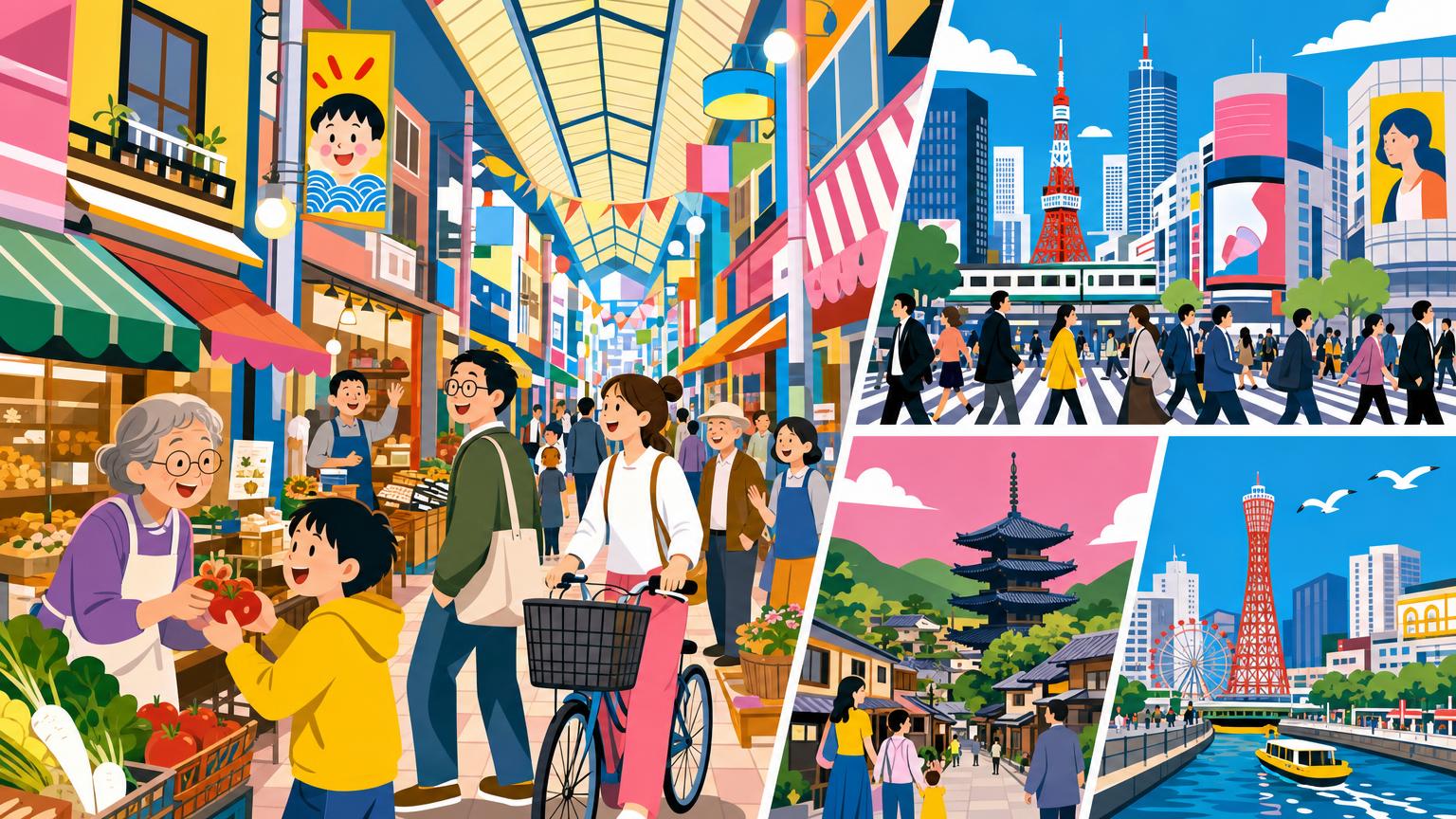
A more useful distinction is social texture. Tokyo’s scale and professional concentration often make anonymity a practical advantage. People commute long distances, change jobs, move between neighbourhoods, and organise their lives through institutions and digital services. Local communities certainly exist, but they may be more difficult to enter without a specific connection.
Osaka also offers anonymity, especially in its central districts. Yet many residential areas retain commercial streets where daily life is visible and repeated. The relationship between shops and neighbourhoods can feel more immediate because the scale is manageable and people still rely on local businesses for ordinary needs.
Senbayashi is not “Tokyo’s opposite.” It is an example of a different urban rhythm. You may still be anonymous to most people, but you are more likely to become familiar to a few through repeated encounters.
For someone deciding whether Osaka is a good place to live, this distinction matters more than the idea that one city is friendly while another is not. Ask yourself how much public familiarity you want. Do you prefer a neighbourhood where nobody notices your routine, or one where a few people may remember it?
Osaka versus newer suburban developments
In a newer suburban district, daily life may be organised around apartment towers, shopping centres, supermarkets, schools, and train stations. The environment can be clean, convenient, and efficient, but social contact may be distributed across separate institutions.
An older shopping arcade brings many functions together in one corridor. Food, clothing, medicine, conversation, errands, and local information overlap. The same path can connect different generations and income groups.
That overlap creates friction as well as community. A busy arcade may be noisy. Shop displays may reduce the walking space. Deliveries can interrupt pedestrians. A conversation may hold up a queue. The old system is not always smooth.
Yet the lack of perfect efficiency makes social interaction more visible. The city feels less like a series of sealed rooms and more like a place where activities come into contact with one another.
Osaka versus tourist-oriented shopping areas
Central Osaka’s famous districts are designed to accommodate visitors. Their shops often provide multilingual signs, clear menus, tax-free procedures, and familiar payment systems. These are useful conveniences, but they create a controlled version of Japanese urban life.
Senbayashi is different because customers are assumed to be residents. Information may be available only in Japanese. Opening hours may vary. A store may close because the owner has an appointment. A restaurant may have limited seating. Cash may still be the simplest payment method. A shopkeeper may not explain every product to a visitor who appears to be browsing casually.
This is not hostility. It is a sign that the street is not organised primarily as a performance for outsiders.
Foreigners sometimes interpret the absence of tourist-oriented service as unfriendliness. A better interpretation is that local businesses are operating according to ordinary neighbourhood expectations. They are not necessarily trying to make you feel like a guest; they are treating you as a potential customer who is responsible for navigating the situation.
How Community Life Feels in Practical Daily Situations
Buying food is also a small social performance
The food culture of a local arcade is not only about taste or price. It is also about how buying food places you in relation to the people around you.
At a small counter, you may need to make a quick decision. Customers behind you may already know what they want. The menu may be handwritten, the seller may call out an order, and you may see food being prepared in front of you rather than chosen from a polished display.
The smell of dashi, frying oil, grilled meat, or takoyaki may drift through the arcade. A hot plate hisses, a paper bag is folded, someone counts coins, and a regular customer jokes with the staff while another person waits quietly.
The appropriate response is not to imitate everything. Observe first. Stand where the other customers stand and have your payment ready. If you need more time, step aside instead of blocking the counter. If the menu is unclear, point and ask politely. These small behaviours demonstrate respect for the local rhythm.
Food also offers a low-risk way to participate. You do not need to have a long conversation. You can say “kore o kudasai,” meaning “this one, please,” and “arigatou gozaimasu” after paying. With repeated visits, the exchange becomes easier.
Bargaining is not the main form of Osaka friendliness
Visitors sometimes assume that Osaka’s reputation for commercial energy means aggressive bargaining is common everywhere. It is not. Prices at local shops are often competitive, but you should not expect every store to welcome negotiation.
The more common expression of local commercial culture is comparison and recommendation. A shop may advertise a bargain, a customer may tell you that another store offers a better deal, or a seller may explain which product is good enough for everyday use and which option is more expensive.
This differs from a luxury retail environment, where the ideal interaction is calm, private, and carefully managed. In a local arcade, value is often discussed openly. Price is not necessarily a source of embarrassment; saving money can be a source of pride.
This attitude reflects Osaka’s long commercial history, but it also reflects present-day economic realities. Families, pensioners, students, and working people all need affordable goods. “Cheap” does not automatically mean careless. It can mean practical, durable enough, and suitable for ordinary life.
The arcade reveals the importance of convenience
Living in Osaka is often less about finding the perfect neighbourhood and more about understanding how your daily routes work. Can you buy groceries on the way home? Is there a pharmacy nearby? Can you get a haircut without travelling across the city? Is there somewhere to sit for ten minutes? Can you manage a rainy day without turning every errand into a train journey?
Senbayashi’s value lies in this concentration of small conveniences. It supports the unglamorous tasks that help make life stable.
Foreigners arriving in Osaka sometimes focus on apartment size, station distance, and rent. These factors are important, but the quality of daily life also depends on whether your neighbourhood gives you reasons to walk outside. A street with useful local shops can make a small apartment feel more connected. A district without everyday public life can feel isolated, even when its transport links are excellent.
What Foreign Residents Often Misunderstand
“People are friendly, so I can be informal right away”
Friendliness does not erase hierarchy, timing, or etiquette. A shopkeeper may joke with a regular customer because years of contact have built trust. That same joke may not be appropriate coming from a new customer.
Begin with polite Japanese. Observe how the other person speaks, and let informality develop gradually. Communication in Osaka may become casual more quickly than you expect, but it still follows a rhythm.
“No one corrected me, so I must have behaved appropriately”
Japanese people often avoid direct confrontation, especially with strangers. Silence does not always indicate approval. If you block a narrow passage, speak loudly late at night, ignore a queue, or leave rubbish in the wrong place, people may simply choose not to argue.
Learn the local rules through observation. Notice where bicycles are parked. Follow the direction of pedestrian flow. Keep phone calls quiet on trains. Do not photograph people without permission. In a small neighbourhood, your behaviour is remembered more easily than you might think.
“A local community will automatically include me”
Community membership is generally earned through presence and reliability. Attend a local event if you are invited. Buy from small businesses when practical. Learn the rubbish rules for your building. Greet your neighbours. Respond politely when someone helps you. If you make a mistake, apologise without turning the situation into a lengthy explanation about cultural differences.
You do not need to become Japanese. You do need to become recognisable as a considerate neighbour.
“Osaka people are all extroverted”
The loud comedian is an image of Osaka, not a complete description of its residents. Many people in Osaka are quiet, private, shy, formal, or cautious. The city’s humour culture may make public interactions more expressive, but it does not turn everyone into a performer.
A quiet shopkeeper may still be observing whether you are respectful. An elderly customer may prefer not to speak. A neighbour who smiles may not want a long conversation. Community also includes the right not to participate constantly.
“A retro shopping street means living in the past”
Senbayashi contains historical layers, but its residents are not actors in a display of nostalgia. They are dealing with rent, staffing, ageing, digital payments, online competition, health, childcare, and changing consumer habits.
If you treat the street as a stage set, you overlook the people who keep it functioning. A better approach is to see heritage as part of an ongoing economic and social life.
How to Participate Without Performing Osaka
Use ordinary Japanese before local slang
You do not need advanced Japanese to start participating, but a few practical phrases can help.
“Sumimasen” can attract someone’s attention or acknowledge a minor inconvenience. “Kore o kudasai” means “this one, please.” “Arigatou gozaimasu” is appropriate after receiving service. “Daijoubu desu” can mean “I am okay” or “that is not necessary,” depending on the context, so use it carefully and accompany it with a gesture if needed.
If you are unsure, say, “Nihongo ga sukoshi dake desu,” meaning that you speak only a little Japanese. This sets expectations without asking the other person to switch entirely to English.
Avoid treating Osaka dialect as a costume. You can learn local expressions over time, but a sincere standard-Japanese phrase is more respectful than exaggerated slang used for entertainment.
Carry cash and patience
Japan has rapidly expanded cashless payment, but a local shopping street may still have independent businesses with different payment systems. Some accept cards or QR payments, while others prefer cash or accept only cash. Carrying yen is practical, not old-fashioned.
Patience is important because local businesses may not operate at the same speed or level of standardisation as chain stores. A shopkeeper may be serving several customers while answering a question. A restaurant may have a small kitchen. An owner may close temporarily for personal reasons.
If you need certainty, check before travelling. If you are already there, accept that small businesses sometimes operate according to human schedules.
Become a regular somewhere
You do not need to visit every shop. Choose one or two places that genuinely fit your routine. Buy breakfast, fruit, tea, stationery, or a simple meal. Return occasionally and learn the staff’s faces. Give them a chance to learn yours.
This is how local life becomes less intimidating. The first visit is a transaction. The second brings recognition. The third may include a question. After that, the relationship may remain brief, but it no longer feels anonymous.
The same principle applies beyond the arcade. Use the same laundrette, café, clinic, gym, bakery, or community centre when appropriate. Urban belonging is often built through repeated minor choices.
Accept help without demanding a relationship
If a shopkeeper explains a product or a neighbour tells you where to find something, say thank you. You do not need to repay every kindness with a gift or an invitation. A respectful response is enough.
At the same time, do not assume that a helpful interaction gives you unlimited access to someone’s time. Osaka’s casual atmosphere can be generous, but boundaries still exist. Read the situation. If the shop becomes busy, bring the conversation to an end.
Community is sustained when interaction remains manageable for everyone.
The Future of Senbayashi’s Community Spirit
Local shopping streets face structural pressure
The community spirit of Senbayashi should not be romanticised. Shopping streets throughout Japan face pressure from online shopping, large retail facilities, demographic change, rising operating costs, and the retirement of business owners. Even a lively street can contain empty units and face an uncertain future.
Official and public-sector descriptions of Senbayashi emphasise efforts to maintain activity, support community projects, and adapt commercial spaces for new uses. This is encouraging, but adaptation is not guaranteed to succeed. A workshop cannot permanently replace a profitable shop. A social media account cannot, by itself, solve succession problems. A nostalgic theme song cannot cover rising costs.
The real question is whether the arcade can remain useful to residents while welcoming new kinds of businesses and new residents. This requires more than preserving old signs. It requires affordable premises, accessible facilities, local participation, and enough commercial activity to support the people who work there.
Community may become more intentional
Older generations may have entered community life automatically because the shopping arcade was where they bought almost everything. Younger residents have more alternatives. Foreign residents may not know how local networks operate. People working irregular hours may not share the same routines as long-term residents.
As a result, community may need to become more intentional. Events, workshops, trial shops, local information channels, and shared spaces can create opportunities for contact that no longer occur naturally.
This does not make the community any less authentic. All communities change as the conditions of daily life change. The important question is whether new forms of connection remain open to ordinary residents rather than becoming another form of branding.
Foreign residents are part of the next chapter
Osaka’s international population is growing, and foreigners are increasingly becoming part of neighbourhood life rather than simply passing through central districts. This creates both opportunities and responsibilities.
Local businesses may need clearer information, more flexible communication, and greater awareness of customers from different backgrounds. Foreign residents may need to understand that inclusion is not only a matter of translation. It also involves queues, noise, rubbish, payment habits, personal space, and the timing of conversations.
The strongest communities will not demand that foreigners disappear into Japanese society. Nor will they expect local residents to provide unlimited cultural instruction. Instead, they will develop ordinary ways for people from different backgrounds to share the same streets.
Senbayashi is valuable precisely because it offers a setting for this gradual process. It is not a staged international festival or a tourist attraction designed to display Osaka. It is a daily street where people can become familiar with one another through ordinary life.
Why Senbayashi Matters if You Are Deciding Whether Osaka Is a Good Place to Live
The question “Is Osaka a good place to live?” cannot be answered by a single ranking. It depends on your tolerance for noise, your need for privacy, your budget, your relationship with the Japanese language, your commute, and the kind of neighbourhood you want around you.
Senbayashi offers one possible answer for people who want practical urban life with visible human contact. It provides the advantages of a large city without requiring every need to be met by a large commercial complex. It demonstrates how affordability, convenience, and social recognition can exist together.
It also reveals the trade-offs. Local life may be less anonymous. Information may be less readily available in English. Businesses may not be open when you expect them to be. The community may have unwritten rules. You may sometimes feel watched before you feel welcomed.
That discomfort is not necessarily a sign that the neighbourhood is wrong for you. It may simply be the adjustment required to live in a place where public life is more shared.
For a foreigner, the most important lesson is simple: Osaka community spirit is not mainly a grand emotional statement. It is a habit of noticing.
A shopkeeper notices a regular customer. A customer notices which store is closing. A neighbour notices a change in the street. Someone notices that you have returned and remembers what you bought last time. You notice that the person who seemed abrupt was actually trying to help. Gradually, the city becomes less like a backdrop and more like a network of ordinary relationships.
That is what Senbayashi Shopping Street reveals. Osaka is not automatically intimate, and its people are not uniformly outgoing. However, in neighbourhoods where local arcades remain active, daily life still creates opportunities for contact that large cities often erase.
If you want to understand what Osaka people are like, do not ask only whether they are friendly. Ask how they share space, how they communicate without making a formal appointment, how they balance privacy with awareness, and how a commercial street becomes part of a district’s social life.
In Senbayashi, the answer can be found in the small exchanges: a greeting, a recommendation, a joke, a paper bag passed across a counter, and a familiar face appearing again tomorrow.