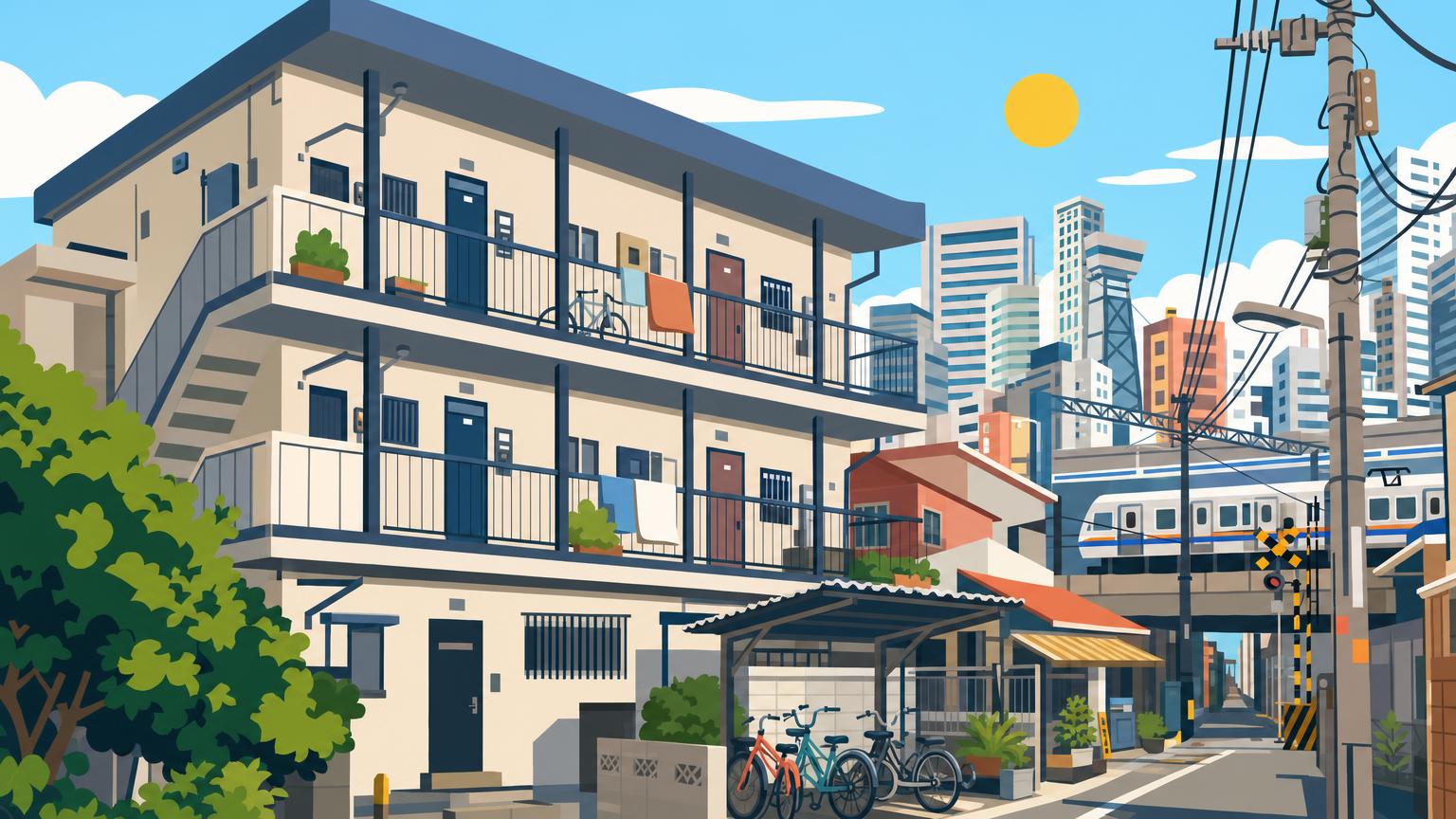
You can live fifteen minutes from Umeda and still feel that you have moved into a completely different Osaka.
That is the central contrast between Juso and Tengachaya. Both offer lower rents than the most polished central wards. Both have strong station access, busy shopping streets, older buildings, and a mix of long-term residents and newcomers. Yet they create very different daily experiences.
Juso, in Yodogawa Ward, sits immediately north of the Yodo River and is linked to Osaka-Umeda, Kobe, and Kyoto by Hankyu Railway. Its station is a major transfer point, and the journey to Osaka-Umeda is only a few minutes. Tengachaya, in Nishinari Ward, is connected to Namba by the Nankai Railway and to central Osaka through the Osaka Metro Sakaisuji Line. It is also a practical route toward Kansai International Airport.
On a property website, the two neighborhoods can look like simple budget alternatives to Kita or Chuo Ward. In real life, they are more complicated. The rent is only one part of the decision. You also need to consider the building’s age, the noise outside your window, the kind of people who use the streets at different hours, the amount of Japanese needed for ordinary errands, and whether you want your neighborhood to remain anonymous or gradually become familiar.
This guide compares the true living costs and community realities of Juso and Tengachaya with more central Osaka areas. It is not a sightseeing guide. It is about the walk home after work, the sound of a shopping arcade closing, the first conversation with a neighbor, the rules around rubbish, the awkwardness of a loud night outside, and the difference between being near the city and actually feeling part of it.
The real question: cheaper rent or a different way of living?
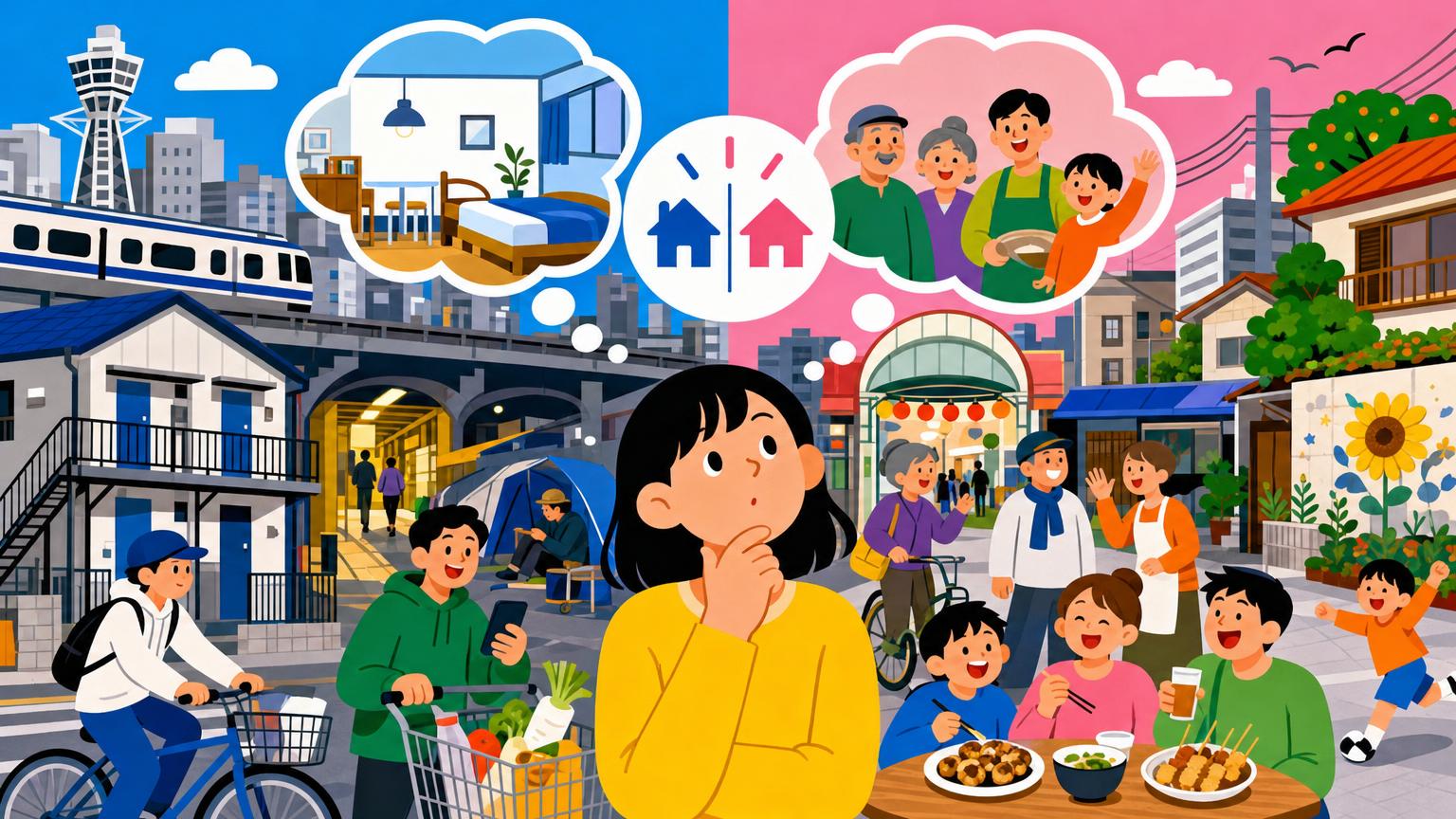
Foreign residents often start with a simple question: “Which area is cheaper?” That is useful, but incomplete.
A better question might be: “What kind of everyday friction am I willing to accept?”
In central Osaka, you generally pay more for a smoother, more legible urban experience. Buildings are often newer or more recently renovated. Stations are easier to navigate in English. Restaurants are more likely to expect customers who are accustomed to card payments and online reservations. Property managers may have more experience with foreign tenants. You can remain anonymous, and nobody is particularly surprised if you do not know the local routine.
In Juso and Tengachaya, the lower rent can provide more space, access, and local texture. It can also place you closer to older infrastructure, smaller businesses, less predictable noise, and neighborhoods where social trust is built slowly rather than offered immediately.
This is one reason Osaka should not be understood simply as a cheaper Tokyo. Osaka is more compressed. A luxury tower, an old row house, a tiny standing bar, a supermarket, a pachinko hall, a workshop, and a public housing complex may all be located within a short walk of one another. The city does not always separate lifestyles into clearly defined districts. Instead, it places them side by side.
That proximity influences how people behave. Osaka conversation can be more direct, more teasing, and more comfortable with minor complaints. A shopkeeper may comment on your Japanese. A neighbor may ask where you are from. A customer may speak to you in Japanese before checking whether you understand. This can feel warm, intrusive, humorous, or all three at once.
The important point is that local friendliness is not the same as constant openness. People in Osaka may talk easily while still protecting their private lives. They may joke with you before they trust you. They may help you carry a bicycle upstairs without ever inviting you into their home. Community integration is often practical before it becomes emotional.
Why central wards cost more even when the apartment looks similar
The difference between a ¥70,000 apartment in a central ward and a ¥60,000 apartment in Juso or Tengachaya is rarely limited to ten thousand yen.
The central apartment may be closer to your office, reducing commuting costs. It may offer better insulation, a newer bathroom, double-glazed windows, or a secure entrance. The building may also have a more predictable management system. The neighborhood may include late-opening supermarkets, pharmacies, clinics, and restaurants serving office workers.
The cheaper apartment may be larger, but poor insulation could lead to higher heating and cooling costs. You may have to walk an additional ten minutes to reach a supermarket selling affordable fresh food. You may take taxis after the last train because your street feels uncomfortable late at night. You might also need to replace an old washing machine, buy a dehumidifier, or pay for a bicycle because local errands are spread out.
Neither option is automatically better. The mistake is to treat the advertised rent as the full monthly cost.
A realistic monthly housing budget for one person should include:
- Base rent
- Building management or common-area fees
- Electricity, gas, water, and internet
- Commuting costs outside your fixed transport pass
- Bicycle parking or occasional taxi expenses
- Tenant insurance and savings for renewal fees
- Furniture, appliances, curtains, and bedding if the apartment is unfurnished
- Waste disposal or bulky-garbage fees when moving in or out
For a foreign resident, add one more category: the price of convenience. A furnished monthly apartment may cost more, but it can save you from buying appliances and navigating a standard lease. A central location may also cost more while reducing the number of difficult journeys you face when you are new to Japan. A neighborhood with a familiar supermarket and a helpful local shopkeeper may be worth more than a slightly newer bathroom.
Current rent reality in Juso and Tengachaya
Rental figures vary according to building age, walking distance, floor level, orientation, renovation quality, and whether the listing is genuinely available. Portal averages are useful for an initial estimate, not a guarantee.
As a current reference, SUUMO’s October 2026 station-area data places the average asking rent for a 1K near Juso Station at approximately ¥75,000 for the listed apartment category. The same source places a 1LDK at around ¥108,000. Its broader listing data shows that many small units under 20 square meters fall within the ¥35,000–¥48,000 range, while 20–30 square meter units commonly range from ¥60,000–¥75,000, depending on age and walking distance.
Tengachaya is generally more varied. At the station level, SUUMO reports a 1K average of approximately ¥67,000 for its selected sample of new-build apartments near the station, while At Home’s recent three-month listing data places the 1K average closer to ¥55,600. This gap illustrates why it is important to compare like with like: a newly built apartment five minutes from the station is not comparable to an older unit ten or fifteen minutes away.
For practical planning, many foreign residents should expect roughly the following ranges:
- Juso: ¥55,000–¥80,000 for a basic 1K, with newer units near the station often costing more
- Juso: ¥75,000–¥120,000 for a comfortable 1LDK, depending heavily on age and location
- Tengachaya: ¥45,000–¥70,000 for an older or modest 1K
- Tengachaya: ¥65,000–¥95,000 for a 1LDK or renovated larger unit
- Central Kita, Chuo, or Nishi areas: often ¥70,000–¥100,000 for a small 1K in a convenient location
- Central Osaka: often ¥100,000 or more for a good 1LDK near major business and entertainment districts
These are planning ranges rather than fixed market prices. A very cheap unit may have a reason: a first-floor window beside a narrow alley, no elevator, a unit bath, a fixed-term contract, a stigma disclosure, weak sound insulation, a building near nightlife, or a management company that does not accept foreign applicants.
A sample monthly budget for Juso
Imagine a single worker renting a 22-square-meter 1K in Juso for ¥70,000.
A realistic monthly budget might look like this:
- Rent: ¥70,000
- Management fee: ¥7,000
- Electricity, gas, and water: ¥12,000–¥18,000 depending on the season
- Internet: ¥4,000–¥6,000
- Mobile phone: ¥3,000–¥8,000
- Groceries and basic household goods: ¥35,000–¥50,000
- Transport beyond a commuter pass: ¥5,000–¥12,000
- Eating out and social spending: ¥15,000–¥35,000
- Monthly reserve for renewal, repairs, and moving costs: ¥5,000–¥10,000
This results in an ordinary monthly budget of approximately ¥156,000–¥216,000 before income tax, pension, health insurance, and major purchases.
Juso can keep this budget efficient because Umeda is nearby and the station area has many inexpensive restaurants. It can also encourage spending. A cheap meal becomes a regular meal; a standing bar becomes a familiar stop; a late-night taxi becomes easy to justify. The neighborhood is affordable partly because it makes daily life accessible, not because it is quiet or minimalist.
A sample monthly budget for Tengachaya
Now imagine a single resident renting a 24-square-meter 1K in Tengachaya for ¥58,000.
A possible budget is:
- Rent: ¥58,000
- Management fee: ¥5,000
- Electricity, gas, and water: ¥12,000–¥18,000
- Internet: ¥4,000–¥6,000
- Mobile phone: ¥3,000–¥8,000
- Groceries and household goods: ¥35,000–¥50,000
- Transport beyond a commuter pass: ¥6,000–¥15,000
- Eating out and social spending: ¥15,000–¥30,000
- Reserve for renewal and unexpected expenses: ¥5,000–¥10,000
The total may come to approximately ¥143,000–¥200,000 before taxes and social insurance.
Tengachaya can offer lower rent, but the benefit is greatest when you actually use the local area. If you travel to Umeda every evening, rely on central supermarkets, and prefer English-speaking services, the savings may be reduced. If you shop locally, cook, use Nankai and Osaka Metro efficiently, and accept older surroundings, the lower rent can be meaningful.
The hidden move-in cost: why the first month feels expensive
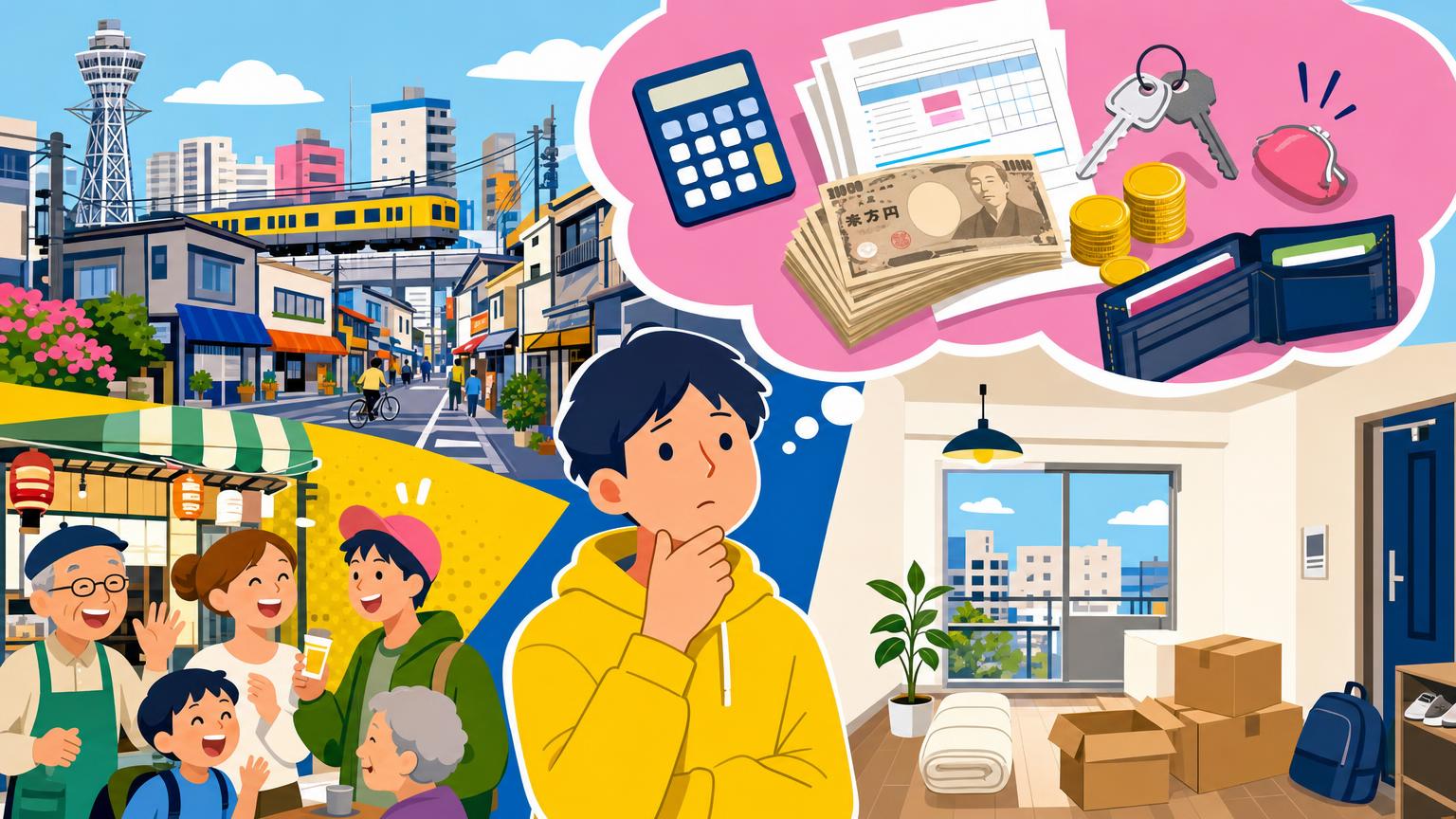
Japan’s rental system is often confusing because the monthly rent is only one item in a much larger initial bill.
A standard unfurnished lease may require several months’ rent upfront. Common costs include:
- First month’s rent, sometimes paid from the contract start date rather than the day you move in
- Shikikin, or a security deposit
- Reikin, or key money paid to the landlord and usually not returned
- Brokerage commission
- Guarantor-company fee
- Fire and household liability insurance
- Lock-change fee
- Cleaning fee, sometimes charged at the beginning rather than the end
- Contract administration or support fees
- Daily rent for the partial month, known as a prorated rent amount
The total often reaches three to five times the monthly rent and can be higher when both reikin and shikikin are charged. OFIX explains that rental housing in Japan can be more expensive initially because these starting and renewal costs are separate from the monthly rent. It also notes that a guarantor-company fee may be around half to one month’s rent.
For a ¥70,000 Juso apartment, prepare for approximately ¥210,000–¥350,000 in initial costs if the property has a relatively simple contract. A property with one month of key money, one month’s deposit, agency fees, insurance, cleaning, and guarantee costs can exceed that range.
For a ¥58,000 Tengachaya apartment, the initial bill might be ¥175,000–¥290,000, but older properties are not automatically inexpensive to enter. Some landlords use a low monthly rent to attract applicants and recover costs through cleaning fees, support packages, key money, or a higher guarantee fee.
Read the total contract estimate, not just the advertised rent.
Shikikin and reikin in everyday language
Shikikin is a deposit. Depending on the contract, it may be used for unpaid rent, damage beyond normal wear and tear, or cleaning. It is not automatically returned in full.
Reikin is key money. Traditionally, it is a payment to the landlord as a gesture of appreciation for renting the property. It is generally non-refundable. Some properties advertise “no key money” but may make up for it through higher rent, cleaning charges, or other fees.
The practical question is not “Does this apartment have key money?” but “What is the total cost over the period I expect to stay?”
If you plan to stay for only one year, a slightly more expensive apartment with no reikin may be cheaper overall. If you plan to stay for five years, a low monthly rent may matter more than a one-time fee. Ask the agent to calculate the total first-year cost and renewal cost in writing.
Renewal fees and the two-year misunderstanding
Many standard rental contracts are described as two-year contracts, but this does not necessarily mean you must leave after two years. Often, the lease can be renewed if both parties follow the contract conditions. Renewal may involve a renewal fee, a new guarantor-company charge, updated insurance, and administrative costs.
Some properties are fixed-term leases. These end on a specified date unless the landlord and tenant agree to a new contract. A fixed-term apartment may suit a researcher, student, or project worker, but it is less flexible if your job or visa plans change.
Do not assume that a two-year contract is the same as a two-year commitment, or that a monthly apartment is automatically safer. Read the cancellation notice period, early termination penalty, and cleaning obligations.
Juso: central access with a street-level personality
Juso is one of the clearest examples of Osaka’s tendency to place contradictory things close together.
Hankyu Juso Station connects the Kobe, Takarazuka, and Kyoto lines, with direct access to Osaka-Umeda. This makes Juso attractive to workers whose jobs are in Umeda, Shin-Osaka, northern Osaka, Kobe, or Kyoto. Hankyu’s station information confirms Juso’s importance as a multi-line station, with separate platforms and gates serving these destinations.
However, Juso is not simply a commuter suburb. Around the station, you will find shopping arcades, casual restaurants, bars, karaoke venues, pachinko parlors, older entertainment businesses, small hotels, and narrow streets. The area has a long-established nighttime economy, and the atmosphere can change dramatically from one block to the next.
This is important when choosing an apartment. A building that seems peaceful at 2 p.m. may be next to a busy drinking street at midnight. A room on the west side may experience different noise levels from one on the east side. A unit near the station may reduce your walking time but expose you to delivery trucks, smokers, late-night customers, voices, and motorcycles.
Juso is often more socially mixed than the polished central districts. Office workers, older residents, young renters, nightlife workers, students, small-business owners, and foreign residents all use the same streets. No single group has complete control over the neighborhood’s image. This can make the area feel lively and authentic, but it can also make it less predictable.
How Juso people communicate
The local communication style is not always as gentle as foreigners might expect from Japan.
A Juso shopkeeper may tell you that your Japanese is good and then immediately correct your pronunciation. A restaurant owner may ask what you are doing in Osaka. A customer may joke about your accent. The conversation can feel direct because Osaka humor often relies on quick reactions, teasing, and an informal challenge: “Can you keep up with the conversation?”
This does not guarantee that everyone is welcoming. It is a way of testing social distance. A joke may be an invitation to continue talking, but it may also simply be a joke. Do not assume that a lively conversation means you have become part of the community. In Osaka, familiarity develops through repeated, ordinary contact: buying the same lunch, greeting the same neighbor, returning to the same bicycle shop, or asking the same supermarket worker where to find an item.
Foreign residents sometimes interpret Osaka directness as either racism or instant friendship. Both interpretations can be overly simplistic. Some comments reflect awkward curiosity. Some indicate genuine prejudice. Others are examples of local humor. Your response depends on the wording, the relationship, and whether the person respects your answer when you set a boundary.
The best parts of Juso for daily life
Juso works well if you value:
- A short commute to Umeda
- Direct train access toward Kobe and Kyoto
- Many inexpensive restaurants within walking distance
- A neighborhood that remains active after office hours
- Opportunities to meet people through repeated local routines
- A more informal atmosphere than Umeda or central Nishi Ward
- A blend of older Osaka culture and new apartment development
The area is particularly practical for people who work in hospitality, entertainment, food service, retail, or companies around Umeda. It may also suit foreign residents who want to practice Japanese through ordinary interactions rather than living inside an English-speaking bubble.
The difficult parts of Juso
Juso may be frustrating if you need:
- Quiet streets every night
- A uniform, polished neighborhood appearance
- A large apartment with excellent insulation at a low price
- Complete separation between residential and nightlife areas
- No cigarette smoke near station exits
- Easy parking or wide streets
- A strong sense of privacy at street level
The Yodo River also matters. The river is part of the area’s geography and identity, but residents of low-lying Osaka neighborhoods need to understand flood and evacuation information. Do not choose an apartment based only on the station map. Check the building’s floor level, emergency exits, flood assumptions, and whether the management company explains evacuation procedures.
Tengachaya: a practical station inside a layered shitamachi
Tengachaya feels different from Juso, even when the rent is similar.
The station is served by Nankai Railway and Osaka Metro’s Sakaisuji Line. Nankai’s station information lists access to Namba, Kansai Airport, and the Koya Line, making Tengachaya convenient for people who work in southern Osaka or travel frequently through the airport.
The area forms part of the broader Nishinari landscape, but “Nishinari” is not one uniform neighborhood. Tengachaya, Kishinosato, Hanazonocho, Haginochaya, the Taisho-era residential streets, and the areas toward Tamade each have different housing stock and street life. A property listing may use a station name that conceals important differences within the ten-minute walk around it.
Tengachaya has a strong shitamachi character. Shitamachi does not simply mean “poor” or “old.” It refers to low-lying, historically working-class urban areas where small plots, narrow streets, neighborhood businesses, public housing, workshops, family homes, and long-term residents developed close together.
That closeness influences daily behavior. People notice who regularly uses a shop. Local businesses often depend on repeat customers. A greeting may matter more than a perfect Japanese sentence. You may receive practical advice about a bicycle, a clinic, a rubbish day, or a leaking tap. At the same time, you may be expected to understand that the street is shared space, rather than an extension of your private apartment.
Tengachaya is not a single safety category
Foreigners often ask, “Is Tengachaya safe?” The question is understandable, but it is too broad to answer responsibly.
Safety is influenced by the exact street, time of day, building entrance, lighting, nearby businesses, personal habits, and your understanding of the local environment. The area includes ordinary residential streets, busy transport routes, older buildings, public housing, commercial areas, and streets with a more visible rough-edged nightlife or welfare-service presence. It also includes many people simply going to work, shopping, taking children to school, or caring for older relatives.
The respectful approach is to inspect the exact property at different times. Visit during daylight, after 8 p.m., and on a weekend. Notice whether the route from the station is well lit. Check whether people gather under the building, whether bicycles obstruct the entrance, and whether your windows face a busy road or a quiet residential lane.
Osaka City publishes flood and disaster information for Nishinari Ward, including scenarios involving river flooding, storm surge, inland flooding, and large earthquakes. The city also identifies local evacuation facilities and neighborhood disaster plans. These are practical considerations for any resident, not judgments about the character of the ward.
The social rhythm of Tengachaya
Tengachaya can feel less performative than central Osaka. People are not necessarily trying to create a fashionable neighborhood identity. The streets may look worn, but the local routine can be strong.
A foreign resident may notice older neighbors watching the street from balconies or doorways. This can feel like surveillance, but it is also a traditional form of informal awareness. The same people who notice your rubbish may notice if you are carrying a heavy box. The same neighborhood that expects quiet at night may offer help during a typhoon.
This is where community integration becomes practical. You may not be invited into a private social circle quickly. You may, however, become recognized. Recognition is important in shitamachi areas. The owner of a small shop may remember that you prefer a certain product. A neighbor may tell you where to take a broken chair. Someone may warn you that the local collection point is not for cardboard on a particular day.
The price of this support is participation. You need to say hello. You need to follow rubbish rules. You need to avoid leaving bicycles or umbrellas in shared spaces. You need to respond when a notice is posted in the building. Your Japanese does not need to be perfect, but ignoring every local signal can make you appear unwilling rather than merely unfamiliar.
Central Osaka versus retro shitamachi: what changes beyond rent?
The difference is not simply between modern and old. It is between anonymous convenience and repeated recognition.
In central wards, people often protect their distance
In Kita, Chuo, Nishi, and the more developed parts of Fukushima, many residents are busy, mobile, and accustomed to people moving in and out. Apartment buildings may house residents from many prefectures and countries. You can live there for years without ever speaking to the person next door.
This can be liberating. Nobody asks about your private life, and nobody notices whether you buy lunch at the same shop. A foreign resident may find it easier to maintain personal boundaries and live independently.
The downside is that central urban life can be socially thin. If something goes wrong, you may have a management company but no nearby personal relationship. The neighborhood is convenient because services are available, not necessarily because people know you.
In shitamachi areas, people often protect shared routines
In Juso and Tengachaya, the streets may be less polished but more socially legible. You learn which shop closes early, which side of the road floods first, where the bicycle racks become crowded, and which convenience store accepts certain payments.
The neighborhood can feel more human because people interact more visibly. It can also feel less private because your behavior is easier to notice. A loud foreign resident, careless rubbish disposal, or bicycle left in the wrong place may become a topic of conversation more quickly than it would in a tower apartment.
This is not necessarily hostility. In a dense neighborhood, one person’s habits can affect others quickly. Osaka’s local culture often expresses this through complaints, jokes, or direct reminders rather than formal written warnings.
What foreigners often misunderstand about “community”
Community integration does not mean that Japanese neighbors will organize your social life.
It usually means:
- People recognize you at a local shop
- You understand how the building handles rubbish and deliveries
- You know whom to contact when something breaks
- You return greetings instead of avoiding eye contact
- You attend, or at least understand, local notices when relevant
- You do not treat older streets as a stage for foreign curiosity
- You learn when conversation is welcome and when people are simply being polite
A foreigner can integrate into a central ward while remaining private. A foreigner can live in a shitamachi area for years and remain socially distant. Location creates opportunities, not automatic belonging.
Renting as a foreigner: where the real friction appears
The legal and administrative process is not designed exclusively for Japanese citizens, but the rental market still assumes applicants have a stable Japanese address, income history, emergency contact, and the ability to understand a detailed contract.
Commonly requested documents include:
- Residence card
- Passport
- Proof of employment or a job offer
- Recent income documents or an employment certificate
- Japanese bank account information
- Emergency contact details
- Japanese phone number, where available
- Student certificate or scholarship information for students
- Resident record, depending on the landlord or housing provider
A joint guarantor may be requested, although many properties now use a rent-guarantee company instead. The Ministry of Land, Infrastructure, Transport and Tourism maintains information on registered guarantee companies that offer language support to foreign residents.
The University of Osaka explains that a guarantor is required for private rental housing and that the procedures are often completed through the real estate company handling the property.
Why Juso may be easier than it looks
Because Juso is close to major transport routes and has a large rental market, agencies often have experience working with employees, students, and residents from outside the local area. There are many apartments, and the station’s commuter value helps support demand.
However, “foreigner-friendly” does not mean that every landlord will accept every applicant. Your visa length, employment status, Japanese emergency contact, nationality, household composition, and expected length of stay can all influence the screening process.
Ask the agent directly:
- Does the landlord accept foreign residents?
- Is a guarantor company required?
- Can an overseas emergency contact be used?
- Is a Japanese phone number required at the application stage?
- Is the lease ordinary or fixed-term?
- What happens if my visa or job changes?
- Are visitors, remote work, pets, or musical instruments restricted?
- Is the building near a late-night business or entertainment venue?
It is better to receive a clear refusal early than to spend days preparing documents for a property that was never realistically available.
Why Tengachaya can require more careful matching
Tengachaya has many different types of housing, including older low-rise buildings, renovated apartments, newer condominiums, public housing, and properties managed by smaller local companies. This variety offers good value, but it also means that the quality of the contract experience can vary.
An older landlord may be less familiar with foreign tenants, even if the building itself is suitable. A small agency may provide excellent local support but limited English assistance. A renovated property may look modern inside while still having old pipes, thin walls, or a complicated set of building rules.
You should not interpret every refusal as a personal judgment, but you also should not ignore repeated signs that an agent is concealing the reason for rejection. A professional agency should explain whether the issue concerns nationality, guarantor requirements, income, visa duration, occupancy rules, or simply the fact that another applicant completed the process first.
Short-term, monthly, and long-term choices
The most sensible housing option depends on how certain your life situation is.
Monthly furnished housing
Monthly apartments, serviced apartments, and share houses generally cost more per month than a standard unfurnished lease. Their advantages include speed, furniture, utilities, and fewer initial hurdles. They can be useful for digital nomads, exchange students, new employees waiting for company housing, or foreigners who need time to understand Osaka before signing a two-year contract.
A monthly apartment in Juso may allow you to test the noise level and commute before making a commitment. A monthly apartment in Tengachaya may help you discover whether you enjoy the local rhythm or miss the anonymity of central Osaka.
Check whether the advertised price includes:
- Utilities
- Wi-Fi
- Cleaning
- Linen or bedding
- Administrative fees
- Electricity limits
- Early checkout penalties
- Registration requirements
- Restrictions on guests or remote work
Monthly housing is not always a bargain. It is a risk-management tool: you pay a premium to keep your options open.
Standard long-term housing
A standard lease usually offers a better monthly price and more control over your home. It also requires more documents, more cash upfront, and greater responsibility for utilities, furniture, repairs, rubbish, and contract obligations.
For most long-term residents, an unfurnished lease in Juso or Tengachaya is financially more advantageous after the first year. The question is whether you can pass the screening process and understand what you are signing.
Do not buy furniture before measuring the apartment. Japanese rooms can be narrow, elevators may be small, and staircases may turn sharply. Check the width of the entrance, hallway, balcony door, and washing-machine space. A cheap sofa can become an expensive disposal problem.
Daily behavior that helps you settle successfully
Learn the sound rules before the social rules
Noise is one of the quickest ways to create tension.
In older Juso and Tengachaya buildings, sound can travel through floors, pipes, balconies, shared corridors, and other connected spaces. Normal conversation is usually fine, but late-night phone calls on a balcony, repeated washing-machine cycles, loud music, or moving heavy furniture can disturb neighbors.
Osaka City specifically reminds foreign residents to avoid excessive noise and follow everyday rules for comfortable living.
The practical rule is simple: behave as though the building is quieter than it appears. Remove your shoes indoors. Avoid dragging chairs. Use headphones after late evening. Close balcony doors when speaking loudly. If you are hosting friends, remind them that the apartment is not a nightclub.
Treat rubbish as a community system
Rubbish collection is not an individual preference; it is part of the neighborhood routine.
Osaka City requires residents to use designated collection points and follow separation and collection schedules. The city warns that improperly sorted rubbish may be left uncollected, and it offers multilingual guidance along with a waste-sorting app.
This is especially important in older neighborhoods where collection points may be shared by many households. Do not assume that because one bag is outside, you can simply add yours. Check the collection day, bag type, and time window. Ask the management company where to place cans, bottles, cardboard, and bulky waste.
In a central tower, the building may have a secure rubbish room. In a small Tengachaya apartment, the collection point may be on the street. The rule is the same, but the social consequences of ignoring it are more visible.
Use Japanese even when the other person speaks English
You do not need fluent Japanese to build a relationship. You do need a few dependable phrases.
“Sumimasen” can open a question without demanding attention. “Onegaishimasu” signals cooperation. “Wakarimashita” shows that you understood a request. “Mata kondo” allows you to end a conversation without making a firm promise.
People in Osaka may appreciate a foreigner who makes an effort, even if the grammar is imperfect. The attempt shows that you understand communication as a shared responsibility. English ability is useful, but it does not replace awareness of local customs.
Do not force Osaka humor
Foreign residents sometimes imitate Osaka comedy too quickly. They make direct jokes, tease shop staff, or assume that everyone enjoys loud banter. This may work among friends, but it can also sound aggressive or disrespectful when you have not yet established a relationship.
The better approach is to observe first. Notice how much the other person jokes. Respond lightly and let the relationship develop. Osaka humor often depends on timing, shared context, and the ability to accept a joke about yourself. It is not simply a louder version of standard Japanese politeness.
Which area suits which kind of foreign resident?
Choose Juso if you want central access without central-ward polish
Juso is a strong choice if you work near Umeda or regularly travel toward Kobe and Kyoto. It suits people who enjoy busy streets, inexpensive food, short commutes, and the possibility of spontaneous conversations.
It may be less suitable if you need quiet, dislike nightlife, or feel stressed when a neighborhood looks visually messy. Choose your exact street carefully. A unit just a few minutes farther from the station may provide much better sleep.
For many young workers, Juso is the more immediately accessible of the two areas. It is close enough to the center to maintain a central Osaka lifestyle while paying somewhat less for housing. The trade-off is that the neighborhood’s identity is visible every night.
Choose Tengachaya if you want value and a more local residential rhythm
Tengachaya suits residents who are comfortable with older buildings, mixed streetscapes, and slower social recognition. It can work especially well for people whose jobs are near Namba, Tennoji, southern Osaka, or the Nankai network.
It may be less suitable if you want a highly international environment, dislike checking your exact route home, or expect every local service to be explained in English. The reward is not fashionable convenience, but space, transport value, and the opportunity to experience an older layer of Osaka as an ordinary resident.
Choose a central ward if you value predictability above local texture
Central Osaka may be worth the higher rent if you want a modern building, easy access to offices, plenty of international services, strong bicycle infrastructure, and a neighborhood that feels familiar to newcomers.
You may pay more to avoid noise, awkward contracts, long walks, or social uncertainty. That is not wasteful if those issues affect your sleep, work, or mental health.
The central wards also make it easier to live privately. If you want to remain anonymous while building your career or settling your visa situation, a large apartment building near a major station may feel more comfortable than a small local building where residents notice every change.
How to inspect a property properly
A viewing should involve more than simply checking whether the room looks bright.
Inside the apartment
Check the age and condition of the air conditioner. Look for mould behind furniture, watermarks around the windows, rust near the bathroom, and signs of insects under the sinks. Test the water pressure. Ask where the washing machine will go, and measure the refrigerator space.
Stand quietly for several minutes. Listen for trains, motorcycles, ventilation fans, elevators, voices, and footsteps from above. Open and close the windows. A room can look beautiful while still being acoustically exhausting.
Check the mobile reception. Ask which internet providers can service the building. If you work remotely, do not assume that an older apartment will support stable video calls.
Around the building
Walk from the station along the route you would take after dark. Pay attention to the lighting, pavement, crossing points, bicycle congestion, and nearby businesses. Check the locations of the supermarket, pharmacy, clinic, laundromat, and rubbish collection point.
In Juso, listen for nightlife noise and inspect both sides of the station. In Tengachaya, look beyond the station name and understand the exact micro-neighborhood. In both areas, check the building entrance, the condition of the mailboxes, the locks, and whether residents leave shoes, umbrellas, or rubbish in shared spaces.
Read the contract estimate
Ask for a written breakdown of every initial charge. Confirm whether tax is included. Ask whether the cleaning fee will be charged again when you move out. Confirm the renewal fee, cancellation notice, guarantee-company renewal, insurance renewal, and restoration obligations.
If an agent says, “Everyone pays this,” ask what the fee is for. Some charges are standard. Some are optional packages. Others are simply common because applicants do not challenge them.
Final judgment: Juso or Tengachaya?
Juso is the better fit for a foreign resident who wants to stay close to central Osaka while accepting a loud, mixed, street-level neighborhood. Its main advantage is not simply cheap rent, but the ability to reach Umeda quickly while living somewhere with its own social life.
Tengachaya is the better fit for a resident seeking stronger value, access to southern Osaka, and a more visibly local environment. Its main advantage is not a romanticized idea of old Osaka, but the practical possibility of paying less for a workable home while becoming familiar with a neighborhood that still depends on repeated everyday contact.
Central wards offer a different kind of bargain. You pay more for predictability, privacy, and a smoother transition. Juso and Tengachaya ask you to participate more actively in your surroundings. You need to inspect the property carefully, understand the contract, manage noise, follow rubbish rules, and accept that the neighborhood may not be designed around foreign expectations.
That is the deeper difference between central Osaka and retro shitamachi areas. In a central ward, the city often serves you quietly. In Juso or Tengachaya, the city speaks back.
Sometimes it speaks through a late-night street, an old building pipe, a blunt shopkeeper, or a notice taped beside the rubbish area. At other times, it speaks through the neighbor who remembers you, the café owner who knows your order, or the stranger who explains which train entrance is less crowded.
If you understand that exchange, you will understand Osaka better. The city is not simply friendly, cheap, or chaotic. It is practical, observant, humorous, and intensely local in small ways. Your housing choice determines how often you encounter those small ways—and how much of yourself you are willing to place inside them.