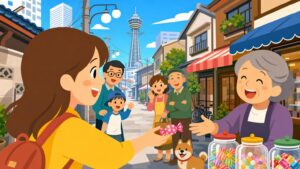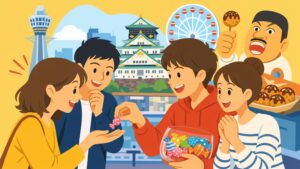
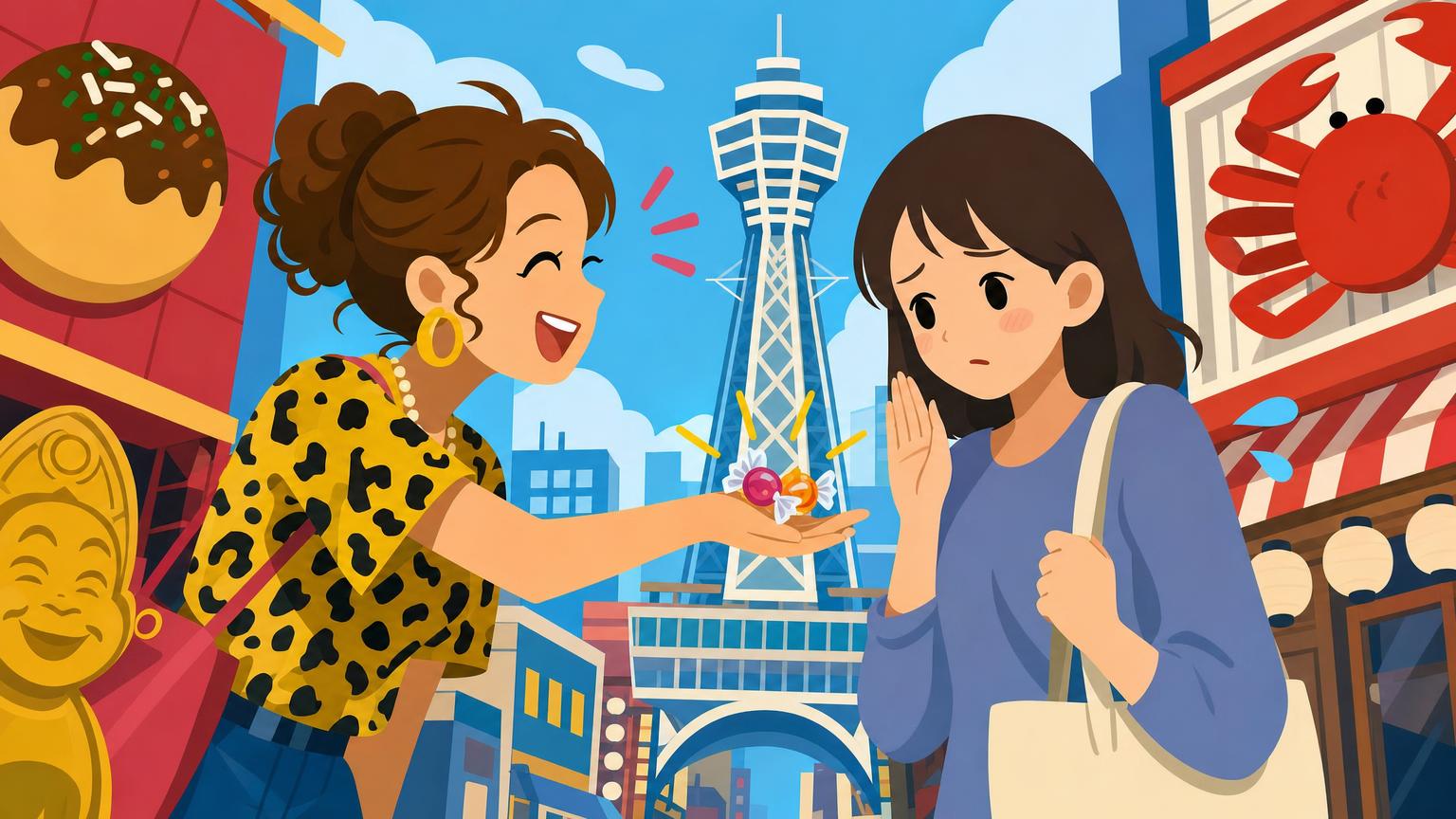
Have you ever been offered a small piece of candy by someone you barely know and wondered whether it was a genuine gift, a social test, or simply a very Osaka way of saying hello?
For many foreign residents, the moment arrives unexpectedly. You are sitting beside an older woman on a local train. You cough once. She opens her handbag, searches through a small pouch, and asks, “Ame-chan, taberu?” Would you like some candy? You may smile, refuse, accept, or freeze while trying to work out the correct response.
In Osaka, this tiny exchange can carry more meaning than the candy itself. It may express concern, friendliness, gratitude, or a desire to make an awkward silence feel more comfortable. It can also be an easy way to begin a conversation without making the relationship feel too serious.
At the same time, the custom is not universal, and it is not always comfortable. Some people are private. Some have allergies. Some do not want food from strangers. Parents may not want their children accepting sweets from people they do not know. A foreign resident may understand the kindness but still feel unsure about the social obligation attached to it.
This is why understanding “ame-chan” matters if you are living in Osaka. It is not merely a cute word for candy. It is a small window into how Osaka relationships often work: warm, practical, lightly humorous, and sometimes more personal than you expected.
What “Ame-chan” Means in Osaka
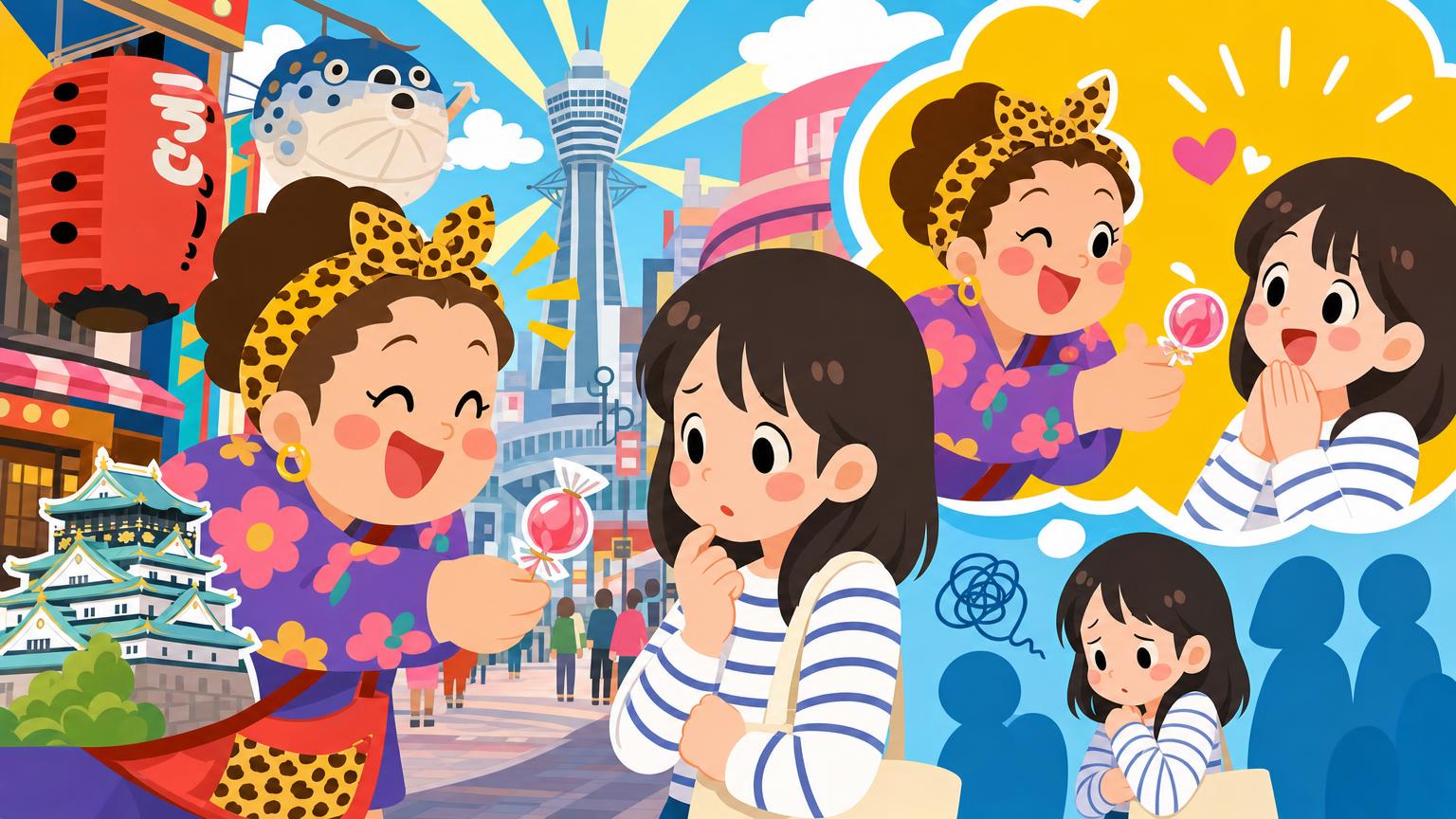
The Japanese word for candy is ame, written 飴. In Kansai speech, especially in Osaka, people commonly say ame-chan. To learners of Japanese, the chan ending usually sounds affectionate or childlike, but in Osaka it is not limited to children. Adults use it naturally, including when talking about everyday food.
You may also hear forms such as o-imo-san for sweet potato, o-mame-san for beans, or o-kai-san for rice porridge. Adding a friendly honorific to food makes it sound familiar and approachable. It is less like giving the object a personal name and more like softening the relationship between the speaker and the thing being discussed. The word ame-chan is widely recognised as a Kansai expression rather than as standard Japanese used equally throughout the country.
For a foreign resident, the important point is simple: when someone in Osaka says ame-chan, they usually mean candy. They are not speaking baby Japanese, trying to be theatrical, or making a joke about a little girl. They are simply using a normal regional word.
Pronunciation can create another small trap. Ame can also mean rain, written 雨, so context matters. Candy is usually pronounced with a different pitch pattern from rain. You do not need perfect pitch accent to get through an ame-chan conversation, but noticing the difference can help you understand what is being said.
The expression also reveals something about communication in Osaka. Language here often feels less formal and more tactile. People talk about food, weather, bodies, money, work, and small inconveniences with fewer layers of distance. A word like ame-chan turns an ordinary sweet into something that can be shared socially.
Why Osaka People Offer Candy to Other People
The most common misunderstanding is that people in Osaka give candy because everyone is secretly trying to become your close friend. That is too simplistic.
Ame-chan is often a low-pressure social tool. It allows someone to show consideration without making a major emotional statement. If a person offers you an expensive gift, the relationship can suddenly feel weighty. If they offer you a single piece of candy, the exchange remains light. You can accept it, thank them, and continue the conversation without creating a significant obligation.
This is especially useful in situations where people are physically close but socially unfamiliar. You might be sitting next to someone on a train, waiting in a clinic, standing in a queue, or sharing a break at work. A cough, a long delay, a hot day, or a restless child can create a small opening for interaction.
The candy gives the speaker a reason to say something. Rather than starting with a personal question, they can begin with a practical offer:
“Do you want a candy?”
The offer may communicate:
- I noticed that you are coughing.
- You look tired.
- The journey is taking a long time.
- My child is eating one, and I am offering you one too.
- We have been sitting together, so the silence feels slightly awkward.
- I want to be kind without making a formal speech.
This kind of gesture is often more about the atmosphere than nutrition. Osaka’s social warmth frequently appears through small acts that make the immediate situation easier. Someone may point out that your umbrella is dripping. A neighbour may warn you that the rubbish collection time has changed. A colleague may leave snacks on the table. A shop worker may make a light joke when you are struggling with a phrase in Japanese.
Ame-chan belongs to that same family of everyday gestures. It is not proof that the giver wants a long-term relationship; it is simply a way to make the present moment more comfortable.
The Community-Minded Side of Ame-chan
Osaka has a strong image of neighbourly interaction, but daily life is not one continuous conversation with strangers. Most people are busy, and many residents are private. Apartment buildings can be quiet, with people sometimes passing each other in the lift without speaking.
This is where ame-chan becomes interesting. It can create a brief sense of community without requiring any permanent commitment.
An older resident may carry candy in a handbag and offer it to people in various situations. A colleague may bring sweets into the office after returning from a trip. Someone at a local gathering may place a packet on the table for everyone. In these cases, the exchange is not a formal ceremony, but a small contribution to the group.
Historically, Osaka has been associated with commerce, food, and the movement of goods. Candy has practical advantages: it is inexpensive, easy to carry, long-lasting, and simple to share among people. Osaka also has a long connection with confectionery production, and several well-known candy companies are based in the city. Cultural explanations often link this practical availability with a local habit of sharing.
That does not mean every Osaka resident carries candy, nor does it mean that the “Osaka obachan,” or older Osaka woman, is a reliable stereotype. Many younger people never offer ame-chan, and many older people do not either. Still, the image survives because it describes a recognisable style of care: direct, inexpensive, slightly humorous, and immediately useful.
Ame-chan can therefore serve as a kind of social glue. It does not solve loneliness or replace genuine friendship. It simply makes it easier for people to acknowledge one another.
Why It Can Feel Awkward for Very Private People
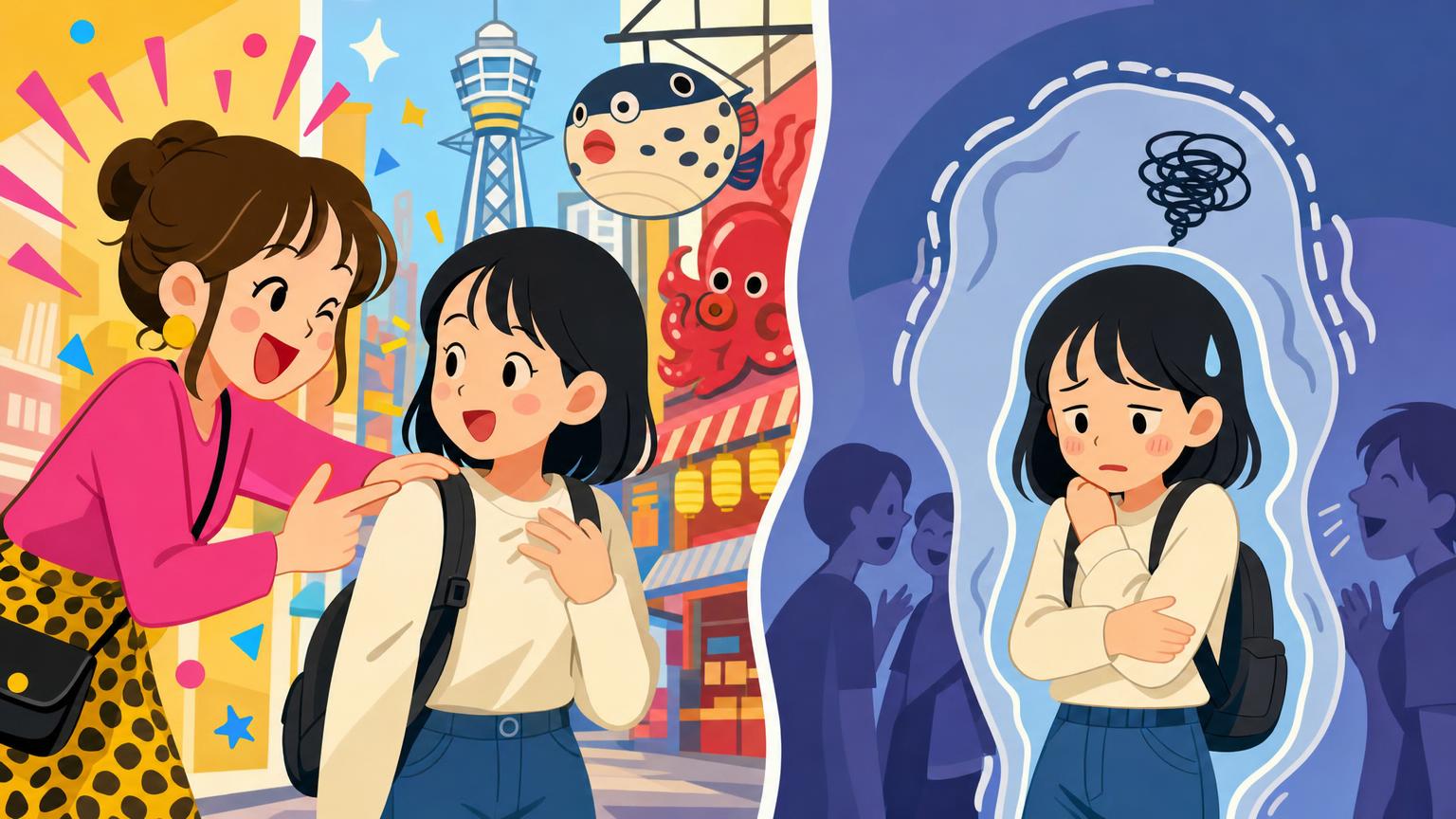
The same quality that makes ame-chan comforting can also make it uncomfortable. The gesture crosses a small boundary.
In many English-speaking countries, accepting food from a stranger may raise questions about safety, allergies, intentions, or personal space. A private person may not want to explain why they are refusing, and they may worry that saying no will seem rude. They may also feel that accepting the candy creates an obligation to continue the conversation.
These concerns are reasonable. You do not have to accept food simply because the offer is friendly.
The social expectation is usually much lighter than foreign residents fear. A calm smile and a brief refusal are enough. You can say:
- “Daijōbu desu, arigatō gozaimasu.” — I’m okay, thank you.
- “Kimochi wa ureshii desu.” — That is kind of you.
- “Gomen nasai, taberarenai n desu.” — Sorry, I cannot eat it.
- “Alerugī ga arimasu.” — I have an allergy.
- “Ima wa kekkō desu.” — I’m fine for now.
You do not need to share your entire medical history. In a casual situation, one clear sentence is sufficient.
If you accept the candy, you do not need to eat it immediately. You can say arigatō gozaimasu, put it in your bag, and deal with it later. If you do not want it, do not accept it simply because you feel trapped. A friendly refusal is usually less awkward than accepting something you cannot use.
The key is to distinguish between refusing the candy and rejecting the person. In Osaka, your tone matters. A cold silence may feel sharper than a simple verbal explanation, but a warm “thank you, I’m okay” will normally bring the exchange to a smooth close.
Ame-chan and the Difference Between Osaka and Tokyo
People often ask whether Osaka is friendlier than Tokyo. The question is too broad to be especially useful, but the difference in social style can be felt in small interactions.
Tokyo often rewards restraint. Public spaces tend to maintain a stronger boundary between strangers, and people may avoid drawing attention to one another, especially on crowded trains. A helpful action can still happen, but it may be offered quietly and with minimal conversation.
Osaka also has crowded trains, tired commuters, silent offices, and people who do not want to talk. The difference is not that everyone in Osaka is outgoing; rather, casual interaction can feel more acceptable when the situation invites it. A comment about the weather, a joke about a delay, or an offer of candy may seem less unusual.
This does not mean that people in Osaka have no boundaries. It means that those boundaries can be negotiated through humour and practical kindness. Someone may ask where you are from, comment on your Japanese, or tell you that you are holding your umbrella incorrectly. The tone can sound direct, but the intention may be helpful rather than aggressive.
For someone from the United Kingdom, this style can feel familiar in one way and unfamiliar in another. Like British small talk, conversation in Osaka often uses humour to reduce tension. However, people in Osaka may move to personal topics more quickly, particularly age, marriage, work, family, or where you live. These questions may not be intended as an invasion; they can be a way of locating you socially.
Ame-chan fits this pattern. It is personal enough to acknowledge you, yet small enough to avoid turning into a serious conversation.
What Foreign Residents Often Misunderstand
“Everyone in Osaka will help me”
Osaka’s reputation for friendliness can create unrealistic expectations. You may receive more spontaneous comments than you would in some other Japanese cities, but that does not mean strangers are available to solve every problem.
Someone may help you find a platform and then continue on their way. A shop worker may joke with you while still following the usual payment rules. A neighbour may give you candy but not want to discuss your private life. Warmth does not eliminate boundaries.
“Ame-chan is a bribe”
Usually, it is not. It is not necessarily payment for a favour. It may accompany a favour, but its meaning is closer to “Here, have something small” than “Now you owe me.”
If someone helps you carry a box and then offers you candy, you can simply thank them. You do not normally need to offer money or an expensive gift in return. Giving them a packet of snacks later may be appreciated, but it is not an immediate obligation.
“I must accept to avoid offending them”
No. You can decline politely. The offer is often intended to be easy to accept or refuse. A relaxed refusal is better than accepting and then appearing distressed.
“It is only an old-person habit”
Older women are strongly associated with the ame-chan stereotype, but the broader idea of sharing food is not limited to them. Office workers, neighbours, shop owners, parents, and community groups may all use small snacks to foster a sense of connection.
“Osaka people are always joking”
Osaka humour can be generous, but it can also be blunt. A comment about your Japanese, clothes, weight, haircut, or accent may be intended as a joke and still make you uncomfortable. You are allowed to dislike it.
A useful response is to laugh lightly when you genuinely find it funny, then set a boundary when necessary. You can say, “That is a little embarrassing” or “I would rather not talk about that” without turning the interaction into a confrontation.
How Ame-chan Works in the Workplace
Foreign residents often come across the custom at work before noticing it on the street.
A colleague may leave candy beside the office kettle. Someone may return from a trip with a large box of individually wrapped sweets. A team member may pass around throat lozenges during a long meeting. A senior colleague may offer candy after noticing that you are tired or have been talking for a long time.
These gestures may be part of a broader Japanese workplace culture in which food helps maintain group harmony. The snack is not always intended as a personal gift; it may simply be a way of saying, “This is for everyone.”
If you are new to the office, you do not need to imitate the custom right away. Observe how others behave. If colleagues take one piece from a shared box, take one yourself. If they leave the sweets for later, you can do the same. If someone offers you an individual piece, a simple thank-you is enough.
When you return from a trip, bringing a box of individually wrapped snacks for the office may be appreciated, but do not assume that every workplace expects it. The custom varies depending on the company, team, and seniority. In a small office, food may play a central role in social life. In a large international workplace, it may be almost irrelevant.
The practical rule is to observe. Osaka may be relaxed in conversation, but workplaces still have unspoken structures. Ame-chan does not replace professional etiquette.
How Ame-chan Appears in Neighbourhood Life
Neighbourhood relationships in Osaka can be closer than foreign residents may expect, particularly in older shopping streets, traditional apartment communities, and areas where people have lived for many years.
A neighbour might ask whether you have recently moved in. Someone may tell you which rubbish bag to use. A local shop owner might remember your usual order. An older resident may offer candy to your child, your partner, or you after a brief conversation.
This can feel wonderfully supportive, but it can also feel like being observed.
Community-mindedness and privacy are not opposites in Osaka. Someone can care about the people around them while also wanting to know what is happening nearby. Questions may sound nosy because the speaker is trying to determine whether you belong to the local rhythm.
If you live in an apartment, basic courtesy can go a long way. Greet neighbours when appropriate. Learn the rubbish collection schedule and keep noise under control. If you receive help, thank the person clearly. If someone gives you candy, you can accept it without assuming that you have formed a deep friendship.
If you do not eat sweets, explain this briefly. If you have a serious allergy, say so directly. People are more likely to respect a clear boundary than a vague refusal that they interpret as shyness.
Parents, Children, and Safety Boundaries
For children, ame-chan can be both charming and complicated. A stranger may offer a sweet on a train, at a local event, or outside a shop. The giver may be entirely sincere, but parents still have to decide whether the child should accept it.
Allergies, choking hazards, dietary restrictions, and family rules come first. You can thank the person while declining on the child’s behalf. A phrase such as “Arigatō gozaimasu, demo kodomo ni wa tabesasete imasen” means, “Thank you, but we do not let our child eat that.”
You can also teach your child a simple routine: look at the parent first, say thank you, and wait for permission before eating the candy. This allows the child to participate in the social exchange without assuming that every offer is automatically safe.
The important cultural lesson is that kindness and caution can coexist. Accepting a friendly gesture is not compulsory, and refusing a gift does not mean that you dislike the giver.
The Gender and Age Stereotypes Around Ame-chan
Popular media often portrays ame-chan through the image of the Osaka obachan: an older woman with a large handbag, strong opinions, and candy ready to share with anyone nearby. This image is partly grounded in lived experience, but it remains a stereotype.
Do not assume that every older woman wants to chat. Do not assume that an older man offering candy is suspicious. Do not assume that a younger person cannot be community-minded. The real social cue is the situation, not the appearance.
The stereotype can also obscure Osaka’s diversity. The city is home to long-established families, newcomers from other parts of Japan, international residents, students, office workers, artists, and people who prefer complete anonymity. Some people enjoy the local style of casual interaction, while others find it exhausting.
When explaining Osaka to friends abroad, it is better to say that the city often allows more informal contact than people expect, rather than claiming that Osaka residents are naturally warm or extroverted.
How to Respond Naturally When Someone Offers You Ame-chan
The safest response is straightforward:
“Arigatō gozaimasu.”
If you would like it, accept it with one hand or both hands, smile, and thank the person. If you want to acknowledge the local expression, you can say, “Ame-chan, arigatō,” although you do not need to imitate Kansai speech.
If you do not want it, smile and say:
“Arigatō gozaimasu, daijōbu desu.”
This roughly means, “Thank you, I’m okay.” It is polite and does not require a lengthy explanation.
If the person continues to insist, give a specific reason:
“Gomen nasai, ame wa taberarenai n desu.”
“Sorry, I cannot eat candy.”
You can also mention an allergy or dietary restriction. A clear reason often helps because the giver may otherwise assume that you are simply being shy.
If the offer comes from a colleague or neighbour and you would like to return the kindness later, a small snack from a local supermarket is sufficient. Do not turn a one-piece exchange into a formal gift relationship unless the broader relationship calls for it.
What You Can Learn from the Gesture
Ame-chan teaches several practical lessons about living in Osaka.
First, friendliness is often expressed through actions rather than abstract words. Someone may not say, “I want you to feel welcome.” Instead, they may hand you a sweet, point out a safer crossing, or tell you where to buy a cheaper household item.
Second, communication in Osaka often lowers the emotional temperature through humour and small gestures. A candy is not a grand gift. That is precisely why it works: it makes contact possible without making the moment feel heavy.
Third, warmth does not mean unlimited access. Osaka people can be generous and intrusive, funny and blunt, helpful and busy. The same person may offer you candy one day and ignore you the next because they are tired or in a hurry.
Fourth, foreigners do not need to perform Osaka. You do not have to use a strong Kansai dialect, constantly make jokes, or carry candy everywhere to fit in. Respectful participation is enough.
Finally, daily life is built from repeated small exchanges: a greeting to the caretaker, a thank-you to the cashier, a nod to the neighbour, a snack left in the office kitchen, or a piece of ame-chan offered during a long wait.
These moments may seem insignificant from the outside, but they show how people manage closeness in a large city. Osaka is not a village, and strangers are not automatically friends. Yet the city often leaves more room for a brief human connection before everyone returns to ordinary life.
Is Ame-chan Still Relevant in Modern Osaka?
Yes, but not in the exaggerated way television sometimes suggests.
Modern Osaka includes remote workers, international companies, chain cafés, high-rise apartments, busy commuters, and residents who may never speak to their neighbours. Social habits are changing. Public health concerns, food allergies, and a stronger awareness of personal boundaries have also made some people more cautious about offering food to strangers.
Ame-chan is therefore best understood as a living tendency rather than a strict rule. It remains recognisable because it reflects a durable local preference for practical warmth, but its form changes depending on the setting.
In an office, it may take the form of individually wrapped sweets. In a neighbourhood, it may be a snack offered during a conversation. On public transport, it may be a brief attempt to comfort someone who is coughing. At home, it may be a packet kept near the entrance for visitors.
Some people now replace candy with bottled tea, tissues, small snacks, or information. The object may change, but the social purpose remains similar: to reduce distance, show attention, and make the immediate situation easier.
A Final Way to Think About Ame-chan
If you live in Osaka, do not treat every ame-chan offer as a demand for intimacy. Instead, see it as an invitation to share a small moment.
You may accept it, refuse it, ask what flavour it is, explain that you have an allergy, or put it in your bag to eat later. All of these responses can be socially acceptable when expressed with gratitude and clarity.
The deeper meaning is not hidden within the candy. It lies in the way the offer adjusts the distance between two people.
For a community-minded person, ame-chan can feel heartwarming because it says, “I noticed you.” For someone very private, it may feel awkward because it says, “I noticed you” before you were ready to be noticed. Both reactions are valid.
That tension is part of life in Osaka. The city often welcomes casual connection, but it does not require you to give up your boundaries. Learning to respond comfortably means finding your own balance: being open enough to recognise the kindness, firm enough to protect your needs, and relaxed enough not to turn one piece of candy into a major social event.
Once you understand that balance, ame-chan no longer seems mysterious. It becomes what it usually was all along: a small, sweet, slightly personal way of making everyday life feel less distant.