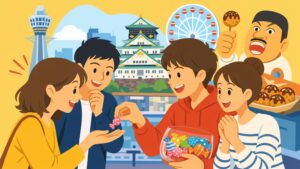
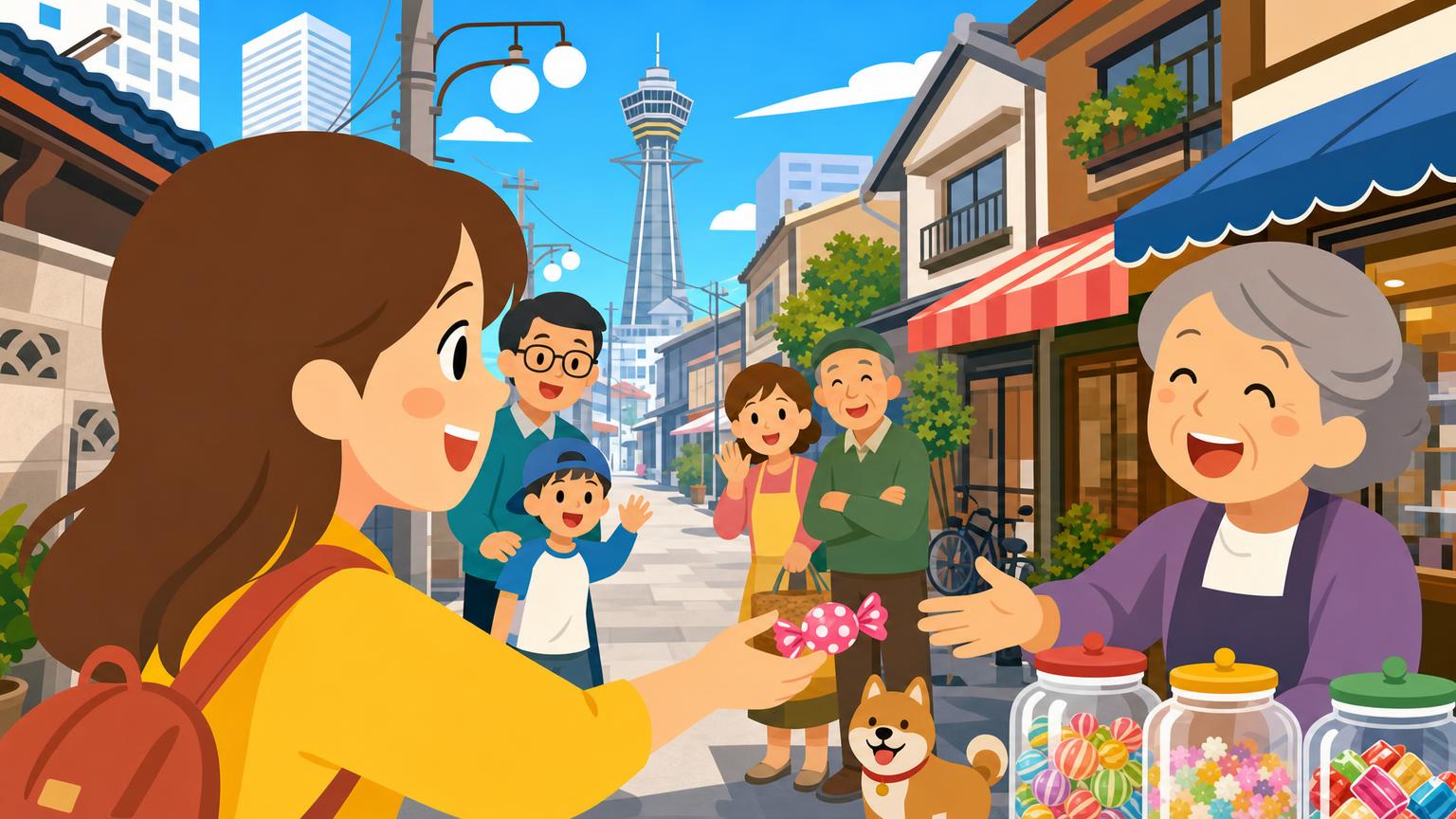
You may move into an Osaka apartment, greet the older woman next door, and suddenly hear, “Ame-chan, taberu?”—“Do you want a candy?” She may pull one from a handbag, shopping bag, or coat pocket and offer it as naturally as if you had known each other for years.
Ame-chan culture is the everyday Kansai habit of treating candy as a small social gift. The candy itself is inexpensive. The important part is the moment around it: a greeting, a joke, a little concern, or an easy way to begin speaking with someone who was previously a stranger. In neighborhood life, particularly among older residents, spontaneous candy sharing can soften distance without requiring a formal introduction or a serious conversation.
For foreigners living in Osaka, this custom can be confusing. Is the person being unusually generous? Is there an expectation to become friends? Is it safe to accept food from someone you do not know? Is the directness friendly, intrusive, or both?
The honest answer is that Ame-chan is usually less dramatic than the popular stereotype suggests. It is not a secret membership ceremony. It is not something every Osaka resident does every day. Sometimes it is simply an older person offering the sweet she already has in her bag. But in a city where people often meet the same shopkeepers, neighbors, school families, and building residents repeatedly, these small gestures can gradually create recognition and trust.
This map is included only as a city reference. The subject here is not sightseeing, but the ordinary human geography of Osaka: apartment entrances, shopping streets, local trains, community rooms, clinics, supermarkets, and the short conversations that make a neighborhood feel inhabited.
What Is the “Ame-chan” Culture in Osaka?
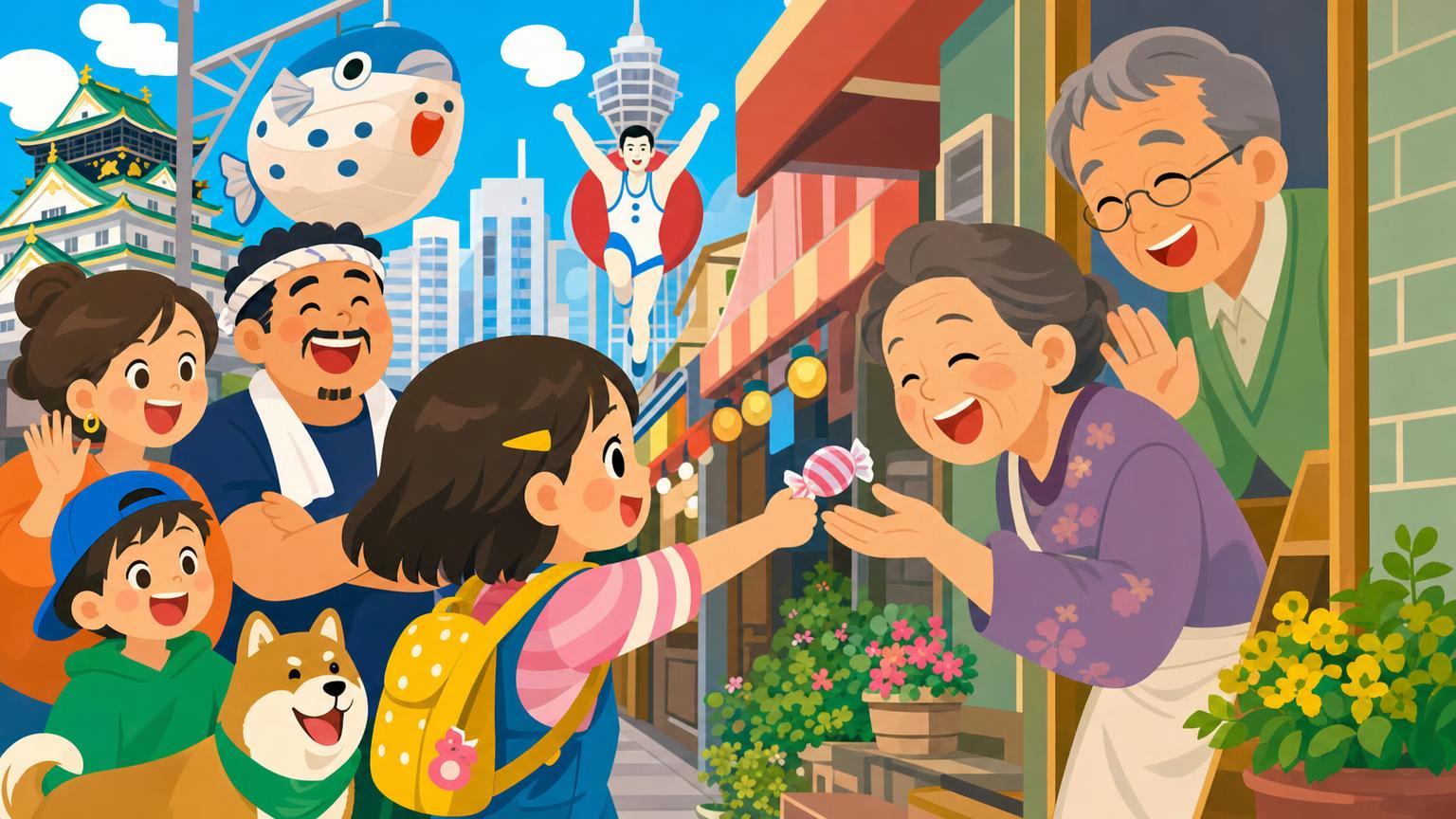
The Meaning Behind the Name “Ame-chan”
In Japanese, ame means candy. Depending on the kanji, it can also mean rain, but ame-chan in this context refers to a sweet, usually a hard candy or throat lozenge.
The ending -chan is normally associated with children, close friends, pets, or something treated affectionately. It can sound cute or intimate. When Osaka and other Kansai speakers call candy ame-chan, they give an ordinary object a warmer, more familiar feeling.
That does not mean the candy is being treated like a child. Japanese offers many ways to add emotional color to everyday words. A food item can feel more approachable when given a friendly suffix. In Kansai speech, adults may also use affectionate expressions such as o-mame-san for beans, o-imo-san for sweet potatoes, or okai-san for rice porridge. The broader pattern is to make food sound familiar and close to home rather than distant or technical.
For an English speaker, “candy-chan” may sound childish. In Osaka, it is better understood as familiar and affectionate. The word carries a small emotional signal: this is not just a product in a package; it is something people pass around, save for later, and offer when they want to make contact.
Why Kansai People Add “Chan” and “San” to Food
The suffixes -chan and -san do not have one simple English equivalent. They can express affection, familiarity, respect, or a softening of the word. Their meaning depends on the relationship, the speaker’s age, the situation, and the item being discussed.
In formal Japanese, you would not normally add -chan to every noun. In a casual Osaka neighborhood, however, food-related language can be more relaxed and personal. An older resident may say ame-chan without consciously deciding to sound cute. It may simply be the word she has used since childhood.
This is important for foreigners because language in Osaka often conveys social information through tone and timing. A person may use standard Japanese vocabulary but deliver it with a Kansai rhythm. The sentence can feel more open, teasing, or conversational than the same words spoken in a formal Tokyo setting.
The difference is not that Tokyo people are cold and Osaka people are warm. That comparison is too simplistic to be useful. A more practical distinction is that Osaka often allows ordinary encounters more room for informality. A comment about the weather may turn into a question about where you live. A question about your shopping bag may lead to a recommendation, a complaint about prices, and then an offer of candy.
The conversation does not always proceed in a straight line. Osaka communication can feel like a series of small openings. Ame-chan is one of those openings.
“Ame-chan” Is Not Always a Special Gift
Foreign residents sometimes overinterpret an offer of candy. They may think, “This person has chosen me for a meaningful cultural exchange.” Sometimes that is partly true. More often, the meaning is smaller and more practical.
An older neighbor may have a bag of individually wrapped sweets and offer one to several people. She may give one to a child, a delivery worker, a shop assistant, another neighbor, and you. The candy is not necessarily a personal invitation. It can simply be a routine way to make the atmosphere more comfortable.
That does not make the gesture meaningless. Small, repeated moments matter in local life. The woman who first offers you a candy may later remember your apartment number, ask whether you have learned the garbage schedule, or warn you that rain will make the bicycle path slippery. The relationship develops through repetition rather than through one grand act of hospitality.
The Iconic “Osaka Obachan”
Who Are the Osaka Obachan?
Obachan is a familiar term for a middle-aged or older woman. Depending on the tone, it may sound affectionate, neutral, or rude. Among people who know one another, it can function as a warm neighborhood title. Used carelessly toward a stranger, especially while joking about her age, it may be disrespectful.
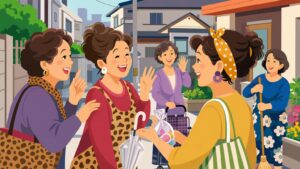
The popular image of the “Osaka obachan” is easy to recognize. She is often imagined as energetic, outspoken, practical, fashion-conscious, and unafraid to speak with strangers. Television and comedy have exaggerated details such as bright colors, bold patterns, lively voices, direct questions, and a handbag filled with candy.
There is some truth behind this image, but it is neither a uniform dress code nor a fixed personality type. Osaka women are not all loud. They do not all wear leopard print or carry candy. Some are shy, private, formal, or simply too busy to talk. The stereotype is useful only when understood as a cultural clue rather than a description of every individual.
What the stereotype captures well is a form of practical sociability. An Osaka neighborhood elder may combine concern with criticism. She might tell you that your umbrella is blocking the entrance and then ask whether you have eaten. She may complain that foreigners do not understand the local recycling rules, then explain them carefully and give you a piece of candy before leaving.
For many foreigners, this combination can be difficult to interpret. In some cultures, criticism suggests distance. In Osaka, criticism may sometimes occur within a relationship of concern. That does not mean every blunt comment is caring, and harassment should not be accepted as cultural charm. However, a direct remark is not automatically an insult.
Why Do They Carry Candy in Their Bags?
Candy is convenient. It is inexpensive, individually wrapped, easy to carry, and less messy than chocolate or cake. It keeps for a long time and can be offered to a group without any preparation. In warm weather, hard candy is often easier to store than a soft snack.
Candy also suits the practical image associated with many neighborhood elders. A handbag may contain tissues, medicine, spare shopping bags, a small towel, a compact umbrella, and sweets for an unexpected occasion. The bag is more than a fashion accessory; it is a portable response system.
An older woman may carry throat candy because someone in her family has a cough. She may keep fruit-flavored sweets for children. She might have received a large bag through a supermarket promotion, from a shop, at work, or from a relative. Or she may simply enjoy having something to offer.
Some Osaka candy companies have strong local associations. Pine Co., based in Osaka, has sold Pine Ame, the familiar ring-shaped pineapple candy, since 1951. The hole in the center is designed to resemble a slice of pineapple.
These details help explain why an offer of candy can feel more natural in Osaka than many foreigners expect. The item is ordinary, familiar, and easy to share. It does not carry the financial or emotional pressure of a large gift.
The Fashion of the “Obachan” Is Not a Costume
Foreign media often turn the Osaka obachan into a visual joke. Bright clothing, strong prints, colorful hair, and unusual accessories become shorthand for an “Osaka personality.” This can be amusing when older women use the image themselves, but it becomes insulting when outsiders treat real residents as characters in a comedy show.
Do not point to someone’s clothing and ask whether she is a “real Osaka obachan.” Do not photograph a stranger simply because she appears to fit the stereotype. Do not assume that an older woman who offers you candy wants to become part of your Osaka story.
The most respectful response is to meet the person rather than the image. Accept the warmth if it is offered. Return the greeting. Laugh if the joke is genuinely funny. But let the relationship determine how informal it becomes.
Ame-chan as the Ultimate Social Icebreaker
Breaking the Ice with Strangers
Candy makes conversation feel less demanding. If an older neighbor asks, “Do you want a candy?” the question has a clear answer. You can say yes, no, or thank you, and ask what flavor it is. The conversation has somewhere to go.
Without the candy, the same person might hesitate to speak. You may both notice each other in the elevator yet remain silent. You may share a train platform or attend a community event without knowing how to begin. The candy provides a small reason to interact.
This is why Ame-chan works as an icebreaker. It creates a social object between two people. You are not expected to reveal something personal right away. You can start by talking about the candy.
A conversation might unfold like this:
“Ame-chan, taberu?”
“Hai, arigatou gozaimasu. What flavor is it?”
“Pine. You know Pine Ame?”
“Yes, I’ve seen it at the supermarket.”
“Where are you from?”
“Canada.”
“Ah, Canada. Cold, isn’t it? Is your bicycle okay in this rain?”
The candy has done its job. It has moved the relationship from silent recognition to a basic conversation.
For foreigners living in Osaka, this matters because a sense of local belonging is often built through repeated, low-level contact. The person at the neighborhood bakery may not become your close friend. The woman who lives upstairs may never invite you inside. However, you may begin to recognize each other, exchange brief comments, and notice when something unusual happens.
That is a genuine form of community. It is quieter than friendship and more useful than a slogan about friendliness.
The Candy Can Carry Concern
Sometimes Ame-chan is offered because someone is concerned about you. If you look tired, cough, wait in the cold, or work late, an older resident may offer you a throat lozenge or sweet. The gesture may be practical rather than sentimental.
A candy may also appear after a small favor. You help hold a door, carry a box, explain how to use a machine, or show someone how to operate a phone. The person may say, “Here, take this,” as though the candy balances the exchange.
Do not expect a perfect exchange of value. The person is not necessarily paying you. In many situations, the candy helps keep the favor from feeling too formal. It says, “Thank you, but let’s keep this light.”
This is one reason Ame-chan is particularly useful among people who see each other regularly. It maintains a comfortable middle distance. You are no longer strangers, but you do not need to become intimate.
What Foreigners Often Misunderstand
The first misunderstanding is that people in Osaka will automatically help you with everything. A lively conversational style does not guarantee personal support. Some residents are generous; others are busy, cautious, or private. You still need to learn official procedures, neighborhood rules, and emergency contacts.
The second misunderstanding is that every direct comment is an insult. Osaka speech can be blunt, playful, or fast. Listen to the interaction as a whole. Does the person also explain, smile, wait, or offer practical help? Context matters. At the same time, you are allowed to set boundaries if someone becomes invasive or disrespectful.
The third misunderstanding is that you should imitate the stereotype. You do not need to speak loudly, make jokes about strangers, bargain aggressively, or carry candy everywhere. Osaka does not require foreigners to perform Osaka.
The fourth misunderstanding is that candy is always safe to accept. Food allergies, dietary restrictions, diabetes, choking risks, and personal boundaries are all real concerns. A wrapped sweet may be harmless, but you do not have to accept one simply because the offer is friendly.
How to React When an Obachan Offers You Candy
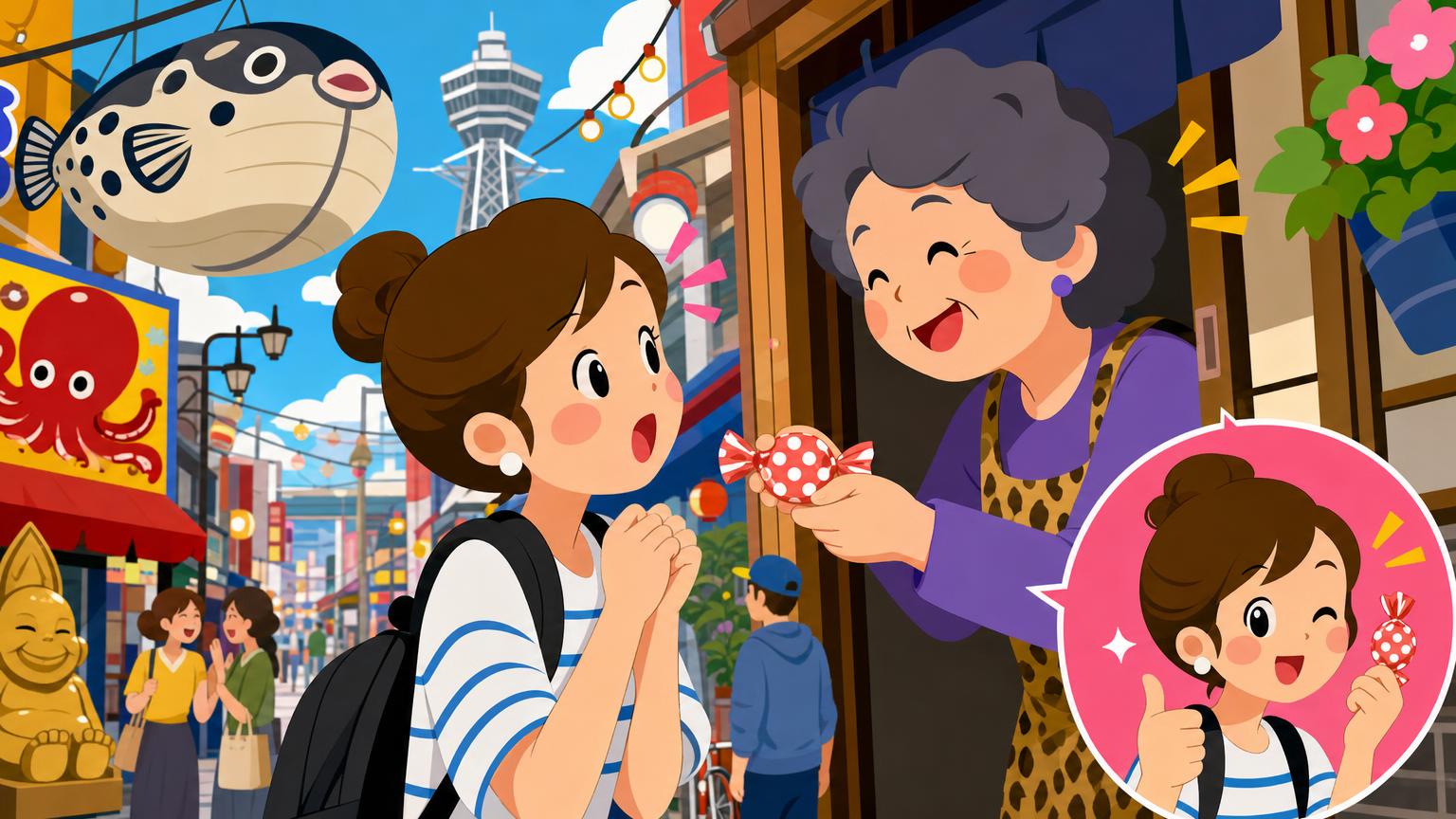
If You Want to Accept It
A simple response is enough:
“Arigatou gozaimasu.” — Thank you.
In a more casual Kansai atmosphere, you may hear or eventually use ookini, a Kansai-style way to say “thank you.” You do not need to force the dialect, however. Standard Japanese spoken warmly is perfectly acceptable.
You can also say:
“Nani-aji desu ka?” — What flavor is it?
“Kore, Osaka no ame desu ka?” — Is this an Osaka candy?
“Ato de tabemasu.” — I will eat it later.
If you cannot eat it right away, you can carefully place it in your bag. You do not have to unwrap it on the spot. The social exchange has already taken place.
A smile and brief eye contact are often more important than perfect Japanese. The giver is usually looking for acknowledgment, not a speech.
If You Do Not Want to Accept It
You can decline politely:
“Daijoubu desu. Arigatou gozaimasu.” — I’m okay, thank you.
Or you can explain:
“Amari amai mono o tabenai n desu.” — I do not usually eat sweet things.
“Arerugii ga arimasu.” — I have an allergy.
“Kenkou no tame ni, satou o hikaeteimasu.” — I am reducing sugar for my health.
A person may offer again. In Osaka, repetition can be part of the conversational rhythm rather than a serious demand. Smile, repeat your reason, and remain clear. A vague “maybe later” may encourage another offer.
You do not owe anyone acceptance. Warmth and boundaries can coexist.
When Safety and Common Sense Matter
If an unknown adult offers candy to your child, the parents should decide. The popular image of a kind older woman with sweets does not replace normal safety rules. Teach children to ask a parent or trusted adult before accepting food from someone they do not know well.
Adults should also use their judgment. Avoid eating anything that is unwrapped, damaged, expired, or impossible to identify. Be cautious if you have allergies, and do not accept food if you feel pressured.
The cultural point is not that every offer must be accepted. Rather, a wrapped candy can be an invitation to interact. You can accept the conversation while declining the food.
Do Not Make the Moment Too Formal
Foreign residents sometimes respond to a small candy offer with an elaborate explanation of Japanese culture, which can make the moment awkward. The giver may simply be sharing a sweet, not conducting a ceremony.
“Thank you” is enough. If you are curious, ask one natural question. If you want to continue the conversation, mention something ordinary, such as the rain, your commute, your new neighborhood, or the flavor of the candy.
Osaka communication often values responsiveness. A silent nod may look like rejection, even when you are only translating in your head. You do not need to be entertaining; a short answer shows that you are present.
Famous Candies You Might Receive in Osaka
Pine Ame
Pine Ame is one of the candies most strongly associated with Osaka. It is a yellow, pineapple-flavored hard candy shaped like a ring. Its central hole is its most recognizable feature, and the candy has been sold since 1951. The official product description highlights its sweet-and-sour pineapple flavor and enduring popularity across generations.
Someone may offer Pine Ame because it is familiar and visually distinctive. It is easy to recognize even if your Japanese is limited. You can say, “Pine Ame?” in a questioning tone, and the giver will often explain the candy’s name or mention that it has been popular for many years.
The candy also suits the social personality of Ame-chan. It is not luxurious; it is recognizable, inexpensive, and slightly playful. Its shape can inspire an easy joke without requiring sophisticated language.
Ougontou, the Golden Hard Candy
Ougontou means “golden sugar” or “golden candy.” It is a transparent, golden hard candy associated with the Osaka-based company Ogontoh. The company traces its origins to 1919 and its Osaka business history to 1923. According to the company’s history and product information, its classic candy is made primarily from sugar and starch syrup, without added flavoring or coloring.
Ougontou has a different character from Pine Ame. Pine Ame is colorful, fruity, and immediately playful, while Ougontou is plain-looking, glossy, and traditional. It can feel like the kind of candy kept by someone who values familiar household items and old memories.
If someone gives you Ougontou, you might ask whether it is a throat candy or an ordinary sweet. The answer can lead to a conversation about family habits, childhood, or the types of candy people used to keep at home.
Other Everyday Possibilities
You may also receive a throat lozenge, plum candy, black candy, ginger candy, mint candy, or a regular supermarket brand. The exact flavor depends on the person, so do not assume that every sweet is a special Osaka product.
Older residents may choose candy for practical reasons. A mint can freshen the mouth, while a throat lozenge may help with a cough. Plum or ginger flavors may be associated with older generations, and a fruit candy may be easier to offer to children.
The category matters less than the gesture. Ame-chan is often a small, portable excuse to care for someone without asking for a significant emotional response.
Ame-chan and the Difference Between Osaka and Tokyo
Foreigners often ask whether Osaka is friendlier than Tokyo. The question is understandable, but the answer depends on what you mean by “friendly.”
Tokyo is not an unfriendly city. It is large, crowded, highly organized, and full of people who value their time and personal space. In many situations, strangers in Tokyo may avoid unnecessary interaction because efficiency and privacy matter. As a result, conversations with strangers can feel less expected.
Osaka is also large, crowded, and busy. People here are not always available for conversation. Commuters hurry, shop staff have work to do, parents are tired, and older residents may prefer privacy. The difference is not that Osaka lacks social distance, but that certain situations may allow for a more informal bridge across it.
Ame-chan is one example. Offering candy can make an interaction between strangers feel less official. A joke can make a request easier to accept, and a direct comment may be followed by practical assistance. The relationship does not necessarily become deep, but the atmosphere can feel less stiff.
This may be why Osaka sometimes feels more accessible to foreigners who are still learning Japanese. You may make mistakes and still receive a response. Someone might correct your pronunciation, laugh, and continue speaking instead of ending the conversation. The experience can be embarrassing, but it is also an opportunity to participate.
The trade-off is that Osaka’s informality can sometimes feel intrusive. People may ask where you are from, whether you are married, why you live alone, or how much Japanese you speak. Someone may intend curiosity rather than judgment, but your discomfort is still valid.
Living in Osaka means learning to distinguish between openness and obligation. You can appreciate the former without surrendering the latter.
Ame-chan in Apartment and Neighborhood Life
The Elevator Encounter
Apartment elevators are common places for brief interactions. You may enter carrying groceries and find an older resident already inside. At first, the conversation may consist only of a greeting. After several meetings, she may ask whether you understand the garbage schedule. Later, she may mention a local shop or offer you a piece of candy.
The process is gradual. Do not expect immediate intimacy. In many buildings, people develop familiarity through repeated, brief encounters rather than planned social events.
A foreign resident who responds consistently—greeting people, keeping shared spaces clean, following garbage rules, and answering simple questions—becomes easier to trust. Candy is part of this process, but it is not the entire process.
The Local Shopping Street
On a neighborhood shopping street, an older shopkeeper may give you a piece of candy after you make a purchase. It may serve as a small reward, a thank-you, or a way to encourage you to come back. The same shopkeeper may also comment on the weather, explain a product, or ask whether you are finding your way around.
Do not assume that the candy means you have received a discount or special treatment. In many cases, it is simply part of the relationship between the shop and its customers. Take it if you like, say thank you, and continue shopping as usual.
If you return regularly, the relationship may become more personal. The shopkeeper may remember your preferred flavor or ask about your work. This recognition is one of the pleasures of neighborhood life, but it develops over time rather than through forced friendliness.
Community Events and Shared Spaces
Ame-chan may appear at a neighborhood clean-up, residents’ meeting, children’s event, volunteer activity, or senior club. In these settings, snacks help people gather together without requiring a formal conversation.
If candy is placed in a shared basket, you may take one and thank the group. If someone offers you one directly, respond to that person. If you bring candy yourself, individually wrapped pieces are generally easier for people to accept than one open package.
In a workplace or community group, observe how others behave. Do people take one right away? Do they wait? Do they choose only one? Do they leave the wrapper in a particular place? These details reveal more about the local atmosphere than any universal rule.
The Foreign Neighbor Problem
Foreign residents can become noticeable in a neighborhood before they feel socially included. People may notice your language, cooking smells, bicycle, garbage habits, or work schedule. Some residents will be curious, while others may be cautious because they have experienced communication problems with previous tenants.
Offering candy can be a low-risk way for someone to approach you. It allows them to show kindness without making a major commitment. Your response can demonstrate that you are open to basic communication.
You do not need to speak fluent Japanese. Try a greeting, thank the person, and ask them to repeat themselves if necessary. “Mou ichido onegaishimasu” is useful when you need to hear something again. A small notebook or translation app can help with practical matters, but do not hide behind your phone when a simple smile and response would be sufficient.
How Foreign Residents Can Participate Without Pretending
Carrying Candy Is Optional
You do not need to keep a bag of sweets in your pocket to become part of life in Osaka. Many younger people do not carry candy, and many men, office workers, students, and foreign residents never offer it to strangers.
If carrying candy suits your personality, keep a few individually wrapped pieces with you. You can share them with colleagues, neighbors, or friends after a long day. Candy from your home country can be a pleasant conversation starter, especially when its flavor or packaging is unusual.
Explain what it is before asking someone to try it. Mention strong ingredients such as mint, ginger, chili, alcohol, dairy, nuts, or unusual fruit. Offering a choice is more considerate than surprising someone.
Offer Without Creating Pressure
The best social gift leaves room for refusal. Hold out the candy and ask, “Would you like one?” If the person says no, accept their answer without trying to persuade them.
In a group, placing wrapped candy in a shared area can be easier than handing a piece to one particular person. People can choose according to their preferences and health needs.
Do not offer candy while someone is speaking, exercising, cycling, caring for a child, or handling something dangerous. Practical kindness should not create a safety risk.
Use Candy to Ask, Not to Perform
If someone gives you candy, you can ask about its flavor, brand, or popularity. You might learn that the person likes black candy, dislikes pineapple, buys throat drops during the winter, or keeps sweets for their grandchildren.
These details are more valuable than memorizing a list of “Osaka customs.” They show how ordinary objects can carry personal memories. One person may see Pine Ame as a nostalgic childhood sweet. Another may view it as a useful candy to give away. Someone else may dislike it entirely.
Osaka culture is not stored inside the candy. It emerges in the conversation around it.
Embracing the Warm and Complicated Culture of Osaka
Ame-chan sharing is easy to romanticize. It is tempting to picture every older woman as a neighborhood guardian, every candy as a symbol of deep trust, and every direct comment as proof of local warmth. Real life is more complicated.
Some candy offers are generous. Some are habitual. Some are awkward. Some happen because the giver wants to talk with you. Others happen because she has too many sweets in her bag. The meaning changes depending on the person and the situation.
That uncertainty is not a problem to eliminate. It is part of learning how Osaka works.
People here often communicate through small, practical gestures: a warning about rain, a complaint about garbage, a question about your train route, a recommendation for a cheap lunch, a reminder to lock your bicycle, or a candy placed in your hand before the conversation ends.
These moments may not seem important from the outside. They can feel random, even nosy, especially when you are still translating the language and trying to read the social rules. But repeated contact gives them shape. You begin to understand who is simply curious, who is offering help, who wants to sell something, who is joking, and who is crossing a boundary.
The Osaka difference is not unlimited friendliness. It is a greater tolerance for informal contact in certain everyday settings. A stranger may speak first. A serious topic may begin with a joke. Concern may come with criticism. A small gift may make an ordinary encounter feel less formal.
When an older neighbor offers you ame-chan, you do not need to solve Osaka in one bite. Accept it if you want to. Decline it clearly if you do not. Say arigatou or ookini. Ask a simple question. Notice the person behind the stereotype.
Over time, you may discover that the candy was never the main point. The real gift was the pause: two people who might otherwise have passed silently, sharing a few seconds of ordinary life.