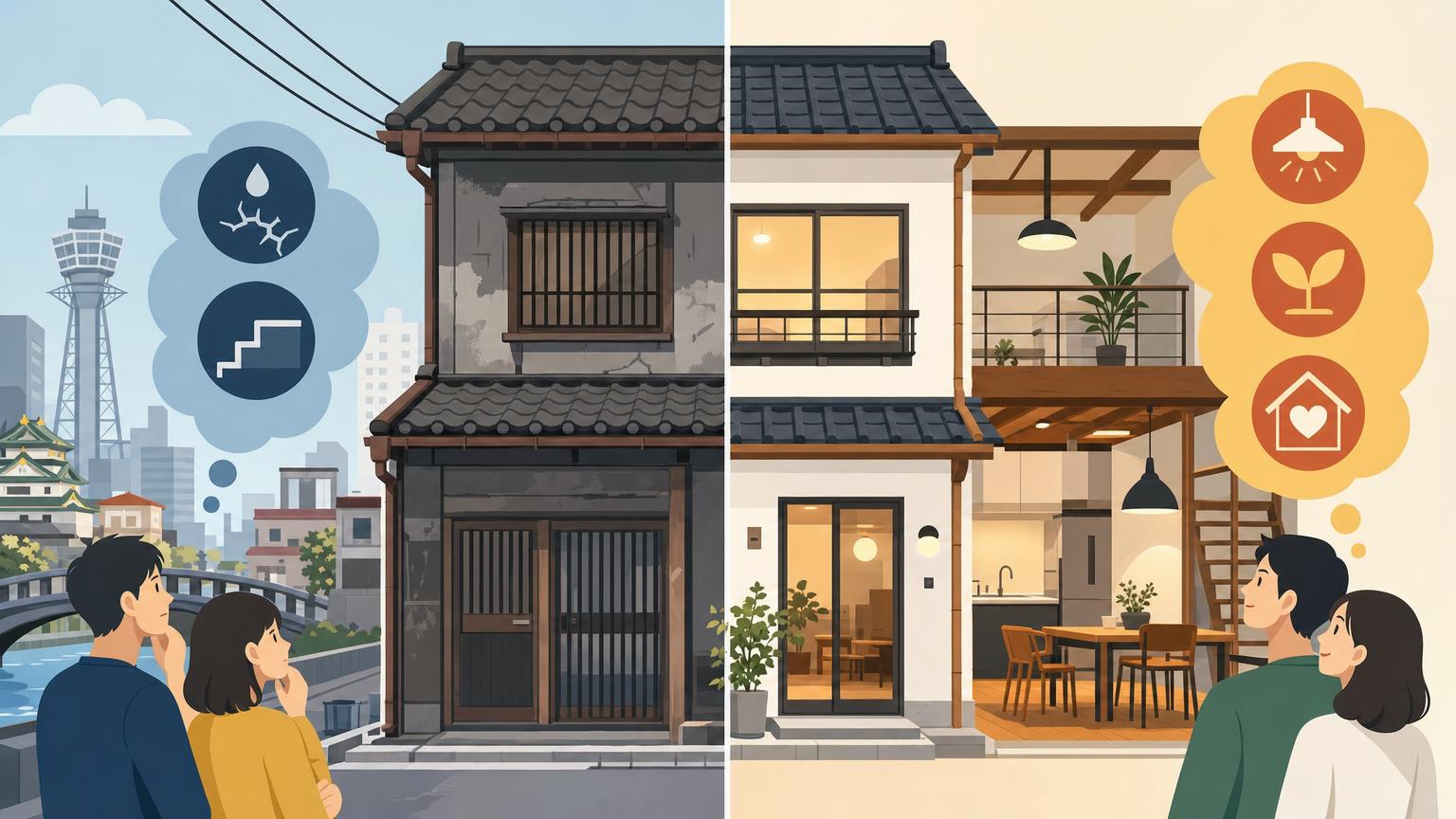
If you are living in Osaka, or seriously considering moving here, a renovated nagaya can look almost too good to be true. You may see exposed timber, plaster walls, a small front garden, a quiet alley, and a rent that appears lower than a stylish apartment in central Tokyo. Then the practical questions arrive. Is the house warm enough in winter? Will the neighbors hear every conversation? Can a foreign resident rent one without a Japanese guarantor? Does “renovated” mean structurally safe, or simply attractive in photographs?
These questions matter because a nagaya is not just an old house with a new kitchen. It is a shared building type, a neighborhood relationship, and a particular way of living. In Osaka’s shitamachi, the experience can feel more personal and less anonymous than life in a modern high-rise. That can be comforting. It can also be demanding.
The most important point is this: renting a renovated nagaya is not automatically a cheaper or more “authentic” version of apartment living. It is a trade. You may gain space, character, and a stronger connection with the street. In exchange, you may give up insulation, privacy, storage, and the ability to ignore your neighbors.
The article below looks at that trade through everyday Osaka life rather than sightseeing. It explains what nagaya means, how renovated properties work, how people in shitamachi neighborhoods tend to interact, and what foreign residents often misunderstand about Osaka compared with Tokyo.
What Is a Nagaya? The Rebirth of Osaka’s Traditional Row Houses
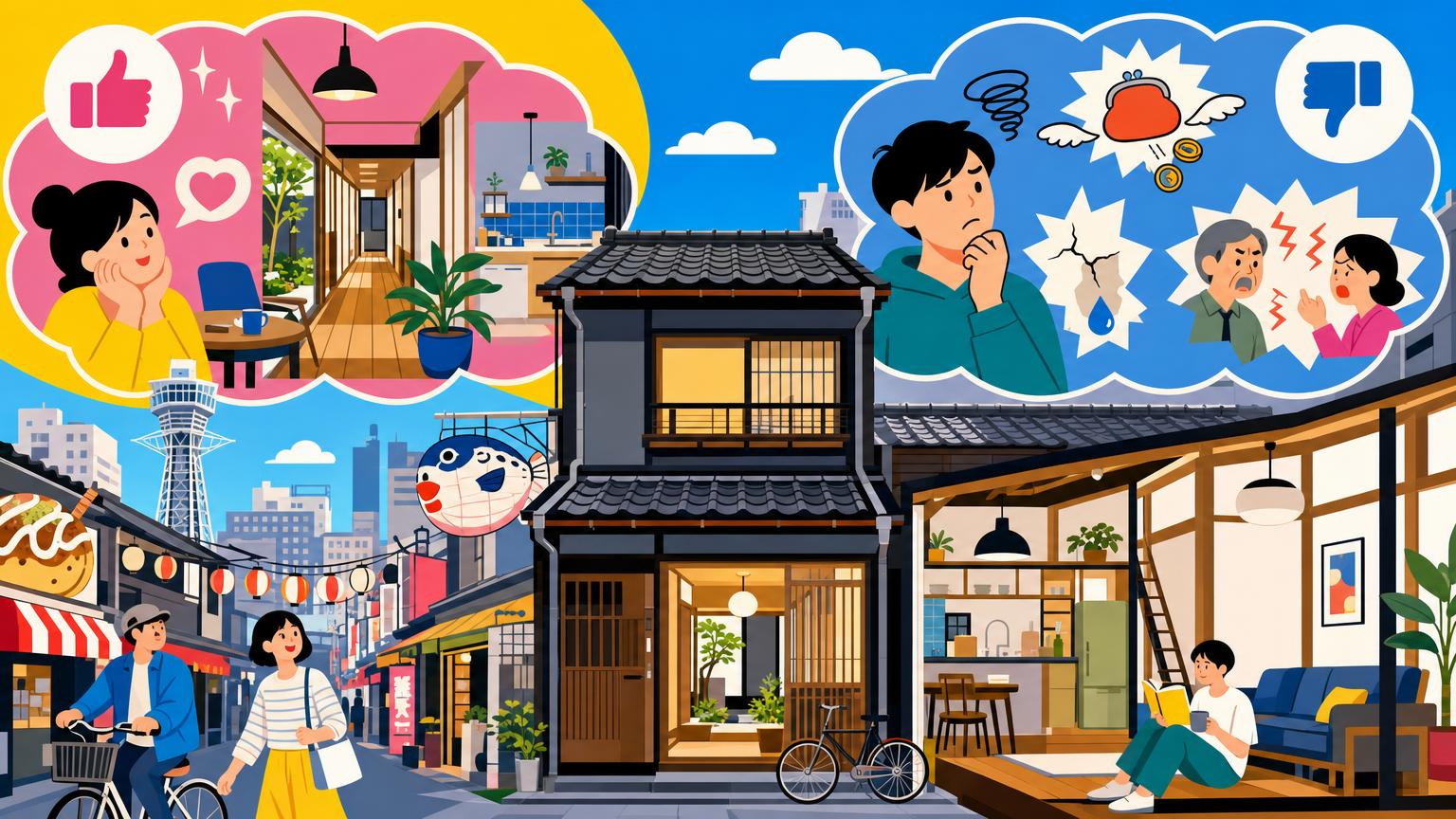
A shared building, not a detached old house
The Japanese word nagaya is often translated as “row house” or “longhouse.” Traditionally, several homes were built side by side beneath one continuous roof. Each household had its own entrance, but the walls, structure, roofline, and sometimes utilities were closely connected.
This arrangement was practical in dense urban districts. Osaka developed as a commercial city, and working people needed housing near shops, workshops, markets, factories, and transport routes. A nagaya used land efficiently while also creating a narrow social distance between households. People could hear a baby crying, notice a missing bicycle, or recognize who had come home late.
That history still influences the atmosphere today. In a modern apartment, relationships between residents are usually managed through building rules, a management company, and anonymous hallways. In a nagaya, those relationships may be much more visible. You may know which neighbor leaves for work before sunrise. Someone may notice that your umbrella has been outside for three days. A local shopkeeper may remember your face before you know their name.
For some foreign residents, this feels like the warm community they hoped to find in Japan. For others, it feels like a loss of privacy. Both reactions are reasonable.
Why “renovated” does not mean “new”
A renovated nagaya may have new plumbing, wiring, insulation, bathrooms, kitchens, windows, and interior finishes. At the same time, it may still have an old foundation, a narrow floor plan, low ceilings, shared walls, and a roof structure that requires special maintenance.
The word “renovation” has a broad meaning in Japan. One property may receive a complete architectural upgrade. Another may have a new kitchen and attractive flooring but only limited structural work. Do not judge the building by the quality of its lighting or furniture. Ask what was actually repaired.
The best renovation projects make this distinction clear. A project such as Suehiro Nagaya, an Osaka row house originally built in 1933, was designed for continued residential use rather than simple preservation as a museum piece. Its approach included compact water areas, the use of front yards, space for residents to customize, and a documented method for seismic reinforcement.
This is an important idea for renters. Good preservation does not freeze a nagaya in the past. Instead, it aims to make old housing usable for present-day life while respecting the building’s limitations.
The materials foreigners often notice first
Renovated Osaka nagaya frequently use natural materials such as cedar, plaster, solid wood, earthen finishes, and traditional joinery. These materials create a sensory experience that differs from vinyl wallpaper and steel doors. The house may smell faintly of wood after rain. The walls may feel soft rather than glossy. Sunlight may move across the room in a way that makes the passage of time especially noticeable.
Uraura Nagaya in Suminoe is a clear example. Its own description presents the property as a renovated Showa-era nagaya using cedar and plaster, with a quiet residential setting and a kitchen designed for everyday cooking. It is near Sumiyoshi Taisha, but the more useful point for a potential resident is its distance from the station and its location within a calm neighborhood rather than a major commercial center.
Natural materials are not automatically easier to maintain. Cedar can become marked and discolored. Plaster can crack. Wooden floors show dust quickly. A front garden requires attention. The same features that give a nagaya its character can also make the house less forgiving than a standardized apartment.
The Pros of Renting a Renovated Nagaya in Osaka’s Shitamachi
More space for the rent, especially in low-rise neighborhoods
The first practical advantage is often the amount of space. Many nagaya are wider or deeper than a typical urban one-room apartment. You may have a separate living room, a small upstairs bedroom, a work corner, a kitchen with enough room to prepare food, and an entrance area for storing bicycles or umbrellas.
This matters in Osaka because daily life often takes place at home in a more relaxed way than in central Tokyo. Someone working remotely may want a room that can be closed off after work. A couple may prefer separate sleeping and living areas. Someone with children may need space for strollers, school bags, and seasonal clothing.
The advantage is not necessarily a greater number of square meters. It is the layout of the space. A narrow modern apartment can be technically efficient but feel emotionally cramped. A nagaya may offer a sequence of rooms that allows different activities to happen at the same time.
However, never assume that every renovated nagaya is spacious. Some have very small rooms, steep staircases, limited closet space, or awkward corners created by preserving the original structure. Measure your furniture before signing. “Two floors” does not necessarily mean “easy to live in.”
A stronger connection to the street
In Osaka’s shitamachi, the front of the home often feels connected to the public street. People sweep outside. Bicycles are parked near the entrance. Shopkeepers speak with customers from the doorway. Older residents may sit near the front of their homes in mild weather. Children move between houses, parks, schools, and neighborhood stores.
A renovated nagaya allows you to take part in this street-level life without necessarily becoming socially overcommitted. You can walk to a small supermarket, buy vegetables from a local shop, greet someone while taking out the trash, and return home through an alley where people recognize one another.
This is one way Osaka can feel different from Tokyo. Tokyo also has local communities, of course, but the default urban experience in many Tokyo apartment districts is more anonymous and professionally managed. In Osaka, especially in older neighborhoods, ordinary conversations may begin more easily. A neighbor may make a joke while warning you about a leaking pipe. A shop owner may ask whether you have just moved in. Someone may say, “Where are you from?” without intending a long conversation.
Foreign residents sometimes interpret this as either unusually welcoming or unusually intrusive. Usually, it is neither. It is a practical Osaka way of making initial contact. The person is testing the atmosphere. If you respond briefly and naturally, the interaction may end there. If you continue, it may develop into a relationship.
A chance to understand Osaka’s indirect directness
Osaka people are often described as direct, but that description requires some care. Directness does not always involve blunt confrontation. It can mean using humor, teasing, exaggeration, or an apparently casual comment to address a practical issue.
For example, a neighbor may not say, “Your washing machine is too loud.” Instead, they may smile and say, “You have a powerful machine, don’t you?” A shop owner may not formally explain a local custom. They may say, “You are doing it Tokyo-style,” and wait to see whether you understand.
The best response is usually not defensiveness. Ask a simple question, apologize if necessary, and adjust your behavior. “I’m sorry. What time would be better?” is more effective than a long explanation about how things are done in your home country.
A nagaya makes these moments more likely because sound, movement, and shared spaces are part of everyday life. Learning to read this style of communication can teach you more about Osaka than memorizing local vocabulary.
Less dependence on anonymous building management
A modern apartment building offers convenience, but many decisions are handled through a management company. Complaints, repairs, garbage issues, and problems in common areas follow formal procedures. In a renovated nagaya, the owner or a small local management team may be easier to reach.
That can be a major advantage when something goes wrong. A landlord who knows the building may understand where rainwater enters, which floorboard shifts in humid weather, or how the previous renovation handled the shared wall. You may receive a faster and more personal response than you would from a large property company.
It can also mean that service is less predictable. A small owner may respond warmly but not immediately. A repair may require a specialist who is familiar with old wooden buildings. You should ask exactly how maintenance requests are handled, particularly if you are not comfortable speaking Japanese.
A home with cultural continuity rather than decorative “Japan”
There is a difference between living in an old neighborhood and staying in a room designed to look old. A renovated nagaya may retain signs of ordinary life: a narrow entrance, a reused beam, a small courtyard, a shared alley, a patched wall, or a kitchen located where the original water area once stood.
That continuity can be meaningful. You are not simply consuming an aesthetic. You are living in a building type that survived because people repeatedly adapted it. It has been a home, a rental, a workspace, an empty building, and perhaps a home again.
Open Nagaya Osaka reflects this broader approach to preservation. The event opens multiple nagaya properties to the public, allowing people to see how these buildings are being lived in, maintained, and reused. The 2026 event is scheduled for November 7 and 8 and is organized with the participation of owners, residents, and researchers and students from Osaka Metropolitan University.
For renters, the lesson is straightforward: preservation depends on ordinary occupancy. A nagaya survives not only when experts admire it, but when someone cooks dinner there, pays rent, separates garbage, reports a leak, and stays long enough to care about the place.
Potentially lower pressure than a central high-rise lifestyle
A shitamachi nagaya may offer a calmer rhythm. The street may be quiet at night. You may hear bicycles rather than traffic. A small neighborhood market may take the place of a large shopping complex. You may begin planning your day around local opening hours instead of expecting every service to be available twenty-four hours a day.
This can be a good fit if you want to live in Osaka rather than simply sleep near a station. Areas around Suminoe, Sumiyoshi, parts of Ikuno, Nakatsu, and older pockets near Fukushima can offer very different versions of local life. The key is not to choose based on the ward name alone. Osaka’s neighborhoods can change noticeably within just a few blocks.
KITA-no-Kita-Nagaya in Nakatsu shows another version of this transition: old wooden housing used as a base for accommodation, creative activities, and small community events. Its existence illustrates how a nagaya can become a shared social space rather than merely a private residence.
The Cons of Renting a Renovated Nagaya
Heating and cooling may be less comfortable than expected
This is the most common practical surprise. A renovated nagaya may look beautiful and still be difficult to heat evenly. Osaka winters are not the coldest in Japan, but the dampness can make cold rooms feel even colder. Summers are hot, humid, and long. A wooden house with older proportions may have rooms that heat and cool at different rates.
One room may become comfortable while the staircase remains cold. The bathroom may feel much colder than the living room. Air conditioning may work well downstairs but fail to reach an upstairs bedroom. You may need to use a dehumidifier in summer and a heater or heated rug in winter.
Ask about insulation, window glazing, roof insulation, and the age of the air-conditioning units. Do not consider “the house has air conditioning” a complete answer. Ask which rooms have units and whether the owner has records of renovation work.
If you work from home, visit the property at the time of day when you expect to work. Pay attention to the temperature, light, street noise, and ventilation. A beautiful room can become tiring if it is too hot by mid-afternoon.
Sound travels through shared walls and narrow streets
Nagaya walls are shared. Even after renovation, the sound environment may not be comparable to that of a reinforced-concrete apartment. You may hear footsteps, water pipes, doors, bicycles, conversations, televisions, or a neighbor’s washing machine.
The reverse is true as well. Your neighbors may hear you. Foreign residents sometimes worry about speaking English, playing music, or cooking late at night. The language is usually not the issue; the volume and timing are.
Osaka’s neighborhood culture often tolerates ordinary life but dislikes careless disturbance. A crying baby is understandable. A washing machine running at an unreasonable hour is not. Someone coming home late is normal. A loud group talking under someone’s window is not.
The safest approach is to live as though the walls are thinner than advertised. Use headphones at night, close doors gently, place felt pads under furniture, and avoid assuming that a quiet street means the neighborhood accepts noise.
Uraura Nagaya’s own rules prohibit parties, loud music, and excessive noise, and state that disruptive behavior can lead to the stay being terminated without a refund. Although this is a short-term property rather than a standard long-term lease, the rules reveal the underlying expectation: a nagaya depends on residents helping to protect the quiet of the shared neighborhood.
Privacy is different from security
A nagaya can feel safe because people know the street. That does not mean you will have complete privacy. Windows may face a narrow passage, and neighbors may pass close to the entrance. Curtains may need to remain closed at certain times. Deliveries, garbage collection, and children playing may take place near your front door.
In Tokyo, many foreign residents become accustomed to privacy created by height and distance. A twentieth-floor apartment separates you from the street. In a nagaya, you are closer to everyday neighborhood activity. The advantage is human contact; the disadvantage is that your daily habits are more visible.
Think carefully about your personality. If you enjoy greeting people and hearing the life of a neighborhood, this may feel grounding. If you need a strong boundary between home and public space, inspect the entrance, windows, and neighboring units very carefully.
Old-house maintenance can be specialized and expensive
Wooden buildings require ongoing attention. Moisture, termites, roof leaks, plumbing failures, mold, drainage problems, and uneven floors are genuine risks. Renovation reduces these risks, but it does not eliminate the building’s age.
As a tenant, you are not normally responsible for major structural repairs, but you are responsible for reporting problems early and using the home properly. The lease should explain repairs, restoration obligations, emergency contacts, and what happens if damage is caused by negligence.
Ask whether the property has undergone a seismic inspection or structural reinforcement. Ask what was renovated and when. Also ask whether the shared roof, exterior wall, drainage system, or foundations are managed by one owner or by multiple owners.
A beautiful interior may conceal complicated ownership arrangements. Some nagaya have separate units with different landlords. Others have shared areas that are not clearly managed. Before moving in, find out who has the authority to approve repairs.
Fire and earthquake concerns deserve direct questions
A wooden row house is not automatically unsafe, but its age and construction method are important. Osaka has many older wooden neighborhoods, and disaster preparedness is part of responsible living. You should know the locations of evacuation areas, fire extinguishers, breakers, gas shutoff procedures, and emergency exits.
Ask whether the renovation included fire-resistant treatments, updated electrical wiring, smoke alarms, and seismic reinforcement. If the answers are vague, treat that as useful information. You are not being difficult by asking; you are deciding whether the property is suitable for long-term living.
A well-managed renovation may include clear documentation. Projects connected with architectural preservation research have emphasized practical reinforcement methods rather than relying on appearance alone. Suehiro Nagaya, for example, included a written approach to seismic improvement as part of its renovation model.
Storage is often worse than the floor plan suggests
Older Japanese homes were designed around different possessions and lifestyles. Built-in closets may be narrow, and there may be no large Western-style wardrobe. The staircase may take up valuable space. The entrance may not accommodate several large suitcases, bicycles, or sports equipment.
Japanese homes also require seasonal rotation. Bedding, heaters, fans, winter clothing, umbrellas, cleaning tools, and recycling containers all take up space. If you live with a partner, agree on storage arrangements before signing the lease.
Measure the doors and stairs. A sofa that fits the room may not fit through the entrance. A refrigerator that fits in the kitchen may not pass through the corridor. These problems are common in older properties and are easier to prevent than to solve.
Daily convenience can be more limited than station distance suggests
A nagaya may be ten minutes from a station but twenty minutes from the supermarket you actually use. The nearest train line may not take you where you need to go. A neighborhood may have restaurants but no late-night pharmacy. A small local store may close early or accept only cash.
This is one way living in Osaka differs from choosing a short-term base. During a trip, walking twenty minutes for groceries can feel pleasant. After work, in heavy rain, with laundry waiting at home, it can feel like a daily tax.
Check the actual route to your workplace, school, supermarket, clinic, bank, and garbage collection point. Walk it after dark. Pay attention to the pavement, bicycle traffic, lighting, and number of people outside.
A neighborhood may be quiet because it is peaceful. It may also be quiet because many shops close early and there is little activity after sunset. Neither is automatically good or bad. The question is whether it suits your routine.
Foreign residents may face more paperwork and hesitation
Some landlords are comfortable renting to foreign residents. Others worry about language, guarantors, emergency contacts, unpaid rent, or misunderstandings about neighborhood rules. An old wooden house may make an owner more cautious because repairs are expensive and the building is closely connected to neighboring units.
This does not mean foreigners cannot rent nagaya. It means preparation is important. Have your residence card, employment or school information, emergency contact, Japanese phone number, and proof of income ready. If a guarantor company is required, ask what it covers and what fees apply.
Do not rely on the phrase “foreigner-friendly” without asking practical questions. Does the contract include an English explanation? Who receives maintenance requests? Can you communicate by email? Are there rules about guests, bicycles, pets, cooking, or working from home?
A local real-estate agent who understands older housing is often more useful than a large agency that only handles standard apartments. You want someone who can explain not only the rent, but also the building’s history and the owner’s expectations.
Osaka Shitamachi Life: What Foreigners Often Misunderstand
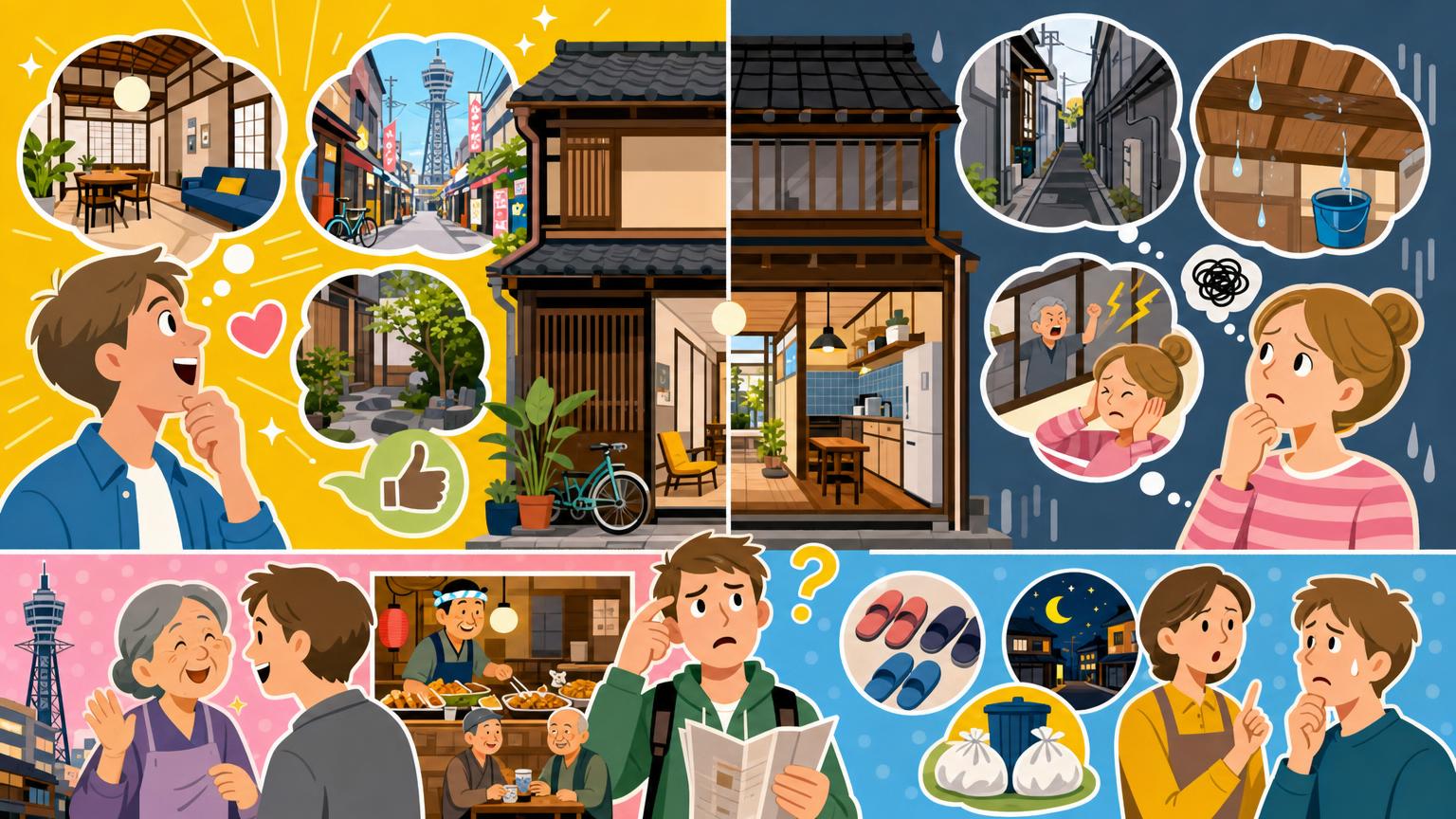
“Friendly” does not mean everyone wants a close relationship
Osaka’s popular image is that its people are friendly, humorous, and open. There is some truth to this, but the word “friendly” can be misleading for foreign residents.
In many Osaka neighborhoods, people may speak to you more casually than people in Tokyo. They may joke with you, ask direct questions, or comment on your Japanese. This does not necessarily mean they are inviting you into their private lives. It may simply be a brief social exchange.
The best response is to accept the moment without expecting more from it. Smile, answer, and pay attention to the other person’s energy. If they continue, continue the conversation. If they return to their work, allow the conversation to end.
At the same time, do not assume that casual speech means rules are optional. An older neighbor may joke with you and still expect you to separate your garbage correctly. A shopkeeper may laugh with you and still refuse service if you arrive after closing. Osaka warmth often exists alongside firm practicality.
Osaka directness is not permission to be loud
Foreign residents sometimes hear that Osaka people are more relaxed than people in Tokyo and conclude that loudness is acceptable. This is a mistake. Osaka may have a more expressive public culture, but neighborhoods still value consideration.
People may laugh loudly in a restaurant, bargain playfully at a market, or speak with emphatic gestures. At home, however, those same people may be strict about late-night noise. Public energy and residential behavior are not the same thing.
In a nagaya, your personal freedom ends where the shared wall begins. You can be sociable without making your home acoustically public.
A local neighborhood may not be designed around foreign residents
Central Osaka offers many services for international residents, but older shitamachi areas may function primarily in Japanese. Notices from the residents’ association may be handwritten. Garbage instructions may be posted only in Japanese. The person managing the neighborhood recycling station may be a retired resident who is not comfortable explaining the system in English.
This is not necessarily a sign of hostility. It indicates that the neighborhood’s systems were established before international residents became common. You may need to ask for help, translate documents, and learn through repetition.
If you make an effort, people often respond positively. You do not need perfect Japanese; you need reliable behavior. Say hello. Put out your garbage at the correct time. Keep your bicycle where you are instructed. Attend a meeting if your landlord says it is important. Tell someone if you will be away for an extended period.
In a small neighborhood, trust is built more through predictable actions than impressive conversation.
Osaka is not one culture, and shitamachi is not one income group
“Shitamachi” means low town or downtown, but it does not describe a single, uniform identity. Neighborhoods differ in history, industry, ethnicity, age structure, income, housing stock, and proximity to stations.
Suminoe and Sumiyoshi do not feel identical to Fukushima. Nakatsu does not feel identical to Ikuno. A street near a major station can change quickly, while a parallel street may still have long-term residents, small factories, and family-owned shops.
Some older areas have strong Korean and other immigrant histories. Some have many elderly residents. Others are changing through new cafés, creative businesses, and renovated housing. You should avoid reducing any area to a simple story about “traditional Osaka.” The people who live there may hold very different views on development, tourism, vacant houses, and foreign residents.
A renovated nagaya often sits directly within these changes. You may be part of neighborhood renewal, but you may also be entering a place where residents are tired of being treated as a backdrop for someone else’s lifestyle.
Where Renovated Nagaya Projects Fit Into Osaka’s Future
From Vacant House to Working Home
Osaka has many older wooden buildings that become difficult to maintain as their original owners age, move away, or divide the property among family members. Demolition is often easier than repair. Yet tearing down a building removes more than just its structure; it also erases a pattern of streets, small gardens, and shared history.
Renovation offers another possibility. A nagaya can be transformed into a long-term rental, design studio, small restaurant, bar, guesthouse, or mixed-use community facility. The challenge is preserving the property’s connection to everyday local life rather than turning it into a decorative shell.
KITA-no-Kita-Nagaya demonstrates how a preserved wooden complex can support accommodation and small-scale creative activity. Suehiro Nagaya shows how an old building can continue serving as rental housing. Uraura Nagaya illustrates how a renovated Showa-era row house can function as a quiet, home-style property near Sumiyoshi. These examples differ, but together they reveal the range of possible futures.
The Risk of Lifestyle Branding
There is also a potential danger. Once a nagaya becomes fashionable, the building may be marketed as a lifestyle product. The language may highlight “hidden alleys,” “authentic Osaka,” natural materials, and local charm while overlooking the people who already live nearby.
For residents, this distinction matters. A new tenant seeking atmosphere may complain about ordinary neighborhood sounds. A café may attract visitors who block entrances or leave trash behind. A short-term rental may bring guests who do not understand quiet hours. Renovation can help preserve a building while weakening the social conditions that made the area livable.
That is why responsible renters should ask how the property is used. Is it a long-term home, short-term accommodation, or mixed-use building? Are guests frequently coming and going? Are events held there? Who handles complaints? What does the owner expect from residents?
Living in a preserved building means recognizing that preservation is social as well as architectural.
A Practical Decision Framework Before You Sign
Questions about the building
Ask when the nagaya was built and whether the construction date has been documented. Clarify what “renovated” includes, and request details about the wiring, plumbing, insulation, windows, roof work, termite treatment, fire safety, and seismic reinforcement.
Ask whether the property shares walls, utilities, a roof, a drainage system, or an entrance with other units. Find out who pays if a shared component fails and how emergency repairs are handled at night.
If the agent cannot answer, ask whether the owner can provide written information. A vague answer does not prove that the property is bad, but it does mean you should not make optimistic assumptions.
Questions about daily life
Ask where residents dispose of burnable garbage, plastics, cans, glass, oversized waste, and recycling. Find out whether the neighborhood association charges a fee or requires volunteer participation. Ask whether bicycles must be registered or kept in a designated parking space.
Ask about pets, guests, musical instruments, working from home, children, cooking smells, smoking, and overnight visitors. Find out whether the front area is private or shared, who sweeps the alley, and whether tenants are expected to participate.
These questions may seem unusually detailed to foreigners. In a nagaya, they are not minor details; they define the relationship between your household and the surrounding homes.
Questions about your own lifestyle
Be honest about your tolerance for heat, cold, noise, stairs, insects, dust, and maintenance. Consider how often you cook, how much storage you need, whether you own a bicycle, and whether you need a quiet room for online meetings.
Think about your work schedule. If you return home at midnight, a quiet residential nagaya may be inconvenient. If you leave at six in the morning, neighbors may hear your routine. If you work remotely, test the internet rather than assuming that a renovated property has reliable service.
Think about visitors. Do you want friends to drop by spontaneously, or would a narrow entrance and close neighbors make that uncomfortable? Do you need an accessible bathroom? Could you manage the stairs if you became injured?
A nagaya rewards self-awareness. It is not the best home for someone who wants to ignore the physical building.
Visit more than once if possible
A single viewing shows you the property, while two or three visits show you the neighborhood.
Visit during the morning rush, in the early evening, and after dark. Listen for trains, delivery trucks, schoolchildren, restaurants, air-conditioning units, and neighborhood announcements. Check how wet the street becomes after rain, and look for signs of standing water, roof damage, mold, or abandoned bicycles.
Do not inspect only the front room. Open closets, look under sinks, check the bathroom ceiling, stand upstairs and listen, test mobile reception, measure the stairs, and examine the distance between your windows and the next building.
The most useful viewing question is not “Does this look beautiful?” but “Can I repeat an ordinary Tuesday here?”
Is Renting a Renovated Nagaya Right for You?
A renovated nagaya in Osaka’s shitamachi can be an excellent choice if you want a home with character, more space than a standard apartment, and a closer connection to the surrounding neighborhood. It can help you experience Osaka through small daily encounters: the neighbor who comments on the rain, the shop owner who remembers your usual purchase, the handwritten notice about garbage collection, and the quiet expectation that everyone will help protect the shared street.
It may not be right for you if you need perfect insulation, complete privacy, predictable modern facilities, ample storage, or a management company that handles every problem from a distance. A nagaya is not simply a charming apartment with a slightly older exterior; it is a connected part of urban life.
Compared with Tokyo, Osaka may offer more room for casual conversation and a less formal atmosphere in everyday interactions. However, that informality comes with responsibility. People may speak openly, but they still notice whether you behave considerately. A joke can make a first encounter easier, but only consistent behavior builds trust.
The strongest reason to rent a renovated nagaya is not its traditional appearance. It is that the home can place you within a living relationship between old buildings, new residents, and established neighborhoods. The strongest reason not to rent one is the same.
If you are prepared to listen through the walls, learn the local rhythm, ask direct questions, and accept that home extends slightly into the street, a renovated nagaya can offer an unusually rich way of living in Osaka. If you want your house to provide atmosphere without asking anything of you, a modern apartment will probably be the better choice.