A common question from foreigners living in Osaka is simple: “Why does my manager want to go drinking after work when we already spent the whole day together?” Another is more difficult: “If I do not join, will people think I am not part of the team?”
The answer is not that every Osaka employee loves alcohol, or that every colleague wants to become your friend. The more useful answer is that the after-work tachinomi—a standing bar where people drink and eat without sitting at a formal table—can function as an informal extension of the workplace. It is a place where rank becomes softer, conversations become less scripted, and professional relationships are tested in ordinary, sometimes awkward, human situations.
This is one reason tachinomi culture matters when you are thinking about living in Osaka. You may encounter it through a Japanese company, a part-time job, a supplier relationship, a neighborhood association, or a group of colleagues who suddenly stop at a small bar near the station. The important thing is not whether you drink. It is understanding what the invitation means, what it does not mean, and how Osaka’s communication style shapes the evening.
The map below is only a central-Osaka reference point. The city’s standing bars are not concentrated in one official district; they appear around station shopping streets, old arcades, office neighborhoods, and the narrow lanes between major railway hubs. Google’s standard method for an embedded map is to select “Share,” choose “Embed a map,” and copy the generated HTML.
What a Tachinomi Really Is in Osaka

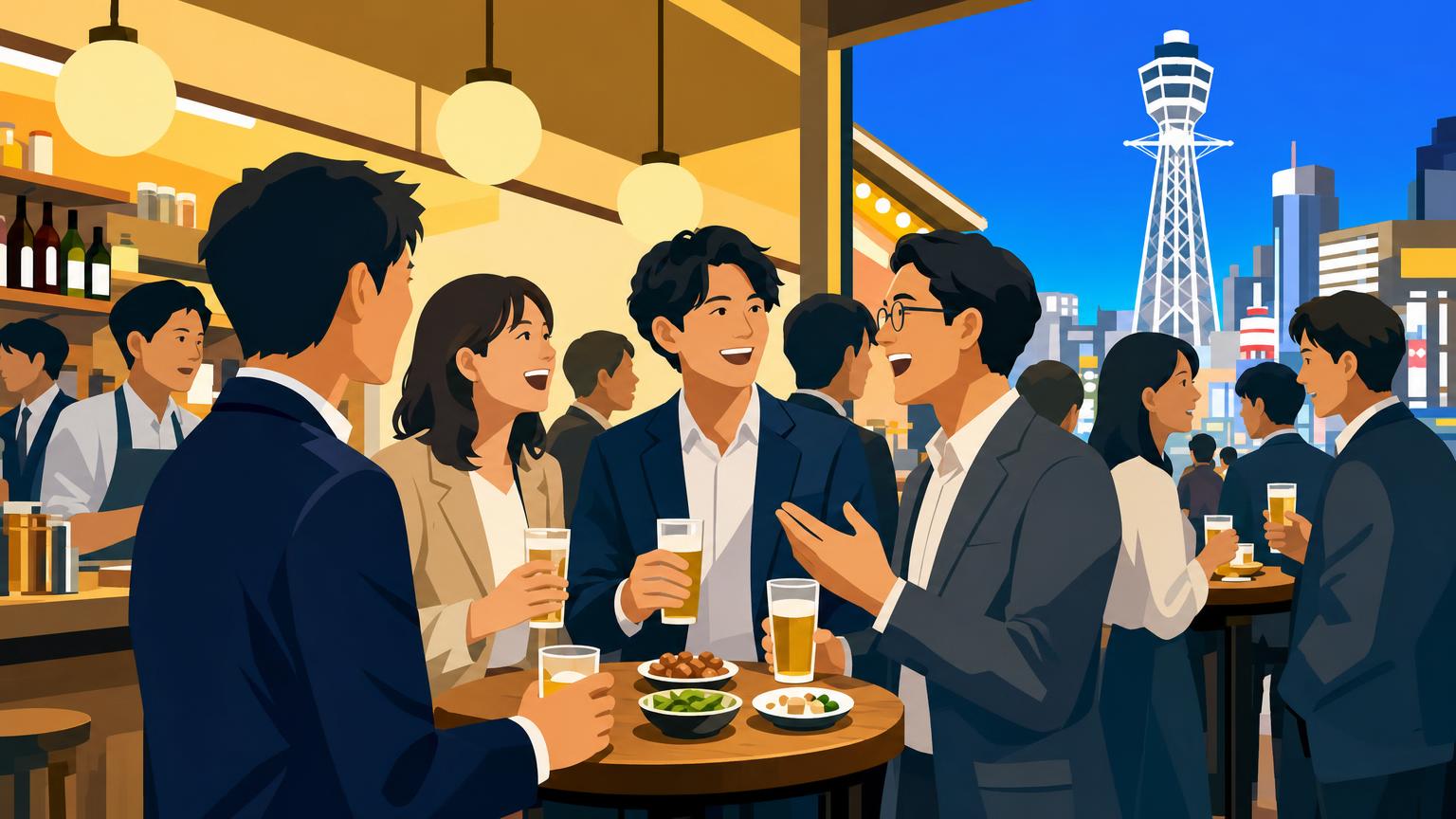
Tachinomi literally means “standing drinking.” In everyday use, it refers to a bar or small restaurant where customers stand at a counter, around narrow tables, or in a compact open space while eating and drinking. Some places provide a few stools, while others are strictly standing. The defining feature is not simply the absence of chairs, but the quick, flexible, low-ceremony style of eating and drinking.
A typical tachinomi may feature a counter covered with small plates of food, handwritten menus, plastic baskets of chopsticks, and bottles lined up behind the staff. You might order a beer, a Lemon Sour, grilled pork, Doteyaki—beef sinew stewed in miso—or a plate of pickles. You eat, talk, pay, and leave without turning the visit into a long, formal meal.
That speed matters in Osaka. The city has long maintained a strong culture of practical commerce, small independent businesses, market streets, and face-to-face negotiation. A tachinomi fits naturally into that environment. It is inexpensive enough for a quick stop, informal enough for spontaneous conversation, and compact enough to operate near a station or shopping arcade.
The atmosphere is often noisy, though not necessarily chaotic. Staff call out orders, glasses touch the counter, and a regular customer may greet someone across the room. Two people who arrived separately may end up discussing baseball, local politics, a difficult customer, or the best place to buy fish. Because the space is physically tight, social distance is reduced. You cannot easily hide behind a large table, a laptop, or a private room.
This physical arrangement influences behavior. In a restaurant, your group can remain enclosed within its own table. At a tachinomi, the boundaries are more porous. You share standing space and may move aside when another customer enters. You might answer a brief question from a stranger or overhear a conversation without being expected to join it. The result is a form of public intimacy: close enough for interaction, but temporary enough to remain low-pressure.
Tachinomi Is Not the Same as a Company Nomikai
Foreign residents often group all after-work drinking under the term nomikai, which can cause confusion. A nomikai is a drinking gathering, often organized for a workplace, club, school, or social group. It may take place in a restaurant with a fixed menu, reserved seating, and a set duration.
A tachinomi stop is generally more flexible. A supervisor may say, “Shall we have one?” and mean a twenty-minute drink before heading home. Someone may join late and leave early, while one colleague may order only tea or food. A group of five may become a group of three after the first round, then split up again when another acquaintance appears.
A formal company drinking party can involve stronger expectations. A tachinomi often allows more room for personal choice. This does not mean there are no social consequences, but the pressure is usually less visible and less ceremonial.
The distinction is useful when living in Osaka because workplace invitations can vary greatly. “Let’s go drinking” might mean a planned event, a small team meal, a spontaneous stop near a station, or simply a polite phrase with no immediate plan behind it. Pay attention to the time, the number of people, and whether someone gives you a specific place and hour.
Why After-Work Tachinomi Matters to Osaka Work Culture
The role of a tachinomi is not merely to help people relax. It creates a second communication channel alongside the official workplace.
During office hours, relationships are structured by job titles, departments, deadlines, and formal responsibilities. A junior employee may speak carefully to a manager. A salesperson may present only information relevant to a client. A foreign employee may use simple Japanese because the meeting is too important for experimentation.
At a tachinomi, the same people meet one another in a less controlled setting. The manager may complain about the train, the junior employee may talk about cooking, and the foreign colleague may discover that a quiet coworker is actually very funny. These details do not automatically create friendship, but they give people more material for understanding one another.
That understanding can influence work. A colleague who knows how you communicate may be more willing to explain an unclear request. A manager who sees that you are considerate in a crowded bar may trust you with a sensitive client interaction. A supplier may remember you as a person rather than simply as the name on an email. A coworker may feel more comfortable warning you about a workplace custom before you accidentally violate it.
This is networking, but it is not usually networking in the self-promotional style familiar in international business settings. You are not expected to give a polished introduction or exchange business cards every few minutes. Networking in a tachinomi tends to develop through repeated contact, practical conversation, and recognition.
The same faces appear near the same stations. A restaurant owner remembers your usual order. A colleague introduces you to someone from another department. Someone asks where you live, which line you take, or how long you have been in Japan. These questions may sound ordinary, but they create a social map. Over time, that map can become more valuable than a single formal meeting.
The Osaka Preference for Informal Testing
Osaka communication often includes a small test of responsiveness. People may joke with you, ask a direct question, or make a playful comment to see how you react. At a tachinomi, this can be especially noticeable.
A coworker may say, “Your Japanese is getting dangerous,” after you use a new phrase. Someone may ask, “Are you really going home after one drink?” Another person may exaggerate a complaint about the weather or the office. The purpose is not always to obtain factual information. It may simply be to create an opening.
Foreigners sometimes interpret this as criticism or unprofessional behavior. Sometimes it is criticism. Osaka is not a magical place where every joke is kind. But in many ordinary interactions, teasing is a way to reduce distance. If you respond only with a serious explanation, the conversation may end. If you smile, answer briefly, or return a gentle joke, the relationship may become more comfortable.
You do not need to perform comedy. A simple response may be enough: “I am still learning,” “That is my Osaka training,” or “I will try one more drink, but only one.” The important skill is recognizing whether the comment is an invitation to continue talking or a genuine boundary being expressed.
Why People Talk More Freely After Work
Alcohol can reduce self-consciousness, but the deeper change comes from the setting. A person who is silent in a conference room may speak more naturally while standing at a counter. There are fewer presentation rules. Conversations begin and end quickly. You can listen without taking notes.
This does not mean that people reveal their true selves in a perfect or complete way. Alcohol can also lead to misunderstandings, unwanted comments, and pressure. Treating a tachinomi as a place where “the truth always comes out” is overly romantic. People are still managing impressions. They are simply using a different style of impression management.
In Osaka, the difference may be noticeable in the language. Formal Japanese can soften into casual Japanese. A person who normally says desu and masu may shift toward shorter endings. Osaka dialect may appear, especially in jokes, complaints, and reactions. The conversation can become more emotional and direct, but it may also become less precise.
For foreigners, this creates both opportunity and risk. You may understand the person better, but you may also mistake a joke for a promise or a complaint for a serious decision. Important work matters should still be confirmed later in a clear message or meeting.
What Happens During an After-Work Tachinomi Stop
The most common pattern is straightforward. A few colleagues leave work together, walk toward the station, and enter a small bar. Someone checks whether the group should sit inside or outside. The first order arrives quickly, and food is selected in small portions. People talk about the day and then move on to unrelated topics.
After ten or thirty minutes, the group decides whether to continue. Some people go home, while others move to a second place. A few may return to the office area or take a train to another neighborhood. There may be no official ending time.
This flexible rhythm is part of the culture. You are not necessarily expected to commit to the entire night. Saying, “I can stay for one drink,” is often a practical way to participate without giving up your evening.
The Meaning of “One Drink”
When a colleague asks you to have one drink, do not assume the phrase is meant literally. It may refer to one actual drink, one short stop, or the first stage of a longer evening. Context matters.
If you need to leave, state your limit early and calmly. “I can stay until eight” is clearer than “Maybe I should go soon.” In Japanese, “I have to leave at eight” can be expressed as hachi-ji ni wa kaerimasu. You do not need to apologize repeatedly. A clear time boundary is easier for everyone than quietly withdrawing.
If you are not drinking, say so at the beginning. “I do not drink alcohol” is osake wa nomimasen. “I am driving” is unten shimasu. “I am taking medicine” is kusuri o nondeimasu. These explanations are not always necessary, but they can help others understand your decision.
Many tachinomi offer non-alcoholic options, soft drinks, tea, food, or alcohol-free beer. The social value of joining is not limited to drinking alcohol. Still, some groups may be less flexible than others. If someone repeatedly pressures you after you have answered clearly, the issue is not Japanese culture; it is that person’s poor behavior.
How Tachinomi Builds Team Bonding

Team bonding in Osaka often develops through a series of small, repeated encounters rather than one dramatic event. A brief stop after work can build familiarity without requiring a deep emotional conversation.
A colleague may discover that you dislike raw fish, are looking for an apartment, or have trouble reading handwritten menus. The next time, they might choose a restaurant with food you can eat, help interpret a menu, or introduce you to someone familiar with the neighborhood. This is practical care, not necessarily sentimental friendship.
The standing format also makes it easier for people to mingle. At a seated restaurant, the person next to you may remain there for two hours. At a tachinomi, people move around, turn, make room, and speak across the room. A manager might stand beside a new employee for five minutes before exchanging places with someone from another team.
This movement can weaken departmental boundaries. In a company where people seldom meet outside their immediate unit, a station-side tachinomi can serve as a neutral zone. The sales team, warehouse staff, designers, technicians, and office administrators may interact without their usual internal labels.
The Value of Low-Stakes Conversation
Not every useful conversation concerns strategy. In fact, many relationships develop through topics that seem unimportant: local train delays, lunch prices, children’s school schedules, a neighborhood festival, a new supermarket, or the best way to dispose of furniture.
These subjects show you how people manage daily life. You may find out that a colleague lives in Tenma, Kyobashi, Fuse, or near the bay area. You may learn which train line they avoid, which shopping street closes early, or which local custom is important to their family.
For a foreign resident, this is a valuable form of cultural education. Official orientation materials can explain garbage collection or commuter passes. Coworkers at a tachinomi may explain what people actually do when the collection schedule is unclear, when a landlord is slow to make repairs, or when a neighborhood association leaves a notice at your door.
The Importance of Remembering Small Details
Networking in Osaka rewards attentiveness. If someone tells you they are studying for a qualification exam, ask about it later. If a colleague recommends a local food, try it and mention it the next time you meet. If someone says their parent is unwell, do not raise the subject loudly in front of the entire group, but a quiet “How is your family?” can show that you were listening.
You do not need to be socially aggressive. Repeated small acknowledgments are enough. Relationships in Osaka often become comfortable through accumulated familiarity. The person who remembers your usual drink, the name of your neighborhood, or your previous job may not be a close friend, but the relationship has become genuine.
Osaka Compared with Tokyo: Similar System, Different Texture
It would be misleading to say that Osaka has one drinking culture while Tokyo has another. Both cities include formal corporate drinking, casual bars, international communities, long-established neighborhood establishments, and young people who would rather go home and watch streaming shows.
The difference is often a matter of texture and expectation rather than a strict rule.
Tokyo’s workplace networks can feel more segmented by industry, company status, neighborhood, and professional identity. Many people maintain several separate social circles, including university friends, coworkers, clients, hobby groups, and family. The city’s size and commuting patterns can make spontaneous contact difficult. A colleague may live far away, change trains twice, and avoid staying out because the last train is a serious concern.
Osaka also has long commutes and strong professional boundaries. However, the city’s central neighborhoods can feel more compact and socially legible. People may know which station area is associated with a particular mood: office workers, old merchants, younger creatives, late-night restaurants, or traditional local businesses. A quick stop after work is often physically easier because the bar, station, shopping street, and residential area are located close together.
Conversation can also feel more openly evaluative in Osaka. People may ask direct questions about your age, job, relationship status, salary range, or ability to eat spicy food. This is not always appropriate, and you may decline to answer. However, the directness can be less about formal intrusion than about quickly placing you within the social conversation.
Tokyo workplace communication may place greater emphasis on polished restraint and the ability to read subtle signals. Osaka communication may place more value on visible reaction, verbal energy, and keeping a conversation moving. Neither style is automatically warmer or more honest; they simply reward different skills.
Osaka Does Not Mean “Everyone Is Easygoing”
One of the most common misunderstandings is the idea that Osaka people are universally friendly and therefore easy to approach. The reality is more specific.
Many interactions in Osaka leave room for informal contact. A shopkeeper may joke with you. A coworker may ask direct questions. A stranger may comment on your Japanese. However, informal contact is not the same as personal acceptance. You still need to show consideration, pay your share, respect privacy, and avoid treating local humor as permission to behave carelessly.
People in Osaka may also be blunt when they are busy. A staff member may tell you to move because you are blocking the entrance. A colleague may quickly reject your proposal. A neighbor may complain about noise without using elaborate softening language. This directness can feel rude if you expect every disagreement to be wrapped in formal politeness.
The useful response is to separate tone from content. Ask yourself what practical information the person is conveying. Are they saying the request is impossible, or only that your timing is bad? Are they joking, or are they asking you to stop? When uncertain, ask for brief clarification rather than guessing.
How Foreign Workers Are Often Included—and Excluded
A tachinomi can be one of the easiest places for a foreign resident to experience everyday workplace life, but inclusion is not automatic.
You may be invited because your colleagues genuinely want you there. You may also be invited because the group assumes that everyone should attend. Sometimes you are included in the social ritual but excluded from the conversation because the Japanese is spoken too quickly. At other times, people may speak more slowly for five minutes, then return to their usual pace when the discussion becomes interesting.
This does not necessarily mean they dislike you. The setting may be noisy, the topic may involve local knowledge, and people may not have the language skills to translate while also taking part in the conversation. Even so, the result can be isolating. A foreign employee should not be expected to spend an evening in which nobody makes a reasonable effort to communicate.
You can improve the situation by asking for a brief explanation rather than a complete translation. “What are you discussing?” or “Can you give me the main point?” is easier for colleagues than “Please translate everything.” You can also contribute through topics that do not require advanced Japanese, such as food preferences, neighborhood comparisons, weekend routines, commuting, sports, fashion, music, or work processes you already understand.
If the group moves to a second location and you are tired, it is perfectly acceptable to leave. If you want to participate but cannot hear, stand closer to one or two people instead of trying to follow the entire room. A small conversation is more valuable than pretending to understand everyone.
Gender, Age, and Power Matter
The casual appearance of tachinomi culture can conceal workplace power differences. A manager who says, “Come with us,” may sound informal, but a junior employee may feel unable to refuse. Women may face expectations to pour drinks, listen to personal complaints, or tolerate comments that would not be made in a daytime meeting. Younger employees may be expected to stay until senior staff leave.
Foreign residents should not assume that Osaka’s joking atmosphere eliminates hierarchy. It often disguises hierarchy rather than removing it.
If you feel uncomfortable, establish a practical boundary. Stay near a trusted colleague. Avoid being the last person alone with a senior coworker if that is not what you want. Arrange your own transportation. Keep enough money and phone battery to leave independently. You can say, “I am going home now,” without giving a lengthy explanation.
A healthy workplace should respect refusal. It should not punish someone for not drinking, not staying late, or not discussing private matters. When evaluating a job in Osaka, observe how a team responds when someone says no. That response tells you more about the company than the mere existence of after-work drinks.
What to Order and How the Menu Supports Conversation
Tachinomi food is generally designed for sharing, eating quickly, and ordering repeatedly. The menu may feature several small dishes rather than large individual meals.
Doteyaki is beef sinew slowly stewed in miso. It is tender and rich, and is often served in a small bowl or on skewers. Kushikatsu consists of ingredients coated in batter, fried, and served on skewers. You may see pork, onion, lotus root, shrimp, or seasonal vegetables. Tamagoyaki is a rolled Japanese omelet. Namagaki means raw oysters. Yakitori refers to grilled chicken skewers, while horumon commonly refers to grilled offal.
You may also come across otsumami, a broad term for small snacks eaten with alcohol. These may include edamame, pickles, grilled fish, cold tofu, potato salad, dried seafood, or spicy vegetables. Food provides a natural way for people to participate, even when conversation is difficult. Asking “What is this?” can start a discussion without requiring a personal question.
For drinks, beer is common but not universal. A Lemon Sour is a shochu-based drink mixed with lemon and soda. Highball usually means whisky with soda. Umeshu is plum liqueur, often served with ice or soda. Nihonshu, commonly called sake in English, is rice-based alcohol served either warm or chilled.
If you do not know what to order, say osusume wa nan desu ka?—“What do you recommend?” You can point to another person’s drink and say onaji mono o onegaishimasu—“The same one, please.” However, do not use this if you have allergies or medical restrictions without first confirming the ingredients.
Food can also reveal workplace habits. The person who orders a large amount may be the informal organizer. The person who checks whether everyone has eaten may be socially attentive. The person who waits to see what the senior employee orders may be following the hierarchy. These patterns are subtle, but they can help you read the group.
Practical Rules for Joining a Tachinomi with Coworkers
You do not need perfect Japanese or expert knowledge of Osaka. You only need a few reliable habits.
Confirm the Invitation Without Making It Heavy
If a coworker invites you to join, ask where and for how long. “Which place?” and “How long will you stay?” are natural questions. If the invitation is vague, wait for a specific plan before rearranging your entire evening.
If you want to join, respond promptly. If you do not, decline simply. “Thank you, but I have plans tonight” is enough. There is no need to invent an emergency. Repeatedly offering complicated excuses can make the relationship more awkward than giving a clear refusal.
Bring Cash and Expect Small Payments
Some standing bars use cash-on-delivery. You place money in a small tray or bowl near your position, and the staff collect payment each time you order. Other places keep a running tab and calculate the bill when you leave. Do not assume that one system is used everywhere.
Observe what the regular customers do. If they place coins or bills on the counter, follow their example. If the staff keep a paper slip beside each customer, ask whether payment is made at the end. A useful phrase is kore wa saki-barai desu ka?—“Do I pay upfront?” You can also say okaikei onegaishimasu when you want the bill.
Small cash is especially useful in older neighborhood bars. Card and mobile payment availability varies. Even when a modern payment system is available, the staff may prefer the quick rhythm of cash for small orders.
Make Room Without Waiting to Be Asked
Standing bars rely on movement. Do not take up enough space for three people when you are alone. Keep your bags close to your legs or use the storage area if there is one. When someone enters, look around and shift slightly. If you need to pass, say sumimasen—“Excuse me”—instead of silently squeezing through.
This is one of the most important everyday words in Japan. Sumimasen can mean excuse me, sorry, or thank you for the inconvenience. In a crowded tachinomi, it shows that you understand other people are sharing limited space.
Do Not Turn a Short Stop into a Private Party
Keep your voice under control. A loud group can dominate a small bar, particularly when several colleagues are speaking English. Avoid placing coats, laptops, or shopping bags in another customer’s space. Do not photograph strangers without their permission.
If you are with coworkers, resist the urge to discuss confidential company matters loudly. The person standing beside you may know someone at your company, work for a competitor, or simply remember what you said. Informal does not mean private.
Leave When You Say You Will
A short visit is easier for everyone when you make a clean exit. Thank the staff, say goodbye to the group, and pay your share. If the group is continuing, you can say saki ni kaerimasu—“I am going home first.” This phrase is common and does not require an emotional explanation.
If your colleagues continue to pressure you, repeat the boundary instead of entering a debate. “I am leaving now. See you tomorrow.” A confident, ordinary exit is more effective than apologizing until someone gives you permission.
How to Use Tachinomi for Professional Networking
If you are looking for work in Osaka, a tachinomi can help you understand the local employment landscape, but it should not be treated as a place to aggressively ask for a job.
Begin with ordinary conversation. Explain what kind of work you do, what you are learning, and what type of workplace you hope to find. Ask which industries are common in the neighborhood or what skills companies are seeking. Someone may mention a friend, supplier, former coworker, or local business owner. The connection may prove useful later, but the first interaction should feel human rather than transactional.
A good introduction should be brief. Say your name, where you live, what you do, and why you are in Osaka. If your Japanese is limited, prepare two versions: one in simple Japanese and another in English. Do not give a long speech; let the other person ask questions.
Business cards may come up, especially when the group includes owners, salespeople, consultants, or older professionals. If possible, receive a card with both hands, read the name, and place it somewhere carefully rather than immediately putting it in a back pocket. However, do not force a card exchange at every small bar. In a casual setting, remembering a name and connecting later may feel more natural.
The most valuable networking behavior is following through. If someone tells you about a company, read about it before asking a second question. If someone introduces you to a contact, thank them. If you promised to send a portfolio or résumé, do so promptly. Osaka’s informal networks can be generous, but people notice whether you respect their time.
What Tachinomi Reveals About Living in Osaka
The after-work standing bar is a small example of a broader Osaka pattern: daily life often operates through flexible, repeated, face-to-face contact rather than through a single official system.
A neighborhood shop may remember you. A colleague may help solve a practical problem through a personal connection. A restaurant near the station may become part of your routine. A brief conversation can lead to useful information about apartments, jobs, schools, doctors, repairs, or local events.
This does not mean you have to become socially outgoing. Life in Osaka can also be tiring, crowded, and demanding. Many residents prefer a quiet evening at home, and not everyone wants to be drawn into conversation. The city’s informal warmth has limits, and people may be direct about those boundaries.
For foreigners, the challenge is learning to distinguish openness from obligation. An invitation may be a genuine welcome, a workplace expectation, or simply a spontaneous suggestion. A joke may be an attempt to include you, a careless remark, or both. A personal question may be ordinary Osaka conversation, but you are still entitled to protect your privacy.
The goal is not to imitate every local behavior, but to understand the choices available to you.
You can join for one drink. You can order food instead of alcohol. You can ask people to speak more slowly. You can leave before going to a second bar. You can build relationships without becoming dependent on drinking culture. You can also decide that a workplace’s after-hours expectations are too demanding for you and seek a different environment.
Is Osaka a Good Place to Live If You Do Not Drink?
Yes, but your experience may vary depending on the workplace and industry.
Osaka offers many social spaces that do not revolve around alcohol, including coffee shops, lunch restaurants, hobby groups, language exchanges, sports clubs, community classes, cultural organizations, and professional meetups. Within companies, a respectful team should accept employees who do not drink.
However, refusing every informal interaction can slow relationship-building, especially in workplaces where colleagues naturally spend time together after work. A practical compromise is to participate selectively: go for the food, stay for thirty minutes, attend important team occasions, or suggest meeting for lunch instead.
What matters is whether your colleagues recognize different forms of participation. A company that says, “Please join us, but order what you like and leave when you need to,” is demonstrating flexibility. A company that treats alcohol as proof of loyalty is revealing a deeper problem with boundaries.
When comparing jobs or deciding whether Osaka is a good place to live, look at the overall pattern. Do coworkers help one another during busy periods? Do managers respect personal time? Are foreign employees included in meaningful discussions, rather than merely invited to drink? Can people disagree without facing punishment? Tachinomi culture may reveal these qualities, but it does not create them.
The Most Honest Way to Understand Osaka People
Do not ask only whether people in Osaka are friendly. Ask how they create familiarity, express disagreement, and decide whom they can trust.
A tachinomi offers useful clues. People often speak more directly, move between conversations, and assess character through small behaviors. They notice whether you make room, whether you listen, whether you can laugh at yourself, whether you pay fairly, and whether you leave gracefully. They may not state these standards explicitly, but they are still present.
The city may feel more informal than Tokyo, but informality does not mean a lack of rules. Osaka’s rules are often practical and social rather than ceremonial: do not waste space, do not make the atmosphere heavy, do not act superior, do not ignore the people around you, and do not mistake a joke for permission.
For a foreign resident, the after-work tachinomi is therefore neither a required rite of passage nor merely a nightlife activity. It is a window into how relationships function in Osaka. People meet between work and home. They exchange local knowledge through everyday conversation. They soften hierarchy without removing it. They test whether a newcomer can participate without demanding the room’s full attention.
Once you understand that balance, the invitation becomes easier to interpret. You can join without pretending to be someone else. You can protect your time without rejecting the group. And you can begin to see Osaka not simply as a city that is “friendly,” but as a city where trust is often built through small, noisy, practical moments—one shared dish, one brief conversation, and one carefully timed goodbye at a station-side standing bar.