
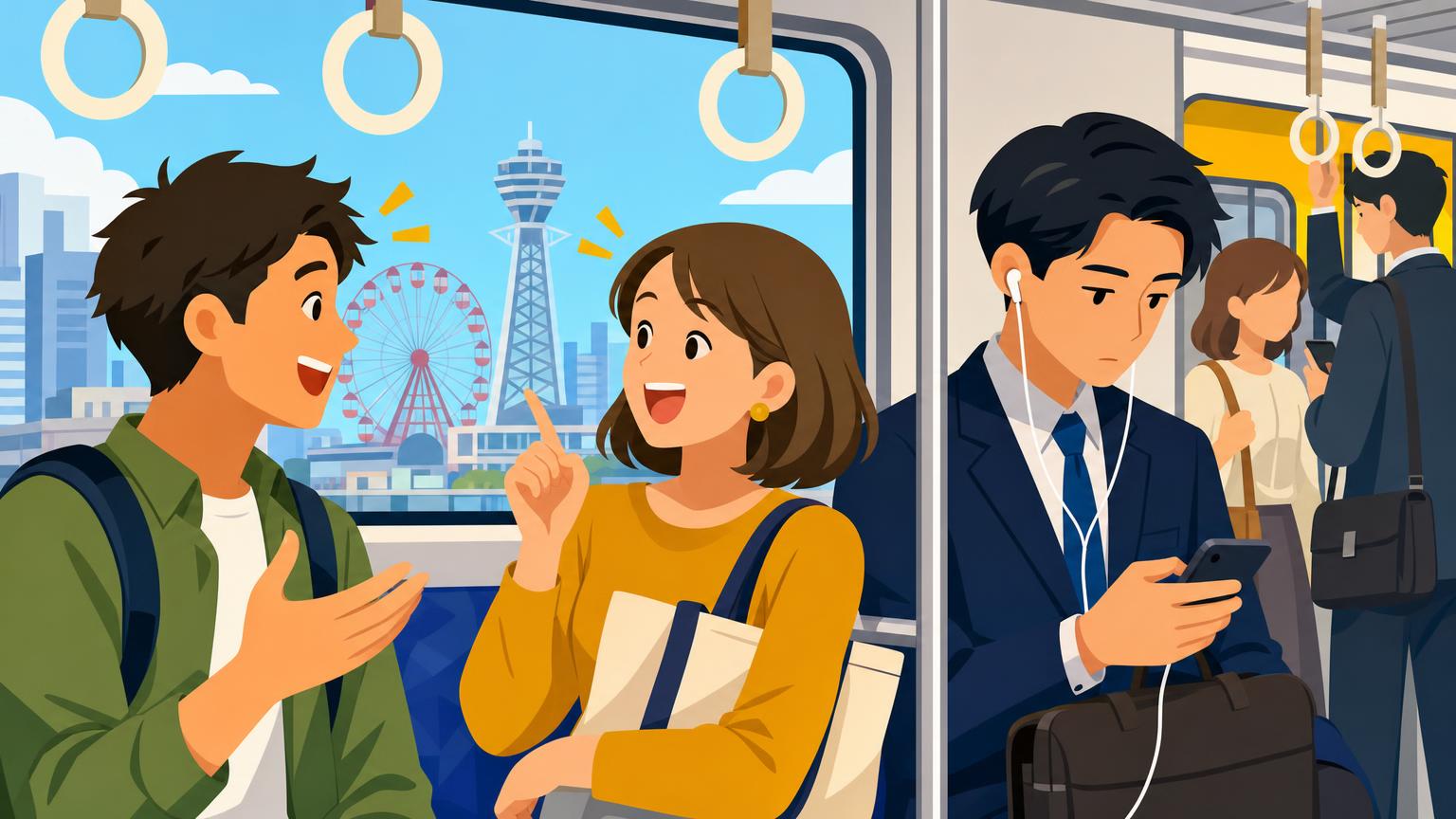
You may notice it during an ordinary train ride: someone comments on the weather, a passenger jokes with the station staff, two strangers laugh after a small delay, or an older person asks where you are from. Then you may ride a train in Tokyo and experience almost the opposite atmosphere—quiet carriages, lowered voices, headphones, and a strong sense that everyone should remain inside their own private space.
So what should you make of the difference? Are Osaka people genuinely more talkative with strangers? Is it acceptable to start a conversation on the Midosuji Line? Does a friendly comment mean someone wants a long relationship, or is it simply a moment of local warmth? And if you are a foreign resident, how can you join in without sounding unnatural or intrusive?
The short answer is that Osaka transit is not a place where every passenger expects conversation. Trains are still shared public spaces, and commuters still value personal boundaries. Yet compared with the highly controlled, quiet atmosphere often associated with Tokyo commuting, Osaka can leave more room for brief human contact. The difference is not a simple rule. It is a style: a little more verbal, a little more playful, and sometimes more willing to turn an awkward moment into a joke.
Understanding that style matters if you are thinking about living in Osaka. Small talk is one of the clearest ways to notice how Osaka people approach strangers, inconvenience, humor, age, status, and everyday cooperation. It also reveals why foreigners sometimes misunderstand Osaka. A quick joke can sound like an invitation. A personal question can sound aggressive. A loud conversation can seem rude until you realize that the speakers are not trying to dominate the carriage; they are simply treating a public moment as socially available.
The map below places this discussion within Osaka’s everyday transit geography, including the central area around Hommachi, where the Midosuji Line, business districts, shopping streets, and residential journeys meet.
Is Osaka Really More Sociable Than Tokyo on Public Transit?
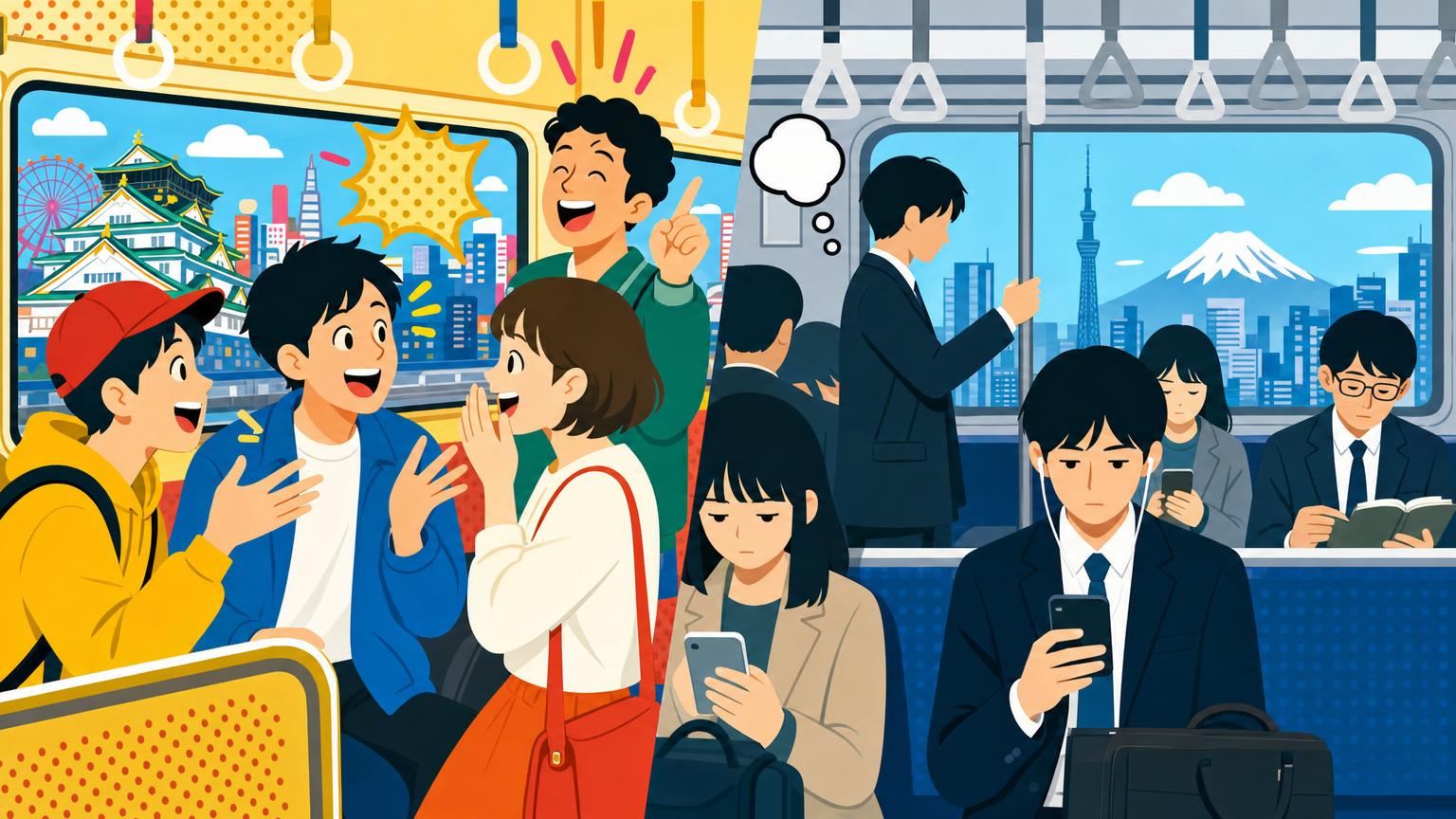
The contrast is real, but it requires careful explanation. Osaka is not a city where strangers constantly chat on trains. During the morning rush, the Midosuji Line between Namba, Shinsaibashi, Hommachi, and Umeda can be just as crowded, quiet, and mentally sealed off as any major urban railway in Japan. People check messages, sleep standing up, read the news, or stare at the floor. No one expects a foreign resident to entertain the entire carriage.
What feels different is the degree of social flexibility. In Osaka, the boundary between public and personal interaction can be slightly less rigid. A passenger may make a brief comment about a delay. Someone may point out that you dropped a glove and add a joke. A person standing beside you may respond when you mention that you are still learning Japanese. On a local platform, a short exchange may feel natural rather than unusual.
Tokyo’s commuter culture is often shaped by scale, speed, and self-protection. Millions of people move through the same stations, often at the same time, with little room for hesitation. Silence becomes efficient. It helps strangers avoid conflict, reduce stimulation, and protect their personal space. Tokyo’s quietness does not necessarily indicate coldness. It often means that people understand the pressure of the environment.
Osaka has crowded trains as well, but the city’s social image has developed around a different rhythm. The city is commercially dense, historically rooted in merchant culture, and famous for verbal humor. That does not mean every person is performing comedy. It means that language can be used more openly to negotiate daily life. A complaint can become a joke. A mistake can become a shared story. A stranger may be treated as someone who can participate in a small social scene, rather than merely as an obstacle in a crowded system.
This is why it is better to describe Osaka as more conversationally permissive than universally friendly. People may be more willing to speak, but that does not mean they want deep personal contact. The conversation may last ten seconds and disappear as soon as the train arrives. The value lies in the moment, not necessarily in building a permanent relationship.
The Osaka difference is often about response, not initiation
Foreign residents sometimes wait for people in Osaka to start talking because they have heard that Osaka is friendly. In reality, the more common pattern is reciprocal. Someone gives you a small opening, and you show that you are willing to respond. Or you make a modest comment, and the other person decides whether to continue.
For example, you might say, in simple Japanese, that the train is unusually crowded. A Tokyo passenger might nod politely or say nothing. An Osaka passenger might reply that it is always like this on Monday, ask whether you work nearby, or complain about the heat. The difference is not guaranteed, but the possibility of a follow-up can feel greater.
The important point is that Osaka small talk depends on mutual recognition. You do not need perfect Japanese. You do need to show that you understand the exchange is social rather than purely informational. A smile, a short answer, or a light laugh may be enough.
Small talk is not the same as forced intimacy
A stranger asking about your nationality, workplace, or length of time in Japan may feel personal, especially if you come from a culture where such questions are considered private. In Osaka, these questions can sometimes serve as easy conversation starters. They may reflect curiosity rather than interrogation.
Still, you are not required to answer everything. Osaka sociability does not cancel your right to privacy. You can respond generally: you are from Europe, North America, Southeast Asia, or another broad region. You can say that you are still settling in. You can smile and change the subject. A friendly atmosphere should not pressure you to disclose your address, salary, relationship status, or immigration details.
The skill is to distinguish warmth from obligation. A short conversation can be enjoyable without becoming a commitment.
Where Small Talk Happens on Osaka Transit
Not every part of the transit system has the same social atmosphere. The line, time of day, station, and physical setting all affect whether conversation feels natural.
A quiet local station in the suburbs may offer more opportunities for brief conversation than a packed platform at Umeda during rush hour. A train traveling between smaller stations may feel more relaxed than the central section of the Osaka Loop Line. Speaking with a station employee may also be easier when there is no long queue behind you.
Local platforms are more conversational than rush-hour carriages
If you want to observe Osaka’s everyday sociability, platforms are often better places than train interiors. People wait, check the electronic signs, and have a few minutes before boarding. A minor delay or platform change can create a shared situation. Someone may ask whether the train is bound for Tennoji. A passenger may explain which side the doors will open on. An older commuter may comment on the weather while everyone waits.
These interactions are usually practical first and social second. The practical question offers a safe reason to speak. Once the immediate issue is resolved, the conversation may end. That is normal. Do not assume that a helpful answer means the person wants to exchange contact details or become a friend.
The Midosuji Line requires more restraint
The Midosuji Line is one of Osaka’s busiest and most central routes. Between Namba and Umeda, particularly during the morning and evening peaks, passengers are dealing with limited space, bags, transfers, and time pressure. Small talk is possible, but the physical conditions are important.
A person wearing earbuds, closing their eyes, or holding a phone close to their face is usually signaling that they do not want interaction. Someone reading a book may be open to a brief practical question, but not to a long conversation. A passenger standing near the door may be focused on getting off quickly at Shinsaibashi, Hommachi, or Yodoyabashi.
In this setting, the most Osaka-like approach is not to speak loudly. It is to notice the situation and keep your comment brief. Sociability works best when it does not create extra work for others.
The Osaka Loop Line has several different social moods
The Osaka Loop Line connects areas with different commuter patterns, so its atmosphere varies from station to station. On a crowded section near Osaka Station, silence and personal space may be the priority. On a less crowded section later in the day, a family, older passenger, or group of coworkers may speak more freely.
Do not treat an entire train line as culturally uniform. Osaka does not have just one personality. The city includes office workers, students, long-established local families, international residents, temporary workers, retirees, and people commuting from neighboring cities. Their behavior depends on age, occupation, neighborhood, and time of day as much as on broad regional identity.
Limited Express and Shinkansen journeys are different
Long-distance trains provide a more acceptable setting for conversation because passengers travel for longer periods and usually have assigned seats. Someone may ask where you are going, comment on the scenery, or discuss a transfer. Even so, many passengers may want to rest, work, or sleep.
The Shinkansen is not automatically a social space simply because it is less crowded than a commuter train. Keep your voice quiet, and limit the conversation to your seat area. If the other passenger gives short answers, returns to a book, or puts on headphones, allow the interaction to end naturally.
The difference is not that Osaka trains encourage constant conversation while Tokyo trains prohibit it. Rather, Osaka may provide more openings. You still need to read the room.
How to Start a Conversation Without Making People Uncomfortable
The safest small talk starts with something you already share. The train is delayed. The weather is severe. A station announcement is confusing. A child is excited about a toy. You are trying to find the correct platform. These subjects do not require private information, and the other person can respond briefly.
A useful opening is usually observational rather than personal. You can comment on the heat, the rain, the crowd, or the unusual quiet. You can ask a practical question about a train’s direction. You can make a brief remark about a transfer. The other person can then decide whether to continue the conversation.
Safe conversation openings
You might say that the train is crowded today. You might ask whether this train stops at Tennoji. You might mention that the rain started suddenly. You might say that you are still learning how the station works. You might ask whether a particular platform is for the local or express service.
In English, these openings may sound basic. In Osaka, basic is useful. Small talk does not need a clever topic. Its purpose is simply to create a relaxed moment.
If your Japanese is limited, a simple phrase may be more effective than an elaborate sentence. A polite greeting, a brief apology before asking a question, and a clear thank-you show consideration. You can use English afterward if the other person replies in English, but do not assume that every younger person wants to practice with you.
Let the other person choose the depth
After your first comment, pause and notice the response. A one-word reply usually means the person is not inviting further conversation. A longer answer, a question in return, eye contact, or a laugh may indicate a willingness to continue.
If the person asks where you live, you can name a neighborhood rather than an exact address. Saying that you live near Tennoji, Fukushima, Sakai, or Suita provides enough information for conversation without compromising your privacy. If you are still deciding whether Osaka is a good place to live, you can say that you are comparing neighborhoods or getting to know the city.
A useful Osaka conversation often develops through shared local knowledge. Someone may ask whether you like the area. You might ask about commuting time. They may recommend a supermarket, a clinic, or a quieter station. This kind of advice can be genuinely helpful, but it is still wise to verify important information independently.
Do not confuse teasing with hostility
Osaka humor can be direct. A stranger may comment on your Japanese, your umbrella, your large suitcase, or your trouble with a ticket machine. The tone may be playful, but the words can still feel sharp if you are unfamiliar with local humor.
A useful test is to see whether the person is also making themselves part of the joke. Osaka-style teasing often relies on shared embarrassment. Someone may laugh at their own mistake, complain about the same train, or make a dramatic comment that is clearly exaggerated. The aim is often to create equality rather than place you below them.
However, not every rude comment is harmless humor. If someone repeatedly mocks your appearance, nationality, language, or personal circumstances, you do not have to laugh along. You can politely end the exchange or move away. Understanding local humor should not mean accepting disrespect.
What Foreign Residents Often Misunderstand About Osaka Friendliness
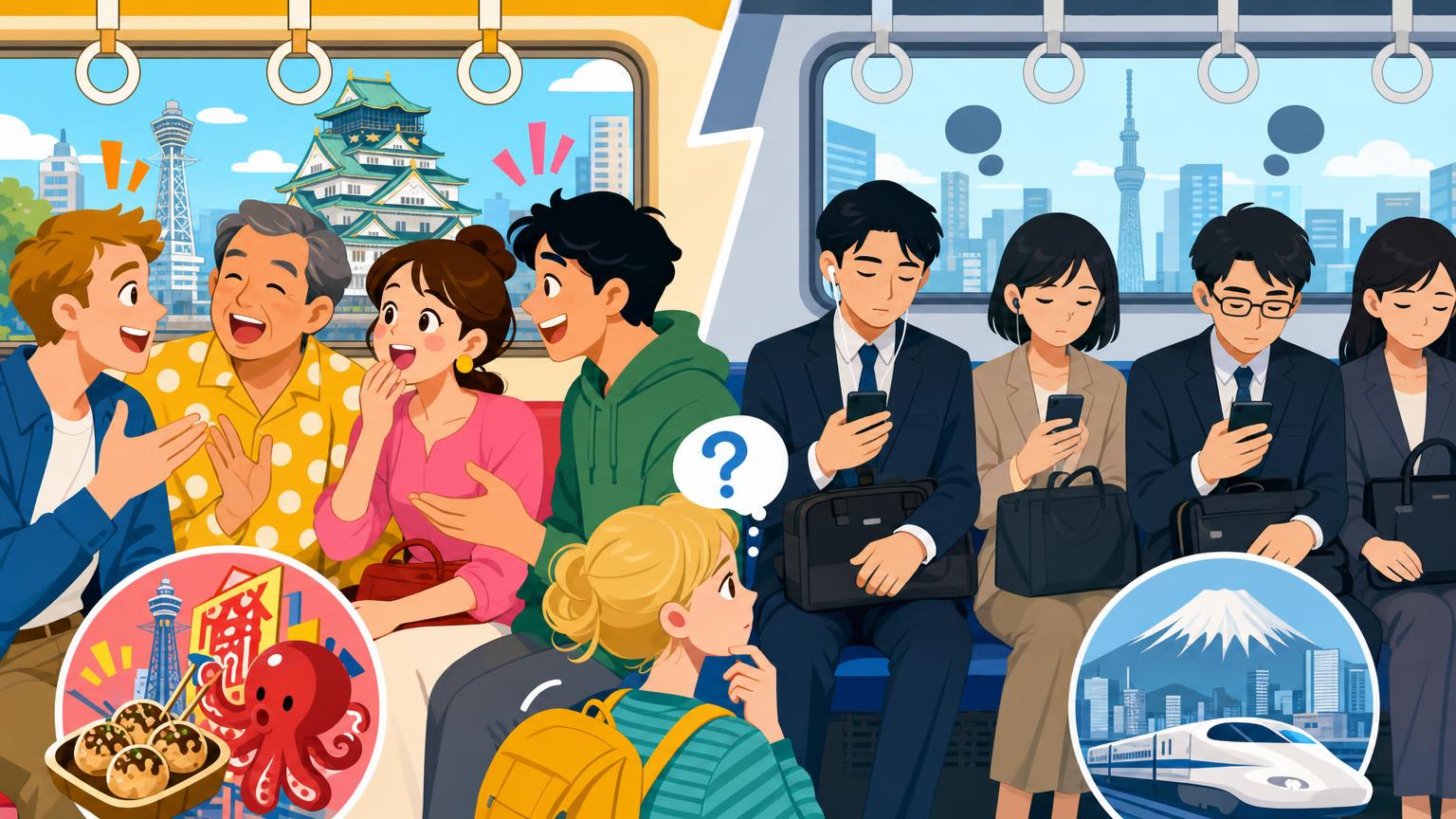
The most common misunderstanding is that people in Osaka are automatically available for friendship. They are not. A warm conversation may simply be a brief social performance of everyday life, not an invitation into someone’s private circle.
Relationships in Japan often develop through repeated contact: at the same workplace, in the same neighborhood, school, sports group, language class, or local shop. A pleasant conversation on the train can make your day better, but friendship usually requires time and reliability. If you want deeper relationships in Osaka, regular presence matters more than one exciting encounter.
Friendly does not mean informal in every situation
People in Osaka may joke with strangers while still caring about conventional politeness. You may hear casual language one moment and formal language the next. A station worker may answer your question professionally even as a nearby passenger laughs and makes jokes.
Foreign residents sometimes assume that Osaka’s relaxed atmosphere means they can immediately use casual Japanese with everyone. That can lead to an awkward result. It is better to begin politely and follow the other person’s level. If someone uses casual language with you, you can respond warmly without copying every expression.
Age and status still matter. A playful exchange with someone your age does not automatically justify speaking casually to an older neighbor, company manager, or public employee. Osaka has a strong everyday social life, but it is not free from hierarchy.
A loud voice is not always aggression
Conversations in Osaka can sound energetic. People may speak with noticeable changes in pitch, laugh loudly, interrupt one another, or use expressive gestures. To a foreign resident from a quieter communication culture, this may sound like an argument.
Sometimes it is an argument. More often, it is simply animated conversation. Observe the broader pattern. Are the speakers smiling? Are they taking turns? Do they relax immediately afterward? Are other passengers reacting with discomfort, or are they ignoring the conversation as normal background noise?
The same volume can have different meanings depending on the context. Loud private phone calls are often viewed more negatively than a lively conversation between passengers sitting together. The issue is not only volume; it is whether the sound feels imposed on people who did not choose to join in.
Direct questions may be practical, not judgmental
People in Osaka may ask questions that foreigners consider unusually direct. They may ask whether you are married, where you work, how long you have lived in Japan, or whether you understand the Kansai dialect. The question may simply be a shortcut to finding common ground.
You can answer at whatever level feels comfortable. A simple response can close the topic without creating conflict. You can also redirect the conversation by asking about the neighborhood, the train, or local food. The goal is not to reject every personal question, but to maintain control of the exchange.
Osaka Dialect and the Feeling of Conversation
You do not need to speak Kansai dialect to live comfortably in Osaka. Standard Japanese is perfectly acceptable, especially in workplaces, public offices, schools, and other formal situations. However, recognizing a few Kansai expressions can help you understand the emotional tone of conversations.
Words such as honma, meaning really or seriously, and ookini, a traditional form of thank you that you may hear in local contexts, can sound more distinctly regional. The familiar phrase maido may also appear in business or service settings. Some people use strong Kansai speech every day, while others use it only with friends, family, or for humor.
The important point is not to memorize a list of dialect words. Rather, it is to recognize that Kansai speech can make a conversation feel closer, lighter, or more theatrical. Intonation often conveys as much meaning as vocabulary.
Do not perform Kansai dialect too quickly
Foreign residents sometimes learn a few well-known Osaka expressions and use them with everyone they meet. This can be charming when the relationship is already relaxed, but it can also sound like a caricature. Many Osaka residents do not want their identity reduced to comedy, food, or exaggerated speech.
Listen first and use standard Japanese clearly. If a local friend teaches you an expression and explains when it is appropriate, you can try using it in that relationship. A natural attempt is better than a performance intended to prove that you understand Osaka.
Humor often depends on timing
Osaka conversation can move quickly. Someone may make a comment, pause for half a second, and expect a reaction. If you respond too seriously, the moment can become awkward. On the other hand, laughing too loudly at a joke you do not understand can also feel unnatural.
You can use modest reactions, such as a smile, a short laugh, or a phrase like wakarimashita when you understand the point. You do not need to come up with your own joke. In many situations, showing that you followed the emotional direction of the conversation is enough.
When You Should Not Start Small Talk on a Train
Osaka’s conversational atmosphere has its limits. The strongest rule is simple: do not turn another person’s commute into your own social project.
Avoid approaching anyone who is visibly distressed, rushing to catch a connection, caring for a child, eating, sleeping, or dealing with a problem. Do not interrupt someone who is on a work call. Do not comment on a person’s body, clothing, age, accent, or appearance unless there is a clear and respectful reason, such as informing them that a piece of clothing is caught in a door.
Be especially mindful of women traveling alone, younger passengers, and people standing in confined spaces. A question that feels harmless to you may feel pressuring to someone who cannot easily leave the conversation.
Respect quiet carriage behavior
Even where formal quiet-car rules are not strictly enforced, the general expectation is that passengers should avoid making unnecessary noise. Keep your voice low. Do not let a group conversation fill the entire carriage. Avoid using speakerphone, playing videos loudly, or repeatedly trying to get strangers to react.
Small talk is most appropriate when it is brief, quiet, and easy to end. If the conversation becomes more animated, continue it after leaving the train. A station concourse, quiet café, or public area gives everyone more space.
Be cautious with alcohol and late-night trains
Late-night trains can feel more relaxed, especially on weekends. People returning from work, restaurants, or social events may be more talkative. However, alcohol can impair judgment. A conversation that seems amusing to you may feel intimidating to a sober passenger who is alone.
Stay aware enough to notice signs of discomfort. If someone gives minimal responses, turns away, changes seats, or stops making eye contact, allow the conversation to end. Osaka’s social openness is not permission to ignore such signals.
How to Respond When Someone Talks to You
You do not need perfect Japanese to handle casual conversations. A calm, friendly response is more important than grammatical precision. If you do not understand, ask the person to repeat themselves. If the accent or dialect is difficult to follow, say that you are still learning Japanese. Many people will slow down or rephrase what they said.
A short response can be enough. You can answer the practical question, add one small detail, and pause. For example, if someone asks whether you live in Osaka, you might say that you recently moved to the city and live near Namba. Then you could ask whether they also live nearby. If they continue, continue. If they do not, smile and return to your phone or book.
Useful conversational boundaries
You can say that you are sorry, but you do not understand. You can explain that your Japanese is limited. You can say that you are in a hurry to change trains. You can answer a personal question in general terms rather than specifically. You can thank someone and end the conversation after they help you.
These are not signs of failure. In daily life in Osaka, knowing how to end a conversation smoothly is just as important as knowing how to start one.
You can decline without seeming cold
Foreign residents sometimes worry that refusing to talk will make them appear rude. It will not, as long as you remain calm and polite. A small bow, a smile, and a brief explanation usually communicate enough.
You might say that you are tired after work, need to check a message, or are still learning Japanese. You do not need to invent an elaborate excuse. Most people understand that public transit is also a time for private recovery.
Small Talk With Station Staff, Shop Workers, and Neighbors
The social style you notice on trains extends into other areas of life in Osaka, but each setting comes with different expectations. Station employees may be polite and helpful without seeking casual conversation. A convenience store worker may exchange a few words with a regular customer. A neighbor may greet you repeatedly before feeling comfortable enough to talk for longer.
Station staff are not just information machines
If you are confused at Namba, Umeda, or a major interchange, asking clearly and thanking the employee is usually enough. Sometimes a staff member may add a local explanation or joke, especially when the problem is minor. Do not interpret a warm response as permission to hold up the queue.
If several people are waiting, address the practical issue first. Move aside before discussing the details. This respects the shared rhythm of the station and gives the employee time to assist others.
Repeated contact builds trust
In Osaka neighborhoods, casual conversation often develops through repetition. You may see the same person at the neighborhood supermarket, the same parent near a school, the same staff member at a local café, or the same elderly resident near the station. At first, you exchange greetings. Later, you comment on the weather. Eventually, you may discuss local events, garbage collection, shops, or community concerns.
This is one reason daily life in Osaka can feel more personal outside the major commercial centers. The city is large, but many residents organize their routines around small areas. People become familiar through ordinary repetition rather than formal introductions.
If you are considering living in Osaka, this pattern may matter more than whether your neighborhood is famous. A place where you regularly walk, shop, commute, and greet people can become socially comfortable over time.
Local advice is often a form of welcome
When someone tells you which supermarket is cheaper, which clinic is easier for foreign residents, or which train car is less crowded, they may be offering more than simple information. They are showing that they have noticed your presence and are willing to help you function locally.
Take the advice seriously, but not as an absolute rule. Osaka people can have strong opinions about restaurants, neighborhoods, and transport routes. Listen, ask a follow-up question, and compare the suggestion with your own needs. Accepting local knowledge does not mean you must accept every local judgment.
Osaka Versus Tokyo: What the Commute Reveals About City Mindset
Comparing Osaka and Tokyo is useful, but the comparison can become overly simplistic if you treat one city as warm and the other as cold. The deeper difference lies in how each city manages public density.
Tokyo often handles density through restraint. People minimize eye contact, keep conversations contained, stand in organized patterns, and avoid drawing attention to themselves. This does not reflect emotional emptiness; rather, it is a way for an enormous number of people to share limited space.
Osaka often manages density through expressive adjustment. People complain, joke, negotiate, and make comments. Conversation can help release pressure. A delay is still annoying, but saying something about it may make the frustration more socially manageable. A small joke can turn strangers into temporary companions for a few minutes.
Neither approach is better in every situation. Tokyo’s silence can feel restful and respectful, while Osaka’s openness can be reassuring and human. Tokyo may offer more predictable privacy, whereas Osaka may provide more opportunities to feel recognized. The best city for you depends partly on which kind of public atmosphere helps you live well.
Quietness and friendliness can exist together
A Tokyo commuter may help you without saying much. An Osaka commuter may talk to you and still forget you immediately. Neither behavior reveals a complete personality. Public conduct is shaped by context, fatigue, work pressure, age, and personal preference.
If you move from Tokyo to Osaka, you may notice more spontaneous comments, but not necessarily deeper relationships. If you move from Osaka to Tokyo, you may notice less small talk, but not less kindness. Avoid judging an entire city by the number of conversations you have on trains.
How Foreign Residents Can Fit Into Osaka’s Social Rhythm
The most effective approach is to be available without being demanding. Greet people, respond when spoken to, make small observations, accept a joke when it is clearly friendly, and maintain your personal boundaries. Let relationships develop through repeated contact.
You do not need to imitate an Osaka personality. You can be quiet and still belong in Osaka, prefer privacy and still enjoy local conversation, and speak standard Japanese while still being accepted. The goal is not to become louder or more extroverted, but to understand when a small social opening is being offered.
Use curiosity rather than performance
Ask people about practical aspects of daily life. Which area do they commute from? Is the transfer difficult? Do they find the station confusing? Is the neighborhood quiet at night? These questions connect with everyday life rather than turning Osaka into a stage set.
Avoid declaring that everyone in Osaka is friendly or funny. Local residents may find that stereotype tiring. Instead, pay attention to what a particular person is doing. Someone may be helpful, reserved, humorous, impatient, or all four at different times. Treating people as individuals is more respectful than looking for a ready-made Osaka character.
Learn the difference between invitation and opportunity
An invitation is direct: someone asks you to join them, continue talking, or meet again. An opportunity is more subtle: a smile, a comment, a practical question, or a shared laugh. Not every opportunity develops into an invitation.
This distinction protects both sides. You can enjoy a brief exchange without expecting friendship, while also recognizing when someone genuinely wants to continue. If the person asks follow-up questions, waits for you after the train arrives, or suggests a specific place and time, the relationship may be moving beyond casual small talk.
Build relationships off the train
If you want a stronger local network, use train conversations as an opening rather than treating them as the entire relationship. Join a neighborhood activity, language exchange, sports group, volunteer project, professional association, or local class. Visit the same community spaces regularly, and offer help when appropriate.
Osaka friendships often become genuine through shared routines. A train ride can create a memorable first contact, but repeated participation builds trust. This is especially important for foreigners who may receive warm attention yet still feel socially outside the community.
Common Situations and How to Read Them
A passenger smiles at you after you apologize for blocking the aisle. Smile back and move along; it may be courtesy rather than an invitation.
Someone asks whether you are a tourist or a resident. Answer as much as you wish, then see if they ask a respectful follow-up. If they continue pressing, change the subject.
A person jokes about your Japanese. Laugh lightly if the tone is kind, then answer honestly about your level. If the joke becomes repetitive or insulting, end the interaction.
An older passenger starts talking about Osaka. Listen patiently, respond simply, and remember that the person may be enjoying the conversation more than seeking factual agreement. You do not need to correct every generalization.
A group of passengers is speaking loudly in the Kansai dialect. Do not assume they are angry. Pay attention to their facial expressions and how they respond to one another. If the conversation is not directed at you, you do not need to participate.
Someone continues speaking after you have given short answers. Move toward a neutral closing phrase, look at your phone, or explain that you need to prepare for your stop. A clear ending is kinder than pretending to understand indefinitely.
Is Osaka a Good Place to Live if You Prefer Quietness?
Yes, but your experience will depend on where and how you live. Osaka offers lively public interaction, but it also has quiet neighborhoods, private apartments, calm cafés, riverside areas, and routines that allow you to avoid constant social contact. The city’s conversational reputation does not mean you have to be socially active every day.
You may enjoy Osaka if you want a major Japanese city where daily life feels less formal and less polished than in Tokyo. You may appreciate the opportunities for casual advice, neighborhood humor, and more direct communication. However, you may also find some interactions tiring if you prefer strict privacy or indirect speech.
The practical solution is to choose your preferred level of social interaction. In a crowded central train, keep to yourself. At a local station, respond warmly if someone speaks to you. In your neighborhood, greet people regularly. At work, observe the existing relationship patterns before making jokes. Over time, you will learn which situations invite conversation and which call for quiet.
Your neighborhood matters more than the city label
Living near a major interchange offers convenience but also brings more anonymous movement. A residential area may provide stronger local recognition but fewer English-language services. A neighborhood with many foreign residents may feel easier at first, while a less international area may provide more opportunities to develop Japanese-based relationships.
There is no single Osaka experience. Life around Umeda differs from life near Namba. A business district differs from a family-oriented residential area. The Osaka Loop Line corridor differs from a suburban station outside the core. Consider your actual routine: commuting, shopping, health care, school, exercise, and the people you are likely to see regularly.
The Unspoken Rule: Leave People With More Ease Than Before
The best Osaka small talk is not necessarily the funniest or most memorable. It is the kind of exchange that leaves both people feeling slightly more relaxed. You ask a practical question, receive help, thank the person, and avoid making them work harder than necessary. You share a comment about the weather, laugh once, and return to your own routine. You answer a personal question without giving up your privacy.
This is the deeper lesson behind Osaka’s public sociability. Conversation is not always a request for closeness. Sometimes, it is simply a way to narrow the distance between strangers for a moment. A train delay becomes less irritating. A confusing transfer becomes manageable. A foreign resident feels less invisible. A local passenger gets to share a small joke before continuing home.
If you come from Tokyo, you may first notice that Osaka feels noisier, more direct, and less socially closed off. If you come from a quieter culture outside Japan, you may wonder whether an ordinary comment is a joke, an invitation, or criticism. Usually, it is none of these by itself. It is a small test of mutual comfort.
Respond warmly, maintain your boundaries, and pay attention to the other person’s signals. You do not need to become an extrovert. You only need to recognize that on Osaka transit, a public commute can occasionally include a human exchange—and that the exchange can end naturally when the train reaches the next station.