If you live in Osaka, you may already know the word “Minami.” It usually means the busy southern side of central Osaka: Namba, Dotonbori, Shinsaibashi, Amerikamura, late-night restaurants, bright signs, and crowds moving between train stations. Then you may hear another expression, “Minami-Kawachi,” and assume it means a quieter neighborhood somewhere south of Namba.
That assumption is understandable, but it is not quite right.
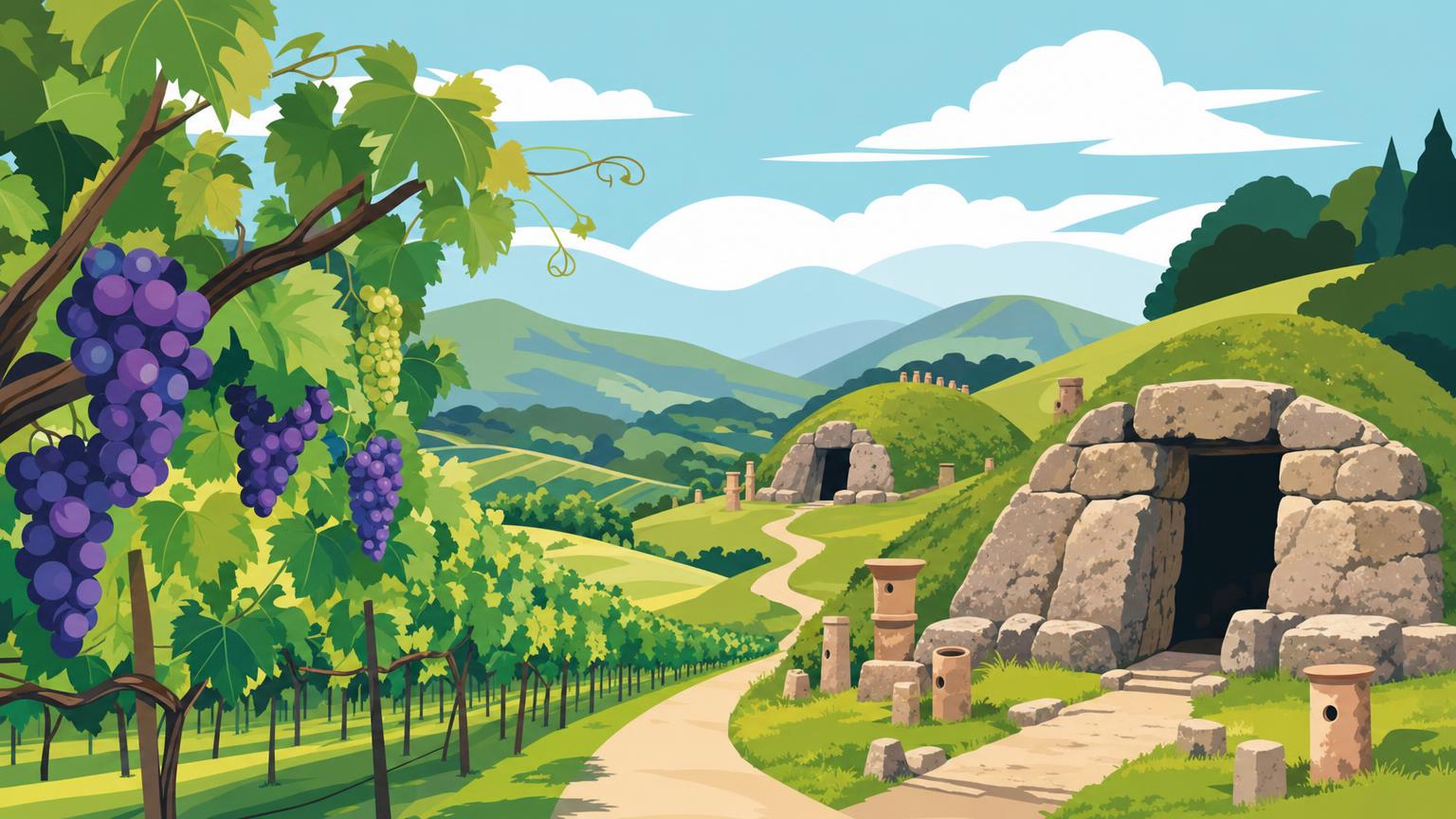
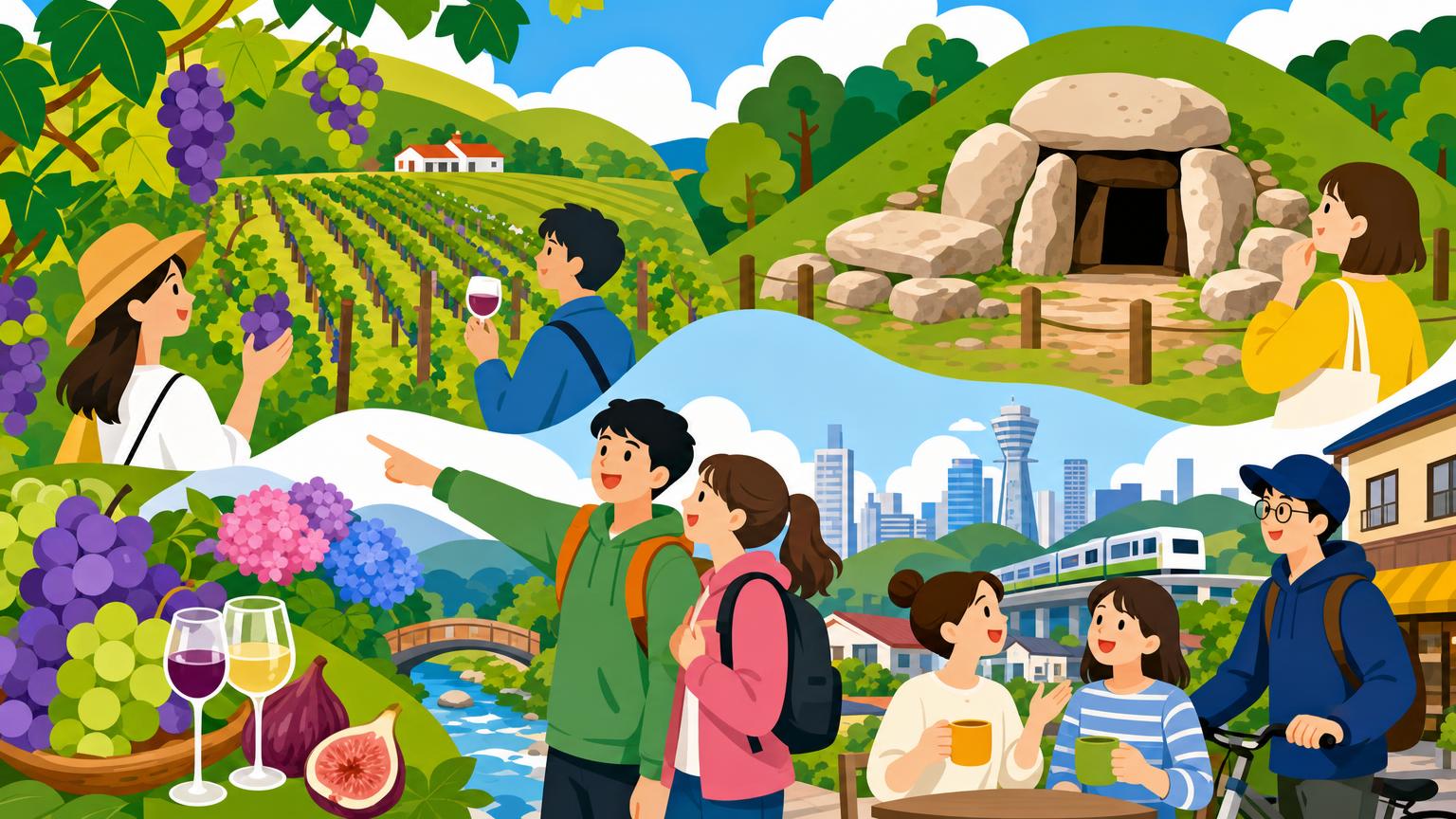
Minami-Kawachi is a broad southeastern area of Osaka Prefecture. It includes places such as Habikino, Fujiidera, Tondabayashi, Kanan, Taishi, Kashiwara, and Kawachinagano. Some parts feel suburban, some agricultural, some deeply historical, and some almost mountainous. You can leave Osaka’s central shopping districts in the morning, pass vineyards and rice fields, walk beside ancient burial mounds, and return home in time for dinner without leaving the prefecture.
For foreigners living in Osaka, that kind of weekend is useful for a reason beyond sightseeing. It shows how Osaka works outside the image of the energetic city center. It reveals how urban life and rural life sit close together, how local identity can be more important than municipal boundaries, and how people use food, railways, festivals, family businesses, and old land routes to keep a connection with the past.
A weekend in Minami-Kawachi is therefore not simply a trip to see grapes and tombs. It is a way to observe the quieter side of Osaka: the practical local networks, the direct but relaxed social style, and the habit of treating history as part of ordinary life rather than as something sealed behind glass.
What Minami-Kawachi Means in Everyday Osaka
“Minami” does not always mean Namba
The first source of confusion is the name itself. In everyday Osaka speech, “Minami” generally refers to the downtown area around Namba and Dotonbori. It is one of the city’s two major urban centers, contrasted with “Kita,” the northern center around Umeda and Osaka Station.
Minami-Kawachi is different. Here, “Minami” simply means south, while “Kawachi” refers to Kawachi, a historic province that once covered much of eastern Osaka and parts of what are now neighboring areas. The name describes the southern part of the broader Kawachi region, not an area of downtown Osaka.
This distinction matters when planning daily life. If someone says they are going to Minami, they may mean shopping in Shinsaibashi or meeting friends in Namba. If they mention Minami-Kawachi, they are probably referring to the southeastern part of the prefecture, where Kintetsu and Nankai railway lines lead toward smaller cities, agricultural districts, foothills, and old settlements.
Japanese place names often preserve older geography, even after modern administrative borders have changed. That is why “Kawachi” appears in railway names, food products, local companies, school names, and regional branding. The name is not merely historical decoration; it remains part of how people understand where they are.
A region rather than a single destination
Minami-Kawachi is not a compact tourist area with one obvious center. It is a collection of connected places. Habikino and Fujiidera are closely associated with the Furuichi Kofun Group and grape cultivation. Tondabayashi has the old Jinaimachi district and a more visibly preserved merchant-town atmosphere. Kanan and Taishi lie closer to the hills and the ancient routes that connected the Osaka plain with Nara. Kawachinagano extends toward Mt. Kongo and the mountains farther south.
This variety is important for understanding Osaka’s structure. From central Osaka, the transition is gradual. Apartment buildings and commercial streets give way to detached houses, small factories, vegetable fields, school grounds, orchards, and wooded slopes. There is no dramatic boundary announcing that you have entered the countryside. The city simply begins to loosen its grip.
This is one reason foreigners sometimes misunderstand Osaka. They may imagine a simple contrast between urban Osaka and a rural Japan located somewhere far away. In reality, Osaka Prefecture contains many layers at once. A person can commute to an office near Umeda, buy vegetables from a local farm stand on the weekend, live near a kofun, and visit a family-run winery without feeling that these activities belong to separate worlds.
The pace is slower, but social expectations remain practical
Minami-Kawachi does not have the same density as central Osaka. Streets can become quiet in the early evening. Some shops close earlier than visitors expect. Buses may run less frequently, and a short distance on a map can take longer when walking between stations, fields, temples, and residential roads.
However, the local attitude is not necessarily slow or sentimental. People still value efficiency. They often want to know where you are going, how long you will stay, whether you have made a reservation, and whether you understand the return route. A shop owner may welcome you warmly and then immediately explain that the last bus leaves at a certain time. That is not a lack of hospitality; it is practical care.
In central Osaka, direct speech can feel theatrical because it is mixed with jokes, teasing, sales talk, and rapid conversation. In smaller Minami-Kawachi communities, directness may be quieter. People may not perform friendliness for strangers, but they often show consideration through useful information: where to buy lunch, which road is safer for bicycles, whether a hill is steeper than it appears, or whether a shrine gate stands on private property.
Foreign residents sometimes expect rural Japan to be automatically more welcoming than a large city. That is not always the case. Smaller communities can have stronger local relationships, meaning that trust may develop gradually. Someone who visits once is a visitor. Someone who returns, greets people, follows local rules, and remembers names gradually becomes familiar.
The same pattern can also be found in Osaka’s urban neighborhoods, although it is easier to notice in Minami-Kawachi. Osaka’s famous sociability is often less about instant intimacy and more about repeated contact. The same bakery, supermarket, station platform, school route, or neighborhood festival brings people into contact time and again.
The Weekend Question: Can You See Nature Without Leaving Osaka?
Why Osaka residents make this trip
For many residents, the appeal of Minami-Kawachi is not that it offers an untouched escape. Rather, it provides breathing room without requiring an elaborate travel plan. The train ride is short enough for a spontaneous Saturday outing, while the landscape is different enough to change your mood.
The region is especially appealing to people who feel worn down by Osaka’s central rhythm. Central Osaka rewards constant movement: walking quickly, transferring trains, crossing busy intersections, and choosing among hundreds of restaurants and shops. In Minami-Kawachi, the same weekend can include long pauses—looking across a vineyard, sitting in a small café, reading a museum explanation, or walking along a road where the main sound is farm machinery rather than traffic.
That contrast can reveal something about Osaka compared with Tokyo. Tokyo often feels organized around large-scale centrality: major stations, recognizable districts, and long journeys between different types of urban space. Osaka is also metropolitan, but its surrounding areas can feel more immediately accessible and more socially connected to the center. The city is not cut off from its regional countryside; it naturally extends into it.
This does not mean Osaka is always more relaxed than Tokyo. Namba and Umeda can be intense, and commuting can be exhausting. The difference is that the city’s southern edge opens onto agricultural and historic landscapes relatively quickly. A weekend in Minami-Kawachi makes that geography emotionally apparent.
What “nature” means here
Nature in Minami-Kawachi is generally managed, inhabited, and cultivated. You will see vineyards arranged in rows, roads running between fields, planted forests, reservoirs, parks, temple grounds, and mountain trails. This is not wilderness in the North American sense, and viewing it as wilderness can lead to careless behavior.
A vineyard is a workplace. A rice field is privately owned agricultural land. A narrow road may be used by delivery vehicles, schoolchildren, or elderly residents. A wooded path may belong to a temple, a municipality, or a local land-management group. Although the landscape may appear open, it is not necessarily public.
This offers a useful lesson in Japanese rural etiquette. Do not enter a field simply because the gate is open. Do not pick fruit without permission. Avoid blocking farm roads when taking photographs. Keep your voice low near graves and residential areas. If you see a sign you cannot read, treat it as meaningful rather than decorative.
The same principle applies to ancient tombs. A kofun may look like a grassy hill, but it could be a designated historical site, a burial place, a sacred space, or all three. Visitors should remain on paths and avoid climbing embankments unless access is clearly permitted.
The local idea of a good day outside
A good outdoor day in Osaka is often social and centered on food rather than purely athletic. People may hike for an hour, stop for noodles, buy fruit, visit a farm stand, and return home before the weather changes. Families bring children, older relatives, and bicycles. A walking route is successful when different generations can enjoy portions of it at their own pace.
Foreign visitors accustomed to long-distance hiking may find this approach modest. However, that modesty is part of the local rhythm. The goal is not always to conquer a mountain or complete a demanding route. It may simply be to spend time outdoors without turning the day into an endurance test.
That attitude reflects a broader Osaka habit: enjoyment should be accessible and worth the effort. People often weigh price, convenience, quality, and social value at the same time. A local outing feels satisfying when the train fare is reasonable, the food is good, the route is manageable, and everyone returns home without unnecessary stress.
Saturday Morning: From the City to the Vineyards
Starting from Osaka-Abenobashi or Namba
For the vineyard side of Minami-Kawachi, Osaka-Abenobashi is generally the most practical starting point. From Tennoji, walk to the nearby Kintetsu Osaka-Abenobashi Station and take the Kintetsu Minami-Osaka Line toward Furuichi and beyond. Habikino, Furuichi, and Kaminotaishi provide access to several historic and agricultural areas.
Kawachi Wine, located in Habikino, is one of the best-known examples of the region’s grape and wine culture. The winery is connected with vineyards, wine production, food, and experiences such as tours and tastings. Reservations may be required, and opening days or event schedules can vary, so check the latest information before setting out.
The journey itself is part of the lesson. You start among Tennoji’s large commercial buildings, pass through dense residential neighborhoods, and gradually encounter more open land. The train is not taking you to a separate “country”; it is carrying you through the changing economic geography of the same prefecture.
This is also why train behavior matters. On the platform, people may seem quiet and absorbed, but they remain attentive to the movement of others. Stand to one side on escalators where local practice requires it, avoid blocking train doors with luggage, and allow passengers to exit before boarding. In a less crowded district, the platform may be calmer, but the basic expectation of not inconveniencing others remains.
Vineyards as part of local identity
Osaka is not usually the first Japanese prefecture that foreigners associate with wine. That makes the vineyards of Habikino, Kashiwara, and the surrounding areas particularly revealing. Grape cultivation has a long history in the Kawachi area, while modern winemaking developed through local agricultural and family-business networks. Osaka’s official tourism information describes southeastern Kawachi as a grape-producing region dating back to the Edo period and identifies several wineries that continue this culture today.
The local wine story is not simply about copying European wine culture. Rather, it is about integrating wine into existing Japanese systems of farming, food, gift-giving, seasonal production, and neighborhood commerce. Local grapes may appear in sweets, juice, wine, and souvenirs. A bottle might be purchased for a meal, a family visit, a business gift, or as a conversation starter.
This is where the vineyard offers a window into Osaka’s mindset. People often value originality, but they also want products to connect with local life. A wine feels more meaningful when it can be explained through the soil, the growers, the family history, and the food it accompanies.
In Osaka, food is rarely just nutrition; it is also a social language. Asking what pairs well with local wine, which grape is grown nearby, or whether a bottle would make a suitable gift can lead to a longer conversation than simply saying that the wine tastes good.
What a winery visit can teach a foreign resident
A winery is an easy place to observe the difference between tourist hospitality and local hospitality. A tour may be structured, timed, and based on reservations. Staff may explain the production process carefully. However, the conversation can become more personal when you show genuine interest in how the business fits into the area.
Try asking practical questions instead of only asking for the “best” wine. What do local families usually buy? Which product goes well with home cooking? Are the grapes sold fresh? Do nearby restaurants use the wine? What happens during harvest season?
These questions acknowledge that the winery is part of a community, not merely an attraction. They also suit Osaka’s preference for concrete conversation. People may enjoy abstract cultural discussions, but they often connect more quickly through work, food, money, weather, and daily routines.
Do not assume that a relaxed tone means you can disregard reservations or schedules. Osaka people may joke while still giving clear instructions. The laughter does not cancel the rule. If a tour starts at a fixed time, arrive early. If tasting is limited, do not pressure the staff for more. If you are driving, do not drink.
Saturday Afternoon: Ancient Tombs in an Ordinary Neighborhood
The Furuichi Kofun Group and the Meaning of “Ordinary” History
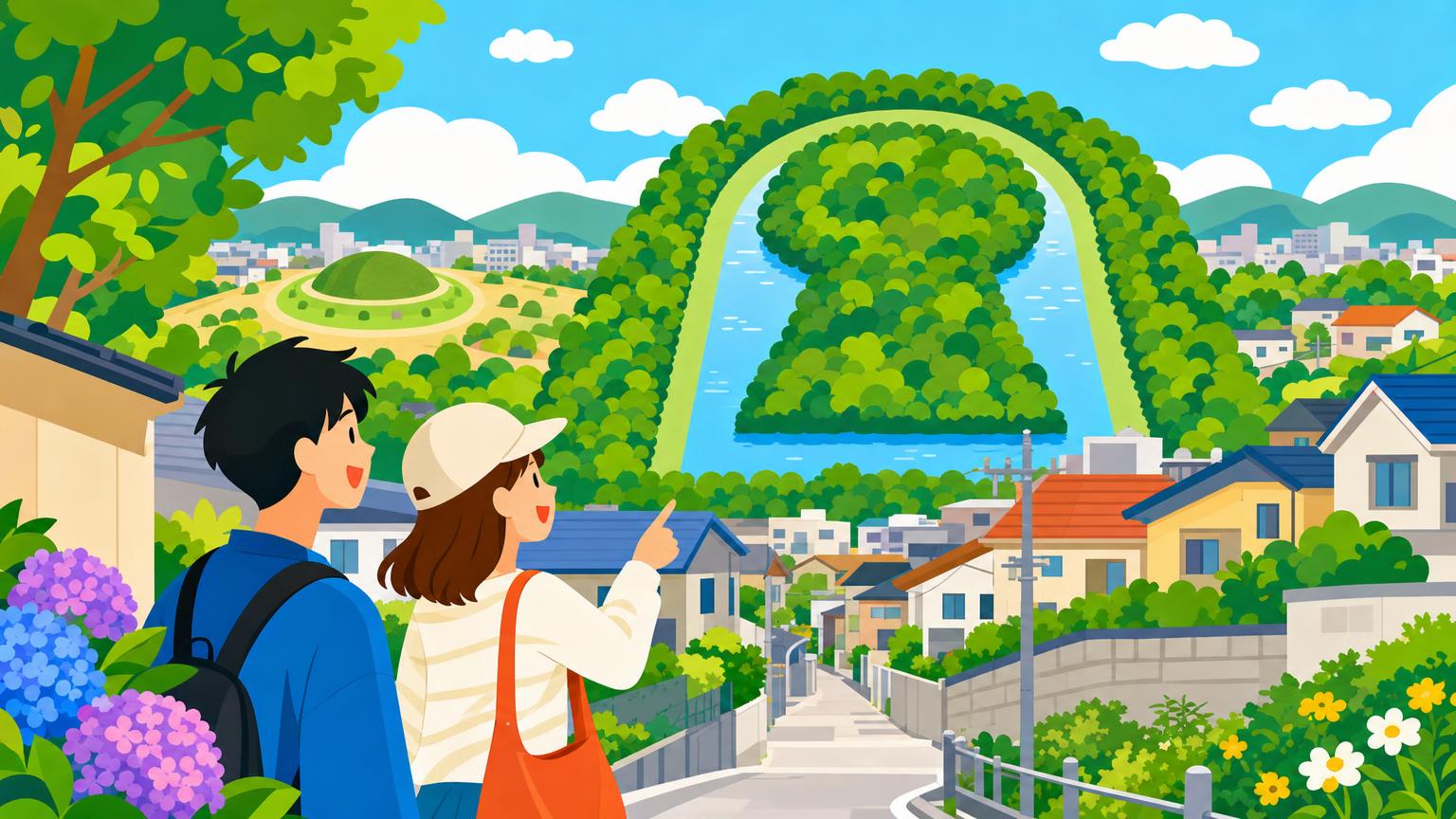
After the vineyards, you can head toward Furuichi and Habikino, where the Furuichi Kofun Group extends across an area that includes Habikino and Fujiidera. The group contains more than forty ancient burial mounds, including the large tomb traditionally associated with Emperor Ojin. The mounds date broadly from the late fourth to the early sixth centuries.
For a foreign visitor, the most surprising aspect may be the surroundings. These are not always isolated ruins set in dramatic landscapes. A kofun may stand beside roads, houses, schools, parks, or ordinary shopping areas. You might be looking at a monument reflecting the power of ancient rulers while hearing a delivery truck reversing nearby.
That mixture is very Osaka. History is not always separated from daily life. Someone may walk past a kofun on the way to work, take a child to a nearby school, or stop at a convenience store afterward. The site does not need to be transformed into a grand stage to be important.
Foreigners sometimes expect Japanese people to treat every historical site with visible solemnity. In practice, behavior depends on the setting. At a major shrine or temple, people may bow, wash their hands, or speak quietly. Near a kofun integrated into a neighborhood, local residents may simply treat the area as part of their daily route while still respecting its boundaries.
The respectful approach is not to imitate a dramatic ritual but to observe what the place requires. Do not climb where signs prohibit it. Do not touch or move objects. Do not use private homes or temple grounds as photo backgrounds without permission. Keep your volume reasonable, especially when the site borders residential areas.
Why the Tombs Are Valuable for Understanding Osaka
Kofun are often introduced through their shapes: keyhole-shaped mounds, circular mounds, and large earthworks surrounded by moats. Those details matter, but the deeper social lesson concerns networks.
The tombs show that the Osaka region was connected to powerful political, economic, and cultural systems long before the modern city existed. They also demonstrate that the plain between the mountains and the bay was valuable enough to organize labor, agriculture, movement, and authority on a large scale.
Modern Osaka still depends on those same geographical advantages. The region has fertile land, transport routes, access to neighboring Nara and Kyoto, and a dense population shaped by movement and exchange. The old tombs make the landscape’s long history visible.
This helps explain why Osaka identity is often less formal than Tokyo identity. Tokyo can feel like a national capital whose institutions dominate the urban experience. Osaka feels more like a commercial and regional network, where neighborhoods, former provinces, railway corridors, markets, factories, and family businesses overlap. The kofun provide evidence that this region has been connected and competitive for a very long time.
Fūdoki no Oka and the Patience of Local History
Fūdoki no Oka Park in Kanan is another useful place to understand how Minami-Kawachi presents its past. More than one hundred burial mounds are preserved across the 29-hectare park, and the Chikatsu-Asuka Museum explains how kofun were built and what kinds of objects were placed inside them. Around forty of the mounds are accessible, although local access conditions should be checked.
The park is not simply a place for collecting photographs. It rewards patience. The mounds may not seem spectacular at first. Their scale becomes clearer as you walk, observe changes in the land, and realize that many were built for people who were neither famous emperors nor figures in popular history.
That is an important difference between consuming history and living near it. Tourism often seeks the most famous person, the largest structure, or the most dramatic view. Local life is shaped by repeated contact with less famous places. A smaller tomb, an old road, a stone wall, or a family temple may matter because it anchors a neighborhood’s sense of continuity.
For foreign residents, this is a useful way to approach Japanese history without turning it into a checklist. Ask what remains in the landscape, who maintains it, and how people use the surrounding area today. The answers often reveal more about contemporary Japan than the monument alone.
Saturday Evening: Food, Conversation, and the Local Economy
Why a café or small restaurant matters
A weekend in Minami-Kawachi should not be planned as though every hour needs to include a major attraction. The most revealing experience may be the meal between two destinations.
Small cafés, bakeries, farm stands, confectionery shops, and local restaurants offer a glimpse into how people earn a living in a less central area. Some businesses rely on regular customers rather than passing tourists. Others combine farming, food processing, retail, and tourism. A winery may include a restaurant, while a bakery may use locally grown fruit. A traditional town may also contain a renovated brewery or a café housed in an old building.
These places demonstrate how Osaka’s economy is often built on practical combinations. A business does not need to fit neatly into a single category. It may preserve an old building, sell a local product, serve lunch, host an event, and maintain relationships with nearby producers. This flexibility is common in a region where population, agriculture, history, and transportation overlap.
When entering a small café, be prepared for limited seating and a menu that may not be fully explained in English. This is not necessarily a problem. Pointing, using translation tools politely, or selecting a simple item can be effective. If the staff appear busy, wait until they have finished serving other customers. Osaka’s conversational style can be lively, but service spaces still have an order.
Local food is often seasonal and specific
Kawachi grapes, chestnuts, vegetables, rice products, Japanese sweets, and locally made drinks may appear in different forms depending on the season. Do not assume that every product will be available each weekend. Agricultural life is not a permanent display.
A fruit shop may sell one variety today and another the following week. A café may close because the owner is preparing products. A farm stand may offer only limited quantities. These inconveniences are also signs that the business remains connected to actual production rather than a standardized visitor experience.
Osaka people often evaluate food by considering several questions at once: Is it fresh? Is the portion reasonable? Is the price fair? Can I take it home? Is it appropriate for the season? Can I introduce it to someone else? A foreign resident who understands these questions will grasp Osaka’s food culture more clearly than someone who simply memorizes a list of famous dishes.
The region’s sweets culture is particularly interesting because grapes can move from vineyard to confectionery. In the wider Kawachi area, local grapes and other produce are used in Japanese sweets and gift products.
Giving food as a gift is common in Japan, but the meaning is not always ceremonial. It may be a way to say thank you, acknowledge a visit, bring something to a workplace, or maintain a relationship. Buying a small local product on the way home can therefore be part of social life, not simply shopping.
The Osaka style of conversation
You may hear more joking in Osaka than in many other parts of Japan, but this should not be reduced to a personality stereotype. Humor often serves as a way to test comfort and lessen social distance. A shopkeeper may tease you about your pronunciation, food choice, or unfamiliarity with the area. A customer may respond with a joke, creating a temporary relationship through the exchange.
However, humor does not mean that every subject is open or that everyone wants an extended conversation. Pay attention to the other person’s pace. If they continue working, give brief answers, or turn to another customer, allow the interaction to end naturally.
Osaka communication is often direct because people want the conversation to keep moving. That directness may sound rude to foreigners who are accustomed to more indirect speech. It can also sound friendly when it is intended simply as efficiency. The best interpretation depends on the relationship, the tone, and what happens afterward.
A useful rule is to listen for practical intention. Is the person trying to help you, sell something, correct you, entertain you, or end the conversation? The words alone may not provide the answer. Osaka speech often conveys meaning through timing and delivery.
Sunday: Toward the Mountains and the Wider Region
Kawachinagano and the shape of southern Osaka
On Sunday, you might continue on to Kawachinagano, where the urban fabric becomes increasingly mountainous. From Namba, the Nankai Koya Line reaches Kawachinagano in roughly thirty minutes under typical service conditions. From Osaka-Abenobashi, the Kintetsu Nagano Line takes approximately forty minutes.
These travel times are one reason people living in Osaka can maintain several identities at once. A resident may work in the city center, shop in a suburban city, visit relatives in a rural district, and hike near Mt. Kongo without considering any of these places far away.
Kawachinagano also demonstrates that the word “nature” is connected to infrastructure. Trails, temples, dams, agricultural parks, cycling routes, and community facilities all require maintenance and coordination. The landscape feels natural partly because local systems keep it accessible and usable.
Visitors should not assume that a mountain area is easy simply because it is close to Osaka. Weather can change, hills may be steeper than they appear on a map, and buses may be infrequent. Bring water, wear suitable shoes, and check the return route before setting out. If you are relying on a local bus, do not assume the next one will arrive soon.
This practical preparation is particularly important for foreigners accustomed to dense transit networks. In central Osaka, missing a train is usually just an inconvenience. In a rural or mountainous district, missing a bus can change the entire day.
Mt. Kongo and the local relationship with mountains
Mt. Kongo is a prominent reference point for southeastern Osaka and the neighboring Nara side. For many local residents, mountains are not distant scenery. They form part of weekend exercise, school memories, religious history, weather awareness, and regional identity.
The mountain area also helps explain why Minami-Kawachi feels different from central Osaka while remaining connected to it. The city’s energy does not disappear; it becomes organized around different needs. People still care about time, access, food, and social convenience, but the environment changes the scale of those decisions.
A mountain outing may involve a car, a train, a bus, walking, and a meal in a small town. It may also require checking the weather forecast and carrying cash. These details are not secondary; they are the actual experience of living near Osaka’s green edge.
The agricultural park and the working countryside
Agricultural parks and local markets can be more informative than a famous viewpoint because they show how food production becomes part of everyday life. Families may visit for seasonal picking, school activities, or a casual meal. Residents may buy produce there because it is convenient, not because they are trying to perform rural authenticity.
For foreigners considering life in Osaka, this offers a useful correction to the idea that Japanese food comes from anonymous supermarkets. Supermarkets are essential, of course, but local produce networks remain visible in southern Osaka. A weekend visit can show you which foods are seasonal, how farmers sell directly, and how urban consumers continue to care about where their ingredients come from.
The relationship is not always romantic. Agricultural work is demanding. Aging farmers, labor shortages, land management, and changing consumer habits all affect the region. A local product may be expensive because production is limited. A field may disappear because it is no longer economically viable. Understanding Minami-Kawachi means recognizing both the beauty of the landscape and the pressures behind it.
What Foreigners Often Misunderstand About Minami-Kawachi
It is not “old Japan” preserved for visitors
Minami-Kawachi contains historic towns, temples, vineyards, tombs, and mountain landscapes, but it is not a museum. People live there, commute, raise children, run businesses, manage land, and deal with everyday problems.
Calling the area “untouched” may sound flattering, but it can also overlook the work required to maintain it. Old buildings survive because someone repairs them. Fields remain open because someone cultivates them. Trails stay usable because someone clears them. Local festivals continue because people contribute their time, money, and labor.
If you visit, avoid treating residents as part of the scenery. Ask before photographing people, homes, workshops, or private gardens. Buy from local businesses when appropriate. Do not enter closed areas simply because they look interesting.
Quiet does not mean empty
A quiet station or road may lead foreigners to think that nothing is happening. In reality, local activity may be spread out rather than concentrated. People may be at work, in school, inside their homes, at temples, on farms, or traveling by car.
Central Osaka makes activity visible through crowds. Minami-Kawachi often conceals activity behind ordinary buildings and dispersed routes. This difference can make the region feel less welcoming at first, especially if you are accustomed to places designed for visitors.
The practical response is to slow down and observe instead of expecting constant stimulation. Notice how people use the streets, where bicycles are parked, how shops display seasonal products, and which businesses seem to know one another. Daily life becomes easier to understand when you stop looking only for landmarks.
Rural does not mean everyone knows English
Some attractions and tourism offices provide English information, and major railway routes are manageable for international residents. However, smaller businesses may operate mainly in Japanese. Menus, reservation procedures, bus announcements, and seasonal notices may not be translated.
This is not a judgment about the region. It reflects the customer base. If most customers are local residents, a business may have little reason to redesign its entire operation for international visitors.
A little preparation can make a major difference. Save your destination’s name and address in Japanese. Carry a charged phone. Learn the Japanese names of your departure and arrival stations. Keep some cash with you. Check whether reservations are required. If you are visiting a winery or rural restaurant, contact the business before traveling.
These habits are useful throughout Osaka, not just in Minami-Kawachi. They also reduce the burden on people who are trying to help you.
What the Trip Reveals About Living in Osaka
Osaka is more regional than many foreigners expect
People often compare Osaka and Tokyo as though they were competing versions of the same metropolitan lifestyle. Tokyo can feel more nationally oriented, with a greater concentration of corporate headquarters, media, government institutions, and international attention. Osaka is also a major city, but its identity is closely connected to the wider Kansai region.
That regional connection can make life feel more layered. You are not limited to the central city; you can build routines across neighboring municipalities. You may live in Osaka City while spending weekends in Sakai, Suita, Minoh, Kawachi, or Minami-Kawachi. The boundaries between city life and regional life are more fluid than many newcomers expect.
This is one reason Osaka can be a good place to live for people who want urban convenience without giving up access to nature and smaller communities. It is not ideal for everyone. If you need English-language services at every stage, late-night activity in every neighborhood, or a highly international social environment, some areas may feel limited. However, if you value food, transport connections, local variety, and convenient access to open space, the balance can be appealing.
“Friendly” is too simple a word
People often describe Osaka as friendly. The word is not inaccurate, but it is incomplete. Osaka friendliness often involves informality, humor, practical advice, and a willingness to speak directly. It may appear as a joke from a stranger, unsolicited guidance on the best train exit, or a shopkeeper honestly telling you that a product is not worth buying that day.
It can also involve boundaries. Someone may be warm in conversation while still expecting you to pay on time, follow the reservation system, separate your trash, or avoid disturbing the neighborhood. Friendliness does not eliminate social responsibility.
In Minami-Kawachi, you may experience a less theatrical version of this style. People may not immediately invite you into their social circle, but they may remember you when you return. They may ask whether you found the correct bus, offer you fruit from a local shop, or explain why a road is closed. This gradual accumulation of small interactions is closer to everyday Osaka than the stereotype of constant joking.
Osaka people often judge sincerity through behavior
In many local relationships, what you do matters more than how enthusiastically you express your respect for Japan. Returning a borrowed item, arriving when you said you would, cleaning up after an event, and not making others repeat instructions are all strong signs of reliability.
This is particularly evident in places where local businesses and community organizations manage cultural sites. People may appreciate foreign interest, but they also notice whether visitors follow the rules. A thoughtful visitor does not need perfect Japanese; they need awareness, patience, and a willingness to adapt.
That lesson also applies to everyday life in Osaka. Neighbors may not ask for a formal introduction when you move into an apartment, but they notice your garbage habits, noise level, bicycle parking, and greetings. Colleagues may appreciate your cultural curiosity, but they also notice whether you respond to messages and respect shared schedules.
A Practical Weekend Rhythm for Residents
Friday evening: prepare lightly
Do not over-plan your weekend. Check the weather, train services, opening days, reservation requirements, and the last return connection. Choose one main area instead of trying to cover every town in Minami-Kawachi.
Prepare comfortable shoes, a phone charger, cash, water, and a small bag for local products. If you plan to visit a winery, confirm whether tastings or tours are available that day. If you intend to hike, check the route rather than relying solely on a general map.
The best local weekends leave room for an unplanned meal or conversation. Over-scheduling can turn a relaxed region into a stressful transport exercise.
Saturday: grapes, tombs, and a slow meal
Start from Osaka-Abenobashi and travel toward Habikino or Furuichi. Spend the morning learning about local vineyards and wine production. Have lunch nearby rather than rushing back toward the city. In the afternoon, explore part of the Furuichi Kofun area or visit a museum and historical park.
Notice the transitions between agricultural land and residential streets. Observe how people use bicycles, how shops display produce, and how ancient sites fit into the surrounding neighborhood. Finish with a local café, bakery, restaurant, or a small purchase to take home.
The point is not to see everything, but to understand how different activities coexist.
Sunday: hills, markets, and a different view of Osaka
Travel from Namba along the Nankai Koya Line toward Kawachinagano, or use the Kintetsu route from Osaka-Abenobashi, depending on your plans. Choose a manageable outdoor activity near the mountains, an agricultural facility, a historic road, or a local market.
Leave time for delays. A Sunday in southern Osaka is not improved by trying to impose city-center speed on rural transport. Return before the last practical connection, especially if you have changed lines or depend on a community bus.
On the way home, consider what felt different. Was it only the scenery, or did people use space differently? Did conversations feel more personal because the businesses were smaller? Did the absence of crowds make the region feel empty, or did it reveal activity that is normally hidden by the city center?
Those questions are more valuable than a list of places visited.
The Deeper Meaning of Vineyards and Tombs
The vineyards and ancient tombs of Minami-Kawachi may seem unrelated. One is associated with agriculture and local food, while the other belongs to archaeology and the formation of the early state. Yet together, they explain an important feature of Osaka culture: the past remains useful when it can become part of present-day life.
A tomb gains meaning through walking routes, museums, school education, local pride, and neighborhood maintenance. A vineyard gains meaning through farming knowledge, family business, regional branding, food culture, and social occasions. Both are connected to people who work with land and memory rather than merely displaying them.
This is why a nature-lover’s weekend in Minami-Kawachi can teach you more about Osaka than a full day spent visiting famous downtown sights. It reveals a city-region that does not divide neatly into modern and traditional, urban and rural, practical and sentimental. The same person may be efficient at work, humorous with friends, attentive to neighborhood rules, proud of local food, and deeply connected to a landscape shaped centuries ago.
For someone deciding whether Osaka is a good place to live, this mixture is worth understanding. Osaka is not only the bright center around Namba. It is also the train ride outward, the small shop that closes early, the vineyard behind a residential road, the kofun beside a school, the mountain visible from a commuter platform, and the local conversation that begins with a practical question.
Minami-Kawachi allows you to see Osaka as residents often experience it: not as a single city with one personality, but as a connected region where everyday life, history, food, and nature remain close enough to share the same weekend.